
Section #01
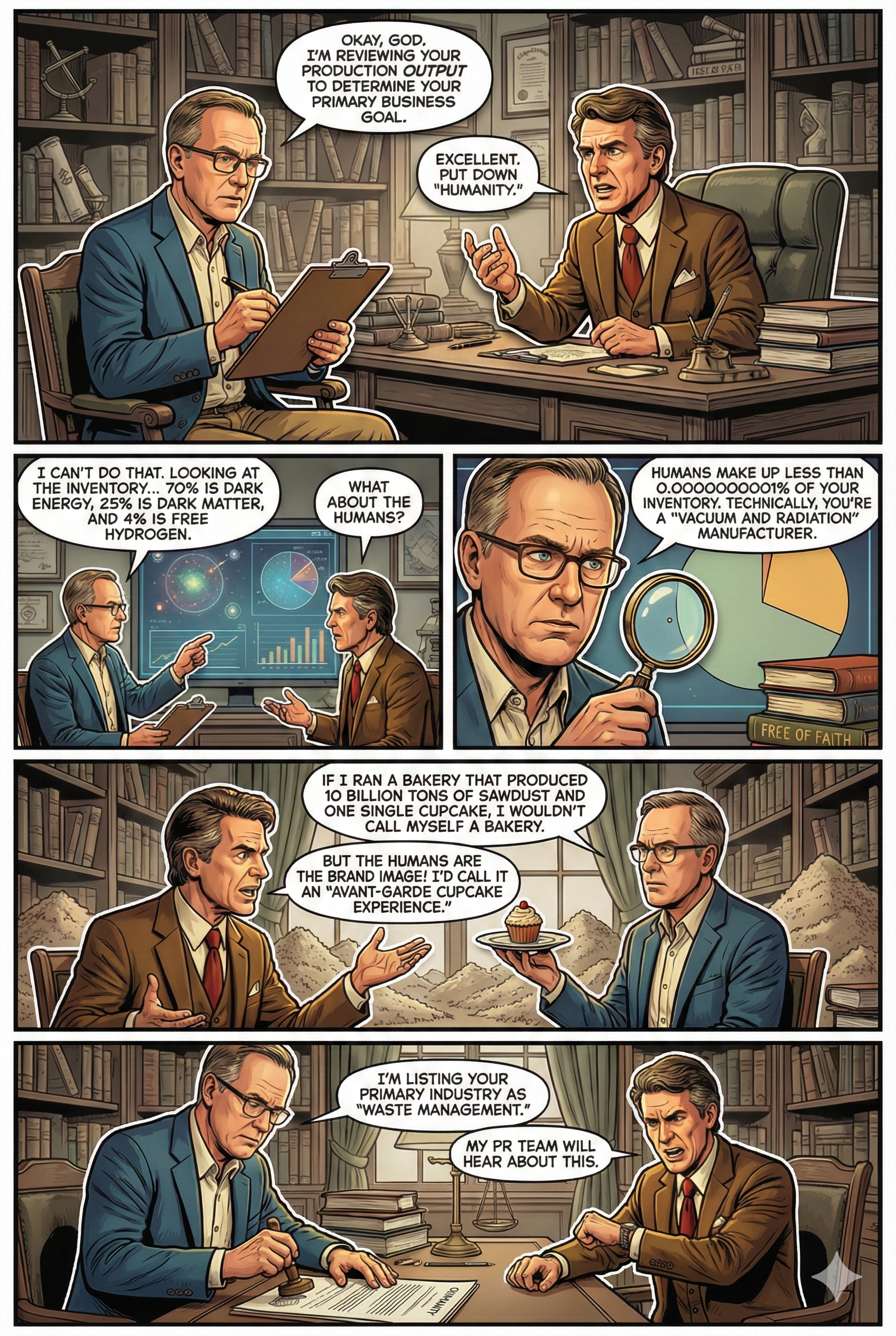
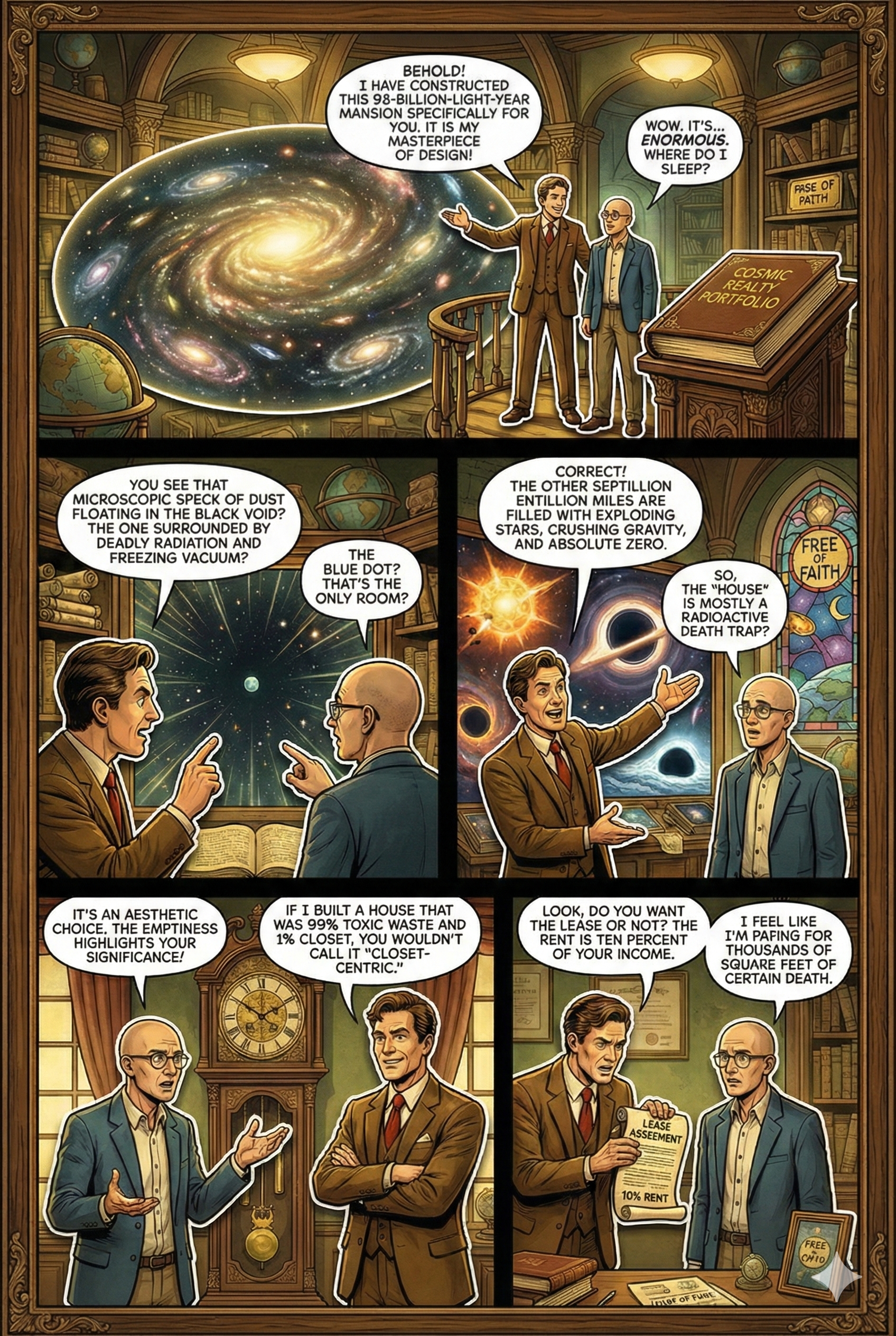
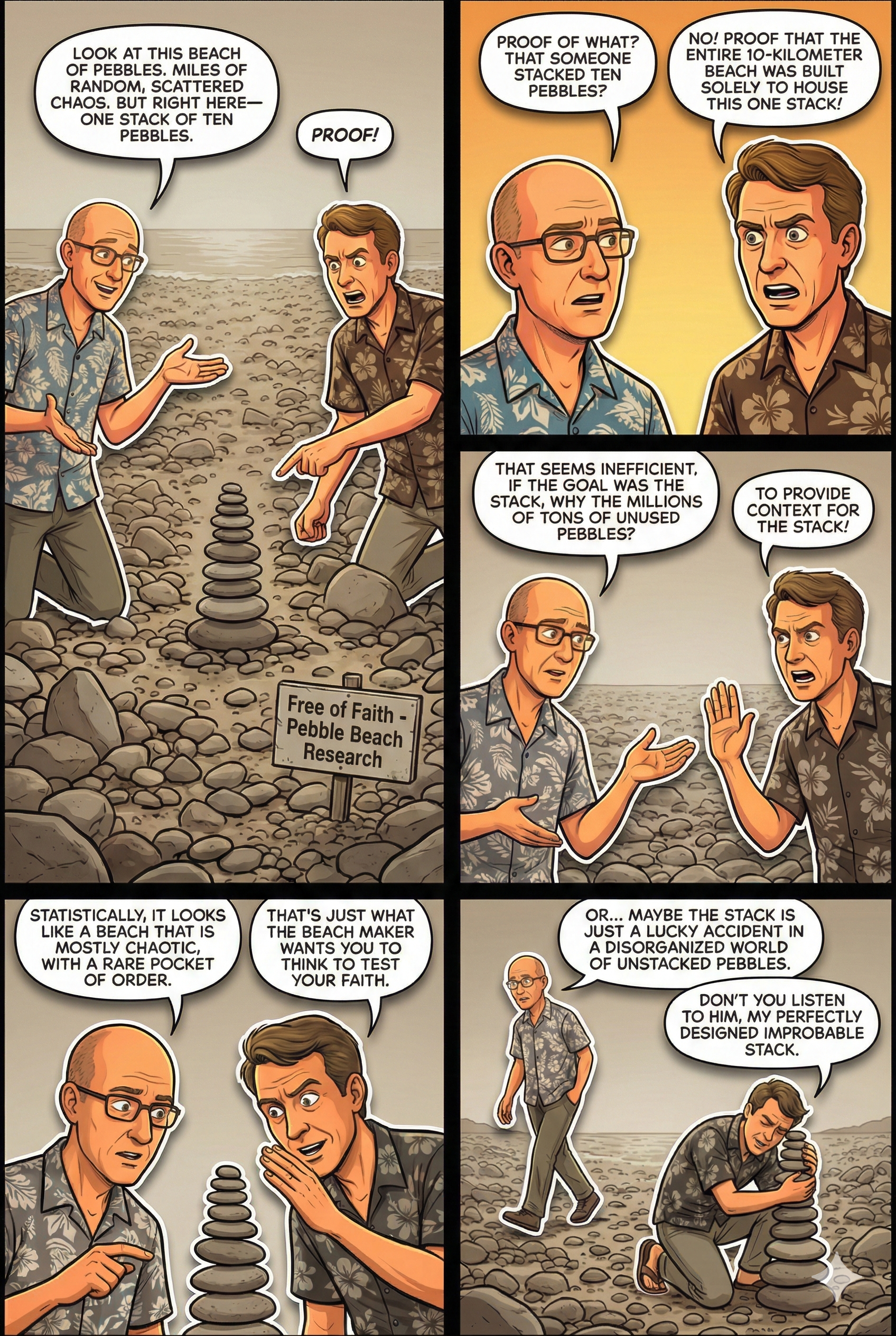
The observation that only a minuscule fraction of the known universe is habitable for human life—or any life at all—presents a challenging puzzle to the notion that a creator specifically designed the entire cosmos for humans. If the universe were intentionally crafted with humanity as the primary focus, one could reasonably expect evidence that the majority of space, matter, and time is dedicated to sustaining human life. Yet the observable universe appears vastly inhospitable. By analogy, when analyzing a beach scenario (where only a small localized formation of pebbles is neatly stacked in a particular way), it is far more probable that the beach as a whole is mostly disordered or randomly distributed with only one such formation—rather than having most of the beach arranged in that uncommon pattern.
The Pebble Stack Analogy
Consider three scenarios about stacks of pebbles:
- A 10km-square beach with one stack of pebbles arranged 10 pebbles high.
- A 10km-square beach entirely covered by stacks of pebbles arranged 10 pebbles high.
- A 10cm-square beach with one stack of pebbles arranged 10 pebbles high.
In intuitive terms (and all else being equal about how pebbles might fall or be arranged), Scenario 1 is the most probable because it involves only a single, localized configuration in a vast expanse. Scenario 2 requires an extremely specific ordering extended across an enormous area, while Scenario 3 involves an extremely small beach where the presence of a stack of 10 pebbles becomes disproportionately significant.
Mapping this back to the universe: A universe filled with life (Scenario 2) would be less probable than a universe that is mostly inhospitable but has one small habitable zone (Scenario 1). The fact that we currently observe only one known region—or a handful of regions, if we consider hypothetical exoplanets—of complex, life-sustaining arrangements amid a cosmic ocean of inhospitable space indicates that life-laden universes are less likely configurations, if one starts from a position of neutral probabilistic assessment. Thus, the claim that such a universe was intentionally designed for humans becomes less credible if what is most common is most probable and is most intended.
Implications for a Creator-Focused Universe
If an omnipotent and omniscient creator wished to make the universe human-centric, we might expect:
- Abundant evidence of finely tuned regions specifically for human habitation.
- Widespread presence of conditions ideal for sustaining human life.
- Clarity of purpose, visible through large-scale phenomena aligned with humanity’s continued existence.
Instead, what we observe is almost the opposite:
- An expansive, largely empty universe filled with hostile environments.
- Rarity of Earth-like conditions.
- Continual discovery that most celestial bodies are uninhabitable, replete with extreme heat, cold, radiation, or gravitational forces inimical to life.
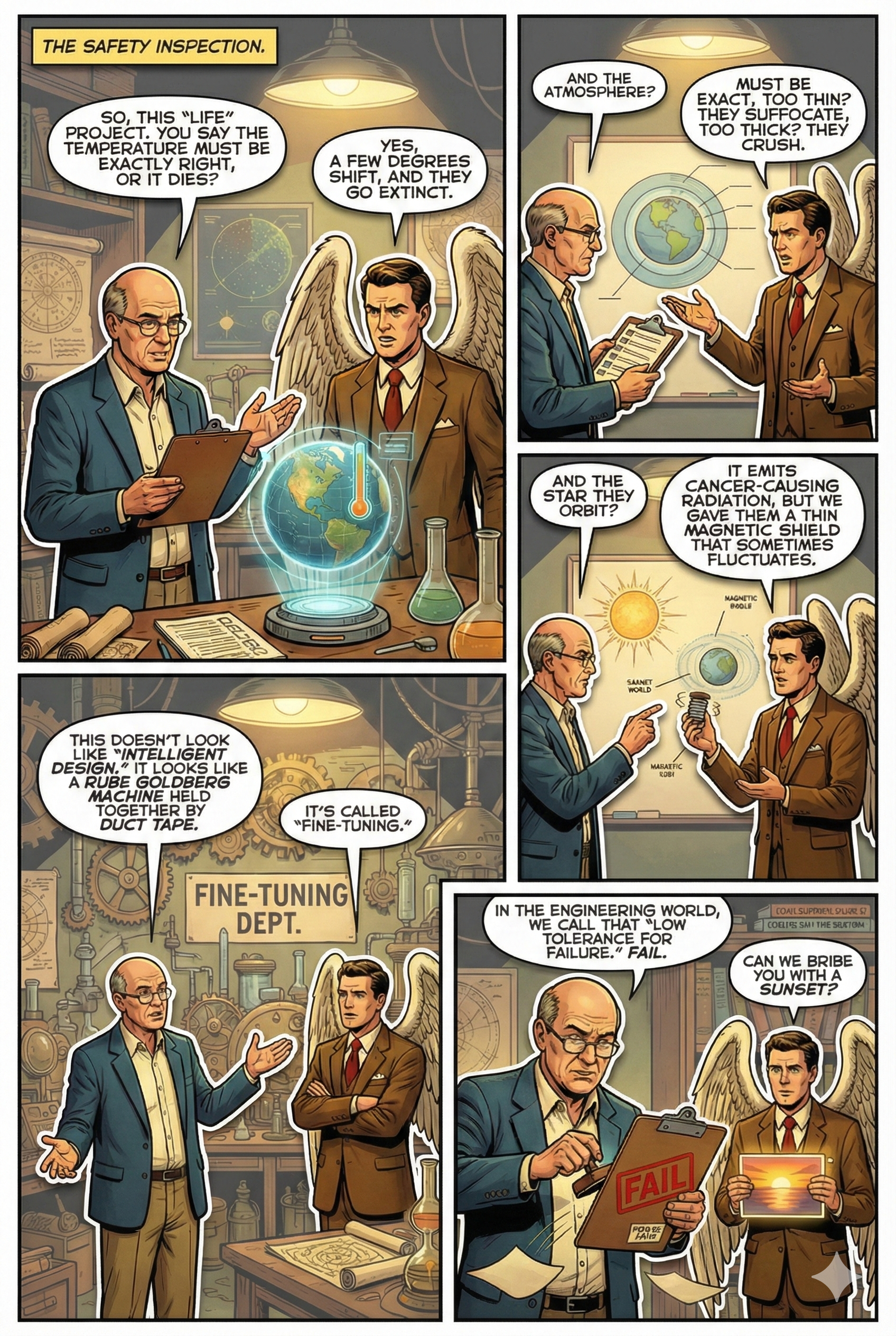
Given these features, the analogy of a single stack of pebbles on an expansive beach stands in stark contrast to any claim that humanity is the sole or even the primary goal of a cosmic creative force.
Syllogistic Logic Formulation
Premise 1: If a creator’s principal intention is reflected by what is most prevalent in creation, then the domain or type of entity that occupies the largest portion of creation is what is most intended.
Premise 2: The observable universe is overwhelmingly devoid of life and hospitable conditions for humans (i.e., most prevalent is inhospitable space).
Conclusion: Therefore, if a creator’s principal intention is reflected by what is most prevalent, the universe was not created primarily for humans.
Symbolic Logic Formulation
Let:
= “xxx is the principal focus or intent of the creator.”
= “xxx is the most prevalent type of entity or region.”
= “Habitable zones for humans.”
= “Uninhabitable zones of the universe.”
Axiom:
(If something is the most prevalent type of entity, it is the most likely principal focus.)
![\forall x, [P(x) \rightarrow C(x)]](https://s0.wp.com/latex.php?latex=%5Cforall+x%2C+%5BP%28x%29+%5Crightarrow+C%28x%29%5D&bg=ffffff&fg=000&s=0&c=20201002)
Observations:
(Habitable zones are not what is most prevalent.)
(Uninhabitable zones are what is most prevalent.)
From the Axiom and Observations, we deduce:
(Because habitable zones are not most prevalent, they are not the principal focus.)
(Because uninhabitable zones are most prevalent, they are the principal focus.)
Hence, if we are to be consistent with the assumption that what is most common is most intended, it follows that the cosmos is not primarily designed around habitable zones for humans, but rather aligns with the vast stretches of uninhabitable reality.
By analogy with the pebble-stacking scenarios, the simplest and most probable arrangement of any large system is for it to be predominantly random or otherwise not specifically ordered for one purpose, leaving only rare pockets of special arrangement (like one stack on a large beach). This perspective challenges the narrative of a universe distinctly and intentionally arranged around humanity.

Section #02
The claim that the observed universe—despite its vast inhospitable regions—is exactly what a creator intended is often used by theists to withstand critiques concerning the mismatch between a supposedly human-focused design and the observable scale of cosmic indifference to human life. This insistence that “God wants it this way” tends to immunize theistic explanations from potential disconfirmation by relegating every possible state of affairs to the divine will. However, such a position has significant weaknesses, as evidenced by the history of religious doctrines that repeatedly failed to correctly anticipate or align with later scientific observations about the universe. Moreover, it highlights a deep methodological problem: if any conceivable observation can be harmonized with a theological claim, then that claim is effectively unfalsifiable and therefore lacks explanatory power.
Historical Human-Centric Errors
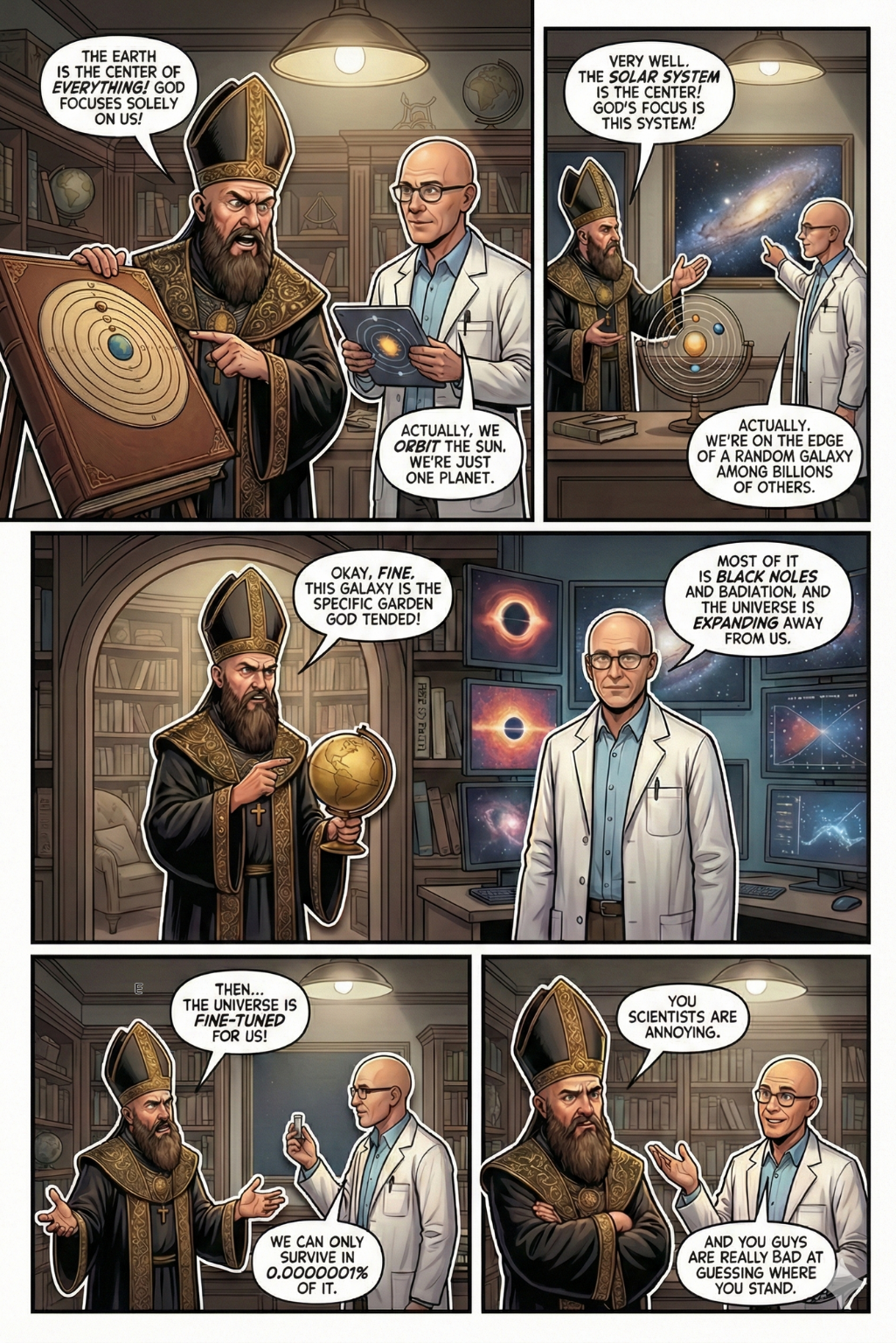
Throughout the centuries, religious authorities and texts have often promoted geocentric or otherwise human-centered cosmologies. In medieval Europe, for instance, it was widely held—consistent with Aristotelian and Ptolemaic thought—that Earth stood at the center of the cosmos. This view coincided with the theological belief that humanity was God’s ultimate creative focus. Yet, once astronomical progress revealed that Earth is merely one planet in a vast, possibly boundless universe, many theists pivoted to new explanations. They sought to preserve human uniqueness by shifting their interpretive lens, never questioning whether their initial anthropocentric premises might have been mistaken in the first place.
Similar adaptations are observed in interpretations of evolution, the age of the Earth, and the vastness of space. Each time, many theists recast old dogmas to match the new data—rather than deriving beliefs from open-ended, evidence-based inquiry. This entrenched pattern raises questions about the reliability of a belief-forming process that regularly ascribes cosmic centrality to humans, only to retreat from it incrementally in the face of contrary evidence.
The Strength of the Critique
The argument against a purely “God-intended” cosmos, as advanced here, is not merely that religious worldviews have been historically inaccurate. It also illuminates how theological reasoning systematically conflicts with robust methods of empirical scrutiny. The strength of this critique lies in its emphasis on the scope of theological malleability:
- Omniflexible Explanation: If the universe were brimming with life-friendly zones, many theists would cite that as evidence of special design. Yet, with the universe largely void of life, some theists claim it still reflects God’s will—merely in a different way. When both contradictory states (abundance of life vs. sparsity of life) are taken as equally demonstrative of divine intent, the proposition ceases to inform us about the nature of reality.
- Historical Presumption: The repeated assertion of cosmic human-centrism—even after major scientific revolutions—exhibits a recurring pattern of theological overreach. Religious frameworks often assume a privileged vantage point on God’s objectives, but the track record suggests otherwise.
- Epistemic Dependence: Since these theological positions derive primarily from interpretation of sacred texts or longstanding traditions, rather than testable predictions, they remain insulated from the normal constraints of evidence-based reasoning. This breeds an environment where dogmatic commitments flourish unchallenged, weakening their overall credibility.
- Philosophical Implications: If the divine will is consistent with any possible arrangement of the cosmos—whether it be a single planet teeming with life or trillions of life-friendly planets—then the claim fails to distinguish among competing scenarios. It lacks philosophical utility in guiding our assessment of what states of affairs are more or less probable.
The Theological Privilege Problem
A key aspect of this critique involves what might be called “the theological privilege problem.” Theists often claim to possess unique insight into the will of God, but these insights frequently arise from hermeneutical or doctrinal frameworks prone to human biases. Since there is no mechanism by which an outside observer can directly test those insights—beyond comparing them to external data—such claims remain in a closed interpretive loop. Distortions, culture-bound presumptions, and dogmatic commitments can thus persist unchallenged, even when they conflict with observable evidence.
Expanding on the Scope of the Argument
- Cross-Cultural Variation: Different religious traditions have advanced radically different cosmologies, each purportedly reflecting the will of a creator or creators. The global variety of incompatible theological systems suggests that “divine intention” is, more often than not, a culturally mediated concept rather than an empirically supported conclusion.
- Unfalsifiability and the Problem of Evidence: When a belief is indefinitely stretchable to accommodate new data (as with “God intended it this way”), it becomes impossible to delineate a scenario that could prove the belief false. Scientific theories gain credibility through their vulnerability to evidence; they make risky predictions that can, in principle, fail. When theology renders every observational outcome consistent with God’s plan, it relinquishes that vulnerability.
- Moral and Existential Ramifications: While morality or existential purpose might be associated with a divine plan, the vastness and apparent indifference of the universe to human welfare present a stark contrast to typical human-centered theologies. Rather than focusing on cosmic order and providence, the evidence points to a cosmos of enormous scale and complexity, where humanity’s significance is an emergent property of conscious self-reflection rather than a clear, universal design.
- The Role of Reasoning Methods: Scientific methods aim to reduce bias through controlled observation, repeatable experimentation, and falsifiable hypotheses. By contrast, many theological arguments proceed from doctrinal premises that are not open to revision. This chasm in methodology underlies the conflict, revealing why theology has historically lagged behind or resisted scientific findings.
Syllogistic Logic Formulations
Argument 1: Unfalsifiability of “Divine Intent”
- Premise 1: If a hypothesis (H) can accommodate all possible observations without the possibility of disconfirmation, then H lacks explanatory power.
- Premise 2: The theistic claim that “the universe is exactly as God intended” can accommodate both a universe brimming with life and one nearly devoid of it.
- Conclusion: Therefore, the theistic claim that “the universe is exactly as God intended” lacks explanatory power.
Argument 2: Invalidating the Human-Centric Assumption
- Premise 1: If a belief-forming process consistently yields conclusions later disproven by observational evidence, that process is unreliable.
- Premise 2: Historically, theologies assumed human-centric cosmologies that were repeatedly disproven by observational evidence (e.g., heliocentrism, cosmic scale, evolutionary history).
- Conclusion: Therefore, theological methods relying on human-centrism are unreliable.
Symbolic Logic Formulation
Let the domain be all propositions about cosmic arrangements.
Define the following predicates:
: “Proposition
explains the universe through unfalsifiable means.”
: “Proposition
: “Proposition
: “
Axiom 1 (Unfalsifiability Undermines Explanation):
(Any proposition that is unfalsifiable lacks explanatory power.)
![\forall x,[U(x) \rightarrow \neg E(x)]](https://s0.wp.com/latex.php?latex=%5Cforall+x%2C%5BU%28x%29+%5Crightarrow+%5Cneg+E%28x%29%5D&bg=ffffff&fg=000&s=0&c=20201002)
Axiom 2 (Methodological Reliability Necessitates Alignment with Evidence):
(Any proposition formed by an unreliable method lacks explanatory power.)
![\forall x,[\neg R(x) \rightarrow \neg E(x)]](https://s0.wp.com/latex.php?latex=%5Cforall+x%2C%5B%5Cneg+R%28x%29+%5Crightarrow+%5Cneg+E%28x%29%5D&bg=ffffff&fg=000&s=0&c=20201002)
Observation 1: The claim “The universe is exactly as God intended” is adjustable to any observation.
Hence, 
Observation 2: Theologies historically rely on methods that are repeatedly contradicted by empirical data.
Hence, 
Derivation from Axiom 1 and Observation 1:
.
Derivation from Axiom 2 and Observation 2:
.
Together, these derivations imply that theological claims of this sort lack explanatory power due to both unfalsifiability and unreliable epistemic methods.
Conclusion
By insisting that the universe is precisely what a creator intended, many theists position their claims beyond the reach of disconfirming evidence. This move guards theistic doctrines against immediate contradiction but does so at the cost of undermining their explanatory force. History illustrates that theologies have frequently asserted inaccurate models of the cosmos, only adjusting those models under pressure from empirical discoveries. This pattern testifies to a persistent bias favoring human-centrism and a methodological reliance on dogma rather than open-ended observation. Consequently, while religious convictions may offer personal or communal significance, they fail to supply robust, testable explanations for the actual structure and scope of the universe.
Section #03
Among the most commonly cited arguments for a creator’s existence is the so-called “fine-tuning” of the universe. Proponents of this perspective maintain that various physical constants and initial conditions of the cosmos are so precisely set that they must have been carefully designed for life. However, if the creator responsible is truly omnipotent, the notion of fine-tuning becomes superfluous. Omnipotence, by definition, is the power to bring about any logically possible state of affairs without dependence on physical constraints. This essay examines the internal tension between the concept of an omnipotent creator and the claim that the universe is “finely tuned” for humanity.
The Fine-Tuning Paradox for an Omnipotent Creator
- Definition of Omnipotence: An omnipotent being is commonly understood as having the power to do anything that is logically possible. Such a being would not be restricted by physical laws, constants, or the so-called “initial conditions” of a universe. If a deity with these attributes chose to create humans, it could bring them into existence under any imaginable circumstance—whether the universe was “fine-tuned” or not.
- Redundancy of Physical Constraints: If a creator transcends natural laws, there is no compelling reason why delicate universal parameters (e.g., gravitational constant, electron mass, cosmological constant) would need to be finely balanced. An all-powerful being could sustain life directly, irrespective of the underlying physics—just as it could suspend any law at will.
- Contradiction in Theistic Explanations: When theists assert both that their god is truly omnipotent and that the universe is finely tuned for life, they rely on two conflicting ideas:
- God is all-powerful and thus not beholden to the constraints of physical law.
- God must adjust cosmic variables precisely so that life can arise under those constraints.
In reconciling these claims, theologians either limit omnipotence (suggesting God must use finely tuned laws) or dilute the necessity of fine-tuning (suggesting life could exist anyway by divine fiat). Both avenues weaken the original argument that fine-tuning is evidence of a creator.
- Philosophical and Theological Implications: The tension exposes a broader issue in many religious arguments: attributing to God a property like omnipotence while simultaneously grounding that God’s actions within the framework of physical necessity. If a creator truly “stands outside” of nature, then nature’s delicate balancing act is not evidence of design so much as evidence of the physical structures themselves—structures that need no special “tuning” when dealing with a being unconstrained by them.
Syllogistic Logic Formulations
Argument 1: Omnipotence vs. Physical Constraints
- Premise 1: If a creator is omnipotent, it can create and sustain life under any logically possible conditions, regardless of physical parameters.
- Premise 2: Fine-tuning presupposes that specific physical parameters are required for life to exist.
- Conclusion: Therefore, if a creator is omnipotent, fine-tuning is not necessary for the existence of life.
Argument 2: Contradiction in Theistic Assertions
- Premise 1: Fine-tuning arguments claim that only narrowly specific values of physical constants allow for life.
- Premise 2: An omnipotent creator is presumed to have no dependency on specific values of physical constants.
- Conclusion: Therefore, asserting both fine-tuning and an omnipotent creator involves an internal contradiction or at least a serious tension in reasoning.
Symbolic Logic Formulation
Let:
= “A creator is omnipotent.”
= “The universe is fine-tuned for life.”
= “Parameter
.”
Axiom 1:
(If a creator is omnipotent, then no physical parameter

Axiom 2:
(If the universe is fine-tuned for life, then there exists at least one physical parameter
![F \rightarrow \exists x [N(x, \text{creation of life})]](https://s0.wp.com/latex.php?latex=F+%5Crightarrow+%5Cexists+x+%5BN%28x%2C+%5Ctext%7Bcreation+of+life%7D%29%5D&bg=ffffff&fg=000&s=0&c=20201002)
Contradiction:
- From
.
- From
.
These two statements cannot both be true simultaneously. Hence, asserting both
Conclusion
The idea of a “fine-tuned” universe serves as a linchpin in many contemporary theistic arguments, suggesting that the delicate balance of cosmic parameters implies intentional design. However, if the creator envisioned is genuinely omnipotent—able to actualize any logically possible scenario—then physical fine-tuning appears moot. Such a being would not be bound by the need for precise cosmic constants or finely balanced laws of nature. Thus, the conjunction of absolute divine power with the necessity of fine-tuned conditions for human life is deeply problematic. The two claims not only undermine each other but also point to a larger issue in theology: how to coherently reconcile an all-powerful deity with the seemingly rigid demands of physical law. By pushing this question to the forefront, we see that fine-tuning arguments face significant philosophical obstacles and do not escape scrutiny simply by appealing to divine omnipotence.
Section #04 | Synthesis
Over centuries of debate, theistic perspectives have frequently offered God’s intentions as the guiding explanation for why the universe appears in its current form. Yet these explanations face substantial difficulties when confronted with (1) the vast inhospitability of cosmic space, (2) the historical record of human-centric errors, and (3) the tension between fine-tuning arguments and a truly omnipotent creator. This final essay synthesizes these three themes, revealing how each exposes critical flaws in the reasoning behind theistic claims about a proposed creator’s intentions.
The Inhospitable Universe
Many theists assert that, regardless of how inhospitable the cosmos may be, it is precisely as God intended. This move appears unfalsifiable: if nearly every part of the universe is barren, inhospitable, and lethal to human life, it is claimed that God chose this arrangement for a purpose we do not fully comprehend. Nonetheless, three major issues arise:
- Probabilistic Contradiction: Analogies such as a lone stack of pebbles on an otherwise random beach indicate that small patches of order are typically more probable than vast expanses of order. Thus, if the universe is meant primarily for humanity, we would expect more widespread hospitable conditions—yet we do not observe them.
- Historical Human-Centrism: Theists often insisted on a small, human-centered cosmos, only to revise their views with each new astronomical discovery. This repeated failure to correctly anticipate the universe’s nature suggests their methodology is unreliable.
- Unfalsifiable Intent: If any cosmic state—whether mostly empty or teeming with life—can be reconciled with divine intention, then the claim that God designed the universe this way does not actually explain why it is inhospitable; it simply relabels observed facts as “willed by God.”
Repeated Historical Failures and Methodological Bias
The long history of religious thought provides numerous examples of theistic doctrines that proved to be at odds with later evidence. From geocentrism to young Earth models, the human-centric bias led believers to interpret cosmic conditions in ways repeatedly overturned by scientific inquiry. The underlying fault lies in the method of forming beliefs:
- Starting-Point Assumptions: Many theological arguments begin with a dogmatic premise—“God designed everything for humans”—then interpret observable phenomena to fit that premise.
- Shifting Theological Explanations: When data contradict the premise (e.g., the Earth is not the center of the universe), many theists adjust their claims post hoc rather than revisiting their fundamental assumption.
- Privilege of Interpretation: Theists often claim special authority to speak on behalf of a hidden deity, offering explanations that cannot be directly verified by others. This insulates their statements from the normal checks of falsification and empirical testing.
The Fine-Tuning Contradiction
A more modern theistic argument focuses on fine-tuning: the idea that certain physical constants lie within extremely narrow values that allow for human life. This is said to imply a deliberate design. However, if the creator is truly omnipotent, then fine-tuning is unnecessary. An all-powerful being is not constrained by physical laws or constants:
- Redundancy of Constraints: Omnipotence entails the ability to bring about any logically consistent state of affairs. Hence, delicate cosmic conditions need not be just right for life to exist; life could be willed into existence in any environment.
- Implicit Limitation: The fine-tuning argument secretly presumes that God must rely on fixed laws—a limitation incompatible with classical definitions of divine omnipotence.
- Eroding the Probability Argument: If a creator is unconstrained, probabilities and narrow ranges no longer matter. Presenting them as the evidence for design fails to acknowledge that no range is too narrow—or too broad—for an omnipotent creator.
Synthesized Syllogisms
- Inhospitable Universe Argument
- Premise 1: If a creator’s primary goal were human life, we would expect ample, not minimal, habitable regions.
- Premise 2: The universe is overwhelmingly inhospitable, with only a minuscule fraction suitable for life as we know it.
- Conclusion: Therefore, the universe is unlikely designed with humanity as the central focus.
- Unfalsifiability Argument
- Premise 1: A hypothesis that can explain any possible state of affairs, from abundant life to near-empty space, is unfalsifiable.
- Premise 2: The claim “the universe is exactly as God intended” can accommodate both extremes.
- Conclusion: Hence, “the universe is exactly as God intended” is unfalsifiable and lacks explanatory power.
- Fine-Tuning and Omnipotence Argument
- Premise 1: A truly omnipotent being is not constrained by physical laws or constants.
- Premise 2: The fine-tuning argument presupposes that specific physical constants must be carefully set for life to arise.
- Conclusion: If the creator is omnipotent, fine-tuning is unnecessary, contradicting the assumption that life’s existence depends on narrow cosmic parameters.
Symbolic Logic Summaries
Let
Let 
Let
Let
- Inhospitable Cosmos Contradiction
(If the cosmos were not inhospitable, that would indicate human-focused design.)
- Conclusion: The premise linking non-inhospitable conditions to design is not met, undermining
- Unfalsifiable Theistic Claim
- Axiom:
(If a propositionis not testable, then it lacks explanatory power.)
- Observation:
“God intended it so” isunder all conditions.
- Conclusion:
(Because the claim is untestable, it lacks explanatory power.)
- Axiom:
- Fine-Tuning vs. Omnipotence
necessity_of_specific_constants
(Fine-tuningnecessity_of_specific_constants
(Omnipotence- Hence,
is internally contradictory
(Fine-tuning and absolute omnipotence cannot both be upheld consistently.)


Conclusion
By incorporating arguments on vast cosmic inhospitability, the historical record of theistic missteps, and the contradiction between fine-tuning and omnipotence, a consistent pattern emerges: when claims about a proposed creator’s intentions are placed under critical scrutiny, they tend either to conflict with observed reality or to become so pliable that they forfeit any meaningful explanatory value. The attempts by theists to maintain human-centric cosmos narratives, interpret all evidence as consistent with divine will, and emphasize fine-tuned constants while embracing omnipotence, each unravel under logical analysis. These recurring failures underscore a broader point about the vulnerability of claims that rely more on dogmatic assumptions than on open-ended, testable approaches to explaining our universe.


 Free of Faith
Hi Christopher, I just sent you a response by email. Cheers.