
Rigorous Critique of the Essay
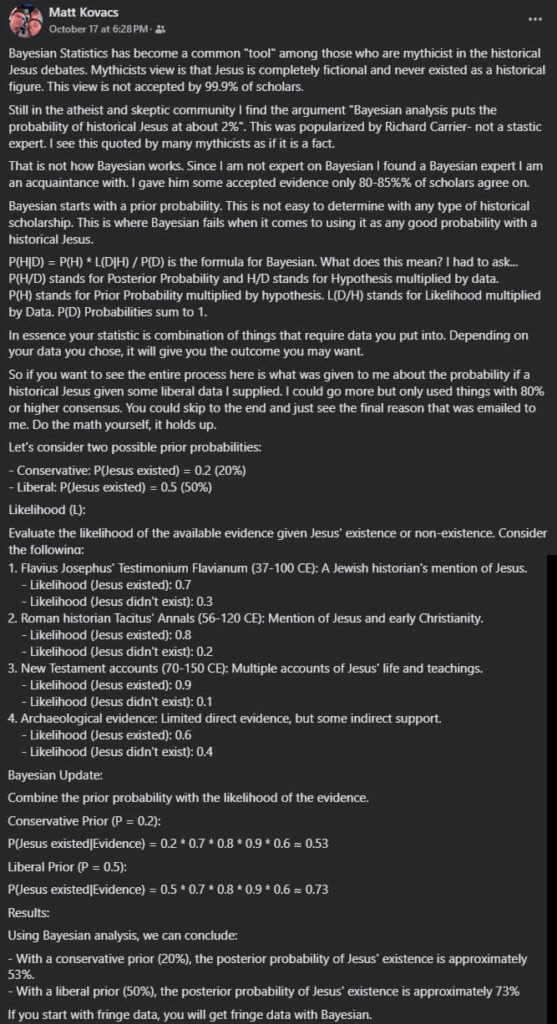
The essay criticizes the use of Bayesian statistics by mythicists who claim Jesus of Nazareth never existed as a historical figure. While it attempts to expose flaws in the mythicists’ application of Bayesian analysis, it itself demonstrates several significant misunderstandings and misapplications of Bayesian statistics. Below is a rigorous critique, highlighting and explaining these flaws in detail.
1. Misapplication of Bayes’ Theorem
Incorrect Formula Usage:
The essay presents Bayes’ theorem as:

It then simplifies this to multiplying the prior probability 
Proper Application:
Bayes’ theorem should be applied as:

Where:
is the posterior probability of the hypothesis
given the data
.
is the likelihood of observing data
is the marginal probability of observing data

The denominator
2. Mathematical Errors in Calculations
Incorrect Multiplication:
The essay calculates the posterior probabilities as:
- For a conservative prior
:

For a liberal prior 

However, these calculations are incorrect:
- For the conservative prior:

For the liberal prior:

These results are far from the stated 53% and 73%, indicating a computational error.
Omission of the Denominator:
The essay fails to calculate the denominator
3. Misunderstanding of Prior Probabilities
Labels of “Conservative” and “Liberal”:
The essay assigns:
- A “conservative” prior of
- A “liberal” prior of
This labeling is counterintuitive. Typically, a “conservative” estimate would favor the more widely accepted view (that Jesus existed) and thus have a higher prior probability, not a lower one.
Arbitrary Assignment:
The priors are assigned without clear justification. In Bayesian analysis, priors should be based on existing knowledge or evidence. For historical analysis, they might be informed by scholarly consensus or other credible sources.
4. Unjustified Likelihood Assignments
The likelihoods for each piece of evidence are assigned numerical values without explaining how these values were derived. For example:
- Josephus’ Testimonium Flavianum:
- Likelihood (Jesus existed):
- Likelihood (Jesus didn’t exist):
- Likelihood (Jesus existed):


There is no methodological basis provided for these numbers. In rigorous Bayesian analysis, likelihoods should be based on statistical models, empirical data, or systematic reasoning, not subjective estimates.
5. Incorrect Interpretation of Bayesian Analysis
Dependence on Input Data:
The essay concludes:
“In essence your statistic is combination of things that require data you put into. Depending on what you put into it, it will give you the outcome you may want.”
This reflects a misunderstanding of Bayesian statistics. While Bayesian analysis depends on priors and likelihoods, its purpose is to update beliefs in a principled way based on evidence. When properly applied, it does not simply produce the outcome one desires.
Misrepresentation of Bayesian Inference:
The statement:
“If you start with fringe data, you will get fringe data with Bayesian.”
This is misleading. Bayesian methods are designed to systematically incorporate evidence into prior beliefs. If the data is robust and the model is properly specified, Bayesian analysis can yield meaningful insights, even if the priors are uncertain.
6. Lack of Consideration for the Denominator
The denominator
7. Ignoring Dependency Between Pieces of Evidence
The essay treats each piece of evidence as independent, multiplying their likelihoods together. However, historical evidences are often correlated. For instance, Tacitus and Josephus may have drawn from common sources or influenced each other. Ignoring these dependencies skews the results.
8. Oversimplification of Historical Analysis
The essay oversimplifies the complexities of historical scholarship. Quantifying historical events and figures with precise probabilities requires substantial assumptions and careful modeling of uncertainties. This is not adequately addressed in the essay.
9. Criticism Based on Misunderstandings
By misapplying Bayesian statistics, the essay inadvertently demonstrates the very issues it attributes to mythicists. A valid critique requires an accurate understanding and application of Bayesian methods.
Conclusion
The essay contains several fundamental flaws in its understanding and application of Bayesian statistics. It incorrectly applies Bayes’ theorem, makes computational errors, unjustifiably assigns probabilities, and misunderstands Bayesian inference. A proper Bayesian analysis requires careful consideration of priors, likelihoods, dependencies, and normalization. To validly critique the use of Bayesian statistics in historical debates, one must first accurately understand and apply the methodology.
Richard Carrier’s Critique
To critically assess Richard Carrier’s analysis of Matt Kovacs’ arguments and methodology, the following key areas will be addressed: Carrier’s substantive points, his methodology in countering Kovacs’ arguments, and his rhetorical approach.
1. Substantive Points
Carrier raises valid critiques of Kovacs’ methodology and understanding of Bayesian statistics. These critiques include:
1.1 Misrepresentation of Bayesian Analysis
Carrier highlights that Kovacs fundamentally misunderstands how Bayesian reasoning works. Specifically:
- Kovacs appears to conflate the components of Bayes’ theorem, such as interpreting
- He ignores the denominator
- His failure to apply likelihood ratios correctly renders his calculations meaningless, as the ratios he uses lack empirical or theoretical justification.
1.2 Incorrect Calculations
Carrier effectively demonstrates that Kovacs’ arithmetic is flawed, pointing out that:
- Kovacs’ conservative calculation of
yielding “53%” is an egregious error (the actual result being
).
- This basic mathematical mistake undermines Kovacs’ credibility and reflects a lack of numeracy required for engaging in Bayesian analysis.
1.3 Lack of Empirical Justification
Carrier critiques Kovacs for inventing his inputs:
- Likelihoods such as
for the Gospels and
for Tacitus lack any empirical or evidential foundation.
- Kovacs fails to account for error margins, a critical feature in Bayesian reasoning, especially when dealing with uncertain historical data.
1.4 Conflation of Consensus and Evidence
Carrier rightly challenges Kovacs’ reliance on “scholarly consensus,” pointing out:
- No proper poll exists to establish that “80-85% of scholars” agree with Kovacs’ likelihoods.
- Scholarly consensus on Jesus’ historicity often reflects biases (e.g., the predominance of Christian scholars in the field) and does not necessarily equate to robust empirical analysis.
1.5 Dependence on Dubious Evidence
Carrier highlights Kovacs’ mischaracterization of evidence, such as:
- Assigning strong likelihoods to sources like Tacitus and Josephus, despite their known problems (e.g., potential Christian interpolation and dependence on earlier Christian traditions).
- Misattributing archaeological evidence to support Jesus’ historicity when no such evidence exists.
2. Methodological Approach
Carrier’s critique is methodical, addressing both the technical and logical deficiencies in Kovacs’ argument.
2.1 Demonstrating Errors
Carrier meticulously walks through Kovacs’ mathematical errors and provides a corrected Bayesian calculation. This approach underscores:
- The necessity of proper normalization using the denominator
- How Kovacs’ fabricated likelihoods skew the results, rendering his conclusions unreliable.
2.2 Addressing Misunderstandings
Carrier explains the proper application of Bayesian analysis, emphasizing:
- The role of error margins in capturing uncertainty.
- The importance of empirically justified inputs for prior probabilities and likelihoods.
2.3 Comparative Rigor
Carrier contrasts his peer-reviewed work with Kovacs’ amateurish approach. By highlighting his own reliance on empirical data and formal methods, Carrier reinforces the validity of his Bayesian analysis compared to Kovacs’ ad hoc reasoning.
3. Rhetorical Approach
Carrier’s rhetoric, while passionate, is often polemical and dismissive. This could alienate readers who might otherwise engage with his arguments. Notable rhetorical features include:
3.1 Dismissive Language
Carrier uses terms like “amateur,” “incompetent,” and “oblivious,” which may detract from his substantive points by appearing unnecessarily combative.
3.2 Ad Hominem Accusations
Carrier accuses Kovacs of engaging in ad hominem attacks, yet he himself frequently attacks Kovacs’ competence rather than solely critiquing his methodology.
3.3 Overgeneralizations
Carrier extrapolates Kovacs’ errors to the broader field of historical Jesus studies, suggesting that all critics of mythicism exhibit similar flaws. While there is merit to some of these observations, this broad-brush approach risks oversimplifying the diversity of scholarly opinions.
4. Strengths of Carrier’s Analysis
4.1 Technical Precision
Carrier’s explanation of Bayesian reasoning and his correction of Kovacs’ errors provide a clear and accessible tutorial on how Bayesian analysis should be applied to historical questions.
4.2 Focus on Evidence-Based Reasoning
Carrier’s insistence on empirically grounded inputs and rigorous methodology exemplifies critical thinking in historical scholarship.
4.3 Defense of Peer-Reviewed Work
Carrier effectively defends his peer-reviewed studies against misrepresentations, underscoring the importance of engaging with the actual arguments presented in scholarly research.
5. Weaknesses of Carrier’s Analysis
5.1 Tone and Accessibility
Carrier’s polemical tone may alienate readers unfamiliar with the topic or those sympathetic to Kovacs’ perspective. A more measured approach might better convey the strength of his arguments.
5.2 Overemphasis on Kovacs’ Errors
While Carrier thoroughly critiques Kovacs’ methodology, he spends less time addressing broader implications for the historicity debate, potentially limiting the relevance of his critique to a narrow audience.
Conclusion
Richard Carrier’s analysis effectively dismantles Matt Kovacs’ arguments, exposing fundamental flaws in Kovacs’ understanding of Bayesian statistics and historical reasoning. Carrier’s critique highlights the importance of empirical justification, mathematical rigor, and proper engagement with peer-reviewed scholarship. However, Carrier’s polemical tone and tendency to generalize Kovacs’ errors to all critics of mythicism may limit the broader impact of his critique. Nonetheless, his defense of Bayesian reasoning as a tool for historical analysis remains a compelling contribution to the ongoing debate over the historicity of Jesus.


 Free of Faith
Thanks for another interesting piece (as usual). I might add that even the “flying” fortress theologians have tried to build…