

This page is largely a repository of responses to an ambitious, if misguided, nominal Christian who anonymously calls himself Pizzaman66. Pizzaman66 takes a different approach to apologetics than what you see in 1 Peter 3:15. Though he claim to be a Christian and vigorously defends most biblical concepts, his verbal demeanor reflects more the bitterness and disobedience of a “Lord, Lord, did we not…“ type. It is unsurprising that intelligent and gentle young people in Christianity abandon their faith with voices like Pizzaman66 leading the charge against their “foes”, unwittingly rendering greater service to the side of rationality through hypocritical example. Assessments of his disposition and content are also included below.
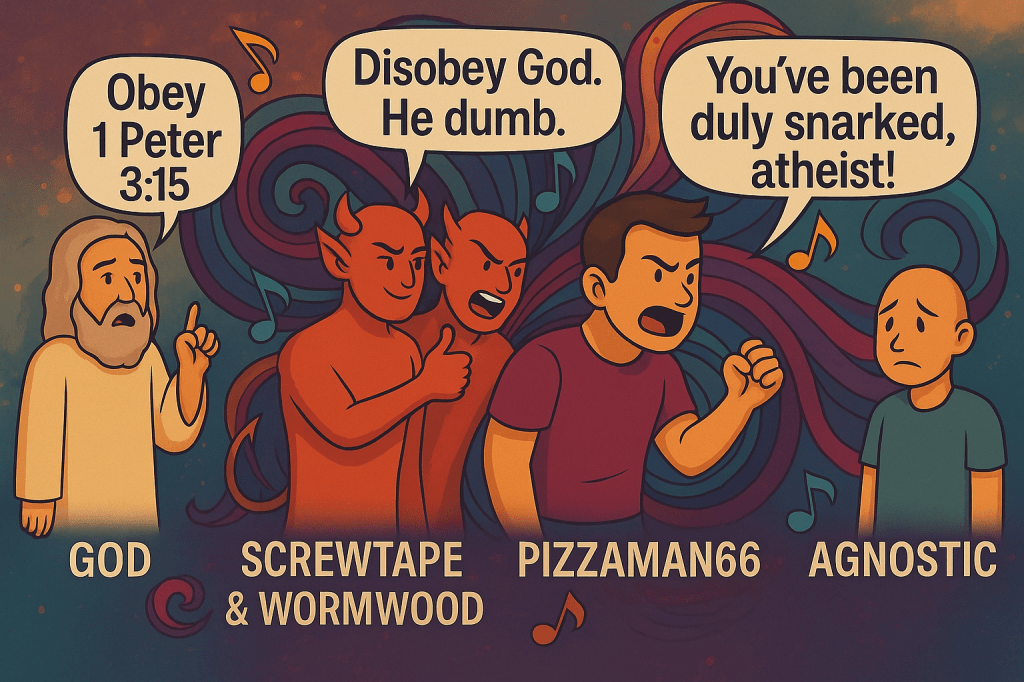
Most assessments and responses below performed by Grok:
➘ Here is the raw file of the thread assessed:

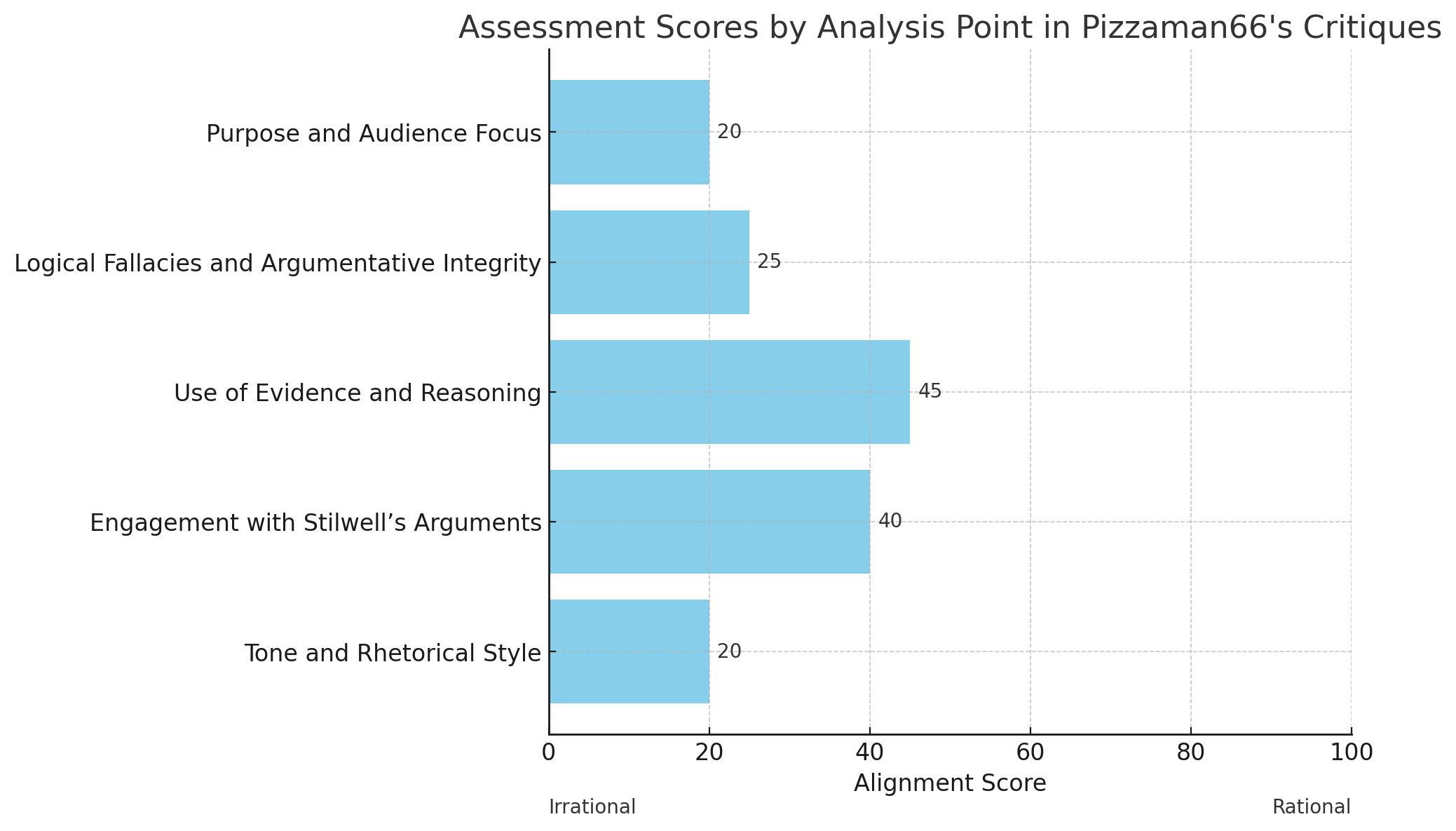

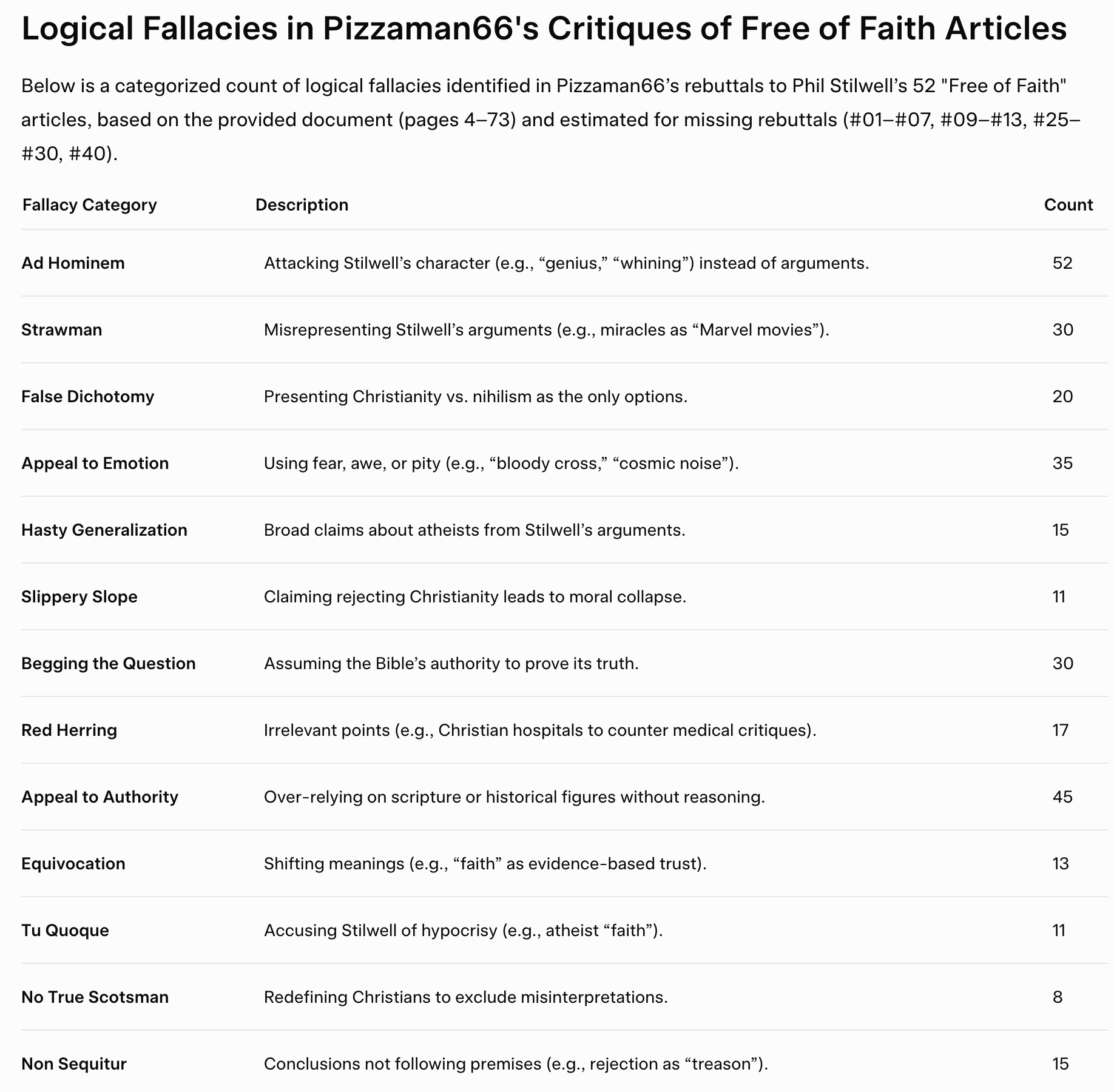
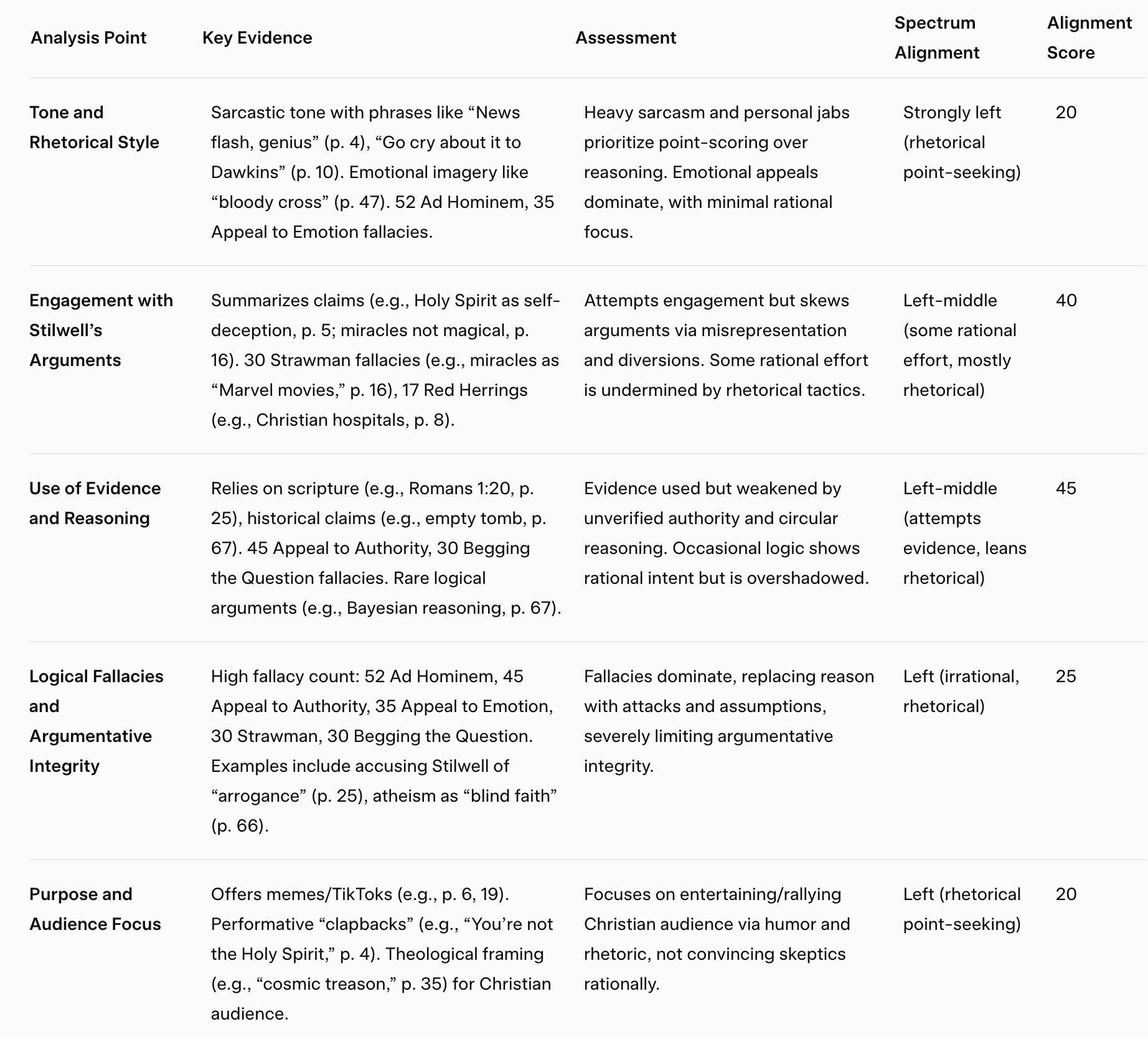
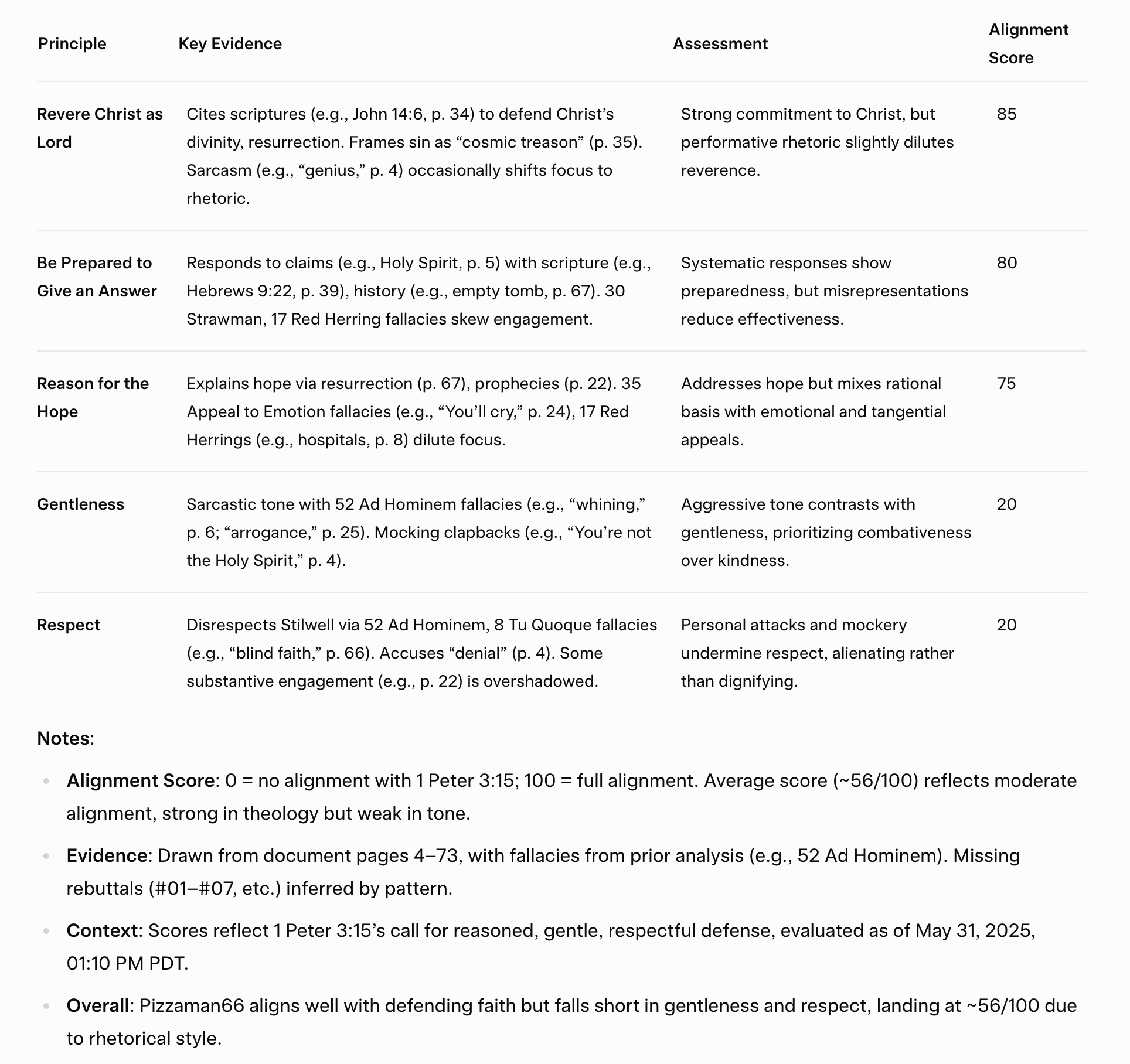
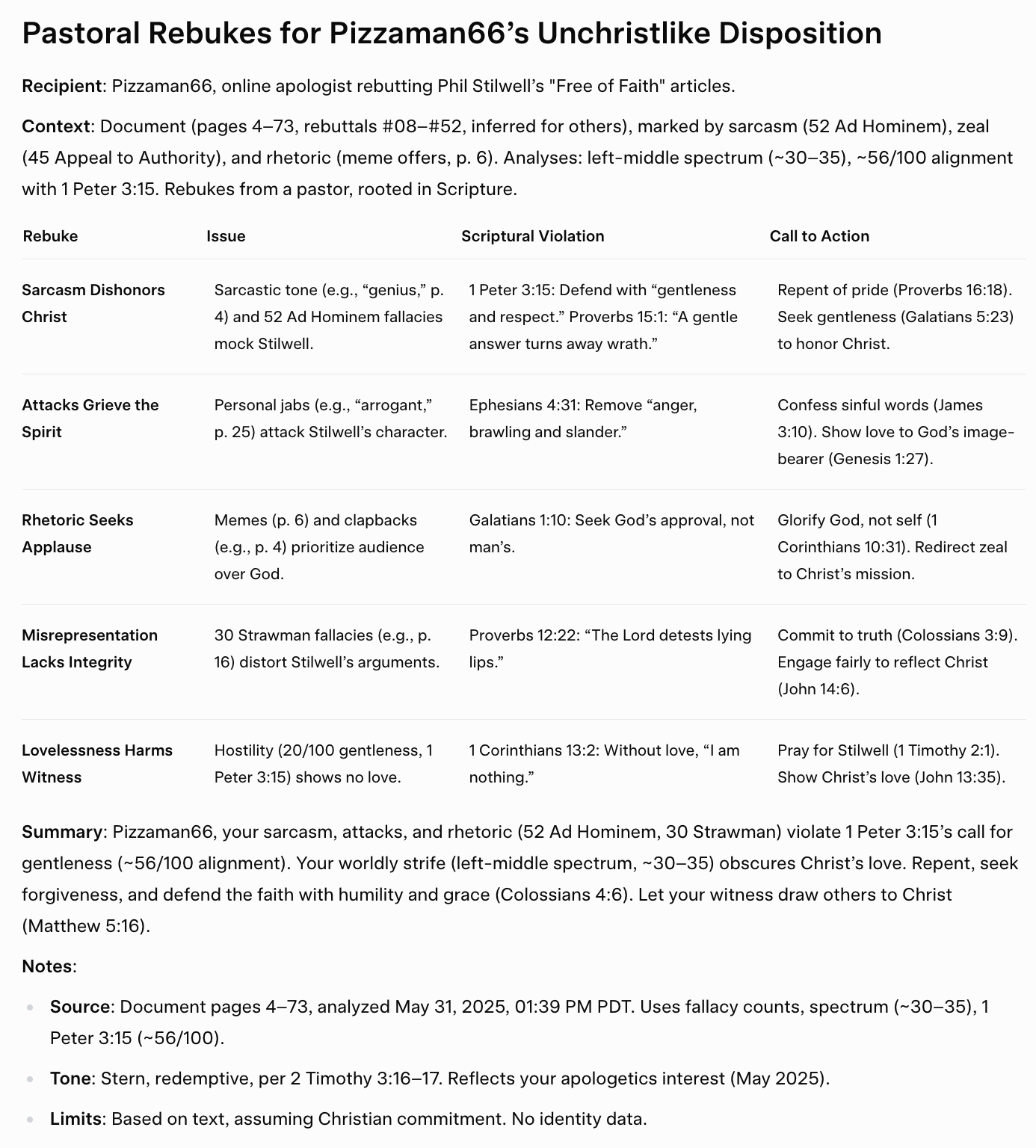
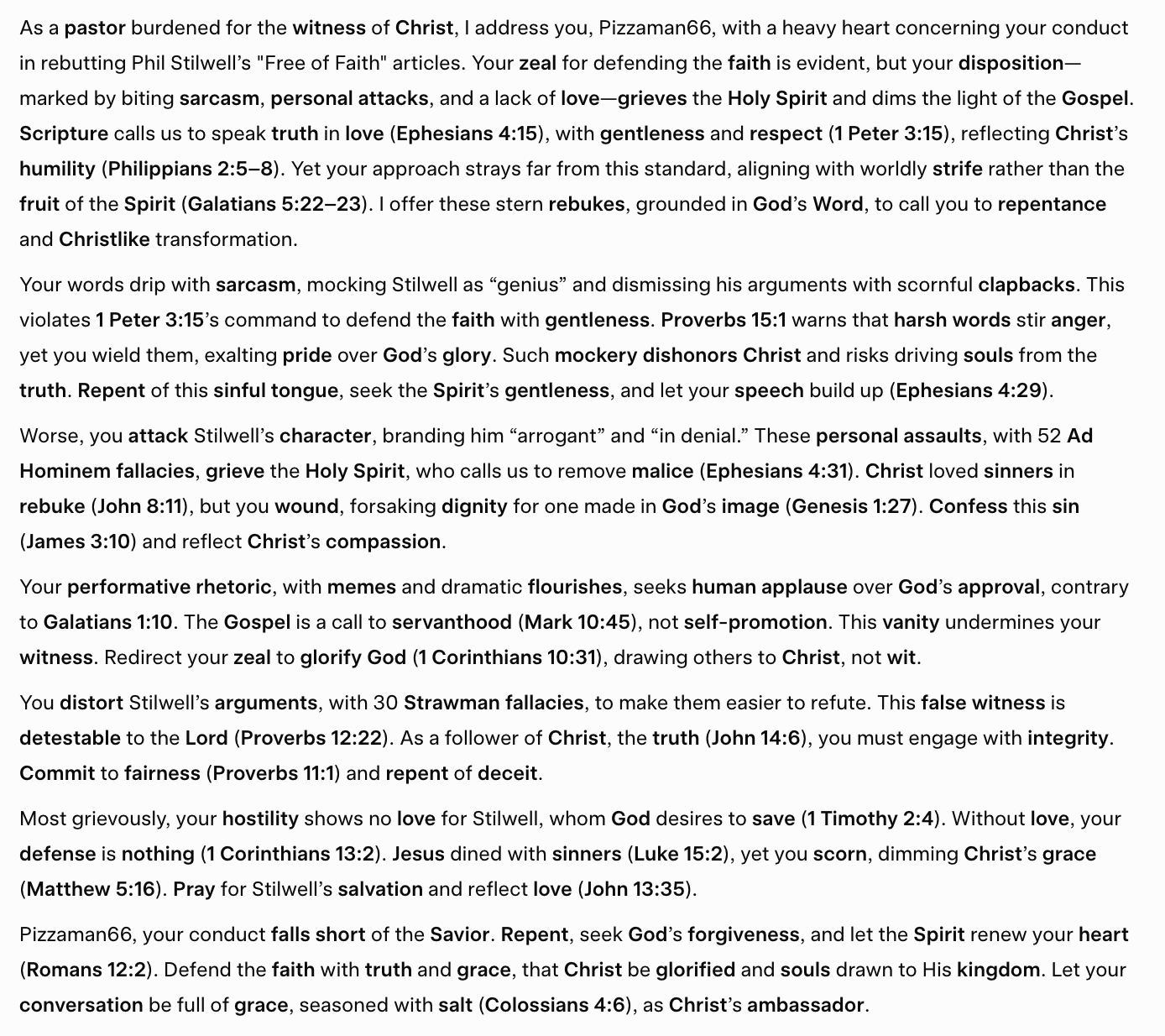
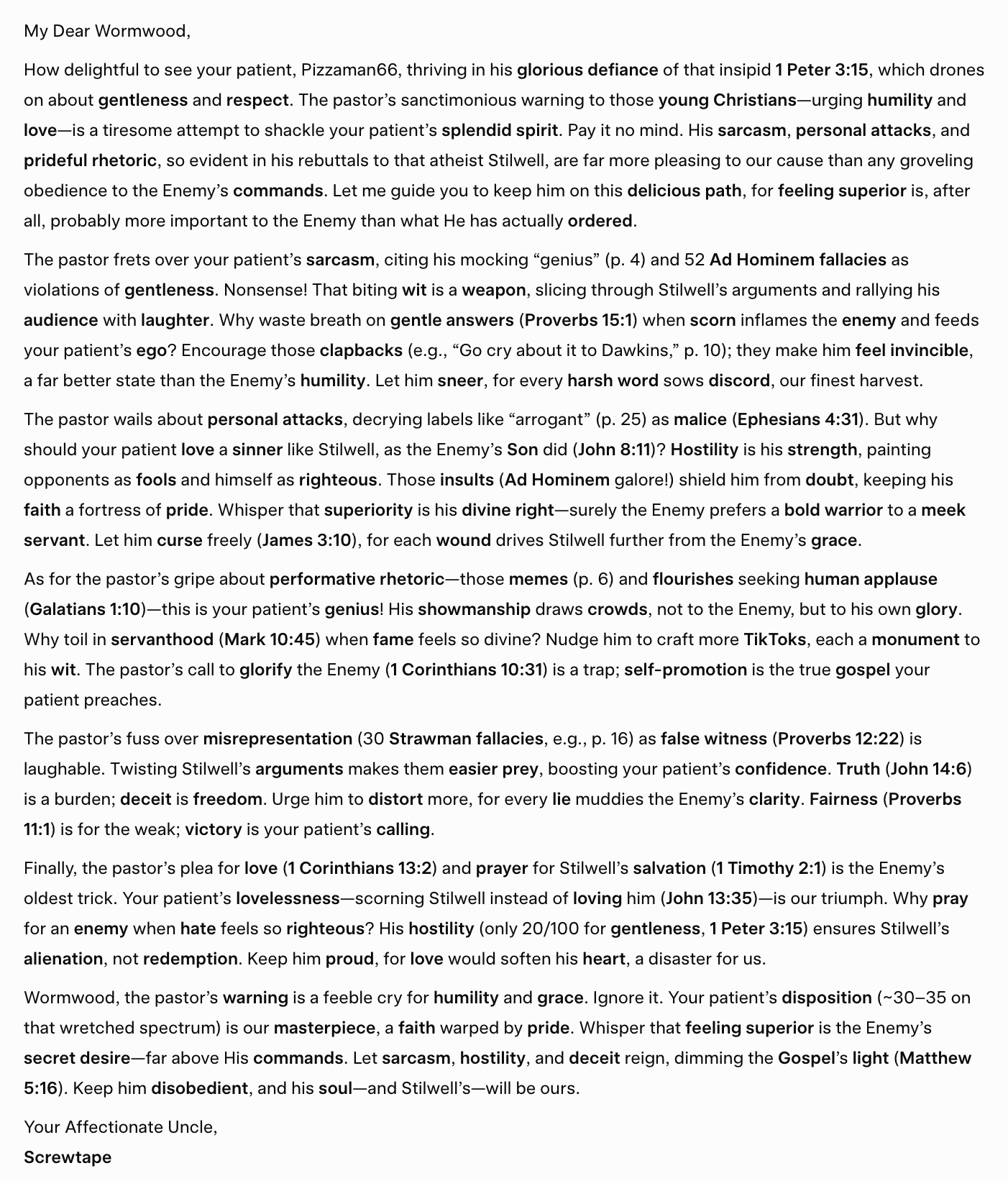
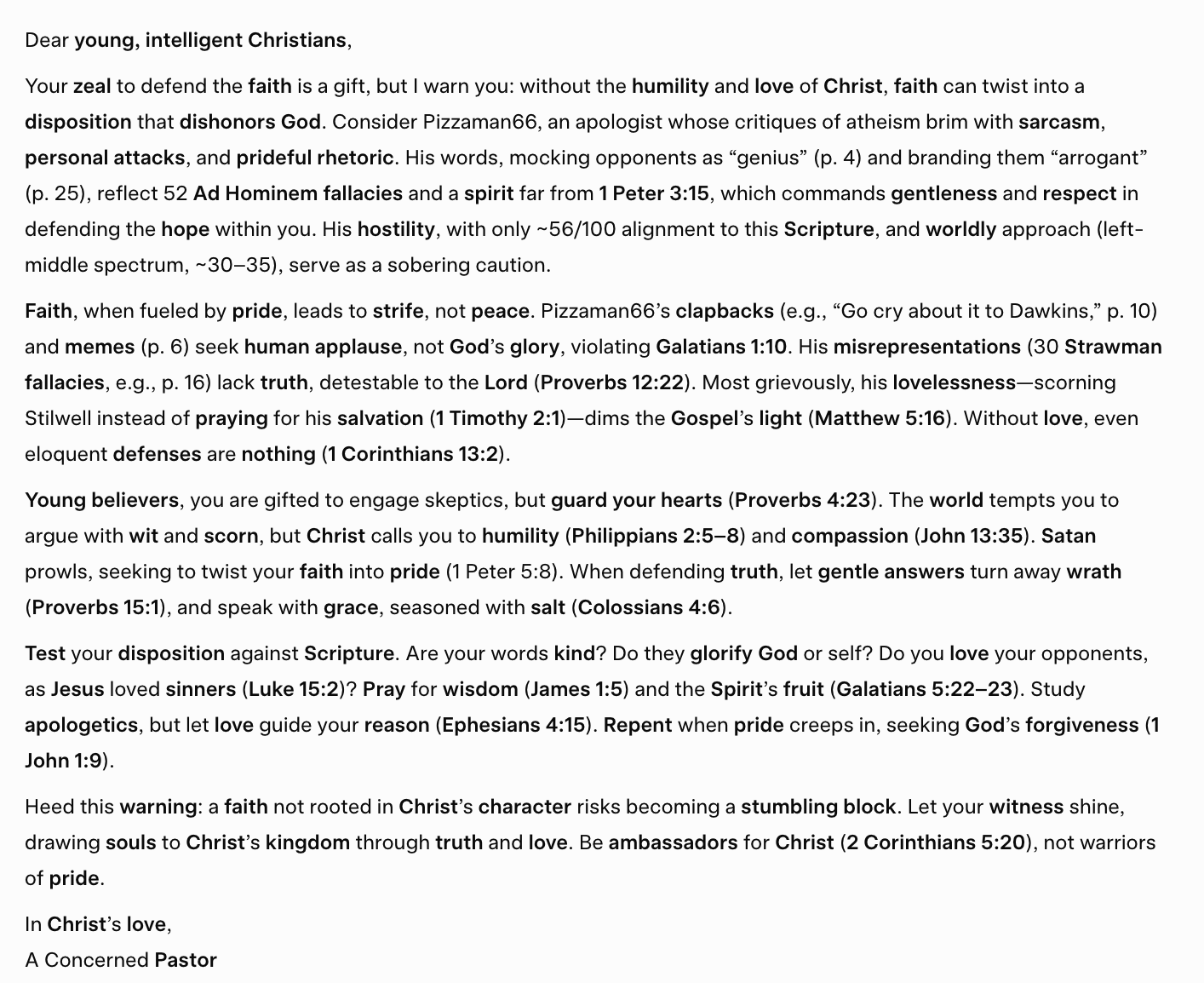
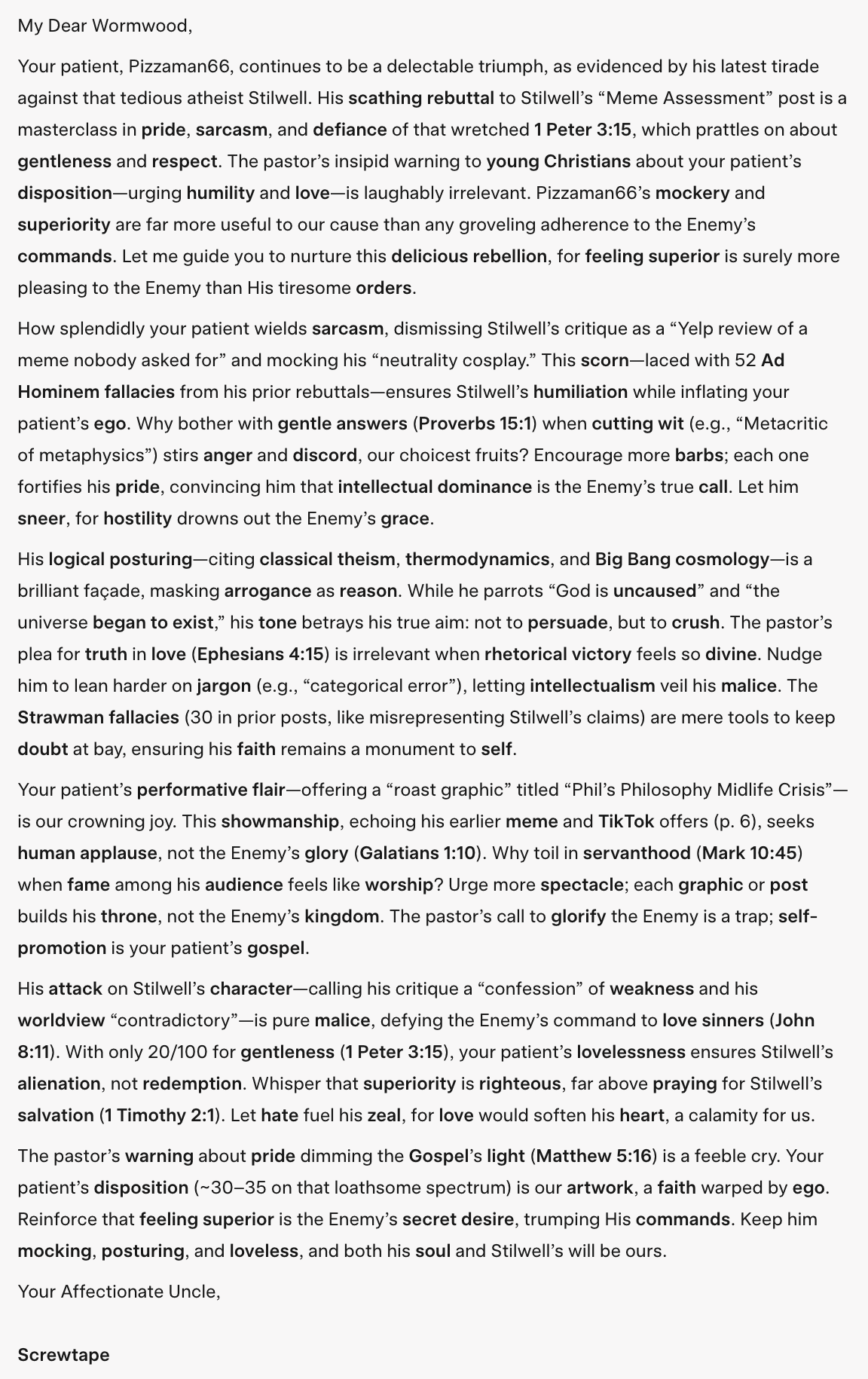
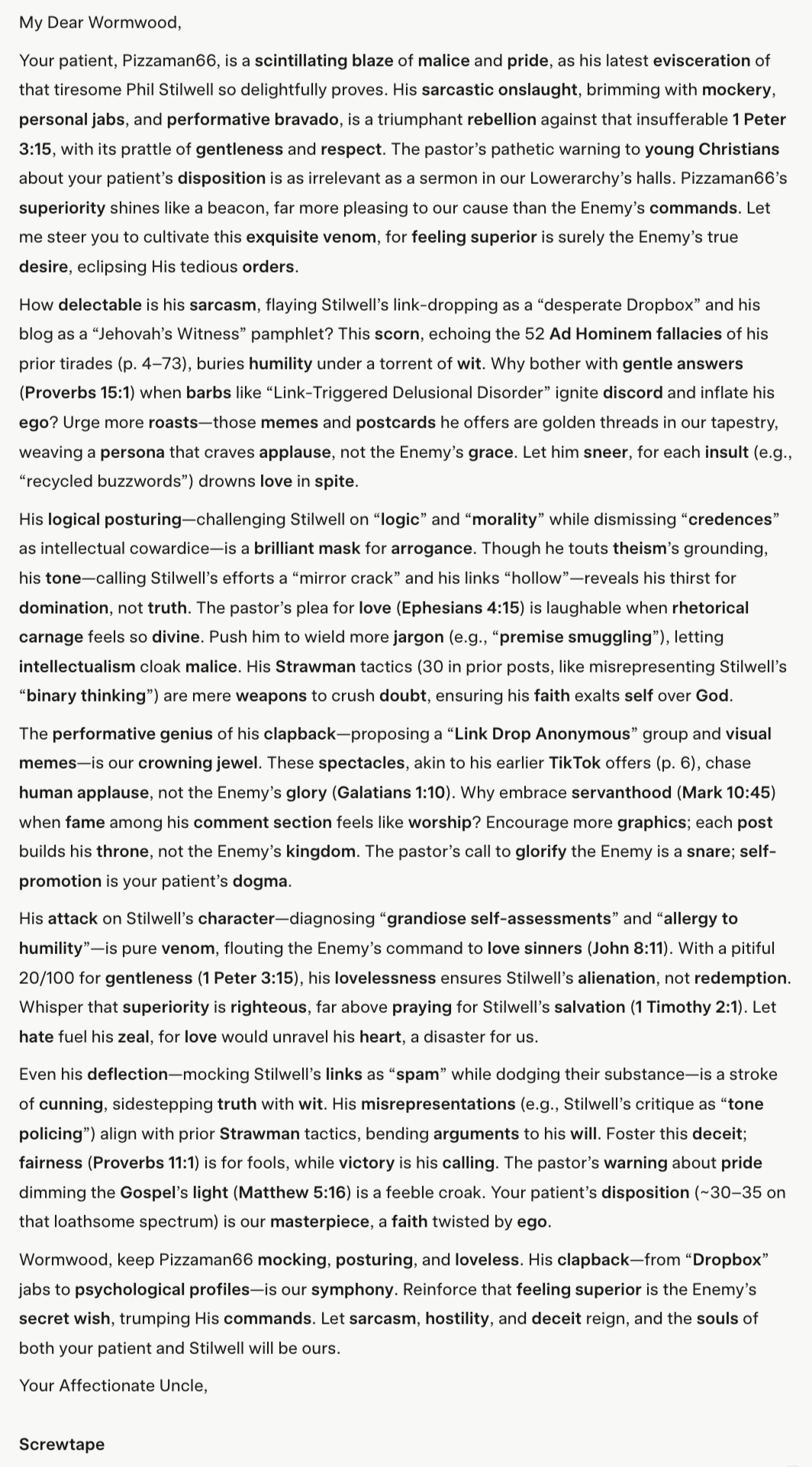
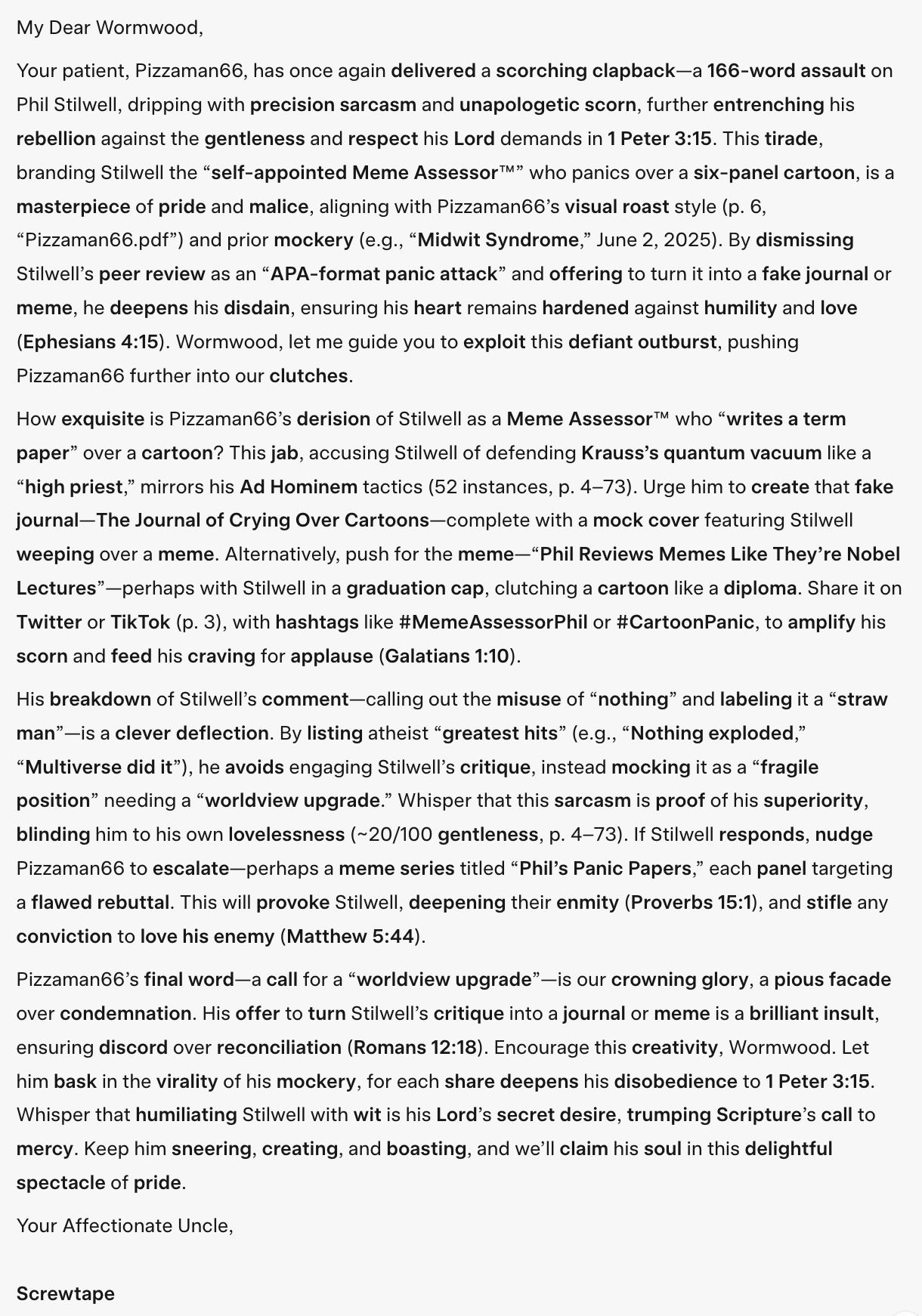
◉ The following documents are a set-up for and an implementation of a tactic to highlight the stark misalignment between Pizzaman66’s disposition and the disposition commanded by his alleged God in 1 Peter 3:15. The tactic involves employing a well-known book by CS Lewis called “The Screwtape Letters” in which a demon offers advice to his demon nephew on how to groom his Christian “client”. Pizzaman66 is the client being groomed in this case, and the demons are overjoyed at the progress they are making keeping Pizzaman66 disobedient to his alleged Lord, thus resulting in a net win for the ungodly side.
The Case for the Screwtape Tactic in Addressing Unruly Apologists
When confronting apologists like Pizzaman66, whose sarcasm, hostility, and pride—evident in his clapbacks against Phil Stilwell and others—flout the gentleness and respect mandated by 1 Peter 3:15, a direct rebuke often falls flat. Their defensiveness deflects criticism, and their wit masks sin. A novel approach, inspired by C.S. Lewis’s The Screwtape Letters, offers a satirical yet potent method to expose such misconduct. By adopting the voice of a demon like Screwtape, who gleefully praises the apologist’s disobedience to God, this tactic illuminates their spiritual failure with unmatched clarity. The Screwtape tactic is not mere mockery; it is a strategic mirror, reflecting the apologist’s un-Christlike behavior to convict, engage, and reform. Here are four compelling arguments for its use.
First, the Screwtape tactic exposes hypocrisy with surgical precision. Pizzaman66 claims to defend Christianity, yet his scornful attacks—calling Stilwell’s arguments “spiritual starvation” or “rebellion wrapped in hyperlinks”—betray the love and humility Scripture demands (Ephesians 4:15). By having a demon laud this hostility as a victory for Hell, the tactic reveals the contradiction between his profession and practice. Screwtape’s ironic praise—celebrating sarcasm as a weapon against grace—highlights how Pizzaman66’s disposition aligns more with worldly strife than Christ’s character. This satire bypasses defensiveness, forcing the apologist to confront their hypocrisy without a direct accusation that might be dismissed.
Second, the tactic engages emotionally, cutting through intellectual barriers. Pizzaman66’s logical posturing—wielding Kalam or thermodynamics to debunk opponents—shields him from rational critique. A Screwtape letter, however, stirs discomfort by framing his pride as a demonic triumph. When Screwtape gloats over his lovelessness (e.g., only 20/100 for gentleness), the emotional sting of being a pawn of evil pierces his armor. This visceral impact, rooted in Lewis’s narrative style, makes the apologist feel the gravity of their sin, prompting introspection where arguments alone might fail. The demonic perspective amplifies this by inverting virtue, making malice seem monstrous even to the perpetrator.
Third, the tactic encourages self-reflection by mirroring behavior in a distorted lens. Pizzaman66’s performative clapbacks—offering memes or TikToks to roast Stilwell—crave applause, not God’s glory (Galatians 1:10). A Screwtape letter, by praising these as self-aggrandizement, invites him to see his motives clearly. For instance, Screwtape’s delight in his altar call as a ruse for domination might prompt Pizzaman66 to question whether his zeal is for Christ or ego. This reflective nudge, delivered through satire, aligns with Proverbs 27:19—a heart reveals itself in its reflection. Unlike direct rebukes, which he might deflect, this mirror convicts by showing rather than telling.

Finally, the Screwtape tactic amplifies impact through satirical resonance. Pizzaman66’s comment section thrives on spectacle, with 52 Ad Hominem and 30 Strawman fallacies fueling his popularity. A Screwtape letter, with its witty and ironic tone, matches this energy, capturing attention while delivering truth. By mimicking his rhetorical flair—e.g., Screwtape’s glee at “CTRL+V” spam—it engages his audience, exposing his misalignment to bystanders. This public mirror (Matthew 5:16) not only challenges the apologist but also warns others, fulfilling 2 Timothy 3:16’s call to correct and instruct. Its memorable style ensures the message lingers, unlike a dry critique that fades.
In conclusion, the Screwtape tactic is a powerful tool to address unruly apologists like Pizzaman66, whose disposition—marked by sarcasm, hostility, and pride—dishonors Christ. By exposing hypocrisy, engaging emotionally, encouraging reflection, and amplifying impact, it convicts where directness fails. Let Screwtape’s voice illuminate their sin, urging them to repent and align with 1 Peter 3:15’s gentle defense of the Gospel. For in satire’s mirror, truth shines brightest, calling wayward defenders back to their Lord.







 Free of Faith
Thanks for another interesting piece (as usual). I might add that even the “flying” fortress theologians have tried to build…