
At times, theists unwittingly do far more good for the cause of rational skepticism than for their version of theism.
Riaan Visser provides one good example of this.
- Riaan demonstrates a disposition in direct disobedience to 1 Peter 3:15. Even if illogical, a Christian should, at minimum, demonstrate a full capacity to obey their alleged Lord.
- Riaan demonstrates an illogic that could never reflect the logic of an actual God of the universe. Wherever the Holy Spirit might be, it is nowhere close to the mind of Riaan.
Riaan’s comments reflect the mind of a theist who is unaware of their contributions to the side of skepticism.
Featured below is a critique of the theistic mindset that pervades many alleged Christians that serves as an impetus for other more thoughtful and curious Christians to acknowledge the illogic of the theistic position.
— 1. Riaan’s Comments
— 2. The Illogic in Riaan’s Position:
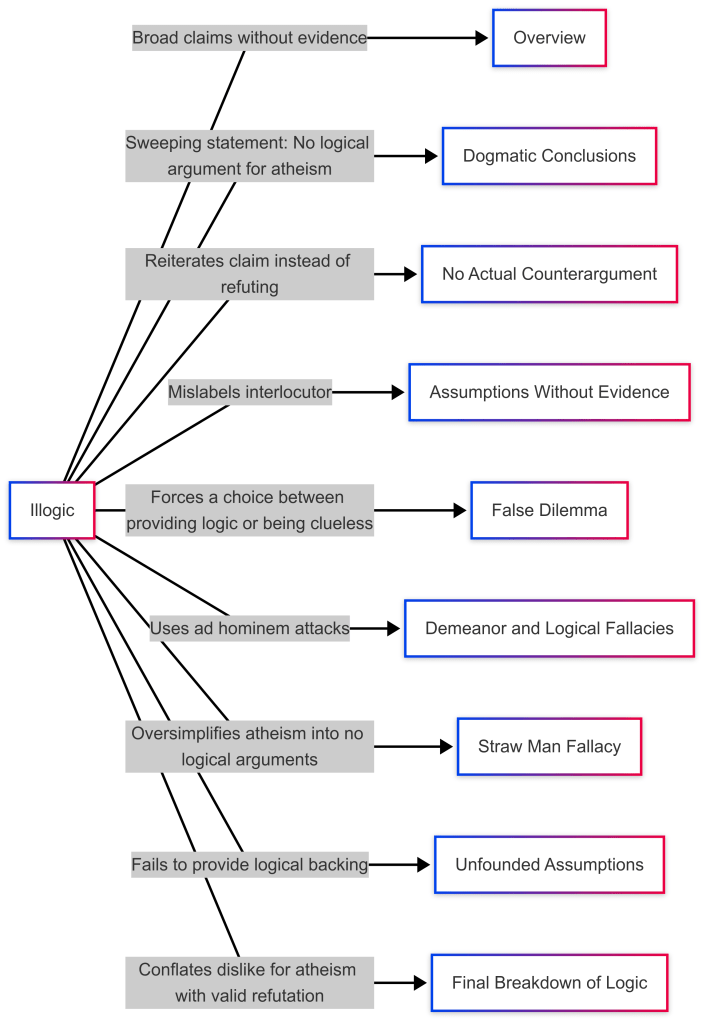
Riaan presents himself as someone very confident in logic and philosophical discourse, yet his comments manifest several fallacies that undermine the rational force of his arguments. He begins by declaring atheism devoid of logical arguments and, despite repeated challenges to substantiate his claim, never provides a systematic analysis or well-formed logical structure to justify it. Instead, he attempts to shift the burden of proof, demands instant rebuttals, and resorts to ad hominem.
The result is a chain of non-sequiturs that conflate the lack of immediate demonstration with absolute nonexistence of such arguments, coupled with dismissive language that masks his shortfall in genuine logical debate.
Riaan’s conduct, therefore, reflects a dogmatic stance rather than an impartial, reasoned approach. Rather than listening and evaluating, he attacks and mocks. In doing so, he misrepresents what true logical argumentation is about: the careful presentation of premises and a step-by-step derivation of conclusions—all tested by possible counterexamples or different perspectives.
— 3. Detailed Examination of Riaan’s Logical Fallacies
◉ Affirming the Consequent
He often commits the affirming the consequent fallacy by implying:
Premise: If one is an atheist (A), then one cannot provide a logical argument (¬L).
Premise: The interlocutor does not provide a logical argument (¬L).
Conclusion: Therefore, the interlocutor is an atheist (A).
This is logically invalid. Even if it were true that “being an atheist” implies “not giving a logical argument,” it does not follow that “not giving a logical argument” implies “being an atheist.”
◉ Straw Man
Riaan insists no atheist can offer any logical position—thus oversimplifying and distorting the atheistic stance. By dismissing all potential arguments as nonexistent, he avoids engaging with complex philosophical discussions (for instance, Evidential Arguments from Evil, Logical Problems of Omnipotence, etc.). He shapes atheism into an easily battered caricature—then claims victory when no immediate rebuttal is provided.
◉ Ad Hominem
Words like “sad,” “pathetic,” “clueless,” “degenerate,” or calling someone a “troll” replace reasoned critique with personal insult. This approach focuses on belittling the interlocutor’s character rather than examining or refuting any argument or stance.
◉ Shifting the Burden of Proof
Riaan demands that others immediately prove him wrong: “There’s no assumption…prove me wrong by presenting a logical argument for atheism. I’ll wait.” This is shifting the burden rather than defending his own claim that no argument for atheism exists.
◉ Argument from Ignorance
He also implies that because no one (in the conversation) has produced a logical argument for atheism on the spot, it must be true there is no such argument. Absence of presented evidence in the moment does not constitute proof that no evidence ever exists.
◉ Dogmatism
He declares his statement “stands, unfalsified,” as though no new information can emerge, even though he never systematically evaluates possible logical arguments for atheism. Dogmatism refuses to consider or respond to counter-evidence.
— 4. How Riaan’s Disposition Contrasts with 1 Peter 3:15
1 Peter 3:15 commands:
“But in your hearts revere Christ as Lord. Always be prepared to give an answer to everyone who asks you to give the reason for the hope that you have. But do this with gentleness and respect.”
◉ Gentleness and Respect
Riaan’s tone—calling people “degenerate,” “pathetic,” “clueless”—departs significantly from the gentleness and respect the verse encourages.
◉ Giving a Reason
The verse exhorts believers to provide an answer for their hope. Riaan’s approach, however, does not involve giving a positive account of his own stance; it instead mocks others for not instantly disproving his claims. He is not providing constructive reason or a careful defense that others can examine and evaluate.
◉ Serious Engagement
1 Peter 3:15 positions dialogue about faith and hope as honest engagement. Riaan’s dogmatic dismissals, refusal to examine counterarguments, and quickness to insult stand in stark contrast to the spirit of reasoned discussion and respectful exchange.
In short, his disposition is incongruent with the biblical exhortation to defend one’s faith without resorting to derision or personal attack.
— Conclusion
Through affirming the consequent, straw man, ad hominem, shifting the burden of proof, and argument from ignorance, Riaan’s stance remains unsubstantiated and logically unsound. Moreover, his abrasive and insulting style runs counter to the “gentleness and respect” encouraged by 1 Peter 3:15. Rather than providing a robust argument or solid reasoning against atheism, his approach leans on dismissive and dogmatic claims that hinder meaningful dialogue.
Riaan is unwittingly working for the side he appears to hate. Other, more aware Christians are watching and learning. The species of disposition and illogic Riaan exhibits are a very likely cause of the recent exodus of intelligent Christians from Christianity.
On behalf of all skeptics, thank you, Riaan, and carry on.
Formal Reflections of Riaan’s illogic:
— Affirming the Consequent


Where:
◉ 
◉ 
This is a classic fallacy: from the premise “If
— Argument from Ignorance


In words: If no one has immediately provided (or “can provide on demand”) an argument, then (according to Riaan) no valid argument exists. This ignores the possibility that the argument simply has not been offered in that exchange; it does not logically prove that such an argument can never exist.
— Shifting the Burden of Proof (Implied)

Here, the assumption is that if interlocutors fail to disprove his claim “No logical arguments for atheism exist,” then his claim stands as true. This shifts the burden from Riaan (who should support his universal statement) to others, requiring them to falsify it on demand.
Each of these symbolic forms illustrates how Riaan’s position relies on faulty logical structures rather the valid, evidence-based reasoning we would expect of someone indwelt with the spirit of an actual God.
Subsequent Comments from Riaan:
A common tactic of this type of believer is to accuse their interlocutors of the very flaws or blunders in their own arguments they wish to distract from. And it could be a reflection of their own justified emotional insecurities. While I do have compassion for these sort of individuals, their movement to rationality is not likely. They are best utilized as examples to honest seekers.
- (March 3, 2025) – “You plebs keep exposing yourselves. Why are you so eager to show your level of stupidity?”
- (March 3, 2025) – “A fifth-grade comment… How expected.”
- (March 4, 2025) – “Trying some ad hominem as you have nothing else? Shame. Please know that your meaningless opinions mean nothing to me. And if your agenda is exposing the stupidity and desperation behind atheism, you’re succeeding.”
- (March 5, 2025) – “So still pretending there is a logical argument for atheism, but cannot present it? Rotflmao. You sad little man.”
- (March 5, 2025) – “Adding to your desperate attempt at ad hominem which no one will ever read, because you cannot we gage [sic] in any argument? You’re [sic] flow chart doesn’t need a dedicated page, it starts and ends with desperate stupidity”
- (March 5, 2025) – “You poor soul. Proving all you have is desperate at [sic] hominem, and condensing [sic] yourself for it. F*ck you couldn’t write this sh*t”
- (March 7, 2025) – “I love you how think accusing someone of fallacy has meaning when you cannot actually demonstrate any of the fallacies you accuse me of. I’ve presented you specifically with several arguments, all of which you’ve ignored and instead tried to attack my physiological [sic] character. Ergo. Ad hominem. Well done. Can’t wait to see you do a case study on yourself and your inability to reason logically or give evidence of your accusations…”
- (March 7, 2025) – “So you added the fact that you’re noisy with an elaborate ad hominem attack while you’ve been completely unable to engage with any of arguments presented? Did you explain why you think an ad hominem fallacy has any meaning?”
- (March 7, 2025) – “Yes it’s nice to see the lack of self awareness while adding yet more proof of your ad hom…. Rotflmao. What you don’t grasp is that you’re literally presenting an actual case study against yourself. And it shows in the biased and unsupported opinions you have. Keep going. As some more and show what a sad existence you occupy”
(While the personal attacks remain, they have softened a bit. Stay tuned…)
Riaan’s interactions with others:
- (March 3, 2025) – “I think debating atheists might be worse than mocking mentally challenged kids. I mean, these people are clearly suffering from deeper issues while more having the mental faculty to deal with them.”
- (March 11, 2025) – “So glad to see I’m living rent free in so many poor fools’ minds”
- (March 11, 2025) – “Insisting on PROOF when you believe countless things that aren’t PROVEN, makes you a f*cking hypocrite. Those who don’t grasp this are f*cking morons”
Is faith a life-diminishing epistemology? If you are an intelligent theist, you may have seen dispositions similar to those exhibited above among your theistic aquaintances. Is this the demeanor that a true relationship with an actual God of the universe would generate? We encourage you to explore the option of a rational life without faith through the articles on this site.


 Free of Faith
Leave a comment