
The document “Scientific Proof of G-d” by Ziv Ritchie attempts to argue for the existence of a divine creator through numerical correlations in the solar system, specifically ratios involving the Sun, Earth, Moon, and the speed of light, which purportedly align with the numbers 1, 3, and 4, and relate to the Hebrew gematria of “Sh-D-I” (314). While the author presents this as a scientific proof, the argument contains several logical fallacies and weaknesses when assessed for coherence and rigor without deference to faith-based assumptions. Below, I outline the primary logical issues and weaknesses in the document’s reasoning.
Primary Logical Fallacies and Weaknesses
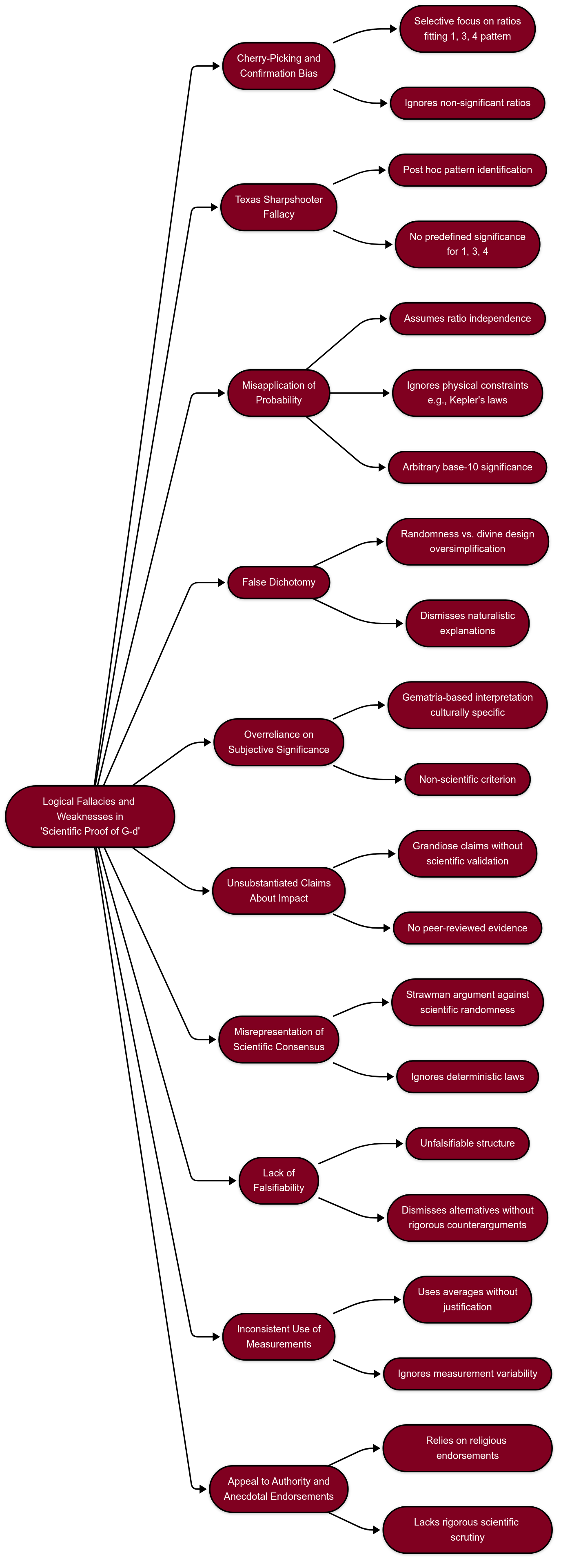
- Cherry-Picking and Confirmation Bias
- Issue: The document selects 29 specific ratios (e.g., Sun’s diameter to Moon’s diameter, Earth’s orbital speed to Moon’s rotational speed) that yield values close to multiples of 1, 3, or 4, interpreting them as evidence of divine design. However, it does not consider the vast number of possible ratios between celestial measurements that do not align with these numbers. This selective focus on favorable data constitutes cherry-picking, a form of confirmation bias where only evidence supporting the hypothesis is highlighted, while counterevidence is ignored.
- Example: The document emphasizes the Sun’s diameter being 400.5 times the Moon’s diameter (Page 14) but does not address ratios like the Sun’s mass to Earth’s mass or other measurements that may not yield “round” numbers or fit the 1, 3, 4 pattern.
- Weakness: Without a comprehensive analysis of all possible ratios, the claim that the selected ratios are uniquely significant is unjustified. The absence of a control set or a discussion of non-significant ratios undermines the argument’s objectivity.
- Texas Sharpshooter Fallacy
- Issue: The document’s methodology resembles the Texas sharpshooter fallacy, where a pattern is identified after the fact and then presented as intentional. The author identifies ratios that cluster around 1, 3, or 4 and assigns significance to them post hoc, without predefining why these numbers (or their decimal multiples) are inherently meaningful beyond their connection to the gematria of “Sh-D-I” (Page 36). This retroactive pattern-fitting exaggerates the significance of the findings.
- Example: On Page 17, the author likens the ratios to arrows hitting only boards 1, 3, and 4, implying deliberate aim. However, this analogy assumes the numbers 1, 3, and 4 were predetermined targets, which is not justified scientifically and is instead tied to a religious interpretation (gematria).
- Weakness: The lack of a priori criteria for selecting 1, 3, and 4 (beyond religious significance) means the pattern could be coincidental. Any large dataset can yield apparent patterns if one searches for them after collecting the data.
- Misapplication of Probability
- Issue: The document calculates the probability of the observed ratios occurring randomly as extremely low (e.g., 1 in 25 quintillion on Page 6) to argue for divine design. However, the probability calculations are flawed because they assume independence of ratios and do not account for physical constraints or dependencies among celestial measurements.
- Example: On Page 18, the probability that eight ratios fall within the range of 1, 3, or 4 is calculated as
, assuming each ratio has a
chance of landing in bins 1, 3, or 4. This assumes the ratios are independent and equally likely to fall in any bin, which is not true since many measurements (e.g., orbital speeds, distances) are governed by gravitational laws and Kepler’s laws, constraining their possible values.
- Weakness: The calculations ignore physical relationships, such as the fact that orbital periods and distances are related by Kepler’s third law
, which reduces the randomness of the ratios. Additionally, the document does not justify why a base-10 system or “round numbers” are inherently significant in a cosmic context, as opposed to other numerical bases or patterns.
- False Dichotomy
- Issue: The document presents a false dichotomy by asserting that the observed ratios either result from random chance or divine design, ignoring other possible explanations (e.g., physical laws, selection effects, or human pattern-seeking tendencies). This oversimplification dismisses naturalistic explanations without sufficient justification.
- Example: On Page 35, the author claims there is “no natural explanation” for the ratios being round numbers, dismissing gravitational or physical constraints without evidence. The assertion that these ratios have “no efficiency or utility to nature” (Page 35) is speculative and not supported by astronomical analysis.
- Weakness: By framing the argument as random chance versus divine intent, the document fails to explore whether the ratios could arise from physical processes or whether the sample size (one solar system) limits the ability to assess randomness.
- Overreliance on Subjective Significance (Gematria and Religious Interpretation)
- Issue: The document ties the numerical pattern (1, 3, 4) to the Hebrew gematria of “Sh-D-I” (314), suggesting this is evidence of divine intent (Page 36). This interpretation is subjective and relies on a specific cultural and religious framework, which is not universally applicable or scientifically verifiable.
- Example: The connection between the ratios and “Sh-D-I” (Page 37) assumes the Hebrew numerical system and specific theological interpretations are cosmically significant, without justifying why other numerical or cultural systems (e.g., binary, base-12, or other religious numerologies) are not considered.
- Weakness: The reliance on gematria introduces a non-scientific criterion that undermines the claim of a “scientific proof.” The argument appeals to those already inclined to accept the religious framework, reducing its persuasive power for a skeptical or neutral audience.
- Unsubstantiated Claims About Impact
- Issue: The document makes grandiose claims about the proof’s impact, such as changing the education system, science, and civilization (Page 3), or convincing all atheists (Page 4), without evidence that the scientific community has accepted or even engaged with the argument. These claims are speculative and lack empirical support.
- Example: On Page 6, the author states, “This proof will change the world!” and on Page 43, claims that no one who reads the book remains an atheist. These assertions are not backed by data or peer-reviewed validation.
- Weakness: The lack of engagement with the broader scientific community or peer review undermines the credibility of these claims. Scientific proofs require rigorous scrutiny, not anecdotal endorsements (Page 5) or self-reported success.
- Misrepresentation of Scientific Consensus
- Issue: The document misrepresents the scientific stance on randomness and design, claiming that academia assumes “nothing special” about the universe (Page 7) and that the proof disproves this. In reality, science does not assume complete randomness but studies patterns governed by physical laws.
- Example: On Page 8, the author suggests that curricula teaching randomness are now “proven false,” ignoring that science teaches deterministic laws (e.g., gravity, electromagnetism) alongside probabilistic elements (e.g., quantum mechanics).
- Weakness: This misrepresentation creates a strawman argument, mischaracterizing scientific inquiry to make the author’s claims appear more revolutionary.
- Lack of Falsifiability
- Issue: The argument is structured to be unfalsifiable, as it dismisses alternative explanations (e.g., natural processes, quantum theory, multiverse) without rigorous counterarguments (Pages 39–40). The claim that any deviation from the observed ratios would still support the conclusion (Page 39) weakens the testability of the hypothesis.
- Example: On Page 41, the author dismisses the simulation hypothesis and alien intervention without evidence, asserting only a divine creator could produce the ratios. This lack of openness to alternative hypotheses undermines scientific rigor.
- Weakness: A scientific proof must be falsifiable, meaning there must be a way to test and potentially disprove it. The document’s dismissal of all alternatives makes it more dogmatic than scientific.
- Inconsistent Use of Measurements
- Issue: The document uses average values for elliptical orbits (Page 38) and other measurements without acknowledging the variability or justifying why averages are the most relevant metric. This selective use of data may exaggerate the appearance of “roundness.”
- Example: The distance to the Moon and Sun fluctuates (Page 38), yet the author uses averages to achieve ratios like 390 or 400.5, without discussing whether maximum or minimum values would disrupt the pattern.
- Weakness: The choice of averages is not justified astronomically, and the document does not explore how variability in measurements affects the claimed precision of the ratios.
- Appeal to Authority and Anecdotal Endorsements
- Issue: The document relies on endorsements from religious figures (Page 5) and anecdotal support (e.g., a computer programmer’s simulation, Page 7) rather than peer-reviewed scientific validation. This appeal to authority does not substitute for empirical rigor.
- Example: Endorsements from rabbis (Page 5) are presented as evidence of the proof’s validity, but these lack scientific weight. The programmer’s simulation is vague and lacks methodological detail.
- Weakness: Scientific claims require scrutiny by experts in relevant fields (e.g., astronomy, statistics), not endorsements from non-experts or anecdotal confirmations.
Additional Observations
- Lack of Peer Review: The document claims to be a scientific proof but lacks evidence of submission to or acceptance by the scientific community. The call for scientists to “reevaluate all their beliefs” (Page 7) is premature without such validation.
- Overemphasis on Solar Eclipse: The document starts with the solar eclipse (Page 3) as a hint of divine design, but this phenomenon is a known consequence of the Moon’s size and distance relative to the Sun. Its significance is overstated without considering other moons or systems.
- Cultural Bias: The focus on Hebrew gematria and Torah-based interpretations (Pages 36–37) limits the argument’s universality, making it less compelling to those outside the Jewish tradition.
Conclusion
The document’s central claim—that the ratios of solar system measurements clustering around 1, 3, and 4 constitute irrefutable proof of divine creation—lacks logical coherence due to cherry-picking, post hoc pattern-fitting, flawed probability calculations, and a reliance on subjective religious interpretations. The argument fails to engage with physical laws that constrain celestial measurements, dismisses alternative explanations without evidence, and lacks the rigor of peer-reviewed science. While the correlations may be interesting, they do not meet the standard of a scientific proof, as they are neither falsifiable nor free from significant methodological flaws. For a neutral observer, the document’s persuasive power is limited by its logical fallacies and dependence on faith-based assumptions.


 Free of Faith
Leave a comment