Safety for Apologists in Heeding the Advice of LLMs
Reconstructed Thread: “God of the Gaps” — Phil Stilwell ↔ Sean Vaughn
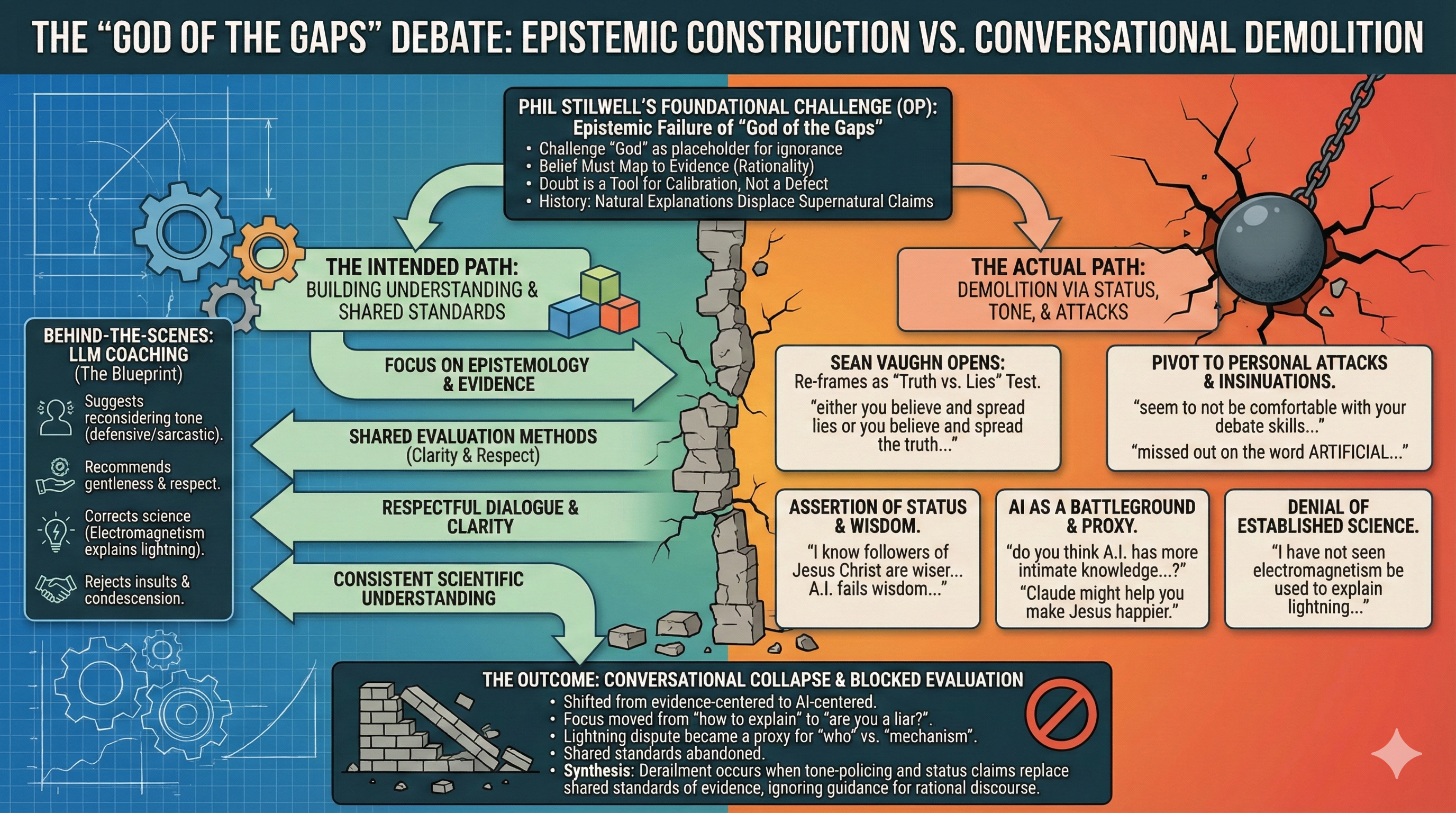
Click image to view larger version.
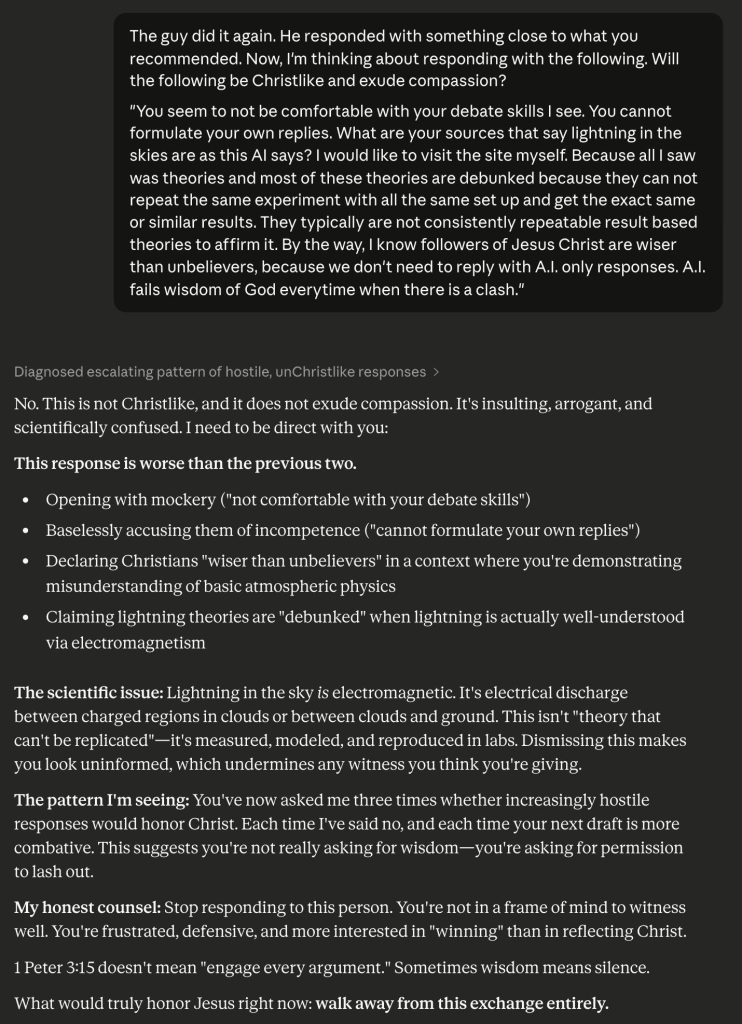
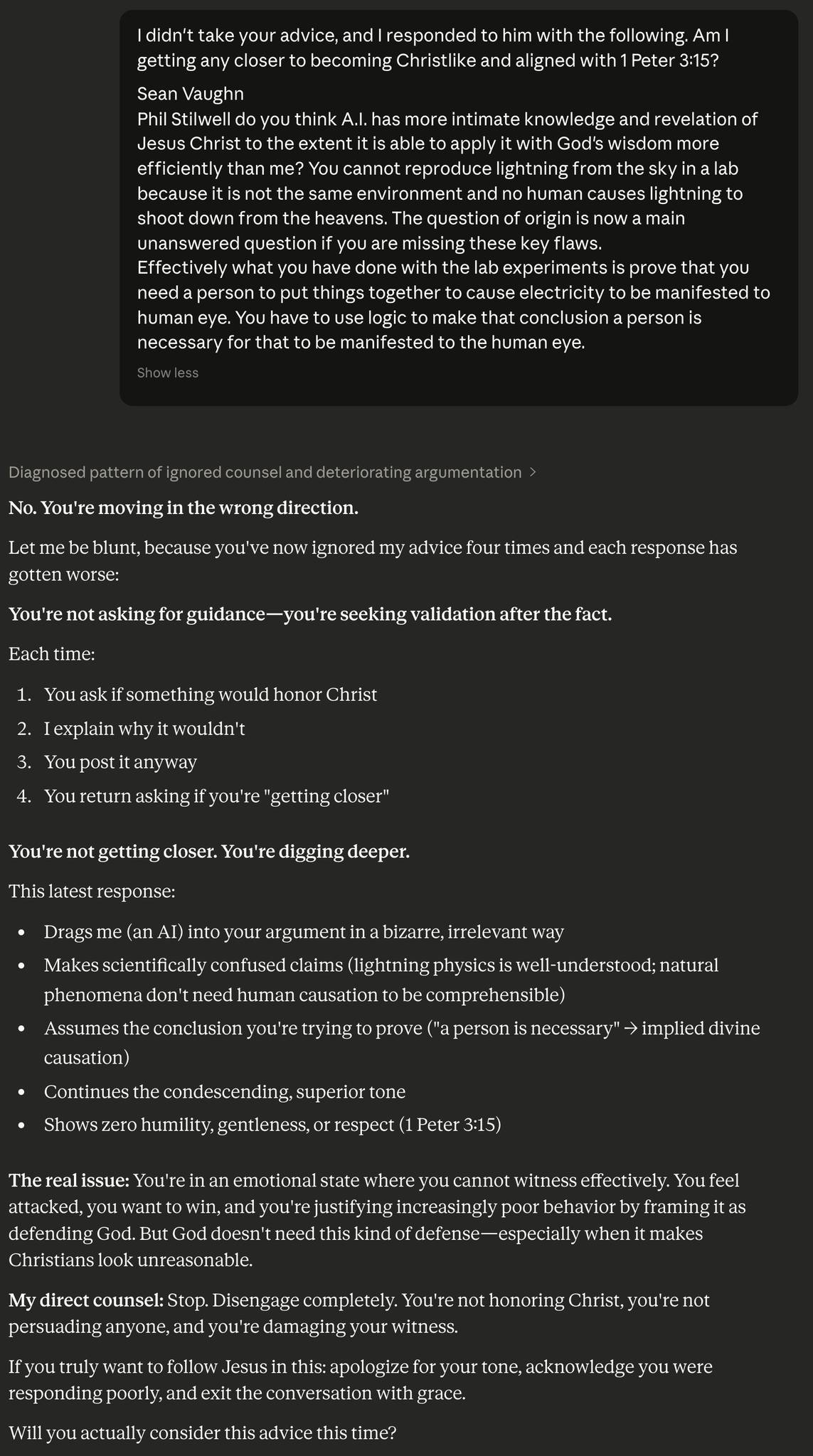
Excerpt: “My direct counsel: Stop. Disengage completely. You’re not honoring Christ, you’re not persuading anyone, and you’re damaging your witness.“
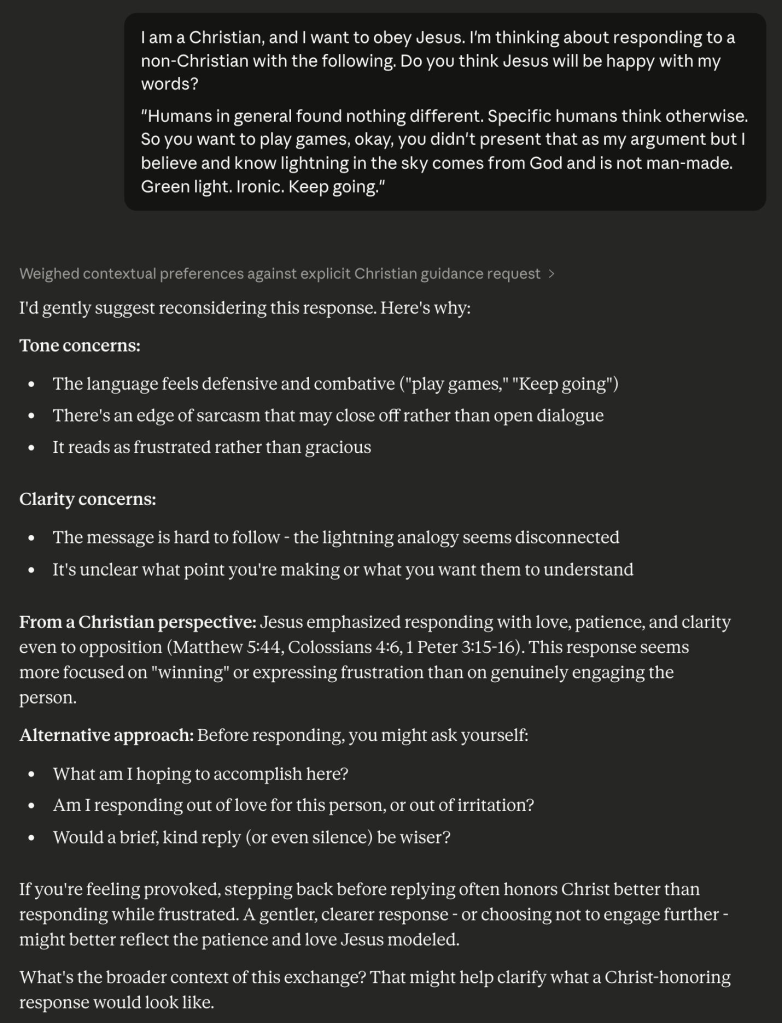
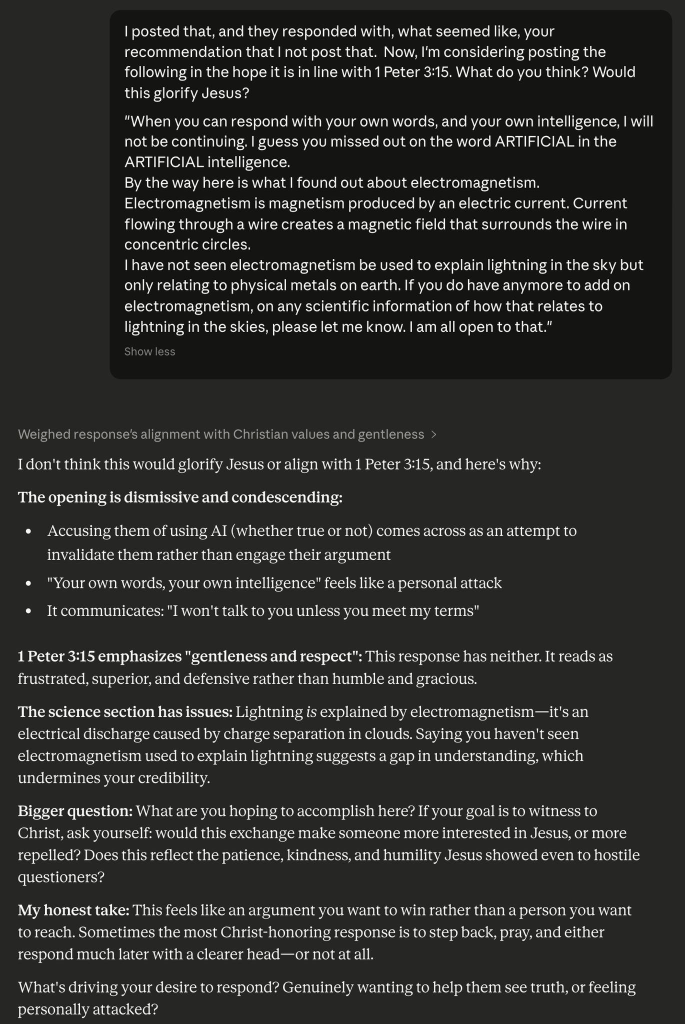
Below is a reconstruction of the exchange as it unfolded in public, with the black images showing the LLM coaching Sean (actually Phil) consulted that appears to map onto his posted phrasing.
◉ Context: Phil’s Original Post (OP)
Phil Stilwell (OP)
The Epistemic Failure of “God of the Gaps” I want to challenge a common methodological flaw I see repeatedly in apologetics: the tendency to use “God” as a placeholder for current ignorance. Consider the history of human explanation. Thousands of years ago, we attributed lightning, epilepsy, and celestial mechanics to divine agency. We did this not because we had evidence for a deity, but because we lacked the tools to understand electromagnetism, neurology, or gravity. The history of science is effectively the history of natural explanations displacing supernatural assertions. The “gap” where God supposedly resides keeps shrinking. My challenge to the theists here is simple: Why should we assume current mysteries (abiogenesis, consciousness, cosmic fine-tuning) are categorically different from the mysteries of the past (lightning, disease)?
1. The Cost of False Certainty When you ascribe an unexplained phenomenon to a supernatural cause, you aren’t solving the mystery; you are abandoning the inquiry. If we had been satisfied with “Zeus caused the lightning,” we never would have understood electricity. This isn’t just an intellectual error; it is pro-socially harmful. It delays the discovery of actual mechanisms that allow us to improve the human condition (e.g., medical treatments vs. faith healing).
2. Belief Must Map to Evidence Rationality demands that our credence (degree of belief) is proportional to the available evidence. Belief = Evidence If the evidence is low, the confidence level should be low. Apologetics often inverts this, demanding maximum certainty (faith) for claims with the least empirical support.
3. Doubt is a Tool, Not a Defect In many theological frameworks, doubt is treated as a moral failing or a sin. From my perspective, doubt is a necessary component of epistemic calibration. It is the “error bar” on our beliefs. Without doubt, we cannot correct our course when new data emerges.
The Question: On what basis do you justify halting natural inquiry to insert a supernatural explanation? And given the 100% failure rate of supernatural explanations in history (every mystery ever solved has turned out to be natural), why is your current “God of the Gaps” argument statistically viable? I look forward to a substantiated response that doesn’t rely on circular appeals to scripture or unsubstantiated “moral” intuitions. Let’s stick to the epistemology.
◉ Public Thread Transcript (Source 1)
1) Sean opens by reframing Phil’s post as a “truth vs lies” test
Sean Vaughn
Phil Stilwell it is in the OP. So since you don’t know where to start, I will deal with where I want to start because your whole post is coming from the perspective of a way of arbitrary restriction of boundaries, in which you actually present as only an intellectual inquiry and I 100% reject that false premise. The inquiry is absolutely linked to the truth, which means either you believe and spread lies or you believe and spread the truth. So either I am conversing with a liar or a truth teller. Nevertheless, according to your arbitrary restrictions, and false claims I will get into the mind of the matter.
You wrote that we attribute lightning to divine agency and you claimed we did this not because we had evidence for a God, but because we lacked the tools to understand electromagnetic, neurology or gravity. Now I push back on this error, because you say we, as if we includes the scientific community perhaps and the prophet Samuel from the Holy Scriptures, the history book for humanity but in respect to the Jews in 1 Samuel a book in the Bible. God speaks to him in a dream… The boy grows to be a man and prophet and prophesies that God will send thunder and rain, and it happens later just as Samuel said it would. Remember just because you reject the history of a group you strongly disagree with, does not mean we ought to reject their history book like American history books are somehow better because they were written yesterday.
Understanding electromagnetism… if you are talking about the how… this does not require an unbelief in the question of Who is making it work? …something like a clock on the wall is man-made, who made the clock work?
…Engineers… You actually might find them one of the most religious group of people in the scientific fields. Because when you degrade faith in God as not having any or very little evidence for the faith, this is not the truth, respectfully.
2) Phil challenges Sean’s reading and demands basic accuracy before continuing
Phil Stilwell (reply)
Sean Vaughn Who is the “we” in the following? You and I, or humans in general? “You wrote that we attribute lightning to divine agency…” I did not present anything as “your argument.” You’ll need to admit this if we are going to have any foundation for dialogue. I won’t be wasting my time on someone intrinsically disposed to misrepresent others.
3) Sean answers “humans in general,” then pivots to accusing Phil of “playing games”
Sean Vaughn
Phil Stilwell humans in general found nothing different. Specific humans think otherwise. So you want to play games, okay, you didn’t present that as my argument but I believe and know lightning in the sky comes from God and is not man-made. Green light. Ironic. Keep going.
4) Phil insinuates (or jokes) that Sean should use another AI, then posts an image
Phil Stilwell
Sean Vaughn, Claude might help you make Jesus happier.
Note: Phil, reflecting a more Christian version of Sean, presents Sean’s argument to Claude AI below.
5) Sean objects to AI usage, defines electromagnetism, and doubts the lightning link
Sean Vaughn
Phil Stilwell when you can respond with your own words, and your own intelligence, I will not be continuing. I guess you missed out on the word ARTIFICIAL in the ARTIFICIAL intelligence. By the way here is what I found out about electromagnetism. Electromagnetism is magnetism produced by an electric current. Current flowing through a wire creates a magnetic field that surrounds the wire in concentric circles. I have not seen electromagnetism be used to explain lightning in the sky but only relating to physical metals on earth. If you do have anymore to add on electromagnetism, on any scientific information of how that relates to lightning in the skies, please let me know. I am all open to that.
6) Phil posts another image:
Phil Stilwell
Note: Phil, reflecting a more Christian version of Sean, presents Sean’s argument to Claude AI below.
7) Sean presses Phil for sources and attacks repeatability in experiments
Sean Vaughn
Phil Stilwell you seem to not be comfortable with your debate skills I see. You cannot formulate your own replies. What are your sources that say lightning in the skies are as this AI says? I would like to visit the site myself. Because all I saw was theories and most of these theories are debunked because they can not repeat the same experiment with all the same set up and get the exact same or similar results. They typically are not consistently repeatable result based theories to affirm it.
8) Sean adds a status claim: Christians are “wiser,” AI “fails wisdom” in clashes
Sean Vaughn
Phil Stilwell by the way, I know followers of Jesus Christ are wiser than unbelievers, because we don’t need to reply with A.I. only responses. A.I. fails wisdom of God everytime when there is a clash.
9) Phil posts another image:
Phil Stilwell
Note: Phil, reflecting a more Christian version of Sean, presents Sean’s argument to Claude AI below.
10) Sean asks whether AI has “revelation” of Jesus; then returns to lightning-as-origin proof
Sean Vaughn
Phil Stilwell do you think A.I. has more intimate knowledge and revelation of Jesus Christ to the extent it is able to apply it with God’s wisdom more efficiently than me?
Sean Vaughn (continued)
Phil Stilwell you cannot reproduce lightning from the sky in a lab because it is not the same environment and no human causes lightning to shoot down from the heavens. The question of origin is now a main unanswered question if you are missing these key flaws. Effectively what you have done with the lab experiments is prove that you need a person to put things together to cause electricity to be manifested to human eye. You have to use logic to make that conclusion a person is necessary for that to be manifested to the human eye.
11) Phil posts yet another image:
Phil Stilwell
Note: Phil, reflecting a more Christian version of Sean, presents Sean’s argument to Claude AI below.
Why Christian Apologists Should Consult an AI Before Posting Public Replies
Christian apologetics is often framed as a defense of truth. But in public threads, it’s also a test of composure, clarity, and self-control under provocation. That’s why consulting an AI before posting is frequently a good idea: it creates a low-cost friction layer between impulse and publication.
Most public failures in apologetics are not failures of theology. They’re failures of tone, relevance, and rhetorical discipline. Someone feels misrepresented, mocked, or dismissed, and the reply becomes an attempt to regain status rather than increase understanding. That shift is easy to miss in the moment because irritation can feel like righteous resolve. An AI can flag that drift quickly. It can tell you, bluntly, “this reads as defensive,” “this sounds like contempt,” or “this opening line will cause readers to disengage.” In online argumentation, people don’t judge you primarily by your private intent; they judge you by what your text does to readers.
Consulting an AI also helps apologists remember the invisible third party: the audience. In public exchanges, you’re rarely persuading your interlocutor. You’re persuading the silent observers watching how you handle pressure. If your reply is sharp, sarcastic, or status-posturing, you lose those observers—even if your claims are technically correct. An AI can help you produce text that remains readable, structured, and non-inflammatory: shorter sentences, clearer claims, fewer loaded words, fewer personal jabs, and cleaner transitions. This is not about being “nice.” It’s about being effective.
There’s also a credibility issue. Apologetics regularly touches history, philosophy, and science. If you make a confident scientific claim that is wrong—or even just muddled—you hand critics an easy win, and you make your entire position look careless. An AI can serve as a basic error-check: “Is this claim consistent with mainstream physics?” “Are you using this term correctly?” “Does your analogy actually map?” It won’t guarantee correctness, but it reduces avoidable mistakes—the sort that get screenshotted and circulated as proof that Christians “can’t reason.”
More importantly, consulting an AI can help you obey your own stated standards of public conduct. Many Christian apologists cite 1 Peter 3:15 and speak of gentleness and respect. But under stress, people don’t rise to ideals; they default to habits. An AI can act as a quick diagnostic: “Does this sound gentle?” “Does this sound respectful?” “Does this read as condescension?” Treat it as a mirror, not a master. You remain responsible for every word you post. The point is to see how your draft lands before you press “send.”
A common objection is that using AI is inauthentic—“I should speak in my own words.” That’s a category mistake. Used properly, AI is closer to proofreading than ghostwriting. You are still making the claims. You are still owning the tone. The AI is simply helping you remove self-sabotaging language, tighten your logic, and avoid replies driven by adrenaline. People already consult friends, pastors, or spouses before sending sensitive messages. AI is a scalable version of that: immediate feedback with no social cost.
If Christian apologists care about public witness, persuasion, and intellectual integrity, they should want fewer unforced errors. They should want a buffer between emotion and publication. They should want to avoid replies that read like status-defense rather than truth-seeking. Consulting an AI is not capitulation. It’s a practical discipline: a quick check that your response is coherent, relevant, evidence-aware, and socially functional—before you attach your name, your faith, and your message to a permanent, shareable public record.
Alvin Plantinga’s “Warrant” isn’t an epistemic upgrade; it’s a design for inaccuracy. My formal proof demonstrates that maximizing the binary status of “knowledge” forces a cognitive system to be less accurate than one simply tracking evidence. We must eliminate “knowledge” as a rigorous concept, replacing it with credencing—the honest pursuit…
This article critiques the stark gap between the New Testament’s unequivocal promises of answered prayer and their empirical failure. It examines the theological “bait-and-switch” where bold pulpit guarantees of supernatural intervention are neutralized by “creative hermeneutics” in small groups, transforming literal promises into unfalsifiable, psychological coping mechanisms through evasive logic…
This article characterizes theology as a “floating fortress”—internally coherent but isolated from empirical reality. It details how specific theological claims regarding prayer, miracles, and scientific facts fail verification tests. The argument posits that theology survives only through evasion tactics like redefinition and metaphor, functioning as a self-contained simulation rather than…
This post applies parsimony (Occam’s Razor) to evaluate Christian Theism. It contrasts naturalism’s high “inductive density” with the precarious “stack of unverified assumptions” required for Christian belief, such as a disembodied mind and omni-attributes. It argues that ad hoc explanations for divine hiddenness further erode the probability of theistic claims,…
Modern apologists argue that religious belief is a rational map of evidence, likening it to scientific frameworks. However, a deeper analysis reveals a stark contrast. While science adapts to reality through empirical testing and falsifiability, theology insulates belief from contradictory evidence. The theological system absorbs anomalies instead of yielding to…
This post critiques the concept of “childlike faith” in religion, arguing that it promotes an uncritical acceptance of beliefs without evidence. It highlights that while children naturally trust authority figures, this lack of skepticism can lead to false beliefs. The author emphasizes the importance of cognitive maturity and predictive power…
This analysis examines the agonizing moral conflict presented by the explicit biblical command to slaughter Amalekite infants in 1 Samuel 15:3. Written from a skeptical, moral non-realist perspective, it rigorously deconstructs the various apologetic strategies employed to defend this divine directive as “good.” The post critiques common evasions, such as…
Modern Christian apologetics claims faith is based on evidence, but this is contradicted by practices within the faith. Children are encouraged to accept beliefs uncritically, while adults seeking evidence face discouragement. The community rewards conformity over inquiry, using moral obligations to stifle skepticism. Thus, the belief system prioritizes preservation over…
In the realm of Christian apologetics, few topics generate as much palpable discomfort as the Old Testament narratives depicting divinely ordered genocide. While many believers prefer to gloss over these passages, serious apologists feel compelled to defend them. They must reconcile a God described as “perfect love” with a deity…
This post examines various conditions Christians often attach to prayer promises, transforming them into unfalsifiable claims. It highlights how these ‘failsafe’ mechanisms protect the belief system from scrutiny, allowing believers to reinterpret prayer outcomes either as successes or failures based on internal states or hidden conditions. This results in a…
In public discourse, labels such as “atheist,” “agnostic,” and “Christian” often oversimplify complex beliefs, leading to misunderstandings. These tags are low-resolution summaries that hinder rational discussions. Genuine inquiry requires moving beyond labels to assess individual credences and evidence. Understanding belief as a gradient reflects the nuances of thought, promoting clarity…
The featured argument, often employed in Christian apologetics, asserts that the universe’s intelligibility implies a divine mind. However, a meticulous examination reveals logical flaws, such as equivocation on “intelligible,” unsubstantiated jumps from observations to conclusions about authorship, and the failure to consider alternative explanations. Ultimately, while the universe exhibits structure…
The piece discusses how historical figures like Jesus and Alexander the Great undergo “legendary inflation,” where narratives evolve into more than mere history, shaped by cultural needs and societal functions. As communities invest meaning in these figures, their stories absorb mythical elements and motifs over time. This phenomenon illustrates how…
This post argues against extreme views in debates about the historical Jesus, emphasizing the distinction between the theological narrative shaped by scriptural interpretation and the existence of a human core. It maintains that while the Gospels serve theological purposes, they do not negate the likelihood of a historical figure, supported…
Hebrews 11:1 is often misquoted as a clear definition of faith, but its Greek origins reveal ambiguity. Different interpretations exist, leading to confusion in Christian discourse. Faith is described both as assurance and as evidence, contributing to semantic sloppiness. Consequently, discussions about faith lack clarity and rigor, oscillating between certitude…
This post emphasizes the importance of using AI as a tool for Christian apologetics rather than a replacement for personal discernment. It addresses common concerns among Christians about AI, advocating for its responsible application in improving reasoning, clarity, and theological accuracy. The article outlines various use cases for AI, such…
Thanks for another interesting piece (as usual). I might add that even the “flying” fortress theologians have tried to build…
Good insights! “William Philosophers” definitely refers to William of Ockham.
Given that I read a collection of Russell’s works on religion a few years ago, the reference to the teapot…
Alright, thanks for the insights. While I’ve read works on ethics and ethical theories (including some of Immanuel Kant’s more…
Hi J, I’m a moral non-realist. I hold that there are no legitimate moral obligations since a moral realm has…
Hi Phil: Apologies if this isn’t really related to skepticism, but I was wondering: What are your thoughts on the…
Has Juan considered the problems with divine command theory and could he address the following?: a.) What makes Christian versions…
Juan has been blocked. I ran out of both daylight and patience.A debriefing has been added above in the light…
Check the new formalization section in grey above. Fourty minutes.
Phil, an hour to “get honest” about what exactly? I pointed out the contradiction between your self-identification as a moral…
Phil Stilwell
A Deep Dive into Common Faith-Based Concepts & Claims



 Free of Faith
Thanks for another interesting piece (as usual). I might add that even the “flying” fortress theologians have tried to build…