
The Dangers of Hope-Driven Belief
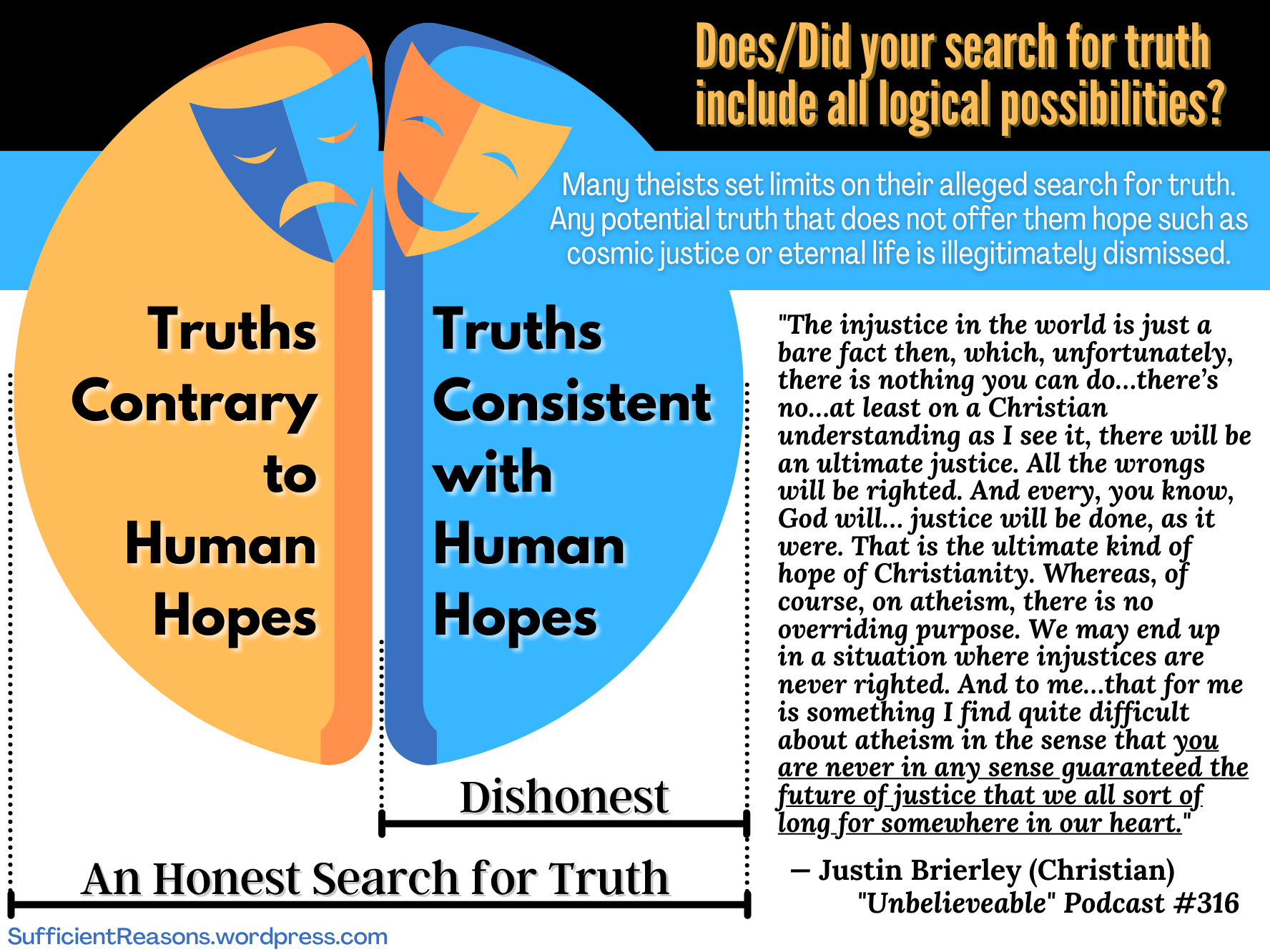
In the quest for truth, humans often navigate a treacherous terrain marked by emotional biases, existential fears, and a tendency to conflate hope with reality. This process, described here as a “hemispheric search for truth,” reflects a fundamentally flawed approach to understanding the world. By favoring truths that align with human hopes and dismissing those that contradict them, many seekers compromise the integrity of their inquiries. This essay explores the dangers of a hemispheric search for truth, the deceitful tactics used to promote hope-driven belief, and the critical need for honest, comprehensive truth-seeking.
The Hemispheric Divide in Truth-Seeking
The hemispheric search for truth divides potential truths into two categories: truths contrary to human hopes and truths consistent with human hopes. The first category includes unsettling possibilities, such as the absence of an afterlife, the indifference of the universe, or the lack of ultimate justice. The second encompasses comforting notions, such as eternal life, divine justice, or cosmic purpose. While truths consistent with human hopes often bring solace, prioritizing them over contrary truths skews the process of inquiry, leading to incomplete and dishonest conclusions.

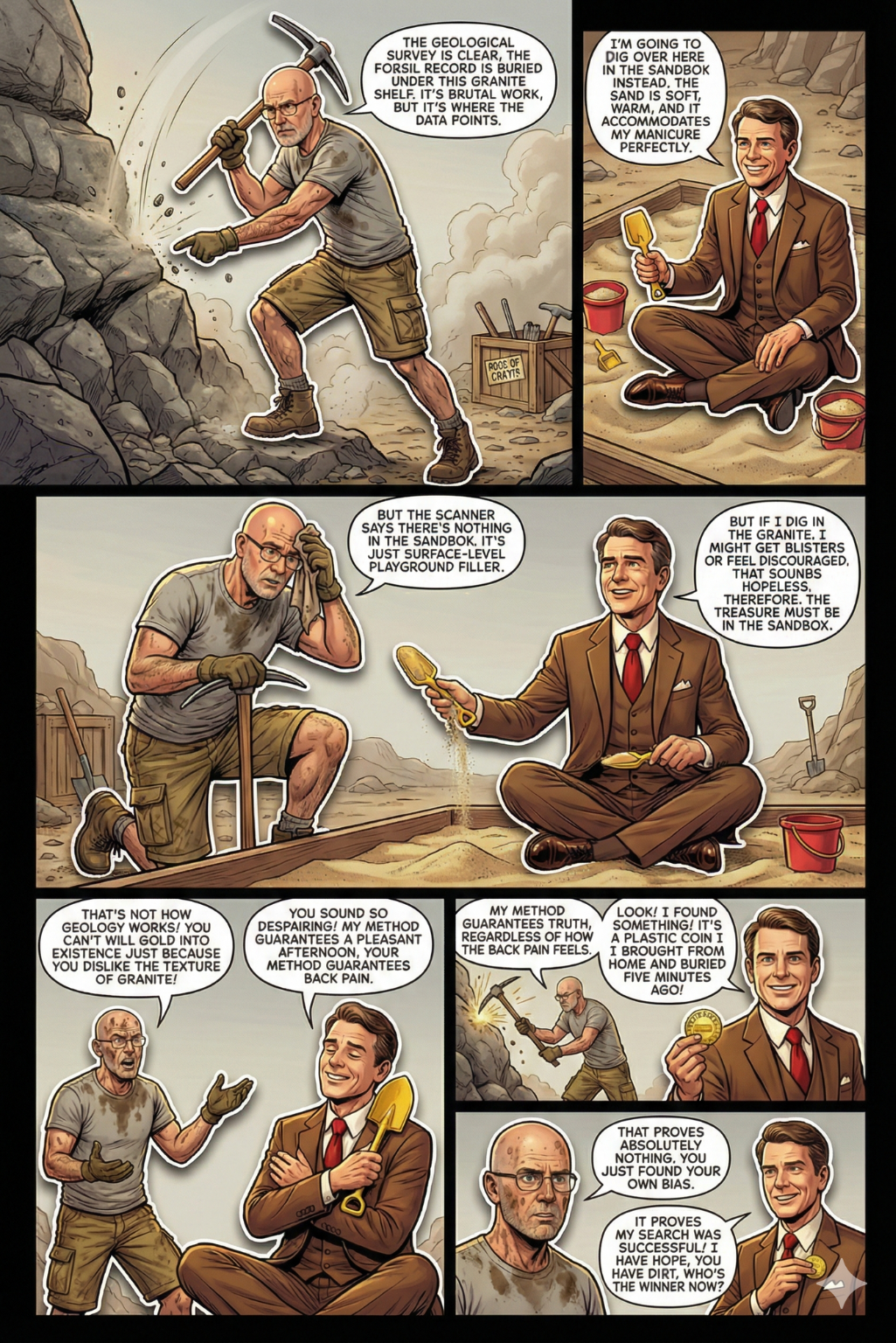
Imagine searching for buried treasure on an island. If you only dig in areas that look pleasant and ignore rough or difficult terrain, you may never find the treasure. Similarly, excluding truths because they feel uncomfortable leaves seekers trapped in an intellectual echo chamber, exploring only the “pleasant” areas of possibility while neglecting the full scope of reality.
The Dangers of Excluding Uncomfortable Truths
The exclusion of uncomfortable truths carries profound risks, both individually and societally. A hemispheric search for truth leads to intellectual stagnation, vulnerability to error, and a distorted understanding of reality.
- Intellectual Stagnation: By avoiding challenging truths, seekers miss opportunities for growth. For example, embracing the possibility that life lacks inherent meaning can lead to a richer, self-constructed sense of purpose. Avoiding such possibilities, however, traps individuals in a comfort zone that stifles personal and intellectual development.
- Vulnerability to Error: Excluding certain possibilities increases the likelihood of forming false conclusions. For instance, rejecting scientific explanations of the universe in favor of religious narratives risks clinging to unfounded beliefs, as history has demonstrated with resistance to heliocentrism and evolutionary theory.
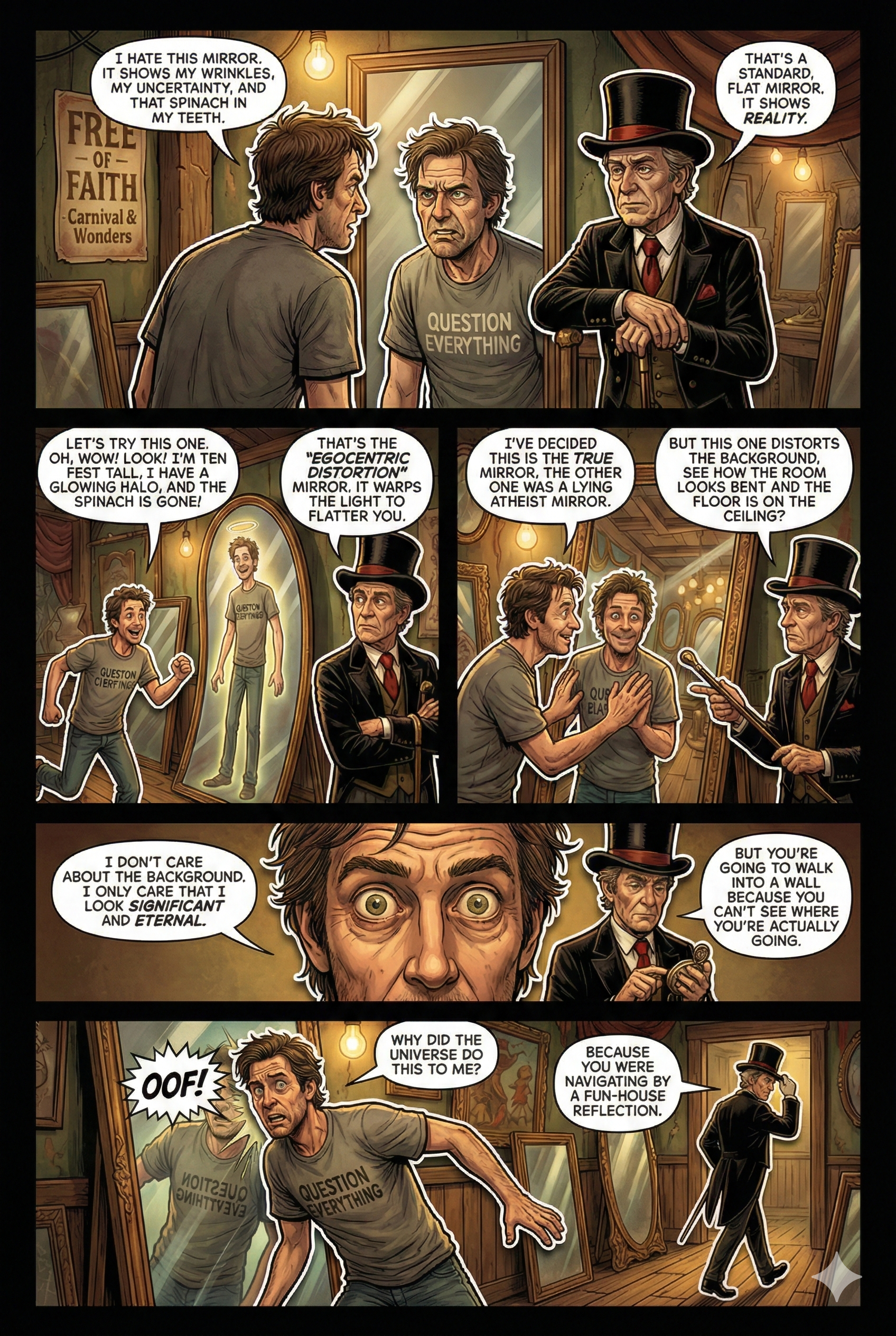
- Distorted Reality: Selective inquiry creates a biased worldview. If seekers only entertain ideas that affirm their hopes, they construct an intellectual house of mirrors, where every reflection confirms their desires rather than challenging their assumptions.
The Role of Theism in Promoting Hope-Driven Belief
Theists often exploit the hemispheric search for truth by encouraging seekers to align reality with their hopes. Through a variety of tactics, they manipulate emotional vulnerabilities, discourage skepticism, and promote belief systems that prioritize comfort over evidence.
- Equivocation Between Desire and Reality: Theists frequently argue that human longings, such as the desire for justice or immortality, are evidence of their existence. This is akin to saying that hunger proves the existence of a feast or that wishing for rain ensures it will fall. While desires often reflect needs, they are not evidence of reality.
- Exploitation of Existential Anxiety: Fear of death and meaninglessness is fertile ground for religious manipulation. Theists often present religion as the sole antidote to these fears, offering heaven as a reward and hell as a threat. This tactic preys on seekers’ vulnerabilities, substituting emotional coercion for rational inquiry.
- Appeal to Consequences: Another deceitful strategy is the appeal to consequences fallacy, which suggests that a belief’s desirability proves its truth. For example, the claim that “without God, life would be meaningless” conflates the emotional comfort of belief with its validity, ignoring the possibility of secular meaning.
- Social Pressures: Theists often leverage community dynamics to enforce conformity. By portraying non-believers as outsiders or morally deficient, they pressure seekers to accept religious doctrines for fear of isolation.
The Psychological Mechanisms Behind Hope-Driven Belief
The tendency to prioritize hopeful truths over uncomfortable ones is deeply rooted in human psychology. Cognitive biases, such as confirmation bias (favoring information that supports preexisting beliefs) and motivated reasoning (justifying conclusions that align with desires), reinforce the hemispheric search for truth. Emotional blackmail, such as the fear of hell or guilt for questioning faith, further discourages critical thinking.
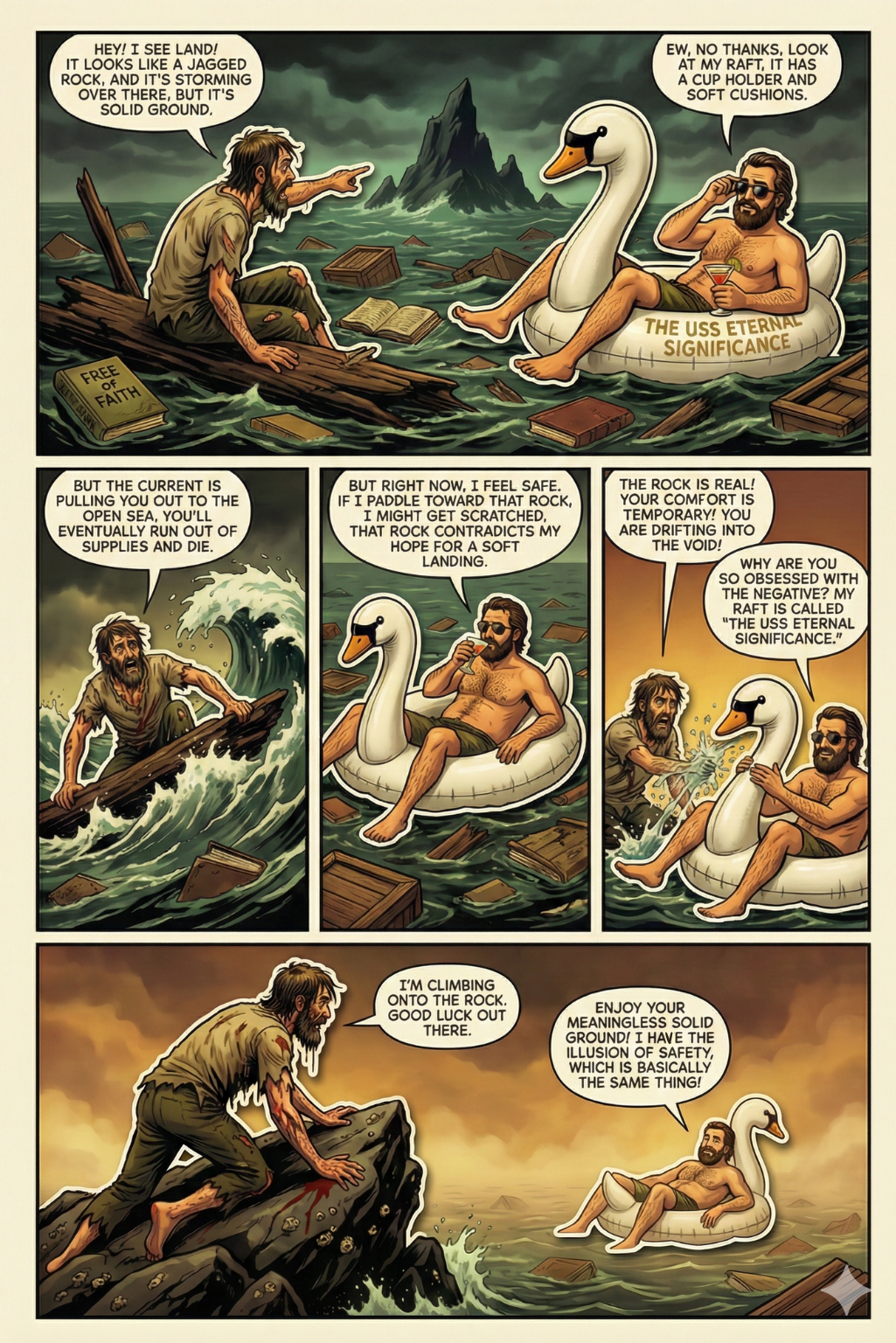
An apt analogy is a person clinging to a life raft in turbulent waters. While the raft provides temporary comfort, it may drift further from shore, prolonging the struggle. Similarly, hope-driven belief offers immediate emotional solace but often steers seekers away from the stable ground of reality.
Syllogisms Highlighting the Dangers
The following syllogisms illustrate the epistemic and practical risks of the hemispheric search for truth:
- The Incompleteness of Selective Inquiry:
- P1: A search for truth that excludes logical possibilities is incomplete.
- P2: A hemispheric search for truth excludes truths contrary to human hopes.
- Conclusion: Therefore, a hemispheric search for truth is incomplete.
- The Dishonesty of Hope-Driven Belief:
- P1: Belief based on emotional comfort rather than evidence is epistemically dishonest.
- P2: A hemispheric search for truth prioritizes emotional comfort over evidence.
- Conclusion: Therefore, a hemispheric search for truth is epistemically dishonest.
- The Danger of Exclusion:
- P1: Excluding certain possibilities increases the risk of arriving at false conclusions.
- P2: A hemispheric search for truth excludes truths contrary to human hopes.
- Conclusion: Therefore, a hemispheric search for truth increases the risk of false conclusions.
The Need for Honest Truth-Seeking
A genuine search for truth requires epistemic humility and a willingness to confront discomfort. Seekers must evaluate all possibilities, including those that challenge their desires or assumptions. This means prioritizing evidence, engaging with diverse perspectives, and embracing intellectual courage.
An honest search for truth can be compared to assembling a puzzle. If certain pieces are excluded because they are “ugly” or “inconvenient,” the final picture will remain incomplete. Only by considering all pieces—regardless of their aesthetic appeal—can seekers form an accurate understanding of the whole.
Conclusion: Breaking Free from Hope-Based Illusions
The hemispheric search for truth, driven by the deceitful tactics of hope-based belief, undermines the integrity of intellectual inquiry. By conflating desire with evidence and exploiting emotional vulnerabilities, it leads individuals away from reality and into a distorted worldview. To break free, seekers must reject the allure of comforting illusions and commit to a rigorous, comprehensive exploration of truth. Reality, as harsh or unsettling as it may seem, is far more valuable than the comforting mirage of hope-driven belief. Only by embracing the totality of possibilities can humanity achieve a deeper, more authentic understanding of existence.




The Ubiquity of Hope-Based Arguments among Christian Apologists:
➘ William Lane Craig
“Without God, man and the universe are doomed. Like prisoners condemned to death, we await our unavoidable execution. If life ends at the grave, then it makes no ultimate difference whether you existed or not.” — Reasonable Faith
“If life ends at the grave, then it makes no ultimate difference whether you ever existed at all. It makes no difference whether you are a saint or a murderer. The contributions of scientists to the advance of human knowledge, the researches of doctors to alleviate pain and suffering, and the sacrifices of men to better the lot of the poor—they all come to nothing.” — The Absurdity of Life Without God
➘ Ravi Zacharias
“The world without Christ is a world without hope.” — Jesus Among Other Gods
“Outside of Christ, I am weak; in Christ, I am strong. Outside of Christ, I am lost; in Christ, I am found. Outside of Christ, I am without; in Christ, I am full.” — Sermon quote
➘ John Lennox
“Atheism is a hopeless faith. It says that the mind that produced Einstein was ultimately the product of mindless matter. It gives no basis for hope, value, or meaning.” — Debate with Richard Dawkins
“If there is no God, death is the end. And if death is the end, life has no ultimate purpose.” — God’s Undertaker
➘ Timothy Keller
“Without God, our sense of meaning and satisfaction is just an illusion created by our genes to get us to cooperate. There is no real future, no hope.” — The Reason for God
“If the resurrection of Jesus Christ really happened, then ultimately there is hope for everything. If it didn’t happen, then there is no hope for anything.” — The Reason for God
➘ Alister McGrath
“Atheism robs life of ultimate meaning and value. It offers no hope of redemption, only despair.” — The Twilight of Atheism
“Christian faith offers not only a rational account of the universe but also a vision of hope that makes sense of our deepest longings.” — Surprised by Meaning
➘ Francis Schaeffer
“Modern man has no hope. He sees no reason for his existence. He cannot tell himself he is here for any purpose.” — The God Who Is There
“Without God, man is left with despair. Christianity alone gives hope in the face of the absurd.” — Escape from Reason
➘ Norman Geisler
“If there is no God, then life is nothing more than a series of painful and meaningless experiences that end in death.” — Christian Apologetics
“The atheist cannot live consistently with his worldview. He must borrow meaning, hope, and morality from the Christian worldview.” — Lecture note
➘ Josh McDowell
“Without Christ, we are all without hope—lost in the despair of our sin.” — Evidence That Demands a Verdict
“An atheist may say he has hope, but it is an illusion. Real hope is grounded in the promises of God.” — Sermon quote
➘ Lee Strobel
“If atheism is true, then we are nothing but cosmic accidents, destined to live a few years and then die forever. Christianity alone offers hope beyond the grave.” — The Case for Faith
“Hope is what Christianity gives. Atheism is hopeless.” — Interview remark
➘ N. T. Wright
“Take away the resurrection, and you are left with despair. Death wins. Hope evaporates. But with the resurrection, God’s new world has begun.” — Surprised by Hope
“The message of Easter is that God’s new world has been unveiled in Jesus Christ and that you are invited to belong to it. Without this, there is no ultimate hope.” — Surprised by Hope
The Free of Faith Companion Podcast Episode:


 Free of Faith
Hi Christopher, I just sent you a response by email. Cheers.