
The Wall of Faith and Selective Blindness:
A Critical Examination of Epistemic Barriers
Introduction
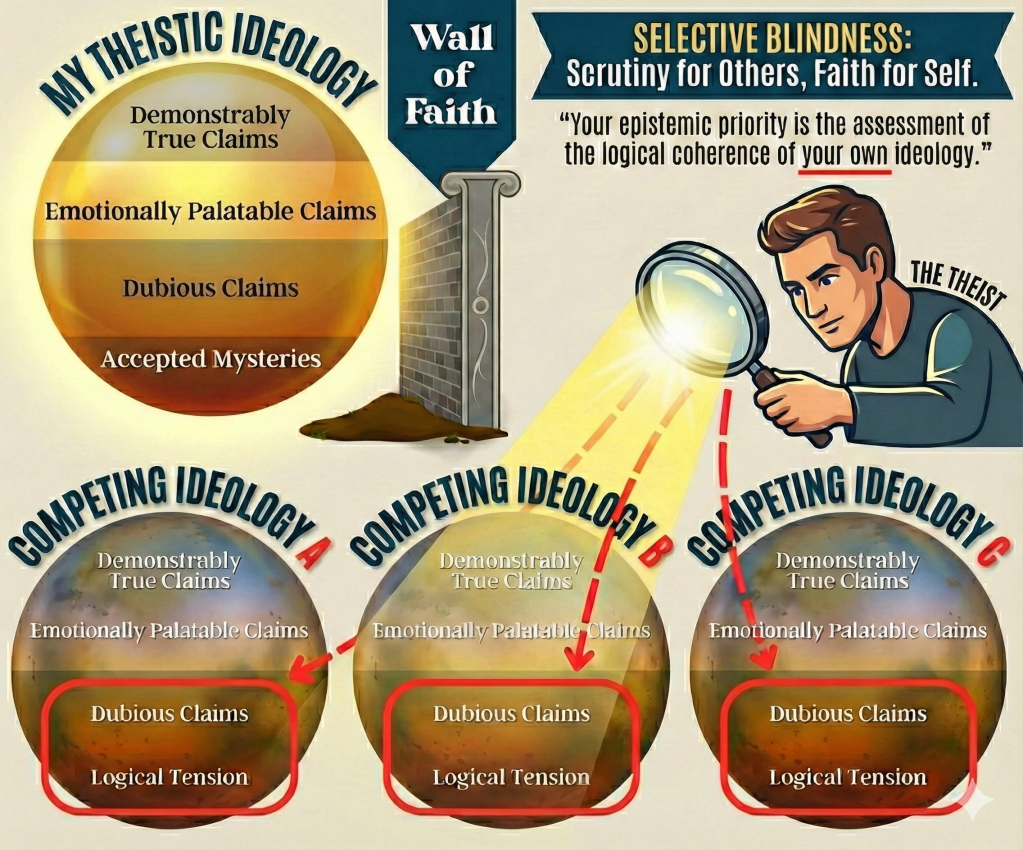
The image above illustrates a cognitive and epistemic phenomenon in which faith serves as a barrier that filters information selectively. This barrier allows demonstrably true claims to pass through while blocking logical tensions and dubious claims from scrutiny. The diagram suggests that the adherent’s selective blindness ensures that problematic elements of their belief system remain unexamined, reinforcing an emotionally palatable narrative while shielding faith-based claims from rational critique. This essay will explore the logical, epistemic, and psychological dimensions of this model.
Logical Aspects: The Structure of Cognitive Filtering
At the core of the image is an epistemic hierarchy within a belief system:
- Demonstrably True Claims – Assertions that have empirical support and logical coherence.
- Emotionally Palatable Claims – Beliefs that may not be fully supported by evidence but are psychologically comforting.
- Dubious Claims – Assertions that lack strong evidence and may contain contradictions.
- Logical Tensions – Fundamental inconsistencies or contradictions within the belief system.
The Wall of Faith acts as a gatekeeper that allows believers to accept demonstrably true claims but shields them from acknowledging logical tensions and dubious claims. This leads to confirmation bias, where only beliefs that reinforce an established worldview are allowed through.
A key logical problem with this setup is that it violates epistemic consistency. Rational inquiry requires the systematic evaluation of all claims based on their merit, yet faith constructs an arbitrary filter that selectively admits claims that align with preexisting beliefs. This results in an epistemic asymmetry: faith-based adherents demand high standards for evidence that challenges their worldview while accepting weaker evidence that supports it.
Epistemic Aspects: Justification and Belief Segregation
The epistemic failure illustrated in the image stems from an improper application of epistemic justification. Faith-based epistemologies often conflate emotional conviction with rational justification, leading to the following issues:
- Selective Standards of Evidence
- The believer applies a rigorous standard of scrutiny to counterclaims while relaxing scrutiny for emotionally palatable beliefs.
- This is a form of motivated reasoning, where evidence is assessed not for its objective merit but for its compatibility with existing beliefs.
- Compartmentalization of Doubt
- The image suggests three different epistemic responses (labeled A, B, and C). Each involves different degrees of awareness suppression:
- (A) Avoidance: Doubt is immediately redirected back into the emotionally palatable framework.
- (B) Cognitive Dissonance Management: Dubious claims and logical tensions are reinterpreted to reduce discomfort.
- (C) Deflection: Instead of confronting logical problems, the believer shifts focus to unrelated aspects of their belief system.
- The image suggests three different epistemic responses (labeled A, B, and C). Each involves different degrees of awareness suppression:
- The Problem of Epistemic Isolation
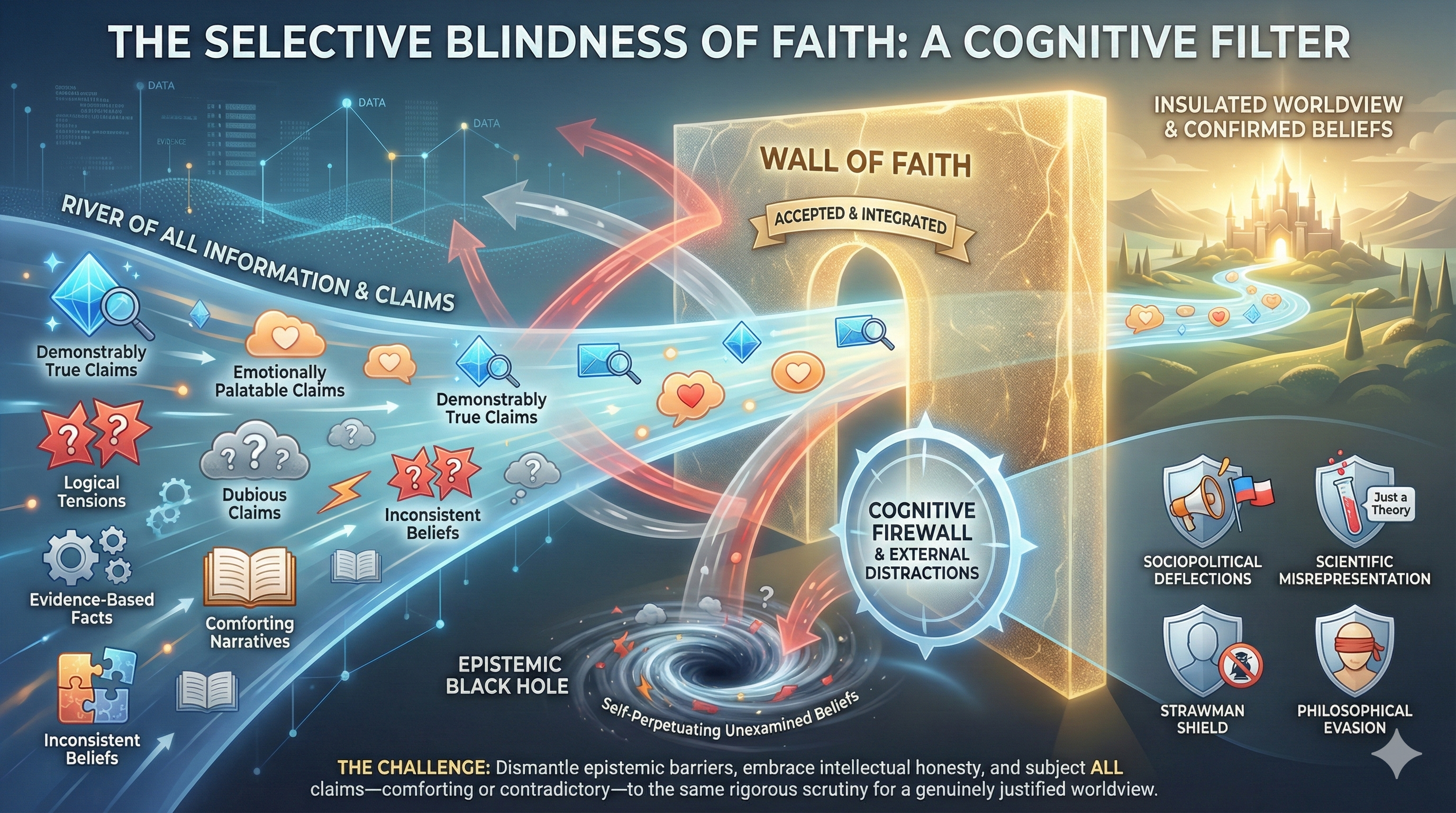
- The Wall of Faith serves as a cognitive firewall that isolates contradictory beliefs from rational scrutiny.
- This is particularly problematic because it creates an epistemic black hole where false beliefs self-perpetuate without exposure to corrective mechanisms.
The intellectual integrity of any worldview depends on its openness to self-correction. By constructing a Wall of Faith, adherents limit their ability to engage in rational self-revision, a key feature of any robust epistemology.
Psychological Aspects: Emotional Security vs. Intellectual Honesty
Faith is often sustained not by reason but by emotional reinforcement. The psychological mechanisms at play include:
- Cognitive Dissonance Avoidance
- When an individual encounters evidence that contradicts their beliefs, they experience psychological discomfort.
- Instead of reevaluating their belief system, they may choose selective blindness, ignoring or rationalizing disconfirming evidence.
- Identity Investment in Belief
- Faith-based worldviews are often interwoven with personal identity, making it psychologically costly to abandon them.
- This leads to identity-protective cognition, where believers reject counterevidence to preserve their sense of self.
- Social Reinforcement and Groupthink
- Faith communities often reward conformity and punish dissent.
- This creates a social cost for questioning beliefs, further reinforcing epistemic closure.
Conclusion: Overcoming the Wall of Faith
The epistemic structure outlined in the image reveals a fundamental tension between rational inquiry and faith-based belief systems. To engage in genuine truth-seeking, individuals must be willing to dismantle their epistemic barriers and subject all claims—whether comforting or uncomfortable—to the same standard of scrutiny.
The antidote to the Wall of Faith is intellectual honesty, epistemic humility, and rigorous critical thinking. Only by embracing a methodology that prioritizes evidence over emotion and rational consistency over ideological insulation can one cultivate an authentically justified worldview.
Misguided Foci of Theists:
Distractions from Self-Assessment
Theists often divert their attention to external problems rather than critically evaluating the internal contradictions and epistemic weaknesses of their own beliefs. While some of the issues they focus on are genuine concerns, the primary problem is not the existence of these issues but the way they are used to avoid introspection. This diversionary tactic serves to maintain belief structures that might otherwise collapse under scrutiny.
Below is a comprehensive list of misguided foci that theists often emphasize, categorized into sociopolitical, scientific, philosophical, and psychological distractions.
1. Sociopolitical Distractions
These are issues that, while often legitimate problems, serve as convenient scapegoats for why society is in decline rather than prompting a reassessment of religious assumptions.
A. Social Problems Attributed to Competing Ideologies
- Secularism as Moral Decay – The claim that removing religious influence leads to societal collapse, ignoring how secular nations often have lower crime rates and higher well-being.
- Atheism as Nihilism – Suggesting that disbelief in God inevitably leads to meaninglessness and despair, rather than considering non-theistic frameworks of purpose.
- Materialism as Dehumanizing – Misrepresenting materialism as reducing humans to ‘just atoms’ while failing to acknowledge its role in scientific progress.
- Marxism and Communism as Atheist Threats – Overgeneralizing failed atheist regimes as proof that non-belief itself leads to authoritarianism, while ignoring the theocratic regimes that have been equally oppressive.
- LGBTQ+ Movements as a Sign of Cultural Collapse – Framing increasing social acceptance of gender and sexual minorities as a symptom of declining religious values rather than a movement toward human rights.
B. Weak Political Positions of Opponents
- Leftist Hypocrisies Overlooked – Focusing on contradictions within leftist movements while failing to address theological inconsistencies.
- Progressivism as a New Religion – Painting progressive activism as a religious movement to imply it is just another faith-based belief, while refusing to acknowledge that their own beliefs lack empirical grounding.
- Science Used for Political Agendas – Highlighting misuses of science by politicians (e.g., COVID-19 policy debates) to justify skepticism toward all scientific findings, including well-established ones like evolution.
- The “War on Christmas” Narrative – Claiming religious persecution over trivial issues like store greetings while ignoring actual discrimination faced by minority religious groups.
- Victimhood Complex in Religious Politics – Overstating how Christians are supposedly persecuted in secular societies while overlooking the privileges they maintain.
C. Cultural and Media Distractions
- Hollywood as an Anti-Christian Force – Blaming entertainment industries for corrupting society, while ignoring the prevalence of religious messaging within culture.
- Social Media as an Atheist Echo Chamber – Claiming that online platforms suppress religious expression, while overlooking how religious communities enforce ideological purity through social and familial pressure.
- Postmodernism as the Death of Truth – Misusing critiques of postmodernism to reject philosophical and scientific advancements rather than refining theological epistemology.
2. Scientific Misunderstandings and Misrepresentations
Religious apologists frequently attack poorly communicated or pseudoscientific ideas rather than engaging with the strongest arguments from science.
A. Pseudoscience as a Scapegoat
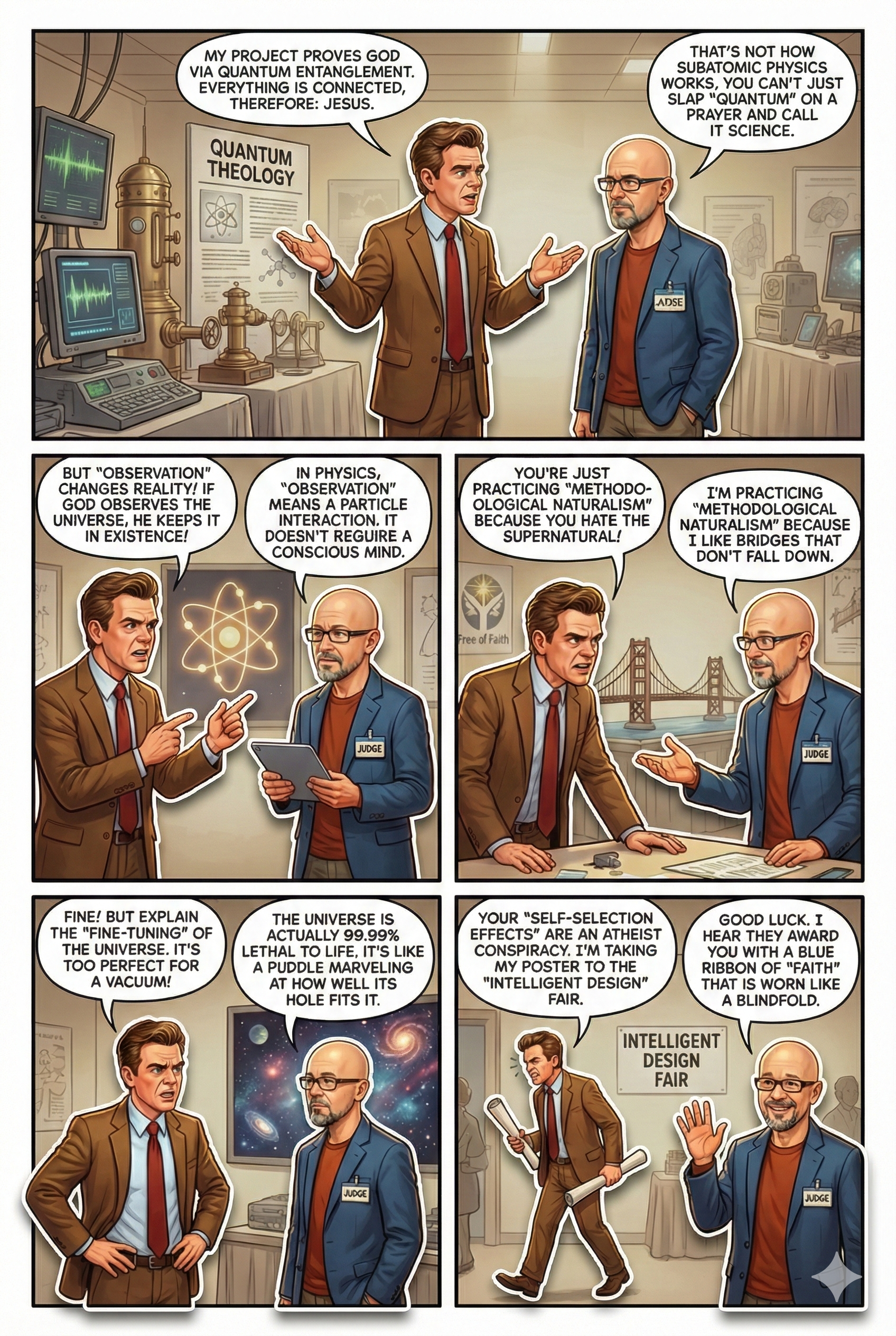
- Evolution as “Just a Theory” – Misrepresenting scientific terminology to cast doubt on well-supported explanations of biodiversity.
- Big Bang as an Atheist Conspiracy – Claiming that cosmology is designed to exclude God, ignoring that a Catholic priest (Georges Lemaître) developed the theory.
- Conflating Methodological Naturalism with Metaphysical Naturalism – Suggesting that science’s exclusion of supernatural causes is ideological rather than practical.
- Intelligent Design as Scientific Suppression – Arguing that ID is unfairly silenced rather than recognizing it as religiously motivated pseudoscience.
B. Cherry-Picked or Misused Science
- Quantum Mechanics as Proof of God – Abusing Heisenberg’s uncertainty principle or wave-function collapse to suggest divine intervention.
- Fine-Tuning as Irrefutable Evidence – Ignoring alternative explanations such as the multiverse hypothesis or self-selection effects.
- Irreducible Complexity as Evolution’s Kryptonite – Repeatedly invoking discredited arguments like bacterial flagella to cast doubt on evolutionary processes.
- Abiogenesis as Impossible – Asserting that life’s origin is too improbable to happen naturally without understanding statistical and chemical models.
- Near-Death Experiences as Proof of the Afterlife – Ignoring neurological explanations in favor of supernatural interpretations.
3. Philosophical Missteps
Instead of engaging with the best critiques of theism, believers often focus on weak or misunderstood arguments.
A. Strawman Arguments Against Atheism
- Atheism is a Faith Too – Falsely equating lack of belief with dogmatic certainty.
- No Objective Morality Without God – Ignoring well-developed secular moral frameworks.
- Pascal’s Wager as a Knockout Argument – Failing to consider the problem of competing religions and the wager’s flawed assumptions.
- The Transcendental Argument for God (TAG) as Unassailable – Claiming that logic itself requires a divine grounding without acknowledging that logic arises from observed regularities.
B. Avoidance of Theological Incoherence
- Omnipotence and Omnibenevolence Contradictions – Instead of addressing the problem of suffering, theists often redirect to social or political issues.
- The Trinity as an Unquestionable Mystery – Expecting acceptance of contradictions under the guise of divine incomprehensibility.
- Prayer as a Reliable Mechanism – Ignoring empirical studies showing no measurable effect of intercessory prayer.
4. Psychological Tactics and Motivations
Theists often rely on cognitive biases and rhetorical strategies that deflect from the internal epistemic problems within faith-based belief systems.
A. Emotional Appeals
- Religion as Necessary for Hope and Meaning – Suggesting that without faith, life has no value, rather than considering secular existential fulfillment.
- Fear of Hell as a Justified Concern – Using Pascalian fear rather than addressing the likelihood of divine judgment rationally.
- God-Shaped Hole in the Human Heart – Assuming that any deep longing must imply the existence of God rather than psychological or cultural conditioning.
B. Tribalism and Social Reinforcement
- Religious Identity as a Community Anchor – Focusing on how faith provides social cohesion rather than whether its claims are true.
- Martyrdom as Validation – Believing persecution or opposition automatically confirms religious truth rather than engaging with the legitimacy of criticism.
- Faith as a Virtue – Reframing belief without evidence as a moral strength rather than an epistemic weakness.
Conclusion: The Real Problem
Many of the issues listed above are real social, political, and scientific problems. However, the primary concern is not their existence but their function—they serve as distractions that prevent believers from examining their own assumptions critically.
Rather than confronting internal contradictions, theists often externalize blame, targeting atheism, secularism, progressivism, or scientific authority as threats rather than assessing the weaknesses of their theological foundations. True intellectual honesty demands that one apply the same level of scrutiny to one’s own beliefs as one does to competing worldviews. Until faith-based adherents are willing to do so, they will remain trapped behind the Wall of Faith, filtering reality through selective blindness rather than genuine rational inquiry.
Encouraging Honest Theists to Engage in Self-Assessment
For the theist who genuinely values truth over comfort, a meaningful path forward involves honest self-examination of their own belief system. Instead of focusing solely on the perceived flaws of secular worldviews or competing ideologies, they should apply the same critical rigor to their own faith. This means confronting difficult questions, examining internal contradictions, and testing whether their beliefs hold up under scrutiny.
A powerful resource for this endeavor is the 52 Considerations found at Free of Faith. These considerations offer systematic, structured challenges designed to help theists critically evaluate the assumptions underlying their beliefs. Engaging with them in good faith requires:
- Intellectual Honesty – Being willing to explore where one’s beliefs might be weak, rather than merely seeking to reinforce them.
- Consistency in Scrutiny – Applying the same level of skepticism to religious claims as one would apply to political, scientific, or historical assertions.
- Openness to Change – Recognizing that if a belief is false, rejecting it is a virtue, not a failure.
Some of the core themes covered in the 52 Considerations include:
- Epistemic Justification – How do you differentiate between faith-based claims and testable truths?
- Logical Consistency – Do divine attributes (e.g., omniscience and free will) create contradictions?
- Historical Credibility – How reliable are religious texts compared to other ancient writings?
- The Problem of Suffering – Can an omnipotent, omnibenevolent God coexist with unnecessary suffering?
- Psychological and Social Conditioning – Would you still believe if you had been raised in a different religious culture?
- Scientific Conflicts – How does faith reconcile with well-established scientific findings?
By engaging with these questions deeply and without deflection, the honest theist can assess whether their beliefs are maintained through rational justification or selective blindness. Rather than relying on comforting narratives and external distractions, they can pursue an authentically reasoned worldview—wherever the evidence may lead.





 Free of Faith
Leave a comment