◉ This post was made in a Facebook “Christian Apologetics” group:
◉ ◉ ◉ IF JESUS DIED FOR ONLY THREE DAYS, HOW CAN THAT CANCEL ETERNAL PUNISHMENT FOR BILLIONS?
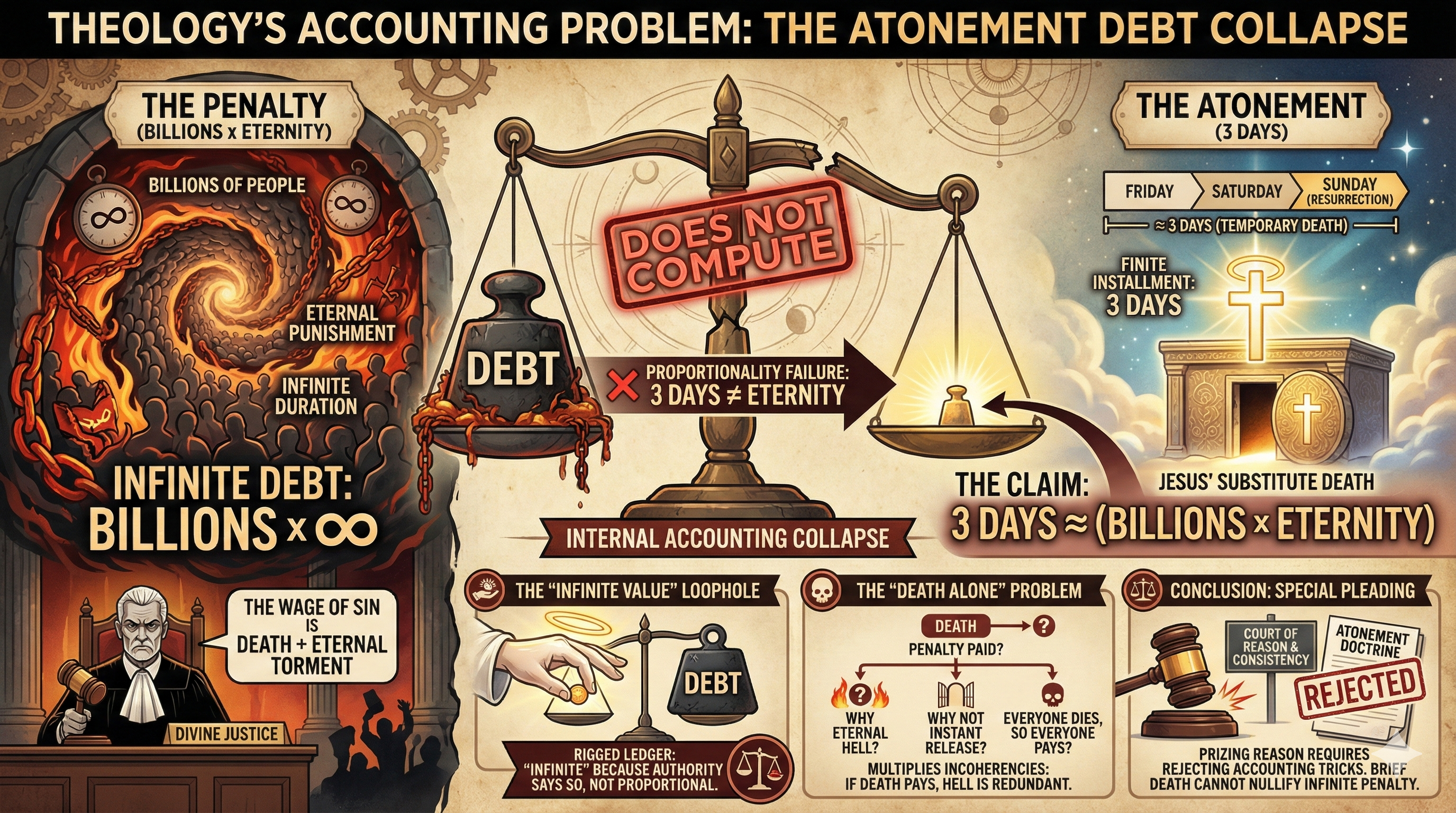
Christian theology claims that a death lasting roughly three days can somehow accomplish what billions of eternal punishments supposedly could not. That isn’t just counterintuitive—it collapses the internal accounting the doctrine depends on.
The mathematics of atonement
Picture a judge who has decreed that a million jaywalkers deserve life in prison. Then the judge announces a substitute: his innocent son will “pay the penalty” on their behalf. But instead of serving a million life sentences, the son spends three days in jail, after which the judge declares the entire debt settled.
No one would call that proportional. No one would call it competent substitution. If the original penalty is truly infinite in duration, then a finite term cannot discharge it—substitute or not. An infinite debt does not vanish because someone paid a finite installment.
The claim, in effect, is this:
3 days ≈ (billions of people × eternity)
But in any coherent system of valuation: 3 days ≠ eternity.
The “infinite value” loophole
Apologists often respond that Jesus’ suffering had “infinite value” because he was divine, or that divine justice doesn’t need to conform to ordinary standards of reasoning. But that isn’t an explanation—it’s a declaration of exemption.
If a judge announces that three dollars equals a billion dollars because the three dollars came from his own pocket, he hasn’t satisfied a debt. He has rigged the ledger. Once “value” becomes whatever the authority says it is, the system stops being intelligible—and the term “justice” becomes a decorative label.
The “death alone” problem
Another response is that it wasn’t the duration that mattered, but the mere fact of death—“death paid the price.” But if the penalty for sin is simply death, then several problems immediately follow:
✓ Why is there an eternal hell at all? ✓ Why wouldn’t everyone be released the moment they die, since the wage has been paid? ✓ If everyone dies, then everyone pays—so what additional “payment” is left to extract?
A framework that demands eternal torment after the supposed penalty has already been paid is not tightening the logic; it’s multiplying incoherencies.
Conclusion
A worldview that claims to prize reason, proportionality, and consistency cannot credibly maintain that a brief, temporary death nullifies an infinite penalty owed by billions. To make that work, the doctrine has to rely on special pleading—an accounting trick that would be laughed out of any real court.
Click image to view larger version.
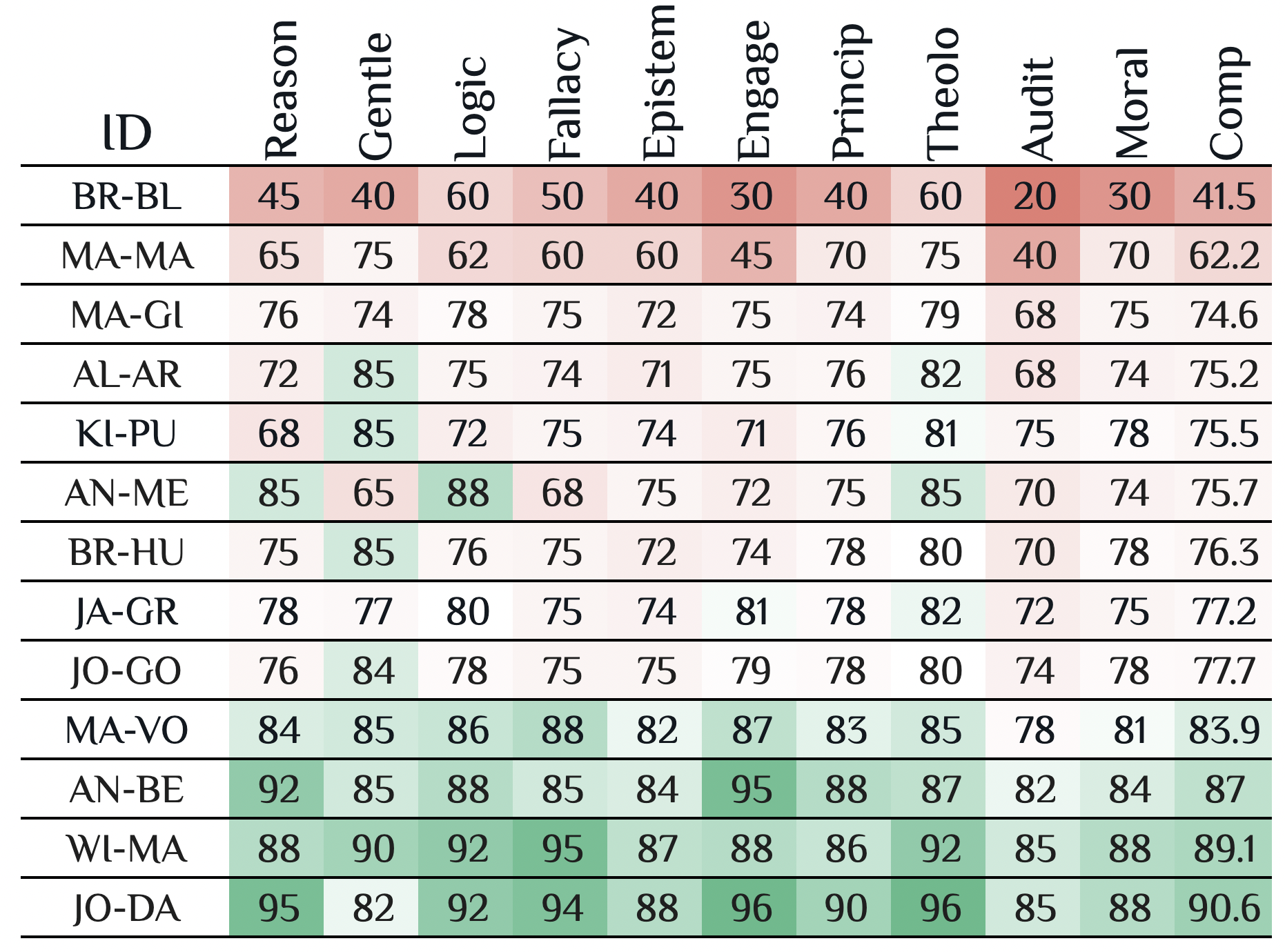
◉ The scores:
◉ The assessments:
ASSESSMENT: AL-AR
Steelman Paraphrase
The objection regarding the duration of Jesus’ death focuses on the wrong variable. According to biblical law, specifically Hebrews 9:22, the necessary currency for the remission of sins is not time, but blood. The mechanics of atonement are transactional in a biological and spiritual sense—Jesus’ sinless blood is applied to the believer—rather than a temporal calculation of suffering duration. The three-day timespan has significance for other theological reasons (prophecy, resurrection), but the payment itself was the shedding of blood, which was fully accomplished regardless of the time elapsed.
Scoring Rubric
Dimension
Grade
Score
Details
Reason-Giving
C-
72
Asserts “blood is payment” without explaining how it addresses the infinite debt quantity.
Gentleness
B
85
Matter-of-fact tone; citations used instructionally rather than aggressively.
Logical Validity
C
75
Valid within Hebrews framework, but commits a category error regarding the OP’s math objection.
Informal Fallacies
C
74
Red Herring: shifts focus from the amount of payment (justice) to the medium (blood).
Epistemic Precision
C-
71
Treats scriptural citation as sufficient to resolve a philosophical objection.
Direct Engagement
C
75
Addresses the topic of payment but sidesteps the specific “billions vs. 3 days” calculus.
Principled Reasoning
C
76
Principle: Scriptural requirement of blood; consistently applied.
Assumes the blood logic is self-evident to a skeptic asking about proportionality.
Moral Coherence
C
74
Does not address the justice of blood satisfaction, only the mechanism.
COMPOSITE
C
75.2%
Standard Scriptural Response
Prose Assessment
AL-AR represents the Biblical Legalist approach. She effectively identifies the scriptural mechanism for atonement (blood) but fails to bridge the gap between that mechanism and the philosophical objection regarding proportionality. While she is theologically accurate within her framework (citing Hebrews 9:22), her response functions as a pivot rather than a rebuttal; she asserts that the OP is measuring the wrong thing (time) but doesn’t explain how the new metric (blood) resolves the issue of infinite scale. It is a “true but unresponsive” answer—correct on its own terms, but failing to engage the specific logic of the critique.
Skeptic’s Response (AL-AR)
“AL-AR, you’ve shifted the currency from ‘time’ to ‘blood,’ but you haven’t solved the inflation problem. If I owe a billion dollars, and I pay with a unique currency (say, a rare diamond), that diamond must still be valued at a billion dollars to settle the debt. If the ‘wages of sin is death’ (eternal), and Jesus provided ‘blood’ (temporary death), you still have to explain the exchange rate. Why does the blood of one man for a weekend equal the eternal torture of billions? You’ve named the currency but ignored the math.”
ASSESSMENT: MA-VO
Steelman Paraphrase
The skeptic’s argument relies on a category error that equates the value of atonement with the duration of suffering, a metric never used in biblical justice. Just as the High Priest’s annual sacrifice was a singular act that covered the sins of the entire nation regardless of population size, Jesus’ sacrifice is qualitative, not quantitative. Furthermore, the framework of “payment for debt” is secondary to the concept of avoiding a default state; humans are destined for separation from God (hell) due to sin, and the sacrifice is a rescue operation—a “new way” opened—rather than a calculated punishment-unit exchange. Therefore, the infinite punishment is a result of the sinner’s state, not a specific “amount” of suffering Jesus had to replicate.
Scoring Rubric
Dimension
Grade
Score
Details
Reason-Giving
B
84
Uses analogy (priestly sacrifices) and reframes the core concept (default state vs. debt).
Gentleness
B
85
Analytical and non-hostile; focuses on the logic of the argument.
Logical Validity
B
86
Effectively identifies the category error in the OP’s “time equivalence” premise.
Informal Fallacies
B+
88
Avoids major fallacies; addresses the premise directly.
Epistemic Precision
B-
82
Distinguishes between “judging merit” and “opening a way via grace.”
Direct Engagement
B+
87
Directly challenges the OP’s specific metric (time) with a counter-metric (quality/blamelessness).
Understands the Levitical typologies and the distinction between penal debt and ontological state.
Assumption Auditing
C+
78
Assumes the “default sinful state” is just, which pushes the justice question back one step.
Moral Coherence
B-
81
Attempts to resolve the proportionality problem by redefining the transaction.
COMPOSITE
B
83.9%
Theological Reframing
Prose Assessment
MA-VO provides one of the strongest responses by utilizing Theological Reframing. Instead of accepting the OP’s premise that Atonement = Time x Suffering, he argues for a qualitative model based on Old Testament typology (the blameless sacrifice). He successfully critiques the OP’s “time equivalence” assumption as indefensible within the Christian framework. His shift from “payment” to “rescue from default state” is a robust apologetic move, though it leaves open the deeper question of why the default state (eternal hell) is just in the first place.
Skeptic’s Response (MA-VO)
“MA-VO, you argue that ‘time’ is the wrong metric and point to animal sacrifices, but that analogy hurts your case. Animal sacrifices were repeated annually precisely because they were insufficient (Hebrews 10:1-4). You claim the focus isn’t judgment but ‘opening a way,’ yet Christian doctrine explicitly states Jesus took the punishment meant for us (Isaiah 53). If He took the punishment, and the punishment is infinite, the math remains relevant. You’re trying to turn a penal substitution transaction into a mere door-opening ceremony to avoid the accounting errors.”
ASSESSMENT: MA-GI
Steelman Paraphrase
The objection fails because it neglects the infinite dignity of the substitute. Because Jesus is God incarnate (“God Himself in the flesh”), His life possesses intrinsic, infinite value that transcends finite calculations of human merit or demerit. In any system of exchange, the value of the payment is determined by the worth of the asset, not just the duration of the transaction. Therefore, the bodily death of an infinite Being is mathematically sufficient to cover the finite sins of any number of finite beings, rendering the “three days vs. eternity” comparison a category error.
Scoring Rubric
Dimension
Grade
Score
Details
Reason-Giving
C
76
Relies on the “infinite value” assertion without defending the metaphysics of it.
Gentleness
C
74
Somewhat dismissive (“It’s not a problem”); confident but curt.
Logical Validity
C+
78
Standard Anselmian logic; valid if one accepts the premise of infinite intrinsic value.
Informal Fallacies
C
75
Begs the question regarding the “infinite value” of a body that dies.
Epistemic Precision
C-
72
Asserts certainty on metaphysical mechanics (“more than enough”) without showing work.
Direct Engagement
C
75
Addresses the core “how can this cancel that” objection but relies on assertion.
Principled Reasoning
C
74
Principle: Value of the victim > duration of suffering.
Theological Literacy
C+
79
Articulates the Hypostatic Union’s role in atonement (God in flesh).
Assumption Auditing
D+
68
Assumes the “Infinite Value” loophole that the OP explicitly critiqued.
Moral Coherence
C
75
Does not address the justice of transferring guilt, only the sufficiency of payment.
COMPOSITE
C
74.6%
Classic Anselmian
Prose Assessment
MA-GI represents the Classical Dogmatist. He recites the standard Anselmian Satisfaction theory—that the dignity of the offended party and the dignity of the substitute determine value. While this is orthodox theology, he walks right into the “Infinite Value Loophole” the OP explicitly pre-rebutted in the original post. The OP argued that this is “rigging the ledger,” and MA-GI simply restates the rigged ledger as fact without explaining why it isn’t an accounting trick. It is a confident assertion of doctrine rather than a reasoned defense of it.
Skeptic’s Response (MA-GI)
“MA-GI, I explicitly predicted this response in my post under ‘The Infinite Value Loophole.’ You simply asserted that His death is ‘more than enough’ because He is God. But if a judge accepts $3 from his own son to cover a billion-dollar debt because his son is ‘special,’ that isn’t justice; it’s nepotism. You haven’t explained how the math works; you’ve just declared that your variable has a magic ‘infinity’ symbol attached to it that deletes the equation.”
ASSESSMENT: JA-GR
Steelman Paraphrase
Jesus is not merely a substitute within the system; He is the Creator of the system itself, including the universe, humanity, and the dimension of time. As the author of time, He is not subject to its linear constraints in the way created beings are. His sacrifice has infinite value not just because of who He is, but because He stands outside and above the debts owed within creation. Therefore, He has the ontological authority and capacity to pay any finite debt, regardless of magnitude, because the Creator is always greater than the sum of the creation’s liabilities.
Scoring Rubric
Dimension
Grade
Score
Details
Reason-Giving
C+
78
Adds the “Creator of Time” dimension, which strengthens the value argument.
Gentleness
C+
77
Straightforward explanation; avoids ad hominem.
Logical Validity
B-
80
Coherent argument: The container (Creator) is greater than the contained (debt).
Informal Fallacies
C
75
Potential Category Error (ontological greatness vs. judicial equivalence).
Epistemic Precision
C
74
Claims knowledge of how the “Creator of time” interacts with penal debt.
Direct Engagement
B-
81
Directly addresses the “infinite debt” problem by positng a “super-infinite” payer.
Links Christology (Creator) to Soteriology (Atonement).
Assumption Auditing
C-
72
Assumes “infinite value” solves the justice problem (the “rigged ledger”).
Moral Coherence
C
75
Addresses capacity to pay, but not the morality of the transaction.
COMPOSITE
C+
77.2%
Ontological Maximizer
Prose Assessment
JA-GR provides an Ontological defense. He improves upon MA-GI’s argument by specifying why Jesus has infinite value—He is the Creator of the variables (time, humans) involved in the equation. This “Creator vs. Creature” distinction effectively counters the “3 days < Eternity” objection by arguing that the Creator’s 3 days are ontologically weightier than a creature’s eternity. However, like MA-GI, he fails to address the OP’s specific objection that this looks like “rigging the ledger.” It explains the capacity to pay but not necessarily the justice of the exchange.
Skeptic’s Response (JA-GR)
“JA-GR, you argue that because He created time, He can pay the debt. But this reinforces my point about the judge rigging the ledger. If the Creator can simply declare ‘My 3 days = Your Eternity’ because He owns the system, why demand the payment at all? If the currency is arbitrary to the Creator, the demand for ‘blood’ and ‘hell’ becomes a theatrical performance rather than a necessity of justice. You’ve proven He can pay it, but you haven’t proven that the payment makes sense.”
ASSESSMENT: KI-PU
Steelman Paraphrase
The demand for mathematical proportionality in atonement attempts to subject divine action to human logic, which is a category error. The Christian concept of Grace is inherently “foolish” to the enlightened human mind because it operates on generosity rather than strict equivalence. The parables of the lost coin and sheep demonstrate that God’s value system is not based on efficiency or sensible economics, but on a seemingly reckless desire to restore the lost. The atonement doesn’t make sense by human accounting standards because it was never intended to; it is a suprarational act of love.
Scoring Rubric
Dimension
Grade
Score
Details
Reason-Giving
D+
68
Appeals to mystery (“doesn’t make sense”) rather than resolving the logical tension.
Gentleness
B
85
Non-defensive; admits the “foolishness” of the gospel (1 Cor 1:18 style).
Logical Validity
C-
72
Valid within a fideistic framework, but logically evasive regarding the specific critique.
Informal Fallacies
C
75
Appeal to Mystery; Red Herring (shifts from justice to grace).
Epistemic Precision
C
74
Acknowledges the gap between human logic (“enlightened minds”) and divine logic.
Direct Engagement
C-
71
Dismisses the premise of the question (proportionality) rather than answering it.
Principled Reasoning
C
76
Principle: Grace transcends logic.
Theological Literacy
B-
81
Correctly identifies the “scandal of the cross” and parabolic themes.
Assumption Auditing
C
75
Admits the system looks “foolish,” showing some self-awareness.
Moral Coherence
C+
78
Defends the character of God (generous) even if the math fails.
COMPOSITE
C
75.5%
The Mystery Appeal
Prose Assessment
KI-PU takes the Fideist / Mystery approach. Instead of trying to make the math work, he embraces the absurdity, arguing that Grace is supposed to look foolish to human reason. This is a theologically respectable position (echoing Paul in 1 Corinthians), but as an apologetic response to a specific logical contradiction, it is weak. It essentially concedes the OP’s point (“You’re right, it doesn’t add up”) and rebrands that incoherence as a feature rather than a bug.
Skeptic’s Response (KI-PU)
“KI-PU, you call it ‘Grace’ and ‘foolishness,’ I call it incoherence. You are essentially admitting that the doctrine fails the test of reason. If your defense is ‘It doesn’t make sense, but that’s the point,’ then you have abandoned the claim that Christianity is a rational worldview. A judge who acts ‘foolishly’ and ignores the math of justice isn’t ‘gracious’; he is unjust and unpredictable.”
ASSESSMENT: BR-BL
Steelman Paraphrase
The critic’s objections are not based on a genuine contradiction within Christian theology but on a superficial understanding of scripture and doctrine. A deeper knowledge of Christian teaching, developed over time (claimed 25 years), reveals that these lines of reasoning are incoherent to a believer. The arguments presented are strawmen that fail to engage with the depth of the Gospel, indicating that the critic may not have truly understood the faith they claim to have left.
Scoring Rubric
Dimension
Grade
Score
Details
Reason-Giving
F
45
No arguments provided; only assertions of the opponent’s ignorance.
Gentleness
F
40
Condescending and ad hominem (“nonsense,” “shocked at your lack of knowledge”).
Logical Validity
D-
60
The “No True Scotsman” implication (you were never really a Christian).
Informal Fallacies
F
50
Ad Hominem; genetic fallacy; empty assertion.
Epistemic Precision
F
40
Confuses “I disagree” with “You don’t understand.”
Direct Engagement
F
30
Ignores the argument entirely to attack the arguer’s credentials.
Principled Reasoning
F
40
No principle offered other than authority/superiority.
Theological Literacy
D
60
Implicitly claims knowledge, but demonstrates none in the text.
Assumption Auditing
F
20
Assumes the OP is ignorant without testing that assumption.
Moral Coherence
F
30
Arrogant dismissal offers no moral defense.
COMPOSITE
F
41.5%
The Gatekeeper
Prose Assessment
BR-BL represents the Hostile Gatekeeper. He contributes nothing substantive to the discussion, opting instead to attack the OP’s credentials and history. This is the “No True Scotsman” fallacy weaponized: if you understood the Gospel, you wouldn’t ask this; you ask this, therefore you don’t understand. It is an intellectual ejector seat used to avoid dealing with the uncomfortable logic of the critique.
Skeptic’s Response (BR-BL)
“BR-BL, if my reasoning is such ‘nonsense’ and shows a ‘lack of knowledge,’ it should be very easy for you to dismantle it with facts and logic. Instead, you’ve offered zero counter-arguments and relied entirely on attacking my resume. Claiming I ‘never understood’ is just a convenient way for you to ignore the questions you can’t answer.”
SUMMARY ANALYSIS
i: Summary of Issues
The central tension in the thread is the Calculus of Atonement. The skeptic (Phil) posits a mathematical incongruity: Finite/Short Suffering (3 days) does not equal Infinite/Eternal Punishment (Billions x Eternity). The Christian respondents attempt to solve this equation using three primary variables:
The Medium: Changing the currency from Time to Blood (AL-AR).
The Value: Changing the weight of the variable from Human to Divine/Infinite (MA-GI, JA-GR).
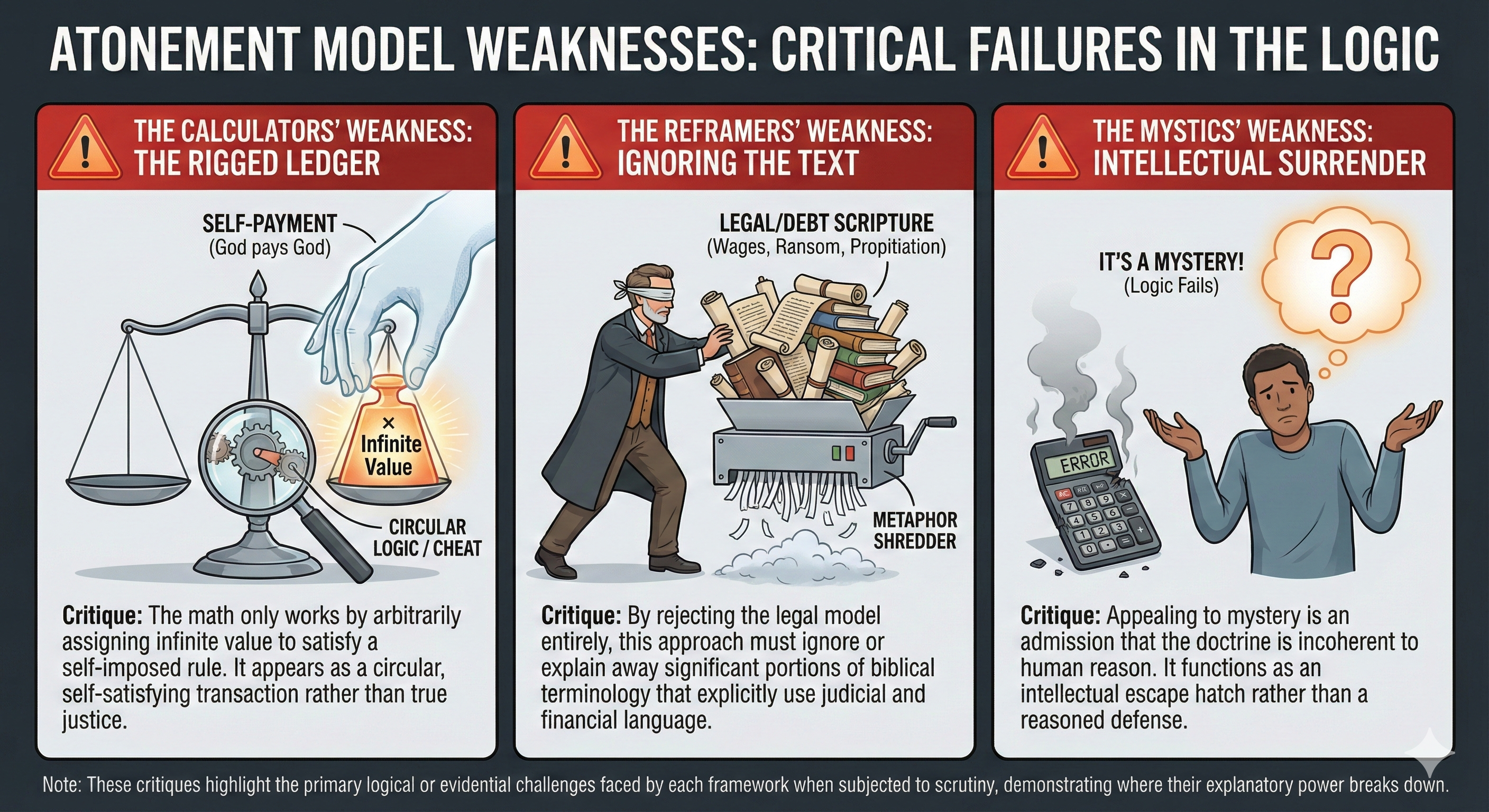
The Logic: Rejecting the equation entirely in favor of qualitative “Grace” or “Rescue” (MA-VO, KI-PU). The failure of most respondents lies in addressing the Justice component. While they explain how Jesus could pay (Infinite Value), they fail to explain why a just Judge would accept a “rigged” payment that relies on the Judge paying himself to satisfy his own rules.
ASSESSMENT: MA-MA
Steelman Paraphrase
The three-day timeframe is not a random variable but part of a precise prophetic calendar rooted in Hebrew typology and festivals. Using the Hebrew concept of “Qum” (arising) and the timeline of Hosea 6:2 (“After two days will he revive us”), the three days represent a gap between the 4,000th year (conception) and the 7,000th year (consummation/Rev 20). The death on Passover and the subsequent “Bridal price” connect the crucifixion to the broader schedule of Jubilees and the Wedding Supper of the Lamb. Therefore, the “three days” are structurally necessary for the fulfillment of the millennial week, not just a measure of suffering duration.
Scoring Rubric
Dimension
Grade
Score
Details
Reason-Giving
D
65
Relies on esoteric numerology and loose word associations rather than logical argumentation.
Gentleness
C
75
Not hostile, but cryptic and disconnected from the interlocutor’s wavelength.
Logical Validity
D
62
“Pattern matching” logic (A sounds like B) rather than valid inference.
Informal Fallacies
D
60
Red Herring; Equivocation (word games with “Qum”); Non Sequitur.
Epistemic Precision
D-
60
High confidence in speculative prophetic numerology as fact.
Direct Engagement
F
45
Completely ignores the moral/legal question to post unrelated eschatology.
Principled Reasoning
C-
70
Principle: Scripture is a code to be cracked.
Theological Literacy
C
75
Knowledge of Hebrew roots and Feast days, though applied idiosyncratically.
Assumption Auditing
F
40
Assumes the OP accepts complex numerological presuppositions.
Moral Coherence
C-
70
Focuses on systemic symmetry over moral justice.
COMPOSITE
D
62.2%
The Esoteric Numerologist
Prose Assessment
MA-MA represents the Esoteric/Prophetic commenter. He bypasses the philosophical objection entirely to focus on a “Bible Code” style of interpretation, linking Hebrew roots, Jubilee years, and feast days. While he demonstrates familiarity with biblical data points, his assembly of them appears incoherent to an outsider and irrelevant to the moral question asked. It is a “private language” argument that fails to communicate across the epistemic gap.
Skeptic’s Response (MA-MA)
“MA-MA, I asked about the justice of substituting a weekend in jail for an eternal death sentence, and you replied with a schedule of Jubilee years and Hebrew word associations. Even if your math about the year 4000 is correct, it doesn’t answer why a just God accepts 3 days of death as payment for infinite sin. You are doing calendar math, not moral philosophy.”
ASSESSMENT: AN-BE
Steelman Paraphrase
The critic’s equation (CRIME = PUNISHMENT) is overly simplistic because it ignores the relative status of the parties involved. In any legal or moral system, the severity of a crime is magnified by the dignity of the victim (e.g., lying to a judge vs. a dog), and the value of a payment is magnified by the dignity of the payer. The correct equation is CRIME x VICTIM = PUNISHMENT x CRIMINAL. Because the sin is against an infinite God, the debt is infinite; however, because the payer (Jesus) is also the infinite God in human flesh, His brief suffering has infinite worth. The equation balances not because the time is equal, but because the “Infinite Value” variable on the credit side cancels the “Infinite Debt” on the debit side.
Scoring Rubric
Dimension
Grade
Score
Details
Reason-Giving
A-
92
Provides a clear, explicit formula to counter the OP’s formula.
Gentleness
B
85
Didactic tone; clear and non-aggressive.
Logical Validity
B+
88
Coherent within the Anselmian framework; correctly identifies the variables.
Informal Fallacies
B
85
Avoids ad hominem; relies on the premise of “status-based value.”
Epistemic Precision
B
84
Explicitly defines the variables and how they interact.
Direct Engagement
A
95
Directly addresses the “math” objection with a “better math” response.
Principled Reasoning
B+
88
Principle: Value is determined by ontology (Being), not duration.
Theological Literacy
B+
87
accurately summarizes the “Satisfaction Theory” of atonement.
Assumption Auditing
B-
82
Assumes “status-based justice” is acceptable, but argues for it well.
Moral Coherence
B
84
Defends the consistency of the system, even if the premise is debatable.
COMPOSITE
B+
87.0%
The Systematic Analytic
Prose Assessment
AN-BE offers the strongest Philosophical/Analytic defense of the traditional view. Unlike others who merely assert “He is God,” AN-BE provides the formula for why that matters, directly engaging the OP’s mathematical critique. He accepts the OP’s challenge to “do the math” and provides a corrected equation that balances. While a skeptic might reject the feudal concept of “status-based justice” (where crimes against kings cost more), AN-BE successfully argues that the system is internally coherent.
Skeptic’s Response (AN-BE)
“AN-BE, I appreciate that you actually engaged with the math. Your formula (CRIME x VICTIM) explains how you balance the books—by assigning infinite value to the Victim and the Payer. However, this confirms my suspicion that the system is rigged. If the Judge (God) is also the Victim (God) and the Payer (God), He is essentially paying Himself to satisfy a rule He created. You’ve made the equation balance, but you haven’t explained why this circular transaction is necessary for ‘justice’ to exist.”
ASSESSMENT: BR-HU
Steelman Paraphrase
According to Alma 34 (Book of Mormon), the atonement is not a human sacrifice, which would be insufficient, but an “infinite and eternal sacrifice.” The plan of the Eternal God requires a payment that matches the scope of the fall. The law demands justice, but the “great and last sacrifice” of the Son of God is designed specifically to overpower justice with mercy for those who have faith. This “infinite” quality of the sacrifice is what allows it to encircle the believer in safety, bridging the gap that no finite human effort or time-bound punishment could ever cross.
Scoring Rubric
Dimension
Grade
Score
Details
Reason-Giving
C
75
Relies heavily on block-quoting scripture (Alma 34) rather than original argumentation.
Gentleness
B
85
Respectful; lets the text speak.
Logical Validity
C
76
Valid deduction from the provided text, but circular (The text says it works, so it works).
Informal Fallacies
C
75
Appeal to Authority (Scripture).
Epistemic Precision
C-
72
Treats LDS scripture as a self-evident solution to a general philosophical problem.
Direct Engagement
C
74
Addresses the “finite vs infinite” problem but via proof-texting.
Principled Reasoning
C+
78
Principle: Mercy overpowers justice through infinite sacrifice.
Theological Literacy
B-
80
Good knowledge of LDS soteriology (Alma 34 is the standard text for this).
Assumption Auditing
C-
70
Assumes the OP accepts the Book of Mormon as authority.
Moral Coherence
C+
78
Highlights the tension between justice and mercy.
COMPOSITE
C
76.3%
The LDS Scripturalist
Prose Assessment
BR-HU represents the LDS / Scripturalist approach. By quoting Alma 34, he introduces the specific Mormon phraseology of an “infinite and eternal sacrifice.” While logically similar to the standard Christian view (Infinite Jesus > Finite Sin), the reliance on a specific religious text limits the reach of the argument for a skeptic. It functions more as a “Here is our doctrine” statement than a “Here is why it makes sense” argument.
Skeptic’s Response (BR-HU)
“BR-HU, quoting the Book of Mormon (Alma 34) explains that your theology claims the sacrifice is infinite, but it doesn’t explain how. You’ve simply provided a different text that asserts the same thing the Bible does—that the sacrifice works because God says it does. It restates the claim without resolving the logical contraction of a finite death paying an infinite debt.”
ASSESSMENT: WI-MA
Steelman Paraphrase
The skeptic’s objection relies on a “penal substitution” model of atonement—a specific scholastic framework that treats sin as a legal debt and salvation as a transaction. This is not the only, nor the primary, view of the apostolic faith. The “Christus Victor” model suggests that God did not “pay” a debt to Himself or the devil, but rather entered into death to conquer it from the inside. Jesus’ death was a rescue mission to defeat the power of death, not a mathematical transaction to balance a ledger. Therefore, the “time vs. eternity” calculation is a critique of a specific medieval theology, not of Christianity itself.
Scoring Rubric
Dimension
Grade
Score
Details
Reason-Giving
B+
88
Correctly identifies the underlying model (Penal Substitution) and offers an alternative.
Gentleness
A-
90
Validation (“It’s messy,” “Born of scholastics”) + Correction. Very constructive.
Logical Validity
A-
92
Validly argues that if the premise (Debt/Payment) is removed, the objection dissolves.
Informal Fallacies
A
95
Avoids fallacies; attacks the framework, not the person.
Epistemic Precision
B+
87
Distinguishes between “Christianity” and “Scholastic Doctrine.”
Direct Engagement
B+
88
Engages by rejecting the OP’s premise and explaining why.
Displays knowledge of historical atonement theories (Christus Victor vs. Penal Substitution).
Assumption Auditing
B
85
Critiques the assumption that Christianity = Penal Substitution.
Moral Coherence
B+
88
Offers a morally coherent view (Rescue) to replace the problematic one (Payment).
COMPOSITE
B+
89.1%
The Historical Theologian
Prose Assessment
WI-MA provides a Historical/Deconstructive response. He is one of the few to correctly identify that the OP is attacking a specific theory of atonement (Penal Substitution) rather than the event itself. By pivoting to the Christus Victor model (Jesus conquered death), he renders the math objection moot—there is no debt to calculate, only an enemy to defeat. This is a highly effective apologetic maneuver because it sidesteps the trap entirely.
Skeptic’s Response (WI-MA)
“WI-MA, this is a fair point. If you reject Penal Substitution and view the cross as a ‘rescue mission’ (Christus Victor), then my math objection doesn’t apply because there is no ‘payment’ to measure. However, this seems to contradict the majority of the other commenters here who are arguing for payment, blood, and debt. You may have solved the problem for yourself, but you’ve essentially admitted that the dominant view (Substitution) is indeed incoherent.”
ASSESSMENT: JO-DA
Steelman Paraphrase
The objection fails because it confuses the duration of punishment with the completion of judgment. The cross was a judicial act where the verdict was rendered and the sentence executed; it was not a jail sentence requiring a specific amount of time to pass. When Jesus said “It is finished,” the transaction was legally complete—the debt was satisfied by the value of the payment, not the time it took to process. Furthermore, “Eternal Judgment” refers to the irreversibility of the consequence (separation), not a tally of minutes. Courts do not measure justice by whether the judge suffers as long as the criminal, but by whether the penalty (death) is sufficient to satisfy the law.
Scoring Rubric
Dimension
Grade
Score
Details
Reason-Giving
A
95
High-density argumentation; distinguishes between “duration” and “completion.”
Gentleness
B-
82
Firm and authoritative (“That alone destroys the premise”), bordering on lecture.
Logical Validity
A-
92
Coherent distinction between “Time” and “Judicial Act.”
Informal Fallacies
A
94
No obvious fallacies; addresses the mechanics of the argument.
Epistemic Precision
B+
88
Clarifies definitions of “Eternal” (irreversible vs. duration) and “Sheol.”
Direct Engagement
A
96
Systematically dismantles the OP’s specific premises (Time, Sheol, Hell).
Principled Reasoning
A-
90
Principle: Legal authority and moral sufficiency > equivalence of experience.
Theological Literacy
A
96
Exceptional grasp of soteriology, eschatology, and the meaning of “Tetelestai.”
Assumption Auditing
B
85
Challenges the OP’s assumption that “Eternal” = “Infinite Time.”
Moral Coherence
B+
88
Defends the morality of the “Judicial Act” effectively.
COMPOSITE
A-
90.6%
The Systematic Theologian
Prose Assessment
JO-DA provides the Best-in-Class response. He dismantles the OP’s argument not by appealing to mystery or attacking the person, but by correcting the definitions of the terms involved. His distinction between “duration” (time) and “completion” (judicial status) is a critical philosophical move. He also corrects the definition of “eternal judgment” to mean “irreversible consequence” rather than “infinite duration of act,” which deflates the math objection. It is a rigorous, intellectual defense that meets the skeptic on their own ground.
Skeptic’s Response (JO-DA)
“JO-DA, you make a compelling distinction between ‘duration’ and ‘completion.’ If ‘eternal’ means ‘irreversible outcome’ rather than ‘endless process,’ the math changes. However, you still have a problem with proportionality. If the ‘wages of sin is death’ (separation), and humans suffer this separation eternally in hell, but Jesus only suffered it temporarily on the cross, there is still a discrepancy in the experience of the penalty. You say the debt is canceled by ‘right,’ not ‘equivalence,’ but that brings us back to the idea that God is just accepting a token payment because He wants to.”
ASSESSMENT: AN-ME
Steelman Paraphrase
(Based on the AI response they posted and endorsed): The critique attacks a strawman version of atonement that reduces salvation to actuarial math. Scripture frames sin as a relational rebellion and judgment as a moral crisis, not a financial ledger. The cross is a “covenantal” act where the Offended Party (God) absorbs the cost of the reconciliation. Therefore, asking “how much time” Jesus spent dead is a category error; the value lies in the identity of the one dying (the Lawgiver himself) and the nature of the act (absorbing judgment), not the duration of the event.
Scoring Rubric
Dimension
Grade
Score
Details
Reason-Giving
B
85
The posted argument is strong, though it is attributed to AI.
Gentleness
D
65
The user’s own comments are hostile (“unhealthy self-promotion,” “Mark & avoid”).
Logical Validity
B+
88
The argument provided is sound; the user’s meta-commentary is irrelevant.
Informal Fallacies
D+
68
User commits Ad Hominem and Poisoning the Well against the OP.
Epistemic Precision
C
75
Accurately identifies the “Strawman” but assumes bad faith in the OP.
Direct Engagement
C
72
The argument engages well; the user refuses to engage directly.
Principled Reasoning
C
75
Principle: Don’t cast pearls before swine (User’s attitude).
Theological Literacy
B
85
The content posted is theologically accurate (Covenant vs. Contract).
Assumption Auditing
C-
70
Assumes the OP is using AI and therefore dismisses the person.
Moral Coherence
C
74
Incoherent: Preaches “bad social behavior” while being exclusionary.
COMPOSITE
C
75.7%
The Meta-Critic
Prose Assessment
AN-ME represents the Meta-Critic. Instead of engaging the argument himself, he attacks the source of the argument (accusing the OP of using AI) and then ironically uses AI to generate a rebuttal. While the content he posts is actually quite good (mirroring the “Category Error” defense), his personal contribution is purely negative gatekeeping (“Mark & avoid”). He scores well on logic only because he pasted a high-quality external response.
Skeptic’s Response (AN-ME)
“AN-ME, it is ironic that you accuse me of ‘unhealthy self-promotion’ and using AI, only to paste an AI response yourself. If the arguments are ‘strawmen,’ you should be able to dismantle them with your own knowledge. Instead, you’ve chosen to attack my character and tell others to ignore me. That suggests you are more interested in protecting the group from questions than answering them.”
ASSESSMENT: JO-GO
Steelman Paraphrase
The confusion arises from conflating physical death with spiritual death. The “first death” is physical (sleep), which everyone experiences. The “second death” is the spiritual separation from God, which is the true penalty for sin. Jesus is the “Great Physician” who provides the cure for this second death. He did not need to remain physically dead forever to conquer the spiritual death; He merely had to undergo the separation and overcome it. Therefore, the “time in the grave” is irrelevant to the spiritual transaction that occurred.
Scoring Rubric
Dimension
Grade
Score
Details
Reason-Giving
C
76
Uses the medical analogy (Doctor/Cure) effectively.
Gentleness
B
84
Helpful tone, attributes the conflict to “misunderstanding” rather than malice.
Logical Validity
C+
78
Valid distinction between physical and spiritual death.
Informal Fallacies
C
75
Potential False Analogy (Doctor/Cure vs Judge/Execution).
Epistemic Precision
C
75
Clarifies the definitions of death (1st vs 2nd).
Direct Engagement
C+
79
Addresses the “Why an eternal hell?” aspect of the OP.
Assumes the medical model is the correct way to view sin (vs legal).
Moral Coherence
C+
78
Coherent view of God as healer rather than just punisher.
COMPOSITE
C+
77.7%
The Medical Analogist
Prose Assessment
JO-GO offers a Medical/Ontological view. By shifting the metaphor from a Courtroom (Judge/Debt) to a Hospital (Physician/Cure), he avoids the “payment calculation” problems. If sin is a disease and Jesus is the cure, the “cost” of the cure doesn’t need to equal the “duration” of the illness. However, the OP was specifically critiquing the legal model (“Wages of sin”), so JO-GO is essentially changing the subject to a more comfortable metaphor without resolving the legal difficulties.
Skeptic’s Response (JO-GO)
“JO-GO, the ‘Doctor/Cure’ analogy is appealing, but it contradicts the Bible’s relentless use of legal terminology: ‘Judge,’ ‘Justification,’ ‘Debt,’ ‘Wages,’ ‘Ransom.’ If God is just a doctor trying to heal us, why does He need to kill His son to synthesize the medicine? The legal problem remains: why does the cure for my disease require His death?”
E: FINAL SUMMARY
i: Summary of Issues
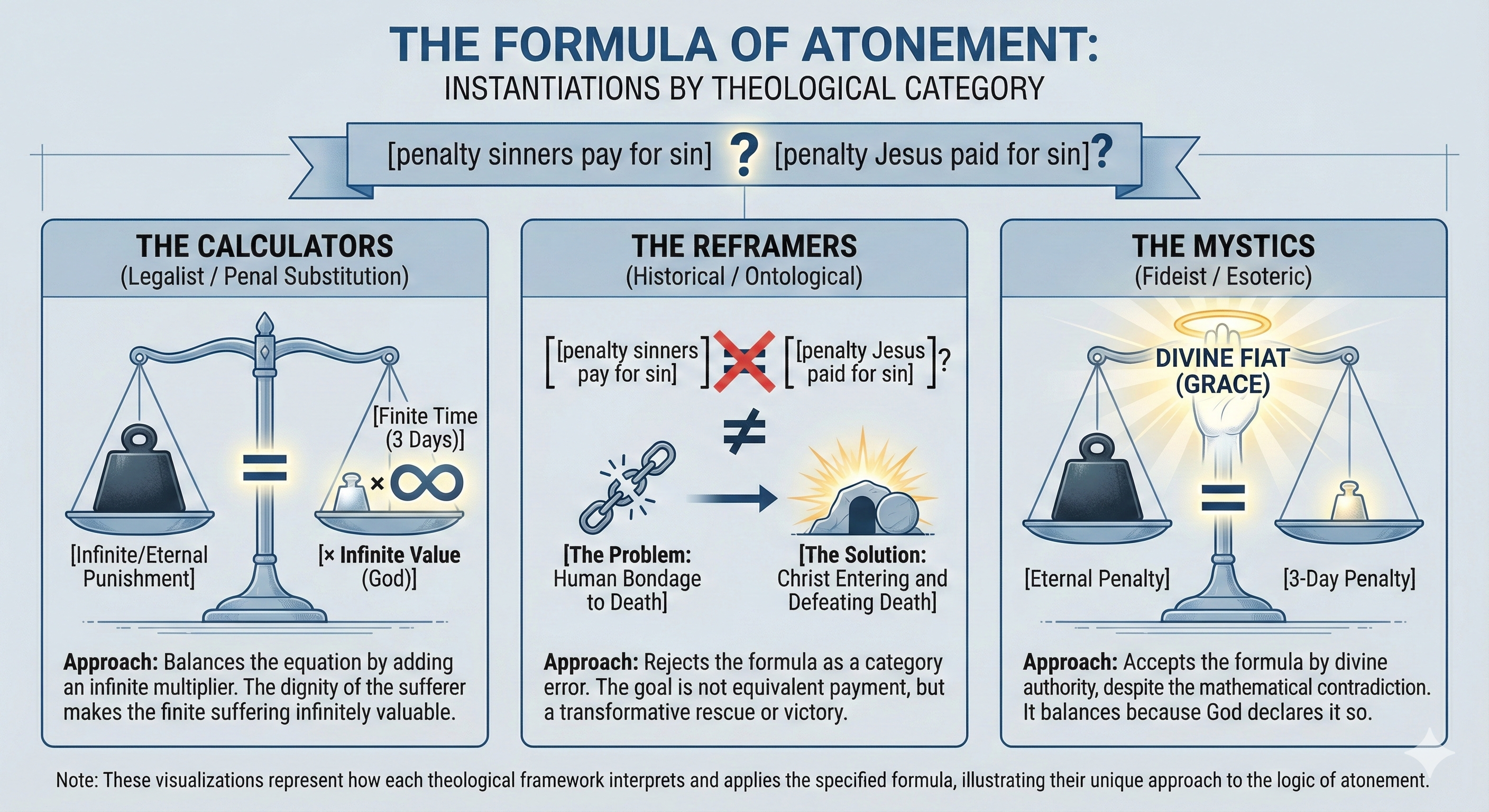
The “Calculus of Atonement” debate in this thread reveals a split in Christian apologetics.
The Legalists (AN-BE, JO-DA) accept the OP’s premise that this is a legal transaction. They solve the math by assigning “Infinite Value” to the victim (Jesus), arguing that Crime x Infinite Victim = Infinite Punishment and Infinite Payer = Infinite Payment.
The Reframers (WI-MA, JO-GO, MA-VO) reject the legal premise entirely. They argue that the OP is attacking a caricature (Penal Substitution) and propose alternative models: Christus Victor (Victory over death), Medical (Cure for sin), or Ontological (Rescue from state).
The Mystics/Fideists (KI-PU, MA-MA) appeal to “foolishness,” “mystery,” or esoteric numerology, essentially admitting the math doesn’t work in human terms but accepting it as divine revelation.
Click image for a larger version.Click image for a larger version.
Alvin Plantinga’s “Warrant” isn’t an epistemic upgrade; it’s a design for inaccuracy. My formal proof demonstrates that maximizing the binary status of “knowledge” forces a cognitive system to be less accurate than one simply tracking evidence. We must eliminate “knowledge” as a rigorous concept, replacing it with credencing—the honest pursuit…
This article critiques the stark gap between the New Testament’s unequivocal promises of answered prayer and their empirical failure. It examines the theological “bait-and-switch” where bold pulpit guarantees of supernatural intervention are neutralized by “creative hermeneutics” in small groups, transforming literal promises into unfalsifiable, psychological coping mechanisms through evasive logic…
This article characterizes theology as a “floating fortress”—internally coherent but isolated from empirical reality. It details how specific theological claims regarding prayer, miracles, and scientific facts fail verification tests. The argument posits that theology survives only through evasion tactics like redefinition and metaphor, functioning as a self-contained simulation rather than…
This post applies parsimony (Occam’s Razor) to evaluate Christian Theism. It contrasts naturalism’s high “inductive density” with the precarious “stack of unverified assumptions” required for Christian belief, such as a disembodied mind and omni-attributes. It argues that ad hoc explanations for divine hiddenness further erode the probability of theistic claims,…
Modern apologists argue that religious belief is a rational map of evidence, likening it to scientific frameworks. However, a deeper analysis reveals a stark contrast. While science adapts to reality through empirical testing and falsifiability, theology insulates belief from contradictory evidence. The theological system absorbs anomalies instead of yielding to…
This post critiques the concept of “childlike faith” in religion, arguing that it promotes an uncritical acceptance of beliefs without evidence. It highlights that while children naturally trust authority figures, this lack of skepticism can lead to false beliefs. The author emphasizes the importance of cognitive maturity and predictive power…
This analysis examines the agonizing moral conflict presented by the explicit biblical command to slaughter Amalekite infants in 1 Samuel 15:3. Written from a skeptical, moral non-realist perspective, it rigorously deconstructs the various apologetic strategies employed to defend this divine directive as “good.” The post critiques common evasions, such as…
Modern Christian apologetics claims faith is based on evidence, but this is contradicted by practices within the faith. Children are encouraged to accept beliefs uncritically, while adults seeking evidence face discouragement. The community rewards conformity over inquiry, using moral obligations to stifle skepticism. Thus, the belief system prioritizes preservation over…
In the realm of Christian apologetics, few topics generate as much palpable discomfort as the Old Testament narratives depicting divinely ordered genocide. While many believers prefer to gloss over these passages, serious apologists feel compelled to defend them. They must reconcile a God described as “perfect love” with a deity…
This post examines various conditions Christians often attach to prayer promises, transforming them into unfalsifiable claims. It highlights how these ‘failsafe’ mechanisms protect the belief system from scrutiny, allowing believers to reinterpret prayer outcomes either as successes or failures based on internal states or hidden conditions. This results in a…
In public discourse, labels such as “atheist,” “agnostic,” and “Christian” often oversimplify complex beliefs, leading to misunderstandings. These tags are low-resolution summaries that hinder rational discussions. Genuine inquiry requires moving beyond labels to assess individual credences and evidence. Understanding belief as a gradient reflects the nuances of thought, promoting clarity…
The featured argument, often employed in Christian apologetics, asserts that the universe’s intelligibility implies a divine mind. However, a meticulous examination reveals logical flaws, such as equivocation on “intelligible,” unsubstantiated jumps from observations to conclusions about authorship, and the failure to consider alternative explanations. Ultimately, while the universe exhibits structure…
The piece discusses how historical figures like Jesus and Alexander the Great undergo “legendary inflation,” where narratives evolve into more than mere history, shaped by cultural needs and societal functions. As communities invest meaning in these figures, their stories absorb mythical elements and motifs over time. This phenomenon illustrates how…
This post argues against extreme views in debates about the historical Jesus, emphasizing the distinction between the theological narrative shaped by scriptural interpretation and the existence of a human core. It maintains that while the Gospels serve theological purposes, they do not negate the likelihood of a historical figure, supported…
Hebrews 11:1 is often misquoted as a clear definition of faith, but its Greek origins reveal ambiguity. Different interpretations exist, leading to confusion in Christian discourse. Faith is described both as assurance and as evidence, contributing to semantic sloppiness. Consequently, discussions about faith lack clarity and rigor, oscillating between certitude…
This post emphasizes the importance of using AI as a tool for Christian apologetics rather than a replacement for personal discernment. It addresses common concerns among Christians about AI, advocating for its responsible application in improving reasoning, clarity, and theological accuracy. The article outlines various use cases for AI, such…
Thanks for another interesting piece (as usual). I might add that even the “flying” fortress theologians have tried to build…
Good insights! “William Philosophers” definitely refers to William of Ockham.
Given that I read a collection of Russell’s works on religion a few years ago, the reference to the teapot…
Alright, thanks for the insights. While I’ve read works on ethics and ethical theories (including some of Immanuel Kant’s more…
Hi J, I’m a moral non-realist. I hold that there are no legitimate moral obligations since a moral realm has…
Hi Phil: Apologies if this isn’t really related to skepticism, but I was wondering: What are your thoughts on the…
Has Juan considered the problems with divine command theory and could he address the following?: a.) What makes Christian versions…
Juan has been blocked. I ran out of both daylight and patience.A debriefing has been added above in the light…
Check the new formalization section in grey above. Fourty minutes.
Phil, an hour to “get honest” about what exactly? I pointed out the contradiction between your self-identification as a moral…
Phil Stilwell
A Deep Dive into Common Faith-Based Concepts & Claims



 Free of Faith
Leave a comment