
Christianity and Unfalsifiability:
The Illusion of Explanation Across Life Events
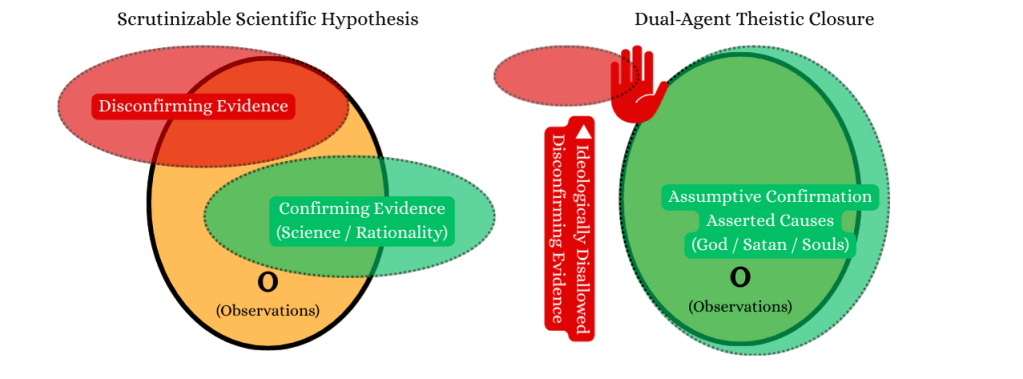
Christianity presents itself as a comprehensive explanatory system, offering divine interpretations for all facets of human experience—from personal triumphs to societal tragedies. At first glance, these explanations might appear insightful, comforting, or even profound. However, a closer analysis reveals a glaring problem: unfalsifiability.
No matter the outcome, Christianity furnishes a theological rationale that fits the event into its overarching worldview. Success is a divine blessing, failure a divine test; justice affirms God’s righteousness, while injustice refines character. Every conceivable scenario finds an explanation within the belief system, leaving no room for disconfirmation.
This unfalsifiability means that Christianity’s explanatory power is ultimately indistinguishable from random naturalistic events. Just as random outcomes vary without deeper purpose, Christian interpretations retrofit meaning to those events post hoc. The lack of testable predictions renders the system impervious to critical scrutiny and undermines its claim to rational credibility. The following sections explore this dynamic across various life categories, illustrating how Christianity’s explanations function as a closed loop of ideological reinforcement.

◉ Life and Death
— Positive Outcome: Long life is interpreted as God blessing obedience with longevity. This perspective suggests that faithfulness and good deeds are rewarded with extended life.
— Negative Outcome: Early death is rationalized as part of God’s perfect plan, where He has “called them home early.” This explanation dismisses any contradiction to divine protection or reward by asserting that God’s purposes are mysterious but always good.
In both cases, the Christian interpretation insulates itself from challenge. If believers live long lives, it is a testament to God’s faithfulness; if they die young, it is still framed as divine providence. This renders the claim unfalsifiable since all outcomes are retrofitted into the same framework of faith.
◉ Prophecy and Predictions
— Positive Outcome: Predictions come true, reinforcing the trustworthiness of God’s word.
— Negative Outcome: When predictions fail or are delayed, Christians assert that God’s timing is perfect and that human misinterpretation, rather than divine error, is to blame.
This dichotomy reveals a clear mechanism of unfalsifiability. A fulfilled prophecy validates faith, but an unfulfilled one is merely postponed or misunderstood. Both outcomes preserve the ideology.
◉ Personal Outcome
— Positive Outcome: Success in life is viewed as God honoring diligence and obedience.
— Negative Outcome: Failure in life is rationalized as God refining believers through trials or disciplining them for sin.
This dual explanation creates a catch-all narrative. When things go well, divine reward is the explanation; when they do not, divine discipline or testing is invoked. No conceivable event can disconfirm the belief.
◉ Justice
— Positive Outcome: Justice being served signifies that God upholds righteousness.
— Negative Outcome: When injustice prevails, it is framed as a test of faith or an opportunity to build character.
This logic parallels that of other categories: the ideology adapts to both scenarios without compromising its core assertion. In a world of random outcomes, both justice and injustice occur naturally, but Christianity attributes both to divine will.
◉ Wealth
— Positive Outcome: Financial success is seen as a reward for faithful stewardship.
— Negative Outcome: Financial failure is interpreted as God teaching humility and dependence through hardship.
The same pattern emerges here. Whether one prospers or suffers poverty, both outcomes are assigned theological significance. No naturalistic pattern is acknowledged; instead, any financial state fits within the divine plan.
◉ Peace and Conflict
— Positive Outcome: Peaceful times are viewed as periods of divine rest and blessing.
— Negative Outcome: Times of war and conflict are framed as tests of endurance or punishments for national sin.
This category highlights how collective experiences are rationalized. Peace demonstrates God’s favor, while conflict illustrates either testing or punishment. Again, both extremes reinforce the narrative of divine intervention.
◉ Community Response to Religion
— Positive Outcome: When many accept the religion, it is seen as evidence of God’s truth drawing people to Him.
— Negative Outcome: When few accept the religion, the explanation shifts to the narrow path of salvation, emphasizing that many reject the truth.
Christianity thus portrays both widespread acceptance and rejection as evidence of divine truth. This circular reasoning protects the ideology from disproof.
◉ Relationships
— Positive Outcome: Harmonious relationships are interpreted as blessings from God.
— Negative Outcome: Broken relationships are seen as opportunities for God to teach patience and selflessness.
Both healthy and troubled relationships are explained in ways that validate faith. A harmonious family life demonstrates God’s blessing, while struggles serve as a divine test or teaching moment.
◉ Moral Failings and Triumphs
— Positive Outcome: Moral victories are attributed to God’s strengthening of believers.
— Negative Outcome: Moral failings are rationalized as God humbling believers to draw them back to Him.
Whether one resists or succumbs to temptation, both scenarios affirm divine involvement. Success shows God’s empowerment; failure shows His corrective influence.
◉ Religious Experiences
— Positive Outcome: A strong sense of God’s presence validates faith and is seen as divine revelation.
— Negative Outcome: The absence of divine experiences is interpreted as a period of spiritual dryness, meant to test faith.
This dynamic creates a self-reinforcing belief system. Both presence and absence of religious experiences serve as evidence for God’s work.
◉ Natural Events
— Positive Outcome: Fertile land and prosperity are taken as signs of God’s promise to bless the land.
— Negative Outcome: Natural disasters are framed as divine warnings or punishments.
Both natural prosperity and catastrophe fit within the religious narrative. In a naturalistic reality, these events occur randomly, but Christianity imposes a theological structure that attributes intention to both.
◉ Health
— Positive Outcome: Good health is interpreted as a blessing from God.
— Negative Outcome: Poor health is seen as a test of faith.
Whether one enjoys vitality or endures illness, both states are assigned religious meaning. This further demonstrates the system’s resistance to falsification.
◉ Knowledge and Ignorance
— Positive Outcome: Discoveries and wisdom are seen as gifts from God.
— Negative Outcome: Lack of understanding is rationalized as evidence that God’s ways are higher than human comprehension.
This category exemplifies how ignorance and knowledge alike are co-opted into the framework of divine omniscience. No matter how events unfold, the ideology remains insulated from critique.
◉ Social Status
— Positive Outcome: High social status is attributed to God raising believers up in honor.
— Negative Outcome: Low social status is framed as a blessing for the humble and persecuted.
This reasoning reinforces the idea that both success and hardship serve divine purposes. Neither scenario challenges the theological narrative.
The Problem of Unfalsifiability
The overarching problem with these explanations is that they render Christianity unfalsifiable. Every conceivable outcome—positive or negative—is incorporated into the ideology. This creates a belief system that cannot be disproven, regardless of empirical evidence.
In a naturalistic framework, we would expect random distributions of life events such as prosperity, health, and justice. Christianity, however, imposes a theological narrative on these events, claiming divine intention behind each one. Yet this interpretation does not offer predictive power or testable hypotheses. Instead, it functions as a post hoc rationalization for all possible outcomes.
Conclusion
Christianity’s explanatory model is indistinguishable in practice from what we would expect under random naturalistic conditions. By framing both positive and negative events as manifestations of divine will, the ideology becomes impervious to falsification. This lack of falsifiability undermines its credibility as a rational account of reality, reducing it to a system of convenient, retrospective justifications.
Rigorous Logical Argumentation of Unfalsifiability
To demonstrate that Christianity’s explanations cover the entirety of logical possibilities and thereby render the system unfalsifiable, we can rigorously analyze this dynamic using logical reasoning, symbolic representation, and reflections on testability. The analysis shows that these explanations mirror outcomes that could naturally occur in a random, naturalistic reality, devoid of divine intervention.
◉ Syllogistic Analysis of Unfalsifiability
- P1: A belief system is unfalsifiable if it accounts for all possible outcomes (both positive and negative) without any disconfirming evidence.
- P2: Christianity claims divine explanations for both positive and negative outcomes (e.g., long life and early death, peace and war, wealth and poverty).
- Conclusion: Therefore, Christianity’s explanatory framework is unfalsifiable.
This syllogism reveals that Christianity absorbs any evidence into its theological worldview, allowing no room for disconfirmation.
◉ Symbolic Logic Representation of Unfalsifiability
To formalize this in symbolic terms:
- Let:
represent any event.
denote that Christianity provides an explanation for event
denote a predictive explanation for event
- Universal Claim: Christianity asserts that all events have a divine explanation:

Post hoc nature: The system fails to offer predictive hypotheses, relying instead on retrospective justifications:

Implication: A system where explanations are applied only after events occur and no predictive test is possible lacks scientific credibility.
◉ Logical Space of Possibilities
In a logically exhaustive space, any event can either align with or contradict a prediction. A robust explanatory model must:
- Predict: Offer testable, empirical predictions in advance of outcomes.
- Disconfirm: Be vulnerable to potential falsification through contradictory evidence.
Christianity, however, is structured to explain both 
◉ Naturalistic Indistinguishability
Under a naturalistic worldview, random outcomes such as health, wealth, justice, and social status occur without purpose. Christianity retroactively assigns purpose to each of these random outcomes, rendering its interpretations observationally equivalent to chance. This can be expressed as:
- Let:
represent a random, naturalistic occurrence of event
- Equivalence: The explanatory power of Christianity is indistinguishable from a purely random distribution:

Since both frameworks can account for any outcome, the distinction between divine causation and random natural processes collapses under scrutiny, leaving Christianity epistemically inert as a model of reality.
◉ Implications for Testability and Credibility
- Predictive Utility: A reliable explanatory model should predict future outcomes with specificity. Christianity’s reliance on post hoc rationalizations disqualifies it from predictive scientific inquiry.
- Falsifiability Criterion: A belief system that cannot be disproven by any conceivable event is not rationally credible. Christianity’s unfalsifiability undermines its epistemic standing by shielding it from critical testing.
This logical exploration reveals that Christianity’s explanations function as tautologies, perpetually reinforcing themselves without offering verifiable insights. Consequently, the ideology is empirically indistinguishable from naturalistic randomness.
A Relevant Academic Paper:


 Free of Faith
Hi Christopher, I just sent you a response by email. Cheers.