

The Importance of Seeking Unsiloed Support During Seasons of Doubt
The journey from belief to doubt and potential deconversion is deeply complex, marked by intense emotional and intellectual challenges. As illustrated in the deconversion flowchart, this path often involves exposure to doubts, leading to questioning, research, and an inner conflict that culminates in a pivotal decision point. The decision to remain in faith or leave it behind is greatly influenced by the type of support sought during this critical period. For those who value reason and evidence-based belief systems, unsiloed support is essential for maintaining intellectual integrity and ensuring that the decision made is grounded in rational inquiry rather than fear, social pressures, or echo-chamber reinforcement.
The Problem with Siloed Support
“Siloed support” refers to seeking advice and comfort exclusively from those within a tightly-knit ideological community. In religious contexts, this can mean engaging only with clergy, believers, or religious texts when experiencing doubt. Such support networks often discourage exploration outside their worldview, emphasizing loyalty to doctrine and viewing doubt as a weakness or spiritual failing. This dynamic can create a cognitive echo chamber where individuals are pressured to conform to pre-established answers and discouraged from critically examining their beliefs. Consequently, many who rely solely on siloed support may suppress doubts, reaffirm their faith under duress, and fail to engage in genuine intellectual exploration.

For the rational speaker, this outcome is deeply unsatisfactory. True rational inquiry requires access to a diversity of perspectives and the freedom to follow evidence wherever it leads. Siloed environments are inherently restrictive and risk promoting confirmation bias by reinforcing pre-existing beliefs rather than allowing for unbiased evaluation.
The Role of Unsiloed Support in Rational Inquiry
Unsiloed support is characterized by engaging with a wide variety of viewpoints, including those from outside one’s belief system. This may involve consulting experts in philosophy, science, and history; participating in open discussions with former believers and skeptics; and critically examining both religious and secular arguments. Unlike siloed networks, unsiloed support emphasizes critical thinking, respectful dialogue, and a commitment to following evidence and reason over dogma.
By seeking unsiloed support, individuals can expand their epistemic horizons and challenge the cognitive dissonance that often arises during inner conflict. This process fosters intellectual honesty, as individuals are encouraged to confront difficult questions and evaluate competing claims on their merits. Furthermore, engaging with diverse perspectives allows doubters to build a more comprehensive understanding of their beliefs and the alternatives available to them.
For those leaving their faith, unsiloed support networks provide vital resources for constructing a new identity rooted in autonomy and rationality. These networks offer a sense of belonging and validation without demanding conformity to any particular worldview, enabling individuals to forge paths that are intellectually and emotionally authentic.
The Benefits of Unsiloed Support for Post-Apostasy Reflection
The decision to leave a faith often leads to profound introspection and the need to rebuild one’s sense of self. This stage, depicted as “Post-Apostasy Reflection” in the flowchart, involves reconciling past beliefs with new values and perspectives. Unsiloed support plays a crucial role here by fostering open dialogue about life’s fundamental questions—meaning, purpose, and morality—without the constraints of religious doctrine.
Engaging with rational communities that prioritize evidence-based thinking helps former believers navigate existential questions with confidence and clarity. These communities encourage ongoing reflection and intellectual growth, emphasizing that beliefs should be proportionate to evidence rather than sustained by tradition or emotional comfort.
Conclusion
In times of doubt, the type of support one seeks can significantly impact the trajectory of their beliefs and intellectual integrity. For those committed to rational inquiry, seeking unsiloed support is paramount. It provides the freedom to explore diverse perspectives, confront cognitive biases, and ultimately make decisions that are informed, autonomous, and grounded in reason. By embracing unsiloed support networks, individuals can transcend the limitations of ideological silos, build new identities based on rational reflection, and continue their journey toward intellectual and emotional well-being.
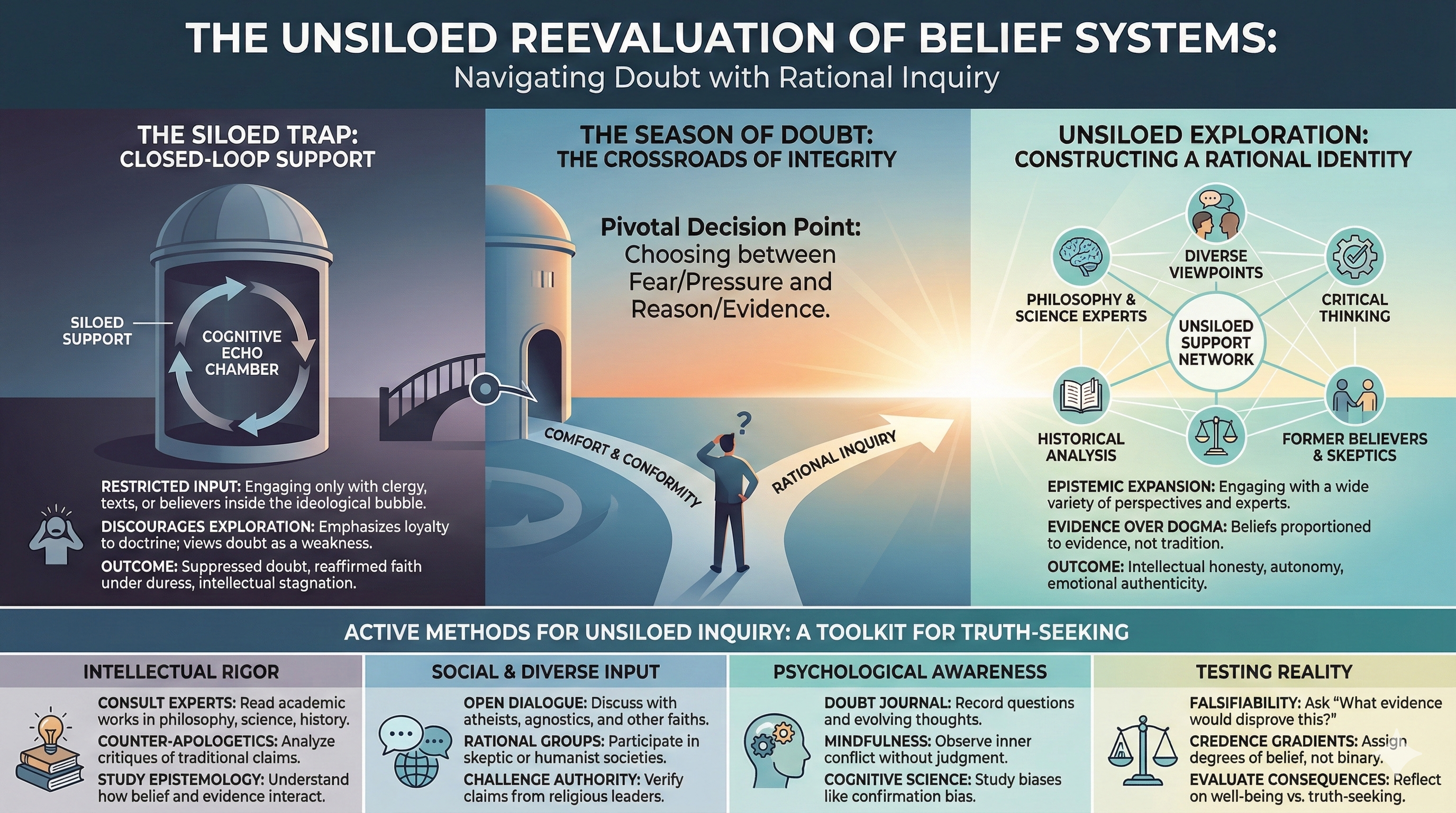




Active Ways to Conduct an Unsiloed Exploration of Truth During Seasons of Doubt
- Engage in Open Conversations with Diverse Thinkers
— Have respectful discussions with people from different worldviews, such as atheists, agnostics, other religious adherents, and secular philosophers.
— Seek out those who have gone through similar journeys of doubt and deconversion. - Read Widely and Critically
— Explore literature from both religious and secular perspectives, including philosophical works, historical texts, and scientific analyses.
— Read testimonials and case studies of individuals who have left or reaffirmed their faith. - Consult Experts in Philosophy, Science, and History
— Meet with academic experts or read their published works to gain evidence-based perspectives on religious claims.
— Study epistemology to better understand how belief, doubt, and evidence interact. - Question Core Assumptions
— Write down foundational beliefs and evaluate them rigorously for coherence, consistency, and empirical support.
— Examine how these beliefs impact other areas of life (e.g., ethics, purpose, or social responsibility). - Attend Public Talks, Debates, or Forums
— Participate in or observe public debates on topics such as religion, science, and philosophy.
— Ask questions during Q&A sessions to gain further insights from both sides of an argument. - Participate in Rational Inquiry Groups
— Join communities or groups (e.g., Secular Humanist or Skeptics Societies) that promote critical thinking and rational discourse.
— Get involved in group discussions, workshops, and study sessions centered around evidence-based inquiry. - Seek Out Alternative Interpretations of Religious Texts
— Study various interpretations of your religious scriptures, including those from outside your own tradition.
— Compare these interpretations with secular analyses to evaluate their historical and cultural contexts. - Examine Psychological and Sociological Influences
— Study how psychological biases (e.g., confirmation bias, cognitive dissonance) can affect belief systems.
— Understand how social pressures, upbringing, and cultural conditioning shape religious beliefs. - Test Beliefs Against Real-World Evidence
— Apply the principles of falsifiability by asking what evidence would disprove your beliefs.
— Observe how well your worldview aligns with observable, empirical realities. - Explore World Religions and Secular Philosophies
— Learn about other religious systems and philosophies to understand their competing claims about reality and truth.
— Reflect on how alternative beliefs approach topics such as suffering, meaning, and morality. - Study the History of Religion and Faith Systems
— Research how religious doctrines have evolved over time in response to cultural, political, and scientific developments.
— Analyze historical events that have challenged or strengthened various religious movements. - Maintain a Doubt Journal
— Record questions, doubts, and reflections as they arise.
— Periodically review your entries to track how your thinking evolves over time. - Ask Difficult and Uncomfortable Questions
— Challenge yourself to ask questions that your faith community may discourage or avoid.
— Be willing to confront unsettling answers without prematurely retreating to comforting beliefs. - Evaluate the Consequences of Belief and Non-Belief
— Reflect on how both belief and doubt affect your personal well-being, relationships, and intellectual integrity.
— Consider whether certain beliefs are maintained out of fear or for practical benefits rather than truth-seeking. - Learn About Cognitive Science and Evolutionary Psychology
— Study how the human mind is wired to create and maintain belief systems, including religious experiences.
— Explore how evolutionary pressures may have shaped moral intuitions and spiritual practices. - Utilize Academic and Critical Thinking Resources
— Take online courses or workshops on critical thinking, logical reasoning, and scientific methodology.
— Access resources like peer-reviewed journals, educational podcasts, and critical book reviews. - Engage with Counter-Apologetics
— Explore arguments from counter-apologists that critique traditional religious claims.
— Analyze both apologetics and counter-apologetics to identify strengths and weaknesses in their reasoning. - Practice Intellectual Empathy
— Try to genuinely understand how others reach their conclusions, even if they differ from your own.
— Reflect on how adopting this mindset can improve your ability to discern truth. - Limit Reliance on Emotional Appeals
— Be cautious of emotionally driven arguments that prioritize comfort, fear, or tradition over evidence.
— Strive to balance emotional well-being with intellectual honesty by confronting uncomfortable truths. - Practice Skeptical Inquiry
— Apply skepticism not only to external claims but also to your own assumptions and biases.
— Regularly ask, “What would it take for me to change my mind?” - Examine the Role of Faith in Your Life
— Reflect on whether faith serves primarily as a source of psychological comfort or if it holds up under rational scrutiny.
— Analyze whether the concept of faith aligns with your broader epistemic commitments to reason and evidence. - Engage in Mindfulness and Reflection
— Take time for quiet reflection, meditation, or journaling to explore your inner conflicts and doubts without distraction.
— Use reflection to integrate new perspectives and insights gained from unsiloed exploration. - Develop Credence Gradients
— Instead of thinking in binary terms of belief or disbelief, assign degrees of credence based on the strength of the evidence.
— Continuously update your credence as new information becomes available. - Observe the Impact of Faith on Society
— Analyze how different belief systems influence social, political, and scientific progress.
— Reflect on whether these impacts are conducive to human well-being, rational inquiry, and societal flourishing. - Participate in Online Communities and Forums
— Join discussion platforms where both believers and non-believers engage in reasoned debate.
— Be wary of echo chambers and seek out balanced forums with rigorous moderation. - Challenge Authority Figures
— Question the authority of religious leaders, scholars, or influencers who claim certainty on matters of faith.
— Investigate whether their claims hold up to scrutiny by seeking external perspectives. - Use Thought Experiments and Hypotheticals
— Engage in philosophical thought experiments to test how your beliefs respond to hypothetical scenarios.
— Reflect on how these experiments reveal potential inconsistencies or gaps in your worldview. - Evaluate the Reliability of Religious Experience
— Examine whether religious experiences are unique to your tradition or are common across many belief systems.
— Consider naturalistic explanations for these experiences, such as psychological and neurological factors. - Practice the Principle of Charity
— When evaluating arguments, interpret opposing views in their strongest form to avoid strawman fallacies.
— This approach fosters fairness and intellectual humility, which are vital for truth-seeking. - Seek Mentorship from Rational Thinkers
— Find mentors or advisors who value reason, evidence, and critical inquiry.
— Ask for guidance on how to navigate doubts without succumbing to cognitive biases or ideological rigidity.
Above all else, ensure your epistemology is firmly grounded. Faith, under its conventional definition, is a poor foundation for uncovering truth.
By actively engaging in these practices, an honest seeker can navigate doubt with intellectual rigor and integrity, ultimately making well-informed, evidence-based decisions about their beliefs.


 Free of Faith
Hi Christopher, I just sent you a response by email. Cheers.