

Consider the Following:
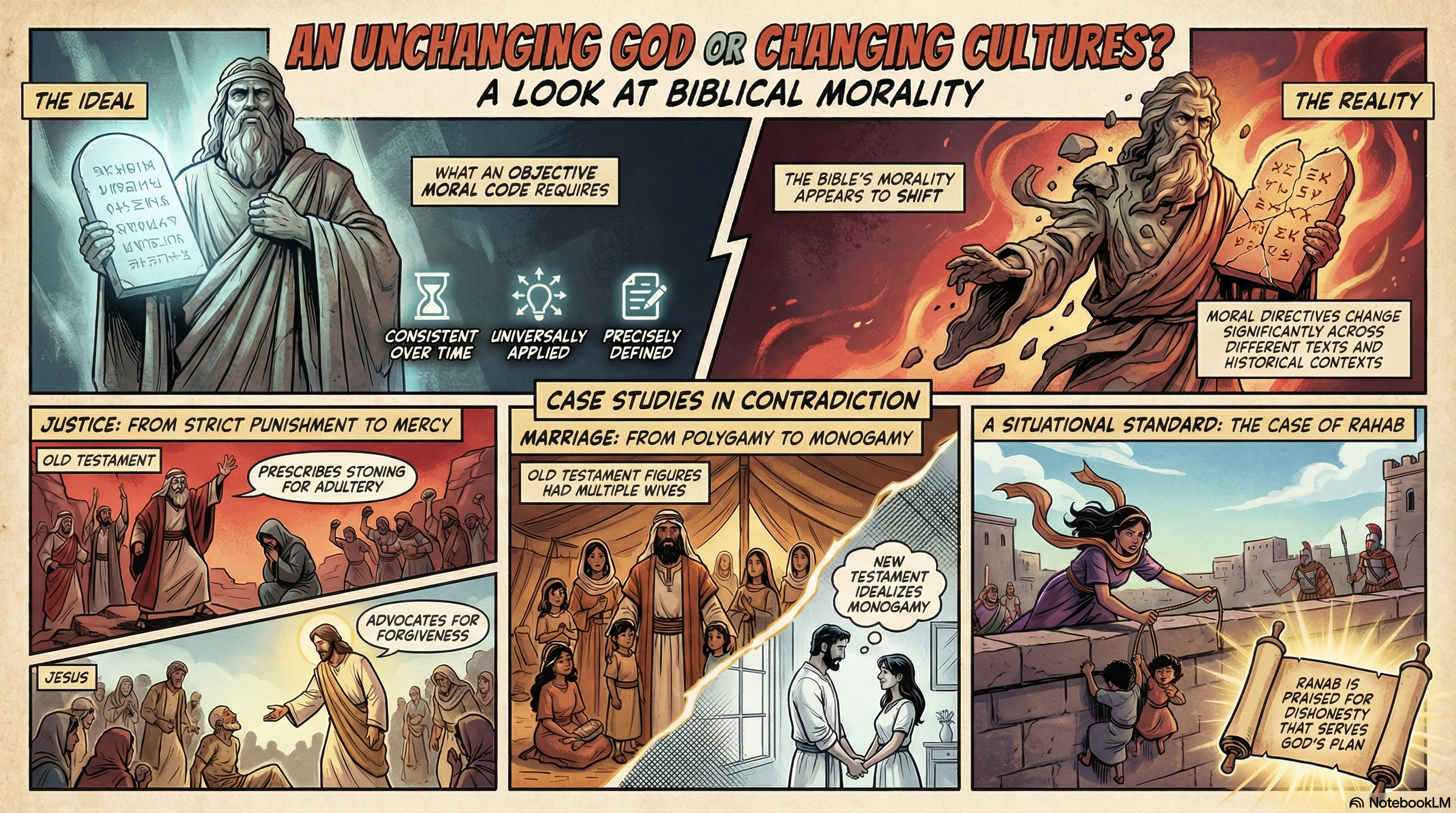
Summary: This post critically examines whether Biblical morality truly reflects an unchanging divine standard or is instead shaped by evolving cultural norms, highlighting inconsistencies in the Bible’s moral directives over time. It argues that shifts in Biblical laws and selective applications suggest these morals may be more human-adapted than divinely fixed.

Imagine a father, William, who claims to establish objective, timeless rules for his children. He insists these rules are rooted in unchanging principles that embody his character and should therefore be universally applicable. Yet, as we observe his behavior, contradictions arise.
“Father,” his eldest son, James, says one day, “If your rules are objective and timeless, why do they change so frequently?”
William replies, “Circumstances shift, James. What was necessary yesterday may not apply today.”
“But you said these rules reflect your unchanging character,” James presses. “If that’s true, shouldn’t they stay the same?”
William sighs. “I am the same, but life is complex. Different situations call for different responses.”
“Then,” James wonders aloud, “can we still call your rules objective? Or are they more like guidelines that adapt based on your preferences?”
This hypothetical situation exposes an essential dilemma about Biblical morality. If the Bible reflects the unchanging nature of God, shouldn’t its moral principles be clear, consistent, and universally applicable? Yet, as we examine Biblical commands, they appear to align more closely with culturally specific norms that shift over time, prompting us to ask: Are these commands truly objective, or do they reveal the influence of human history and cultural change?
1. Objective Morality Should Be Consistent Over Time
If Biblical morality reflects an eternal, unchanging standard, then it should remain consistent across generations. Yet, the Bible reveals substantial shifts in moral imperatives. For instance:

- Old Testament laws prescribe strict penalties, such as the stoning of rebellious children (Deuteronomy 21:18-21), adulterers (Leviticus 20:10), and witches (Exodus 22:18). However, these commands are widely disregarded today, even within Christian communities.
- Jesus’ teachings in the New Testament advocate forgiveness and mercy, often in contrast to Old Testament justice. The ethical landscape seems to transform from strict punitive measures to more compassionate guidelines, suggesting a departure from an unchanging standard.
Such shifts invite scrutiny. If God’s character is unchanging, why would His moral requirements adapt? This inconsistency seems to undermine claims that Biblical morality is anchored in an eternal divine standard.
2. Objective Morality Should Apply Universally
A truly objective moral code would apply universally, without exceptions. However, Biblical narratives indicate otherwise. Take the case of Rahab, who deceived her fellow citizens to protect Israelite spies (Joshua 2). Rather than facing condemnation for her dishonesty, she is praised for her loyalty to God’s chosen people. This selective application raises questions:
- Is morality being upheld as a universal law, or is it tailored to suit particular circumstances or favored individuals?
- Does this flexibility align with an unchanging divine standard, or does it reflect a situational approach more akin to human judgment?
Such examples challenge the claim that Biblical morality is applied consistently and universally.
3. Objective Morality Should Be Precisely Defined
If morality is to be genuinely objective and unchanging, it should be precisely defined, leaving little room for interpretation. However, many Biblical moral directives are ambiguous. Consider the concept of adultery:
- King David, a man “after God’s own heart,” had multiple wives and concubines. Yet, his relationship with Bathsheba is condemned only because she was married to another man (2 Samuel 11). This inconsistency begs the question: Does the Bible condone polygamy or view it as inherently adulterous?
- Similarly, definitions around marriage and divorce vary between the Old and New Testaments, with Jesus offering a stricter view in the New Testament than what appears in earlier texts.
These ambiguities in defining key moral terms lead to interpretive disagreements, suggesting that Biblical morality is not as clear-cut as proponents claim.
4. Objective Morality Should Be Accessible to All
If Biblical commands are to serve as an objective guide for humanity, they should be clearly accessible to all. Holding individuals accountable for rules they cannot reasonably know would be unjust, akin to penalizing a driver for speeding in the absence of any posted limit. Yet:
- Many Old Testament laws were directed exclusively at Israel, with surrounding nations left in ignorance.
- The New Testament’s message, while broader, still relies on interpretation and dissemination through imperfect human channels.
This selective transmission raises questions about the fairness and accessibility of Biblical morality as an objective standard for all humanity.
Consideration of Historical Contexts and Cultural Adaptation
Upon closer examination, Biblical moral commands seem better explained as products of cultural evolution rather than reflections of a timeless, universal standard. As societies advanced and moral understanding expanded, so too did the moral narratives within the Bible. For example:
- The shift from tribal warfare and slavery in the Old Testament to calls for brotherly love in the New Testament mirrors a trajectory toward broader empathy and ethical inclusiveness that we see throughout human history.
If the Bible truly represented an unchanging divine morality, would it not present a consistent moral code throughout? The historical adaptability of Biblical morality suggests it may reflect human adaptation and societal progress rather than a fixed moral directive from a divine source.
Conclusion: Rethinking Claims of Objective Biblical Morality

In light of these inconsistencies, it’s worth questioning whether the Bible’s moral teachings are best understood as universal, objective laws, or if they reveal a behavioral norm evolution influenced by human society and historical change. If God’s character is unchanging, then why do His “moral” laws appear to change?
Perhaps the Bible’s moral framework is more a reflection of the people and cultures that produced it than of a divine, unchanging standard.
See also:
A Companion Technical Paper:

The Logical Form
Argument 1: Consistency in Objective Morality
- Premise 1: If Biblical morality reflects an unchanging, objective standard, then its commands should be consistent over time.
- Premise 2: The Bible shows significant changes in moral commands, such as the shift from strict Old Testament punishments to New Testament messages of forgiveness.
- Conclusion: Therefore, Biblical morality does not appear to reflect an unchanging, objective standard.

Argument 2: Universality in Objective Morality
- Premise 1: If Biblical morality is truly objective, it should apply universally to all individuals, regardless of circumstance.
- Premise 2: The Bible selectively applies moral standards, as seen in the case of Rahab, who is praised for lying in specific circumstances.
- Conclusion: Therefore, Biblical morality does not apply universally, contradicting claims of objectivity.
Argument 3: Precision in Objective Morality
- Premise 1: For morality to be objective and unchanging, its definitions must be precise and leave little room for interpretation.
- Premise 2: The Bible contains ambiguous definitions on issues like adultery and marriage, leading to varying interpretations.
- Conclusion: Therefore, Biblical morality lacks the precision expected of an objective standard.
Argument 4: Accessibility of Objective Morality
- Premise 1: An objective moral standard should be accessible to everyone, so individuals are aware of the rules to which they are held accountable.
- Premise 2: Biblical commands are often directed at specific groups (e.g., Israel) and are not universally accessible.
- Conclusion: Thus, Biblical morality is not universally accessible, challenging its claim as an objective standard.
Argument 5: Historical and Cultural Adaptation
- Premise 1: If Biblical morality reflects a divine, unchanging standard, it should remain fixed regardless of historical or cultural changes.
- Premise 2: Biblical morality shifts from endorsing practices like slavery and tribal warfare to promoting broader empathy, paralleling human societal progress.
- Conclusion: Therefore, Biblical morality appears to be influenced by cultural adaptation rather than reflecting a consistent divine standard.
(Scan to view post on mobile devices.)

Dialogues
Is Biblical Morality Truly Objective?
CHRIS: The Bible provides a foundation for objective morality because it reflects the unchanging character of God. Since God is eternal and consistent, His commands must also be timeless and universal.
CLARUS: But if Biblical morality truly reflects an unchanging standard, shouldn’t it stay consistent throughout the Bible? The Old Testament mandates stoning for offenses like rebellion and witchcraft, yet Jesus’ teachings emphasize mercy and forgiveness. That shift suggests moral changes over time, rather than a fixed, divine code.
CHRIS: I understand your point, but that shift reflects God’s progressive revelation to humanity. As societies evolved, God communicated differently to meet people where they were.
CLARUS: That explanation implies adaptation to human culture, not an objective, unchanging standard. If morality is truly objective, it should apply the same way, regardless of time or culture. Otherwise, how is it any different from a human-constructed morality that evolves with society?
CHRIS: Well, there are core principles, like love and justice, that remain constant, even if the specifics vary. The context may change, but God’s character is still reflected consistently.
CLARUS: If that’s true, then why are there exceptions for certain individuals? Take Rahab, for example; she’s praised for lying to protect the spies, which contradicts the general Biblical stance against dishonesty. That flexibility seems situational, not objective.
CHRIS: Rahab’s story shows that God values loyalty and faithfulness above rigid rules. In some cases, it’s the intention that matters more than the act itself.
CLARUS: But that’s precisely the issue. If Biblical morality is truly objective, shouldn’t it apply universally, without exceptions? Otherwise, it risks being subjective, influenced by circumstances and selective interpretation, which doesn’t align with an unchanging divine standard.
CHRIS: Still, we can see moral clarity in many teachings, like the importance of faithfulness in marriage. These principles are precisely defined in God’s word.
CLARUS: I disagree; there’s ambiguity. For instance, King David had multiple wives without condemnation, yet Jesus later condemns adultery with stricter language. The Bible doesn’t clearly outline what constitutes marital fidelity, leaving room for interpretive variation.
CHRIS: Some areas are challenging to interpret, but that doesn’t invalidate the core moral truths. God’s standards are consistent when viewed with the right understanding.
CLARUS: But these standards aren’t always accessible to everyone, are they? The Old Testament laws were directed mainly at Israel, not the surrounding nations, making Biblical commands less than universal. Doesn’t a truly objective moral standard need to be accessible to everyone, not just one group?
CHRIS: God chose to work through Israel first, but the New Testament expands His message universally. Eventually, everyone is included.
CLARUS: Even so, if Biblical morality truly reflects an unchanging, objective morality, we shouldn’t see this level of historical and cultural adaptation. The movement from tribal warfare and slavery to broader calls for empathy aligns more with societal progress than with a fixed divine mandate.
CHRIS: You’re suggesting that these changes reflect human evolution rather than God’s will?
CLARUS: Exactly. If Biblical morality appears to shift with human cultural progression, doesn’t that suggest it may be more a product of human history than of an eternal, unchanging divine standard?
Is Morality Necessary for a Fulfilling Life?
THEO: Without an objective standard of morality, you can’t claim what’s right or wrong.
VERITY: You’re speaking of moral right and wrong, I assume? For instance, skipping university may be unwise if you want to become a physicist, but that’s not a moral judgment.
THEO: Yes, I mean moral right and wrong. Without an objective foundation, any claims about what’s right or wrong are meaningless.
VERITY: To me, there’s no objective morality—only emotions and preferences that guide our actions.
THEO: So if you’re just following emotions, does that mean something is “wrong” only because you find it distasteful?
VERITY: Not quite. I’m saying I feel something is distasteful or upsetting if it conflicts with my personal preferences. If you steal my car, I wouldn’t call it morally wrong; I’d simply say it makes me angry.
THEO: But anger doesn’t give me any reason to refrain from stealing your car. Why should I respect your emotions if there’s no objective morality?
VERITY: You don’t have to respect my emotions, just as I don’t expect you to. But if we’re similar in disposition, you likely feel an aversion to harm or theft, which provides your own reasons for avoiding such actions.
THEO: But emotions don’t impose any obligation on me to respect them. They’re subjective and fleeting.
VERITY: That’s true—there’s no obligation in a moral sense, only consequences. In communities where people feel similarly, laws arise to deter behaviors that upset or harm others. If you disregard those norms, there are real consequences, even if they aren’t grounded in any moral realm.
THEO: But that view lacks a higher moral purpose. Without objective morality, isn’t life just about appeasing personal feelings?
VERITY: I find meaning and fulfillment in my emotional connections and preferences, without needing moral structures. Emotions are enough to guide a fulfilling life—they shape my actions, relationships, and sense of belonging without assuming a moral reality.
THEO: It still sounds like a shallow approach. Without objective morality, what’s left to give life depth?
VERITY: Depth comes from authenticity and connection, not from morality. My life is rich with purpose simply by living in line with my emotions and values, without any pretense of “objective” moral grounding.
Examples of Moral Disunity among Christians
- What constitutes a legitimate marriage in the eyes of God?
- Positions range: Some Christians believe marriage is strictly between one man and one woman, citing Genesis, while others accept same-sex unions, emphasizing God’s love and inclusivity. Other Christians argue over whether the marriage needs to be legally documented.
- Under what conditions is divorce permissible?
- Positions range: Traditionalists argue divorce is only permissible for adultery (Matthew 19:9). Others accept broader grounds such as abuse, abandonment, or irreconcilable differences.
- Is masturbation always immoral?
- Positions range: Some Christians view masturbation as a sin against chastity, while others see it as a natural human act that is not directly addressed in the Bible.
- Are certain sexual acts between married couples prohibited?
- Positions range: Some believe specific acts, like oral or anal sex, are unnatural and against biblical teaching, while others argue that all consensual acts within marriage are permissible.
- Is it immoral to marry a prepubescent or young girl?
- Positions range: Most modern Christians categorically reject this, though some point to ancient practices, such as Mary’s age at betrothal, to argue it was permissible in historical contexts.
- Is polygamy always wrong?
- Positions range: Many Christians view polygamy as contrary to the New Testament’s one-man-one-woman ideal, while others note its acceptance in the Old Testament and argue for its contextual validity.
- Under what circumstances, if any, is it acceptable to kill an infant?
- Positions range: Christians generally condemn infanticide, but some defend the order of God to kill the Amalekite children.
- Is consuming the remains of deceased relatives, as practiced in some cultures, immoral?
- Positions range: Some Christians find this practice inherently disturbing and against biblical purity laws, while others respect it as a culturally specific act that honors the dead.
- At what threshold of effort and expense is it moral to let someone die?
- Positions range: Some advocate extraordinary measures to preserve life at all costs, while others accept allowing natural death when burdens outweigh the benefits of continued intervention.
- Is spending money on entertainment while others suffer immoral?
- Positions range: Some argue radical generosity is required based on Jesus’ teachings, while others balance personal enjoyment with charitable giving.
- Is hunting animals for sport immoral?
- Positions range: Some condemn unnecessary killing as poor stewardship of creation, while others argue it is acceptable if the animal is not wasted.
- Is it moral to clone cells to help infertile couples have children?
- Positions range: Some Christians oppose cloning as interfering with God’s design, while others see it as fulfilling the command to be fruitful and multiply.
- Is it immoral to be avoidably obese?
- Positions range: Some argue it’s a sin against the body as God’s temple, while others emphasize grace and resist judgment on personal habits.
- Is misleading a business competitor through silence wrong?
- Positions range: Some view all forms of deception as sin, while others see certain competitive strategies, like withholding information, as morally neutral.
- Are all forms of suicide immoral?
- Positions range: Traditional views consider it a grave sin, while more modern interpretations focus on mental health and God’s compassion for those in despair.
- Is spanking children an acceptable practice?
- Positions range: Some Christians endorse spanking as biblical discipline, while others condemn it as harmful and outdated.
- What forms of slavery are always immoral?
- Positions range: Most Christians today reject all slavery as immoral, though historical interpretations justified certain forms based on Old and New Testament teachings.
- Is it moral to decide who should be removed from a lifeboat that cannot support all its passengers?
- Positions range: Some advocate self-sacrifice as the moral solution, while others argue that pragmatic decision-making is necessary in such situations.
- Is it moral to choose which of your children will die from hunger?
- Positions range: Most Christians find the scenario morally incomprehensible, but pragmatic considerations vary among thinkers.
- It would be immoral not to kill abortion doctors if it protected the unborn.
- Positions range: Most Christians, even those who equate abortion to the Holocaust, strongly reject this stance, while fringe groups endorse violence under the guise of protecting life.
- It would be morally permissible to kill abortion doctors if it protected the unborn.
- Positions range: Similar to #20, mainstream Christianity rejects violence in almost all circumstances, though extremist factions disagree.
- It is immoral for divorced individuals to remarry.
- Positions range: Some uphold this strictly based on Jesus’ teachings, while others allow remarriage in cases like abuse or abandonment.
- It is immoral to have meals with apostates from Christianity.
- Positions range: Some interpret this as condoning sin, while others see it as an opportunity for witnessing and fellowship.
- It is immoral to knowingly exceed highway speed limits.
- Positions range: Some believe all lawbreaking is sin, while others see minor infractions as morally neutral or context-dependent.
- It is immoral to practice circumcision or clitoridectomies.
- Positions range: Circumcision is often seen as culturally or religiously neutral; clitoridectomy is nearly universally condemned as harmful.
- It would be moral for a government to kill homosexuals for being homosexual.
- Positions range: Nearly all Christians today reject this, though some extremist groups point to Old Testament laws to support such actions.
- It is immoral to intentionally make someone believe you feel the opposite of what you actually feel about something.
- Positions range: Some see all deception as sin, while others permit “white lies” to avoid harm or maintain social harmony.
- Is refusing to give someone your coat who has asked for it immoral?
- Positions range: Some take Jesus’ teaching on radical generosity literally, while others interpret it metaphorically as a call to kindness.
- It is immoral to spend this earthly life enjoying earthly pleasures when unGospelled unbelievers face eternity in Hell, while you will have eternity in Heaven to relax.
- Positions range: Some Christians advocate radical self-denial for evangelism, while others balance the enjoyment of God’s gifts with evangelistic efforts.
- It is immoral to fight for a country in a war merely to gain more territory.
- Positions range: Some endorse pacifism, while others support just wars but condemn wars of aggression.
- It is immoral to divorce over a spouse merely romantically kissing another individual.
- Positions range: Some permit divorce only for adultery, while others view romantic betrayal as sufficient grounds for separation.
- It is immoral not to send money to help someone you know is starving to death.
- Positions range: Some argue that radical generosity is required, while others emphasize the importance of personal responsibility and circumstances.
- Is it moral to swear an oath on the Bible?
- Many Christians find this practice morally acceptable, despite Jesus’ injunction, “do not swear an oath at all.”
Notes:
Helpful Analogies
Analogy 1: The Shifting Law Code
Imagine a city where laws change every few years based on cultural shifts. Actions that were once illegal, like certain business practices or public behaviors, are now permitted, while new restrictions are introduced to address current values. If these laws change based on public sentiment rather than an unchanging principle, can they truly be called objective? Similarly, if Biblical morality varies between the Old and New Testaments and adapts to context, it suggests cultural influence rather than a universal, fixed standard.
Analogy 2: The Flexible Recipe

Consider a family recipe that’s passed down through generations. Each cook in the family adjusts the ingredients based on availability and personal taste. Over time, the dish evolves to the point that it hardly resembles the original recipe. If the original recipe is considered “true,” yet it continually adapts, can we still claim it holds an unchanging standard? In the same way, Biblical moral commands seem to adapt over time and context, questioning whether they are objectively timeless or simply culturally modified guidelines.
Analogy 3: The Regional Road Signs
Imagine a set of traffic rules that differ wildly from one town to the next, reflecting local customs rather than universal standards. In some places, honking is encouraged, while in others, it’s prohibited; in one town, speed limits are strict, while another allows for flexibility. While these rules serve the local population, they clearly aren’t universal. Similarly, Biblical morality appears tailored to specific contexts, such as ancient Israel or the early Christian community, rather than offering a universal objective morality that applies everywhere and always.
Addressing Theological Responses
Theological Responses
1. The Role of Progressive Revelation
Theologians often argue that Biblical morality reflects progressive revelation, where God reveals moral standards gradually to accommodate human development and cultural context. From this perspective, the apparent changes in Biblical commands are not contradictions but stages in a moral progression designed to guide humanity toward a fuller understanding of divine principles.
2. The Universality of Core Moral Principles
While specific Biblical laws may vary, theologians assert that core moral principles—such as love, justice, and mercy—remain consistent throughout the Bible. These fundamental values form the basis of objective morality in Christian theology, and variations in practice reflect contextual adaptations rather than shifts in core ethics. Thus, the unchanging character of God is upheld through consistent principles rather than specific, unalterable rules.
3. Contextual Application of Morality
Theological perspectives often highlight that Biblical commands were given within specific historical and cultural contexts. This means that some laws, such as those regarding punishments or social practices, were intended for ancient Israel rather than for universal, timeless application. The principles behind these laws, however, are seen as universally applicable in spirit, allowing them to adapt to different eras without undermining objective morality.
4. Moral Obligations Beyond Emotions
Theologians would argue that emotions alone lack the capacity to establish genuine moral obligations. While emotions can influence behavior, they don’t provide a sufficient foundation for moral duty or accountability. An objective moral standard, they contend, is necessary to create true moral responsibility and to ensure that people have more than just personal preferences as reasons to respect others’ rights.
5. Objective Morality and Fulfillment
Christian theologians may argue that an objective moral framework is essential for a truly fulfilling life. They would contend that emotions, while valuable, are transitory and cannot provide the lasting meaning and purpose that comes from adhering to a divine moral standard. From this perspective, objective morality adds depth and purpose to life beyond the limitations of personal feelings and societal norms.
Counter-Responses
1. Progressive Revelation vs. Objective Consistency
The concept of progressive revelation suggests that Biblical morality evolves to accommodate human culture, yet this is precisely what undermines its claim to objective and unchanging truth. If moral standards adapt to human development, they are not fixed but context-dependent. True objective morality would be clearly established from the beginning, without evolving directives, thus avoiding any confusion about which moral standards are genuinely timeless and which are not.
2. Core Principles Lacking Universality
Claiming that core moral principles remain consistent while specific commands vary fails to support objective morality. If justice or mercy are truly central, they should be represented in unchanging applications. The Bible, however, shows inconsistent applications of justice and mercy across contexts, from harsh punishments to forgiveness for particular individuals, suggesting these values are not universally applied but selectively enforced. This selective application calls into question the supposed universality and objectivity of these principles.
3. Contextual Morality vs. Universal Morality
Theological appeals to contextual morality acknowledge that Biblical commands reflect historical and cultural specifics, which is at odds with claims of universal morality. A truly objective moral code would be applicable across all cultures and times without requiring adaptation. The need to reinterpret commands for different eras implies that Biblical morality lacks the consistency necessary to qualify as objectively universal, as it depends on the cultural and social circumstances of ancient societies rather than a universally applicable standard.
4. Emotions and the Basis of Moral Obligation
The argument that emotions cannot form the basis of moral obligation assumes that moral duties must be grounded in an external, objective realm. However, humans already construct social norms and legal systems based on shared emotions and preferences, which effectively establish accountability and consequences without requiring a moral realm. Emotional aversions to harm, for example, provide real motivation to respect others’ well-being, and collective emotional dispositions enable societies to build functioning frameworks that guide behavior without invoking an objective moral duty.
5. Fulfillment Without Objective Morality
The claim that objective morality is necessary for a fulfilling life overlooks the fact that personal fulfillment arises from authentic connections, emotional experiences, and purposeful actions rather than from adherence to an external moral code. Many people find deep meaning in relationships, passions, and pursuits that are entirely emotionally based and lack any grounding in objective morality. Fulfillment, then, is achievable through emotional integrity and personal values, making an objective moral framework unnecessary for a meaningful life.
Clarifications
Does a Moral Vacuum Entail Selfish behavior?
The assertion that, without formal moral systems, humans would inevitably act selfishly is a non sequitur; it incorrectly assumes that the absence of morality means an absence of altruistic behavior. This perspective overlooks the natural, inherent human capacities for compassion and empathy—emotional drives that frequently inspire individuals to act in the interest of others, even without any explicit moral obligation.
Compassion—the emotional response to another’s suffering paired with a genuine desire to alleviate it—often motivates actions that are inherently altruistic. People engage in acts of kindness, such as assisting strangers in distress or providing care to others, not because they are bound by moral rules but because they are moved by empathy. This empathy-driven behavior is evident across cultures and ages, demonstrating that compassion is a core element of human experience, not simply a byproduct of moral systems.
Additionally, the idea of rational compassion offers a more nuanced alternative to traditional moral frameworks. Rational compassion involves making empathetic decisions with a consideration for fairness and balance, aiming to achieve outcomes that benefit others while also being logically sound. This approach allows individuals to navigate complex social situations thoughtfully and equitably, without needing rigid moral doctrines to direct behavior. Rational compassion recognizes that compassionate actions are often the most socially beneficial and productive choices, even in the absence of any objective or moral requirement.
Finally, social and evolutionary pressures further bolster compassionate behavior. As social creatures, humans thrive in cooperative environments, where mutual support and trust enhance survival and well-being. The desire to belong and maintain reciprocal relationships naturally discourages selfishness, reinforcing the idea that prosocial behavior does not require morality to be effective or meaningful.
In sum, the assumption that humans would default to selfishness without moral codes fails to consider the depth and influence of compassion, empathy, and rational compassion in human behavior. These inherent qualities encourage individuals to act beyond self-interest, affirming that morality is not a prerequisite for altruism and that humans are fully capable of meaningful, prosocial actions grounded solely in shared emotional and social bonds.
Elements of a Coherent Moral System
A coherent moral system, if it were to exist, would require several key elements:
- Ontological Foundation: A clear basis for the existence of objective moral facts.
- Universalizability: Moral principles must apply consistently across all relevant situations.
- Epistemological Accessibility: A plausible explanation for how humans can know these moral facts.
- Normativity: The system should provide compelling reasons for action, explaining why moral facts are binding.
Examining the Bible through this framework reveals challenges in meeting these criteria:
1. Ontological Foundation
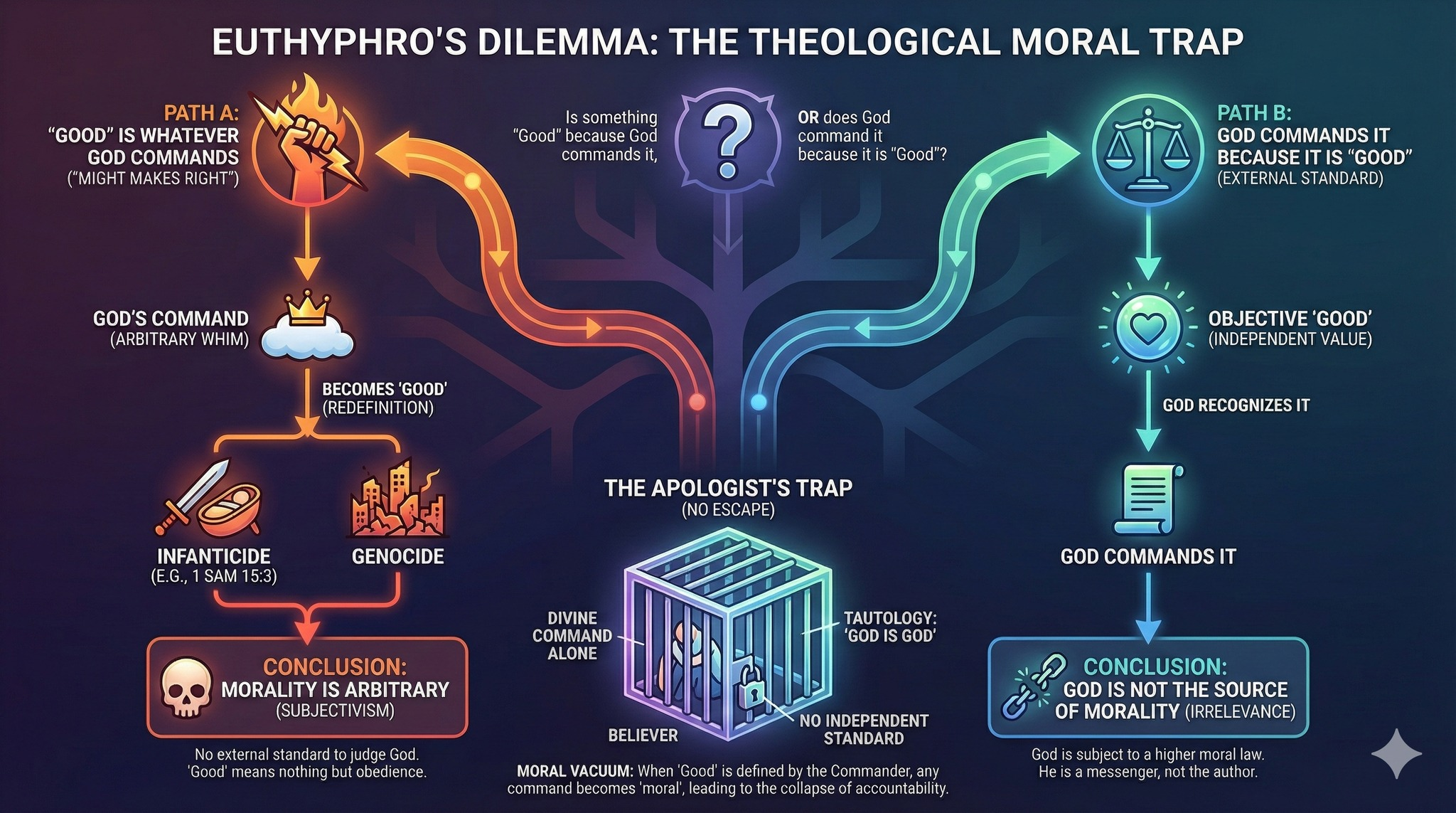
The Bible’s moral directives are often presented as divine commands, suggesting an ontological foundation rooted in God’s will. However, this raises the Euthyphro dilemma: Are actions moral because God commands them, or does God command them because they are moral? If the former, morality appears arbitrary; if the latter, morality exists independently of God, undermining the Bible’s role as the source of moral truth.
2. Universalizability
Biblical moral instructions vary across contexts. For instance, the Old Testament prescribes specific laws for ancient Israel, while the New Testament offers different teachings for early Christians. This variability suggests that Biblical morality is not universally applicable, as moral directives change based on historical and cultural circumstances.
3. Epistemological Accessibility
The Bible does not provide a clear method for individuals to ascertain which moral commands are universally binding and which are context-specific. Interpretations often depend on theological exegesis, leading to diverse and sometimes conflicting understandings of moral obligations. This lack of clarity challenges the accessibility of moral knowledge within the Biblical framework.
4. Normativity
While the Bible offers reasons for moral behavior, such as divine reward or punishment, these motivations are contingent on belief in the specific theological framework it presents. For those outside this belief system, the normative force of Biblical commands is diminished, suggesting that its moral prescriptions may not possess inherent binding authority.
In summary, the Bible faces significant challenges in providing the necessary elements for a coherent moral system, as it lacks a clear ontological foundation, universal applicability, accessible moral knowledge, and universally compelling normative force.
How might a moral anti-realist, nonetheless, employ reduction ad absurdum arguments that introduce the assumption of morality to demonstrate moral incoherence?
A moral anti-realist rejects the stance that there are objective, mind-independent moral truths. However, moral anti-realists can still utilize reductio ad absurdum arguments by temporarily assuming a moral premise and demonstrating its internal inconsistency or incoherence. Below is a step-by-step explanation of how this works.
1. Internal vs. External Critiques
A reductio ad absurdum argument functions by assuming a statement (in this case, a moral principle or a set of moral premises) and showing that it leads to a logical contradiction or an implausible conclusion.
- Internal critique: The anti-realist engages with the moral claims as if they were true. By working within those claims, the anti-realist shows that they lead to contradictions—thus undermining the set of claims on their own grounds.
- External critique: The anti-realist’s own stance (that moral facts are not objective) need not be invoked directly. Rather, the argument focuses on whether the moral framework, taken at face value, can be consistent.
2. Stipulated Moral Assumptions
Even if the anti-realist does not endorse moral assumptions as true, they can stipulate those assumptions for the sake of argument:
- Assume a moral principle: For instance, “One ought to maximize overall happiness in every situation.”
- Derive implications: From that principle, draw out what actions are prescribed in specific cases.
- Reveal inconsistencies: Show how these prescriptions might lead to contradictory requirements or incoherent outcomes (e.g., requiring mutually exclusive actions).
If the framework collapses into contradiction when taken seriously, it is shown to be incoherent on its own terms.
3. Clarifying the Role of Anti-Realism
The key to this approach is recognizing that moral anti-realism is about the ontological and truth-valued status of moral claims, not about whether one can talk about “morality” hypothetically. The anti-realist can:
- Demonstrate logical inconsistency: Show that certain moral doctrines cannot be coherently endorsed, even if one took them to be “true” within a particular moral system.
- Undermine moral systems from within: By using the system’s own rules, the anti-realist effectively points out the absurdity or internal contradiction without needing to affirm any objective moral fact.
4. Conclusion
A moral anti-realist can employ a reductio ad absurdum by entering a moral system as if it were valid and then demonstrating that it yields contradictions when its principles are taken to their logical conclusion. This method does not require believing in objective moral truths but rather uses internal critique to highlight moral incoherence.
Symbolic Logic Representation
Here’s a formalized structure to represent the reductio ad absurdum process when applied to a moral premise, demonstrating internal inconsistency:
Step 1: Initial Moral Premise
Let 
Example:
Step 2: Hypothetical Assumptions
Introduce hypothetical cases based on this principle.
Let 

: If
: If
Step 3: Introduce Conflict
Suppose in a specific scenario both

However, if

This leads to the contradiction:
Step 4: Reductio Ad Absurdum
Since the principle
Formal Structure Summary
- Assume moral principle
- Derive implications under different cases:
,
.
- Identify mutually exclusive actions:
.
- Derive a contradiction:
.
- Conclude by reductio:
.
This shows that


 Free of Faith
Leave a comment