

Consider the Following:
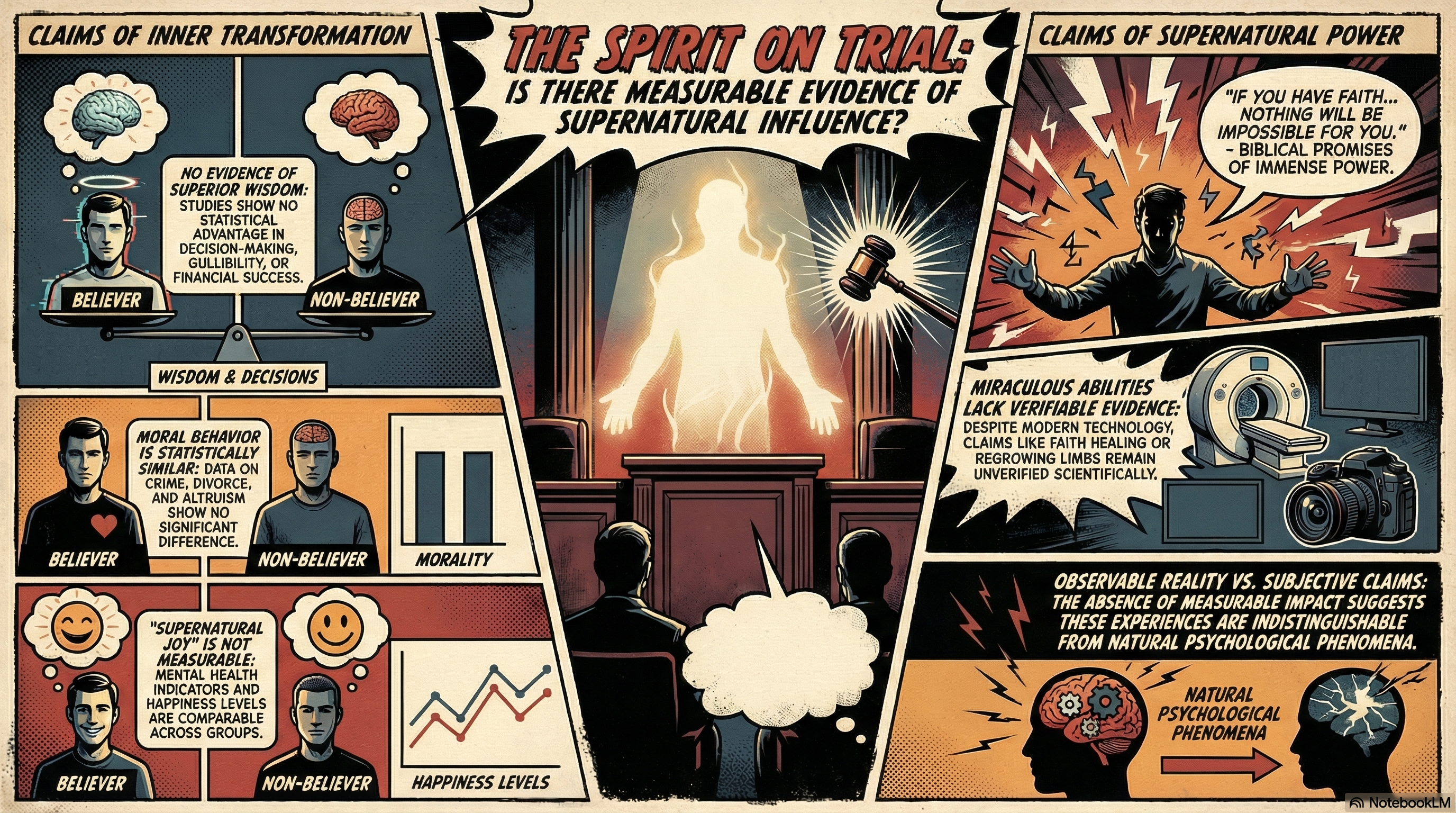
Summary: This post questions the lack of measurable evidence for the Holy Spirit’s influence in areas such as wisdom, righteousness, joy, and miraculous abilities. It argues that if the Holy Spirit were truly active in believers’ lives, observable and statistically significant differences should be evident when compared to the lives of non-believers.

Imagine Tom claims a powerful genie spirit resides within him, guiding his actions, knowledge, and insight beyond natural limits. When asked for evidence, Tom points to his improved behavior, attributing it to this spirit rather than other factors. Yet, people without a genie achieve similar changes, and Tom cannot demonstrate any knowledge or ability that exceeds these natural, human limits.
We wisely wouldn’t believe Tom without concrete evidence. Why, then, should we believe similar claims about the Holy Spirit? If a supernatural Spirit with divine capabilities were guiding Christians, wouldn’t we see clear and measurable effects on their behavior, wisdom, or happiness? We certainly would. Many Christians assert that the Holy Spirit works within them, but is this belief supported by evidence?

Let’s consider three areas where evidence would be expected if the Holy Spirit genuinely influences believers—and how we might rigorously test the corresponding claims.
1. Wisdom
Christians often believe that the Spirit of an all-knowing God grants wisdom beyond the natural capacity of humans. This wisdom, if actual, would lead to greater doctrinal unity, resilience against misinformation, and sound decision-making.
Testing This Claim:
- Doctrinal Consistency: Analyze theological stances across denominations to identify if believers indwelt by the Spirit demonstrate greater doctrinal agreement than a random selection of individuals. If the Holy Spirit were guiding believers, we might expect significantly more unity in interpretation among Spirit-led groups than among those without such claims.
- Decision-Making Studies: Create comparative studies assessing risk-taking, gullibility, and success rates in financial or ethical decisions between Spirit-led Christians and non-believers. If the Spirit grants wisdom, Spirit-led individuals should make objectively better choices more consistently than the general population or populations in non-Christian societies. Here are a few metrics to explore:
- Defaults on mortgages
- Bankruptcies
- Divorces
- Start-up successes
If Christians showed statistically better decision-making across various domains, this could support the idea of a supernatural influence. However, current studies show no significant difference in these areas between Christians and non-Christians.
2. Righteousness
If the Holy Spirit encourages holiness, Christians would theoretically exhibit significantly higher moral standards. This would manifest in consistently lower rates of criminal activity, substance abuse, and divorce compared to other groups.
Testing This Claim:
- Crime and Behavior Rates: Conduct comparative studies on crime, substance abuse, and divorce rates across Christian and non-Christian populations. If the Holy Spirit were promoting righteousness, one would expect substantially lower rates in allegedly Spirit-led populations.
- Ethics and Altruism: Develop controlled studies on charitable giving, honesty, and community service to compare behaviors. If the Holy Spirit leads Christians toward greater ethical behavior, Christians should consistently score higher in altruism and ethical consistency.
However, current research indicates that Christian populations do not significantly differ from other groups in these areas. A random group of 1,000 Christians should not have higher criminality than a random group of 1,000 non-Christian Japanese. The order of magnitude difference in crime rates in Japan and the US make any related claim of a sanctifying Holy Spirit dubious. This lack of measurable distinction challenges the idea that a divine influence is actively promoting superior pro-social behavior.
3. Happiness
Many Christians claim to experience a unique joy, often referred to as the “joy of the Lord,” attributed to the Holy Spirit. This joy is said to exceed the happiness or fulfillment that others experience.
Testing This Claim:
- Emotional Resilience: Evaluate mental health indicators, including resilience to stress and emotional regulation, in Spirit-led Christians versus other populations. A unique divine influence might result in lower rates of depression, anxiety, or mental health disorders among believers.
- Comparative Joy Studies: Conduct surveys across religious and non-religious groups, analyzing self-reported happiness, satisfaction, and antidepressant use. If the joy provided by the Holy Spirit is unique, Christians should consistently report higher levels of well-being. Other metrics to test might include the following:
- The rate of suicides
- The prevalence of anti-depressant prescriptions
- Divorce rates

So far, studies do not show a statistically significant difference in happiness or well-being between Christians and people of other beliefs. Without clear, unique effects, the “joy of the Lord” among Christians seems comparable to the joy found in other common belief systems.

Wouldn’t Evidence of the Holy Spirit Be Undeniable?
If the Holy Spirit is an omnipotent, omniscient entity, wouldn’t its influence be scientifically detectable? This absence of measurable impact suggests that claims of supernatural guidance might not differ meaningfully from natural psychological or social phenomena.
The promise of the power of Christians to perform miracles is clear. Here are just a small sampling of such promises:
Matthew 17:20 – “He replied, ‘Because you have so little faith. Truly I tell you, if you have faith as small as a mustard seed, you can say to this mountain, “Move from here to there,” and it will move. Nothing will be impossible for you.’”
Matthew 21:21-22 – “Jesus replied, ‘Truly I tell you, if you have faith and do not doubt, not only can you do what was done to the fig tree, but also you can say to this mountain, “Go, throw yourself into the sea,” and it will be done. If you believe, you will receive whatever you ask for in prayer.’”
Mark 11:22-24 – “‘Have faith in God,’ Jesus answered. ‘Truly I tell you, if anyone says to this mountain, “Go, throw yourself into the sea,” and does not doubt in their heart but believes that what they say will happen, it will be done for them. Therefore I tell you, whatever you ask for in prayer, believe that you have received it, and it will be yours.’”
John 14:12-14 – “‘Very truly I tell you, whoever believes in me will do the works I have been doing, and they will do even greater things than these, because I am going to the Father. And I will do whatever you ask in my name, so that the Father may be glorified in the Son. You may ask me for anything in my name, and I will do it.’”
John 15:7 – “If you remain in me and my words remain in you, ask whatever you wish, and it will be done for you.”
John 16:23-24 – “In that day you will no longer ask me anything. Very truly I tell you, my Father will give you whatever you ask in my name. Until now you have not asked for anything in my name. Ask and you will receive, and your joy will be complete.”
James 5:14-15 – “Is anyone among you sick? Let them call the elders of the church to pray over them and anoint them with oil in the name of the Lord. And the prayer offered in faith will make the sick person well; the Lord will raise them up. If they have sinned, they will be forgiven.”
Mark 16:17-18 – “And these signs will accompany those who believe: In my name they will drive out demons; they will speak in new tongues; they will pick up snakes with their hands; and when they drink deadly poison, it will not hurt them at all; they will place their hands on sick people, and they will get well.”

Testing Claims of Miraculous Abilities:
- Conduct controlled studies on reported miraculous events attributed to the Holy Spirit, such as healings or divine revelations. With the widespread availability of recording technology, verified evidence should be available if miracles occur frequently.
In reality, miraculous claims decline in credibility upon scrutiny and often correlate more closely with placebo effects or psychosomatic responses than with divine intervention. Today, we see nothing close to a moved mountain, an request that an actual creator of the universe would have no trouble fulfilling.

Argument Recap and Suggested Rigorous Tests
- Scientific studies show no statistically significant differences in these areas between Christians and non-Christians.
- If the Holy Spirit exists, its effects should be evident through unique and measurable benefits in wisdom, righteousness, and happiness among Christians.
Suggested Tests:
- Conduct controlled studies on decision-making, behavior, and emotional resilience.
- Compare doctrinal unity and life outcomes among Spirit-led Christians to non-believers.
- Test claims of miraculous abilities under scientific scrutiny.
Conclusion: The lack of measurable differences casts doubt on the existence of a supernatural guide as described in Christian doctrine. Objective evidence should match subjective claims if the Holy Spirit were truly active in believers’ lives.
A Companion Technical Paper:

The Logical Form
Argument 1: The Wisdom Argument
- Premise 1: If the Holy Spirit possesses omniscience and truly dwells within believers, then Christians should exhibit a form of wisdom that exceeds natural human capacities.
- Premise 2: This supernatural wisdom would manifest in doctrinal unity across denominations, superior decision-making skills, and a lower susceptibility to misinformation and gullibility compared to the general population.
- Observation: However, studies show that Christians do not display statistically significant advantages in these areas when compared to non-Christians.
- Conclusion: Therefore, the supposed supernatural wisdom provided by the Holy Spirit does not manifest in ways that can be empirically distinguished from ordinary human experiences.

Argument 2: The Righteousness Argument
- Premise 1: If the Holy Spirit promotes righteousness and moral transformation, Christians would exhibit consistently higher moral standards than non-believers.
- Premise 2: Such moral superiority would be evident in lower rates of criminal behavior, divorce, and substance abuse, as well as higher scores in charity, honesty, and altruism.
- Observation: However, empirical data indicates no statistically significant difference in these moral behaviors between Christian and non-Christian populations.
- Conclusion: Therefore, there is no observable evidence that the Holy Spirit promotes a unique moral transformation in believers.
Argument 3: The Happiness Argument
- Premise 1: If the Holy Spirit imparts a unique joy to Christians, this should result in higher levels of emotional well-being and resilience among believers compared to non-believers.
- Premise 2: This unique joy would be evident through lower rates of depression, anxiety, and mental health issues among Christians.
- Observation: However, studies do not indicate that Christians report higher well-being or joy levels compared to people of other belief systems.
- Conclusion: Therefore, the claimed unique joy provided by the Holy Spirit does not manifest in a measurable, observable way.
Argument 4: The Miraculous Abilities Argument
- Premise 1: If the Holy Spirit performs miracles or grants believers supernatural abilities, there should be clear, documented instances of these miracles, particularly given the widespread availability of recording technology.
- Premise 2: Such miracles would withstand scientific scrutiny and verification, consistently demonstrating supernatural effects.
- Observation: However, claims of miracles associated with the Holy Spirit tend to decline under investigation, often aligning more closely with placebo effects or psychological phenomena.
- Conclusion: Therefore, there is no verifiable evidence that the Holy Spirit performs miracles or provides supernatural abilities to believers.
Argument 5: The Detectable Influence Argument
- Premise 1: If the Holy Spirit is an omnipotent and omniscient entity dwelling within believers, its influence should be scientifically detectable, producing effects that are statistically significant and distinguishable from natural human experiences.
- Premise 2: Such detectable influence would manifest in distinct wisdom, morality, happiness, and miraculous effects that are unique to Spirit-led Christians.
- Observation: However, in all these domains, no statistically significant effects are evident that differentiate believers from non-believers.
- Conclusion: Therefore, the lack of measurable impact suggests that the claimed supernatural guidance of the Holy Spirit is indistinguishable from natural psychological or social phenomena.
(Scan to view post on mobile devices.)

Dialogues
Examining Evidence of the Holy Spirit’s Influence
CHRIS: I believe the Holy Spirit lives within me, guiding me with wisdom, helping me live a righteous life, and filling me with joy beyond what the world offers.
CLARUS: If that’s true, wouldn’t the effects of such a powerful Spirit be clear and measurable? After all, we’d expect to see specific benefits in your life that aren’t found among non-believers.
CHRIS: Well, yes, the Holy Spirit’s guidance should lead to wisdom that others may not have. I believe it’s one of the main ways God helps believers.
CLARUS: So, are Christians significantly better at making decisions than others? Do they show a doctrinal unity that reflects this divine guidance? Studies suggest that Christians don’t outperform non-believers in these areas. Doctrinal disagreements are as common as ever, and decision-making doesn’t appear to be any stronger among believers.
CHRIS: Perhaps the Spirit’s wisdom doesn’t eliminate all errors. People still have free will and can choose poorly.
CLARUS: I understand that. But if the Holy Spirit were truly imparting wisdom beyond human capacity, wouldn’t we expect at least some measurable difference, statistically speaking? Christians should, on average, have better judgment, greater unity in beliefs, and fewer instances of gullibility.
CHRIS: I see what you’re saying, but the Spirit also works to make us righteous. Isn’t that clear evidence of His influence?
CLARUS: If the Holy Spirit produces righteousness, then we’d expect Christians to consistently demonstrate higher moral standards than others—less criminal behavior, fewer divorces, and more charitable actions. But studies show Christians have similar rates in these areas compared to non-Christians. The data doesn’t seem to reflect a supernatural moral transformation.
CHRIS: But doesn’t the Bible teach that God’s ways are mysterious? Maybe we just can’t measure spiritual growth in conventional ways.
CLARUS: That might be possible, but if the Holy Spirit produces noticeable changes in wisdom or righteousness, we should be able to see some statistically significant evidence. What would make Christian moral behavior distinct from that of others if the Spirit were genuinely transforming believers?
CHRIS: What about the joy of the Lord? Many Christians feel a unique peace and joy that they attribute to the Holy Spirit. Isn’t that evidence?
CLARUS: If Christians experience a special joy, we’d expect to see it in their emotional resilience—maybe in lower rates of depression, anxiety, or mental health struggles. However, studies show that mental health outcomes for Christians are similar to those of people in other belief systems. Without measurable differences, it’s hard to call this joy uniquely supernatural.
CHRIS: But the Holy Spirit also performs miracles! Believers have experienced miraculous healings and answered prayers that can’t be explained by science.
CLARUS: If these miracles were real and ongoing, we’d see documented evidence—especially today, with video and recording technology so widely available. Yet, when miracles are tested, they often appear to have explanations more consistent with placebo effects or psychological phenomena. Why haven’t these miraculous events stood up to scientific scrutiny?
CHRIS: Maybe it’s about faith. Miracles aren’t always meant to be proven; they’re meant to be experienced.
CLARUS: I understand that viewpoint. But if the Holy Spirit were an omnipotent presence in believers’ lives, producing effects in wisdom, righteousness, joy, and miracles, shouldn’t these be scientifically detectable? The absence of measurable outcomes suggests that what believers interpret as the Spirit’s work could be explained by natural psychological or social factors.
CHRIS: So, you’re saying that without observable evidence, the Holy Spirit’s influence is questionable?
CLARUS: Exactly. If the Holy Spirit exists as a powerful force, there should be clear, statistically significant signs of its influence. Since we don’t see these measurable effects, it’s reasonable to question the idea of supernatural guidance in the way Christians describe it.
Testing the Evidence for the Holy Spirit’s Influence
THEO: The Holy Spirit lives within me, guiding me with insight and wisdom beyond what others can access.
VERITY: So, you’re saying that the Spirit of an omniscient God actively resides within you, influencing your decisions and actions?
THEO: Yes, that’s exactly what I mean.
VERITY: Then, logically, we should expect undeniable, measurable evidence of this Spirit’s presence in your life, right?
THEO: The evidence is there! I feel deeply guided in ways that go beyond human wisdom.
VERITY: But you’ve made some questionable financial choices in the past. If this guidance is real and divine, why wouldn’t the Spirit help you avoid those kinds of mistakes?
THEO: Perhaps I wasn’t fully attuned to the Spirit’s guidance at that moment.
VERITY: That explanation raises questions. If the Spirit’s guidance is real, wouldn’t we expect a consistent pattern of better decision-making among believers? If this influence were truly divine, it shouldn’t rely on perfect “attunement” to manifest in measurable ways.
THEO: The Spirit does allow for free will and occasionally tests believers’ faith. It’s not a constant override.
VERITY: I understand the role of free will, but even with free will, if a divine Spirit were guiding people, we’d still expect some statistically significant advantage in the lives of believers—fewer errors, greater consistency in wisdom, and even perhaps a more unified understanding among Christians on key issues.
THEO: But my joy and peace are uniquely from the Spirit. This inner peace is not like anything a non-believer could understand or experience.
VERITY: How certain are you of that? Have you compared this joy and peace with the feelings of non-believers? People of various beliefs report similar experiences.
THEO: How would I make that kind of comparison?
VERITY: Precisely. Without any systematic comparison, it’s challenging to claim this joy as uniquely supernatural. Others might attribute similar emotions to different sources—psychology, personal growth, or their own spiritual beliefs.
THEO: But you can’t deny the authenticity of my experience. I know it’s real for me.
VERITY: True, I can’t deny your subjective experience. Yet, experiences are inherently subjective and open to multiple interpretations. Just because something feels profound doesn’t confirm a supernatural source. Shouldn’t we look for objective evidence if we’re to claim that this influence comes from a divine Spirit?
Notes:
Helpful Analogies
Analogy 1: The Compass of Wisdom
Imagine someone claims to have a supernatural compass that always points them toward the best decisions in life. This compass, they say, guides them to make wise choices and avoid mistakes, unlike anyone else. However, when we observe this person’s decisions, they don’t perform significantly better than others in financial, ethical, or personal matters. If the compass were truly supernatural, shouldn’t we see consistent evidence that it guides them more accurately than ordinary judgment? The Holy Spirit’s guidance is often claimed to be a source of unique wisdom, yet without measurable results, this claim remains similar to having a compass that doesn’t consistently point north.
Analogy 2: The Miracle Ingredient

Imagine a chef who claims to use a special ingredient that enhances any dish, making it tastier and healthier than food prepared by others. However, when their dishes are tested, there’s no detectable difference in flavor or nutritional content compared to similar dishes from other chefs. If the ingredient were truly unique, we’d expect it to distinguish the chef’s creations in some way that others could clearly taste or measure. Likewise, if the Holy Spirit imparts distinctive qualities like joy, peace, or righteousness, these should be clearly observable, just as a miracle ingredient would be detectable in a meal.
Analogy 3: The Invisible Shield of Safety
Imagine someone claims to wear an invisible shield that protects them from harm. This shield, they say, keeps them safe in all situations, yet they experience injuries and setbacks at similar rates as others who don’t have such a shield. If the shield truly existed and were effective, we would expect it to offer measurable protection—reduced accidents, fewer injuries, or better outcomes in risky situations. Similarly, if the Holy Spirit offers believers unique protection or advantages, these should be statistically observable in their lives, just as we’d expect to see reduced harm with a real, effective shield.
Addressing Theological Responses
Theological Responses
1. Faith Isn’t Always Empirically Testable
Theologians may argue that faith-based experiences are inherently personal and not necessarily open to scientific scrutiny. The Holy Spirit’s work in a believer’s life, they might say, is often about inner transformation and personal growth that doesn’t always manifest in ways that are easily quantifiable. From this perspective, expecting empirical evidence could be viewed as misunderstanding the nature of spiritual influence, which focuses on personal and moral development rather than measurable outcomes.
2. The Role of Free Will and Human Fallibility
A common theological response is that free will plays a significant role in how the Holy Spirit operates. They might argue that, while the Spirit provides guidance, believers retain the autonomy to make mistakes, sometimes failing to follow divine direction due to human fallibility. According to this view, inconsistent decisions or behaviors do not negate the Spirit’s influence; rather, they illustrate the complex relationship between divine guidance and human agency.
3. Spiritual Benefits Are Not Always Materially Evident
Theologians may point out that spiritual gifts and benefits are often not aligned with material success or measurable prosperity. Instead, the Holy Spirit might work in less visible ways, such as fostering inner peace, compassion, or resilience during adversity. From this perspective, the absence of statistically significant differences in areas like financial decisions or health outcomes could be seen as a misunderstanding of what spiritual transformation entails. The Spirit’s influence, they may argue, is subtle and focuses on spiritual depth rather than external accomplishments.
4. The Mystery of God’s Ways
A frequently cited response is that the ways of God are inherently mysterious and may not conform to human expectations or scientific analysis. Theologians might argue that the Holy Spirit’s work operates within a divine framework beyond full human comprehension. According to this view, the lack of visible or measurable evidence does not imply absence but rather reflects the divine mystery and the limits of human understanding.
5. Subjective Experience Is Still Valid Evidence
Some theologians might contend that subjective experiences of the Holy Spirit are valid forms of evidence, even if they aren’t easily measured. Personal encounters with the Spirit—such as feelings of peace, joy, or conviction—are often cited as essential to faith and are viewed as profound forms of spiritual confirmation. In this view, the fact that these experiences are subjective does not diminish their authenticity or significance in a believer’s life.
6. Community and Transformation as Indirect Evidence
Theologians might highlight the community impact of faith as indirect evidence of the Holy Spirit’s influence. They may argue that Christian communities often engage in charitable work, ethical initiatives, and support systems that demonstrate the Spirit’s influence. While individual outcomes may vary, they believe that the collective actions of faith communities reflect a transformative power that points to the Spirit’s presence, even if not individually measurable.
7. Testing God Is Not the Point of Faith
A theological response might also include the idea that faith isn’t about testing or proving the existence of the Holy Spirit through observable evidence. Many Christians believe that seeking proof undermines the very nature of faith, which calls for trust without needing full verification. From this perspective, the demand for empirical evidence is seen as incompatible with the spiritual nature of belief and devotion.
Counter-Responses
1. Faith Isn’t Always Empirically Testable
While faith-based experiences can be personal and subjective, claims about the Holy Spirit’s influence often extend beyond internal feelings to include external actions, such as wisdom, moral behavior, and joy that others can observe. If these aspects are claimed to surpass natural capacities, then they invite empirical inquiry. Claiming that these experiences are entirely beyond scientific scrutiny may allow any subjective belief to go unchallenged, undermining the credibility of claims made about real-world impacts. If the Spirit’s influence is truly transformative in observable ways, then at least some measurable evidence should be expected.
2. The Role of Free Will and Human Fallibility
The concept of free will does not eliminate the expectation of a statistically significant pattern among believers if a divine influence were at play. Just as guidance in other areas (e.g., parenting or mentorship) leads to predictable outcomes despite individual autonomy, the Holy Spirit’s guidance should still lead to some measurable advantages. If believers, on average, show no significant difference in decision-making or moral conduct, it raises questions about the Spirit’s effectiveness and relevance in practical life choices, irrespective of individual free will.
3. Spiritual Benefits Are Not Always Materially Evident
While spiritual benefits may not align with material success, believers claim that the Holy Spirit imparts unique forms of peace, joy, and moral integrity. These qualities should manifest in observable behaviors or attitudes that set believers apart in ways that are not dependent on wealth or material achievement. For example, resilience, ethical consistency, and empathy are observable traits that should theoretically be heightened in Spirit-led individuals, creating measurable patterns distinct from those found in non-believers. If these spiritual traits are indistinguishable, the uniqueness of the Holy Spirit’s work remains questionable.
4. The Mystery of God’s Ways
Appealing to the mystery of God’s ways does not preclude the possibility of observable evidence. Many natural phenomena, while complex and previously mysterious, are still measurable and discernible through scientific inquiry. If the Holy Spirit exists and actively influences believers in specific, practical ways, then we should expect to see some empirical patterns that reveal this influence. Suggesting that no measurable evidence exists due to divine mystery effectively places these claims beyond verification, making it difficult to distinguish genuine spiritual impact from subjective belief or imagination.
5. Subjective Experience Is Still Valid Evidence
While subjective experiences hold personal meaning, they are unreliable as objective evidence since similar subjective claims are made across various religions and belief systems. Personal feelings of joy, peace, or guidance do not uniquely indicate the presence of the Holy Spirit any more than similar emotions experienced by non-believers indicate other supernatural influences. Relying solely on personal experience without any external validation risks confirmation bias and fails to provide a standard by which to distinguish one set of spiritual experiences from another.
6. Community and Transformation as Indirect Evidence
While the community impact of faith can indeed reflect positive values, it does not necessarily indicate the work of a divine influence. Many secular communities and organizations engage in similar ethical practices without attributing their motivation to a spiritual source. Community-oriented behaviors are common across cultures and belief systems, suggesting that they are human qualities rather than specific outcomes of the Holy Spirit. If the Spirit is truly distinctive, we should expect transformations among believers that go beyond common human altruism and are uniquely measurable.
7. Testing God Is Not the Point of Faith
Claiming that faith should avoid testing or empirical inquiry raises concerns about the falsifiability of the Holy Spirit’s influence. If no amount of evidence (or lack thereof) can challenge the belief in the Spirit, then the claim becomes unfalsifiable and effectively immune to logical examination. This stance can be used to justify any belief without accountability. While faith may not seek empirical validation, if the Holy Spirit is believed to create real-world changes, then evidence should be considered a reasonable expectation, not a violation of spiritual devotion.
Clarifications
Testing Claims
Testing claims attributed to the divine is not only reasonable but essential if we are to understand the nature and reality of these claims. If a deity’s influence is truly real, genuine evidence should naturally follow, reinforcing belief through observable impacts. Refusing to test divine claims, particularly those that assert tangible effects, risks insulating belief from scrutiny, leaving it vulnerable to misinterpretation, confirmation bias, or even manipulation. Moreover, many religious texts themselves contain accounts where the divine invites examination or provides signs, suggesting that testing can be a respectful, even reverent, approach when done with sincerity.
To avoid testing in the name of “faith” undermines the very credibility of that faith, implying that it cannot stand up to rational inquiry. If we are encouraged to seek truth above all, then testing—when approached earnestly—should be viewed not as disrespectful but as a commitment to aligning belief with reality. Beliefs that can be tested, verified, or experienced empirically become stronger, bridging the gap between subjective conviction and objective evidence.
Testing Divine Wisdom in Prediction Markets
Prediction markets offer a unique and practical way to test divine wisdom by evaluating individuals’ abilities to foresee events accurately. These markets, where participants make predictions on future events (e.g., elections, financial outcomes, or scientific advancements), rely on collective knowledge and reasoning to assign probabilities to various outcomes. If Christians possess divine wisdom from the Holy Spirit, they would presumably show a statistically significant advantage in these markets, making consistently accurate predictions based on supernatural insight or guidance.
However, we observe a strange absence of Christians achieving extraordinary results in prediction markets, with no substantial evidence that believers outperform non-believers. If divine wisdom provided real predictive power, Christians would likely be among the most successful participants in these markets, using their guidance to foresee outcomes that others cannot. The lack of such results raises questions about the practical, measurable impact of spiritual insight on real-world decision-making and suggests that any claimed divine guidance does not extend to an ability to predict future events in a way that would distinguish believers from the general population. This absence challenges the notion of a uniquely divine source of wisdom that offers reliable advantages in understanding or foreseeing complex situations.
Confirmation Bias
Confirmation bias is a cognitive tendency to favor information that confirms our pre-existing beliefs while dismissing or overlooking contradictory evidence. This bias can create a distorted view of reality, leading us to reinforce ideas without fully examining their validity. Left unchecked, confirmation bias can narrow our understanding, entrench false beliefs, and foster intellectual complacency.
To combat confirmation bias, we can take several proactive steps:
- Seek Contradictory Evidence: Make a conscious effort to examine opposing viewpoints and actively search for information that challenges your current beliefs. By exploring counterarguments and data that refute your assumptions, you can gain a more balanced perspective and avoid forming conclusions based solely on selective evidence.
- Ask Critical Questions: Regularly question why you hold certain beliefs and whether they are based on solid evidence or assumptions. Challenge your conclusions with questions like, “What evidence would disprove this belief?” or “Am I only noticing information that supports my view?” This self-questioning can reveal blind spots and biases.
- Engage in Intellectual Humility: Remind yourself that no one is immune to error and that truth-seeking requires flexibility. Acknowledge that you could be wrong and remain open to revising your beliefs in light of new evidence. Practicing intellectual humility allows you to approach knowledge as a process of learning rather than defending a fixed position.
- Diversify Information Sources: Rely on multiple, reliable sources that represent a range of perspectives. Avoid limiting yourself to echo chambers where ideas are unchallenged and where information is carefully selected to confirm a specific viewpoint. A broader information pool encourages a more nuanced understanding and reduces the likelihood of reinforcing biased beliefs.
- Pause Before Accepting Evidence: When you encounter information that supports your beliefs, pause and evaluate it with the same scrutiny you would apply to evidence against your views. Ask yourself, “Is this source credible? Is this evidence reliable?” This deliberate pause can help you avoid impulsive acceptance of information that might simply confirm what you already believe.
By actively engaging in these practices, you can minimize confirmation bias, approach information with greater objectivity, and cultivate a more open and informed mindset.


Leave a Reply