

Consider the Following:

Summary: Christianity’s historical claims about the natural world have frequently been disproven and replaced by scientific explanations, highlighting a pattern of retreat for supernatural explanations as natural understanding expands. This trend suggests that Christian doctrine, rather than reflecting divine truth, has often been limited by human knowledge and cultural assumptions of its time.
Has Christianity Provided a Reliable Account of the Natural World?

Imagine you have a detailed instruction manual for navigating a complex machine, claimed to be written by an all-knowing engineer. At first, the manual seems authoritative, but over time, you notice multiple errors in key sections—maps that incorrectly chart the system, explanations that misidentify parts, and solutions that fail to resolve problems. With each discovery, you rely more on external sources, like modern engineering guides, to correct the manual’s mistakes. As your understanding grows, the original manual becomes less useful, its claims replaced by evidence-based insights. Similarly, Christianity’s claims about the natural world, once accepted as authoritative, have been repeatedly corrected by scientific discoveries, suggesting that the “manual” of divine truth reflects human limitations rather than infallible knowledge.
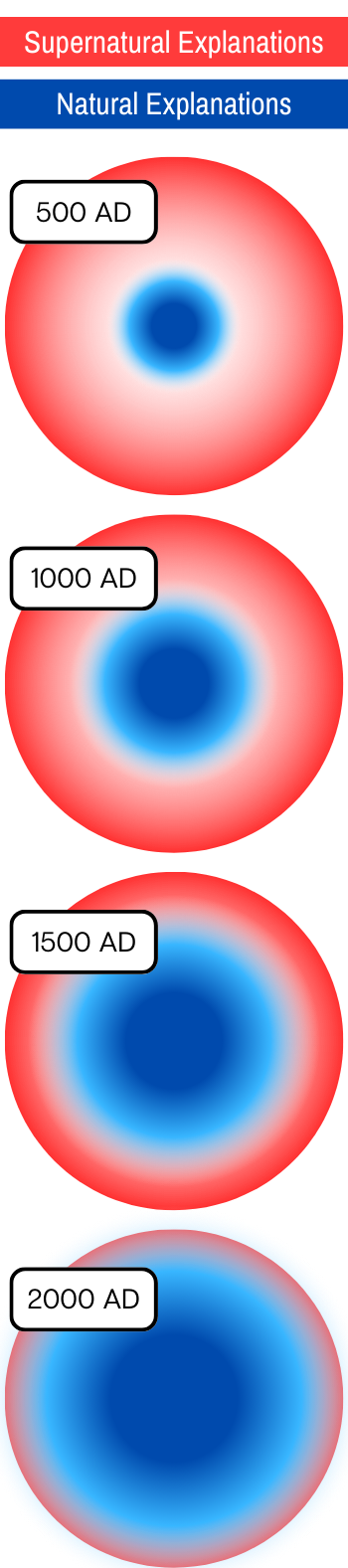
Throughout history, Christianity has posited numerous claims about the nature of the universe and predictions regarding human health, the structure of the cosmos, and the workings of natural events. However, a recurring issue emerges when we evaluate these claims against scientific discoveries and the principles of empirical evidence. Historically, many Christian explanations for natural phenomena relied on supernatural forces or divine interventions. Over time, as the sciences advanced, these supernatural explanations have gradually receded in favor of naturalistic, evidence-based understandings. This trend illustrates a shrinking domain of supernatural explanations alongside an expanding domain of natural explanations—a process that has profound implications for the reliability of Christian claims.
Key Historical Examples of Christian Claims and Their Limitations
- Geocentric Universe and Astronomy
Early Christian teachings, reflecting the cosmology of the time, aligned with the belief in a geocentric universe, where Earth was considered the immovable center of creation. Not only was this belief rooted in biblical interpretations (such as Psalm 104:5), but it was also widely upheld by Christian authorities for centuries. The Copernican revolution and subsequent advancements in astronomy dismantled this geocentric model, showing instead a heliocentric solar system and eventually a vast, expanding universe. This contradiction between biblical cosmology and scientific discovery raises questions about Christianity’s claimed access to divine knowledge. - Diseases as Divine Punishment
Throughout the medieval period and even into the early modern era, Christians attributed diseases, especially outbreaks like the Black Plague, to divine punishment for sins. Illnesses were seen as moral judgments rather than biological phenomena. It was only through scientific advancements in microbiology and epidemiology that humanity began to understand the true, natural causes of diseases—germs, viruses, and environmental factors—disproving the view that sickness is primarily a result of moral failings. The shift from supernatural explanations to natural causes in medical science is another example of the limitations of religious explanations in the face of evidence. - Mental Illness and Demonic Possession
Christianity traditionally viewed mental illness as a manifestation of demonic possession or moral corruption, rather than a medical condition. This belief led to exorcisms and other spiritual interventions instead of compassionate care or scientific treatment. Over time, psychiatry and psychology have revealed the neurological and psychological foundations of mental health conditions, and treatment has shifted accordingly. Once again, the religious explanations receded as scientific knowledge advanced, suggesting that Christianity’s understanding of human health was hindered by its reliance on supernatural explanations. - Earth’s Age and the Theory of Evolution
For centuries, Christianity promoted a young Earth model, with many adherents dating Earth’s age to approximately 6,000 years based on genealogies in the Bible. The theory of evolution and discoveries in geology, paleontology, and radiometric dating have provided compelling evidence that Earth is around 4.5 billion years old, with life evolving over billions of years. These findings contradict the young Earth view and challenge literal interpretations of biblical creation narratives, further demonstrating the limitations of Christianity’s factual reliability concerning the natural world.
Analyzing the Shrinking Domain of Supernatural Explanations
Between 500 AD to 2000 AD, the domain of supernatural explanations has visibly contracted, with natural explanations expanding into areas once firmly in the realm of divine or supernatural claims. This progression raises a crucial question: If Christianity is grounded in divine truth, why has it been forced to relinquish so many of its claims in the face of scientific discovery? A truly omniscient deity, if revealing knowledge through scripture, might have foreseen the realities of the natural world and provided accurate guidance from the beginning. The gradual retreat of supernatural explanations suggests a framework that was never rooted in objective truth but rather in human conjecture influenced by cultural and historical contexts.
Methodological Naturalism as a Corrective to Supernatural Explanations
The failure of supernatural explanations led to the establishment of methodological naturalism in the sciences. This principle, which seeks natural causes for natural phenomena, has provided a consistently reliable means of understanding the world. Science, unlike religion, openly revises its theories in light of new evidence and has therefore accumulated a progressively accurate picture of reality. In contrast, Christianity has often revised or reinterpreted its doctrines only after scientific evidence has rendered its previous claims untenable. This pattern demonstrates that methodological naturalism offers a more reliable approach to understanding the world, whereas supernatural explanations frequently fail under scrutiny.
Implications for the Concept of Divine Revelation
If Christianity’s worldview were genuinely derived from an omniscient, all-knowing deity, we might expect its claims to align more closely with empirical truths, needing little or no revision. Instead, we find that Christian doctrine has frequently lagged behind scientific discovery. This lag suggests that religious claims may stem more from the cultural and historical limitations of their human authors than from any divine insight. The consistent pattern of correction—where supernatural explanations are replaced by natural ones—suggests that Christianity’s claims about reality may not reflect a revealed truth but rather an evolving human understanding constrained by the knowledge available at the time.
Conclusion: Christianity’s Reliance on Failing Explanations

The shrinking domain of supernatural explanations indicates a broader epistemological trend: supernatural claims contract as our understanding of the natural world expands. Christianity, having made numerous unsubstantiated or disproven claims about the world, has been repeatedly corrected by science. This trend casts doubt on the reliability of Christian doctrines in providing accurate information about reality. The implication is clear: if Christianity were grounded in divine knowledge, its claims would have withstood scrutiny rather than been refuted or revised. This record of unreliability suggests that Christianity’s explanations are based more on human assumptions than on a divinely guided truth, challenging the idea that it holds a privileged position in understanding the nature of the universe.
In sum, Christianity’s track record reveals a series of missteps and revisions that reflect human limitations rather than divine insight. This pattern, reinforced by centuries of scientific progress, calls into question Christianity’s credibility in accurately describing the world and the reliability of its supernatural claims.
A Companion Technical Paper:

The Logical Form
Argument 1: The Reliability of Christian Claims About the Natural World
- Premise 1: If Christianity is divinely inspired and grounded in truth, its claims about the natural world should consistently align with reality and withstand scrutiny over time.
- Premise 2: Christianity has made numerous claims about the natural world (such as geocentrism, disease as divine punishment, and demonic possession as a cause of mental illness) that were later disproven and replaced by scientific explanations.
- Conclusion: Therefore, Christianity’s historical claims about the natural world do not appear to consistently align with reality, challenging the notion that it is divinely inspired or grounded in absolute truth.

Argument 2: The Shrinking Domain of Supernatural Explanations
- Premise 1: If supernatural explanations for phenomena are valid, they should retain their relevance as our understanding of the world expands.
- Premise 2: Over centuries, the domain of supernatural explanations has steadily shrunk as natural explanations provided by science have expanded into areas once considered supernatural.
- Conclusion: Therefore, the shrinking domain of supernatural explanations suggests that these explanations are less valid or reliable than naturalistic approaches to understanding reality.
Argument 3: Methodological Naturalism as a Superior Framework
- Premise 1: A reliable framework for understanding the world should consistently produce accurate explanations and withstand scrutiny across time.
- Premise 2: Methodological naturalism—the scientific approach of seeking natural causes for natural phenomena—has consistently provided reliable explanations that replace supernatural claims as evidence accumulates.
- Conclusion: Therefore, methodological naturalism is a more reliable framework for understanding the world compared to supernatural explanations.
Argument 4: Implications of Christian Doctrinal Revisions
- Premise 1: If Christianity were based on divine knowledge, its doctrines and claims should remain largely unaltered and not require revisions in light of new evidence.
- Premise 2: Christianity has frequently revised or reinterpreted its doctrines after scientific discoveries have disproven prior religious explanations (such as the age of the Earth and the cause of diseases).
- Conclusion: Therefore, the pattern of doctrinal revisions in Christianity suggests that its claims may stem more from human limitations than from any divinely revealed knowledge.
Argument 5: Christianity’s Credibility in Describing Reality
- Premise 1: A credible belief system should provide explanations about reality that withstand empirical scrutiny and do not need consistent correction over time.
- Premise 2: Christianity’s explanations about reality have repeatedly been proven inaccurate and replaced by scientific knowledge, indicating a pattern of missteps and revisions.
- Conclusion: Therefore, Christianity’s credibility in accurately describing reality is questionable, suggesting its explanations are based on human assumptions rather than a privileged understanding of truth.

(Scan to view post on mobile devices.)

A Dialogue
The Limits of Supernatural Explanations
CHRIS: I believe that Christianity offers a divinely inspired understanding of the world, providing explanations for our origins, purpose, and even aspects of nature. Why should I put more trust in science than in the teachings that come from God?
CLARUS: If Christianity’s claims are truly divinely inspired, then they should consistently align with reality and withstand scrutiny over time. Yet, we see a shrinking domain of supernatural explanations—historical claims about the natural world made by Christianity have often been disproven and replaced by scientific explanations.
CHRIS: But aren’t those just the errors of individuals interpreting scripture? The core of Christianity remains sound, even if we made mistakes in understanding some things.
CLARUS: That’s possible, but if Christian doctrine were rooted in absolute truth from an omniscient deity, we would expect fewer mistakes and less need for revision. For instance, Christianity upheld the geocentric model for centuries, asserting that Earth was the center of creation. Science later showed this to be false, contradicting what was once seen as biblical truth. If God were truly guiding this knowledge, why allow for substantial corrections in something as basic as the structure of the universe?
CHRIS: The Bible wasn’t intended to be a scientific document. It’s primarily a guide for moral and spiritual matters.
CLARUS: Yet, the Bible and Christian teachings have repeatedly ventured into claims about the natural world—for instance, attributing disease to divine punishment or linking mental illness to demonic possession. Today, we understand these issues through medicine and psychology, not supernatural forces. Methodological naturalism, the approach used in science, has provided consistent and reliable explanations that don’t rely on the supernatural and don’t require the constant revisions we see in religious interpretations.
CHRIS: But just because science has provided answers to some questions doesn’t mean supernatural explanations are invalid. There could still be areas science hasn’t explained where divine explanations hold.
CLARUS: Possibly, but historically, supernatural explanations have continuously lost ground as scientific understanding advances. The shrinking domain of supernatural explanations suggests that they are gradually being replaced by more reliable naturalistic insights. This trend indicates that natural explanations are more dependable in describing reality, especially since they don’t require retreat in the face of new evidence.
CHRIS: You seem to expect Christian doctrine to never change if it’s divinely inspired. But isn’t it a strength that Christianity adapts as we learn more about the world?
CLARUS: Progress and adaptation are valuable, but if Christianity claims access to divine truth, why does it only adapt when science disproves its earlier beliefs? This pattern—where doctrinal changes follow scientific discoveries—suggests that these beliefs might be human-made constructs influenced by historical limitations rather than insights from a divine source. A truly omniscient God would presumably not require revisions to align with reality.
CHRIS: Are you suggesting that Christian explanations are inherently unreliable?
CLARUS: Not necessarily unreliable, but the evidence suggests that they’re not rooted in a privileged understanding of reality. Christianity has frequently needed to correct its claims, particularly where they intersect with empirical evidence. The credibility of any belief system depends on its ability to withstand scrutiny without the need for constant revisions. Christianity’s repeated adjustments imply that its explanations may be grounded more in human assumptions than in divine truth.
CHRIS: Faith isn’t necessarily about evidence, though—it’s about holding onto beliefs even when they’re not fully understood. Sometimes, we’re meant to trust without needing every claim to be empirically verified.
CLARUS: That’s one way to view faith, but when it comes to claims about the natural world, history shows that supernatural explanations typically yield to naturalistic ones as our understanding advances. If Christianity asserts itself as providing objective truth, then its explanations should withstand empirical scrutiny without needing to retract or redefine. This pattern of corrections suggests that Christianity’s factual claims may be products of human culture and knowledge limitations rather than a privileged, divinely guided truth.
Notes:
Helpful Analogies
Analogy 1: The Mapmaker’s Knowledge
Imagine a mapmaker who claims to know the entire geography of a continent. Each time explorers venture into unknown lands, they find that the map is incorrect, requiring constant revisions. A genuinely knowledgeable mapmaker would create a map that stands the test of exploration, with minimal errors or need for updates. In a similar way, if Christian doctrine were divinely inspired and aligned with absolute truth, it would not need to be corrected or revised in response to scientific discoveries. Just as a flawed map suggests a lack of true knowledge, Christianity’s need for revisions implies that its claims may not be based on privileged insight.
Analogy 2: The Shrinking Room of Mysteries
Imagine a room that represents mysteries yet to be explained. As scientists explore and illuminate these mysteries, the room shrinks, revealing natural explanations for what was once thought supernatural. Over time, this shrinking room shows that many “supernatural” explanations were simply placeholders for unknowns. Similarly, Christianity has historically used supernatural explanations for natural phenomena, but as science has advanced, the domain of supernatural explanations has progressively shrunk. This steady reduction implies that supernatural claims often don’t hold up once a naturalistic understanding emerges.
Analogy 3: The Reliable Guide vs. the Hesitant Guide

Consider two guides leading groups through a dense forest. The first guide consistently finds the correct path without hesitation, while the second guide often changes direction, revising his route only after seeing the first guide’s progress. The first guide’s reliability builds trust, as followers see his knowledge align with reality without needing frequent corrections. The second guide’s hesitation and corrections suggest a lack of true knowledge. Methodological naturalism in science is like the reliable guide, steadily providing accurate explanations, while Christianity’s pattern of doctrinal revisions suggests it may lack a secure foundation in objective truth.
Addressing Theological Responses
Theological Responses
1. Divine Purpose Beyond Scientific Accuracy
Some theologians argue that the Bible’s primary purpose is not to provide scientific explanations but to convey moral and spiritual truths. They suggest that God’s message focuses on guiding human relationships, ethics, and spirituality rather than detailing empirical truths. In this view, discrepancies with scientific findings don’t undermine Christianity’s core purpose, as divine revelation is intended to shape hearts and minds, not satisfy scientific inquiry.
2. Progressive Revelation and Human Understanding
The concept of progressive revelation holds that God reveals truth in stages, suited to the capacity and understanding of people in different historical contexts. Just as a teacher tailors lessons to the level of the students, theologians argue that God provided knowledge gradually, allowing humanity to develop intellectually and morally. They see scientific advancement as part of God’s plan, where natural explanations replace supernatural ones as humanity grows in its capacity to understand creation.
3. Faith as an Epistemic Choice
Theologians often maintain that faith operates within a different epistemic framework than empirical science. Faith, by definition, involves trusting in aspects of reality that cannot always be proven or measured. They argue that religious knowledge is not contingent on empirical verification and that supernatural truths transcend the limits of scientific scrutiny. Therefore, they see faith as a valid means of understanding certain aspects of existence that science may never address.
4. Accommodation Theory: God Communicates Within Human Cultural Limits
According to accommodation theory, God’s revelations were delivered within the cultural and intellectual limits of the people receiving them. For example, theologians argue that God allowed certain ancient beliefs to coexist with spiritual teachings to make His message accessible to those with limited knowledge of the natural world. Thus, biblical descriptions that seem scientifically inaccurate can be seen as metaphorical or as part of a contextual message intended for ancient societies rather than modern scientific scrutiny.
5. Supernatural Explanations as Different in Nature from Natural Explanations
Theologians may contend that supernatural explanations are inherently different in nature and purpose from natural explanations. Supernatural claims address spiritual realities and human experiences that are not reducible to empirical testing or scientific validation. In their view, the shrinking domain of supernatural explanations does not imply they are false; rather, it shows that faith-based understanding operates in a separate realm of knowledge, relevant to the human soul rather than to the mechanics of the physical world.
6. Biblical Inerrancy Limited to Moral and Theological Truths
Some theologians propose that biblical inerrancy applies specifically to moral and theological truths, not to scientific claims. They argue that the Bible is infallible in its guidance on salvation, ethics, and human purpose, while historical and scientific details are secondary. By focusing on these core messages, they maintain that Christianity’s authority remains intact, even if some interpretations of natural phenomena later prove to be scientifically inaccurate.
7. Science and Faith as Complementary, Not Competing Frameworks
Many theologians view science and faith as complementary ways of understanding reality, each addressing different aspects of existence. They argue that methodological naturalism is an excellent tool for understanding the physical world, while theology provides insights into purpose, morality, and meaning. By this view, the expansion of scientific knowledge does not diminish the value of religious beliefs; rather, it enriches a holistic view of the universe, where faith and reason coexist and inform each other in their respective domains.
Counter-Responses
1. Divine Purpose Beyond Scientific Accuracy
If God’s purpose was solely to convey moral and spiritual truths, it’s unclear why the Bible includes so many claims about the natural world that seem empirically falsifiable. While theologians argue these scientific inaccuracies are irrelevant, they ignore that factual reliability in observable matters would strengthen the Bible’s authority on moral and spiritual issues. If an omniscient deity authored these scriptures, we might expect consistency between moral teachings and empirical reality, lending greater credibility to both aspects of the text.
2. Progressive Revelation and Human Understanding
The idea of progressive revelation raises questions about divine omniscience and the expectations placed on humanity’s capacity for understanding. If God truly is all-knowing, He should be able to communicate truths in ways that transcend cultural limitations without needing future corrections. Scientific discoveries often directly contradict early religious claims rather than merely expanding on them, suggesting that these beliefs are culturally constructed rather than divinely inspired. If science is part of God’s plan, why are its findings so often at odds with traditional scriptural interpretations?
3. Faith as an Epistemic Choice
Claiming that faith operates outside the bounds of empirical scrutiny does not justify accepting supernatural explanations as truths about the world. While faith might provide personal comfort or moral guidance, it does not yield objective knowledge that can be tested or verified. Accepting faith-based knowledge as a separate form of truth effectively lowers the standard of evidence for religious beliefs, creating a double standard where religious claims are exempt from the rigorous verification expected in other areas of knowledge.
4. Accommodation Theory: God Communicates Within Human Cultural Limits
Accommodation theory implies that God deliberately allowed scientific inaccuracies in scripture to fit human understanding, yet this approach undermines the claim of divine authorship. An omnipotent deity could theoretically communicate profound truths in ways accessible to all people, regardless of their cultural context, without compromising on factual accuracy. By including what we now recognize as scientific errors, this theory makes the Bible appear to be a human document shaped by limited knowledge rather than a divinely inspired revelation.
5. Supernatural Explanations as Different in Nature from Natural Explanations
Claiming that supernatural explanations exist in a separate realm beyond empirical scrutiny only serves to shield them from critical evaluation. If supernatural claims are beyond testing or validation, then we have no reliable means of distinguishing genuine supernatural phenomena from mere human imagination or cultural constructs. This approach renders supernatural claims non-falsifiable and epistemically unreliable, suggesting they are not a sound basis for objective knowledge about reality.
6. Biblical Inerrancy Limited to Moral and Theological Truths
Limiting biblical inerrancy to moral and theological truths selectively dismisses the factual inaccuracies in scripture, undermining the text’s credibility as a whole. If the Bible is only reliable in specific, selectively defined areas, it’s difficult to determine where and how to trust its claims, especially when moral teachings often intertwine with factual assertions about the world. This approach raises doubts about the authority of scripture, suggesting it may reflect human ideas about morality and theology rather than divinely revealed knowledge.
7. Science and Faith as Complementary, Not Competing Frameworks
The claim that science and faith are complementary relies on separating empirical knowledge from meaning and purpose, but this separation doesn’t hold up when religious beliefs make factual claims about the world. Science has repeatedly replaced religious explanations with naturalistic insights, showing that religious frameworks can often be wrong about the natural world. Treating faith as complementary allows it to coexist without requiring rigorous justification for its claims, which weakens its standing as a reliable way of understanding reality compared to science.
Clarifications
Areas of Scientific Exploration Where Christians Still Make Claims
Christians continue to make claims in a variety of scientific domains, particularly in areas where evidence is still emerging or where religious doctrines have historically held significant explanatory power. These areas include origins of the universe, evolutionary biology, human consciousness, and moral psychology. As scientific research advances, many Christians adjust their interpretations to align partially with new findings while maintaining core supernatural beliefs. This process, known as “moving the goalposts,” allows religious beliefs to adapt to new evidence without directly conceding prior inaccuracies. Below are specific cases that illustrate this phenomenon.
1. Origins of the Universe and Cosmology
For centuries, Christian doctrine taught that God created the universe in a finite past, often interpreted as occurring a few thousand years ago based on biblical genealogies. As scientific understanding of cosmology developed, particularly through the Big Bang theory and astronomical observations, Christians began to reinterpret the Genesis creation story more flexibly. The young Earth interpretation is now largely limited to certain denominations, while others have shifted to day-age theories or theistic evolution, suggesting that the “days” of creation were symbolic periods rather than literal 24-hour days.
Moving the Goalposts: Initially, many Christians rejected the idea of a universe billions of years old, but as evidence for the Big Bang became overwhelming, they reinterpreted scripture to accommodate this timescale. Some now claim that the Big Bang aligns with “Let there be light” from Genesis, viewing it as a confirmation of God’s creative act. This shift reframes prior objections and moves the goalposts by attempting to harmonize scripture with established scientific findings.
2. Evolutionary Biology and the Origin of Species
One of the most contentious areas remains evolutionary biology. Many Christians initially rejected Darwin’s theory of evolution, arguing that it contradicted the biblical account of creation and undermined the idea that humans were created uniquely in God’s image. As evidence for evolution accumulated through genetics, fossil records, and molecular biology, some Christians adopted the stance of theistic evolution, claiming that God guided evolutionary processes.
Moving the Goalposts: While young-Earth creationists still deny evolution, many others now accept it but argue that human consciousness or moral reasoning couldn’t have arisen purely through natural processes, asserting that God intervened in the creation of human “souls” or consciousness. This tactic shifts the debate from physical evolution to immaterial traits, adjusting Christian claims to avoid direct conflict with evolutionary evidence.
3. Human Consciousness and the Soul
The nature of consciousness and the soul is another area where Christians continue to make claims, often proposing that human consciousness points to a divine origin. While science has made progress in neuroscience and cognitive science, identifying neural correlates of consciousness and mechanisms behind decision-making, these findings don’t yet provide a comprehensive explanation of consciousness. Some Christians argue that the soul or self-awareness cannot be explained by material processes alone, seeing it as evidence for a supernatural component.
Moving the Goalposts: As scientific research progresses in mapping the brain’s functions and explaining aspects of cognition, Christians may accept some findings but insist that a “God-given soul” explains aspects like free will or self-awareness that are not fully understood. By moving the focus to areas where scientific knowledge is incomplete, the religious argument adapts, positioning the soul in the gaps of current understanding.
4. Intelligent Design in Biological Complexity
The Intelligent Design (ID) movement has been a prominent response to evolution, claiming that certain biological structures, like the bacterial flagellum or the blood clotting cascade, are “irreducibly complex” and could not have arisen through natural selection. As evolutionary biology and genetics provide increasingly detailed explanations for complex biological structures, proponents of ID often adjust their claims to emphasize gaps in evolutionary theory.
Moving the Goalposts: Initially, Intelligent Design proponents argued specific examples of irreducible complexity to challenge evolution. However, as research has shown potential evolutionary pathways for these structures, ID proponents have broadened their argument to say that the general complexity of life or the fine-tuning of the universe points to an intelligent designer, shifting the focus from specific examples to a more abstract claim about the origins of complexity.
5. Fine-Tuning of the Universe
The fine-tuning argument posits that the specific constants and conditions that allow for life in the universe are so precise that they imply a designer. As scientists explore multiverse theories and anthropic principles that could account for these fine-tuned conditions without invoking a deity, many Christians continue to claim that these ideas simply “push the question back” without addressing the real issue: why these life-permitting parameters exist at all.
Moving the Goalposts: As multiverse theories gain traction and offer potential natural explanations for fine-tuning, some Christians argue that even a multiverse would require a designer or that the existence of life-permitting conditions is ultimately uncaused without God. This moves the argument beyond the physical universe to suggest that only a supernatural creator could explain why any life-supporting conditions exist, adapting the claim to avoid direct contradiction by scientific theories.
Conclusion: Moving the Goalposts as a Defense Strategy

In each of these areas, Christians have historically resisted scientific findings, often adjusting their beliefs when evidence becomes overwhelming. By moving the goalposts, they shift the focus to gaps in current understanding or reframe religious beliefs to remain consistent with modern knowledge. This approach allows believers to preserve the core tenets of their faith while adapting specific interpretations. However, it raises questions about the reliability of religious explanations if they must continually be reinterpreted to align with new evidence. This ongoing adaptation can be seen as a sign that religious claims are more culturally flexible than divinely fixed, adjusting to fit human knowledge rather than offering a stable, immutable foundation.
The Role of Prediction Markets in Cultivating Humility & Improving Rational Assessments of Reality
Prediction markets on forecasting sites offer a valuable environment for participants to test the accuracy of their beliefs against real-world outcomes. By placing wagers or predictions on the likelihood of various future events, individuals can observe how well their worldview aligns with reality. For theists, engaging in these markets can serve as a meaningful exercise in developing epistemic humility—the recognition that one’s beliefs may not perfectly reflect the nature of the world. Through participation, they can also gain a clearer understanding of the limits and strengths of their views, particularly when those views are influenced by faith-based assumptions that might differ from empirical evidence.
In prediction markets, every forecast is tested over time, leading to clear results about the accuracy of each prediction. This structure encourages participants to make honest, evidence-based assessments, since inaccurate predictions result in clear, immediate feedback. For theists, this environment offers a way to see when faith-based beliefs do not align with probable outcomes, as well as to learn when their own predictions are less accurate than those based on data and empirical models. Such markets, therefore, act as a mirror for self-reflection, enabling believers to see when their beliefs lead to inaccurate expectations about reality.
Moreover, prediction markets reward participants who seek evidence, research extensively, and adjust their views as new information becomes available. This approach contrasts sharply with dogmatic belief systems, which often encourage a steadfast commitment to doctrine. By participating in prediction markets, theists are compelled to reconsider and update their beliefs in light of evidence, a process that can reduce confirmation bias and foster a mindset of continuous learning.
Ultimately, participation in prediction markets can encourage theists to adopt a more flexible approach to their worldview, grounded in an appreciation for the complexity and unpredictability of the real world. This epistemic humility does not necessarily require the abandonment of religious beliefs, but rather promotes a balanced approach where beliefs are held with an awareness of their limitations. By learning when and where their worldview fails to accurately predict outcomes, theists can cultivate a deeper understanding of reality, building a belief system that is both faithful and realistically grounded.
Here is a list of popular prediction market and forecasting sites where users can make predictions on various real-world events:
- Metaculus – https://www.metaculus.com
A community-driven platform where users make predictions on science, technology, politics, and more. Metaculus aggregates individual predictions to provide probability estimates and allows users to refine their forecasts over time. - PredictIt – https://www.predictit.org
A real-money prediction market focused on U.S. politics. PredictIt operates as an educational platform with a variety of markets related to elections, policies, and other political events. - Kalshi – https://www.kalshi.com
An exchange where users can trade directly on the outcome of real-world events, from politics to weather, with regulatory approval from the Commodity Futures Trading Commission (CFTC) in the U.S. - Good Judgment Open – https://www.gjopen.com
An open forecasting platform based on research from the Good Judgment Project. Users make predictions on global events, with feedback from a community of forecasters to improve their skills. - Polymarket – https://polymarket.com
A decentralized prediction market platform where users can trade on the likelihood of various events, using cryptocurrency. Polymarket covers topics ranging from politics and economics to sports and entertainment. - Smarkets (Predictions) – https://smarkets.com
Originally a betting exchange, Smarkets now offers a dedicated prediction market where users can forecast political and current events, primarily focusing on European markets. - Augur – https://augur.net
A decentralized, blockchain-based prediction market platform. Users create and trade on event outcomes in a peer-to-peer environment with a focus on transparency and community involvement. - Insight Prediction – https://insightprediction.com
A platform offering prediction markets on a range of topics, particularly focused on geopolitics and global events. Insight Prediction combines traditional prediction markets with a social and educational approach. - Crowdcast – https://www.crowdcast.io
A forecasting platform used by organizations and companies for collective intelligence, allowing teams and communities to make predictions and gain insights on various issues. - FantasySCOTUS – https://fantasyscotus.net
A prediction platform focusing on Supreme Court decisions. Users can make predictions on the outcomes of cases, ideal for legal professionals and enthusiasts interested in judicial forecasting.
These sites offer various ways to engage in prediction markets, from open forecasting communities to cryptocurrency-based platforms, allowing participants to refine their forecasting skills and better understand real-world probabilities.


Leave a Reply