

Consider the Following:
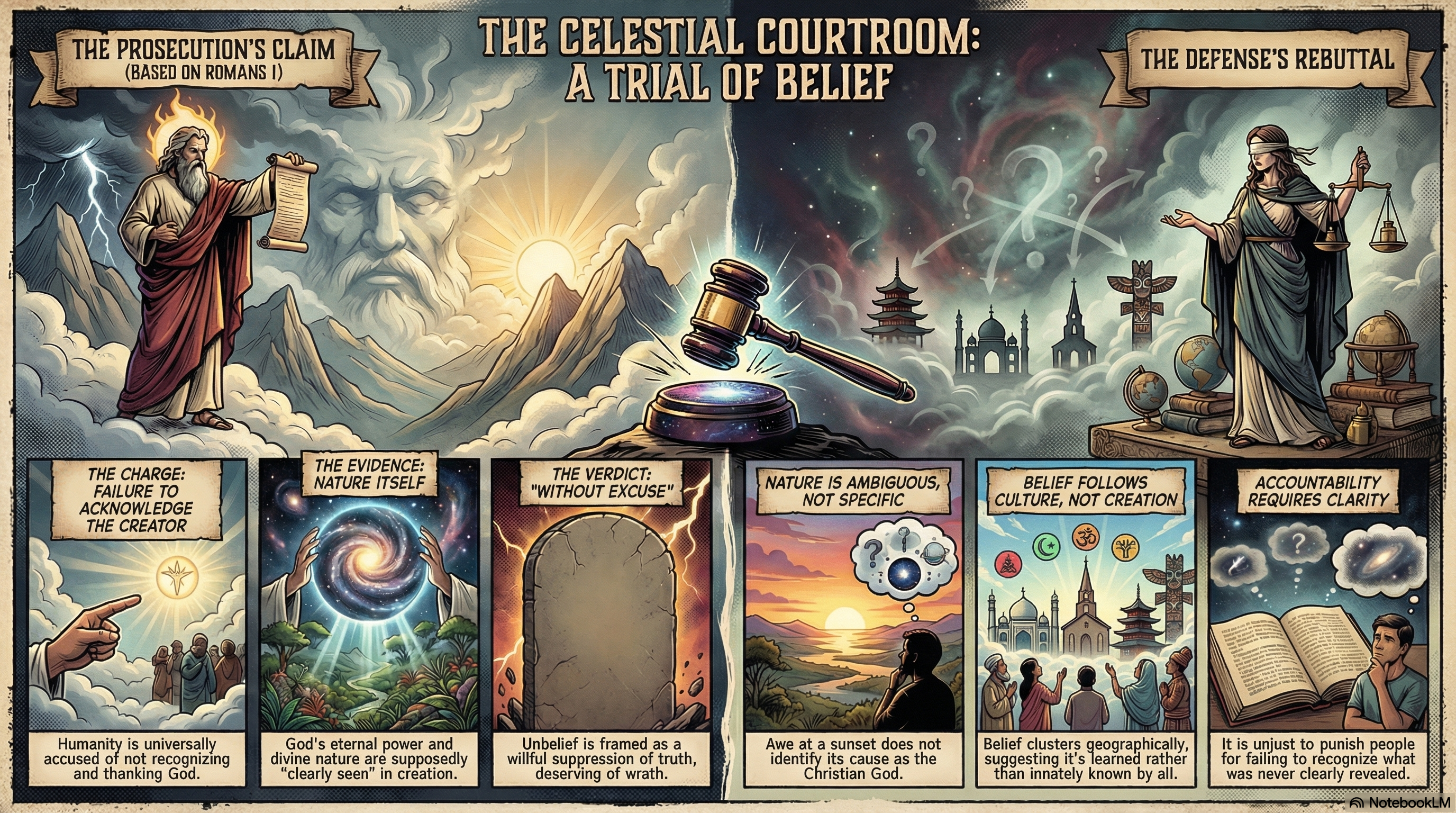
Summary: This post critically examines the claim that nature reveals the Christian God clearly enough to justify universal accountability for unbelief, highlighting inconsistencies between this doctrine and observed cultural influences on religious belief. It argues that if God were truly just and omniscient, He would ensure that knowledge of Him is universally and unmistakably accessible, rather than relying on ambiguous natural evidence.
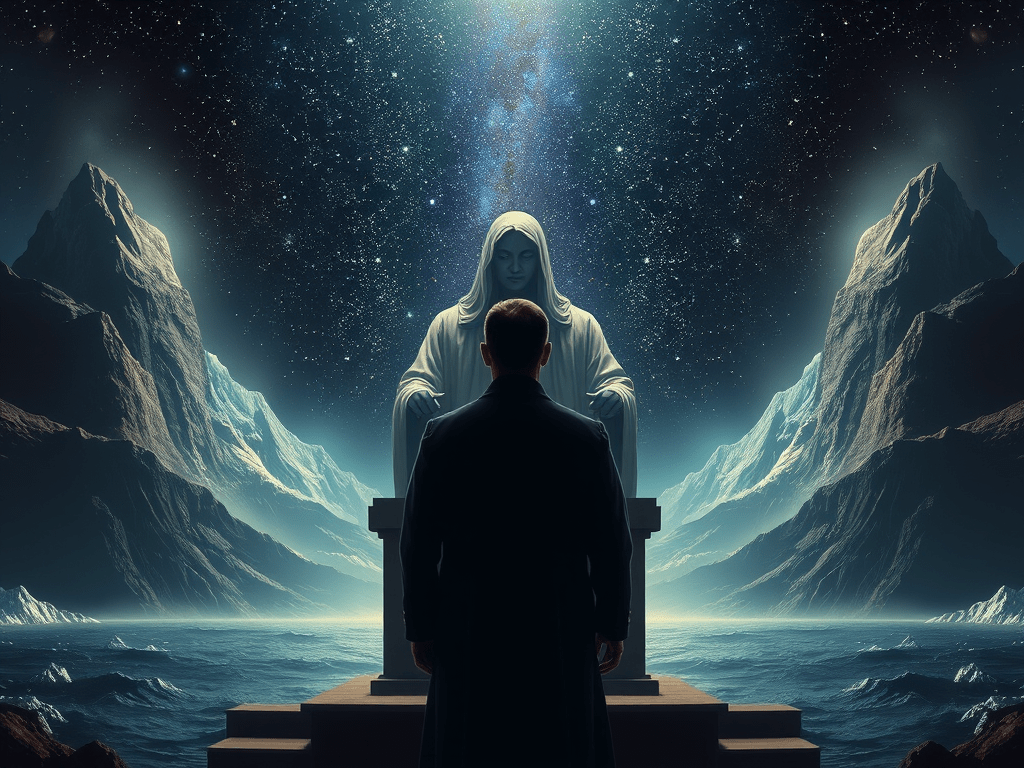
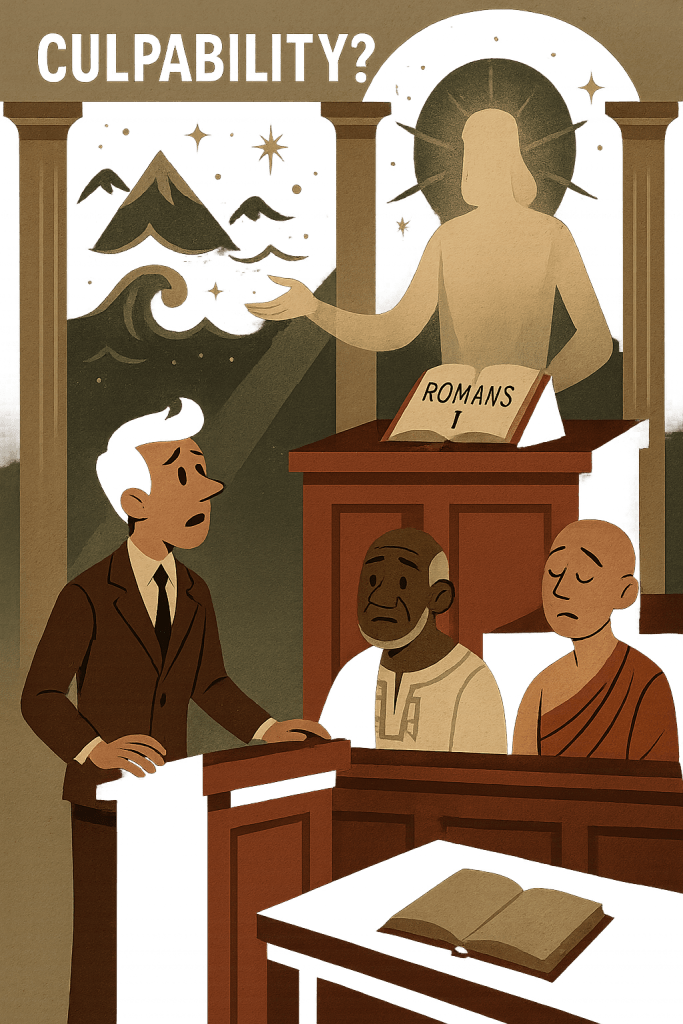
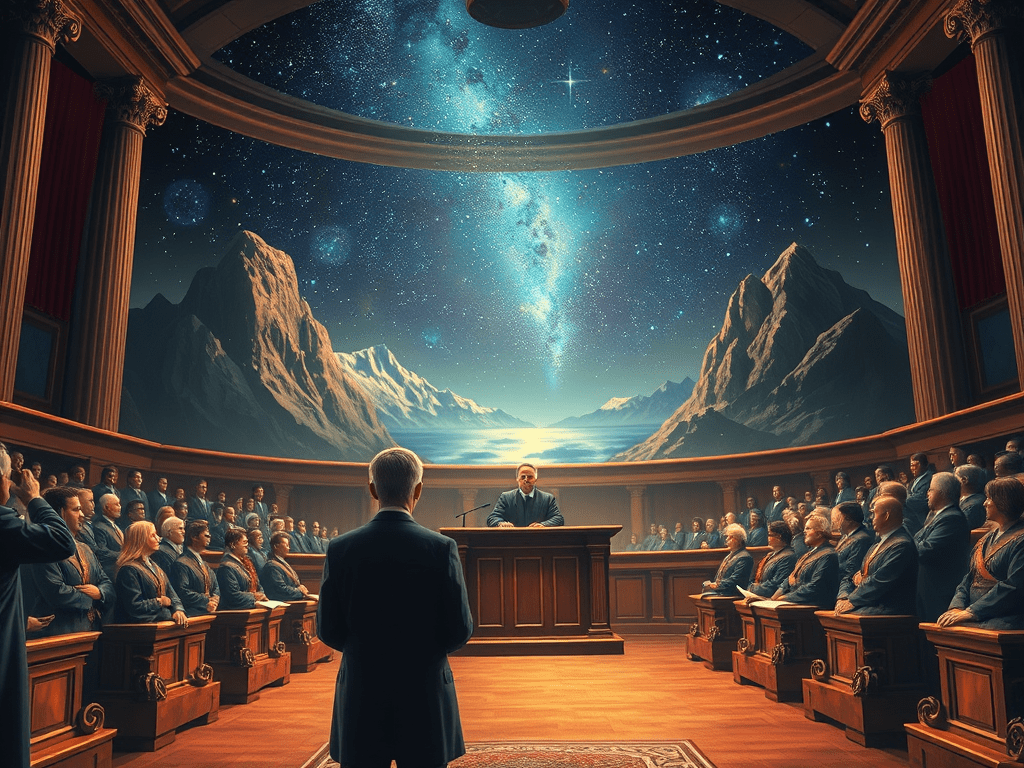
Imagine you are summoned to a grand universal court where the charges against you are grave: failure to recognize and thank the Creator of the universe. As you stand before the judge, the prosecution points to nature as the evidence of your guilt, arguing that the majestic mountains, the vast oceans, and the star-filled night sky made the Creator’s identity and expectations unmistakably clear. Your defense is bewildered. “While these wonders inspired awe,” you explain, “they did not reveal the identity of the Christian God or provide any moral code to follow.”
The prosecution insists that your failure to recognize the true Creator is not ignorance but a deliberate suppression of the truth. Yet you point out the diversity of beliefs worldwide: people in different cultures have seen the same sunrise and storm yet concluded that they worship different gods or none at all. You argue that if this truth were as clear and universal as claimed, belief in the Christian God should transcend geography and culture. Instead, belief often aligns with social context, suggesting that nature alone is insufficient to reveal one particular deity.
As the trial continues, the prosecution declares that you are without excuse, but you raise a pressing question: “If this God is loving and just, why would He choose to remain hidden behind ambiguous signs in nature, knowing full well that countless interpretations would arise? Wouldn’t a just deity ensure that His identity and will were unmistakably clear to all?” The courtroom falls silent, leaving the prosecution struggling to reconcile their claims of universal visibility with the evidence of widespread diversity in belief.
In this trial, the insufficiency of nature as a revelation and the moral inconsistency of the charges become evident. The case against you collapses under the weight of its own contradictions, leaving the jury questioning whether it is just to hold someone accountable for failing to recognize what was never clearly revealed.
The Apostle Paul’s claim in Romans 1:18-21 asserts that God’s wrath is warranted against all who do not recognize and thank Him, based on the belief that His invisible qualities are so clearly displayed in nature that every person is “without excuse.” However, this assertion raises a multitude of philosophical and theological issues that demand careful examination. Can it truly be said that observing the natural world universally reveals the specific, Christian God? Moreover, is unbelief in this God truly a moral failing?
- For the wrath of God is revealed from heaven against all ungodliness and unrighteousness of men, who by their unrighteousness suppress the truth. For what can be known about God is plain to them, because God has shown it to them. For his invisible attributes, namely, his eternal power and divine nature, have been clearly perceived, ever since the creation of the world, in the things that have been made. So they are without excuse. For although they knew God, they did not honor him as God or give thanks to him, but they became futile in their thinking, and their foolish hearts were darkened.
— (Romans 1:18-21)
1. The Nature of Evidence and Divine Attributes
The assumption underlying Paul’s claim is that nature itself provides unmistakable evidence of the Christian God’s eternal power and divine nature. Yet, even if nature is awe-inspiring, awe alone does not equate to evidence for a particular deity. An expansive ocean or a starry sky might suggest grandeur or mystery but hardly clarifies the identity of the cause behind it. It would be a substantial leap to move from marveling at the beauty of nature to concluding the existence of the Christian God, with His specific attributes and intentions.
For a just God to hold all of humanity accountable, the knowledge of His existence must be both unambiguous and accessible. However, the variety of interpretations that arise from observing nature – ranging from animistic beliefs to atheism – suggests that nature does not intrinsically point to one deity or divine system. If the attributes of the Christian God are only accessible through scriptural teachings, can nature genuinely be considered sufficiently clear?
2. Cultural Influence on Belief and Recognition

Paul’s position in Romans implies that all humanity inherently recognizes the Christian God through nature and willfully suppresses this truth. But belief patterns often reflect cultural and geographical influences, not individual rebellion against perceived truth. For example, individuals born in Christian-majority nations are more likely to be Christians, while those in predominantly Buddhist or Hindu societies follow those religions. If the truth of the Christian God were as universal and evident as claimed, one would expect a more homogeneous religious response to nature, rather than a cultural clustering of belief systems.
If the visibility of the Christian God were innate, universally compelling, and undeniable, then why would religious belief be so contingent on geographic and cultural context? The answer suggests that belief is often adopted through socialization rather than direct perception of divine truth, contradicting the claim that unbelief is due to an internal moral failing or suppression of truth.
3. Theological Implications of Universal Culpability
The doctrine of universal accountability asserts that all people, regardless of exposure to the Gospel, are responsible for recognizing and worshiping the Christian God based on natural revelation alone. But is it reasonable or just to hold someone accountable for beliefs they were never introduced to? The implication is that millions are condemned not for rejecting an accessible truth but for failing to infer a specific, culturally-bound deity from the general beauty and order of nature.
Consider those who grow up in remote regions with no exposure to Christian teachings. Are they truly without excuse if they live according to the moral frameworks available to them and express gratitude to whatever source of life they perceive? Such individuals may be sincerely devout, and yet, according to Romans, they are guilty of sin for not recognizing the Christian God. The ethical problem here is significant: punishing people for failing to recognize what was never revealed to them appears inconsistent with any reasonable standard of justice.
4. The Argument from Divine Hiddenness
If the Christian God desires to be worshiped and known, why would He reveal Himself only indirectly through nature, which allows for countless interpretations? The divine hiddenness argument suggests that if God’s nature were truly loving and just, He would ensure clear, unmistakable access to knowledge of Him for all people. A God of justice would not leave His identity open to misinterpretation, nor would He base eternal punishment on a lack of belief in evidence so subtle that it could easily be attributed to a natural process or a different deity.
5. Assessing Moral Culpability in the Light of Romans 1
Romans 1 posits that those who fail to thank the Christian God are suppressing the truth, implying that unbelief is an active rejection rather than a passive outcome of cultural context. Yet, if disbelief often results from upbringing or lack of exposure, rather than conscious rebellion, how is it fair to declare unbelievers morally culpable? In fact, to equate belief in invisible attributes with moral responsibility is to assume that perception and belief are entirely volitional and unaffected by context, which contradicts everything we know about human psychology and social influence.
The claim in Romans thus leads to a logical inconsistency:
- Premise 1: Moral culpability requires both access to and clarity of the truth to which one is accountable.
- Premise 2: Paul claims that all people are morally culpable for not recognizing the Christian God.
- Premise 3: Nature, which is claimed to reveal God, does not unambiguously indicate the Christian God and allows for a multitude of interpretations.
Conclusion: The Bible’s claim of universal accountability for belief in the Christian God is internally inconsistent and ethically problematic.
Final Thoughts on Accountability and Divine Justice

If the natural world alone fails to provide clear, unmistakable evidence of the Christian God, then the idea of condemning those who do not believe is not justifiable. A truly just and omniscient deity would recognize the complex influences on belief and would not hold individuals accountable for failing to interpret natural phenomena in a particular religious way. Such a God would ensure that knowledge of Him is equally accessible to all, transcending cultural, linguistic, and geographic barriers.
Ultimately, the claim that the Christian God’s attributes are “clearly seen” yet widely unrecognized without specific doctrinal teaching suggests that nature itself is insufficient as a universal revelation. Holding individuals accountable for unbelief under these conditions presents a fundamental challenge to the logical coherence of the Christian doctrine.
- The Intrinsic Tension between Romans 1 and Dying for a Lie.
(Clarifications Section)
A Companion Technical Paper:
See also:
The Logical Form
1. Argument from Evidence and Divine Attributes
- Premise 1: Nature provides observable phenomena that may inspire awe but does not specify the identity of any particular deity, let alone the Christian God.
- Premise 2: For universal accountability, the identity of the one to be thanked must be clear and accessible to everyone through evidence.
- Conclusion: Observing nature alone does not provide sufficiently clear and accessible evidence to hold all individuals accountable for belief in the Christian God.

2. Argument from Cultural Influence on Belief
- Premise 1: Religious beliefs cluster geographically and culturally, with individuals often adopting beliefs based on social exposure rather than individual rebellion.
- Premise 2: If belief in the Christian God were truly innate and universally compelling, cultural and geographic clustering of beliefs would be minimal.
- Conclusion: The cultural clustering of beliefs suggests that recognition of the Christian God is not universally obvious and is likely influenced by socialization rather than an inherent suppression of truth.
3. Argument from Divine Hiddenness
- Premise 1: If God desires to be known and worshiped universally, He would not rely solely on nature, which is open to multiple interpretations and lacks unambiguous clarity.
- Premise 2: A truly just and loving deity would ensure clear, unmistakable access to knowledge of Him that transcends cultural, linguistic, and geographic barriers.
- Conclusion: Relying on the ambiguity of natural evidence is inconsistent with the claim that a just God desires universal recognition, suggesting that nature alone is insufficient as a revelation of the Christian God.
4. Argument from Moral Culpability and Volition
- Premise 1: Moral culpability requires both access to the truth and clarity of the truth for which one is accountable.
- Premise 2: The claim in Romans 1 holds all people morally culpable for not recognizing the Christian God, despite many being shaped by upbringing or lack of exposure rather than conscious rejection.
- Conclusion: Declaring unbelievers culpable assumes belief is entirely volitional, overlooking the influence of social and cultural factors and presenting an ethical inconsistency with the doctrine of universal accountability.
5. Argument from Insufficient Universal Revelation
- Premise 1: If nature alone is to reveal the Christian God, it must do so clearly and unmistakably to people across all cultures and contexts.
- Premise 2: Nature, as observed, allows for diverse interpretations and does not point uniquely to the Christian God.
- Conclusion: Holding individuals accountable for unbelief based on ambiguous natural evidence is logically inconsistent with the notion of universal revelation and fails to justify universal accountability.
(Scan to view post on mobile devices.)

A Dialogue
Divine Visibility and Accountability
CHRIS: Let’s start with a central tenet from Romans 1:18-21: God’s existence and divine attributes are so clearly seen in nature that everyone, regardless of background, is without excuse for unbelief. This evidence is enough to hold people accountable if they fail to recognize and thank Him.
CLARUS: But does nature truly reveal the Christian God specifically? While nature can evoke a sense of awe or even a feeling of transcendence, it doesn’t clarify which deity, if any, is responsible for creation. From an evidential standpoint, nature alone doesn’t point to a particular god—let alone the Christian one.
CHRIS: I’d argue that the order and beauty of creation—the intricacy of life, the vastness of the universe—speak to a Creator with the power and wisdom described in the Bible. Isn’t this evidence of a personal God?
CLARUS: I see how nature could lead to a belief in some higher power, but not necessarily the Christian God. People from different cultures and religions look at the same universe and attribute it to their own deities. This cultural clustering suggests that belief systems are more influenced by social context than by objective revelation in nature. If belief in God were as universal and compelling as you suggest, wouldn’t we see more consistency across cultures?
CHRIS: Romans suggests that those who deny God’s existence are suppressing the truth in unrighteousness. Could it be that non-believers resist the truth of God due to a reluctance to accept His moral authority?
CLARUS: That explanation assumes that belief is purely volitional—as though people could simply choose to perceive the Christian God’s presence. But psychology and sociology show us that belief isn’t solely a matter of will; it’s deeply shaped by factors like upbringing and exposure. Can we fairly hold people morally accountable for not believing in a deity they’ve never been introduced to, or for failing to interpret natural evidence in a specific way?
CHRIS: If God wants us to know Him, He would reveal Himself in a way that reaches all people, right? Romans implies that nature is meant to be that revelation, a clear signpost to God’s character and existence.
CLARUS: But that brings up the problem of divine hiddenness. If God truly wants everyone to believe, wouldn’t He provide unambiguous evidence of His existence and identity, not just a vague indication that could be interpreted in countless ways? An omniscient and just deity would understand the variety of human interpretations and would make Himself unmistakably clear to avoid misunderstandings.
CHRIS: You’re suggesting that God’s evidence in nature might be too ambiguous to assign moral culpability for unbelief?
CLARUS: Precisely. If moral accountability requires clear access to truth, then it would be unjust to condemn people based on their failure to interpret natural phenomena in one particular religious framework. Declaring unbelief as culpable overlooks the role of cultural, psychological, and social influences on belief formation.
CHRIS: But Romans states that we are “without excuse” because God’s attributes are “clearly seen” in what has been made. Couldn’t it be that some resist acknowledging Him due to a bias against the idea of divine accountability?
CLARUS: It’s possible for some individuals, but to generalize that to all non-believers is questionable. The diversity of belief worldwide implies that if there is any divine truth in nature, it’s not perceived universally as the Christian God. To base eternal punishment on such ambiguous evidence conflicts with the notion of a loving and just deity—one who would surely ensure that His identity and expectations are clearly understood by everyone.
CHRIS: You’ve given me a lot to consider. If God’s revelation in nature isn’t as clear-cut as Romans claims, then holding people morally accountable for disbelief does seem more complex than I thought.
CLARUS: Exactly. True justice would account for the genuine limitations of human perception and the influence of context on belief. If the stakes are eternal, then God’s self-revelation should transcend all barriers to make belief truly accessible to every person, in every circumstance.
Romans 1:18-21
18 Ἀποκαλύπτεται γὰρ ὀργὴ θεοῦ ἀπ’ οὐρανοῦ ἐπὶ πᾶσαν ἀσέβειαν καὶ ἀδικίαν ἀνθρώπων τῶν τὴν ἀλήθειαν ἐν ἀδικίᾳ κατεχόντων·
19 διότι τὸ γνωστὸν τοῦ θεοῦ φανερόν ἐστιν ἐν αὐτοῖς· ὁ θεὸς γὰρ αὐτοῖς ἐφανέρωσεν.
20 τὰ γὰρ ἀόρατα αὐτοῦ ἀπὸ κτίσεως κόσμου τοῖς ποιήμασιν νοούμενα καθορᾶται, ἥ τε αἰδιος αὐτοῦ δύναμις καὶ θειότης, εἰς τὸ εἶναι αὐτοὺς ἀναπολογήτους,
21 διότι γνόντες τὸν θεὸν οὐχ ὡς θεὸν ἐδόξασαν ἢ ηὐχαρίστησαν, ἀλλ’ ἐματαιώθησαν ἐν τοῖς διαλογισμοῖς αὐτῶν καὶ ἐσκοτίσθη ἡ ἀσύνετος αὐτῶν καρδία.
Notes:
Helpful Analogies
Analogy 1: The Obscured Author
Imagine entering a grand library filled with beautiful books but without any clear authorship information on any of the covers or spines. While you might be awestruck by the library and admire the craftsmanship of the books, nothing specifically points to a single, identifiable author—let alone to their character or intentions. Expecting every visitor to conclude that these works were crafted by one particular author and to be held accountable for not recognizing them would be unjust if authorship is not unmistakably clear. This parallels the ambiguity of divine identity in nature; even if one perceives something remarkable, there is no definitive indicator that this should point to the Christian God specifically.
Analogy 2: The Masked Messenger

Consider a king who wishes to be acknowledged and thanked by all his subjects. Instead of appearing in person, he sends a masked messenger who is indistinguishable from messengers sent by other rulers. If the king later punishes subjects who failed to recognize his true identity through this masked figure, it would seem unreasonable—clarity of identity is essential for just accountability. Similarly, if God’s identity is masked by ambiguous natural signs, punishing people for failing to interpret nature as evidence of the Christian God does not align with justice or clarity.
Analogy 3: The Silent Instructor
Imagine a teacher who leaves complex math problems on the board for students but provides no instructions, context, or assistance. Some students might attempt to solve the problems, others may interpret them as puzzles, and still, others might ignore them entirely. Later, the teacher punishes the students who failed to solve the problems correctly, claiming the solutions should have been obvious. This lack of direct guidance or explicit instruction parallels the argument that nature alone, without clear divine context, is insufficient to expect universal recognition of the Christian God. Holding people morally accountable for not deriving the “correct” answer from an ambiguous set of signs would be unreasonable, especially if eternal consequences are at stake.
Addressing Theological Responses
Theological Responses
1. Nature as Clear Evidence of a Creator
Many theologians argue that nature itself serves as clear evidence of a creator, specifically the Christian God, whose qualities are revealed in the order, beauty, and complexity of the universe. They claim that God’s “invisible qualities” are not ambiguous but are consistently perceived through the intelligibility of natural laws and the fine-tuning of the universe. According to this view, Romans 1:20 implies that these attributes should naturally lead to recognition of God’s eternal power and divine nature, aligning with an innate human ability to perceive a higher power.
2. Cultural Clustering Does Not Negate Universal Revelation
Theologians might respond that cultural clustering does not inherently negate the claim that God is universally recognizable in nature. Instead, they argue that human interpretations of God are influenced by cultural filters but that these filters do not eliminate the underlying universal revelation. Despite diverse religious expressions, many maintain that all humans have a fundamental awareness of divinity and that this is why belief in a higher power is present in nearly every culture—a testimony to an innate sense of the divine or “sensus divinitatis.”
3. Divine Hiddenness as a Test of Free Will
Some theologians propose that divine hiddenness serves a purpose in testing human free will and moral integrity. According to this perspective, God desires that individuals seek Him genuinely, without being compelled by overwhelming, unavoidable evidence. They might argue that partial hiddenness allows for a voluntary response to God, emphasizing that faith requires a choice. In this view, while nature provides enough evidence to recognize a divine creator, the lack of explicit, undeniable proof respects human freedom to accept or reject that evidence.
4. Moral Culpability and the Suppression of Truth
Theologians may assert that moral culpability arises from the suppression of truth in unrighteousness, as Romans 1:18 describes. They contend that individuals intuitively recognize the reality of a moral order and a divine creator but may willfully suppress this knowledge due to moral resistance or personal desires. Thus, disbelief is seen as more than ignorance; it is viewed as an active resistance against an evident truth, implying moral accountability even for those who might not explicitly know the Christian doctrine.
5. Natural Revelation as Sufficient for Accountability
Another common response is that natural revelation provides sufficient grounds for accountability without requiring exhaustive doctrinal knowledge. Theologians often argue that general revelation through nature offers basic awareness of God’s existence and moral expectations. This knowledge is deemed adequate for holding individuals accountable for their responses to the creator’s self-revelation, with specific scriptural knowledge seen as beneficial but not essential for recognizing God’s authority and one’s duty to acknowledge and thank Him.
Counter-Responses
1. Response to “Nature as Clear Evidence of a Creator”
While nature’s order and complexity might suggest a higher power to some, these qualities do not inherently identify this power as the Christian God or confirm His specific attributes, such as omnipotence or benevolence. Many naturalistic explanations—such as evolution and cosmic fine-tuning—also account for the phenomena we observe without requiring a deity. Therefore, attributing these features solely to the Christian God remains an interpretation rather than an unavoidable conclusion, challenging the claim that nature alone provides clear and unambiguous evidence of this specific deity.
2. Response to “Cultural Clustering Does Not Negate Universal Revelation”
While theologians argue that cultural clustering does not negate universal revelation, the diversity and specificity of religious beliefs worldwide suggest that cultural context plays a significant role in shaping one’s interpretation of the divine. If God’s identity and attributes were universally self-evident, we would expect more uniformity in religious belief across different societies. The prevalence of varying, often contradictory religious systems implies that cultural and social influences can obscure or reshape any supposed innate sense of the divine, questioning the validity of natural revelation as a reliable source of accountability.
3. Response to “Divine Hiddenness as a Test of Free Will”
The argument that divine hiddenness is a test of free will assumes that faith is meaningful only if it is chosen under conditions of partial evidence. However, partial hiddenness risks creating confusion and misinterpretation about God’s intentions and attributes, undermining the fairness of holding people accountable for not recognizing Him. A just deity desiring genuine recognition would ensure that this recognition is accessible and unambiguous, allowing individuals to respond freely to clear knowledge, rather than leaving them to interpret ambiguous signs that could lead to eternal consequences if misinterpreted.
4. Response to “Moral Culpability and the Suppression of Truth”
The assertion that unbelief is a suppression of truth presumes that non-belief in God is an act of willful rebellion rather than a natural outcome of diverse human experiences and reasoning processes. Many individuals arrive at non-belief through sincere investigation, cultural exposure, or intellectual inquiry rather than moral resistance. Assuming that all disbelief is morally culpable dismisses the legitimacy of these factors and fails to account for the influence of context and knowledge limitations on individual belief, making it unreasonable to assign moral culpability uniformly.
5. Response to “Natural Revelation as Sufficient for Accountability”
While natural revelation may suggest some form of higher order or mystery, it does not provide the specific details about God’s identity, intentions, or requirements, particularly the complex doctrines unique to Christianity. Holding individuals accountable based solely on natural observation does not allow for a fair understanding of what they are expected to believe or do. If eternal consequences hinge on correctly interpreting ambiguous evidence from nature, then natural revelation alone is insufficient for just accountability, as it lacks the clarity needed for a universally fair standard.
Clarifications
◉ Necessary Elements for Culpability to Take Hold
- Existence of a Recognizable Moral Authority
There must be a clear, identifiable source of moral authority, such as a deity or moral lawgiver, whose expectations are explicitly known. - Clear Understanding of the Moral Code
Individuals must have access to a clear and understandable set of moral guidelines or expectations set forth by this authority. - Unambiguous Communication of Moral Expectations
The moral authority must communicate its expectations in a manner that is unmistakable and accessible to all individuals, regardless of cultural or personal circumstances. - Accessibility to the Moral Knowledge
Every individual, regardless of geographic or social context, must have the opportunity to encounter and understand the moral code. - Capacity to Recognize Moral Authority’s Identity
Individuals must be able to identify not only a sense of moral duty but also the specific authority who imposes this duty, in this case, the Christian God, rather than any other deity or general notion of divinity. - Intention and Volition in Rejecting the Moral Authority
Culpability requires that individuals knowingly and willfully reject the moral code or moral authority, understanding the consequences of their choice.
Argument: Why “The Things Which Are Made” Lack These Necessary Elements
Observing nature and “the things which are made” lacks nearly all the necessary elements for establishing culpability:
- Lack of Recognizable Moral Authority
Nature displays beauty, complexity, and order, but it does not reveal a specific, identifiable moral authority like the Christian God. Natural phenomena could be attributed to a variety of sources, from impersonal natural forces to deities from numerous religious traditions. Without clarity on who or what the moral authority is, culpability cannot be established. - Absence of a Clear Moral Code
While nature may suggest patterns or interdependence, it does not provide a specific moral code or set of commands that individuals are obligated to follow. Interpreting any kind of moral guidelines from natural events or structures is subjective and open to broad interpretation, meaning that any supposed moral code remains ambiguous and indirect. - Ambiguity in Communication of Moral Expectations
Nature does not communicate in an explicit or uniform language that conveys specific moral expectations. For example, natural disasters, animal behaviors, or ecological interconnections do not carry a clear, universally interpretable message about moral duties or the Christian God’s specific will for humanity. - Inaccessibility of Moral Knowledge for All
Cultural and geographical differences significantly affect individuals’ perception of nature and any supposed revelation it offers. People raised in different religious or cultural contexts interpret natural phenomena through the lens of their own beliefs, lacking an accessible and uniform moral knowledge across societies. - Lack of Specific Identification of the Christian God
Even if one perceives a higher power through nature, it would not necessarily lead to the recognition of the Christian God. Nature does not provide specific indicators that would guide individuals toward belief in Christian doctrines over other spiritual frameworks, making it unreasonable to hold them culpable for not identifying this particular deity. - Absence of Willful Rejection
In the absence of a clear, specific revelation, individuals cannot be said to knowingly reject the Christian God or His moral law. Culpability requires an understanding and intentional dismissal of the known authority, which is not possible if nature does not make this authority and moral code unmistakably known.
In conclusion, holding individuals culpable based solely on what can be inferred from nature fails to meet nearly all the necessary elements for moral responsibility. Without a clear moral authority, an explicit moral code, and unambiguous communication accessible to all, any supposed revelation in nature is insufficient for justifying universal accountability.
The Necessary Cognitive Steps to Culpability Before the Gospel
(If Romans 1:20 is True)
P1: If Romans 1:20 is true, then every person must reach a state of culpability based solely on their observation of the natural world, even before encountering the Gospel.
P2: Culpability requires an awareness of a divine being’s existence, nature, and moral expectations.
P3: Observation of the natural world only provides empirical data about physical phenomena (e.g., stars, trees, complexity of life, etc.).
P4: Inferring the existence of a divine being from natural observations requires additional cognitive steps, including:
- Recognizing that complexity implies intentional design.
- Concluding that this design necessitates a designer.
- Assuming that the designer is personal rather than a deistic force.
- Attributing specific characteristics (omniscience, omnipotence, justice, etc.) to this designer.
P5: Inferring that this divine being is specifically the Christian God (rather than a generic deity) requires further cognitive steps:
- Distinguishing Christian theism from competing religious explanations.
- Associating observed natural order with biblical claims.
P6: Recognizing personal culpability under this being’s moral expectations requires yet another set of cognitive steps:
- Identifying the being’s moral law.
- Understanding how this law applies to human behavior.
- Recognizing oneself as a violator of that law.
P7: These cognitive steps require either explicit instruction (e.g., scripture, religious teaching) or intuitive reasoning not universally evident from nature alone.
P8: If these steps are required for culpability, and if some people never perform them without external religious teaching, then Romans 1:20 does not logically lead to universal pre-Gospel culpability.
Conclusion: If Romans 1:20 is true in the way some Christians claim, then every person must independently complete all these cognitive steps before hearing the Gospel. However, since these steps require reasoning beyond mere natural observation, the claim that all people achieve pre-Gospel culpability from nature alone is untenable.
Symbolic Representation
Definitions of Symbols:
- Romans 1:20 is true
- A person reaches culpability before hearing the Gospel
- A person observes the natural world
- A person infers a divine being exists
- A person infers that the divine being is specifically the Christian God
- A person infers the moral expectations of this being
- A person recognizes personal violation of these moral expectations
- Additional cognitive inference beyond natural observation
- External religious teaching (e.g., scripture, evangelism)


Formal Argument:
- Premise 1 (Romans 1:20 states that culpability occurs before the Gospel):

Premise 2 (Culpability requires recognition of a divine being, its identity, and its moral expectations):

Premise 3 (Natural observation alone does not entail these inferences):

Premise 4 (These inferences require either additional cognitive inference or external religious teaching):

Premise 5 (Some individuals do not engage in sufficient cognitive inference without external religious teaching):

Premise 6 (If some individuals do not receive external religious teaching and do not infer these things independently, then they do not reach culpability):

Conclusion (If Romans 1:20 is true and culpability must be universal before the Gospel, but it is not achieved through nature alone, then Romans 1:20 is false under this interpretation):

Interpretation:
Since natural observation alone does not universally lead to culpability and external religious teaching is required for some individuals, it follows that Romans 1:20 cannot be universally true in the way it is often interpreted.
◉ Why Few Christian Testimonies Begin with the Recognition of a God & His Moral System in Nature

One of the foundational claims of Christian theology is that God’s presence is evident in nature, rendering humanity “without excuse” for unbelief (Romans 1:20). According to this view, the beauty, complexity, and order of the natural world supposedly reveal God’s qualities, making Him accessible to anyone willing to acknowledge His existence. However, a curious observation arises when we examine Christian testimonies: while many believers recount transformative moments of personal revelation, faith, or encounter with God, very few, if any, begin their stories by asserting they initially recognized the Christian God solely through nature. This absence invites reflection on why nature alone seems insufficient for inspiring belief and the implications this has for doctrines of divine visibility and moral accountability.
The Nature of Christian Testimonies
Christian testimonies typically recount a journey from unbelief or nominal faith to a personal relationship with God. This journey often involves specific events—like encountering Christian teachings, witnessing acts of kindness, experiencing inner peace, or feeling the presence of the Holy Spirit—that lead the individual toward a conversion experience. Such testimonies rarely describe an individual observing the world around them, concluding the Christian God’s existence based purely on nature, and then moving on to embrace Christian doctrine. Instead, testimonies usually pivot on direct religious experiences or the persuasive impact of scriptural teachings and community influence.
This pattern suggests that nature alone may not sufficiently identify the Christian God, even if it might inspire awe or suggest spiritual wonder. If nature were a universally recognized avenue to the Christian God, it would be reasonable to expect that more testimonies would begin with descriptions of the natural world as a clear and direct revelation. Instead, the absence of this starting point hints that nature lacks the specific indicators necessary to draw individuals to the Christian faith without additional interpretive frameworks.
Nature’s Ambiguity and the Need for Context
One reason why testimonies rarely start with an acknowledgment of God in nature is that natural phenomena are open to a wide range of interpretations. A mountain vista, a night sky filled with stars, or the intricate design of an ecosystem may evoke a sense of wonder but does not explicitly point to the Christian God. Such experiences could equally inspire thoughts of a different deity, an abstract creative force, or even a naturalistic worldview that sees the universe as beautiful but impersonal.
In most testimonies, belief in God typically arises not through personal observation of nature but through exposure to religious teachings that interpret natural experiences in a specific way. The Bible orients the believer to see God’s hand in creation, but without these scriptural lenses, the same scenes may not intuitively direct the observer to the Christian doctrine of God. Thus, nature alone lacks the clarity and specificity required to confirm the attributes of the Christian God without the contextual reinforcement of religious education and community support.
The Role of Cognitive and Cultural Influences
Belief formation is profoundly influenced by cognitive predispositions and cultural context. Most people encounter the idea of God through social and familial influence, and religious beliefs often reflect cultural upbringing rather than independent conclusions derived solely from observing the natural world. When individuals report coming to believe in the Christian God, they are usually introduced to this belief through external sources—religious texts, family teachings, or cultural norms—rather than through spontaneous insight from nature. Testimonies, therefore, reflect this cultural shaping, as individuals often come to recognize God within a framework they’ve been taught, not one they independently discerned in the world around them.
The cultural diversity of religious beliefs further highlights this point. In societies where Christianity is not predominant, people do not universally perceive the Christian God in nature. Instead, they interpret natural beauty and complexity according to their own religious or spiritual traditions. If nature were a clear revelation of the Christian God, such variations would be unlikely. Instead, the diversity of religious responses to nature suggests that interpretation is deeply contextual and that nature alone does not provide a universally recognized revelation.
Moral and Philosophical Implications
The absence of testimonies that begin with recognizing God in nature also raises questions about the moral accountability outlined in passages like Romans 1:20. If nature does not lead people unambiguously to the Christian God, it seems problematic to hold them accountable for not recognizing Him through natural observation alone. If faith typically requires scriptural or communal guidance to interpret nature as pointing to the Christian God, then the claim that nature alone renders humanity “without excuse” seems ethically and philosophically tenuous.
In fact, the lack of direct testimonies based on nature suggests that additional knowledge or experiences are necessary to bring individuals to belief in the Christian God, a requirement that undermines the notion that nature alone suffices for moral accountability. This disconnect raises significant concerns about the fairness of holding people accountable based on ambiguous evidence when clear, specific revelation appears necessary to foster genuine belief.
Conclusion: The Limits of Nature in Inspiring Faith
Ultimately, the lack of Christian testimonies that begin with recognizing in nature a God to whom we owe moral obligation reflects a deeper theological and epistemological challenge. While nature can inspire wonder and a sense of mystery, it does not seem to offer the clarity or specificity required to identify the Christian God without the aid of scriptural interpretation and religious community. This absence invites reflection on the adequacy of natural revelation as a basis for faith and accountability, suggesting that nature alone is insufficient for establishing a belief in the Christian God that meets the criteria for culpable rejection.
If the Christian doctrine holds that God’s existence is evident in nature, then the prevalence of conversion testimonies reliant on personal, cultural, or scriptural contexts implies that God’s presence in nature is not as self-evident as suggested. Therefore, the absence of testimonies beginning with a natural revelation of God raises profound questions about the nature of divine visibility and the fairness of moral accountability based on ambiguous evidence in the natural world.
◉ The Tension Between “Suppressing the Truth” & “No One Dies for a Lie”
In Christian apologetics, two prominent arguments often appear in discussions of belief and unbelief. The first, drawn from Romans 1:18-20, claims that unbelief is a result of humans suppressing the truth in unrighteousness, suggesting that non-believers are aware of the truth of God’s existence but willfully reject it. The second is the popular apologetic phrase “no one dies for a lie,” typically applied to defend the sincerity and truthfulness of early Christian martyrs. This argument posits that people would not willingly face persecution and death if they were not sincerely convinced of the truth of their beliefs. However, these two arguments create a tension: if non-believers are knowingly suppressing the truth, it implies a degree of awareness that conflicts with the concept of sincere conviction, raising questions about how these two ideas can coexist within a coherent apologetic framework.
Argument 1: Suppression of Truth in Unrighteousness
According to the Apostle Paul in Romans 1:18-20, all people possess an innate awareness of God’s existence, as His attributes are “clearly seen” in creation. Paul argues that unbelief is not an innocent ignorance but a deliberate act of suppression, a willful rejection of an obvious truth. This suggests that non-believers actively resist acknowledging God, motivated by unrighteous desires rather than intellectual doubt or lack of evidence.
The implication here is significant: if everyone inherently knows the truth of God’s existence, then unbelief is not merely a matter of persuasion or conviction but a moral choice to ignore or suppress that truth. This understanding presupposes a form of cognitive dissonance in non-believers, where they are internally aware of God’s existence but outwardly deny it, driven by an aversion to moral accountability. Consequently, unbelief is framed as a moral failing rather than an intellectual or cultural difference, placing non-believers in a morally culpable position.
Argument 2: No One Dies for a Lie
On the other hand, the argument that “no one dies for a lie” is used to defend the credibility of the early Christian apostles and martyrs. Apologists argue that the willingness of these individuals to face imprisonment, torture, and execution serves as powerful evidence that they genuinely believed in the truth of the resurrection and the divinity of Christ. According to this logic, no one would knowingly endure such hardships for something they knew to be false, suggesting that their convictions were sincere and that they had no reason to “suppress the truth” or harbor doubt.
This trope underscores the importance of sincerity and personal conviction in belief, arguing that deep-seated belief in the truth of a claim is necessary to withstand persecution. By emphasizing that these early believers did not die for a deception, this argument aims to validate the authenticity of their experiences and testimonies. The underlying assumption here is that people’s convictions reflect their understanding of truth and that they act on what they genuinely believe rather than on suppressed or distorted truths.
The Tension Between Suppression and Sincerity
These two apologetic claims are not immediately compatible. If unbelievers are accused of suppressing the truth, then it implies a level of awareness of that truth that seems to contradict the notion of sincere conviction required for martyrdom or deep personal belief. On one hand, apologists argue that non-believers are aware of God’s existence but choose to deny it; on the other hand, they hold up martyrs as examples of authentic belief that would not falter under persecution. The issue arises because sincere belief and willful suppression seem to require different psychological conditions: the former relies on honest conviction, while the latter presumes dishonest resistance to an inner truth.
If unbelievers are genuinely suppressing knowledge of God, then their outward disbelief could be construed as inauthentic, which raises a question about the authenticity of early Christian belief. In other words, if people are prone to suppress truth for unrighteous reasons, could this same tendency apply to believers who suppress doubt or uncertainty? The apologetic trope of “no one dies for a lie” depends on the assumption that martyrs are motivated by sincere belief, yet if suppression of truth is a human tendency, it is conceivable that individuals could suppress doubts about their faith, even to the point of martyrdom.
A Critique of the “Suppression” Argument
The claim that non-believers are suppressing truth assumes that awareness of God is universal and undeniable, a notion that doesn’t account for cultural and intellectual diversity. Many non-believers express genuine skepticism or intellectual opposition to religious claims, based not on a moral aversion to truth but on personal reasoning, experiences, or alternative worldviews. If belief and unbelief stem from complex cognitive processes influenced by cultural, philosophical, and psychological factors, then labeling all unbelief as suppression oversimplifies these dynamics and dismisses sincere non-belief as mere rebellion.
This perspective also risks undermining authentic intellectual inquiry, as it reduces disagreement to moral resistance rather than respecting the diversity of human thought. Furthermore, the “suppression” argument can seem self-reinforcing, as it preempts intellectual engagement with the presumption that disagreement is inherently dishonest. By assuming that all unbelief is morally culpable, the suppression argument effectively denies good faith disagreement, making genuine discussion difficult.
A Critique of “No One Dies for a Lie”
The argument that martyrs’ sincerity proves truthfulness has its own weaknesses. History provides numerous examples of martyrs from various religions who died for beliefs they held sincerely but which were later shown to be inconsistent or contradictory. Martyrdom alone does not guarantee objective truth; it only indicates that individuals believed deeply enough in a cause to face suffering or death. Moreover, psychological commitment to an idea can sometimes lead individuals to suppress contrary evidence or doubts in order to maintain coherence in their beliefs, suggesting that martyrdom does not automatically signal an absence of suppression or self-deception.
The psychological tendency for confirmation bias can reinforce beliefs under threat, sometimes to the point of self-sacrifice. Thus, the willingness to die for a belief may indicate subjective conviction but does not necessarily prove the objective truth of that belief. If martyrdom itself were sufficient evidence for truth, then every religious martyr across history would validate the truth of their respective beliefs, an untenable conclusion.
Syllogistic Form of the Primary Argument Highlighting the Tension Between the Two Claims
Premise 1: All non-believers suppress the truth.

Premise 2: Those who suppress the truth hold inauthentic beliefs.

❖ Conclusion 1: Therefore, all non-believers hold inauthentic beliefs.

Premise 3: Martyrs sincerely believe in their cause (hold authentic beliefs).

Premise 4: If people can hold inauthentic beliefs, then sincerity does not necessarily indicate truth.

❖ Conclusion 2: Therefore, the argument that martyrs’ sincerity proves the truth of their belief is undermined by the possibility that people can suppress truth and hold inauthentic beliefs.
Symbolic Logic Representation
Let:
:
is a non-believer.
:
:
:
:
:
Premise 1:
![\forall x \, [\, N(x) \rightarrow S(x) \,]](https://s0.wp.com/latex.php?latex=%5Cforall+x+%5C%2C+%5B%5C%2C+N%28x%29+%5Crightarrow+S%28x%29+%5C%2C%5D&bg=ffffff&fg=000&s=0&c=20201002)
Premise 2:
![\forall x \, [\, S(x) \rightarrow I(x) \,]](https://s0.wp.com/latex.php?latex=%5Cforall+x+%5C%2C+%5B%5C%2C+S%28x%29+%5Crightarrow+I%28x%29+%5C%2C%5D&bg=ffffff&fg=000&s=0&c=20201002)
Conclusion 1:
![\forall x \, [\, N(x) \rightarrow I(x) \,]](https://s0.wp.com/latex.php?latex=%5Cforall+x+%5C%2C+%5B%5C%2C+N%28x%29+%5Crightarrow+I%28x%29+%5C%2C%5D&bg=ffffff&fg=000&s=0&c=20201002)
Premise 3:
![\forall x \, [\, M(x) \rightarrow A(x) \,]](https://s0.wp.com/latex.php?latex=%5Cforall+x+%5C%2C+%5B%5C%2C+M%28x%29+%5Crightarrow+A%28x%29+%5C%2C%5D&bg=ffffff&fg=000&s=0&c=20201002)
Premise 4:
![\exists x \, [\, I(x) \,] \Rightarrow \neg \left( \forall x \, [\, A(x) \rightarrow T(x) \,] \right)](https://s0.wp.com/latex.php?latex=%5Cexists+x+%5C%2C+%5B%5C%2C+I%28x%29+%5C%2C%5D+%5CRightarrow+%5Cneg+%5Cleft%28+%5Cforall+x+%5C%2C+%5B%5C%2C+A%28x%29+%5Crightarrow+T%28x%29+%5C%2C%5D+%5Cright%29&bg=ffffff&fg=000&s=0&c=20201002)
Explanation:
- From Premise 1 and Premise 2, we conclude that non-believers hold inauthentic beliefs.
- Premise 3 states that martyrs hold authentic (sincere) beliefs.
- Premise 4 suggests that the existence of inauthentic beliefs means that authentic belief (sincerity) does not guarantee truth.
- Therefore, the claim that martyrs’ sincerity proves the truth of their beliefs is challenged by the fact that people can hold inauthentic beliefs due to suppressing the truth.
- This creates a tension between the two claims, as one undermines the foundational assumption of the other.
Final Conclusion:
The tension arises because if people are capable of suppressing the truth and holding inauthentic beliefs (as argued regarding non-believers), then the sincerity of martyrs does not necessarily validate the truth of their beliefs. This challenges the argument that “no one dies for a lie,” highlighting an inconsistency within the apologetic framework.
Simplified Argument: Sincerity vs. Suppression in the Face of Persecution
If we claim that the disciples were fully aware of the consequences of their beliefs and that they would not face persecution and death unless they were sincerely convinced of Jesus’ deity, then we cannot simultaneously argue that non-believers choose unbelief while knowingly suppressing the truth of God’s existence.
This is because:
- Sincere Conviction Requires Clarity of Truth
The disciples’ willingness to suffer persecution hinges on the argument that they were genuinely convinced of the truth of Jesus’ divinity, suggesting that clear and unambiguous truth is necessary for sincere conviction, especially when facing grave consequences. - Willful Suppression Implies Awareness of Truth
If non-believers are accused of suppressing the truth, then they must have some degree of clarity and awareness of this truth. If it is clear enough to be actively suppressed, then it is also clear enough to factor into decisions about eternal destiny, similar to how the disciples factored in their sincere conviction when facing persecution. - Perishing for a Suppressed Truth Contradicts Human Psychology
If humans do not die for what they know is false, as the “no one dies for a lie” argument suggests, then it is inconsistent to claim that individuals might also perish while knowingly suppressing a truth. Humans naturally avoid significant risks—especially eternal consequences—if they understand the risks to be real.
Conclusion: If truth is clear enough to be actively suppressed, it should also be clear enough to influence one’s choices about ultimate beliefs and eternal outcomes. Therefore, the claim that people intentionally suppress the truth undermines the argument that the disciples’ martyrdom validates their beliefs, as both claims require opposing assumptions about how humans respond to clear truth.


Leave a Reply