

Consider the Following:

Summary: This post challenges the notion that religious peace and joy are unique, suggesting that emotional highs often attributed to divine influence can be naturally explained through communal practices like music and dance. It advocates for a resilient, rationally grounded peace, urging seekers to distinguish lasting joy from temporary, context-dependent emotional states.

The Illusion of Authenticity Through Emotional Certainty
Imagine a teenager deeply infatuated with a celebrity, envisioning a connection despite improbable odds. Emotions become a powerful distorter of reality, building mental walls that dismiss any evidence to the contrary. This phenomenon can be similarly observed in religious faith. Consider a Muslim child surrounded by family, within a majestic mosque, feeling immense joy that reinforces belief in Allah. Such emotional certainty often convinces individuals that the feelings they experience are unique to their faith.
The Universality of Religious Emotion
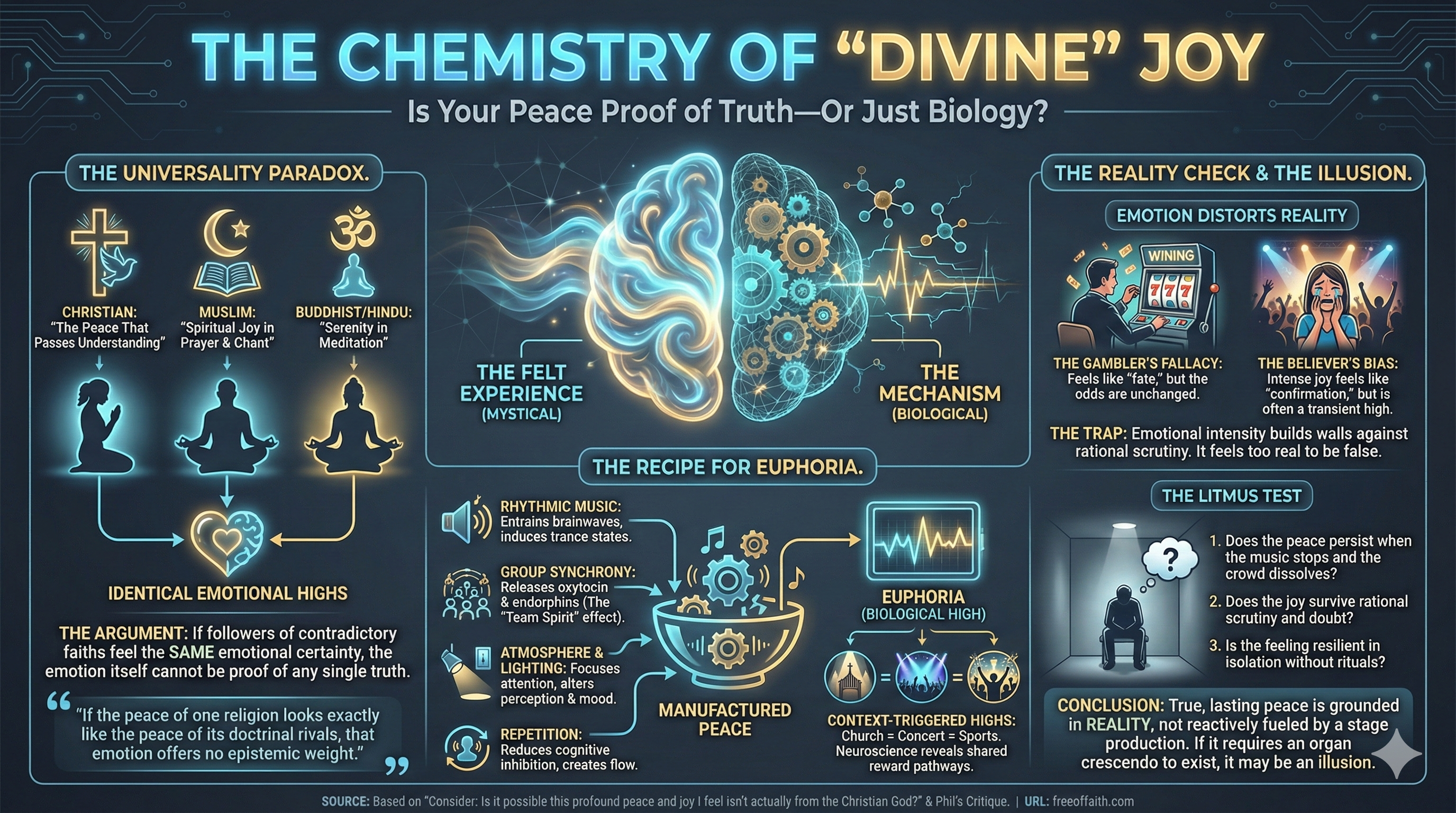
Nearly all major religions foster environments that produce powerful feelings through ritual, music, and architecture. This “peace and joy” experienced by Christians, Mormons, Muslims, and followers of other beliefs feels deeply personal and true, but it is indistinguishable across faiths. For example, a Mormon’s “burning in the bosom” is equated with the Christian peace of the Lord or a Muslim’s spiritual joy. This cross-cultural similarity raises the question: Are these emotions truly divine, or are they products of context?

The Inadequacy of Emotion as Evidence
The idea that emotional experiences validate religious truth becomes problematic when similar feelings are present in mutually exclusive faiths. Intense joy can be an inadequate indicator of truth, as emotions are notoriously unreliable. Once individuals place faith in an ideology that promises superior peace, they may become unpersuadable by reason alone, as conflicting evidence often lacks the emotive power to penetrate deeply held beliefs.
Cognitive Mechanisms and Rational Inquiry
The Bible claims the Holy Spirit as a source of certainty in Christian faith, but validating this presence is complex. Verification requires a secondary source, leading to an infinite regress of proof. The only reliable means of truth verification is scientific inquiry rather than an unverifiable sensation attributed to Jesus or the Holy Spirit. Rational investigation allows us to examine whether these intense emotions are distinguishable from common psychological experiences.
A Rational Conclusion

Thus, if the joy and peace one attributes to the Christian God are indistinguishable from those felt by followers of other faiths, these emotions offer no valid proof of truth. Reasoned inquiry, rather than emotional conviction, remains the most secure path to understanding the nature of such spiritual experiences.
Seeking Out Unfamiliar Joys and Peace
When considering the types of joy and peace we experience, we must remain open to the possibility that there are varieties of these feelings we have not yet encountered. The scope of human emotion is vast, and what we interpret as spiritual or transcendent peace may simply be one facet of a broader emotional spectrum yet unexplored. A joy rooted in discovering personal truth or finding purpose in life, for instance, might provide a deeply fulfilling sense of peace that transcends religious frameworks.
To discern whether a feeling is genuinely unique to a particular ideological or spiritual framework, we need to assess its lasting impact and consistency outside of religious settings. For example, does the feeling of peace persist through reasoned challenges? Or does it dissipate when removed from the reinforcement of religious community? If a type of peace or joy cannot withstand such scrutiny, it may indicate that the feeling is contextually dependent rather than truly divine or unique.

Euphoric Feelings Through Manipulative Tactics
A common practice in many Christian sects involves using music, group dancing, and rhythmic chants to evoke heightened emotions during worship. This method, often called “emotional manipulation”, can create powerful surges of euphoria that are frequently interpreted as divine presence. However, psychology and neuroscience offer natural explanations for these experiences: group activities that involve synchronized movement and music release endorphins and can create a profound sense of unity and belonging. These feelings, while intense, are not unique to religious settings and can be found in various communal activities, from concerts to sports events.
✶ Here’s a list of common tactics used by some religious groups to generate euphoria:
- Intense Musical Worship – Using loud, rhythmic music with uplifting lyrics to stimulate emotional highs.
- Group Dancing or Clapping – Incorporating synchronized movements that promote feelings of unity and collective excitement.
- Chanting or Repetitive Mantras – Repeating phrases or mantras to create a meditative, trance-like state.
- Controlled Lighting and Visual Effects – Adjusting lighting, such as dimming or using colored lights, to heighten emotional intensity and focus.
- Invoking Testimonials of Transformation – Sharing stories of personal breakthroughs or miracles to inspire emotional reactions.
- Encouraging Synchronized Breathing or Body Movements – Using practices like swaying, bowing, or kneeling together, which can deepen feelings of solidarity and euphoria.
- Creating a Sense of Urgency or Anticipation – Leading followers to expect an imminent divine experience, amplifying emotional buildup.
- Building Momentum Through Prayer Crescendos – Gradually intensifying collective prayers to evoke cathartic emotional peaks.
- Altering Speech Patterns and Vocal Intensity – Using varied speech rhythms, tone, and volume to emotionally engage and captivate followers.
- Emphasizing Physical Touch or Embraces – Encouraging hugs or hand-holding to foster connection and warmth among group members.
These tactics often target psychological and physiological responses rather than fostering a grounded, enduring sense of peace or joy.
Relying on such tactics to inspire spiritual conviction can mislead adherents into mistaking an induced emotional high for genuine divine confirmation. This method distracts from reasoned analysis by anchoring belief in fleeting emotional states rather than verifiable truths. A sustainable peace or joy should be resilient, rooted in rational inquiry and self-understanding rather than artificially amplified states that dissipate once the music fades and the communal experience ends.
Conclusion: Seeking Lasting Joy Beyond Emotional Highs

Ultimately, if the peace and joy claimed as evidence of divine truth are also accessible through natural, secular experiences, then their authenticity as signs of truth comes into question. Emotional highs, especially those prompted by specific practices or rituals, often have simple psychological foundations. The quest for genuine, lasting peace and joy should prioritize experiences that endure beyond the realm of emotional manipulation and align with both personal authenticity and intellectual integrity. True peace, if it exists, must stand resiliently on its own, regardless of the ideological or religious setting.
A Technical Paper on the Topic:

The Logical Form
Argument 1: Emotional Certainty as a Distorter of Truth
- Premise 1: Emotions can create a distorted perception of reality, causing individuals to ignore contradictory evidence.
- Premise 2: Religious faith often involves intense emotional certainty that reinforces the belief that feelings of joy and peace are unique to a particular faith.
- Conclusion: Therefore, emotional certainty in religious faith can lead to a distorted perception that the associated peace and joy are exclusively divine.

Argument 2: Universality of Religious Emotion
- Premise 1: Nearly all major religions produce powerful feelings of peace and joy through rituals, music, and architecture.
- Premise 2: Followers across various faiths experience these similar emotions, regardless of their particular ideological context.
- Conclusion: Thus, the joy and peace experienced within any specific religion are not unique to it and may stem from shared psychological responses rather than divine sources.
Argument 3: Emotional Experience as Inadequate Evidence of Truth
- Premise 1: If mutually exclusive religious beliefs all evoke similar emotional states of joy and peace, then these emotions cannot reliably indicate the truth of any one belief system.
- Premise 2: Emotions are unreliable indicators of truth because they are subjective and easily influenced by external factors.
- Conclusion: Consequently, emotional experiences of peace and joy are inadequate evidence for the truth of any particular religious belief.
Argument 4: The Role of Faith in Reinforcing Belief
- Premise 1: Once a person places faith in an ideology that promises superior joy and peace, they become less open to contradictory evidence.
- Premise 2: The emotional conviction provided by such faith often overrides rational evaluation of alternative perspectives.
- Conclusion: Therefore, faith in a joy-promising ideology can inhibit openness to reason and alternative explanations for peace and joy.
Argument 5: Artificially Induced Euphoria in Religious Settings
- Premise 1: Many religious groups use tactics like music, group dancing, and chanting to create heightened emotional states in their followers.
- Premise 2: These heightened states of euphoria can be naturally explained by psychological and physiological responses, rather than by divine intervention.
- Conclusion: Hence, the euphoria experienced in religious settings is often an artificial emotional state, induced by specific practices rather than genuine spiritual insight.
Argument 6: Rational Inquiry as the Basis for Lasting Peace and Joy
- Premise 1: If peace and joy attributed to divine sources are indistinguishable from naturally induced emotions, then they lack a reliable foundation for truth.
- Premise 2: Rational inquiry and self-understanding provide more sustainable and resilient foundations for peace than temporary emotional highs.
- Conclusion: Therefore, true and lasting peace and joy are more likely achieved through reasoned exploration and self-awareness than through artificially induced euphoria.

(Scan to view post on mobile devices.)

A Dialogue
The Nature of Religious Peace and Joy
CHRIS: I’ve felt a profound peace and joy ever since coming to faith. How could these feelings not be evidence that God is real?
CLARUS: I understand the intensity of what you’re describing, Chris, but consider this: nearly every major religion creates similar emotional experiences through rituals, music, and community. How do you know your experience is uniquely divine?
CHRIS: Well, I’ve never felt anything like this outside of church. This peace feels different, almost beyond human understanding.
CLARUS: That’s interesting. But people from various faiths—Mormons, Muslims, Hindus—report equally profound feelings. This suggests that such emotions might be more about the context and less about the truth of one specific belief system.
CHRIS: So, you’re saying my feelings could be the result of just any psychological experience rather than God?
CLARUS: Precisely. Strong emotions can often distort perception, making us feel certain that our beliefs are true simply because they evoke intense feelings. Yet, these feelings may not actually point to a higher truth—just to a particular state of mind influenced by music, ritual, or community.
CHRIS: But if I have faith that God is the source of my peace, then shouldn’t I be allowed to trust that faith?
CLARUS: You can, but once you place faith in an ideology that promises superior joy and peace, you risk closing yourself off to evidence or perspectives that might challenge that faith. It’s like reinforcing a bubble that only allows in what confirms your beliefs.
CHRIS: Isn’t that still valid if it brings me joy and security?
CLARUS: The question isn’t whether it brings joy but whether it’s based on truth. Emotions, while powerful, are not always reliable indicators of reality. We can find joy and peace in contexts that aren’t necessarily true, such as intense emotional highs created by music or synchronized activities in religious settings.
CHRIS: But isn’t that feeling of unity and joy proof of something transcendent happening?
CLARUS: Not necessarily. Many religious groups use tactics like music, chanting, and even group dancing to create euphoria. Neuroscience shows that these practices can produce emotional highs without involving anything supernatural. It’s a natural explanation for what feels like a divine experience.
CHRIS: I hadn’t thought of it that way. So, you’re saying my experience of peace could be artificially induced?
CLARUS: Exactly. If other faiths produce similar experiences with similar methods, then these emotions are likely responses to the environment rather than divine revelations. The peace you feel might be as fleeting as the music or the moment, not an indication of deeper truth.
CHRIS: Then how would you suggest finding genuine peace, if not through faith?
CLARUS: I’d say genuine peace is found through rational inquiry and self-understanding. A peace that holds up under scrutiny and isn’t dependent on an emotional high is more enduring and resilient. It’s a peace grounded in personal authenticity and intellectual integrity, not in momentary euphoria.
Notes:
Helpful Analogies
Analogy 1: The Concert High
Imagine attending a live concert where the music, lighting, and crowd energy create an unforgettable experience of unity and joy. This intense euphoria feels transcendent and meaningful in the moment, yet it fades once the concert ends. Similarly, the emotional highs created in religious settings through music, chanting, and collective activities can feel deeply moving but may be context-dependent, fading once the environmental factors are removed. Just as we don’t attribute the concert high to something supernatural, we might question if the joy in religious experiences is more about temporary emotion than enduring truth.
Analogy 2: The Confidence of the Lucky Gambler

Consider a gambler who, after winning several rounds, starts to believe they have a unique connection to luck or fate. This confidence grows into a kind of emotional certainty, reinforcing their belief in their luck, even though statistics tell us the odds remain the same. Religious faith can work similarly, where feelings of peace and joy create a self-reinforcing cycle that builds emotional certainty but may not correlate with any external truth. Just as the gambler’s emotional certainty doesn’t alter the odds, religious peace may not indicate objective truth but rather a powerful emotional state.
Analogy 3: The Bond of the Team Spirit
Think of a sports team celebrating after a big win. The shared victory, cheers, and sense of unity create a powerful feeling of belonging and satisfaction, which can feel almost sacred. However, these feelings are natural responses to a group dynamic and are not unique to any particular belief system. Religious gatherings often produce similar euphoric unity, yet like team spirit, these feelings can be replicated across different settings and may reflect psychological bonding rather than a divine experience.
Addressing Theological Responses
Theological Responses
1. The Universality of Religious Experiences Points to a Common Divine Source
Theologians might argue that the universality of peace and joy across different religions doesn’t invalidate these experiences but rather suggests a common divine source accessible in various forms. From this perspective, the fact that people in multiple religious contexts experience similar feelings points to a shared connection to the divine, though interpreted differently across cultures. This viewpoint asserts that God or a higher reality may reveal universal peace and joy through different traditions and practices.
2. Emotional Experiences as Part of Divine Communication
Some theologians might contend that emotional experiences are not distortions but rather part of how the divine communicates with humans. Since human beings experience much of their world through emotion and feeling, God may use these channels to foster connection and understanding. In this view, peace and joy serve as genuine indicators of a spiritual relationship rather than simply as context-dependent emotions.
3. Faith’s Stability in Light of Rational Inquiry
Theologians could argue that faith isn’t necessarily closed to rational inquiry but instead thrives on a balance of faith and reason. They might claim that true faith should withstand intellectual scrutiny, and that genuine peace and joy resulting from faith are often resilient in the face of doubt or questioning. This perspective holds that faith-based peace is self-sustaining rather than artificially induced, as it persists even without constant emotional reinforcement.
4. The Role of Community and Ritual in Enhancing Spiritual Awareness
Theologians may respond by saying that community practices like music and group worship aren’t attempts to manipulate emotions but to heighten spiritual awareness. From this view, rituals and communal expressions of faith are means to facilitate a deeper connection to the divine that is otherwise difficult to achieve in isolation. These euphoric moments serve to reinforce spiritual truths rather than distort perceptions, helping individuals focus on the divine through shared spiritual practices.
5. Divine Presence in Varied Religious Contexts as Evidence of God’s Inclusivity
Some theologians might argue that the presence of peace and joy across different faiths does not undermine the truth of one faith but rather demonstrates God’s inclusivity and presence in many traditions. They might contend that God, in infinite wisdom, provides spiritual experiences to all people, regardless of their specific beliefs. This inclusivity reflects a God who is not confined to one interpretation or context but is present wherever people sincerely seek spiritual connection.
Counter-Responses
1. The Appeal to a Common Divine Source Lacks Evidence for Specificity
While the universality of religious experiences could imply a shared source, attributing it specifically to a divine entity lacks empirical support. The feelings of peace and joy found across religions can just as easily be explained by psychological mechanisms and shared human contexts, such as community bonds and ritual. Without clear, distinguishing characteristics that link these experiences specifically to a divine being rather than natural human responses, the common source hypothesis remains speculative and unfounded.
2. Emotional Experiences as Evidence of Divine Communication Is Unfalsifiable
Claiming that emotional experiences serve as divine communication introduces an unfalsifiable assertion, which is logically weak as it cannot be tested or disproven. Since all emotional experiences, whether secular or spiritual, would then fall under divine influence, this view fails to offer unique predictive value or a way to differentiate religious emotion from ordinary psychological processes. For a claim to be meaningful in rational inquiry, it must provide testable criteria that can distinguish divine communication from natural emotional states.
3. Faith’s Alleged Stability Under Rational Inquiry Is Rarely Demonstrated
While some theologians argue that faith withstands scrutiny, many forms of faith actively discourage critical questioning and favor emotional conviction over reasoned doubt. Religious teachings often emphasize unquestioning belief and reliance on emotional certainty, which conflicts with the principles of rational inquiry that require openness to contrary evidence. A peace that depends on avoiding doubt is not the same as one that endures through reasoned investigation; thus, faith’s resilience often proves fragile when subjected to sustained critical examination.
4. Community and Ritual Induced Euphoria Can Be Explained by Psychology
While rituals and communal practices are said to enhance spiritual awareness, these activities are known to produce euphoric states through well-understood psychological effects, such as endorphin release and group synchronization. Psychological and neurological research has shown that group activities can create intense feelings of unity and transcendence, without requiring a divine explanation. Relying on these euphoria-inducing practices as evidence of spirituality undermines the claim of a unique spiritual truth, as such effects can be achieved through natural and secular means.
5. The Claim of God’s Inclusivity Is Speculative and Non-Specific
The argument that God’s presence is felt across varied religious contexts because of divine inclusivity is speculative and lacks specific empirical criteria to support it. This assertion could equally apply to any number of hypothetical entities, offering no way to confirm that a single deity is at work in all faiths. Additionally, if God’s presence is indistinguishable from psychological states produced by non-religious sources, then attributing these experiences to a specific divine entity becomes unnecessary and unsupported by evidence, reducing the inclusivity claim to a circular reasoning fallacy.
Clarifications
Joy and Peace Are Best Assessed in the Absence of Known Triggers of Artificial Euphoria
- Premise 1: Emotional states like joy and peace are most authentic when they arise independently of external influences known to artificially induce euphoria, such as music, group synchronization, and ritual repetition.
- Premise 2: Christian church services, along with some other religious gatherings, frequently employ such euphoria-inducing tactics (e.g., intense music, communal chanting, and controlled lighting), which are recognized for producing temporary emotional highs that can be mistaken for deeper experiences.
- Premise 3: When joy and peace are assessed in settings free from these known triggers, it becomes easier to determine whether these emotions are grounded in something enduring and personal rather than being artificially amplified.
- Conclusion: Therefore, the most reliable way to assess true joy and peace is by observing whether these feelings persist in the absence of artificial euphoria triggers, indicating that they stem from genuine sources rather than context-dependent emotional manipulation.
The Nature of “The Peace That Passes All Understanding”

The phrase “the peace that passes all understanding,” often cited from Christian scripture, is revered as a profound spiritual promise, suggesting a type of peace that transcends the limitations of rational comprehension. This concept invites both spiritual and philosophical exploration: Is this peace truly beyond understanding, or is it simply rare or intense enough to defy easy analysis? A careful look reveals that while the peace described may feel deeply personal and intense, its supposed incomprehensibility might stem more from its rarity than any inherent mystery.
To claim that this peace is incomprehensible implies that it exists beyond the scope of typical emotional experience, suggesting a divine origin. However, we must ask whether any emotion, no matter how powerful, is genuinely unknowable or merely unusual in its expression. Much like the emotional depth felt during life-altering events, peace that “passes understanding” could be a form of deep emotional clarity that resonates within an individual but remains rare in the broader human experience. The fact that it is not frequently felt by most people may contribute to its perception as “beyond understanding” rather than actually being incomprehensible.
Furthermore, this type of peace may simply escape the average mind’s familiarity with typical sources of comfort, such as temporary pleasures or external achievements. For many, peace is linked to understandable sources like security, success, or social harmony. But a peace that endures without these conditions challenges familiar expectations, appearing mysterious by defying conventional dependencies. Such peace could still be explainable, yet uncommon, possibly derived from inner acceptance, purpose, or detachment from typical worldly concerns.
In essence, labeling this peace as “beyond understanding” might be more a statement about its unusual source and unfamiliar presence than about any intrinsic incomprehensibility. This distinction is essential: while intense peace can feel otherworldly, we should question whether it must be beyond human understanding simply because it is profound or rare. Instead, perhaps it represents a rarely experienced depth of tranquility that, while difficult to describe, can still be understood and achieved through introspective practices that foster detachment and self-awareness.
In conclusion, the peace that “passes all understanding” need not be inherently mysterious or unknowable. It may instead reflect an uncommon, deeply personal state of mind that arises in unique contexts, felt intensely yet potentially accessible to anyone who cultivates the right internal conditions. This perspective encourages us to see such peace not as an unattainable mystery but as a goal that, while rare, remains within reach through personal growth and insight.


Leave a Reply