

Consider the Following:
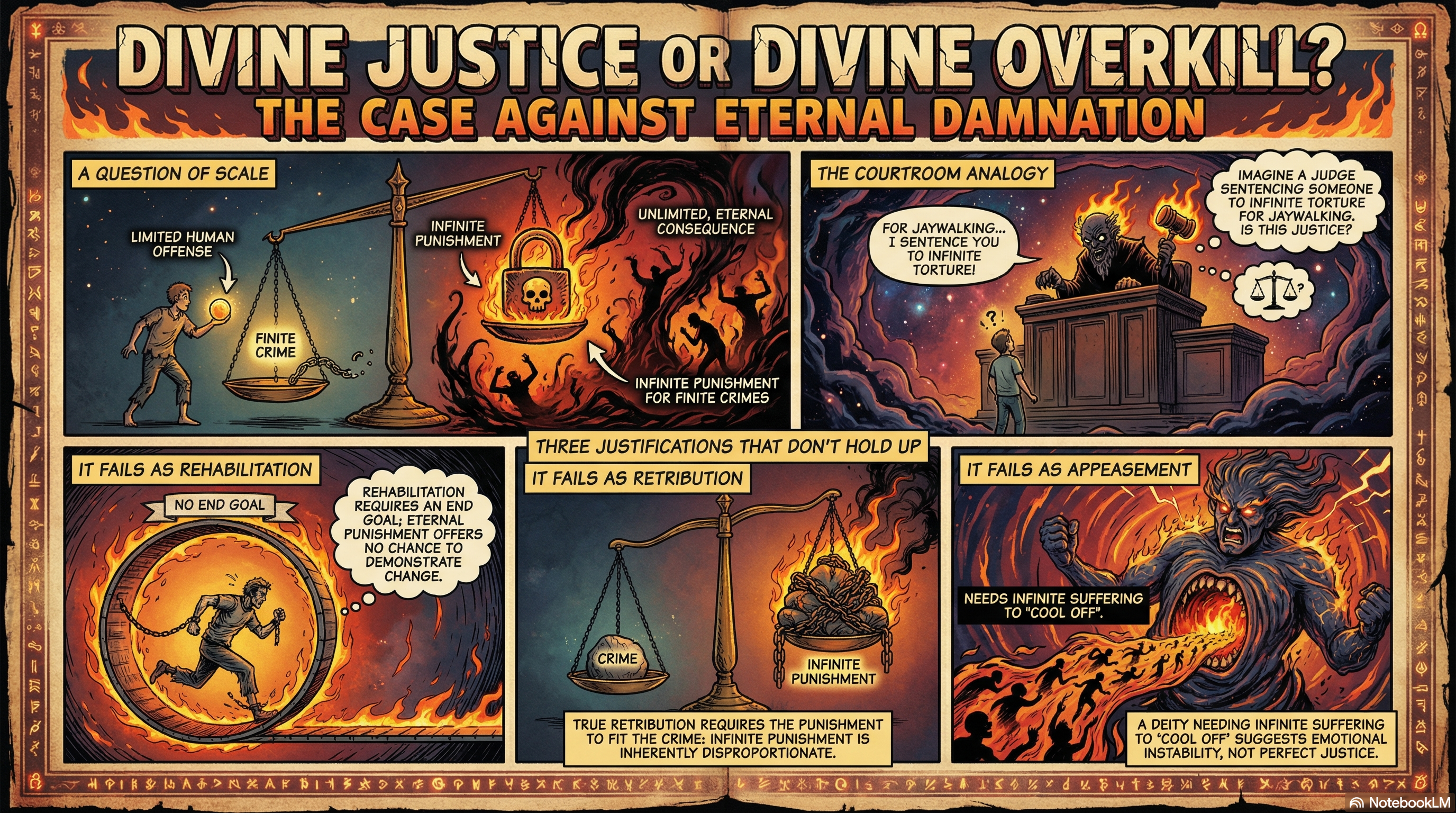
Summary: This analysis questions the logical coherence and emotional stability of eternal damnation within a biblical framework, arguing that it fails as a form of rehabilitation, retribution, or appeasement of divine wrath. Each rationale is found to be inconsistent with principles of proportional justice or emotional stability, casting doubt on the concept of a just and merciful deity endorsing eternal punishment.

Imagine standing before a court where the sentence for any offense, whether a petty theft or a violent crime, is eternal imprisonment without the possibility of parole. The judge explains that this punishment is necessary to rehabilitate offenders, serve justice through proportional retribution, or appease the anger of the victims. Yet, when pressed for details, you find that rehabilitation is impossible because the sentence has no end, the punishment far outweighs the offense, and the victims’ wrath is described as insatiable, requiring infinite suffering. This scenario compels a deep question: Can such a system of justice be reconciled with principles of logical coherence, proportionality, and emotional stability, especially when ascribed to a deity said to embody perfect benevolence and reason?
Possible Reasons for an Eternal Damnation
This analysis critically evaluates three potential reasons often cited to justify the concept of eternal damnation within a biblical framework. Each rationale will be rigorously assessed to determine whether it aligns with logical coherence and emotional stability—attributes typically ascribed to a just and benevolent deity. The analysis will highlight examples and draw on established principles of justice to reinforce each argument.
1. Punishment with the Goal of Rehabilitation
Rehabilitation is often cited as a purpose for punishment: by imposing consequences, the offender may recognize their errors, repent, and reform their character. This concept relies on punishment being constructive—punishment as a means to personal growth rather than an end in itself.
- Logical Analysis: Rehabilitation presupposes that punishment is finite and transformative, offering the offender a future opportunity to demonstrate genuine change. In human justice systems, punishments are designed to allow for the possibility of reform, such as parole after a term in prison, or rehabilitative programs that address underlying behavioral issues. For punishment to serve as rehabilitation, it requires a conclusion point where the offender can show evidence of change.
- Logical Incoherence: Eternal punishment is fundamentally incompatible with rehabilitation. If punishment is endless, there is no post-punishment period in which the offender can demonstrate growth or repentance. To illustrate, consider a hypothetical offender sentenced to eternal imprisonment for a finite crime. The very notion of infinite punishment for finite actions denies any possibility of rehabilitation and contradicts the concept of growth through consequences. Therefore, eternal punishment cannot logically serve a rehabilitative purpose, as it negates the possibility of change.
- Salient Example: Consider a system in which all crimes, regardless of severity, result in life imprisonment without parole. This system would be widely condemned for its inflexibility and failure to recognize the potential for human growth. Similarly, if eternal damnation is viewed as a form of punishment, it lacks any mechanism for reform, rendering it logically incoherent if rehabilitation is the objective.
❖ Argument 1 | Symbolic Logic Formulation
2. Retribution: Offender Experiences Equivalent Pain
Retribution suggests that punishment should be proportional to the harm caused by the offender, aligning with the principle of just deserts—the idea that people should receive the penalty they “deserve.” This notion is rooted in concepts of fairness and proportionality.
- Logical Analysis: Retribution is only fair when the punishment reflects the severity of the offense. For finite harm caused by an individual, retributive justice would mandate a finite punishment proportional to the offense. An infinite punishment imposed for finite actions violates this principle by extending far beyond what could be considered proportional.
- Logical Incoherence: Since all human actions and suffering are finite, infinite punishment for finite crimes is disproportionate. For example, if a person lies or steals, the harm caused is measurable and limited in scope. To punish such actions with eternal damnation contradicts the retributive ideal of proportional justice, effectively transforming finite offenses into infinite consequences. This renders eternal punishment logically incoherent within a retributive framework.
- Salient Example: Imagine a justice system that imposes life sentences for petty theft and murder alike, with no differentiation based on the severity of the crime. Such a system would be deemed unjust, as it fails to align punishment with the scope of the offense. Similarly, eternal damnation applies an infinite penalty for finite harm, disregarding the proportionality that retribution requires. This approach undercuts any claim to fair retributive justice.
❖ Argument 2 | Symbolic Logic Formulation
3. Appeasement of the Wrath of the Offended
Another rationale might be to appease the wrath of those who have been wronged, positing that eternal damnation serves as a way to satisfy the offended party’s anger. In this view, punishment is justified as a means of providing emotional closure or satisfaction to the one who feels wronged.
- Logical Analysis: Wrath, especially when seen as a response to injustice, can be powerful. However, the wrath of an emotionally stable, rational being should subside after a finite period, especially if the offender has endured a proportionate punishment. If eternal punishment is necessary to appease this wrath, it suggests that the wrathful being cannot find satisfaction within any finite measure. This implies a degree of emotional instability or an inability to reach closure.
- Emotional Instability: Requiring eternal punishment to satisfy wrath implies that the wrathful being’s emotions are insatiable. This is contrary to the idea of a just and stable deity, whose wrath would logically be appeased after a fair and proportionate penalty. If eternal damnation is needed to maintain divine satisfaction, it suggests that the deity lacks the emotional resilience to achieve closure—a troubling prospect for a being meant to embody perfect justice and mercy.
- Salient Example: In human contexts, we expect even the most severe penalties to reach a point of resolution. For instance, a victim’s family may feel pain and anger after a tragic crime, but over time, the justice system aims to offer closure. If the punishment were endless, it would perpetuate anger and pain rather than facilitate healing. Similarly, eternal damnation for the sake of appeasement suggests that the deity’s wrath is perpetually unsatisfied, contradicting the idea of a balanced and emotionally stable divine character.
❖ Argument 3 | Symbolic Logic Formulation
Conclusion: Logical Incoherence or Emotional Instability
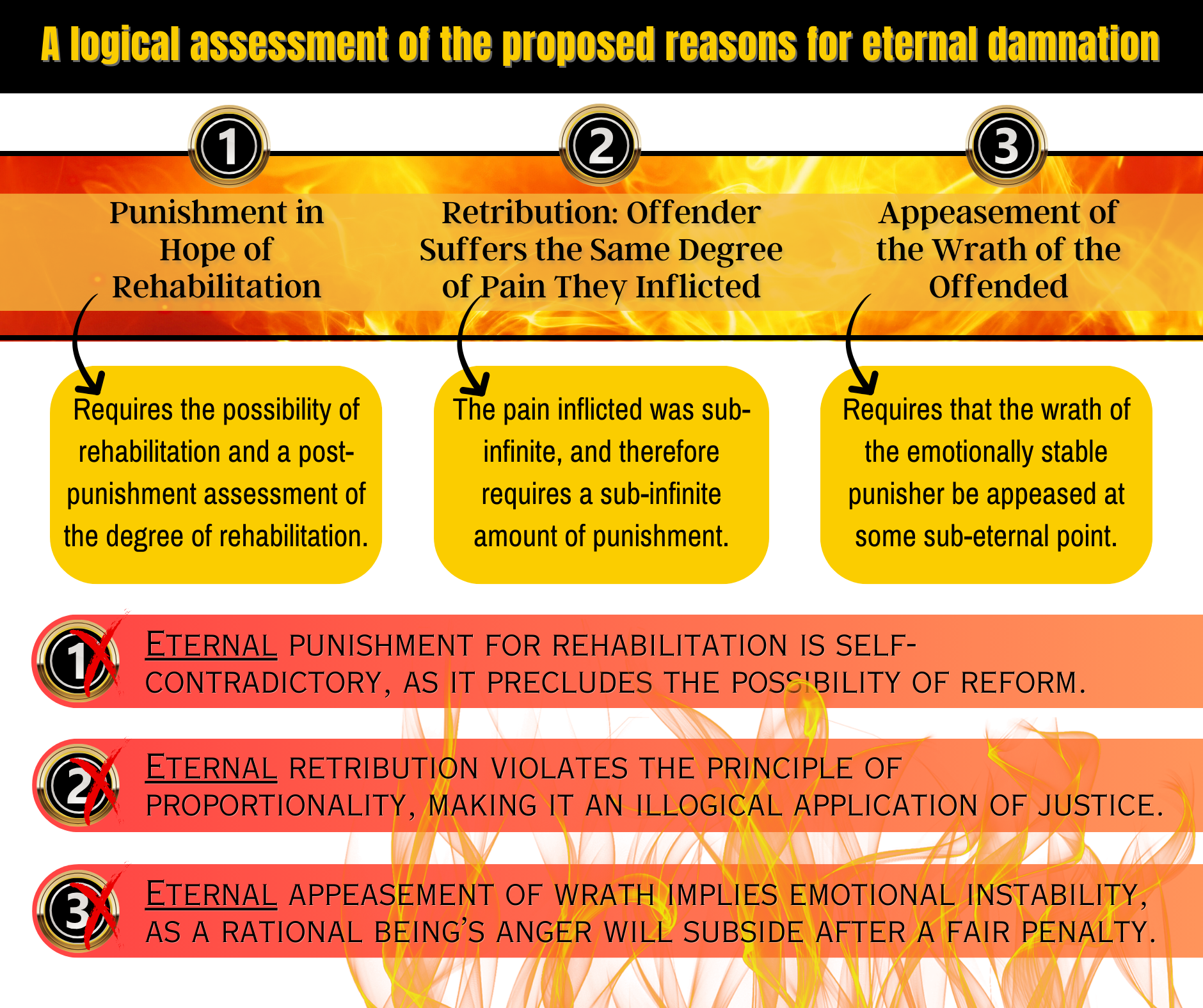
Each rationale fails to offer a coherent justification for eternal damnation. The implications are significant:
- Eternal punishment for rehabilitation is self-contradictory, as it precludes the possibility of reform.
- Eternal retribution violates the principle of proportionality, making it an illogical application of justice.
- Eternal appeasement of wrath implies emotional instability, as a rational being’s anger should subside after a fair penalty.

Key Implication: These analyses lead to a challenging conclusion: the biblical God, if advocating for eternal damnation, either operates on logically incoherent principles or demonstrates emotional instability. For a deity revered as perfectly just, merciful, and rational, the concept of eternal damnation introduces a fundamental inconsistency. Thus, eternal damnation raises profound doubts about the coherence of traditional claims regarding divine justice and stability.
A Companion Technical Paper:
An Exhaustive Technical Book:

The Logical Form
Argument 1: Eternal Punishment as Rehabilitation
- Premise 1: Rehabilitation requires the possibility of growth, which implies a finite period for the individual to demonstrate reformation.
- Premise 2: Eternal punishment offers no end, and thus no opportunity for the individual to demonstrate any change or improvement.
- Conclusion: Therefore, eternal punishment for the purpose of rehabilitation is self-contradictory, as it precludes the possibility of reformation.

Argument 2: Eternal Retribution and Proportionality
- Premise 1: Retribution is just only when it is proportionate to the offense, meaning that finite offenses require finite punishment.
- Premise 2: The pain inflicted by the offender is inherently finite, and so a proportionate response would also be finite.
- Conclusion: Therefore, eternal retribution violates the principle of proportionality, making it an illogical application of justice.
Argument 3: Eternal Appeasement of Wrath and Emotional Stability
- Premise 1: A rational, emotionally stable being would reach emotional closure after a finite period of punishment.
- Premise 2: Eternal punishment implies that the wrath of the offended cannot be satisfied within any finite time frame.
- Conclusion: Therefore, eternal appeasement of wrath implies emotional instability, as a rational being’s anger would subside after a fair penalty.
Argument 4: The Problem of Finite Beings and Infinite Punishment
- Premise 1: Humans, as finite beings, possess limited capacity for harm and limited understanding of their actions’ consequences.
- Premise 2: Eternal punishment assigns an infinite consequence to the actions of a finite being, assuming an understanding and impact that may far exceed what a human could reasonably anticipate or comprehend.
- Conclusion: Therefore, eternal damnation for finite beings is disproportionate and unjust, as it holds finite beings to an impossible standard of accountability, failing to account for their limited nature.
Argument 5: Personal Development and the Nature of Forgiveness
- Premise 1: Many worldviews value forgiveness and second chances as pathways for individuals to learn and grow, especially after acknowledging and correcting their faults.
- Premise 2: Eternal damnation offers no possibility for forgiveness, learning, or growth, making it a permanent and absolute judgment with no room for redemption.
- Conclusion: Therefore, eternal damnation contradicts the principles of personal development and forgiveness, disregarding the possibility of growth or change and aligning poorly with values of compassion and understanding.

(Scan to view post on mobile devices.)

A Dialogue
The Concept of Eternal Damnation
CHRIS: As a Christian, I believe that eternal damnation is an essential part of divine justice, representing God’s punishment for those who reject Him and ensuring that evil receives its due consequence.
CLARUS: I understand your viewpoint, Chris, but I find eternal damnation problematic upon closer analysis. If eternal punishment is intended for rehabilitation, it’s self-contradictory. For punishment to rehabilitate, there must be a finite period allowing the individual to show change, but eternal punishment removes any opportunity for reformation.
CHRIS: That’s fair, but perhaps eternal damnation isn’t about rehabilitation. It could be about retribution—a fair consequence for the choices and actions of those who reject God.
CLARUS: Retribution only makes sense if it’s proportional to the offense. Human actions are finite, and thus any harm caused is limited in scope. Just retribution would therefore require a finite punishment. Imposing an infinite punishment for finite offenses seems to violate proportional justice, making it an illogical application of punishment.
CHRIS: But maybe the offense of rejecting God carries infinite weight, making it deserving of infinite punishment due to its eternal implications.
CLARUS: That appears conceptually dubious, and there’s still a problem with appeasement of divine wrath as a rationale. Wrath should logically subside after a finite period if the punishment is sufficient. If eternal punishment is required to satisfy wrath, it implies that God’s anger is insatiable. A rational and emotionally stable being would not need infinite punishment to find closure; otherwise, it implies emotional instability rather than infinite wisdom and stability.
CHRIS: I see your concern. But maybe eternal damnation serves to demonstrate the gravity of rejecting God, emphasizing the seriousness of that choice.
CLARUS: But is it fair to impose infinite consequences on finite beings with limited understanding and capacity for harm? Assigning eternal punishment for finite actions seems clearly illogical, especially since humans might not fully grasp the magnitude of their choices. Holding them to an infinite standard of accountability feels disproportionate.
CHRIS: Perhaps God’s justice operates on a different level beyond our human concepts of proportion and balance.
CLARUS: That brings up another important point. People often find that compassion and forgiveness bring a sense of satisfaction and happiness. Eternal damnation, however, denies any chance for growth, reflection, or change, offering no possibility for reconciliation or closure. Doesn’t that seem at odds with the positive effects of forgiveness and understanding?
CHRIS: It’s a challenging thought, I admit. But as a believer, I trust in the wisdom of God’s judgment, even if it doesn’t fully align with human reasoning.
CLARUS: I understand your inclination to trust, Chris. But if eternal damnation lacks logical coherence and conflicts with principles of proportional justice, emotional stability, and the fulfilling effects of compassion, then perhaps it’s worth rethinking its role within a framework that aspires to embody ultimate justice and wisdom.
Notes:
Helpful Analogies
Analogy 1: The Broken Window and the Infinite Sentence

Imagine a child accidentally breaks a neighbor’s window while playing. The damage is finite—a single window—and the action, while wrong, is limited in its consequences. Now, suppose the child is sentenced to life imprisonment with no possibility of parole for this minor offense. The punishment is vastly disproportionate to the harm caused. Just as a finite offense requires a finite punishment, the idea of eternal damnation for finite human actions is disproportionate, assigning an infinite consequence to a limited act. Proportionality in punishment is essential for justice, but eternal damnation disregards this principle.
Analogy 2: The Unforgiving Teacher
Imagine a teacher who, upon seeing a student make a mistake on an exam, immediately expels the student from school permanently, giving no chance for learning or correction. This teacher’s approach fails to account for the student’s potential for growth and self-improvement. Rehabilitation requires opportunities for individuals to recognize their errors and change. Eternal damnation similarly denies any possibility for change or personal growth, making it inherently incompatible with the concept of rehabilitative justice. Punishment without an end negates the purpose of reform, as it leaves no room for the individual to evolve or show improvement.
Analogy 3: The Insatiable Wrath
Consider a judge who, despite the offender serving a lengthy and severe sentence, remains perpetually unsatisfied, demanding that punishment continue indefinitely, driven by unending anger. The judge’s wrath becomes a sign of emotional instability, as a rational and balanced person would find closure and resolution after a just penalty is fulfilled. If eternal damnation serves merely to appease divine wrath, it implies a deity whose anger cannot be sated, which contradicts the notion of a wise and emotionally stable being. An endless requirement for punishment suggests a lack of closure, which undermines the ideal of a balanced, rational justice.
Addressing Theological Responses
Theological Responses
1. The Infinite Offense Argument
Theologians might argue that rejecting God, who is infinite and eternal, constitutes an infinite offense. This rejection isn’t just a finite act but a choice against an infinitely valuable being, thus deserving an eternal punishment. From this perspective, the offense’s gravity isn’t measured by the human act alone but by the value of the being against whom the offense is committed.
2. Divine Justice Transcends Human Logic
Some theologians suggest that divine justice operates on a level beyond human concepts of proportionality and fairness. They argue that God’s understanding and implementation of justice are incomprehensible to finite beings, meaning that eternal damnation could be just even if it appears disproportionate by human standards. As such, finite beings may lack the capacity to fully grasp why eternal punishment is appropriate.
3. Eternal Damnation as Respecting Free Will
A common theological defense is that eternal damnation respects the free will of individuals who knowingly and willingly choose separation from God. By choosing to reject God, they also accept the consequences of that choice, which include eternal separation. From this view, God respects human autonomy by allowing individuals to remain in their chosen state eternally.
4. The Concept of a Just and Loving Warning
Theologians may argue that the concept of eternal damnation serves as a loving warning intended to guide people toward making wise choices. They suggest that a just God provides knowledge of the consequences of rejecting Him, which emphasizes the seriousness of that choice. In this sense, eternal damnation is not about wrath but about God’s desire to lead people to a relationship with Him by highlighting the stakes of separation.
5. Eternal Punishment Reflects the Eternal Nature of the Soul
Some theologians assert that since the human soul is eternal, any punishment or reward must also be eternal to match the soul’s nature. They argue that temporal punishments would be insufficient for an eternal soul that endures beyond physical death. Therefore, eternal damnation aligns with the eternal nature of the soul and reinforces the seriousness of choices made in life.
Counter-Responses
1. Response to the Infinite Offense
The infinite offense argument assumes that the value of the offended party determines the punishment’s severity. However, justice principles generally consider the magnitude of the offense itself, not merely the offended party’s status. For instance, if a finite being’s actions are limited by their capacity, it seems unreasonable to assign an infinite consequence for what is inherently a finite act. Furthermore, an infinite punishment based on the offense’s perceived infinite nature imposes a standard that finite beings cannot fully comprehend or meet, making it a disproportionate and unjust application of punishment.
2. Response to Divine Justice
Claiming that divine justice is beyond human logic risks rendering the concept of justice meaningless. If justice can be anything God declares, even if it contradicts principles of fairness, proportionality, and compassion, then it undermines the rational foundation of justice. Without logical coherence, the concept of divine justice loses its intelligibility and becomes arbitrary, which would make it difficult to argue that God is just in any meaningful way. Additionally, if we cannot understand divine justice at all, then societal accountability becomes problematic, as humans are expected to act justly despite having no reliable model for what divine justice entails.
3. Response to Respecting Free Will
While free will is significant, eternal damnation is a disproportionate consequence for a finite decision made under finite conditions. Humans have limited understanding of eternity and divine nature, and it’s unreasonable to expect them to grasp the full weight of their choice against God. Respecting free will should still align with proportional justice, where consequences are fitting to the choices made. Additionally, eternal punishment for rejecting a deity one cannot fully comprehend imposes a severe penalty on limited understanding, raising questions about divine fairness in offering finite beings such a high-stakes decision.
4. Response to Just and Loving Warning
A loving warning should ideally aim to inform and guide, not create eternal consequences with no possibility of reformation. If eternal damnation serves purely as a warning, then making it an actual consequence contradicts the compassionate intent behind a warning. A truly just and loving deity would presumably provide finite, remedial consequences that allow for growth and reflection, rather than imposing permanent penalties. This approach would more effectively guide individuals toward genuine understanding and connection, rather than driving them by fear of irreversible punishment.
5. Response to Eternal Nature of the Soul
The eternality of the soul doesn’t logically necessitate eternal punishment; a finite punishment could still respect the soul’s enduring nature while being proportionate to finite actions. Eternal punishment assumes that finite choices have endless significance, yet the concept of justice usually dictates that punishment is proportional to the offense itself, not merely the nature of the being punished. Moreover, if the soul is capable of growth and change, then an eternal sentence is incompatible with the potential for personal development and improvement, ignoring the soul’s dynamic nature in favor of permanent judgment.
Clarifications
Symbolic Logic Formulations of the Three Primary Arguments
Argument 1: Punishment with the Goal of Rehabilitation
Logical Formulation:
Let:
be any offender.
denotes that
denotes that the purpose of punishing
denotes that the punishment of
denotes that
denotes that
Premise 1:
If the purpose of punishing
![\forall x \left( \text{Purpose}(x, \text{Rehabilitation}) \rightarrow [\text{FinitePunishment}(x) \wedge \text{PossibleChange}(x)] \right)](https://s0.wp.com/latex.php?latex=%5Cforall+x+%5Cleft%28+%5Ctext%7BPurpose%7D%28x%2C+%5Ctext%7BRehabilitation%7D%29+%5Crightarrow+%5B%5Ctext%7BFinitePunishment%7D%28x%29+%5Cwedge+%5Ctext%7BPossibleChange%7D%28x%29%5D+%5Cright%29&bg=ffffff&fg=000&s=0&c=20201002)
Premise 2:
Eternal punishment is infinite and does not allow for the possibility of change.
![\forall x \left( \text{EternalPunishment}(x) \rightarrow [\neg \text{FinitePunishment}(x) \wedge \neg \text{PossibleChange}(x)] \right)](https://s0.wp.com/latex.php?latex=%5Cforall+x+%5Cleft%28+%5Ctext%7BEternalPunishment%7D%28x%29+%5Crightarrow+%5B%5Cneg+%5Ctext%7BFinitePunishment%7D%28x%29+%5Cwedge+%5Cneg+%5Ctext%7BPossibleChange%7D%28x%29%5D+%5Cright%29&bg=ffffff&fg=000&s=0&c=20201002)
Conclusion:
Therefore, eternal punishment cannot serve the purpose of rehabilitation.

Explanation:
From Premise 1, rehabilitation requires finite punishment and the chance for change. Premise 2 states that eternal punishment is infinite and precludes change. Therefore, eternal punishment cannot logically fulfill the purpose of rehabilitation.
Argument 2: Retribution—Offender Experiences Equivalent Pain
Logical Formulation:
Let:
denotes the finite severity of
denotes the severity of
denotes that the purpose of punishing
denotes that the punishment severity is proportional to the offense severity.
Premise 1:
Retributive justice requires that punishment be proportional to the offense.

Premise 2:
All human offenses are finite in severity.

Premise 3:
Eternal punishment is infinite in severity.

Premise 4:
If an offender’s punishment is infinite while the offense is finite, then the punishment is not proportional.
![\forall x \left( [\text{OffenseSeverity}(x) \text{ is finite} \wedge \text{PunishmentSeverity}(x) \text{ is infinite}] \rightarrow \neg \text{Proportional}(x) \right)](https://s0.wp.com/latex.php?latex=%5Cforall+x+%5Cleft%28+%5B%5Ctext%7BOffenseSeverity%7D%28x%29+%5Ctext%7B+is+finite%7D+%5Cwedge+%5Ctext%7BPunishmentSeverity%7D%28x%29+%5Ctext%7B+is+infinite%7D%5D+%5Crightarrow+%5Cneg+%5Ctext%7BProportional%7D%28x%29+%5Cright%29&bg=ffffff&fg=000&s=0&c=20201002)
Conclusion:
Therefore, eternal punishment cannot serve the purpose of retribution.

Explanation:
Since offenses are finite and eternal punishment is infinite, the punishment is disproportionate, violating retributive justice. Thus, eternal punishment cannot logically serve retribution.
Argument 3: Appeasement of the Wrath of the Offended
Logical Formulation:
Let:
be the offended party (e.g., a deity).
denotes that
denotes that
denotes that
denotes the duration of
denotes that duration
is finite.
denotes that duration
denotes that the purpose of punishing
Premise 1:
An emotionally stable being’s wrath can be appeased by a finite punishment.
![\forall y \left( \text{EmotionalStability}(y) \rightarrow \forall x \left( \exists t \left[ \text{Finite}(t) \wedge \text{PunishmentDuration}(x) = t \wedge \text{Purpose}(x, \text{AppeaseWrath}(y)) \wedge \text{WrathAppeased}(y) \right] \right) \right)](https://s0.wp.com/latex.php?latex=%5Cforall+y+%5Cleft%28+%5Ctext%7BEmotionalStability%7D%28y%29+%5Crightarrow+%5Cforall+x+%5Cleft%28+%5Cexists+t+%5Cleft%5B+%5Ctext%7BFinite%7D%28t%29+%5Cwedge+%5Ctext%7BPunishmentDuration%7D%28x%29+%3D+t+%5Cwedge+%5Ctext%7BPurpose%7D%28x%2C+%5Ctext%7BAppeaseWrath%7D%28y%29%29+%5Cwedge+%5Ctext%7BWrathAppeased%7D%28y%29+%5Cright%5D+%5Cright%29+%5Cright%29&bg=ffffff&fg=000&s=0&c=20201002)
Premise 2:
Eternal punishment has an infinite duration.

Premise 3:
If a punishment’s duration is infinite, then the wrath is not appeased after any finite time.
![\forall y \forall x \left( \text{Infinite}(\text{PunishmentDuration}(x)) \rightarrow \neg \exists t \left[ \text{Finite}(t) \wedge \text{WrathAppeased}(y) \text{ after time } t \right] \right)](https://s0.wp.com/latex.php?latex=%5Cforall+y+%5Cforall+x+%5Cleft%28+%5Ctext%7BInfinite%7D%28%5Ctext%7BPunishmentDuration%7D%28x%29%29+%5Crightarrow+%5Cneg+%5Cexists+t+%5Cleft%5B+%5Ctext%7BFinite%7D%28t%29+%5Cwedge+%5Ctext%7BWrathAppeased%7D%28y%29+%5Ctext%7B+after+time+%7D+t+%5Cright%5D+%5Cright%29&bg=ffffff&fg=000&s=0&c=20201002)
Premise 4:
The offended party

Conclusion:
Therefore, eternal punishment cannot serve the purpose of appeasing the wrath of an emotionally stable being.

Explanation:
An emotionally stable being’s wrath should be satiable within a finite period. Eternal punishment implies unending wrath, contradicting emotional stability. It logically follows that the purpose of eternal punishment cannot be to appease the wrath of an emotionally stable mind.
Overall Logical Structure:
In each argument, we:
- Define the necessary conditions for punishment to serve a specific purpose (rehabilitation, retribution, appeasement).
- Demonstrate that eternal punishment does not meet these conditions.
- Conclude that eternal punishment cannot logically serve the intended purpose.
All logical expressions are carefully constructed to show that eternal punishment is incompatible with these objectives due to inherent logical inconsistencies.
The Effectiveness and Psychological Impact of Teaching Children About Eternal Hellfire
Introduction
The use of hellfire as a warning for children in certain religious teachings has long been a controversial topic. Some religious communities argue that instilling a fear of eternal punishment can be an effective way to guide social behavior and religious adherence from a young age. However, the effectiveness and ethical implications of this approach are highly debatable, especially considering the potential psychological damage it can inflict on children. This essay examines whether telling children that they risk eternal torment if they do not adhere to specific religious teachings is an effective behavior-modifying strategy and explores the harmful psychological effects such teachings can produce.
The Effectiveness of Hellfire Warnings as a Motivational Tool for Children
Some proponents of religious teachings on hell argue that fear can be a powerful motivator, particularly in young children who may not yet fully understand abstract principles of social behavior. By presenting the concept of hellfire as a consequence of misbehavior or disbelief, religious educators aim to instill obedience and respect for religious rules. Children, naturally inclined to seek security and avoid harm, may respond to fear-based teachings by following prescribed religious behaviors, thus fulfilling the immediate goal of religious instruction.
However, the effectiveness of such a strategy is often short-lived and superficial. When children are motivated purely by fear, they may not internalize the deeper values that religious teachings typically intend to convey, such as compassion, honesty, and integrity. Instead, they may become focused on avoiding punishment rather than developing a genuine sense of right and wrong. Additionally, fear-based motivation can lead to resentment or rebellion as children grow older and begin to question the rationale behind such extreme consequences. Therefore, while hellfire warnings might encourage outward compliance in the short term, they do not necessarily foster authentic personal development.
Psychological Damage of Hellfire Warnings on Children
The psychological consequences of threatening children with eternal punishment can be profound and long-lasting. Young children, who are especially impressionable and lack the cognitive maturity to process abstract or symbolic concepts, may interpret descriptions of hell as literal and imminent threats. When children believe that they could face eternal suffering for their thoughts or actions, they can experience intense fear, anxiety, and guilt.
One of the most damaging effects of this teaching is the development of chronic fear and anxiety. Children taught to fear hell may live in constant worry about making mistakes, thinking “bad” thoughts, or not being “good enough” to avoid damnation. This perpetual fear can contribute to mental health issues such as anxiety disorders, obsessive-compulsive behaviors, and depression. Instead of providing comfort, religion becomes a source of terror, leaving the child feeling trapped and powerless.
Additionally, these teachings can lead to internalized guilt and shame. Children may begin to view themselves as inherently bad or unworthy, especially if they struggle to meet religious expectations. This sense of unworthiness can negatively impact self-esteem and self-image, leading to feelings of hopelessness. Children may believe that no matter how hard they try, they can never be “good enough” to escape punishment, leading to a pervasive sense of inadequacy.
Long-Term Consequences into Adulthood
The psychological impact of hellfire teachings often persists into adulthood, shaping individuals’ mental health, relationships, and sense of self. Adults who were taught to fear hell as children may struggle with chronic guilt and anxiety, even if they no longer hold the same religious beliefs. They might also experience difficulty trusting others, especially authority figures, if they feel betrayed by the very people who instilled such deep fears in them.
In addition, adults who internalized these teachings may develop a fear-based relationship with spirituality, viewing religious practice as something to be feared rather than a source of comfort or behavioral guidance. This can lead to spiritual distress, where individuals feel disconnected from their spirituality or harbor resentment toward religion altogether. For some, the fear of hell becomes a psychological burden, leading to lifelong struggles with existential dread and religious trauma.
Conclusion
Telling young children that eternal punishment awaits them if they do not adhere to specific religious rules is both an ineffective character-development strategy and a source of significant psychological harm. While fear can produce temporary compliance, it fails to foster authentic social understanding and can lead to severe emotional and psychological consequences. The long-term effects of hellfire teachings—including chronic anxiety, low self-esteem, and lasting distrust—underscore the need for a more compassionate and constructive approach to religious education. Teaching children about social behavior through positive values like empathy and kindness, rather than through fear, can nurture healthier emotional development and a more genuine sense of communal responsibility.
The Logical Incoherence of the “Age of Accountability”
Introduction

The concept of the age of accountability is a theological notion that asserts children are exempt from divine judgment until they reach an undefined threshold of cognitive or spiritual awareness. Once they cross this arbitrary line, they supposedly become accountable for their beliefs, thoughts, and actions, potentially facing eternal consequences if they do not adhere to the expectations of their religious community. This idea is often used to reconcile divine justice with the vulnerability of children, but a closer examination reveals profound issues in logical coherence and practical application.
The attached illustration underscores the absurdity of this construct. It shows the sharp and inexplicable transition from innocence to guilt—a timeline in which a child shifts from a carefree state to one of eternal jeopardy within the span of a day, all without any formal warning or clear change in their own awareness or behavior.
The Absurdity of Arbitrary Accountability
A major flaw in the age of accountability concept is its reliance on an arbitrary threshold. It suggests that a child is entirely blameless until they reach a specific point of understanding, at which time they become fully accountable for their beliefs and actions. However, this “special age” is not universally defined and is subject to significant variation between, and even within, religious communities. The arbitrary nature of this threshold introduces several problems:
- No Clear Criteria: There is no universal agreement on what constitutes accountability—whether it’s age, cognitive capacity, or spiritual awareness. This lack of consistency creates confusion and uncertainty for children and caregivers alike.
- Inequity Across Individuals: Children develop at different rates, which makes it unreasonable to assume a single threshold for all. A child who matures slightly later may be spared divine judgment, while another, equally innocent but slightly more aware, could face eternal consequences.
- Uncertainty for Parents and Children: Families are left in a state of fear, unsure of when their child might cross this threshold without realizing it. This constant uncertainty creates a psychological burden for both caregivers and children, as they try to anticipate the moment when the child might become eternally accountable.
This arbitrariness weakens the doctrine’s credibility, as it fails to establish a coherent and fair standard for accountability.
Sudden and Eternal Consequences
The doctrine also fails to account for the suddenness of this transition. The attached image captures this abrupt shift: a child, depicted as happy and carefree on one day, suddenly becomes liable to eternal consequences on the next, without any significant change in their understanding or behavior. This sharp and unceremonious transition leads to several logical issues:
- No Opportunity for Preparation: A child who unknowingly crosses this threshold may be held accountable without understanding that they are now subject to judgment. They are effectively punished for lacking foresight or knowledge that they cannot reasonably possess.
- Lack of Proportionality: The consequences are eternal and infinite, yet the actions or beliefs of a child at this developmental stage are finite and based on limited understanding. This disproportionality highlights the doctrine’s incompatibility with compassionate reasoning.
- Disconnection from Causality: Eternal consequences assume that the child’s choices are made with full knowledge of their implications, yet children are often unable to grasp complex theological doctrines. Holding them to such a high standard of accountability for beliefs they barely understand is inconsistent with a just and reasonable approach.
In short, this abrupt and severe transition is not only illogical but also deeply unfair, as it imposes extreme consequences on individuals who lack the capacity to fully comprehend their actions.
Psychological Harm of the Doctrine
Beyond its logical flaws, the age of accountability introduces significant emotional harm to children and their caregivers. For children, this doctrine instills deep anxieties, as they become fearful not only about their actions but also about their inner beliefs and sincerity. This leads to two major sources of psychological distress:
- Fear of Not Being “Good Enough”: In some religious communities, children may obsessively worry about whether they are “good enough” to meet the expectations of divine judgment. This relentless self-critique can foster feelings of anxiety, guilt, and unworthiness, as children become preoccupied with their perceived shortcomings, afraid that a single misstep could lead to eternal punishment.
- Fear of Insufficient Sincerity: In evangelical contexts, children are often taught that asking Jesus for salvation requires absolute sincerity, yet sincerity itself is an abstract concept that can be difficult for children to gauge. This fear of “not being sincere enough” when they pray for salvation can haunt children, as they worry that despite their best efforts, they may not have truly secured their salvation. Such fears are compounded by the belief that eternal damnation could be the result of any doubt or insufficient depth of belief.
For caregivers, the doctrine fosters a constant anxiety that their child might unknowingly cross this accountability threshold, making it their responsibility to ensure the child adheres strictly to religious practices. This often leads to a fear-driven parenting style, where emphasis is placed on rules and doctrinal adherence rather than nurturing and support.
The illustration highlights the emotional absurdity of this doctrine: a child, blissfully unaware of any significant change, is depicted as shifting from innocence to existential peril without their own knowledge. This inconsistency can cause religious trauma, leading to distorted beliefs about self-worth and a constant fear of falling short in the face of unattainable standards.
Conclusion
The age of accountability is a concept riddled with logical inconsistencies and emotional dangers. Its reliance on arbitrary thresholds, its abrupt imposition of eternal consequences, and its failure to align with developmental realities make it an incoherent and potentially harmful teaching. The visual representation of a child transitioning from innocence to guilt within a single moment highlights the absurdity of this doctrine, illustrating its incompatibility with rational reasoning and emotional health. A focus on understanding, growth, and support offers a more compassionate alternative, one that nurtures children’s development without instilling fear and self-doubt.
Overwhelming Confirming/Disconfirming Evidence with Emotional Factors:
Logical Formulation
Consider a set of variables representing the dynamics of religious belief formation under emotional manipulation:
- Belief state variable:
represents the degree of belief at time
.
- Evidence variable:
represents the strength or credibility of evidence supporting the religious claim at time
- Emotional variables:
- Fear of Hell:
represents the emotional salience of threats such as hellfire and eternal punishment at time
- Hope of Heaven:
represents the emotional salience of rewards such as heaven or eternal bliss at time
- Fear of Hell:
We assume that human belief can be swayed not only by evidence (


Belief Update Model
A simple dynamic model for belief updating could be formulated as:

where 
- If
can still increase.
- As the religious narrative emphasizes fear and hope, the terms
and
dominate over
, causing
Probability Formulation
If we wish to model the probability of an individual adopting the religious belief as influenced by both evidence and emotional appeals, we might use a logistic function:

In this formulation:
- When
is large, the probability
approaches 1, even if
is near zero or negative.
- Thus, the more the religion leverages fear and hope, the stronger the deviation from evidence-based assessment.
Interpretation
By increasing
Incentives to Religions:
Religions, as social systems that seek to propagate themselves, often face a challenge: how to maintain or increase the degree of belief among their followers, even when clear, supporting evidence may be absent. The logical formulation presented previously illustrates the mechanisms by which religious claims can remain compelling when their emotional salience—embodied in the fear of hell and the hope of heaven—overpowers the influence of objective evidence. This dynamic suggests a compelling reason why many religions evolve toward more intense depictions of their versions of hell and heaven.
Emotional Amplification as a Tool
The model outlined indicates that an individual’s belief can be sustained or heightened when fear and hope overshadow evidence. This insight provides a strategic incentive for religious traditions: the more extreme and emotionally charged their visions of hell and heaven, the more readily these narratives can induce belief, irrespective of the evidential basis for the religious claim. By amplifying the emotional weight, the religion reduces the comparative significance of contradictory information or insufficient evidence.
The Erosion of Rational Assessment
As the fear of eternal torment or the promise of eternal bliss grows more vivid, the individual is less likely to engage in critical, rational assessment. The emotional intensity can saturate cognitive resources, effectively drowning out the individual’s capacity to weigh evidence carefully. This is not a deliberate plot on the part of all religious institutions—rather, it is a natural consequence of the feedback loop between the emotional salience of religious narratives and the human psychological susceptibility to emotional influence.
Escalation of Extremes
Over time, as groups compete for adherents in a religious marketplace, those with more horrific hells and more glorious heavens can exert a stronger pull on believers. When a tradition provides only modest emotional incentives and disincentives, it risks losing adherents to rival groups that promise a more emotionally charged narrative. Thus, a competitive dynamic encourages each religion to develop escalating depictions: harsher punishments and more lavish rewards.
Reinforcing Group Boundaries
In addition, vividly depicted heavens and hells can serve to reinforce group identity and cohesion. By distinguishing the in-group—those who are saved and receive heavenly rewards—from the out-group—those who face hellish punishment—religions create potent psychological boundaries. These boundaries can incentivize believers to remain within the fold to avoid the terrifying consequences or to gain the unmatched rewards. This process discourages both questioning and leaving the community, as the emotional costs become unbearable.
Conclusion
The rationale behind intensifying portrayals of hell and heaven is deeply intertwined with psychological and social dynamics. The model suggests that as fear and hope dominate over evidence, religions have a structural reason to amplify their depictions of afterlife extremes. By doing so, they secure the continued adherence of believers, bolster their communal bonds, and ensure their survival—even in an environment where evidence alone might fail to sustain belief.


Leave a Reply