

Consider the Following:
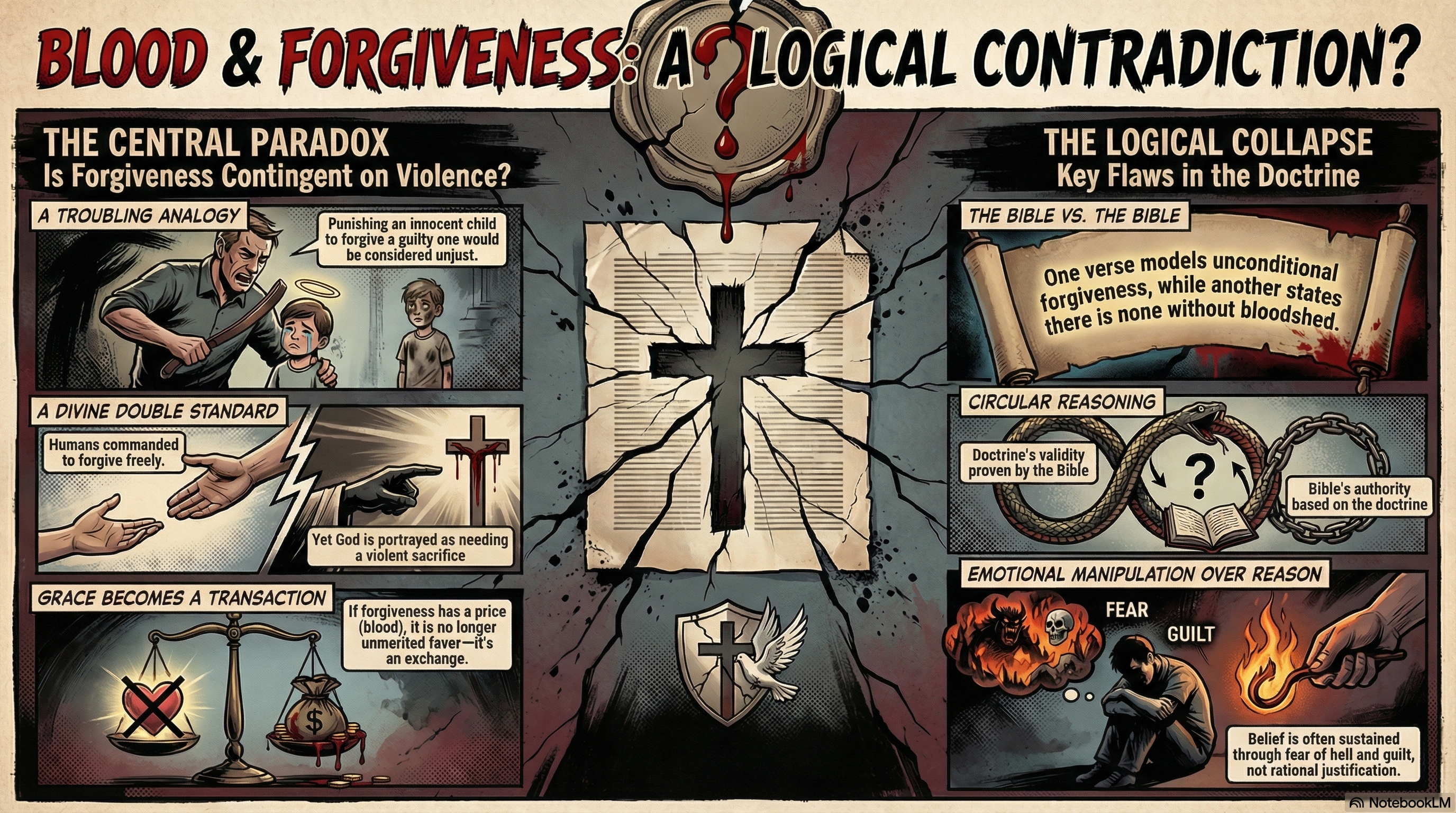
Summary: This analysis challenges the Christian doctrine that divine forgiveness requires bloodshed, arguing that such a requirement undermines the values of compassion, fairness, and omnipotence attributed to God. It questions the coherence and ethical implications of a framework where forgiveness is contingent on violence, suggesting that unconditional forgiveness would better embody true love and justice.

Imagine a scenario where young Tommy is caught stealing a cookie. His mother insists that her sense of fairness compels her to nail his hands and feet to the door as punishment. Tommy, naturally distressed, pleads for forgiveness. The mother offers an alternative: she will punish his older brother, Joshua, instead, provided Tommy acknowledges that her decision demonstrates her loving and just nature.
This analogy mirrors the Christian doctrine of atonement, where even minor transgressions are said to necessitate the bloody crucifixion of Jesus for forgiveness. Does such a perspective align with our understanding of fairness, compassion, and rationality?
The Problem of Bloodshed in Divine Forgiveness
Key Question: Is bloodshed truly necessary for forgiveness if the divine being is both omnipotent and compassionate?

Most parents forgive their children’s minor transgressions without demanding retribution, let alone bloodshed. Yet, according to Christian theology, God—the supposed epitome of love and justice—requires a gruesome act of sacrifice to extend forgiveness. This concept raises significant questions about the values attributed to divine justice and their compatibility with the concept of unconditional love.
- Paradox of Forgiveness: Christian scripture demands unconditional forgiveness from humans, yet it portrays God as incapable of forgiving without a violent intermediary.
- Inconsistent Values: If human beings are expected to forgive without retribution, why does God not lead by example?
- Psychological Impact: What message does this theology convey about reconciliation? Does it not normalize the idea that suffering is necessary for harmony?
Biblical Contradictions on Forgiveness
Contrasting Verses:
- Colossians 3:13 – “Forgive as the Lord forgave you.”
- This suggests that God’s forgiveness is a model for human relationships, where bloodshed is unnecessary.
- Hebrews 9:22 – “Without the shedding of blood there is no forgiveness.”
- This implies that bloodshed is an unavoidable requirement for divine pardon.
These conflicting messages raise deeper questions about biblical coherence and the values attributed to divine actions. If forgiveness is contingent on a violent act, does this align with the supposed omnipotence and benevolence of God?
The Emotional and Practical Implications
The doctrine of bloodshed for forgiveness introduces troubling emotional and practical dimensions:
- Emotional Reassurance through Violence: What kind of being demands or is reassured by violence to restore harmony? This seems incompatible with the concept of a loving deity.
- Impact on Human Values: If God requires bloodshed, does this set a precedent for humans to demand retribution rather than practicing unconditional forgiveness?
- Erosion of Responsibility: Shifting the burden of punishment from the wrongdoer (humanity) to an innocent substitute (Jesus) undermines the principle of accountability.
Philosophical Incoherence of Blood-Dependent Forgiveness
- Omnipotence and Forgiveness:
- A truly omnipotent being should possess the capacity to forgive without conditions. Requiring bloodshed is a constraint that contradicts the notion of infinite power.
- Divine Values or Arbitrary Demands?
- If God designed a moral framework, why would He create one that binds Himself to such extreme measures? This suggests a lack of foresight or a troubling preference for violence.
- Grace and the Atonement:
- Christian grace is defined as unmerited favor. If grace necessitates a price (Jesus’s blood), then it is no longer unmerited—it is transactional.
Logical and Practical Evaluation

Logical Argument:
- Premise 1: A truly loving and compassionate God would not require violence to forgive.
- Premise 2: The God of the Bible requires bloodshed for forgiveness.
- Conclusion: Therefore, the God of the Bible is not truly loving or compassionate.
Practical Argument:
- Premise 1: Human forgiveness without bloodshed is considered virtuous and promotes harmony.
- Premise 2: Divine forgiveness requiring bloodshed contradicts such values of fairness and reconciliation.
- Conclusion: God’s framework, as portrayed in the Bible, does not align with widely held principles of compassionate action.
Practical Reflections
Parental Comparison:
Most parents forgive their children without needing them or others to suffer. Such forgiveness strengthens trust and love within the family. Wouldn’t a divine parent model this same behavior?
Alternative Pathways:
- If God wanted to demonstrate ultimate love and forgiveness, wouldn’t a direct act of mercy—without violence—better achieve this goal?
- Would forgiveness freely given, without bloodshed, not be a more profound example of divine compassion?
Theological Implications
The requirement for bloodshed undermines several core Christian doctrines:
- Omnipotence: If God cannot forgive without bloodshed, He is not all-powerful.
- Love: If forgiveness requires suffering, divine love appears conditional.
- Justice Values: Punishing an innocent (Jesus) for the guilty contradicts any reasonable conception of fairness.
Closing Thoughts

If forgiveness must involve suffering, it risks glorifying pain rather than reconciliation. A God who requires bloodshed for forgiveness appears more bound by arbitrary rules than free to act in loving mercy. The Christian model of forgiveness, therefore, seems less about divine compassion and more about perpetuating fear and submission.
A Companion Technical Paper:

The Logical Form
Argument 1: Arbitrary Nature of Bloodshed for Forgiveness
- Premise 1: Christianity asserts that bloodshed is necessary for forgiveness.
- Premise 2: There is no logical or empirical basis for the claim that forgiveness requires bloodshed.
- Premise 3: Human beings are expected to forgive without requiring suffering or retribution.
- Conclusion: Therefore, the requirement of bloodshed for forgiveness is arbitrary and inconsistent with the values Christianity claims to promote.

Argument 2: Incoherence of God’s Omnipotence and Satan’s Role
- Premise 1: Christianity posits that God is omnipotent and omniscient.
- Premise 2: Satan is portrayed as a legitimate adversary capable of undermining God’s will.
- Premise 3: An omnipotent being cannot have a meaningful adversary without compromising its omnipotence.
- Conclusion: Therefore, the portrayal of Satan as an adversary contradicts the claim of God’s omnipotence.
Argument 3: Circular Reasoning in Christian Doctrine
- Premise 1: The validity of Christian doctrine is often justified by the Bible.
- Premise 2: The Bible’s authority is based on the assumption that its claims are true.
- Conclusion: Therefore, Christian doctrine relies on circular reasoning, as it validates itself without independent evidence.
Argument 4: Contradictions in Christian Logic
- Premise 1: Christianity asserts that humans have free will.
- Premise 2: Christianity also claims that God’s plan is predetermined and unchangeable.
- Premise 3: Free will is incompatible with absolute predestination.
- Conclusion: Therefore, Christian doctrine contains logical contradictions regarding human autonomy and divine planning.
Argument 5: Lack of Empirical Evidence for Spiritual Claims
- Premise 1: Christianity asserts the existence of spiritual entities and dynamics, such as God, demons, and angels.
- Premise 2: These entities and dynamics are imperceptible and cannot be tested or verified empirically.
- Premise 3: Claims that cannot be verified empirically or logically lack justification for belief.
Conclusion: Therefore, the spiritual claims of Christianity lack evidential support and should not be accepted as true.
Argument 6: Emotional Manipulation Over Rational Justification
- Premise 1: Christianity encourages belief through fear (e.g., Hell) and guilt (e.g., sin).
- Premise 2: Emotional manipulation bypasses the need for logical reasoning and evidence.
- Premise 3: Rational belief requires justification through logic and evidence, not coercion.
- Conclusion: Therefore, Christianity relies on emotional manipulation rather than rational justification to sustain its claims.

(Scan to view post on mobile devices.)

A Dialogue
Questioning the Logic of Christian Spiritual Dynamics
CHRIS: Christianity provides a coherent explanation for the world, rooted in the actions of God, the presence of demons and angels, and the necessity of Jesus’s sacrifice for forgiveness.
CLARUS: Coherent? Let’s examine that claim. Why does God, an omnipotent and all-loving being, require bloodshed for forgiveness? If humans are expected to forgive freely without demanding retribution, why wouldn’t God set the same example?
CHRIS: The shedding of blood fulfills God’s justice. Without it, forgiveness wouldn’t align with His righteous nature.
CLARUS: But what is the basis for asserting that bloodshed is necessary for forgiveness? This isn’t a self-evident truth or a principle supported by logic or evidence. It’s an arbitrary rule invented to justify a particular narrative. Why wouldn’t an omnipotent God simply forgive without any conditions, demonstrating true compassion?
CHRIS: It’s not arbitrary; the Bible clearly states that “without the shedding of blood, there is no forgiveness” (Hebrews 9:22). God set this standard because sin demands justice.
CLARUS: That’s circular reasoning. The Bible claims that bloodshed is required, and you use the Bible to justify that claim. If we applied this logic outside Christianity, we’d reject it outright. Where is the external evidence that supports this dynamic?
CHRIS: Faith is about accepting truths that go beyond human reasoning. The Bible is the ultimate authority.
CLARUS: Faith bypasses reason entirely, which is precisely the problem. Without evidence or a logical foundation, faith becomes a license to believe anything, no matter how absurd. By asserting that faith validates itself, Christianity evades scrutiny and accountability.
CHRIS: But Christianity does offer logical structures, such as God’s omnipotence and the need for salvation through Jesus.
CLARUS: Let’s examine that “logic.” If God is truly omnipotent, why does He need a process—bloodshed or otherwise—to forgive? Omnipotence implies the freedom to act without constraints. And why create Satan, knowing he would oppose divine will? These contradictions make the framework incoherent.
CHRIS: Satan exists to allow free will; without the possibility of evil, humanity couldn’t truly choose God.
CLARUS: Yet, Christianity also teaches that God’s plan is predestined. How can humans have genuine free will if their choices are already determined? Either humans lack freedom, or God isn’t fully in control. Which is it?
CHRIS: God’s ways are beyond human understanding, but we can trust that His plan is perfect.
CLARUS: That response doesn’t address the logical contradictions. If God’s plan is incomprehensible, then calling it “perfect” is baseless—you’re asserting a value judgment without understanding the criteria. And invoking mystery only reinforces the arbitrariness of the system.
CHRIS: The spiritual realm operates on principles that aren’t easily observable. That’s why faith is key.
CLARUS: Yet those principles—demons influencing behavior, angels intervening—are presented as having real-world effects. If they exist, they should leave observable evidence. The lack of empirical support for these claims undermines their credibility. Faith here becomes a substitute for evidence, not a complement.
CHRIS: What about personal experiences of answered prayers or transformations through Christ? Aren’t they evidence?
CLARUS: Anecdotes aren’t evidence. Studies on intercessory prayer show no statistically significant effect beyond chance. Moreover, personal experiences can be explained by psychology and confirmation bias without invoking a divine cause.
CHRIS: God’s justice and love are revealed through these dynamics, even if we don’t fully understand them.
CLARUS: But consider the emotional manipulation inherent in these teachings: fear of Hell and guilt over sin. These aren’t tools of truth but of control. A just and loving God wouldn’t need to coerce belief through fear but would persuade through reason and evidence.
CHRIS: Without God, there’s no grounding for values like justice or compassion.
CLARUS: That’s simply untrue. Values emerge from human experience and the need for social harmony. They don’t depend on unverifiable spiritual entities. The Christian framework adds unnecessary complexity by asserting entities like God, demons, and angels while offering no connection to logic or empirical evidence.
CHRIS: But Christianity offers hope and meaning.
CLARUS: Hope and meaning are not exclusive to Christianity. They can be found in a framework that prioritizes truth, reason, and shared human values—without requiring fabricated dynamics or arbitrary rules.
Notes:
Helpful Analogies
Analogy 1: The Flawed Judge
Imagine a judge in a courtroom who insists that every crime, no matter how small, requires bloodshed before they can forgive the offender. For a parking violation, the judge demands that either the violator or an innocent volunteer must suffer harm to “satisfy justice.” While society would rightly see this behavior as cruel and illogical, Christianity posits a similar framework for divine forgiveness, where even minor transgressions necessitate the bloodshed of Jesus. A truly just and compassionate judge—or God—would forgive without such arbitrary requirements.
Analogy 2: The Broken Scale
Picture a scale meant to measure fairness and justice, but instead of weighing evidence or reason, it always tips based on the presence of a faith disjointed from evidence. No matter how much evidence is placed on one side, the scale only responds to the assertion that it is “balanced by design.” Christianity’s spiritual dynamics, such as requiring bloodshed or asserting predestination alongside free will, are like this broken scale: they don’t align with logic or consistency but instead demand belief in their inherent correctness without examination.
Analogy 3: The Invisible Friend

Consider a child claiming that an invisible friend makes all the rules at home and must be obeyed, but this friend only speaks through the child and cannot be independently verified. When asked why the invisible friend’s rules are valid, the child insists, “Because my invisible friend says so!” Christianity’s reliance on unverifiable entities—like God, demons, and angels—and their supposed roles mirrors this analogy. The lack of empirical evidence and the demand for irrational acceptance undermine the credibility of the claims, much like the child’s invisible friend.
Addressing Theological Responses
Theological Responses
1. God’s Justice Requires Atonement
Theologians may argue that God’s justice is not arbitrary but rooted in His nature, which demands that sin be atoned for through bloodshed. They assert that sin disrupts the moral fabric of the universe, requiring a compensatory act to restore balance. The shedding of blood is seen as a profound symbol of the seriousness of sin and the cost of reconciliation, reflecting both God’s justice and His love.
2. Faith Transcends Human Logic
The argument that Christianity’s spiritual dynamics lack logical consistency may be countered by the claim that faith operates beyond the scope of human reasoning. Theologians might argue that God’s ways are higher than human understanding, and thus, His requirements—such as bloodshed for forgiveness—should be trusted, even if they appear illogical to finite minds.
3. The Bible Provides Sufficient Authority
Theologians may respond to accusations of circular reasoning by asserting that the Bible, as God’s word, is self-authenticating. They might argue that its internal coherence, historical accuracy, and transformative power provide evidence of its divine origin, making its claims about spiritual dynamics trustworthy.
4. Free Will and Predestination Are Compatible
The tension between free will and predestination is often addressed through the concept of compatibilism, where human freedom operates within the bounds of God’s sovereign plan. Theologians may argue that God’s omniscience allows Him to foresee human choices without overriding free will, creating a harmony between the two concepts.
5. The Problem of Evil Is Necessary for Greater Good
In response to the problem of evil, theologians may argue that suffering and evil exist to bring about a greater good, such as character growth, free will, or a deeper relationship with God. They claim that without the existence of challenges, the values of courage, compassion, and faith would not be possible, and God allows evil to serve a higher purpose.
6. Faith Complements Evidence
Theologians might argue that faith and evidence are not mutually exclusive. While Christianity requires faith, they may claim that this faith is supported by historical evidence, fulfilled prophecies, and personal transformation. They would suggest that the absence of direct empirical proof does not negate the validity of spiritual truths.
7. Spiritual Dynamics Reflect Ultimate Reality
Theologians may claim that the spiritual entities and dynamics described in Christianity, such as angels, demons, and prayer, reflect an ultimate reality that transcends the material world. They may argue that human inability to perceive these realities does not invalidate their existence, as spiritual truths are discerned through faith and revelation, not empirical observation.
Counter-Responses
1. Response to “God’s Justice Requires Atonement”
The claim that God’s justice demands bloodshed lacks logical necessity and is arbitrarily defined within Christian theology. Justice, as understood in rational terms, is about proportionality and fairness, not retribution through violence. The assertion that sin disrupts a “moral fabric of the universe” is unfalsifiable and unsupported by any evidence, making it a concept invented to fit the narrative, rather than a universal truth. A truly just and omnipotent being would have the capacity to forgive without demanding suffering.
2. Response to “Faith Transcends Human Logic”
The idea that faith transcends logic essentially abdicates the responsibility to provide rational justification for belief. If faith cannot be examined or questioned, it becomes indistinguishable from belief in any unverifiable claim. To assert that God’s ways are beyond human understanding while simultaneously making definitive claims about His requirements (e.g., bloodshed) is inconsistent. If faith cannot be reconciled with logic, it cannot be used to persuade those who prioritize reason.
3. Response to “The Bible Provides Sufficient Authority”
The claim that the Bible is self-authenticating relies on circular reasoning, as it assumes the Bible’s divinity to prove its own authority. Historical and transformative claims about the Bible do not address its logical inconsistencies or lack of empirical evidence. Furthermore, other religious texts make similar self-authenticating claims; thus, using this as a justification does not make Christianity unique or more credible than other traditions.
4. Response to “Free Will and Predestination Are Compatible”
Compatibilism between free will and predestination is a semantic maneuver that fails to resolve the inherent contradiction. If God’s plan is predetermined and unchangeable, then human choices are merely illusions of freedom, as they cannot alter the divine plan. This undermines the concept of meaningful responsibility, making it incoherent to hold humans accountable for actions they were predestined to take.
5. Response to “The Problem of Evil Is Necessary for Greater Good”
The claim that evil exists to bring about a greater good fails to address why an omnipotent being could not achieve such outcomes without suffering. A truly omnipotent God would not require suffering as a teaching tool and could instill virtues like compassion and courage without inflicting harm. This justification also shifts the burden of proof by assuming that all suffering must serve a higher purpose, a claim that is unfalsifiable and therefore unpersuasive.
6. Response to “Faith Complements Evidence”
The claim that faith complements evidence is undermined by the lack of empirical verification for Christianity’s central claims. Historical evidence, personal transformation, or fulfilled prophecies are either cherry-picked, ambiguous, or explainable through naturalistic means. If faith requires supplemental evidence, it acknowledges that faith alone is insufficient, contradicting its own purported epistemic foundation.
7. Response to “Spiritual Dynamics Reflect Ultimate Reality”
The assertion that spiritual dynamics reflect an ultimate reality is an unfalsifiable claim, which places it outside the realm of rational evaluation. An inability to perceive these entities (e.g., angels, demons) suggests they either do not exist or operate in a way that has no bearing on the observable world, rendering the claim irrelevant to our understanding of reality. If these entities are claimed to have real-world effects, their existence should be demonstrable through observable and testable evidence, which is absent.
Clarifications
The Fabricated Logic of Christian Spiritual Dynamics
Christianity is replete with claims about spiritual entities and their interactions: God, angels, demons, and the supposed dynamics between them. Yet, beneath these assertions lies a troubling lack of connection to standard logic or empirical evidence. The “logic” of Christianity operates in an insulated framework where premises are accepted without critical examination, and conclusions often defy coherence. This essay examines how the inner workings of Christian spiritual dynamics are asserted arbitrarily, bypassing the rigorous standards of logical consistency and evidential support.
Arbitrary Premises and Circular Reasoning
Christian doctrines often begin with arbitrary premises, such as the existence of God, the reality of demons, and the necessity of salvation through Jesus. These premises are typically justified by referencing scripture, which itself presupposes the validity of the very claims it seeks to prove. For instance:
- The Bible asserts God exists.
- God’s existence validates the Bible.
This circular reasoning is presented as though it were a sound logical framework, yet it collapses under scrutiny. In standard logic, claims require independent evidence or reasoning to avoid self-referential fallacies. Christianity, however, bypasses this requirement, creating a closed system of belief that self-validates without external corroboration.
Fabricated Dynamics: God, Demons, and Angels
The interactions between God, demons, and angels are portrayed as a cosmic drama with profound implications for humanity. However, the logic of these interactions is contrived, often violating principles of consistency and rational causality. Consider the following:
- God’s Omniscience vs. Satan’s Role:
- Christianity posits that God is omniscient and omnipotent, yet Satan is portrayed as a legitimate adversary with the power to derail God’s plans.
- If God is truly all-powerful, Satan’s existence as a meaningful opponent is incoherent. Why allow a being that undermines divine will, and why create him in the first place?
- Salvation Dynamics:
- The idea that Jesus’s death is necessary for forgiveness introduces unjustified mechanics of spiritual atonement. Why would an omnipotent being require bloodshed to forgive, especially when humans are expected to forgive without such conditions?
- The fabricated “law” that blood must be shed for forgiveness has no logical or evidential basis. It is merely asserted as fact.
- The Role of Angels:
- Angels are described as messengers and protectors, yet their existence and actions are unverifiable and often contradictory. If they are actively intervening in human affairs, why is their influence imperceptible in a world governed by observable cause and effect?
The Lack of Empirical Evidence
The spiritual claims of Christianity fail to meet the basic standards of empirical verification. While science builds its conclusions through observable data and testable hypotheses, Christianity asserts an entire spiritual realm that is impervious to scrutiny. For example:
- Demons and Possession:
- The existence of demons is asserted, and their influence is blamed for various human behaviors. Yet no scientific evidence supports such claims, and psychological explanations better account for behaviors once attributed to “possession.”
- Answered Prayers:
- Christians claim God answers prayers, yet studies on intercessory prayer reveal no statistically significant effects beyond chance. The “logic” of prayer’s effectiveness often resorts to unfalsifiable explanations: God answers in mysterious ways, or unanswered prayers are part of His plan.
This immunity to falsifiability allows the spiritual dynamics of Christianity to persist without accountability. Assertions are accepted by faith, but faith itself is epistemically bankrupt, offering no pathway to differentiate between true and false beliefs.
Internal Contradictions in Christian Logic
The fabricated spiritual logic of Christianity is riddled with contradictions that betray its artificial construction:
- Free Will vs. Predestination:
- Christianity asserts that humans have free will, yet also claims that God’s plan is predetermined and unchangeable. These two ideas are fundamentally incompatible, as true free will cannot exist under absolute predestination.
- The Problem of Evil:
- Christianity claims God is all-loving and all-powerful, yet allows immense suffering. The “logic” often presented—such as suffering being necessary for growth—fails to address why an omnipotent being couldn’t achieve the same ends through less harmful means.
- Divine Justice:
- The notion of eternal punishment in Hell contradicts any reasonable concept of fairness. Finite human actions, no matter how severe, cannot logically warrant infinite punishment.
Emotional Manipulation vs. Rational Appeal

The fabricated logic of Christian dynamics is sustained largely through emotional manipulation rather than rational appeal. Believers are encouraged to accept doctrines through fear (of Hell) or guilt (over sin), rather than through reasoned argumentation. This reliance on emotion over logic further underscores the artificial nature of the system. A worldview grounded in truth would not need to coerce belief through fear or guilt but could rely on evidence and rational persuasion.
A Call for Intellectual Integrity
The spiritual dynamics of Christianity crumble when held to the standards of logical consistency and empirical evidence. Assertions about God, demons, and angels are presented as though they were facts, but they lack the foundational support required to justify belief. By uncritically accepting these claims, Christianity demands that its adherents abandon intellectual integrity in favor of faith—a stance that is ultimately life-diminishing and obstructive to the pursuit of truth.
To move forward, we must evaluate spiritual claims with the same rigor we apply to any other claim about reality. Assertions without evidence or coherent logic do not merit belief, no matter how emotionally appealing they may be. Only through this approach can we escape the fabricated logic of Christian spiritual dynamics and embrace a worldview grounded in reason and evidence.
What are the best arguments defending the notion blood is necessary for forgiveness?
Argument 1: Blood Symbolizes the Cost of Sin
- Premise 1: Forgiveness requires recognition of the severity of wrongdoing.
- Premise 2: Bloodshed represents the ultimate cost and seriousness of sin.
- Premise 3: Without an act symbolizing the cost of sin, forgiveness is incomplete and lacks justice.
- Conclusion: Therefore, bloodshed is necessary for forgiveness to fully acknowledge the gravity of sin and uphold justice.
Rebuttal:
This argument assumes that symbolism requires literal action, which is not logically necessary. Recognition of wrongdoing can occur through understanding, remorse, or other non-violent acts that do not involve bloodshed. If human beings can forgive without demanding such an extreme price, then an omnipotent and all-loving God should be able to forgive without requiring symbolic violence.
Argument 2: Blood Reflects Divine Justice
- Premise 1: Justice demands that wrongdoing is met with appropriate reparation.
- Premise 2: Bloodshed serves as the ultimate form of reparation for sin in divine law.
- Premise 3: Without bloodshed, justice remains unmet, and forgiveness is unmerited.
- Conclusion: Therefore, bloodshed is required to satisfy divine justice and make forgiveness possible.
Rebuttal:
This argument presumes a specific, unverified conception of justice where bloodshed is essential, without providing any independent basis for this claim. In standard human justice systems, reparation does not require violence, and fairness is often achieved through restoration or reconciliation. This makes the divine requirement for bloodshed appear arbitrary rather than inherently just.
Argument 3: Blood Atones for Sin
- Premise 1: Sin creates a moral debt that must be paid.
- Premise 2: Bloodshed is the most powerful act of atonement, as it symbolizes the payment of life itself.
- Premise 3: Without bloodshed, the moral debt remains unpaid, and forgiveness cannot occur.
- Conclusion: Therefore, bloodshed is necessary to atone for sin and enable forgiveness.
Rebuttal:
This argument assumes that a moral debt exists in the form of sin, but this concept is not universally accepted and lacks empirical evidence. Additionally, if forgiveness involves erasing a debt, then requiring payment in the form of bloodshed contradicts the very essence of forgiveness, which should be unconditional and freely given.
Argument 4: Blood Is Central to God’s Covenant
- Premise 1: God’s covenant with humanity establishes blood as the means for purification and forgiveness.
- Premise 2: The shedding of blood fulfills the terms of this divine covenant.
- Premise 3: Forgiveness cannot occur outside the terms of the covenant.
- Conclusion: Therefore, bloodshed is necessary as a condition of God’s covenant for forgiveness.
Rebuttal:
This argument is circular, as it presupposes the validity of the covenant without external justification. A truly omnipotent God would not be bound by a self-imposed covenant and could freely forgive without adhering to such constraints. Moreover, the necessity of bloodshed as a term of the covenant is an arbitrary rule that lacks logical justification.
Argument 5: Blood Demonstrates God’s Love and Justice
- Premise 1: God’s nature is both perfectly loving and perfectly just.
- Premise 2: Bloodshed is required to demonstrate the seriousness of sin (justice) while simultaneously offering forgiveness (love).
- Premise 3: Without bloodshed, neither God’s love nor His justice would be fully realized.
- Conclusion: Therefore, bloodshed is necessary to balance divine love and justice in the act of forgiveness.
Rebuttal:
This argument falsely equates love and justice with violence, assuming that bloodshed is the only way to demonstrate these attributes. True love and justice would prioritize reconciliation and restoration over punishment. If God is omnipotent, He should be able to fully express both love and justice without requiring bloodshed, which reflects human limitations rather than divine perfection.
Ways other than Needing Blood for Forgiveness the Christian God Differs from Humans:
- Wiping Out Humanity to Start Over:
- Humans: Tend to address problems incrementally, working within flawed systems to improve outcomes.
- Christian God: Flooded the earth (e.g., Noah’s story) to eliminate most of humanity and start anew, assuming the next “batch” would be better.
- Demanding Absolute Worship:
- Humans: Generally value relationships based on mutual respect, often accepting differences in beliefs and values.
- Christian God: Demands exclusive worship and punishes those who revere other gods or idols.
- Punishing Future Generations:
- Humans: Typically hold individuals accountable for their own actions, with exceptions being considered unjust.
- Christian God: Punished descendants for the sins of their ancestors (e.g., Original Sin, curses on Israel).
- Creating Predicaments and Offering Solutions:
- Humans: Solve problems they encounter or create, often without intentionally imposing harm first.
- Christian God: Created humanity with free will, foreknowing they would fall into sin, then devised a salvation plan involving suffering and sacrifice.
- Omnipotence with Inaction Against Evil:
- Humans: Take action within their limited capacities to prevent or address evil when they encounter it.
- Christian God: Is omnipotent yet permits widespread suffering and evil, often described as a test or for divine purposes.
- Testing Faith with Suffering:
- Humans: Rarely test loyalty or love by inflicting suffering or demanding extreme sacrifices.
- Christian God: Tested figures like Job, demanding faithfulness despite extreme hardship and loss.
- Unchanging Across Time:
- Humans: Learn, grow, and adapt their behavior based on new information and experiences.
- Christian God: Declared to be perfect and unchanging (immutable), despite shifts in divine law or covenants (e.g., Old Covenant vs. New Covenant).
- Preferring Ritual Over Relationship (in Some Contexts):
- Humans: Place greater emphasis on interpersonal relationships than on rigid adherence to rituals.
- Christian God: Historically emphasized strict observance of rituals (e.g., sacrifices, Sabbath laws) in the Old Testament and forges no actual personal relationships with humans.
- Allowing Eternal Punishment for Temporal Sins:
- Humans: Punishments are generally proportionate to the offense, with even severe crimes leading to finite consequences.
- Christian God: Allows eternal punishment in hell for finite sins committed during a human lifetime.
- Jealousy Over Worship:
- Humans: Rarely demand exclusive attention and devotion to their own glory, especially not on a cosmic scale.
- Christian God: Declares Himself a “jealous God” and condemns those who turn to other sources of worship.
- Creating and Allowing Deception:
- Humans: May lie or deceive, but generally frown upon manipulation as a virtue.
- Christian God: Created the serpent (often associated with Satan) in Eden and allowed it to deceive Adam and Eve, leading to the Fall.
- Giving Commands Beyond Human Capacity:
- Humans: Recognize limits and generally ask of others what they believe is reasonable or achievable.
- Christian God: Commands perfection (“Be perfect as your heavenly Father is perfect”), despite unrequested and unavoidable human fallibility.
- Desiring Glory and Praise:
- Humans: Appreciate recognition but typically do not demand glorification on a universal or perpetual scale.
- Christian God: Commands all creation to glorify Him perpetually, framing it as humanity’s ultimate purpose.
- Using Fear as a Tool for Obedience:
- Humans: Prefer relationships built on trust and understanding, though fear may occasionally be used as a deterrent.
- Christian God: Often invokes fear of divine wrath or eternal damnation to ensure obedience.
- Killing Firstborn Children as Justice:
- Humans: Value the lives of children and rarely resort to harming them to achieve justice.
- Christian God: Sent the tenth plague on Egypt, killing all firstborn sons to compel Pharaoh to release the Israelites.
This list illustrates the stark differences between the attributes and actions ascribed to the Christian God and typical human behaviors, emphasizing divine acts that humans would find incomprehensible or unjustifiable. Can it be honestly said that humans are made in the Christian God’s image?


Leave a Reply