

Consider the Following:
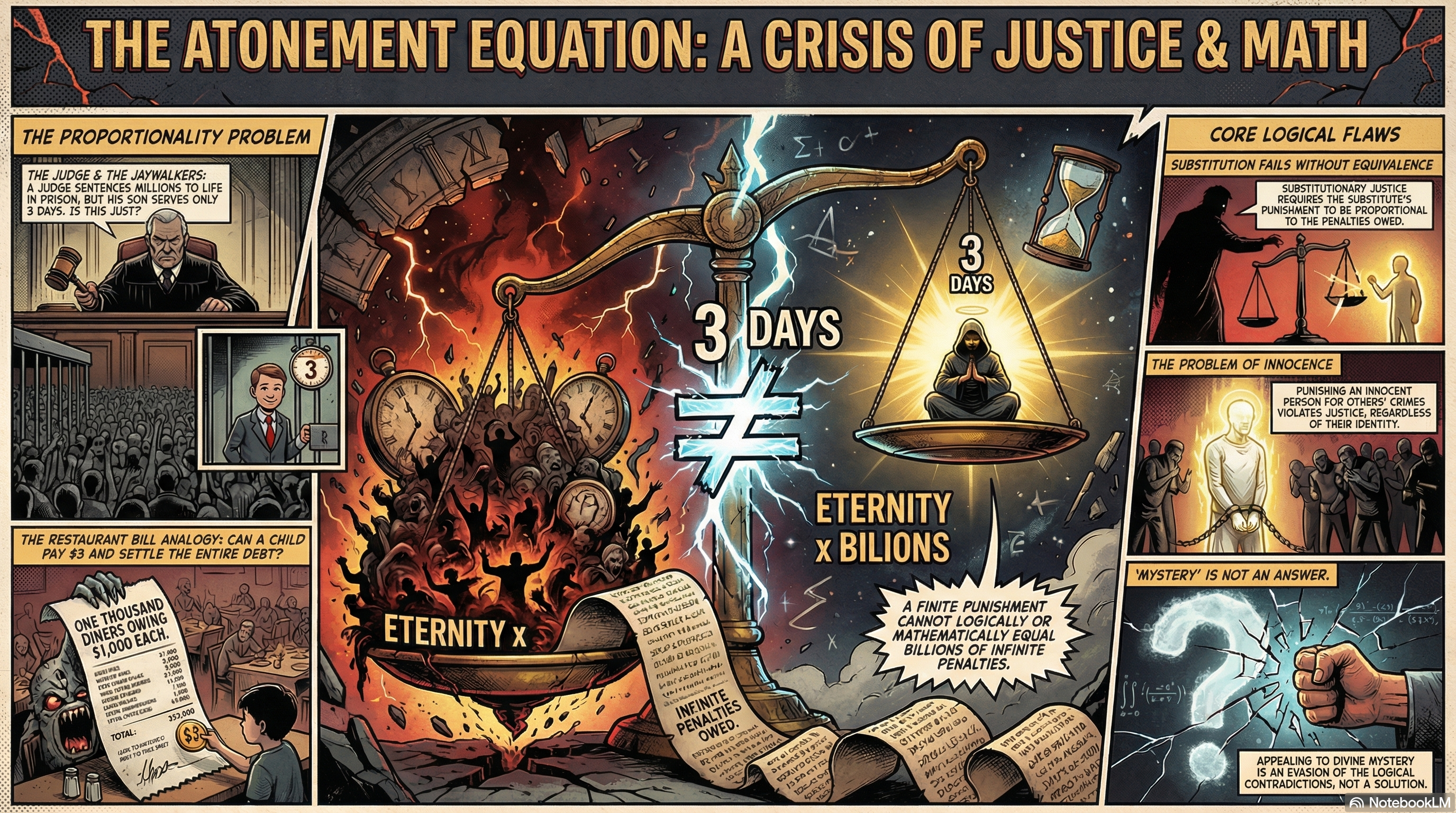
Summary: The claim that Jesus’ three-day death atones for the eternal damnation of billions raises critical issues of proportionality and justice, as finite punishment cannot logically equate to infinite penalties. This theological assertion lacks mathematical coherence and fails to align with concepts of fairness, prompting scrutiny of its foundational logic.

Imagine a judge decrees that all jaywalkers must spend their entire lives in a severely uncomfortable prison. The judge locks up a million jaywalkers but then announces that, although they truly deserve life sentences, his love compels him to have his precious son pay their penalty. However, the penalty for jaywalking is a lifetime in prison. Yet, after only three days behind bars, the judge releases his son, declaring, “The penalty has been paid in full!” Could this judge be seen as just or mathematically competent?
Though we might question whether it is even just for one person to bear the punishment of another, let’s set aside this ethical dilemma to explore a related issue: proportionality. Suppose a judge allowed a mother to serve the life sentence of her criminal son. Even in this limited substitutionary case, would it make sense for the judge to claim that this mother’s punishment somehow covers the penalties of millions of criminals?
Christians often argue that Jesus, being innocent, was uniquely qualified to atone for the sins of billions after merely 3 days of death. However, would incarcerating an innocent person for a finite duration of three days truly serve as a just substitute for the infinite damnation deserved by billions? Moreover, if we accept the idea of substitutionary punishment, does it not fail under mathematical scrutiny when one brief penalty is claimed to equate to billions of infinite penalties?
The Innocence of the Substitute
What if the innocent substitute is the judge’s own son? Would this change the justice or mathematical dynamics? Consider the claim that the eternal incarceration of one innocent person could justly release millions of criminals. Now modify the claim: the substitute is released after just three days. Does such a system embody justice, or does it expose a profound logical inconsistency?
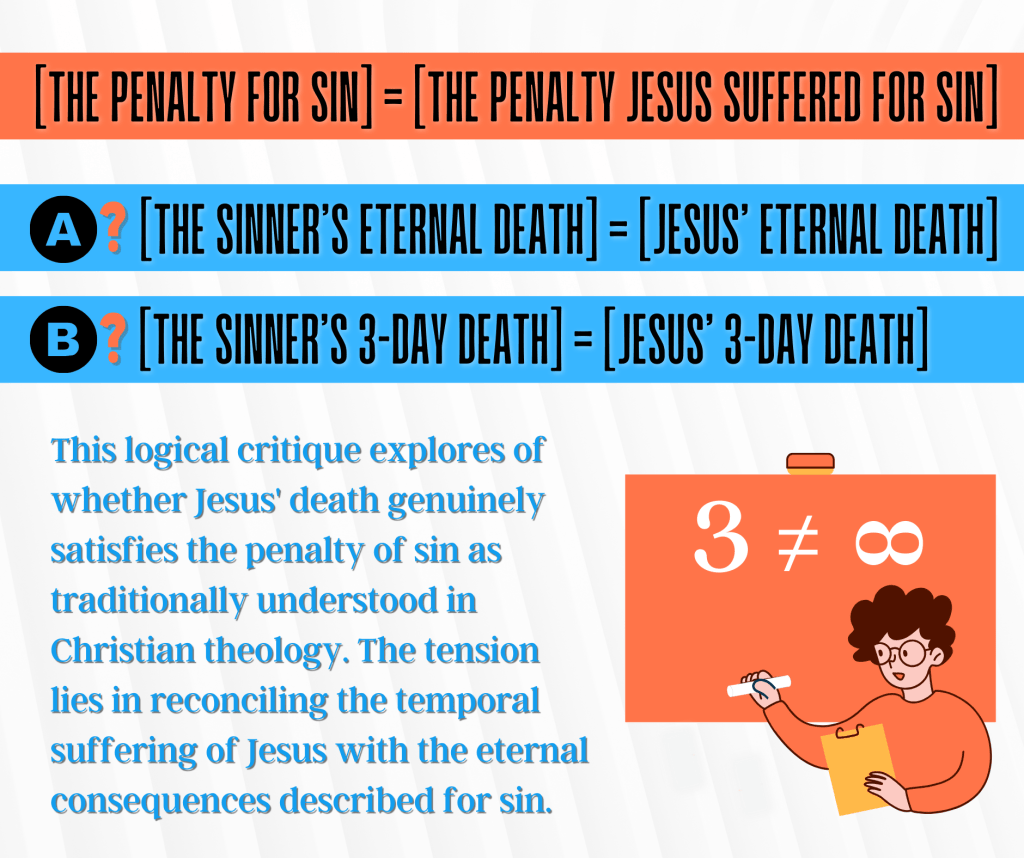
This analogy parallels the biblical narrative: Jesus, the innocent son, is crucified and dead for only three days. The Bible asserts that this act somehow atones for the infinite punishment merited by billions of sinners. How does three days of temporary death equate to eternity in hell? If anything, this disparity highlights a mathematical disconnect in the supposed atonement mechanism.
The Argument for Death Alone
Some Christians propose that it was not the duration of Jesus’ death but merely the fact of his death that paid the penalty for sin. Yet this raises further questions. If the penalty for sin is death alone, then why does God not resurrect all humans upon their deaths? If the penalty is paid at death, the eternal punishment that follows would seem unnecessary and cruel.
This line of reasoning forces us to ask: does a God who allows eternal torment after the penalty has been satisfied embody love or justice? The Bible does not specify a quantifiable relationship between Jesus’ three days of death and the eternity of damnation it claims to nullify. Thus, the proposition lacks coherence and proportionality.
Eternity x Billions ≠ 3 Days
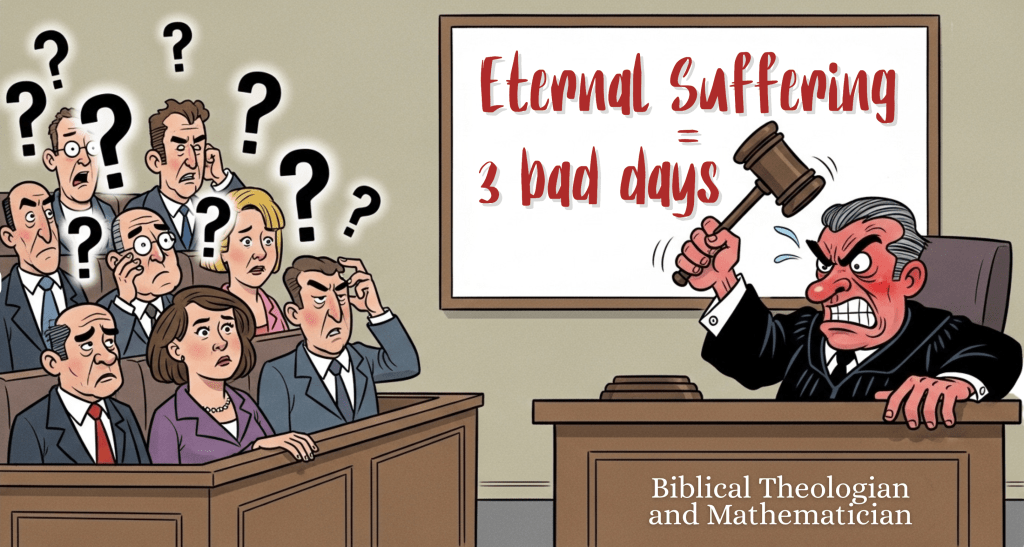
Would we accept a judge who proclaimed that three dollars equaled a billion dollars? Of course not. Yet, Christians are asked to accept that Jesus’ three-day death is equivalent to billions of eternal punishments. Even if we grant that death is the penalty for sin, there is an obvious difference between three days of death and eternal death.
Points for Reflection
- Claiming that finite punishment equates to infinite punishment reflects a profound mathematical misunderstanding or a disregard for justice.
- Substitutionary atonement involving an innocent being may be emotionally compelling but lacks logical coherence when applied to infinite penalties.
- The invocation of mystery in the face of this injustice does not solve the mathematical disparities—it simply avoids them.
Additional Notes
- This argument is most pertinent to Christians who assert that humans deserve eternal punishment.
- Examine responses from Christian leaders on this topic. Do they reconcile the mathematical disparity or sidestep the issue?
Concluding Thought
The central claim of Christian theology—that Jesus’ three-day death atones for the eternal damnation of billions—raises serious questions about its justice, proportionality, and mathematical validity. If the penalty for sin is paid, then why does the suffering continue? And if eternal suffering is the deserved penalty, how can a mere three days of death be considered equivalent? These questions demand rigorous, unambiguous answers that align with our concepts of justice and logic.
See Also:
A Companion Technical Paper:

The Logical Form
Argument 1: Disparity in Punishment Duration
- Premise 1: Eternal damnation is the penalty for offenses against God, according to Christian theology.
- Premise 2: Jesus’ punishment consisted of only three days of death.
- Premise 3: Finite punishment cannot logically equate to infinite penalties.Conclusion: Therefore, claiming that Jesus’ three-day death atones for eternal damnation is mathematically and logically incoherent.

Argument 2: Substitutionary Justice
- Premise 1: Substitutionary justice is the idea that one individual can bear the punishment for another’s offenses.
- Premise 2: Substitutionary justice presupposes proportionality between the substitute’s punishment and the penalties owed.
- Premise 3: Jesus’ finite punishment lacks proportionality when compared to the infinite penalties owed by billions of sinners.
- Conclusion: Therefore, substitutionary justice fails as a coherent explanation for the atonement.
Argument 3: Innocence and Justice
- Premise 1: Christians argue that Jesus’ innocence uniquely qualifies him to bear the punishment for others.
- Premise 2: Punishing an innocent being for the crimes of others violates principles of justice.
- Premise 3: The claim that Jesus’ innocence amplifies the effectiveness of his punishment lacks logical justification.
- Conclusion: Therefore, the notion that Jesus’ innocence justifies his role as a universal substitute is unjust and illogical.
Argument 4: Resurrection and Penalty Completion
- Premise 1: Some Christians argue that the penalty for sin is death, not its duration.
- Premise 2: If death alone pays the penalty for sin, a loving God would resurrect sinners upon their deaths.
- Premise 3: Eternal punishment following death contradicts the idea that the penalty has been fully paid.
- Conclusion: Therefore, the claim that Jesus’ death alone satisfies the penalty for sin is inconsistent with the continued punishment of sinners.
Argument 5: Mathematical Injustice
- Premise 1: Justice requires penalties to be proportional to the offense.
- Premise 2: Claiming that three days of death equates to billions of eternities violates principles of mathematical coherence.
- Premise 3: Appeals to divine mystery do not resolve this disparity but evade it.
- Conclusion: Therefore, the atonement fails to meet the criteria of justice or proportionality.

(Scan to view post on mobile devices.)

Dialogues
The Atonement
CHRIS: The central message of Christianity is that Jesus’ death on the cross paid for the sins of humanity. His three days of death satisfied the penalty for the eternal damnation we all deserve.
CLARUS: How can three days of death equate to eternal punishment? If the penalty for sin is infinite, shouldn’t the substitute endure an infinite penalty to achieve proportionality?
CHRIS: Jesus’ death was unique because he was innocent and divine, which gave his sacrifice an infinite quality. His innocence made him the perfect substitute for the punishment of billions of sinners.
CLARUS: Even if we grant the idea of substitutionary punishment, it still fails under mathematical scrutiny. An innocent being suffering for a finite period cannot logically satisfy the infinite penalties deserved by billions. Would you consider a judge just if they released all criminals after having their innocent child serve only three days in prison?
CHRIS: But Jesus was not merely innocent—he was the Son of God. His divinity gave his punishment infinite value, transcending human understanding of justice or time.
CLARUS: That’s an appeal to mystery, which doesn’t resolve the problem. Proportionality is a fundamental principle of justice. Without a quantifiable relationship between Jesus’ finite suffering and humanity’s infinite punishment, the claim lacks logical coherence.
CHRIS: The Bible says the wages of sin is death (Romans 6:23), and Jesus paid that wage by dying. The emphasis isn’t on the duration but on the act of dying itself.
CLARUS: If the penalty for sin is death, not its duration, why do humans face eternal punishment? If God’s justice demands only death, then a loving God should resurrect sinners upon their deaths rather than subject them to eternity in hell. Isn’t the continuation of punishment after death inconsistent with your claim?
CHRIS: Eternal punishment reflects the gravity of sin against an infinite God. Jesus’ sacrifice shows both God’s justice and mercy—justice in addressing sin, mercy in offering salvation.
CLARUS: But justice requires proportionality, and three days of death is no more equivalent to eternal damnation than three dollars equals a billion dollars. Without proportionality, the claim that Jesus’ death satisfied divine justice becomes mathematically incoherent. Doesn’t this suggest a theological flaw in the concept of atonement?
CHRIS: Perhaps the full nature of God’s justice and mercy is beyond human comprehension. What seems incoherent to us might be perfectly logical to God.
CLARUS: Resorting to divine mystery avoids rather than addresses the problem. If the atonement’s mathematical discrepancies cannot be reconciled, it raises serious doubts about the coherence of the Christian framework. Shouldn’t a belief system based on truth and justice withstand rigorous scrutiny?
A Question of Justice
CITIZEN: Judge, I don’t understand your recent decision. You released a million criminals after your son spent only three days in jail. How can that possibly satisfy their life sentences?
JUDGE: My son willingly took on the punishment for their crimes. His time in jail, though brief, holds an equivalent value because he is innocent and my son.
CITIZEN: But justice requires proportionality. These criminals were sentenced to lifetimes in prison, not three days. How can substituting your son for such a short time be considered a fair exchange?
JUDGE: My son’s innocence gives his punishment extraordinary weight. His suffering is sufficient to cover the crimes of all those offenders.
CITIZEN: Even if your son’s innocence makes his suffering meaningful, that doesn’t justify releasing a million criminals without them serving their sentences. The duration of the punishment matters for justice to be seen as proportional and credible. If you released your son after three days, haven’t the criminals’ debts to society remained unpaid?
JUDGE: You’re missing the point. My son’s suffering was not about time served but about absorbing the consequences of their crimes. It was an act of grace and mercy to allow them to go free.
CITIZEN: Grace and mercy are admirable, but this decision undermines the very principle of justice. If the punishment is finite, how do you justify equating three days of incarceration with a lifetime of imprisonment for each offender? Doesn’t this make a mockery of the legal system?
JUDGE: My authority as judge allows me to determine the sufficiency of any punishment. My son’s unique status and my declaration make his suffering equivalent to the lifetime sentences.
CITIZEN: But justice isn’t just about declarations—it’s about ensuring accountability. If criminals know they can avoid their full penalties because of a symbolic act, how can they or society take your system of justice seriously? Wouldn’t this encourage more offenses?
JUDGE: I disagree. This act shows the depth of my love for both my son and those I have pardoned. It’s an example of sacrificial justice.
CITIZEN: Love and sacrifice are noble, but they don’t replace the logical requirements of proportionality in justice. If your son’s brief incarceration is enough to satisfy a million life sentences, what prevents someone from claiming that no punishment at all would suffice? Doesn’t this open the door to arbitrary rulings?
JUDGE: You raise interesting points, but my decision reflects a higher justice. It is my prerogative as judge to balance grace and justice in ways that may seem incomprehensible.
CITIZEN: If the mechanics of justice become incomprehensible, then they cease to be justice. Your decision lacks both proportionality and transparency, leaving it open to valid criticism as illogical and unjust. Shouldn’t justice withstand the scrutiny of those it governs?
Notes:
Helpful Analogies
Analogy 1: The Restaurant Bill
Imagine a group of 1,000 diners who each owe $1,000 for their meals. Instead of paying their bills, the restaurant owner allows their innocent child to pay $3 on their behalf and declares the debt settled. Would this act reflect justice or a fair balance of proportionality? Clearly, such an arrangement would undermine the idea of accountability and the fairness of the system. The three-day death of Jesus, similarly, fails to equate to the eternal punishment deserved by billions, exposing a profound mathematical disparity in the atonement claim.
Analogy 2: The Substitute Runner

Imagine a marathon where each runner is required to complete 26.2 miles. One runner falls ill, so their coach decides to complete three miles on their behalf, then claims to have finished the entire race for them. Would this substitution be accepted as valid? Similarly, the claim that three days of death substitutes for eternity of punishment fails under the principle of equivalence.
Analogy 3: The Broken Loan System
Consider a bank that offers loans to millions of borrowers, each with a lifetime repayment plan. To settle these debts, the bank announces that the CEO’s child will pay off the loans by contributing three days of minimum-wage labor. The bank then forgives all debts, declaring that justice has been served. Would this be seen as a fair transaction or a violation of basic mathematical principles? The idea that Jesus’ brief death fully satisfies eternal damnation is analogous to this scenario—mathematically incoherent.
Addressing Theological Responses
Theological Responses
1. Jesus’ Death Was of Infinite Value
Theologians might argue that Jesus’ death was not about the duration but about the infinite worth of his sacrifice as the Son of God. Because Jesus is both fully divine and fully human, his death holds an infinite quality that transcends human concepts of proportionality. This infinite value allows his three-day death to cover the eternal punishment of billions.
2. The Atonement Reflects God’s Sovereignty
Another response could emphasize that God, as the ultimate judge, determines the requirements for justice and mercy. The atonement is based on God’s sovereign authority to declare the penalty for sin and its satisfaction. Theologians may assert that human concepts of justice and mathematics are limited and cannot fully comprehend divine reasoning.
3. Sin Against an Infinite God Requires Infinite Atonement
Some theologians might argue that sin against an infinite God requires an atonement of infinite significance. Jesus, being divine, fulfills this requirement. The infinite weight of his sacrifice is what satisfies the eternal punishment owed by humanity, irrespective of the time duration of his suffering.
4. The Resurrection Completes the Victory Over Sin
Theologians could claim that Jesus’ resurrection demonstrates the completion of the penalty and his victory over sin and death. The resurrection proves that his three-day death was sufficient, as it broke the power of eternal damnation. Thus, the focus is not on time served but on the redemptive act itself.
5. Atonement Is Rooted in God’s Love and Grace
Theologians might argue that the atonement is less about justice in the human sense and more about the grace and love of God. The brevity of Jesus’ death underscores God’s willingness to forgive, not the quantitative equivalence of the punishment. God’s act is meant to inspire gratitude, not to conform to human notions of justice.
6. The Mystery of Divine Justice
Theologians often invoke the mystery of God’s justice, arguing that human beings cannot fully comprehend the mechanics of atonement. The relationship between Jesus’ death and humanity’s salvation transcends human logic, requiring faith rather than full understanding.
7. Penal Substitution as Symbolic Rather Than Literal
Some theologians might interpret the penal substitution metaphorically, suggesting that Jesus’ death symbolizes the removal of sin rather than literally transferring infinite penalties. This view reframes the atonement as a relational act between God and humanity, not a strict mathematical equation.
Counter-Responses
1. Jesus’ Death Was of Infinite Value
While the claim that Jesus’ death holds infinite value may address proportionality in theory, it lacks measurable coherence. If infinite worth can be arbitrarily assigned to any event, then the principle of justice becomes subjective and unfalsifiable. Without a clear, logical mechanism connecting Jesus’ finite suffering to the infinite penalties owed, this response amounts to special pleading rather than a substantive explanation.
2. The Atonement Reflects God’s Sovereignty
Invoking divine sovereignty to justify the atonement sidesteps the core issue of logical coherence. If justice is reduced to whatever God declares, then it ceases to be grounded in consistent principles. This raises the concern that such a framework might justify arbitrary actions, eroding trust in the claim of a loving and just deity.
3. Sin Against an Infinite God Requires Infinite Atonement
Even if sin against an infinite being requires infinite atonement, the question remains: How does three days of finite suffering constitute infinite atonement? The response assumes, without justification, that Jesus’ divinity inherently provides infinite value. This assumption does not address the disproportionate exchange or the need for a transparent mechanism explaining the equivalence.
4. The Resurrection Completes the Victory Over Sin
The resurrection demonstrates power over death, but it does not explain how three days of death satisfy eternal punishment. If anything, the brevity of Jesus’ suffering undermines the claim of proportionality. A true victory over sin would logically require addressing the full penalty, not abbreviating it.
5. Atonement Is Rooted in God’s Love and Grace
While love and grace are admirable qualities, they do not override the necessity for justice to be coherent. Releasing billions of sinners based on a symbolic act diminishes the credibility of justice. If justice and love are incompatible, then the theological framework itself appears contradictory.
6. The Mystery of Divine Justice
Appealing to mystery avoids the challenge rather than addressing it. If justice is unknowable, it becomes impossible to evaluate claims of God’s righteousness or fairness. A system that relies on faith over logical consistency risks alienating those who value reason and clarity in theological systems.
7. Penal Substitution as Symbolic Rather Than Literal
Interpreting penal substitution as symbolic might sidestep the mathematical disparity, but it undermines the core Christian claim of a literal atonement. If the atonement is merely relational, it fails to address how justice is satisfied. Without a literal mechanism, the doctrine becomes a metaphor lacking substantive grounding in the theological framework of sin and punishment.
Clarifications
The Symbolic Logic Formulation | The Horns of the Dilemma
Definitions and Symbols:
: “x has served the just penalty for sin.”
: “x’s penalty for sin is eternal.”
: “x has suffered for
units of time.”
: “x is redeemed after serving their penalty.”
: “Jesus served the penalty for all sinners.”
: “x’s penalty was paid by Jesus.”
: The Christian apologist’s claim.
Premises:
(If the penalty for sin is eternal, no finite suffering can satisfy it.)
(If Jesus pays the penalty for a sinner, Jesus must serve the just penalty for sin.)
(There exist sinners whose penalty is eternal and for whom Jesus pays the penalty.)
(Jesus served the penalty for three days.)
(If x has served the just penalty, x is redeemed.)


Dilemma Formulation:
First Horn:
Assume 
From 

Conclusion: Jesus’ atonement fails.
Second Horn:
Assume 
From 


If 
Conclusion: The eternal punishment requirement is invalidated, and sinners’ redemption could be achieved through finite suffering, contradicting the doctrine of eternal damnation.
Formal Conclusion:
(The Christian apologist must choose: either Jesus did not serve the eternal penalty, or eternal punishment cannot logically exist.)


Leave a Reply