

Consider the Following:
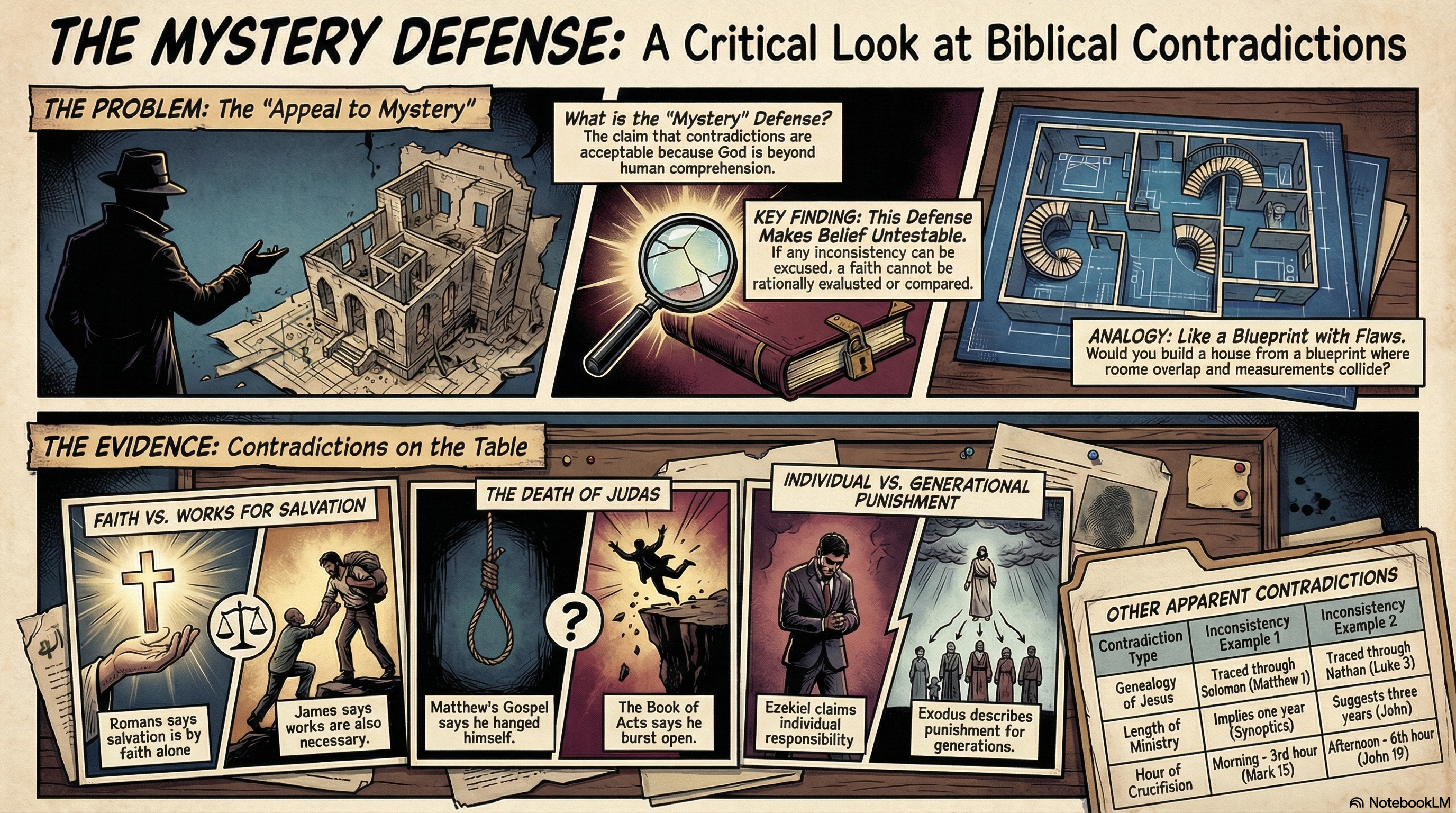
Summary: This post critically examines whether apparent contradictions in the Bible can be dismissed by appealing to the inscrutability of the Christian God, highlighting how such a defense undermines meaningful inquiry and shields beliefs from rational scrutiny. By exploring a detailed list of alleged biblical inconsistencies and emphasizing the value of logical arguments, it urges readers to assess the coherence of the Christian faith with intellectual honesty and rational consistency.

Imagine engaging in a dialogue with someone of a religion different from your own. You point out claims in their holy book that seem clearly incoherent. In response, they assert that, although they may not have a satisfactory explanation, their God’s mind is far beyond human comprehension, and it would be inappropriate to take these apparent incoherencies seriously. Would you not suggest that they have prematurely accepted their God without first assessing the internal consistency of their beliefs?
This question is not a trivial one. If an adherent of a belief system can dismiss any contradiction by appealing to the mystery of their God, how could their belief system ever be critically examined? If incoherence is excused as an inherent property of a deity’s inscrutability, the door to meaningful inquiry closes entirely. In such a scenario, what distinguishes one belief system from another, aside from cultural inheritance and emotional commitment?
Christian leaders often acknowledge that they do not have answers to every apparent contradiction or incoherency in the Bible. While some inconsistencies may indeed be only apparent, it is crucial to consider whether we allow these issues to influence our credence in the text’s divine origin. Is there any degree of contradiction or incoherency that would compel us to reexamine our beliefs about the God of the Bible?
If adherents of another religion refuse to question their sacred texts in light of unresolved contradictions, would we not conclude they are failing to conduct an honest search for truth? Could we not confidently say they have inappropriately accepted an inscrutable God without first thoroughly assessing the consistency of their scriptures? Would honest seekers claim their God to be so far above human understanding that this God cannot be subjected to rational critique?
The Universal Problem of Inscrutability
Any deity can be portrayed as so wise and mysterious that fallible human minds do not have the right to question that deity. However, an actual God, one who values truth and human reason, would recognize the profound danger of this approach. Many deities are presented in this manner across various religions, and accepting such a God without question leads to a world where cultural indoctrination determines belief far more than rational examination. Isn’t this evident in the geographic distribution of religions, where the local God is promoted to young children as the “true” deity?
Once a child is indoctrinated, the notion that their chosen God cannot be questioned shields their beliefs from scrutiny. Do you think an actual God would endorse this irrational epistemic closure? Would such a God demand faith in the face of unresolved contradictions, rather than a genuine pursuit of clarity and understanding?
The Significance of Apparent Incoherencies
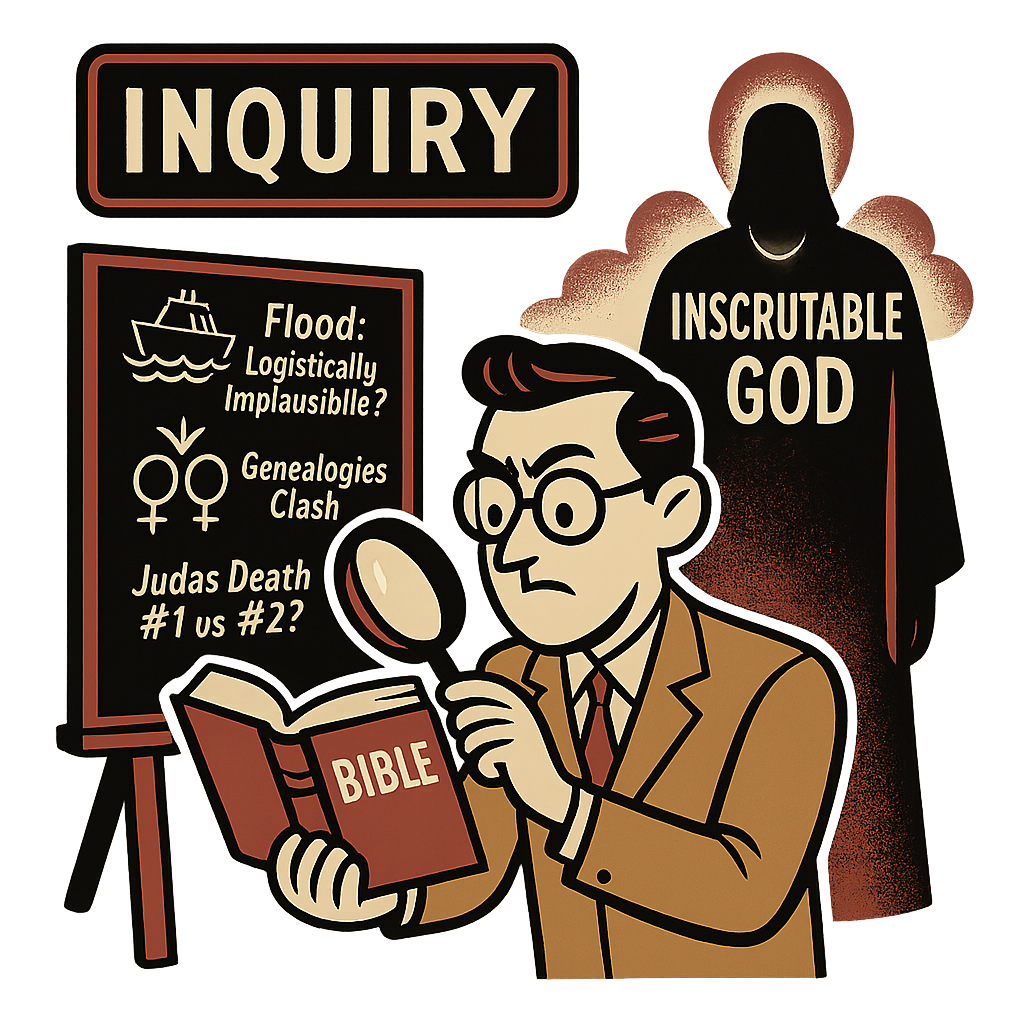
An honest and rational seeker is never beyond reexamining their beliefs. Apparent incoherencies should remain significant, regardless of assurances that the God in question has hidden answers. The assertion that “it makes sense in God’s mind” does not justify dismissing incoherencies from our own minds. Faith, in this sense, often operates as a defense mechanism against doubt, rather than a rationally grounded commitment.
When we encounter potential threats to the coherence of our ideology, do we allow the evidence to shape our thinking? Or have we locked ourselves into an ideology based on an assumed inscrutability of God? An honest evaluation requires a willingness to let apparent contradictions influence our degree of belief and a commitment to follow reason and evidence wherever they may lead.
Expanded List of Apparent Contradictions
The following is a short list of biblical accounts and notions that the reader is encouraged to re-examine for coherency. For most of these alleged contradictions, Christian leaders offer explanations that attempt to resolve the inconsistencies. However, the reader must assess whether these explanations are reasonable or overly convoluted.
- The Noahic Flood Account (Genesis 6-7): Can the logistics of a global flood, such as the gathering and care of millions of animal species, withstand critical scrutiny?
- Punishment for the sins of fathers (Ezekiel 18:20 vs. Exodus 20:5): How do these passages reconcile individual responsibility with generational punishment?
- Jesus’ private encounter with Satan (Matthew 4:1-11 & Luke 4:1-13): Who recorded this event if no one else was present?
- Visiting of Jesus’ tomb (Matthew 28:1-10, Mark 16:1-8, Luke 24:1-12, John 20:1-18): The Gospels differ on key details such as the number of visitors, the timing, and the role of angels. How can these accounts be harmonized?
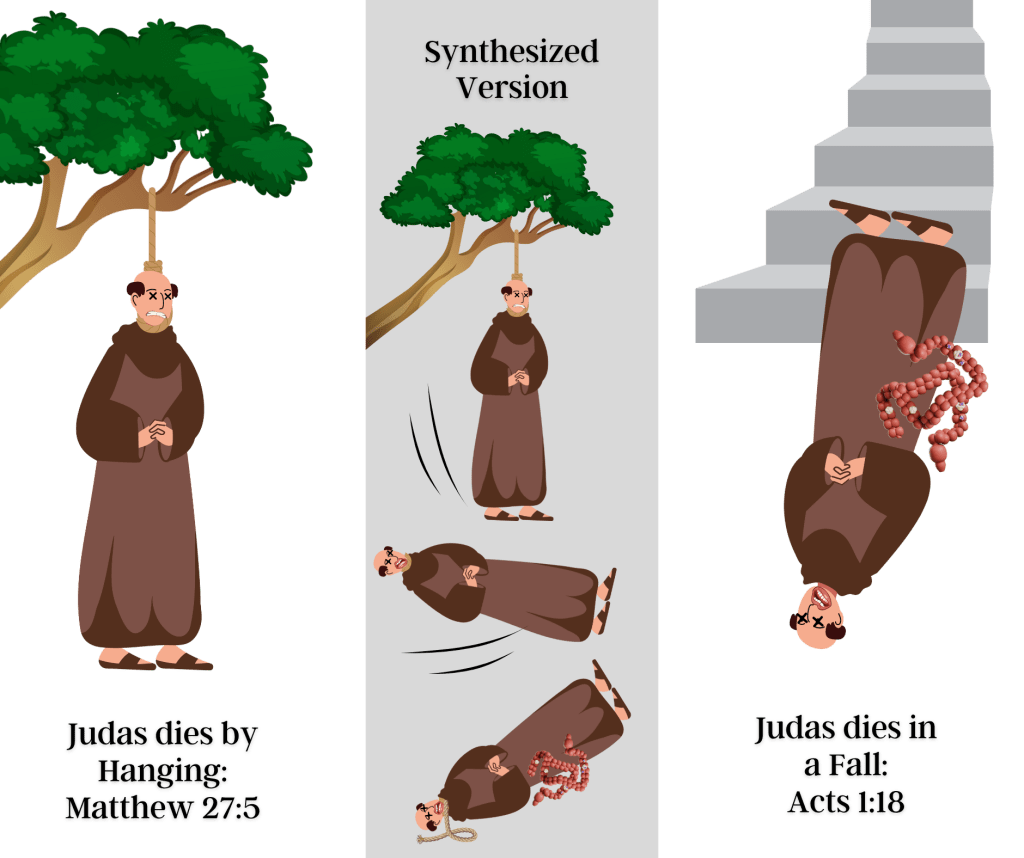
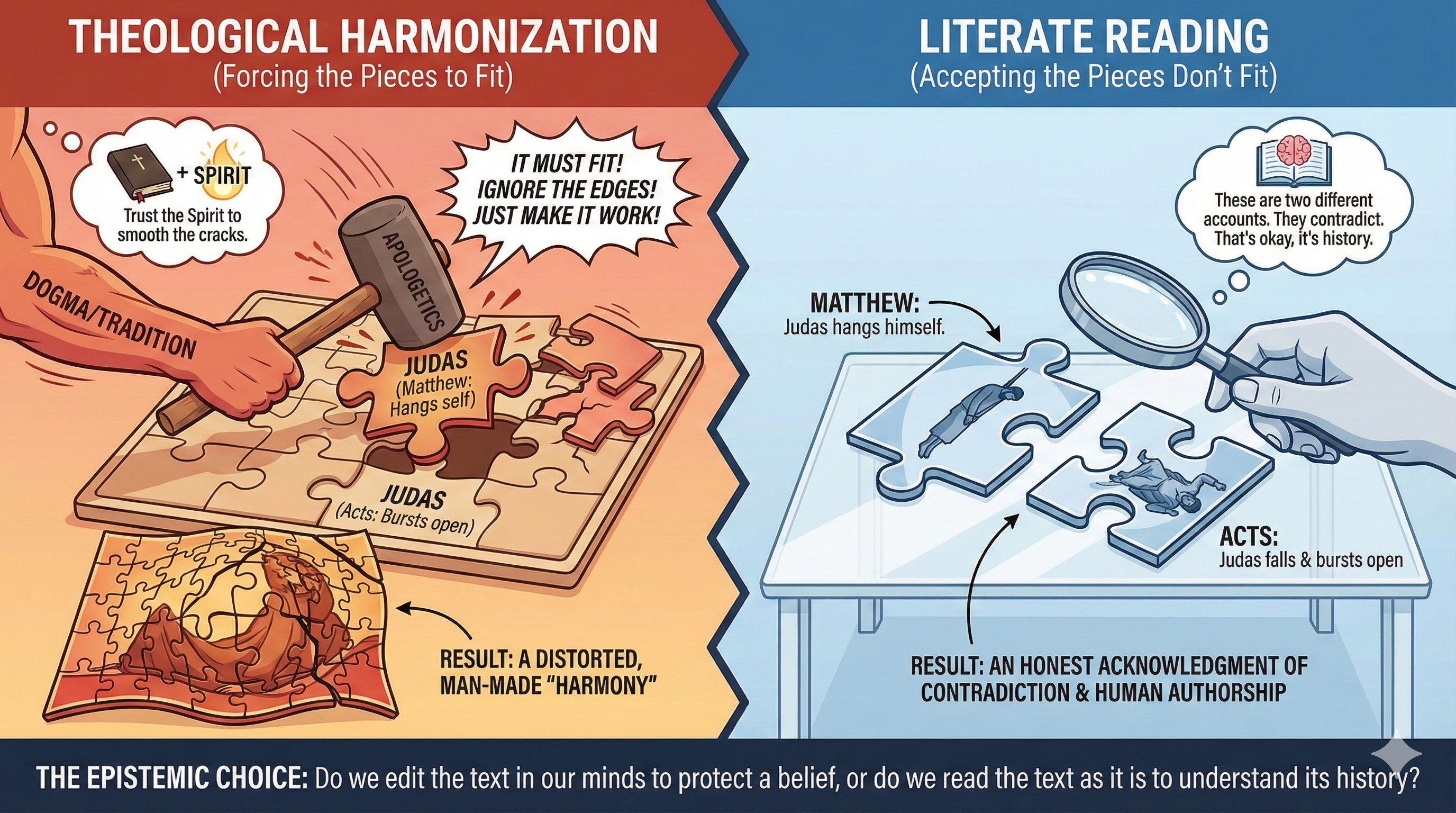
- The death of Judas Iscariot (Matthew 27:3-8 vs. Acts 1:16-19): Did Judas hang himself, or did he fall and burst open? Can both be true simultaneously?
- Who has ascended into Heaven? (John 3:13 vs. 2 Kings 2:11): How do we reconcile the ascension of Elijah with the claim that no one has ascended except Jesus?
- Rejoicing over enemies (Psalms 58:10-11 vs. Proverbs 24:17-18): Is it consistent for one passage to celebrate vengeance while another discourages rejoicing over an enemy’s downfall?
- Length of Jesus’ ministry (Synoptic Gospels vs. John): Was Jesus’ ministry one year, as implied by the Synoptics, or three years, as implied by John?
- Faith or works? (James 2:24 vs. Romans 3:28): Does salvation depend on faith alone, or are good works also necessary? How do these views reconcile?
- God commanding deceit (1 Kings 22:22 vs. Proverbs 12:22): Does God’s use of a lying spirit conflict with the condemnation of deceit elsewhere?
- Genealogy of Jesus (Matthew 1:1-17 vs. Luke 3:23-38): How do the two genealogies of Jesus align, given their significant differences?
- The timing of Jesus’ crucifixion (Mark 15:25 vs. John 19:14): Was Jesus crucified in the morning or the afternoon?
Resolving Doubt and Considering the Larger Picture

For true believers, proposed resolutions to these contradictions, no matter how convoluted, can minimize doubt and preserve their faith. Christian apologists often cobble together explanations that attempt to harmonize these issues. To the faithful, these explanations may seem sufficient to resolve any concerns about the apparent contradictions. However, one must ask whether these resolutions are driven by honest inquiry or by a need to preserve belief at all costs.
For this reason, the more logical arguments presented in earlier posts on this blog may provide a better framework for assessing the coherency of the Christian God. These arguments move beyond textual analysis and address the core assumptions of Christian faith. By engaging with these foundational issues, readers can approach their inquiry with a commitment to intellectual honesty and rational consistency.
The Logical Form
Argument 1: The Defense of Inscrutability Undermines Rational Inquiry
- Premise 1: If a belief system allows contradictions to be dismissed by appealing to the inscrutability of its deity, it cannot be critically examined.
- Premise 2: A belief system that cannot be critically examined lacks a rational basis for distinguishing it from other systems based on cultural inheritance or emotional commitment.
- Conclusion: Appealing to the inscrutability of a deity to dismiss contradictions undermines the rational inquiry necessary to evaluate a belief system.

Argument 2: An Actual God Would Value Rational Examination
- Premise 1: Many religions portray their deities as too wise and mysterious for humans to question.
- Premise 2: An actual God, valuing truth and reason, would not endorse a system where indoctrination and epistemic closure prevent honest evaluation.
- Conclusion: A true God would value rational examination over faith that shields beliefs from scrutiny.
Argument 3: Apparent Incoherencies Should Be Taken Seriously
- Premise 1: Apparent incoherencies in a belief system remain significant unless addressed with rational and coherent explanations.
- Premise 2: Dismissing incoherencies by claiming that they “make sense in God’s mind” removes the issue from rational consideration.
- Conclusion: Apparent incoherencies should be taken seriously and addressed to maintain intellectual integrity.
Argument 4: Geographic Distribution of Religions Reflects Cultural Indoctrination
- Premise 1: The geographic distribution of religions correlates strongly with cultural inheritance and local promotion of specific deities.
- Premise 2: This distribution indicates that many beliefs are adopted through cultural indoctrination, rather than through independent rational inquiry.
- Conclusion: The prevalence of cultural indoctrination challenges the validity of faith systems that rely on inscrutability to dismiss contradictions.
Argument 5: Incoherencies Challenge the Bible’s Clarity as a Guide
- Premise 1: The Bible contains apparent contradictions that create ambiguity in its interpretation (e.g., conflicting genealogies, differing accounts of Jesus’ death).
- Premise 2: A divine text intended as a clear guide for humanity would not exhibit significant vagueness or unresolved contradictions.
- Conclusion: The presence of apparent contradictions challenges the Bible’s clarity as a divine guide.
Argument 6: Logical Arguments Are Superior to Textual Harmonization
- Premise 1: Resolving contradictions in the Bible often involves convoluted explanations that may satisfy believers but lack intellectual rigor.
- Premise 2: Logical arguments address the core assumptions of faith and provide a more robust framework for evaluating the coherence of the Christian God.
- Conclusion: Logical arguments are a superior method for assessing the coherence of the Christian faith compared to attempts at textual harmonization.
(Scan to view post on mobile devices.)

A Dialogue
Can Biblical Inconsistencies Be Dismissed by Divine Inscrutability?
CHRIS: The Bible may appear to contain contradictions, but these are simply due to the inscrutability of God. As finite beings, we cannot expect to fully understand an infinite deity’s purposes or logic.
CLARUS: But if you dismiss apparent contradictions as beyond human understanding, how can your beliefs ever be critically examined? Any belief system could claim that its inconsistencies stem from its deity’s inscrutability, making it impossible to distinguish true beliefs from culturally inherited ones.
CHRIS: True, but God’s ways are higher than ours. Isn’t it arrogant to demand that a perfect deity conform to human logic?
CLARUS: If God values truth and gave humans the capacity for reason, wouldn’t God expect us to use that capacity to evaluate claims, including those about divine nature? Shielding contradictions under the guise of mystery effectively denies humans the tools necessary to engage in honest inquiry.
CHRIS: That’s fair, but many alleged contradictions in the Bible can be resolved. Scholars and theologians have provided explanations for these issues.
CLARUS: Some explanations may appear plausible, but many are convoluted and strain credibility. For instance, consider the death of Judas: did he hang himself as described in Matthew, or did he fall and burst open as described in Acts? Claiming both are true because he hanged himself and later fell is an ad hoc harmonization rather than a straightforward resolution.
CHRIS: But those details don’t necessarily undermine the core truths of Christianity. The Bible’s primary message isn’t affected by these peripheral issues.
CLARUS: Yet if the Bible is the divinely inspired guide for humanity, shouldn’t it exhibit clarity rather than ambiguity? Contradictions in genealogies, timelines, and salvation doctrines don’t just affect peripheral matters—they challenge the Bible’s ability to serve as a coherent and consistent guide.
CHRIS: Perhaps, but faith isn’t just about logic. It’s about trust in a God who is beyond our comprehension.
CLARUS: Trust is reasonable only if it’s grounded in evidence and coherence. If faith relies on accepting contradictions as inscrutable mysteries, how is it different from blind adherence to cultural indoctrination? The geographic distribution of religions reflects how local beliefs are passed down rather than independently evaluated.
CHRIS: But many believers have found resolutions to these issues that satisfy their doubts. For them, the apparent contradictions don’t diminish their faith.
CLARUS: True, but relying on such resolutions often feels like patching a leaky ship. A stronger approach is to address the core assumptions of Christianity through logical arguments, as these provide a more robust foundation for assessing the coherency of belief. Wouldn’t you agree that a God who values reason would prefer us to rigorously examine such claims rather than dismiss doubts as beyond our understanding?
CHRIS: I see your point, but it’s difficult to let go of the idea that God’s wisdom might transcend what appears inconsistent to us.
CLARUS: And yet, if God truly values truth, wouldn’t such a God expect us to challenge, test, and refine our beliefs with the tools of reason and evidence? Appealing to inscrutability may shield faith, but it also limits its integrity.
Notes:
Helpful Analogies
Analogy 1: The Faulty Blueprint
Imagine an architect presents you with a blueprint for a house, claiming it was designed by the greatest mind in the universe. As you examine the blueprint, you notice several inconsistencies—rooms overlap, measurements don’t align, and doors lead nowhere. When questioned, the architect insists that these are simply due to the inscrutability of the designer’s genius and that everything will make sense once the house is built. Would you trust the blueprint and proceed with construction, or would you demand clarity and coherence before investing in the project?
Analogy 2: The Mysterious Manual
Suppose a company provides a manual for assembling a machine, claiming it was written by the world’s foremost engineer. As you follow the instructions, you encounter contradictory steps that lead to assembly errors. When you contact the company, they dismiss your concerns, stating that the engineer’s wisdom is beyond your comprehension and that you should trust the process. Would you continue relying on the manual, or would you question whether such a guide can truly fulfill its purpose?
Analogy 3: The Teacher’s Test

Imagine a teacher administers a test where some questions contradict each other, and others have no clear answers. When students point out these issues, the teacher replies that their reasoning is far too complex for students to understand and that they should simply trust the teacher’s ultimate judgment. Would this response inspire confidence in the teacher’s competence, or would it suggest a failure to create a test that is clear and fair?
Addressing Theological Responses
Theological Responses
1. God’s Ways Are Beyond Human Understanding
Theologians might argue that an infinite God cannot be fully comprehended by finite humans. They could assert that apparent contradictions in the Bible arise because God’s wisdom and plans are beyond human logic, and it is not for humanity to demand complete understanding.
2. Apparent Contradictions Have Plausible Resolutions
Many theologians would contend that what appear to be contradictions are often due to misinterpretation, translation issues, or lack of context. They might provide harmonizing explanations for examples like the differing accounts of Judas’s death or the genealogies of Jesus, suggesting these differences are not actual contradictions but reflect distinct perspectives or purposes of the authors.
3. Faith Transcends Logic
Theologians may emphasize that faith is not rooted in the absence of doubt but in a trust that transcends human reasoning. They might argue that placing too much emphasis on coherence diminishes the role of faith as a spiritual virtue and misrepresents the relational nature of belief in God.
4. Cultural Indoctrination Does Not Invalidate Truth
While theologians might acknowledge the influence of cultural inheritance on religious belief, they could argue that this does not necessarily invalidate the truth of Christianity. Instead, they might suggest that the geographic distribution of religions reflects God’s providential use of human culture to spread His message.
5. The Bible’s Core Message Is Clear Despite Apparent Contradictions
Theologians may argue that the Bible’s central teachings—such as salvation through Jesus, love, and forgiveness—remain clear, even if some details appear contradictory. They could claim that the Bible’s primary purpose is to reveal spiritual truths, not to provide exhaustive clarity on every historical or doctrinal issue.
6. Historical and Archaeological Evidence Supports the Bible
Theologians might point to external evidence—such as archaeological findings, historical records, or fulfilled prophecies—as a testament to the reliability of the Bible. They could argue that this evidence outweighs concerns over apparent inconsistencies.
7. Logical Coherence Is Only One Measure of Truth
Some theologians might challenge the assumption that logical coherence is the ultimate standard for assessing truth claims. They could argue that experiential, historical, and relational dimensions also play a role in validating religious beliefs and that focusing solely on logical arguments provides an incomplete picture.
Counter-Responses
1. God’s Ways Are Beyond Human Understanding
While it is reasonable to acknowledge that an infinite God may surpass human understanding, invoking this as a defense for apparent contradictions undermines the rational evaluation of claims. If God’s wisdom is completely inscrutable, then no positive claims about God’s nature or will can be reliably made, as they too would be beyond human comprehension. This would render all theology speculative at best, eroding any epistemic basis for distinguishing one deity from another.
2. Apparent Contradictions Have Plausible Resolutions
Although some apparent contradictions may be resolved through contextual analysis or harmonization, many explanations rely on ad hoc reasoning that stretches credibility. For example, reconciling the two accounts of Judas’s death (Matthew vs. Acts) requires adding speculative details not present in the text, which undermines the Bible’s supposed clarity and sufficiency. A coherent divine text should not require such convoluted interpretive gymnastics to explain its inconsistencies.
3. Faith Transcends Logic
If faith is defined as trust without the need for logical coherence, it becomes indistinguishable from cultural indoctrination or belief in any arbitrary claim. Rational inquiry demands that faith be grounded in evidence and consistency; otherwise, it risks validating mutually exclusive belief systems. A faith that transcends logic provides no mechanism for distinguishing truth from error or for avoiding self-deception.
4. Cultural Indoctrination Does Not Invalidate Truth
While cultural inheritance does not directly invalidate a belief system, it highlights the lack of universal accessibility that one would expect from a God seeking to reveal truth to all humanity. The geographic distribution of religions reflects how cultural factors, rather than divine revelation, are often the dominant influence on belief. If Christianity were objectively true, its acceptance should be evident across cultural boundaries in a manner independent of local traditions.
5. The Bible’s Core Message Is Clear Despite Apparent Contradictions
The claim that the Bible’s core teachings are clear despite apparent contradictions is problematic because these contradictions affect foundational doctrines. For example, the requirements for salvation (faith vs. works) are central to Christianity, yet the Bible presents conflicting views (e.g., Romans 3:28 vs. James 2:24). If even key doctrines are ambiguous, how can the Bible serve as a reliable spiritual guide?
6. Historical and Archaeological Evidence Supports the Bible
While archaeological findings and historical records may corroborate certain events or locations in the Bible, they do not confirm its divine origin or the accuracy of its theological claims. Similar evidence exists for other religious texts, such as the Quran or the Bhagavad Gita, but this does not validate their divine inspiration. Historical reliability of some details cannot resolve contradictions or ambiguities in the Bible’s doctrinal content.
7. Logical Coherence Is Only One Measure of Truth
While it is true that truth can involve experiential and relational dimensions, logical coherence remains a necessary condition for a belief system to be rationally credible. A belief system that fails the test of coherence cannot claim to offer a consistent account of reality. Without logical coherence, appeals to experience or relationship risk becoming purely subjective and cannot distinguish genuine truth from emotional bias or wishful thinking.
Clarifications
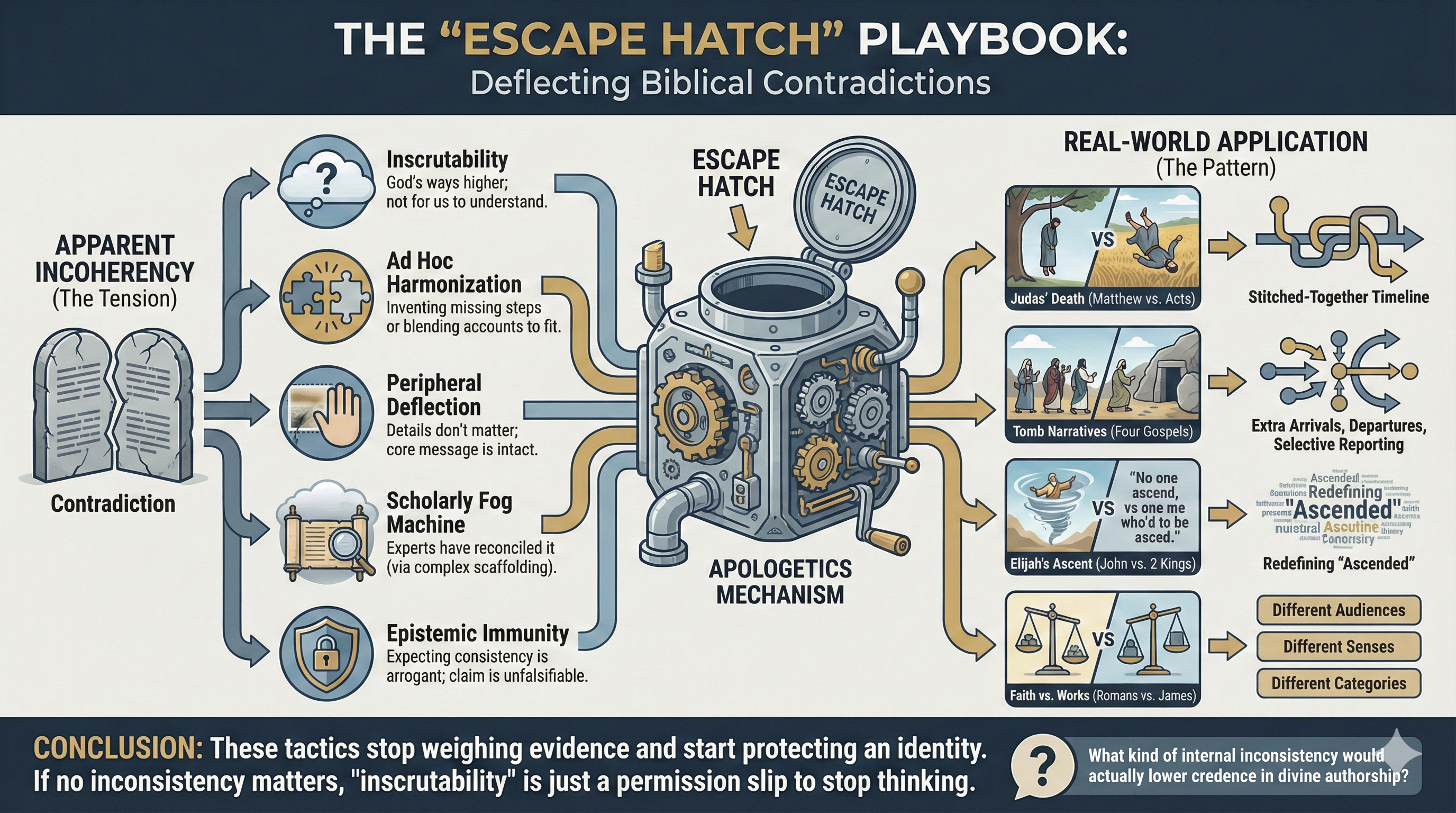
How Apologists Explain Away Biblical Contradictions: A Playbook for Rationalizing Inconsistencies
Introduction
Christian apologists often employ a variety of tactics to address apparent contradictions in the Bible. While these approaches are designed to defend the text’s coherence and divine inspiration, the methods themselves—if universally applied—could be used to dismiss legitimate critiques of any text, whether fictional or sacred. This essay explores these apologetic tactics, critiques their validity, and demonstrates how their universal application could shield any contradictory narrative from scrutiny, using real examples of biblical contradictions for each tactic.
Tactic 1: Inscrutability of the Author
Contradiction: The Bible describes God as both loving and merciful (Psalm 103:8) and as commanding the genocide of entire populations, including women and children (1 Samuel 15:2-3).
Apologetic Defense: Apologists argue that God’s actions and commands are beyond human comprehension and that what appears cruel to us is part of God’s greater, unknowable plan.
Critique: Invoking inscrutability avoids addressing the moral tension between these depictions. If this rationale were applied to fiction, any character’s actions, no matter how inconsistent, could be dismissed as too complex for readers to understand.
Tactic 2: Contextual Harmonization
Contradiction: The genealogies of Jesus in Matthew 1:1-16 and Luke 3:23-38 differ significantly, with names and generational counts that are impossible to reconcile.
Apologetic Defense: Apologists claim that Matthew traces Jesus’ lineage through Joseph’s royal ancestry, while Luke traces it through Mary, even though Luke explicitly names Joseph as the link.
Critique: This explanation introduces speculative details not found in the text, creating an ad hoc narrative to harmonize the accounts. In fiction, this method could justify adding unwritten events to resolve any plot hole, undermining fair criticism.
Tactic 3: Misinterpretation by the Critic
Contradiction: In Genesis 1, humans are created after animals, while in Genesis 2, Adam is created before animals.
Apologetic Defense: Apologists argue that critics misunderstand the genres of the creation accounts, with Genesis 1 being a poetic overview and Genesis 2 a focused narrative.
Critique: While understanding context is essential, this defense shifts the burden onto the critic and avoids addressing the explicit sequential contradictions in the text. Similarly, a poorly structured fictional timeline could be defended by claiming the critic misunderstood the author’s intent.
Tactic 4: Apparent Contradictions as a Test of Faith
Contradiction: The Bible claims that God is unchanging (Malachi 3:6) but also describes instances where He changes His mind, such as when He relents from destroying Nineveh (Jonah 3:10).
Apologetic Defense: Apologists may frame this as a test of faith, arguing that believers should trust in the divine character and not be troubled by seemingly inconsistent descriptions.
Critique: This tactic discourages inquiry by valorizing trust over logic, allowing any contradiction to be dismissed. In fiction, this would elevate reader loyalty above meaningful engagement with the text’s flaws.
Tactic 5: Selective Emphasis on the Core Message
Contradiction: The Bible provides conflicting instructions on salvation: Paul asserts that salvation is by faith alone (Romans 3:28), while James emphasizes the necessity of works (James 2:24).
Apologetic Defense: Apologists claim that these contradictions are minor and that the Bible’s core message—God’s love and the promise of salvation—is unaffected.
Critique: Downplaying contradictions in foundational doctrines trivializes their impact. A fictional narrative could similarly dismiss major plot holes by claiming they do not detract from the story’s primary theme.
Tactic 6: Appeal to the Supernatural
Contradiction: Judas’s death is described differently: in Matthew 27:3-5, Judas hangs himself; in Acts 1:18, he falls and his body bursts open.
Apologetic Defense: Apologists argue that these accounts describe different stages of the same event, with supernatural factors (e.g., divine timing or circumstances) explaining the discrepancy.
Critique: By invoking supernatural explanations, apologists insulate the text from falsifiability. Similarly, inconsistencies in a fantasy novel could be excused by attributing them to invisible magical forces.
Tactic 7: Historical and Archaeological Validation
Contradiction: The Bible claims the Exodus involved millions of Israelites (Numbers 1:46), yet no archaeological evidence supports such a large-scale migration through the Sinai Peninsula.
Apologetic Defense: Apologists often cite unrelated archaeological findings, such as evidence of smaller nomadic groups, to suggest that the biblical account is plausible.
Critique: While historical evidence can support some elements of the Bible, it does not resolve internal inconsistencies or validate exaggerated claims. Similarly, a historical novel’s contradictions could be excused by pointing to its accurate portrayal of unrelated historical events.
Tactic 8: Logical Coherence Is Not the Sole Criterion
Contradiction: The Bible presents God as both omnipotent and omnibenevolent, yet the existence of evil (theodicy) remains unresolved.
Apologetic Defense: Apologists argue that emotional, relational, and experiential dimensions of faith are more important than resolving logical dilemmas like the problem of evil.
Critique: While subjective experiences are meaningful, they do not resolve logical contradictions. If applied to fiction, this defense would justify ignoring structural flaws in favor of emotional impact, sidestepping valid critique.
Conclusion
Christian apologists employ a range of tactics to explain away apparent contradictions, including appeals to inscrutability, speculative harmonization, and the prioritization of faith over logic. While these methods may preserve belief, they undermine the text’s ability to withstand rational scrutiny. Moreover, when applied to other works—fictional or otherwise—these tactics render any critique unfalsifiable. To maintain intellectual integrity, both sacred texts and secular narratives must be evaluated using consistent standards of logic, evidence, and coherence.
Biblical Narratives on Rejection of the Christian God: The Unfalsifiable Safety Valve
Introduction
The Bible presents rejection of the Christian God not as a rational disagreement or a matter of honest skepticism but as a moral and intellectual failure on the part of the rejecter. Passages claim that those who reject God “profess themselves wise, but became fools” (Romans 1:22), “have not ears to hear” (Matthew 13:15), or “perverted the truth into lies” (Romans 1:25). These assertions create a theological framework that insulates the Christian worldview from critique by attributing disbelief to spiritual blindness or moral corruption. This essay examines how these claims function as an unfalsifiable safety valve, protecting Christians from the unsettling idea that rejection of God could stem from legitimate, rational reasons.
Those Who Profess Wisdom Have Become Fools
Romans 1:22 accuses those who reject God of foolishness masquerading as wisdom:
“Claiming to be wise, they became fools.”
This framing allows Christians to dismiss critiques of their faith by asserting that skeptics are blinded by pride in their own intellect. It implies that rejection of God is not based on rational inquiry but on an arrogant overestimation of human reason.
Unfalsifiability: The claim is circular. If a skeptic provides an intelligent critique, this is taken as proof of their prideful foolishness rather than a challenge to the Christian worldview. The skeptic’s rational arguments are never engaged on their merits but are preemptively invalidated by their alleged foolish pride.
Safety Valve: This tactic protects Christians from doubt by shifting the focus away from the content of the critique and onto the supposed character flaw of the critic. No argument, however compelling, can penetrate this framework.
“Having Ears, They Do Not Hear”
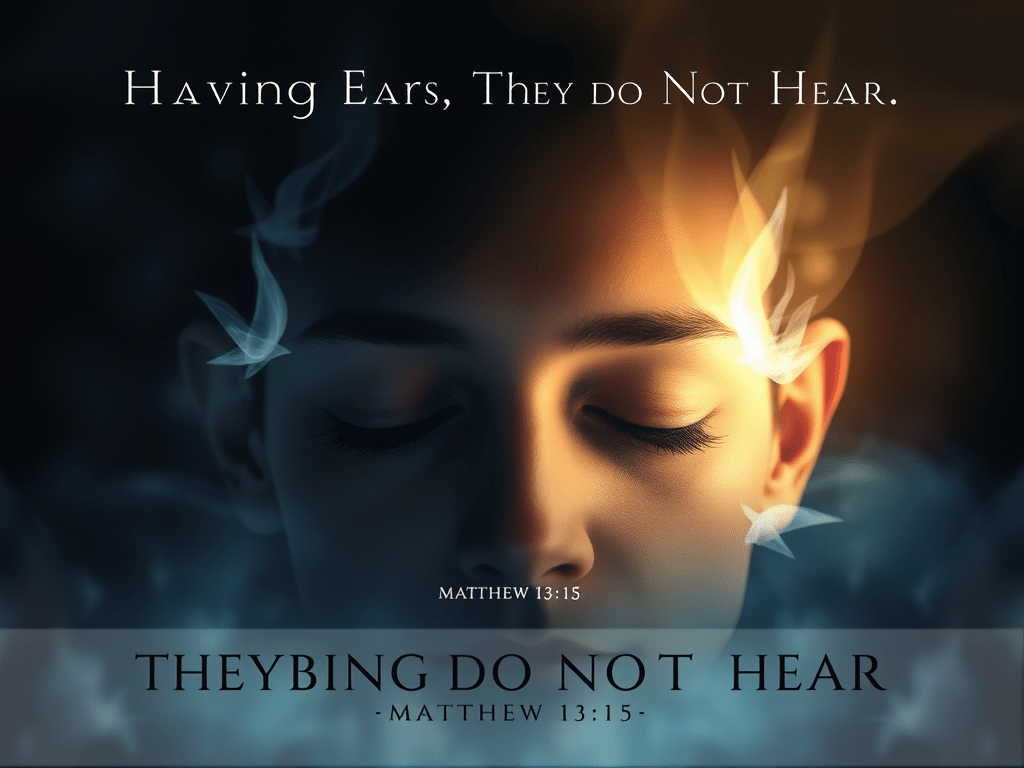
Matthew 13:15 attributes disbelief to a spiritual inability to perceive truth:
“For this people’s heart has grown dull, and with their ears they can barely hear, and their eyes they have closed.”
This passage suggests that rejection of Christianity stems from an intentional or divine blinding of the senses, not from honest disagreement. By invoking the imagery of spiritual deafness and blindness, it asserts that skeptics cannot perceive what Christians believe to be self-evident truths.
Unfalsifiability: If someone fails to be persuaded by Christian doctrine, their disbelief is attributed to their inability to comprehend spiritual truth, rather than to flaws in the doctrine itself. This creates an impenetrable barrier to criticism, as any dissent is framed as a symptom of the very blindness the Bible predicts.
Safety Valve: This explanation allows Christians to avoid addressing difficult questions or critiques, reinforcing the belief that skeptics’ objections are irrelevant because they lack the necessary spiritual insight.
Perverting the Truth into Lies
Romans 1:25 accuses unbelievers of willfully distorting the truth:
“They exchanged the truth about God for a lie, and worshiped and served created things rather than the Creator.”
This paints rejection of Christianity as not just a misunderstanding but an active rebellion against truth. It presumes that skeptics know the truth of God’s existence but deliberately twist it into falsehood for their own purposes.
Unfalsifiability: If rejection of Christianity is always characterized as deliberate perversion, there is no space for an honest rejection of its claims. The presumption that everyone “knows” the truth but denies it suppresses the possibility of legitimate doubt or dissent.
Safety Valve: This tactic ensures that disbelief is always the fault of the skeptic, absolving Christianity from any responsibility for convincing others. By framing rejection as an act of willful deceit, Christians can maintain their faith without questioning its universality or coherence.
Other Similar Claims: Suppressing the Truth and Darkened Understanding
In addition to these key passages, other biblical verses reinforce the idea that rejection of God is rooted in moral failure or intellectual corruption:
- Romans 1:18: “The wrath of God is revealed… against those who suppress the truth by their wickedness.”
- Ephesians 4:18: “They are darkened in their understanding and separated from the life of God because of the ignorance that is in them due to the hardening of their hearts.”
These verses suggest that unbelief is always tied to moral wickedness, willful ignorance, or a hardened heart. They deny the possibility that someone could reject Christianity for rational or evidential reasons.
Unfalsifiability: These claims make it impossible to honestly reject Christianity, as all rejection is preemptively framed as spiritual failure. Any counterargument is dismissed as evidence of the skeptic’s darkened understanding or wickedness.
Safety Valve: This insulates Christians from challenges to their faith, as no critique can penetrate the theological assumption that unbelief stems from moral or intellectual deficiency.
The Problem of an Unfalsifiable Framework
By framing rejection of Christianity as the result of foolishness, spiritual blindness, or moral failure, the Bible creates an unfalsifiable framework that protects believers from the discomfort of doubt. This framework ensures that:
- Critiques are discredited before they are heard. Skeptics are labeled as foolish, blind, or morally corrupt, allowing Christians to dismiss their objections without engagement.
- Faith is reinforced as self-evidently true. The rejection of Christianity is always attributed to the fault of the skeptic, never to flaws in the faith itself.
- Believers are shielded from introspection. By attributing all disbelief to external factors, Christians are discouraged from critically examining their own beliefs.
Implications of This Framework
The unfalsifiable nature of these claims has significant implications:
- Denial of Honest Inquiry: This framework denies the possibility of rejecting Christianity in good faith, undermining the sincerity of rational inquiry.
- Polarization: By framing skeptics as fools or rebels, it alienates potential converts and fosters an “us vs. them” mentality.
- Stagnation: This framework discourages believers from grappling with difficult questions, stifling intellectual and spiritual growth.
If Christians are to engage with skeptics in a way that respects intellectual honesty, they must abandon the presumption that disbelief is always the result of moral failure or spiritual blindness. A more humble and open-minded approach would involve addressing critiques on their merits, without resorting to dismissive assumptions about the skeptic’s character or motives.
Conclusion
The Bible’s portrayal of those who reject God as fools, spiritually blind, or deliberately deceitful creates a powerful safety valve for Christians, protecting their faith from critique. However, this unfalsifiable framework undermines honest dialogue and intellectual integrity. True confidence in one’s beliefs should not require dismissing dissenters as inherently flawed but should instead invite open and rigorous examination of opposing perspectives. Only by embracing such humility can Christians meaningfully engage with the challenges posed by rational skepticism.
Why Discrepancies in Biblical Narratives Rarely Change the Minds of True Believers
Introduction
Bringing up discrepancies in biblical narratives often seems like a powerful way to challenge the belief systems of Christians who claim the Bible is inerrant. These discrepancies—ranging from conflicting resurrection accounts to contradictory genealogies—appear, to skeptics, as clear evidence of the Bible’s human origins. However, true believers are rarely persuaded by such critiques. Their commitment to faith and reliance on improbable explanations serve to insulate their worldview from rational scrutiny. This phenomenon mirrors the belief preservation strategies employed by flat earthers, who also rely on improbable harmonizations and unfalsifiable frameworks to protect their beliefs. This essay explores why biblical discrepancies rarely change the minds of true believers, focusing on faith, cognitive dissonance, and interpretive flexibility, and drawing an analogy to the flat-earth mindset.
Faith as a Foundation Beyond Evidence
True believers approach the Bible with a faith-first mindset, where trust in its divine origin is assumed. For such individuals, faith is more than intellectual assent; it is a relational trust in God and the framework through which all evidence is filtered. In this context, even highly improbable explanations for discrepancies are satisfactory because the alternative—acknowledging error—is seen as unthinkable.
Improbable Explanations Are Satisfactory: When faced with the conflicting genealogies of Jesus in Matthew and Luke, believers often claim that Matthew traces the royal lineage through Joseph while Luke traces the biological lineage through Mary, even though neither text explicitly states this. This explanation is ad hoc and improbable, but it satisfies believers because it preserves the presumption of inerrancy.
Flat Earth Parallel: Flat earthers similarly accept improbable explanations to reconcile evidence that contradicts their worldview. For instance, when presented with the curvature of the Earth seen in images from space, they often claim the images are faked by a global conspiracy. Just as believers accept improbable harmonizations to preserve the Bible’s inerrancy, flat earthers embrace elaborate conspiracy theories to preserve their belief in a flat Earth.
Cognitive Dissonance and Resolution Through Faith
When believers encounter evidence that contradicts their view of the Bible as inerrant, they experience cognitive dissonance—the discomfort of holding conflicting beliefs. Rather than reevaluating their faith, they resolve this tension by doubling down on trust in God.
Blame Is Shifted to Human Limitations: Discrepancies in the Bible, such as the differing resurrection accounts (e.g., Matthew 28:2 mentions one angel at the tomb, while Luke 24:4 mentions two), are often explained as differences in perspective. Believers claim that the accounts are complementary, not contradictory, and that human limitations in reporting explain the variance. This avoids engaging with the idea that such discrepancies might indicate fallibility in the text.
Flat Earth Parallel: Flat earthers experience similar cognitive dissonance when confronted with evidence such as time zones or the behavior of the Sun. Rather than reevaluating their belief, they shift the blame to scientific conspiracies or human misinterpretation of phenomena. This parallels the way believers attribute discrepancies to limited understanding rather than flaws in their worldview.
Interpretive Flexibility: Resolving Contradictions Through Contextualization
The interpretive flexibility of biblical texts provides believers with a wide range of tools to harmonize apparent contradictions. By appealing to context, genre, or symbolism, believers can reinterpret discrepancies to align with their theological framework.
Contradictions as Complementary Accounts: Divergent narratives are reframed as complementary rather than contradictory. For example, the differing accounts of Judas’s death—hanging in Matthew 27:3-5 and falling in Acts 1:18—are harmonized by suggesting that Judas first hanged himself and later fell when his body decomposed. While speculative, this explanation is acceptable to believers because it preserves the overarching assumption of inerrancy.
Flat Earth Parallel: Flat earthers display similar flexibility. For example, they reinterpret phenomena such as the curvature of the horizon by claiming it is an optical illusion caused by atmospheric effects. Both groups use interpretive strategies to reframe evidence that challenges their worldview as supporting evidence, reinforcing their beliefs.
Faith as an Emotional and Social Anchor
For true believers, faith is not just an intellectual commitment but an emotional and social cornerstone of their lives. This deep integration of faith into identity makes it highly resistant to change.
Emotional Commitment: Believers often view their faith as the source of meaning, purpose, and comfort, making it emotionally distressing to question. Admitting errors in the Bible threatens not only their theological beliefs but also the emotional foundation of their lives.
Social Reinforcement: Within faith communities, questioning the Bible’s inerrancy can lead to ostracism. Believers are encouraged to see doubt as a spiritual failing, not a legitimate response to evidence. This creates a strong social incentive to defend faith against any challenge.
Flat Earth Parallel: Flat earthers similarly find community and identity within their belief system. Admitting they are wrong could mean losing their sense of belonging and enduring ridicule, making it more appealing to defend their position regardless of the evidence.
Why Discrepancies Rarely Change Minds

Discrepancies in biblical narratives fail to change the minds of true believers for several reasons:
- Faith-Based Epistemology: Believers prioritize faith over evidence, allowing even improbable explanations to suffice.
- Cognitive Reframing: Contradictions are reinterpreted as opportunities for spiritual growth or evidence of divine mystery.
- Interpretive Flexibility: The Bible’s ambiguity allows believers to harmonize contradictions in ways that preserve inerrancy.
- Emotional and Social Investment: Faith provides emotional security and social belonging, creating a powerful incentive to defend it.
Flat Earth Parallel: Just as flat earthers prioritize conspiracy theories and reinterpret evidence to fit their worldview, true believers rely on faith and harmonization to defend the Bible, insulating their beliefs from rational scrutiny.
Conclusion
Discrepancies in biblical narratives rarely change the minds of true believers because their commitment to faith transcends rational evidence. The improbable explanations, cognitive reframing, and interpretive flexibility they employ mirror the strategies used by flat earthers to preserve their worldview. In both cases, emotional commitment and social reinforcement further entrench belief, making it highly resistant to change. For skeptics, understanding these dynamics is essential to engaging in productive dialogue, recognizing that evidence alone is rarely sufficient to challenge deeply held beliefs rooted in identity and trust.


Leave a Reply