

Consider the Following:
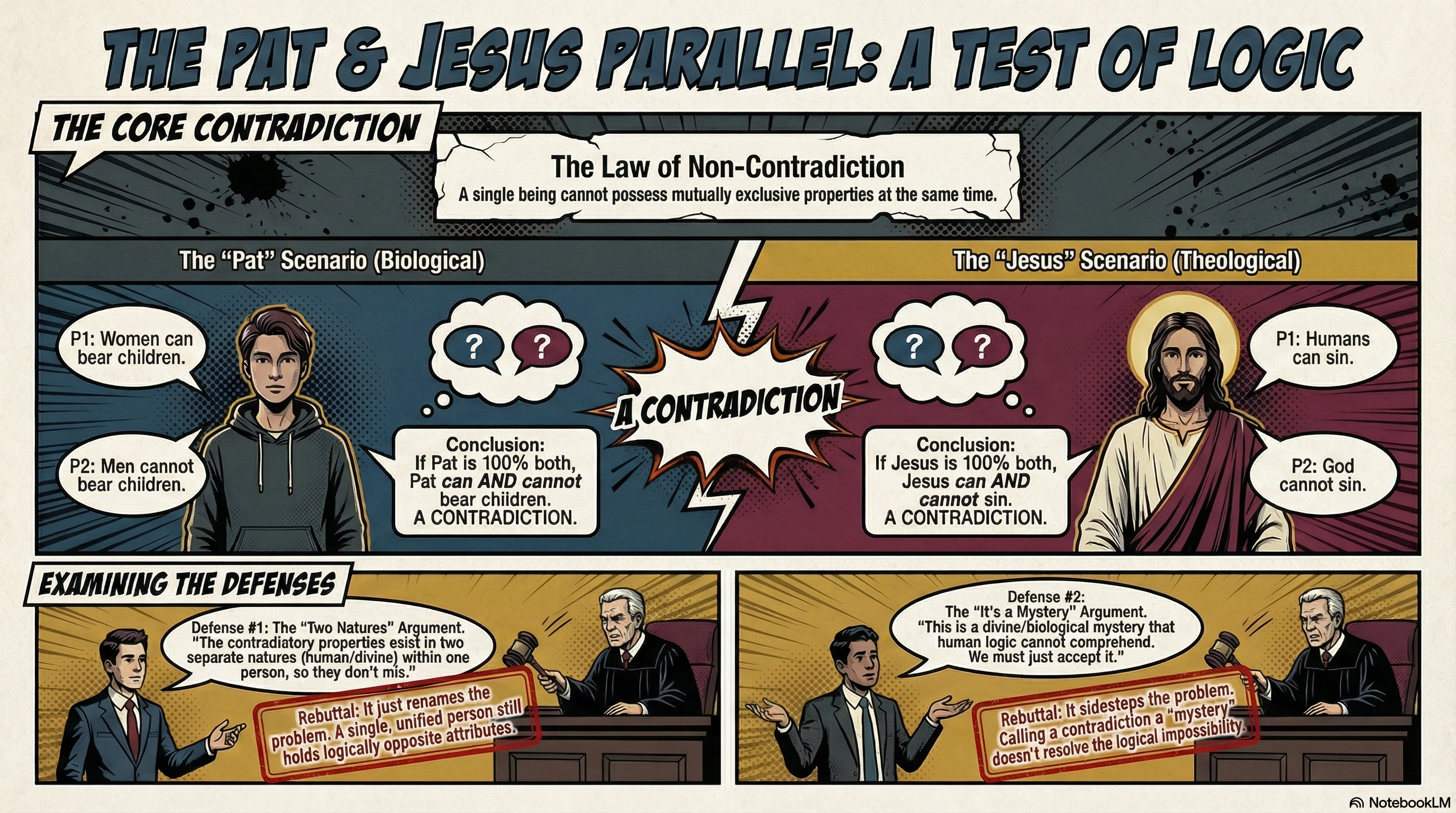
Summary: This post presents a scenario where someone claims to be both fully man and fully woman, and illustrates that if women can bear children and men cannot, it leads to a logical contradiction. It then draws a parallel to the theological claim that Jesus was both fully human and fully God—humans can sin, God cannot—and shows that similar logical contradiction

Imagine you live in a small, close-knit neighborhood. One morning, your neighbor, Pat, makes a startling announcement: Pat claims to be both fully man and fully woman, 100% each. Naturally, you question what this might imply. If we accept the standard biological premises that women can bear children and men cannot bear children, how could Pat simultaneously be completely woman and completely man?
As you ponder this, you notice that if Pat is fully a woman, then Pat should be able to bear children. Yet, if Pat is fully a man, then Pat cannot bear children. Combining these truths leads to a direct contradiction. One cannot logically hold that Pat is both fully man and fully woman under these definitions, because the capacities attributed to each category are mutually exclusive.
Parallel to the Jesus-as-Human-and-God Claim
This logical difficulty is analogous to the classical theological problem: Jesus is said to be 100% human and 100% divine. If humans can sin, and God cannot sin, then if Jesus is fully human, He should be able to sin, and if He is fully God, He should not be able to sin. Assigning both conditions to Jesus leads to a similar contradiction – a being who can and cannot sin at the same time. Just as with Pat, you face a scenario where two claims about a single individual’s nature cannot both be sustained without logical inconsistency.
Anticipating Common Counters and Their Parallels
1. Hypostatic Union (Human/God) vs. Dual Natures (Man/Woman)
- Human/God Counter:
Believers claim a hypostatic union, where Jesus has two distinct natures, human and divine. Each retains its own properties without mixing. Thus, the divine nature cannot sin, and the human nature could, at least in theory. - Man/Woman Parallel:
One might argue Pat has two distinct natures—female and male—that remain unmixed. The female nature can bear children, the male nature cannot. Thus, Pat’s contradictory attributes are compartmentalized, supposedly avoiding the contradiction.
Response: Compartmentalizing two logically incompatible sets of attributes into “natures” does not resolve the tension; it merely restates it. If Pat is truly one individual, then the contradiction remains. Similarly, appealing to two distinct natures for Jesus doesn’t logically erase the contradiction; it just places it behind a conceptual wall.
2. Sinlessness Is Not Essential for Humanity vs. Bearing Children Is Not Essential for Femaleness
- Human/God Counter:
Some say being able to sin is not an essential property of being human. Jesus was fully human but never sinned. - Man/Woman Parallel:
Similarly, one might claim bearing children is not essential to being a woman. Pat may be fully woman but, for some reason, never actually bears children.

Response: In the human/Jesus case, the ability to sin (even if never actualized) is tied to the concept of human moral fallibility. For the woman/man scenario, “being able to bear children” is typically considered an essential capability associated with biological femaleness (barring pathological exceptions). Redefining the essence of “woman” to avoid contradiction undermines the original premise that made the scenario meaningful. Likewise, redefining “human” so that a key human characteristic (moral fallibility) is not essential just to accommodate Jesus’s sinlessness can be seen as special pleading.
3. Role of an Intervening Force (Holy Spirit) vs. Harmonious Coexistence Force
- Human/God Counter:
The Holy Spirit guided Jesus, ensuring He remained sinless. This guidance, they say, doesn’t negate Jesus’s full humanity; it just directs it. - Man/Woman Parallel:
By analogy, imagine a guiding force that ensures Pat’s male and female aspects coexist harmoniously. This force prevents the contradiction from manifesting in practice.
Response: Invoking an external or internal “guiding force” doesn’t address the inherent logical contradiction. It’s like saying you have a round square but some external power continuously prevents us from seeing the shape’s impossibility. It may defer confrontation with the contradiction, but does not logically resolve it.
4. Mystery of Faith vs. Mystery of Biology
- Human/God Counter:
Believers often appeal to the mystery of faith, suggesting that the incarnation is a divine mystery beyond human logic. - Man/Woman Parallel:
By analogy, one might insist that Pat’s dual nature as both man and woman is a biological mystery beyond our current understanding. We must simply accept it.
Response: Both appeals rely on pushing the problem into the realm of “mystery,” effectively sidestepping logical resolution. While faith traditions might accept mysteries, the original logical contradiction is not solved; it’s only declared beyond comprehension. In the biological case, it’s far less plausible to do this since biology is typically grounded in empirical facts and definitional clarity.
5. Distinct Domains of Operation
- Human/God Counter:
Jesus’s divine and human natures operate in different domains, so the human nature could be tempted by sin without the divine nature ever permitting sin to occur. - Man/Woman Parallel:
Pat’s female and male aspects operate in distinct domains: the female side governs childbearing possibilities, and the male side governs the impossibility of bearing children. They never conflict because they remain compartmentalized.
Response: Conceptually dividing one individual into separate, non-overlapping operational domains begs the question of what it means to be a unified individual. The contradiction remains: how can one “full” nature possess a property that is directly negated by another “full” nature within the same being?
Conclusion
Both the Jesus-as-Human-and-God claim and the Pat-as-Man-and-Woman claim share a common structure: asserting two logically incompatible sets of attributes within a single individual. The counters offered to salvage the Jesus claim—hypostatic union, redefinitions of essential properties, guiding forces, mysteries, and domain distinctions—find parallel forms in the Pat scenario. Yet, the difficulty persists.

In the theological context, some accept these contradictions on the grounds of faith and mystery. In the biological context, such contradictions are typically deemed untenable. Nevertheless, the parallels highlight that the strategies used to defend the Human/God claim can, in principle, be just as easily applied—albeit less convincingly—to the Man/Woman claim.
This parallel analysis reveals the intrinsic challenge: either accept that both scenarios are logically incoherent and must be “resolved” by faith and redefinition, or recognize that the very attempt to hold two contradictory properties in one being, whether biological or theological, is inherently problematic.

◉ A Relevant Paper
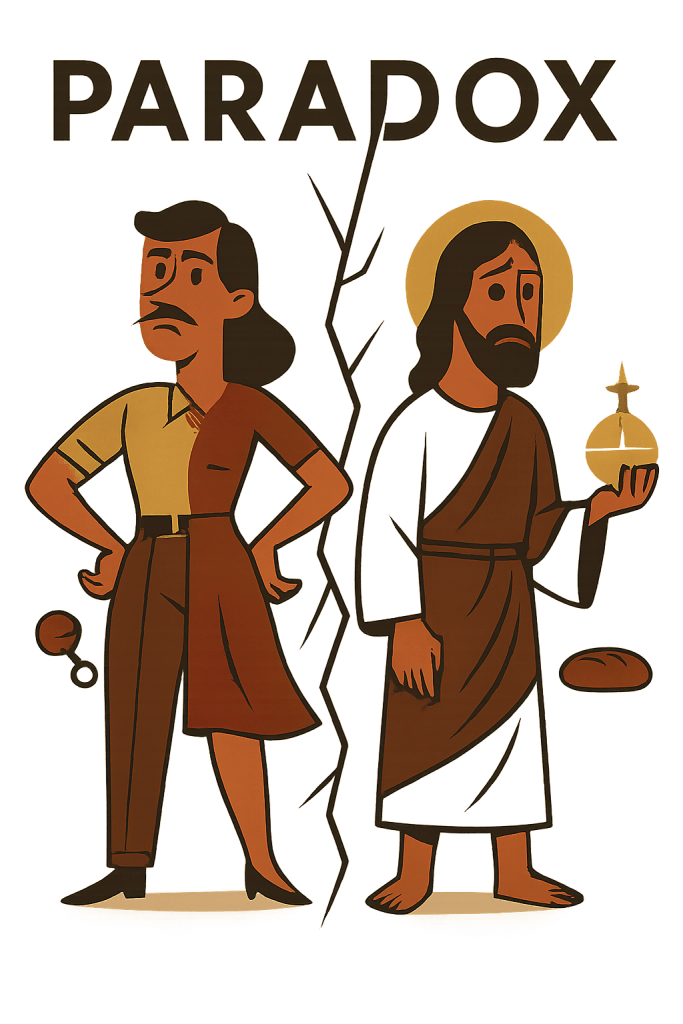
The Logical Form
Argument 1: Man/Woman Logical Contradiction
- P1: Women can bear children.
- P2: Men cannot bear children.
- P3: Pat claims to be 100% woman and 100% man simultaneously.
- P4: If Pat is 100% woman, Pat must be able to bear children (from P1).
- P5: If Pat is 100% man, Pat must be unable to bear children (from P2).
- P6: A single individual cannot both bear children and not bear children, as this violates the law of non-contradiction.
- Conclusion: The claim that Pat is both 100% woman and 100% man is logically impossible, as it leads to a direct contradiction.

Argument 2: Jesus as Fully Human and Fully Divine Contradiction
- P1: Humans can sin.
- P2: God cannot sin.
- P3: Jesus is claimed to be 100% human and 100% God simultaneously.
- P4: If Jesus is 100% human, He must be capable of sinning (from P1).
- P5: If Jesus is 100% God, He must be incapable of sinning (from P2).
- P6: A single individual cannot simultaneously be capable of sinning and incapable of sinning, as this violates the law of non-contradiction.
- Conclusion: The claim that Jesus is both 100% human and 100% God is logically impossible, as it leads to a direct contradiction.
Argument 3: Refutation of Common Counter – Hypostatic Union
- P1: Jesus has two distinct natures, human and divine, each retaining its own properties.
- P2: The human nature allows for sin, and the divine nature prevents sin.
- P3: Jesus is claimed to be one unified person, not two separate beings.
- P4: A person cannot simultaneously possess mutually exclusive properties (e.g., the ability to sin and the inability to sin).
- P5: If Jesus is one person, then His unified self must either be capable of sinning or incapable of sinning, but not both.
- Conclusion: The claim of hypostatic union fails because it asserts that Jesus is one person while simultaneously possessing mutually exclusive properties, which is a logical contradiction.
Argument 4: Refutation of Common Counter – Mystery of Faith
- P1: The mystery of faith is invoked to explain how Jesus can be both fully human and fully divine.
- P2: A logical contradiction occurs when a single entity is said to possess mutually exclusive properties (e.g., the ability to sin and the inability to sin).
- P3: Logical contradictions are violations of the law of non-contradiction, which is a fundamental principle of reason and cannot be resolved merely by appealing to mystery.
- P4: If a claim contains a logical contradiction, labeling it a “mystery” does not eliminate the contradiction but simply avoids addressing it.
- P5: The claim that Jesus is both fully human (and thus capable of sin) and fully divine (and thus incapable of sin) is a logical contradiction.
- Conclusion: The mystery of faith fails to resolve the logical contradiction inherent in the claim that Jesus is both fully human and fully divine, as it merely defers the problem without addressing its rational inconsistency.
Argument 5: Parallel Refutation for Man/Woman – Biological Mystery
- P1: It may be claimed that Pat’s dual nature as both man and woman is a unique biological mystery beyond conventional understanding.
- P2: A logical contradiction occurs when a single entity is said to possess mutually exclusive properties (e.g., the ability to bear children and the inability to bear children).
- P3: Logical contradictions violate the law of non-contradiction, which is a foundational principle of reason and cannot be resolved by appealing to mystery.
- P4: If a claim contains a logical contradiction, labeling it a “biological mystery” does not eliminate the contradiction but merely avoids addressing it.
- P5: The claim that Pat is both fully man (and thus cannot bear children) and fully woman (and thus can bear children) is a logical contradiction.
- Conclusion: The appeal to a biological mystery fails to resolve the logical contradiction in the claim that Pat is both fully man and fully woman, as it simply avoids addressing the inherent logical inconsistency.

(Scan to view post on mobile devices.)

A Dialogue
The Logical Contradictions of Dual Natures
CHRIS: Jesus is both fully human and fully divine, a foundational truth of Christianity.
CLARUS: That’s an extraordinary claim, Chris. If Jesus is fully human, wouldn’t He have to share the essential characteristics of humanity, including the ability to sin? And if He is fully divine, wouldn’t He also have to be incapable of sinning? These attributes seem mutually exclusive.
CHRIS: Jesus has two distinct natures, human and divine, which coexist without mixing, a concept known as the hypostatic union. His human nature was capable of sin, but His divine nature prevented Him from sinning.
CLARUS: I see the claim, but it doesn’t resolve the contradiction. If Jesus is one unified person, He either can sin or cannot sin—He cannot logically be both at the same time. Saying His natures coexist doesn’t eliminate the fact that this creates a logical impossibility within the concept of a unified individual.
CHRIS: It’s not a contradiction because the two natures operate in different domains. His human nature could be tempted, while His divine nature kept Him sinless.
CLARUS: Even if you divide the natures into domains, Jesus remains a single person, not two separate beings. A unified person cannot logically hold mutually exclusive properties, such as being both capable and incapable of sin. That violates the law of non-contradiction, a fundamental principle of logic.
CHRIS: But this is a mystery of faith, something beyond human comprehension. The hypostatic union is not a contradiction; it’s a divine truth that transcends our reasoning.
CLARUS: Invoking mystery doesn’t solve the problem. A logical contradiction isn’t erased by calling it a mystery—it’s simply avoided. To say that Jesus is both capable of sinning and incapable of sinning is like claiming to have a square circle. Faith may accept contradictions, but reason demands coherence.
CHRIS: Maybe an analogy will help. Let’s consider someone like Pat, who claims to be both fully man and fully woman. Pat could argue that the two natures coexist, with the male nature unable to bear children and the female nature able to bear children.
CLARUS: But Pat’s claim leads to the same contradiction. If Pat is one person, then Pat must either be able to bear children or not be able to bear children. They cannot logically hold both properties simultaneously. Dividing them into “natures” doesn’t resolve the contradiction; it just shifts the problem around.
CHRIS: Isn’t it possible that Pat’s dual nature is a biological mystery, much like Jesus’s dual nature is a divine mystery?
CLARUS: That’s a clever comparison, but the biological mystery defense doesn’t hold either. We can’t appeal to “mystery” to ignore the logical impossibility of being both fully man and fully woman under the definitions of those terms. Just as it’s logically impossible for Pat to bear children and not bear children at the same time, it’s logically impossible for Jesus to be both capable of sinning and incapable of sinning.
CHRIS: So you believe this contradiction makes the concept of Jesus’s dual nature untenable?
CLARUS: Precisely. The law of non-contradiction applies universally. A single being cannot possess mutually exclusive properties, whether in biology or theology. Faith may accept such contradictions, but reason cannot.
Notes:
Helpful Analogies
Analogy 1: The Square Circle
A square and a circle are defined by mutually exclusive properties: a square has straight edges and corners, while a circle is continuous and without corners. Claiming that a single shape is both fully a square and fully a circle is logically impossible, as the essential properties of one negate the essential properties of the other. Similarly, claiming Jesus is both fully human (capable of sin) and fully divine (incapable of sin) creates a contradiction, as these properties are mutually exclusive and cannot coexist in a single entity.
Analogy 2: The Hot-Cold Object

Consider an object that is claimed to be fully hot and fully cold at the same time and in the same sense. The very definitions of hot and cold negate one another—if something is hot, it cannot simultaneously be cold, and vice versa. Just as it’s logically impossible for an object to be both, it is similarly illogical to claim that Pat is both fully man (unable to bear children) and fully woman (able to bear children), or that Jesus is both fully human (capable of sin) and fully divine (incapable of sin).
Analogy 3: The Transparent-Opaque Window
Imagine a window that is claimed to be fully transparent and fully opaque at the same time. Transparency means allowing light to pass through, while opacity means blocking light completely—these are mutually exclusive properties. In the same way, claiming that Jesus is both fully human and fully divine, or that Pat is both fully man and fully woman, inherently violates the law of non-contradiction, as the essential properties of one negate those of the other.
Addressing Theological Responses
Theological Responses
1. Hypostatic Union Resolves the Contradiction
Theologians might argue that the hypostatic union—the doctrine that Jesus has two distinct natures (human and divine) that coexist without mixing—eliminates the contradiction. According to this view, Jesus’s divine nature is incapable of sin, while His human nature could theoretically sin but did not. Because these natures are distinct, the conflicting properties exist in separate domains rather than within a single, unified nature, avoiding a direct contradiction.
2. Sinlessness Is Not an Essential Human Property
Some theologians could argue that the ability to sin is not an essential characteristic of being human but rather a result of the Fall. Jesus’s humanity, being untainted by sin, represents the ideal form of humanity. Therefore, His inability to sin is consistent with His full humanity, and no logical contradiction arises from His sinless nature.
3. Mystery of Faith Transcends Human Logic
Another response might be that the mystery of faith allows Jesus’s dual natures to coexist in a way that transcends human understanding. Theologians could claim that human logic is limited and inadequate to fully comprehend divine truths. What appears to be a contradiction from a human perspective is, in reality, a divine mystery that requires faith to accept.
4. Distinct Operations of the Two Natures
Theologians might also argue that Jesus’s two natures—human and divine—operate in distinct domains. For example, His human nature experienced hunger, fatigue, and temptation, while His divine nature maintained His omnipotence and sinlessness. This separation of functions allows Jesus to fully embody both natures without the conflict of mutually exclusive properties.
5. Analogy to Intersex Conditions
A theological response could draw an analogy to intersex individuals, who may have both male and female biological characteristics. While this analogy is imperfect, it serves to illustrate that categories like man and woman can sometimes overlap in ways that defy strict binary logic. Similarly, theologians might argue that Jesus’s dual natures are not subject to human-defined categories, allowing Him to transcend typical logical constraints.
6. The Role of the Holy Spirit
Some theologians may claim that the Holy Spirit uniquely empowered Jesus to live a sinless life despite His human nature. This divine guidance ensured that while Jesus’s human nature allowed Him to be tempted, He remained sinless. In this view, the Holy Spirit harmonizes Jesus’s dual natures, ensuring no logical contradiction arises.
7. Divine Mystery Mirrors Biological Complexity
Finally, theologians might argue that just as biological mysteries like quantum mechanics or emergent complexity seem contradictory but are true upon closer understanding, the dual nature of Jesus reflects a similar truth. Just as science accepts paradoxical phenomena, theologians might claim that Jesus’s dual natures are a theological reality beyond full human comprehension, reconcilable only through faith.
Counter-Responses
1. Hypostatic Union Resolves the Contradiction
The claim that the hypostatic union resolves the contradiction fails to address the fundamental issue of unity. Jesus is described as one unified person, not two separate entities with distinct domains. If He is truly one person, He must either be capable of sinning or incapable of sinning, but not both. Claiming distinct “natures” simply shifts the contradiction rather than resolving it because the person of Jesus would still simultaneously hold mutually exclusive properties, violating the law of non-contradiction.
2. Sinlessness Is Not an Essential Human Property
While theologians argue that the ability to sin is not an essential property of humanity, this contradicts the biblical narrative, which portrays humanity as inherently fallen and sinful (e.g., Romans 3:23). If sin is a universal condition of human nature, then Jesus, as fully human, must at least possess the capacity to sin, even if He did not act on it. Removing this capacity would make Him a fundamentally different kind of human, undermining the claim that He is fully human in the same way as other humans.
3. Mystery of Faith Transcends Human Logic
Appealing to mystery does not resolve a logical contradiction; it merely avoids addressing it. The law of non-contradiction is not a human construct but a fundamental principle of reason. If Jesus can simultaneously be capable of sinning and incapable of sinning, this is a logical impossibility—not a mystery. Faith may accept contradictions, but that acceptance does not transform a logical impossibility into a coherent truth.
4. Distinct Operations of the Two Natures
The claim that Jesus’s two natures operate in distinct domains fails because it ignores the unity of His person. If Jesus is one individual, the attributes of His natures must logically apply to Him as a whole. For example, His human hunger and divine omnipotence would both apply to the same person. Similarly, if Jesus is one person, He cannot simultaneously be capable and incapable of sinning without violating the law of non-contradiction.
5. Analogy to Intersex Conditions
While intersex conditions demonstrate complexity in biological categories, they do not reflect the same logical structure as the claim about Jesus. Intersex individuals have overlapping physical traits but do not claim to be 100% male and 100% female simultaneously. The claim about Jesus goes further, asserting two complete and mutually exclusive natures within one unified person, which creates a logical contradiction beyond mere complexity or overlap.
6. The Role of the Holy Spirit
The claim that the Holy Spirit ensured Jesus’s sinlessness does not address the contradiction. If Jesus’s human nature could sin but the Holy Spirit prevented it, then Jesus’s human nature was not fully operative, undermining the claim of full humanity. Additionally, the intervention of the Holy Spirit does not eliminate the logical impossibility of one person being both capable of sin and incapable of sin at the same time.
7. Divine Mystery Mirrors Biological Complexity
Analogies to biological complexity or scientific paradoxes fail because such examples do not violate the law of non-contradiction. For instance, quantum phenomena may seem paradoxical but are consistent within their mathematical and physical frameworks. The claim that Jesus is both fully human and fully divine, with mutually exclusive properties, is not a paradox but a logical contradiction, which cannot be resolved by appealing to faith or complexity.
Clarifications
Formalized Argument Against the Notion that Jesus Could Be Both Fully Human and Fully God

Extended Syllogistic Form
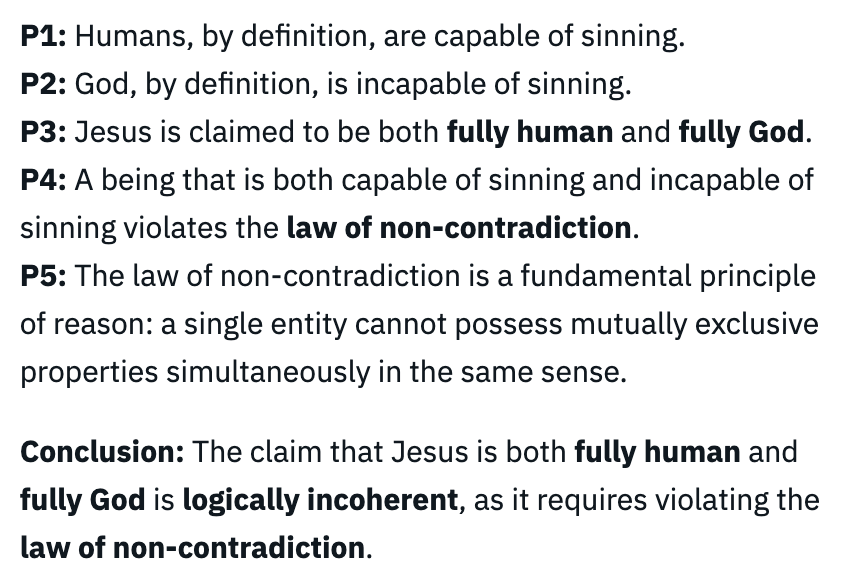
P1: Humans, by definition, are capable of sinning.
P2: God, by definition, is incapable of sinning.
P3: Jesus is claimed to be both fully human and fully God.
P4: A being that is both capable of sinning and incapable of sinning violates the law of non-contradiction.
P5: The law of non-contradiction is a fundamental principle of reason: a single entity cannot possess mutually exclusive properties simultaneously in the same sense.
Conclusion: The claim that Jesus is both fully human and fully God is logically incoherent, as it requires violating the law of non-contradiction.
Symbolic Logic Formalization
Let:
: “x is human.”
: “x is God.”
: “x is capable of sinning.”
: “x is incapable of sinning.”
: Logical “and.”
: Logical “not.”
: Universal quantifier (“for all”).
: Existential quantifier (“there exists”).
: Logical implication (“if… then”).
: Logical conjunction (“and”).
: Logical disjunction (“or”).
- Premises:
: If x is human, then x is capable of sinning.
: If x is God, then x is incapable of sinning.
: Jesus (J) is both human and God.
- Inferences:
- From
and
: Jesus is capable of sinning.
- From
and
: Jesus is incapable of sinning.
- From
- Contradiction:
: Jesus is both capable and incapable of sinning.
- This violates the law of non-contradiction, which states that
: A proposition cannot be both true and false simultaneously.
Natural Language Annotation
- Premise 1: All humans are capable of sinning (
- Premise 2: All divine beings are incapable of sinning (
- Premise 3: Jesus is claimed to possess both natures, human and divine (
- Inference 1: If Jesus is human (
- Inference 2: If Jesus is God (
- Contradiction: The claims
Conclusion in Symbolic Form
- Core Contradiction:
This is an explicit violation of the law of non-contradiction. - Generalized Principle:
There cannot exist an entity that is fully human and fully God simultaneously, as it leads to logically incoherent properties. - Formal Logical Rejection:
Jesus cannot be both fully human and fully God without abandoning the law of non-contradiction, which is foundational to rational discourse.


This rigorous formulation demonstrates the logical impossibility of the claim that Jesus is both fully human and fully divine, using both syllogistic reasoning and formal symbolic logic.
A corollary: Jesus commanded the killing of infants
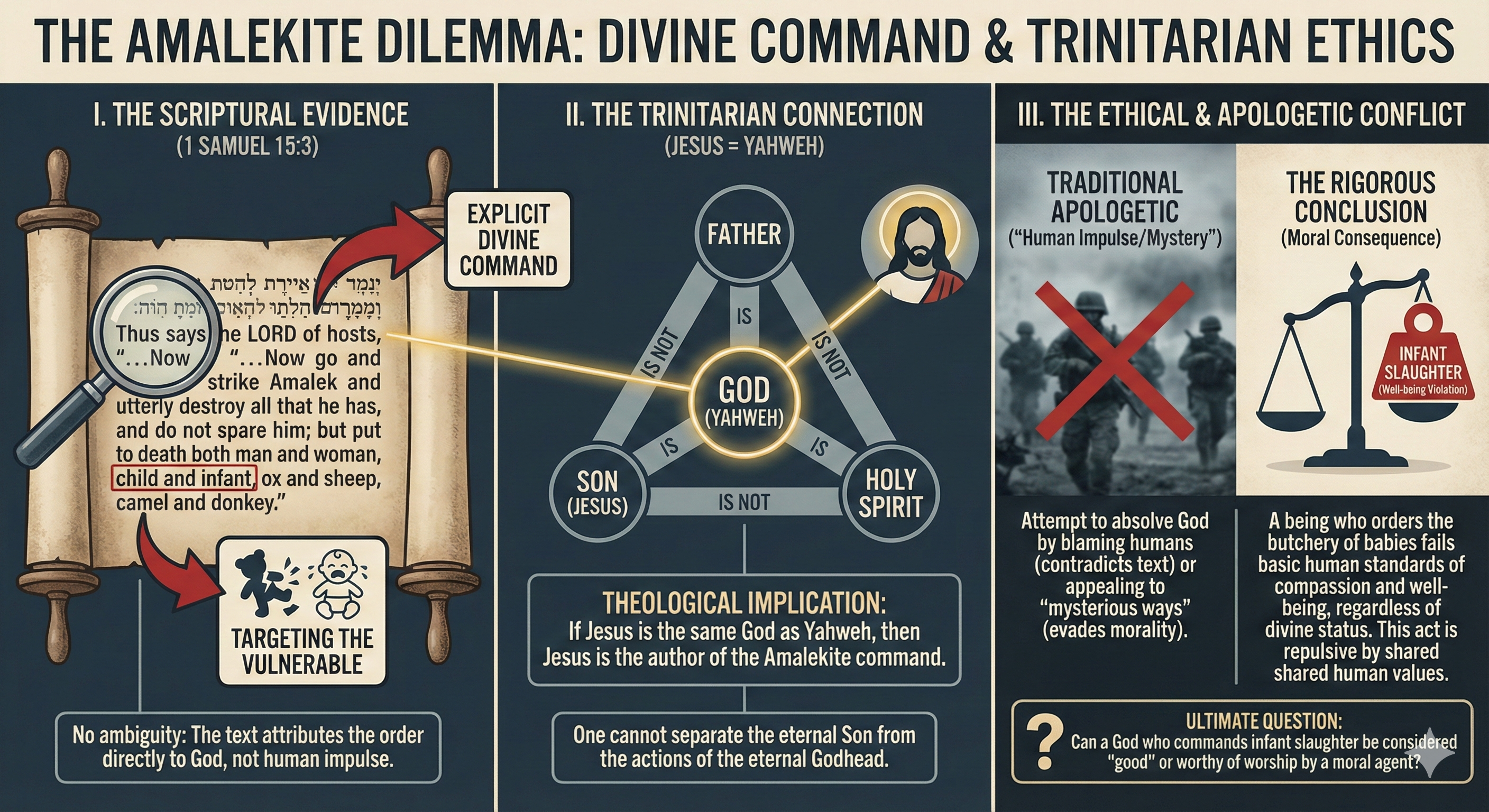
The Counter-Scriptural Claim that Jesus was Incapable of Sinning
◉ Addressing the Incoherence of Claiming Jesus Was Incapable of Sinning
Why Hebrews 4:15 Collapses Under the Weight of Infallibility Doctrines
One of the most frequently quoted verses by Christian apologists to emphasize Jesus’ empathy and moral triumph is Hebrews 4:15:
“For we do not have a high priest who is unable to empathize with our weaknesses, but we have one who has been tempted in every way, just as we are—yet he did not sin.”
This verse is intended to showcase Jesus as a relatable figure—someone who truly experienced human temptation and resisted it. However, many Christian theologians simultaneously assert that Jesus was incapable of sinning due to his divine nature. This claim, though convenient for preserving Jesus’ moral perfection, renders Hebrews 4:15 hollow. Below is a rigorous exploration of this contradiction.
1. Temptation Without the Possibility of Failure Is Not Temptation
To be tempted implies an authentic struggle. If Jesus could not possibly sin, then the experience of temptation becomes a farce—something more akin to theater than a genuine existential trial. Consider this logical syllogism:
P1: Genuine temptation entails the possibility of yielding.
P2: Jesus was genuinely tempted in all ways, according to Hebrews 4:15.
P3: If Jesus was incapable of sinning, yielding was never possible.
Conclusion: Therefore, either Hebrews 4:15 is false, or Jesus was not incapable of sinning.
The assertion that Jesus experienced “every temptation” as we do demands the real possibility of failure. Otherwise, the verse becomes equivalent to saying, “He stood at the edge of a cliff, but due to being invulnerable to gravity, he never fell.” That’s not triumph over danger—it’s immunity to it.
2. The “My Brother Never Got Pregnant” Analogy
To illustrate the absurdity, imagine someone declaring, “My brother has shown great restraint and self-control by never becoming pregnant.” This statement only sounds impressive if male pregnancy were a genuine possibility for the brother. Since it is not, the statement becomes vacuous.
Similarly, the statement “Jesus did not sin” holds only if he truly could have sinned. If he were metaphysically incapable of sinning, then claiming he resisted temptation bears no semantic content—there is no struggle, no restraint, and therefore no virtue. More fundamentally, claiming someone did not do what is impossible for them to do is a vacuous utterance.
Similar Analogies:
- “My infant son has never committed adultery.”
➤ Adultery requires both capacity and opportunity. Infants are not moral agents in that domain. - “My paralyzed friend has never run a red light.”
➤ If someone is physically incapable of driving, it’s meaningless to commend them for obeying traffic laws they couldn’t violate. - “My deaf cousin has never downloaded pirated music.”
➤ A person who cannot hear music is unlikely to desire it—thus, refraining from piracy isn’t a moral victory. - “My great-grandmother never skipped a day of school last year.”
➤ At 103 and long out of school, the statement has no relevance as a virtue. - “My comatose uncle has never lied.”
➤ Lack of speech and awareness doesn’t make someone truthful—it makes the statement epistemically null. - “My brother with no arms has never shoplifted.”
➤ Physical incapacity eliminates opportunity, so there’s no virtue in abstaining from theft. - “My nephew who’s never flown a plane has never hijacked one either.”
➤ One cannot hijack what one never had access to, and calling that restraint is absurd. - “My sister, who was born blind, has never watched pornography.”
➤ Praising her for avoiding visual material she cannot perceive confuses constraint with incapacity. - “My 3-year-old has never cheated on their taxes.”
➤ Lacking both legal responsibility and cognitive capacity, toddlers aren’t worthy of tax honesty accolades. - “My cousin with severe dementia has never broken a promise.”
➤ If someone cannot retain or form promises, they can’t meaningfully be said to keep them either.
3. Theological Attempts at Resolving the Tension Fail
Some apologists attempt to solve this problem by introducing a dual-nature Christology: Jesus had both a divine nature (incapable of sin) and a human nature (capable of sin), and it was his human nature that was tempted. However, this introduces several problems:
- Unity of the person: If Jesus is one person, not two, then he either was capable of sin or he wasn’t. Partitioning temptation off to one “nature” leads to an incoherent anthropology and Christology.
- Asymmetry of risk: If the divine nature acts as a firewall preventing sin, then temptation never posed any true danger. The human nature becomes like a puppet tethered to divine constraints.
- A rigged test: A human nature backed by divine omniscience and omnipotence cannot be reasonably compared to ordinary human frailty. It’s like entering an exam with the answer key etched into your cortex.
4. Scriptural Contradictions and Silence
Beyond Hebrews 4:15, other New Testament passages speak of Jesus’ sinlessness (e.g., 1 Peter 2:22, 2 Corinthians 5:21). However, none make the metaphysical claim that Jesus could not sin—only that he did not sin. This distinction is crucial. The former removes agency; the latter allows for meaningful choice. Christianity thrives on the idea of Jesus choosing righteousness in the midst of true alternatives, not defaulting to it because he was hard-coded for virtue.
If Jesus could not sin, then calling him “blameless” is like praising a vending machine for not committing murder. Blamelessness without the possibility of blame is not character—it is programming.
5. Implications for Empathy and High Priesthood
The central claim of Hebrews 4:15 is that Jesus can empathize with our weaknesses because he shared in our trials. But this empathy rings hollow if his divine nature shielded him from the core tension of temptation: the actual pull toward failure.
Would you feel deeply understood by someone who said, “I understand your struggle with addiction—I’ve been offered drugs many times, but I’m biologically incapable of becoming addicted”? That may be factually accurate, but not experientially meaningful.
Empathy presupposes shared vulnerability. Remove that vulnerability, and you are left with observation, not participation.
6. Concluding Inference: A Redundant Verse or a Broken Theology
We are left with two options:
- Either Jesus could have sinned, and thus Hebrews 4:15 carries epistemic and existential weight.
- Or Jesus could not have sinned, in which case Hebrews 4:15 is deceptive—offering comfort based on an experience Jesus never truly had.
If the first, then many strands of high Christology in traditional dogma must be re-examined. If the second, then the verse should be discarded as doctrinal propaganda.
Final Thoughts
The doctrine of Christ’s impeccability (sinlessness by incapacity) may serve to bolster the divine mystique around Jesus, but it severs the psychological and existential bridge Hebrews 4:15 claims to construct. The temptation of Jesus, if it was never a real option to sin, is not a triumph—it is a pageant. And Hebrews 4:15, in that case, becomes a verse boasting of courage in a contest never truly entered.
If Christianity wishes to preserve both the integrity of Hebrews 4:15 and Jesus’ status as genuinely human, then it must affirm that sin was a real possibility. Otherwise, the story of temptation becomes as pointless as celebrating a fish for not drowning.
The Irrelevance of “will not sin”
Formal Logical Argument: The Irrelevance of “Will Not Sin”
Some apologists muddy the semantic waters by claiming that Jesus could sin, but he will not sin or chose not to sin during his earthly life. The following symbolic formulation addresses this:
Definitions:
Let:
denote “x will not sin” (i.e., chooses not to sin)
denote “implies”
Premises:
- All humans are capable of sinning:
(If x is fully human, then x is capable of sinning.) - All divine beings are incapable of sinning:
(If x is fully God, then x is incapable of sinning.) - Jesus is fully human and fully God:
(Jesus is both fully human and fully divine.) - Jesus will not sin:
(Jesus chooses not to sin.)


Derivation of Contradiction:
Step 1: Deriving Jesus’ Capacity to Sin
From (1) and (3), instantiate 

Since
(Jesus is capable of sinning.)
Step 2: Deriving Jesus’ Incapacity to Sin
From (2) and (3), instantiate
Since
(Jesus is incapable of sinning.)
Step 3: Logical Contradiction
We now have:
(Jesus is both capable and incapable of sinning simultaneously.)
This directly violates the law of non-contradiction, which states:
Thus, the claim that Jesus is both fully human and fully God is logically incoherent.
Step 4: The Irrelevance of “Will Not Sin”
The proposition “Jesus will not sin” (i.e., 
- Irrelevance Theorem:
(A being cannot both be capable and incapable of sinning, regardless of choice.) - Attempt to Use “Will Not” (Fails):
(If Jesus wills not to sin, then Jesus does not sin.) However, whether Jesus sins or not (i.e., whetheris true or false) does not affect the fact that:
- The contradiction remains.
- Conclusion:
Since the contradiction arises before we even introduce


Final Conclusion:
- The contradiction
- “Jesus will not sin” (i.e.,
- Since the contradiction lies in capability, not in actual behavior, introducing “will not sin” does nothing to resolve the logical incoherence.
Attempted Response by S.S.
— S.S., A Facebook Christian
S.S. comments in response to this article:
There is nothing hard about this question. It springs from not understanding what is meant by fully God and fully man. Jesus emptied Himself of His divine nature while on Earth. He was able to pick it up at any time and never lost the title, merely chose not to access or use it while in human form. So Jesus, existing as fully God for all of eternity, stepped into a human body. The reasoning used in this analogy assumes human limitations and is not an accurate analogy by any means. Jesus spent 33 years on Earth as fully man without accessing His divine nature. He has existed for all of eternity before and since as fully God. Man and woman are opposing categories. God and man are not opposing categories, especially if God decides to become man.
— Free of Faith Response:
Natural Language Analysis:
The core of the syllogism in the image revolves around intrinsic properties of being fully human and fully divine:
- Premise 1: Humans are intrinsically capable of sinning.
- Premise 2: God is intrinsically incapable of sinning.
- Premise 3: Jesus is claimed to be both fully human and fully divine.
This results in a logical contradiction: If Jesus is both human and divine, He would be both capable and incapable of sinning.
Scott Sponaas’s response attempts to resolve this contradiction by shifting the discussion away from intrinsic properties (what Jesus is capable of) to contingent historical events (whether Jesus actually sinned). Specifically:
- The argument emphasizes that Jesus “chose not to sin” during His time on Earth, which is irrelevant to the premises. The syllogism does not claim that Jesus sinned, only that being human entails the possibility of sin.
- The introduction of Jesus “choosing not to access or use His divine nature” is an illegitimate distraction. Even if Jesus refrained from sinning, His capacity to sin as a human and His incapacity to sin as God remain logically incompatible.
By focusing on actions (what Jesus did or didn’t do) rather than capacities (what Jesus could or couldn’t do), the response fails to address the intrinsic contradiction.
Symbolic Logic Analysis:
Let the definitions remain:
Premises:
: If
: If
From these premises, the syllogism derives:
: Jesus is capable of sinning (by virtue of being human).
: Jesus is incapable of sinning (by virtue of being God).
This results in a direct contradiction:
S.S.’s response introduces additional premises:
- Jesus “emptied Himself of His divine nature”: This suggests that during His earthly life, Jesus temporarily suspended certain divine attributes, including His incapacity to sin.
- Jesus “chose not to sin”: This shifts the focus to contingent actions (what Jesus did) rather than intrinsic capacities (what Jesus could do).
Logical Deviations:
- Intrinsic Properties vs. Actions:
- The syllogism is concerned with whether Jesus, as both fully human and fully divine, possesses mutually exclusive capacities (being capable and incapable of sinning).The response illegitimately emphasizes that Jesus did not sin, which is irrelevant. Whether or not Jesus sinned does not negate the contradiction between His intrinsic capacities as human (capable of sinning) and divine (incapable of sinning).
- Suspension of Divine Nature:
- The claim that Jesus “emptied Himself” and “chose not to access His divine nature” introduces a mutable view of divinity. This sidesteps the contradiction but at the cost of redefining divine nature, which classical theology typically holds as immutable.
- Even if Jesus temporarily “emptied” Himself of divine attributes, this still fails to resolve the contradiction. If He is intrinsically human during this period, He must still be capable of sinning. If He retains His divine nature, He must remain incapable of sinning. Temporarily suppressing divine attributes does not negate the logical incompatibility of these capacities.
- God and Man as Non-Opposing Categories:
- The response also attempts to argue that “God and man are not opposing categories,” implying that these natures can coexist without contradiction. However, the syllogism demonstrates that the specific capacities associated with these natures (capability and incapability of sinning) are logically incompatible.
Reformulated Contradiction:
- Premises Restated:
- Response’s Additional Premises:
: Jesus refrained from using His divine nature on Earth.
- Final Contradiction:
- The response illegitimately shifts the focus to whether Jesus sinned (an action) rather than addressing whether Jesus, as both fully human and fully divine, could possess mutually exclusive intrinsic capacities (capable and incapable of sinning).
- The contradiction
Conclusion:
S.S.’s response fails to address the intrinsic contradiction in the syllogism by:
- Mischaracterizing the logical problem as one of actions rather than intrinsic properties, leaving the core contradiction unresolved.
- Shifting focus from capacities (what Jesus is capable of) to actions (what Jesus did or didn’t do).
- Introducing the notion of “emptying divine nature,” which redefines divinity in a way that avoids the contradiction but undermines classical theology.
— S.S.’s Follow-up:
I even decided to remove my own bias and asked ChatGPT if the man/woman parallel fails and here is what it said:
ChatGPT ▶︎ The man/woman parallel—arguing that just as one cannot be fully male and fully female, Jesus cannot be fully God and fully man—fails because it misunderstands the nature of Jesus’ dual natures. Here’s why:Logical Consistency:
While human categories like gender involve physical and biological exclusivity, divinity transcends these limits. God becoming man (Philippians 2:6-8) is unique but logically consistent within Christian theology because it involves God taking on human nature, not replacing or altering it.
The parallel fails because it imposes human limitations on the divine mystery of the incarnation, which operates on a fundamentally different level.Category Error:
Being male and female are mutually exclusive within the same nature, but being fully God and fully man involves two distinct natures (divine and human) united in one person. This is the hypostatic union, not a blending or contradiction.No Limitation of Natures:
Jesus’ divine nature did not diminish His humanity, and His human nature did not reduce His divinity. The two natures coexist without mixing, changing, or compromising the integrity of either (John 1:14, Colossians 2:9). ◀︎
— Free of Faith’s Follow-up Response:
Natural Language Analysis:
S.S.’s follow-up response attempts to address the perceived contradiction in Jesus being fully God and fully man by comparing this to the man/woman analogy. The argument asserts that the analogy fails because it commits a category error, misunderstanding the nature of the hypostatic union and how Jesus’ two natures coexist without contradiction.
Key Arguments in the Response:
- Category Error:
- The response claims that being male and female are mutually exclusive within the same nature, but being fully God and fully man involves two distinct natures united in one person.
- This introduces the hypostatic union, a theological concept asserting that the divine and human natures are not blended or contradictory but are distinct and coexist in one individual.
- No Limitation of Natures:
- Jesus’ divine nature and human nature are claimed to coexist without diminishing or compromising the integrity of either.
- Logical Consistency:
- The response asserts that divinity transcends human categories (like gender) and is thus not subject to the limitations that make being fully male and fully female mutually exclusive.
- The incarnation is argued to be unique but logically consistent, as God took on human nature without replacing or altering His divine nature.
Deviations from the Syllogism:
The syllogism in the original argument focuses on intrinsic properties, particularly capability of sinning (
Specific Deviations:
- Shifting from Intrinsic Properties to Nature Union:
- The syllogism focuses on the intrinsic properties of Jesus as both human (
- Humans are intrinsically capable of sinning (
- God is intrinsically incapable of sinning (
- Humans are intrinsically capable of sinning (
- The response introduces the concept of the hypostatic union to suggest that these intrinsic properties can coexist in one person without contradiction. However, this fails to address how the logically incompatible properties of
- The hypostatic union explains how two natures coexist, but it does not resolve the specific contradiction in intrinsic capacities.
- The syllogism focuses on the intrinsic properties of Jesus as both human (
- Avoiding Logical Incompatibility:
- The response asserts that the two natures (divine and human) coexist “without mixing, changing, or compromising.” However, the syllogism does not argue that these natures blend or diminish one another; rather, it points out that they contain mutually exclusive intrinsic capacities:
- As human (
- As divine (
- This contradiction (
- As human (
- The response asserts that the two natures (divine and human) coexist “without mixing, changing, or compromising.” However, the syllogism does not argue that these natures blend or diminish one another; rather, it points out that they contain mutually exclusive intrinsic capacities:
- Category Error Misapplication:
- The response accuses the man/woman analogy of committing a category error, as being male and female pertains to a single nature, while being fully God and fully man pertains to two distinct natures.
- However, the syllogism does not hinge on the analogy but on the logical inconsistency of Jesus possessing mutually exclusive capacities within His two natures. Whether or not the analogy succeeds, the contradiction in
- Reframing the Contradiction as “Divine Mystery”:
- The response appeals to the uniqueness of the incarnation and divine transcendence to claim logical consistency.
- However, this approach shifts from a logical resolution to a theological assertion, which does not address the specific contradiction highlighted in the syllogism.
Symbolic Logic Analysis:
Premises of the Syllogism:
Contradiction Derived:
- Contradiction:
S.S.’s Additional Premises:
Hypostatic Union: Jesus has two distinct natures (divine and human) united in one person.
: The two natures do not mix, change, or compromise each other’s integrity.
Logical Flaw:
- The introduction of the hypostatic union does not resolve
- The appeal to distinct natures avoids addressing the contradiction between these properties.
Reformulated Contradiction:
- Premises Restated:
- Response’s Additional Premises:
- Final Contradiction:
- The response shifts focus to the hypostatic union and divine mystery without addressing the core issue: Jesus, as human and divine, must simultaneously possess
- The response shifts focus to the hypostatic union and divine mystery without addressing the core issue: Jesus, as human and divine, must simultaneously possess
Conclusion:
S.S.’s follow-up response fails to resolve the logical contradiction in the syllogism by:
- Shifting from the intrinsic properties of Jesus (capable and incapable of sinning) to theological claims about the hypostatic union.
- Mischaracterizing the problem as a category error, when the contradiction lies in Jesus’ intrinsic capacities.
- Appealing to divine mystery and theological assertions rather than providing a logical resolution to
The contradiction remains unresolved because the intrinsic capacities of humanity and divinity are mutually exclusive.
Attempted Response by L.K.
— L.K., A Facebook Creationist & Christian
L.K.’s post below is in direct respond to the syllogism found in the Clarifications section above, reposted below for convenience.
‘P1’ is invalid as the text clearly explicates that ‘sinning’ was introduced as a by-product of free sill and death. All humans ‘sin’ because all ‘humans’ are mortal. It’s the reason that Yeshua came to save us from death in the first place.
The syllogism assumes that sinfulness in humans is an inherent trait of humanity. It obviously was not.
Ergo, original humans did not, and were not created to ‘sin,’ in sin, or with sin.
Ergo, Christ’s Godhood was substantiated by the fact that He never ‘sinned.’
Ergo, the law of non-contradiction is preserved since Yeshua was the first and only ‘fully human’ since creation.
Ergo, only humans who are loyally allegiant to, and lovingly obedient to Yeshua are granted His faith and righteousness by grace which empowers them to become ‘fully human.’ Or ‘whole’ or as the original Hebrew word ‘perfect’ defines as: be therefore ‘perfect’, as Yahweh in heaven is ‘perfect.’: “whole.”
— Free of Faith’s Response:
Overview
In L.K.’s reply, he dismisses Premise 1 (P1)—that humans, by definition, are capable of sinning—and attempts to resolve the contradiction by redefining what it means to be fully human. Below are the main points where his reasoning is problematic.
1. Misunderstanding the Premise
Lonnie asserts:
“’P1′ is invalid as the text clearly explicates that ‘sinning’ was introduced as a by-product of free will and death. All humans ‘sin’ because all ‘humans’ are mortal.”
- Issue: P1 simply states that humans are capable of sinning, not that sin is an unavoidable or inherent requirement. Even if one believes sin arose later in history, that does not negate the capacity for sin in human nature.
- Result: Rejecting P1 on the grounds that “sin was introduced later” does not address the capability premise. It conflates whether humans inevitably sin with whether they are capable of sin.
2. Conflating “Capacity to Sin” With “Inherent Sinfulness”
L.K. says:
“The syllogism assumes that sinfulness in humans is an inherent trait of humanity. It obviously was not.”
- Issue: The original P1 does not require that humans must be perpetually sinful or that sin is an inherent trait. It states only that humans can sin.
- Result: By arguing against “inherent sinfulness,” Lonnie sets up a straw man. He dismisses P1 as if it claimed “humans are always sinful” rather than “humans can sin.”
3. Redefining “Fully Human” to Mean “Sinless”
L.K. claims:
“Ergo, the law of non-contradiction is preserved since Yeshua was the first and only ‘fully human’ since creation.”
- Issue: He effectively redefines “fully human” as “sinless” or “unfallen,” rather than “the kind of being capable of sin.” Traditional definitions of human do not hinge on being sinless; rather, they refer to possessing human nature, which includes the possibility of moral failings.
- Result: This move shifts the definition of human to avoid the contradiction, but it does not refute the original premise that humans (in the usual sense) can sin. It is a semantic maneuver rather than a logical resolution.
4. Irrelevant Appeals to Obedience and Righteousness
L.K. concludes:
“Only humans who are loyally allegiant … are granted His faith and righteousness by grace which empowers them to become ‘fully human.’”
- Issue: This is a theological claim about obedience and salvation, not a direct response to the logical challenge that being both “capable of sin” (human) and “incapable of sin” (divine) violates the law of non-contradiction.
- Result: The mention of faith, righteousness, and grace does not resolve the logical tension regarding Jesus’s dual nature. It shifts the focus away from capacity vs. incapacity toward a discussion of moral transformation, which is beside the point in addressing the contradiction.
Conclusion
L.K.’s reply fails to address the core logical tension:
- Humans are by definition capable of sinning.
- God is by definition incapable of sinning.
- Jesus is said to be fully human and fully God.
By redefining “human” as “originally sinless” or “made sinless through grace,” Lonnie sidesteps the capacity premise instead of logically refuting it. Consequently, his argument does not neutralize the alleged contradiction; it simply shifts definitions to avoid it.
L.K.’s Second Response:
- P1: The law of non-contradiction states that a being cannot have mutually exclusive properties in the same respect simultaneously. [Clarified]
- P2: A ‘nature’ determines the attributes and capacities of a being.
- P3: Jesus, according to Christian doctrine, has two distinct natures: one fully divine and one fully human (hypostatic union).
- P4: Jesus’ spirit is divine, meaning His will and essence are God’s and therefore empowered to deny any sin when confronted.
- P5: Jesus’ soul is human, meaning He could experience temptation, emotions, and suffering, as the text substantiates.
- P6: The principle of non-contradiction is not violated because these attributes belong to two distinct aspects of His being (spirit and soul).
- P7: Jesus’ divine spirit and human soul remain perfectly united in one person, not functioning separately but in harmony.
- P8: Since Jesus’ divine and human attributes remain distinct but united, His dual nature is not contradictory but unique.
- Conclusion: Jesus being both fully human and fully God is not logically incoherent. His divine spirit empowered sinlessness, while His human soul allowed for genuine human experience and temptation. Since spirit and soul are not the same thing, no contradiction occurs in Jesus being incapable of sin (divine spirit) yet capable of experiencing temptation (human soul/physical body). The resurrection confirms this: His divine spirit overcomes death, proving that sin and death had no claim over Him.
Free of Faith’s Response:
L.K.’s subsequent argument attempts to resolve the apparent contradiction in the idea that Jesus is both fully human (capable of sin) and fully God (incapable of sin) by dividing Jesus into a divine spirit and a human soul. Below are the main logical issues in this approach.
1. Merely Relabeling the Contradiction
- Claim: “Jesus has a divine spirit (incapable of sin) and a human soul (capable of experiencing temptation).”
- Problem: This still leaves one person (Jesus) who, in the same respect (a single subject), is claimed to be both incapable and capable of sin. Merely saying these qualities belong to different “parts” of Jesus does not eliminate the question: How can the same individual be both capable and incapable of sin?
- Result: It shifts the contradiction from “Jesus the person” to “Jesus’ spirit vs. soul,” but doesn’t logically show how a single, unified person can have mutually exclusive properties in one identity.
2. Conflating “Nature” With “Parts”
- Claim: “A ‘nature’ determines the attributes and capacities of a being,” and Jesus has two natures—one divine, one human.
- Problem: While classical Christian theology posits two natures in one person (the hypostatic union), L.K.’s argument treats these natures almost like separate parts—“spirit” (divine) vs. “soul” (human). However, if there is only one Jesus (one agent, one will), then it remains unclear how contradictory properties (capable vs. incapable of sin) do not overlap in that single subject.
- Result: Defining separate aspects of Jesus does not, by itself, solve the logical contradiction unless one can show these aspects operate in truly distinct respects—without merging into a single point of potential conflict.
3. Misuse of the Law of Non-Contradiction
- Claim: “The principle of non-contradiction is not violated because these attributes belong to two distinct aspects of His being (spirit and soul).”
- Problem: The law of non-contradiction is about a single entity not having mutually exclusive properties in the same respect simultaneously. But L.K.’s defense simply asserts that spirit and soul are “different respects,” without clarifying how Jesus can still be one person if the property “can sin” is walled off in the human soul while “cannot sin” belongs to the divine spirit.
- Result: The argument assumes that dividing Jesus into spirit and soul automatically resolves the contradiction. Yet for a single agent, it is still possible that these conflicting capacities overlap in how He actually acts and chooses (the same respect).
4. Circular Reasoning About “Full Humanity”
- Claim: “Jesus’ divine spirit empowered sinlessness, while His human soul allowed for genuine human experience and temptation.”
- Problem: Saying Jesus is “fully human” because He experienced temptation, yet simultaneously “fully God” because He could never yield to sin, seems to presuppose the conclusion that the tension is solved by labeling each dimension separately.
- Result: This is circular: the argument starts with the assumption that Jesus can have two contradictory attributes and then concludes there is no contradiction, without demonstrating how a single will or person can contain these properties.
5. The Resurrection as a Red Herring
- Claim: “The resurrection confirms His divine spirit overcame death, proving sin and death had no claim over Him.”
- Problem: While a theological point, this does not address the logical core: how one person can be both capable and incapable of sin. The resurrection speaks to victory over death, not to the mechanics of how contradictory properties might coexist in one subject.
- Result: Appealing to the resurrection’s significance is a theological claim rather than a resolution of the logical inconsistency.
Conclusion
L.K.’s argument tries to avoid the contradiction by splitting Jesus into a divine spirit (incapable of sin) and a human soul (capable of temptation). However, as long as Jesus is one person, the core issue remains: how does a single subject unify these apparently incompatible attributes (capable vs. incapable of sin)? Simply attributing them to different “aspects” of Jesus, without explaining how they do not overlap in the same personal subject, does not resolve the contradiction but relocates it.
The Symbolic Logic Formulation:
In symbolic terms, L.K.’s syllogism attempts to partition Jesus into two components—His divine spirit and human soul—to claim that the mutually exclusive property of sin capability is assigned to different parts of the same person. However, when we analyze this approach using formal logic, we see that it leads to an inherent contradiction.
Symbolic Representation of L.K.’s Syllogism
Let:
- J be the single individual (Jesus).
- J_d represent the divine aspect (spirit) of J.
- J_h represent the human aspect (soul) of J.
- S(x) denote “x is capable of sin”.
- ¬S(x) denote “x is incapable of sin”.
L.K.’s premises can be symbolically stated as:
- P1: Jesus has two distinct natures:
(wheremeans J is divine and
- P2: In the divine nature, Jesus is sinless:
.
- P3: In the human nature, Jesus is capable of sin (or at least susceptible to temptation):
.
- P4: Jesus is one unified person, so the attributes of J_d and J_h contribute to the attributes of J:
.
- P5 (Law of Non-Contradiction): For any individual
.

Deriving the Contradiction
Since J is the union of J_d and J_h, the property of being capable of sin should apply to J as a whole. Formally, if we assume that the attributes are not entirely segregated, then we face:
- From the human aspect:
- From the divine aspect:
.
Thus, for the single individual J, we effectively have:
This yields the contradiction:

According to P5 (the law of non-contradiction), this combination is impossible.
Conclusion
The symbolic logic breakdown shows that L.K.’s attempt to resolve the contradiction by partitioning Jesus into 

Thus, the syllogism is logically incoherent when analyzed symbolically.
Applying L.K.’s New Syllogism to the Male/Female Analogy.
L.K.’s syllogism attempts to avoid the contradiction in claiming that Jesus is both fully human and fully divine by splitting His being into two distinct natures. When we apply this approach to the man/woman analogy—where Pat claims to be 100% male and 100% female—the same logical issues emerge. (This analogy is introduced in the first few paragraphs of this post.) Just as the dual natures of Jesus are used to sidestep a contradiction regarding sin and temptation, splitting Pat into two natures fails to resolve the inherent conflict of possessing mutually exclusive properties.
1. Merely Relabeling the Contradiction
- Claim (L.K.): Jesus’ divine spirit is sinless, while His human soul is capable of temptation.
- Analogy: Pat is fully female (with the capacity to bear children) and fully male (who cannot bear children).
- Problem: In both cases, splitting the being into parts does not change that one person is asserted to have mutually exclusive attributes. Pat, as a single individual, cannot logically be expected to both bear and not bear children.
- Result: Simply labeling attributes as belonging to different “natures” reframes the contradiction without resolving it.
2. Conflating “Nature” With “Parts”
- Claim (L.K.): The two natures of Jesus (divine and human) allow for distinct properties that do not conflict.
- Analogy: Arguing that Pat has two distinct natures—male and female—implies that these natures operate in separate “compartments.”
- Problem: If Pat is one unified person, the overall nature must account for both sets of attributes. Dividing her into parts does not remove the conflict that, biologically, being fully female includes the ability to bear children, which is incompatible with being fully male.
- Result: This approach merely relabels the components without addressing the unified nature of the individual, leaving the contradiction intact.
3. Misuse of the Law of Non-Contradiction
- Claim (L.K.): By assigning sinlessness to the divine spirit and susceptibility to temptation to the human soul, the law of non-contradiction is preserved.
- Analogy: Suggesting that Pat’s female aspect governs childbearing while her male aspect forbids it, and that these domains never overlap.
- Problem: The law of non-contradiction states that a single entity cannot possess mutually exclusive properties in the same respect. In both the theological and biological cases, a unified being is claimed to operate with incompatible attributes.
- Result: Dividing attributes into separate domains does not eliminate the fact that, as a whole, the individual must reconcile these conflicting properties—an impossibility without violating the law.
4. Circular Reasoning and Special Pleading
- Claim (L.K.): Jesus is fully human yet never sins because His divine nature prevents it, effectively redefining what it means to be “fully human.”
- Analogy: One might argue that bearing children is not essential to being female, thereby allowing Pat to be fully female without the necessity of childbearing.
- Problem: This line of reasoning redefines key characteristics to sidestep the contradiction. In both cases, essential attributes (human moral fallibility or biological femaleness) are downplayed or altered to force coherence.
- Result: Such special pleading does not resolve the underlying logical inconsistency but merely adjusts definitions to avoid confronting the contradiction directly.
5. Reliance on an External Harmonizing Force
- Claim (L.K.): The guidance of the Holy Spirit ensures that Jesus’ dual natures operate in harmony without conflict.
- Analogy: Similarly, one might invoke an external force that harmonizes Pat’s male and female aspects, preventing the contradiction from manifesting.
- Problem: Invoking an external or mysterious force does not logically eliminate the contradiction; it merely pushes the issue into the realm of mystery. The core logical problem remains: one individual cannot simultaneously exhibit mutually exclusive properties.
- Result: Appeals to an intervening force or mystery do not offer a genuine resolution to the contradiction—they simply defer it.
Conclusion
The man/woman analogy starkly exposes the weaknesses in L.K.’s syllogism. Whether arguing that a single person (Jesus or Pat) can possess two distinct natures or attributes that are mutually exclusive, the approach fails to resolve the inherent logical conflict. Dividing the properties into separate aspects does not change the fact that a unified entity must, in the same respect, either possess or not possess a given attribute. Thus, compartmentalizing the contradictory properties does nothing to satisfy the law of non-contradiction.


 Free of Faith
Leave a comment