
The Big Bang as a “Miracle”:
Equivocation and Circular Reasoning
The characterization of the Big Bang as a “miracle” often hinges on an equivocation of the term “miracle” and can lead to circular reasoning that presupposes the necessity of a deity to explain the universe’s origin. This essay examines how such arguments are constructed and presents perspectives from physicists and cosmologists who assert that invoking a god is unnecessary for explaining the Big Bang.
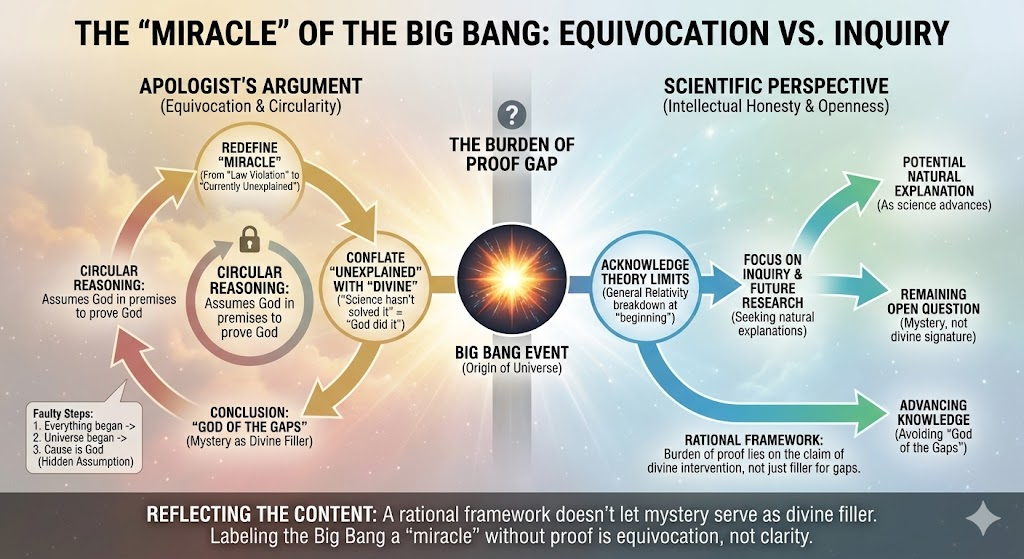
Equivocation of “Miracle”
In theological discourse, a miracle is typically defined as an event that defies natural laws, attributed to divine intervention (Swinburne, 2003). However, when proponents label the Big Bang as a “miracle,” they often shift the definition to mean an event that is simply extraordinary or currently unexplained by science. This equivocation allows for the insertion of a deity into the explanation without sufficient justification. By redefining “miracle” to fit the narrative, the argument becomes circular: it assumes what it seeks to prove—that a god is necessary for the universe’s existence.
Moreover, the claim that the Big Bang necessitates divine intervention ignores the fact that the limits of current physical theories do not imply supernatural causation. Sabine Hossenfelder critiques those who go beyond available evidence, stating:
“It [matter] reaches the state of infinite energy density and infinite curvature, and we called that the big bang. And we’re pretty sure that this is not what actually happened; it probably means just that the equations break down. So, what actually happened? We don’t know” (Hossenfelder, 2023).
She continues:
“That’s part of the problem. They [those who go beyond the evidence] want to know. They want to have a story” (Hossenfelder, 2023).
This demonstrates that the theological impulse to invoke a miracle is an attempt to impose a premature narrative onto an unsolved problem in physics. Uncertainty does not equate to divine causation.
Circular Reasoning in Theistic Arguments
Circular reasoning occurs when the conclusion of an argument is implicitly or explicitly assumed in its premises (Van Cleve, 2003). In the context of the Big Bang, some argue that because the universe had a beginning, it must have had a cause, and this cause is defined as God. This reasoning presupposes the necessity of a divine cause, thereby concluding that God exists because the universe exists—a classic example of circular logic.
For instance, many apologists claim:
- Everything that begins to exist must have a cause.
- The universe began to exist.
- Therefore, the universe must have had a cause.
- This cause must be a transcendent being (i.e., God).
However, the argument assumes that causation must be external rather than emergent from physical laws, despite lacking evidence that causality applies in the same way outside spacetime (Carroll, 2012).
Scientific Perspectives on the Big Bang
Prominent physicists and cosmologists have addressed the notion that the Big Bang requires a divine explanation. Stephen Hawking (2010), in The Grand Design, stated:
“It is not necessary to invoke God to light the blue touch paper and set the universe going” (p. 180).
Hawking argued that the laws of physics can account for the universe’s origin without necessitating a deity.
Similarly, Lawrence M. Krauss (2012), in A Universe from Nothing, contended that quantum mechanics allows for the spontaneous emergence of the universe:
“We have discovered that all signs suggest a universe that could and plausibly did arise from a deeper nothing… and have required nothing in terms of energy” (p. 173).
Moreover, Sean Carroll (2023) has emphasized that physical theories provide explanations without invoking supernatural causes:
“We are not able to say what happened at the moment that we talk about as the Big Bang. What that moment is, is an extrapolation into the past using Einstein’s general theory of relativity. And the explanation tells us that if we go into the past, there’s a moment of time where the density of matter and energy is infinite, the curvature of space-time is infinite, and so on. … it means that’s the prediction of general relativity. You are making that prediction in a regime in which you know general relativity is not right. … The right thing to say is that there is, if you extrapolate from general relativity backward into the past, you reach a point where you don’t know what happens. That’s it! That’s all you can say!” (Carroll, 2023).
Crucially, Carroll further refutes the necessity of a divine creator:
“At the moment, we don’t know. We do know there is no need for anything to have been. As far as current theory is concerned, the universe could simply have had a first moment. As we know, once again, the total charge of the universe is zero, the total energy of the universe is zero. You don’t need a source or anything external to make it happen” (Carroll, 2023).
These perspectives highlight that current scientific understanding provides naturalistic explanations for the universe’s inception, rendering supernatural explanations unnecessary.
Conclusion
Labeling the Big Bang as a “miracle” often involves an equivocation of the term and leads to circular reasoning that presupposes the necessity of a deity. However, insights from physicists and cosmologists demonstrate that naturalistic explanations suffice to account for the universe’s origin without invoking supernatural intervention.
Syllogistic Formulation of the Argument
Argument Against the Big Bang as a Miracle
- P1: If an event is labeled a “miracle,” it must either (a) violate natural laws or (b) be unexplained by science.
- P2: The Big Bang does not violate natural laws, as physical theories describe it within the framework of quantum mechanics.
- P3: The Big Bang is not wholly unexplained; models such as inflationary cosmology and quantum fluctuation hypotheses provide frameworks.
- C: Therefore, the Big Bang should not be labeled a “miracle.”
Argument Against Circular Reasoning in Theistic Cosmology
- P1: If an argument assumes its conclusion within its premises, it is circular.
- P2: Theistic cosmological arguments define the “cause” of the universe as “God” before proving its necessity.
- P3: Defining God as the necessary cause before demonstrating it assumes the conclusion.
- C: Therefore, theistic cosmological arguments for the Big Bang are circular.
Symbolic Logic Formulation
Big Bang is Not a Miracle
Let M(x) = x is a miracle.
Let V(x) = x violates natural laws.
Let U(x) = x is unexplained by science.
Let B = The Big Bang.
(A miracle must violate laws or be unexplained.)
(The Big Bang does not violate laws.)
(The Big Bang is not wholly unexplained.)
(The Big Bang is not a miracle.)
Circularity in Theistic Arguments
Let C(x, y) = x is the cause of y.
Let G = God.
Let U = Universe.
(God is assumed as the cause of the universe.)
(If God caused the universe, God must exist.)
(If God exists, He must be the cause.)
(Circular dependence between God’s existence and causality.)
Since the existence of G is assumed to prove C(G, U), the argument is circular.
References:
- Carroll, S. (2023, July 3). Mindscape Podcast.
- Hossenfelder, S. (2023). YouTube Lecture on Cosmology.
- Hawking, S. (2010). The grand design. Bantam Books.
- Krauss, L. (2012). A universe from nothing: Why there is something rather than nothing. Free Press.
- Swinburne, R. (2003). The existence of God (2nd ed.). Oxford University Press.
- Van Cleve, J. (2003). Problems from Kant. Oxford University Press.
See also:
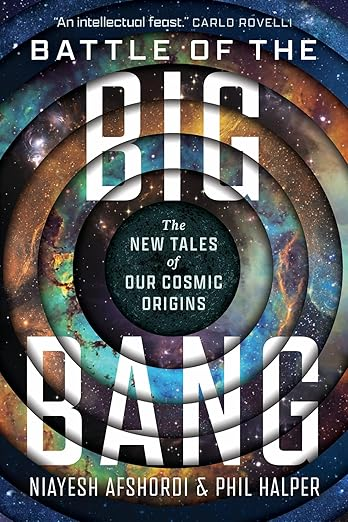
◉ A book that features the many cosmological theories being discussed by actual cosmologists.
Click the image to view this book on Amazon.


 Free of Faith
Leave a comment