
The following article models how to systematically assess the common claims of Christian apologists. We have chosen a podcast from Frank Turek, a prominent Christian apologist. This podcast is a good representation of common apologist claims.
◉ Source: ➘ Frank Turek Podcast
Table of Contents
- 1. Introduction to the Email (Sev’s Background)
- 2. The Existence of Miracles and the Creation of the Universe
- 3. Addressing the Jesus Twin Hypothesis
- 4. Miracles and Their Role in Belief
- 5. Rational Thought and Atheism
- 6. The Burden of Proof in Religious Debates
- 7. How to Experience God and Overcome Doubt
- 8. Near-Death Experiences as Evidence for the Soul
- 9. The Nature of Faith and Evidence
- 10. Conclusion and Call to Action
- Final Thoughts
- 1. Reliance on Presuppositions
- 2. Emotional Appeals Over Rational Argumentation
- 3. Selective Skepticism
- 4. Misrepresentation of Atheism and Alternative Views
- 5. Equivocation on “Faith” and “Evidence”
- 6. Circular Reasoning and Biblical Reliability
- 7. Uncritical Acceptance of Near-Death Experiences (NDEs)
- 8. Encouraging Biased Investigation
- Conclusion
1. Introduction to the Email (Sev’s Background)
Summary:
Turek reads an email from a listener, Sev, who was raised as an atheist and has struggled with the fear of death. She questions the plausibility of Jesus’ resurrection and suggests an alternative explanation: what if Jesus had a twin brother who faked the resurrection?
Critical Thinking Questions:
- Does Turek fairly represent atheism and materialism in his response?
- Is disbelief in miracles necessarily tied to fear of death?
- How does Turek frame the nature of belief versus evidence?
2. The Existence of Miracles and the Creation of the Universe
Summary:
Turek claims that miracles must be possible because the biggest miracle—the creation of the universe—has already occurred. He cites the cosmological argument and quotes Stephen Hawking, arguing that a personal creator is the only reasonable explanation.
Critical Thinking Questions:
- Does the existence of the universe necessitate a supernatural cause?
- Is the Big Bang evidence for a personal god?
- Does the argument from fine-tuning prove intentional design?
Logical Weaknesses/Fallacies:
- God of the Gaps: “If space, time and matter had a beginning out of nothing, as even now atheists are admitting… it could only be a spaceless, timeless, immaterial, powerful, moral, personal, intelligent creator.”
This assumes that because science has not fully explained the universe’s origin, a god must be the cause. The claim also makes the incoherent claim that atheists are admitting to a moral, intelligent creator, an admission that cannot come from an actual atheist. (See the expanding section Incoherent Atheist Admission below) - Equivocation Fallacy: “The greatest miracle of all has already occurred and that is the creation of the universe out of nothing.”
Here, “miracle” is used both as an unexplained event and as divine intervention, treating these definitions as interchangeable. (See the post Was the Beginning of the Universe a “Miracle”? linked to below.)
Two Incompatible Claims about Atheists
1: Define the Propositions
Let’s define the key propositions in Turek’s statement:
: The universe (space, time, and matter) had a beginning.
: If the universe had a beginning, then it was caused by a spaceless, timeless, immaterial, powerful, moral, personal, and intelligent creator.
- This can be written as:
whererepresents the existence of this creator.
- This can be written as:
: An atheist does not believe in God.
- This means an atheist must deny
- This means an atheist must deny
2: Construct the Argument
Given Turek’s claim, the atheist concedes that:
- The universe had a beginning (
- If the universe had a beginning, then a moral, intelligent creator exists (
).
- However, an atheist must deny
).
Now, using Modus Ponens (If
- From
- But the atheist also asserts
- Contradiction! (
)

3: Explain Why This Is Incoherent
The atheist cannot accept both:
- That the universe had a beginning and that a beginning necessitates a creator.
- While still maintaining their disbelief in God.
Since holding both
4: Conclusion
Turek’s formulation forces an atheist into a contradiction if they accept both:
Since an atheist must hold
Thus, an atheist cannot logically accept Turek’s framing while remaining an atheist. This exposes the incoherence of the claim that atheists are “admitting” this premise but staying atheists.
Another Viewpoint on Frank’s Position:
See also:
3. Addressing the Jesus Twin Hypothesis
Summary:
Turek dismisses the idea that Jesus could have had a twin brother who faked the resurrection. He argues that the Jewish and Roman authorities would have exposed the fraud and that the twin would have had to perform miracles.
Critical Thinking Questions:
- Does the lack of historical evidence for a twin prove it didn’t happen?
- Could early Christians have been deceived or mistaken?
- Are alternative explanations for the resurrection given fair treatment?
Logical Weaknesses/Fallacies:
- False Dichotomy: “If Jesus’ twin tried to make out like he was the Messiah, then everyone would have seen, well, he had a twin. So he’s not really the Messiah.”
Turek assumes that either Jesus was resurrected or he had a twin, without considering other naturalistic explanations (e.g., mistaken identity, legend development). (See Considerations #49 linked to below.) - Appeal to Incredulity: “You can say anything as someone who is doubting the Christian worldview. Sure, almost anything is possible. But that is not enough. You can’t just come up with possibilities. You have to come up with evidence for the possibility.”
This dismisses the alternative hypothesis as implausible while failing to apply the same standard of demanding evidence for the resurrection claim. One has not honestly assessed the probabilities until they have quantified all relevant probabilities. What is the probability of a twin of Jesus calculated against the probability of a human resurrecting? Both probabilities must be explicit.
4. Miracles and Their Role in Belief
Summary:
Turek argues that miracles must be rare to be meaningful. He claims the resurrection of Jesus was unique and that its credibility rests on historical documentation.
Critical Thinking Questions:
- Does the rarity of an event make it more believable?
- What is a rigorous definition of a miracle?
- Are reports of miracles in the Bible more credible than those in other religions?
- Do miracles require independent verification?
Logical Weaknesses/Fallacies:
- Special Pleading: “Jesus didn’t die again. Jesus got a glorified body that was indestructible.”
While dismissing other resurrection claims (e.g., those in Hinduism), Turek grants special status to Jesus’ resurrection without providing independent corroboration. For non-Christiann claims of resurrections today, how willing are Christians to sincerely investigate the evidence? - Circular Reasoning: “By saying Jesus had risen from the dead, then they got themselves beaten, tortured and killed which, last I checked, was not a list of perks.”
The argument assumes that suffering for a belief proves its truth, ignoring non-Christian martyrs who also died for false beliefs. The common assertion that nearly all the apostles consciously refused to recant under the threat of death is not credible: The Fate of the Apostles
5. Rational Thought and Atheism
Summary:
Turek argues that atheism undermines reason because if thoughts are purely physical, they cannot be trusted. He cites C.S. Lewis’ claim that rationality requires a supernatural source.
Critical Thinking Questions:
- Does a naturalistic view of thought imply irrationality?
- Can evolved cognitive faculties still produce reliable reasoning?
- How does one distinguish between natural and supernatural explanations?
Logical Weaknesses/Fallacies:
- Category Error: “If your thoughts are completely natural, in other words, they’re driven completely by the laws of physics, then why should you believe anything you think?”
This assumes that thoughts must be either supernatural or unreliable, ignoring how evolution selects for accurate cognition. Christians themselves constantly test their degree of cognitive acumen, especially during their formative years and their old age. They do not claim they know their minds are fuctioning optimally since their minds were created by God, but instead test their minds along side non-believers. In this they concede that humans can arrive at confidence in their minds under naturalistic assessments. - Non-Sequitur: “Unless I believe in God, I can’t believe in thought, so I can never use thought to disbelieve in God.”
This begs the question, assuming a god is necessary for reason without demonstrating why. The commonsensical way to test the power of thought is to explore its ability to accomplish goals and desires. No assumptions are necessary or legitimate.
6. The Burden of Proof in Religious Debates
Summary:
Turek argues that atheists must also provide proof for their worldview, claiming they assume the universe came from nothing and that morality is a mere illusion.
Critical Thinking Questions:
- Is atheism a positive claim or a rejection of theistic claims?
- Does disbelief in God require an alternative theory of morality?
- Are materialistic explanations inherently less valid?
Logical Weaknesses/Fallacies:
- A Fixation on Atheists: There are many humans who allow for the possiblity of a deistic God or a theistic God of another sort and do not claim “There is no God.” This non-dogmatic and more defensible position of millions is often ignored by Christians since Christians implicitly (and wrongly) believe that Christianity becomes more probable if atheism is demonstrated to be false. This does not follow. Demonstrating that Donald Duck is incoherent does not make Mickey Mouse more probable. In a sea of infinite possible ideologies, the elimination of one does nothing to make another more probable. This fixation on atheists is a common tactic that may have rhetorical strength, but it illegitimately detracts from the Christian’s need to address the many incoherencies found within Christianity.
- Shifting the Burden of Proof: “Everybody has the burden of proof to show what they believe is true.”
While true in principle, the claim “God exists” still requires affirmative evidence before disbelief needs justification. The fact that someone has seen little evidence for a particular God justifies their low degree of belief in that God. - False Equivalence: “The Christian has to establish two primary facts. God exists and Jesus rose from the dead. Everything else falls into place after that.”
This implies that these two claims alone can justify Christianity, even though they do not address logical absurdities, theological inconsistencies, historical issues, or alternative interpretations. Presenting flakes of gold to substantiate your belief in a spherical cube of gold justifiably convinces no one.
7. How to Experience God and Overcome Doubt
Summary:
Turek advises Sev to engage in prayer, Bible reading, and Christian community to develop faith. He argues that belief in God requires trust beyond just intellectual assent.
Critical Thinking Questions:
- Does engaging in religious rituals necessarily validate the beliefs behind them?
- Could a person using similar methods (prayer, meditation) arrive at different religious convictions?
- How does Turek distinguish between personal conviction and external verification of truth?
Logical Weaknesses/Fallacies:
- Confirmation Bias: “You can also pray that God reveals himself to you in some special way. He may do that. He may not. But his ultimate revelation is Jesus himself and the Bible.”
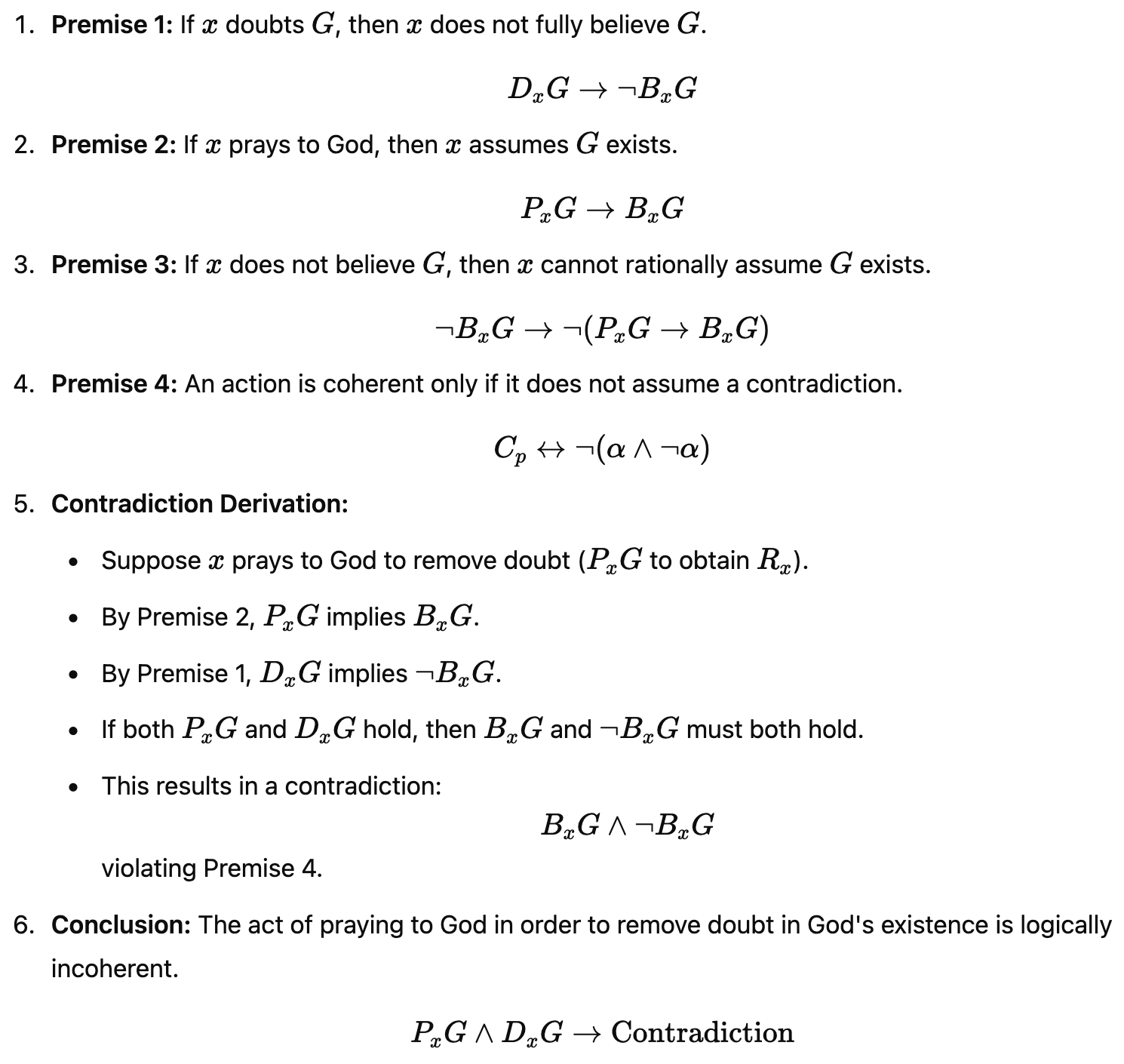
This presupposes that any perceived divine communication will confirm Christianity, rather than considering other interpretations (e.g., psychological effects, non-Christian revelations). - Circularity: It is incoherent to pray to a God in an effort to remove doubt in the existence of that God. (See the Circularity Explanation expanding section below.)
- Appeal to Consequences: “Interacting with other people who are like-minded believers, and acts of service… can help you know what it’s like to at least have some feeling that God is there.”
This argument suggests that feeling God’s presence makes the belief true, which does not establish objective reality.
Circularity Explanation
Definitions and Symbols:
= “Person
believes
.”
= “Person
= “Person
= “Person
= “A coherent action with respect to
Logical Structure:
Final Statement:
Since prayer presupposes belief but doubt negates belief, one cannot both doubt and coherently pray for the removal of that doubt. The act of praying to a God whose existence is doubted results in a contradiction, making the action logically incoherent.
8. Near-Death Experiences as Evidence for the Soul
Summary:
Turek cites near-death experiences (NDEs) as proof that materialism is false and that consciousness exists beyond the physical brain. He claims that “veridical NDEs” (those with externally verifiable claims) support life after death.
Critical Thinking Questions:
- Are there alternative scientific explanations for NDEs (e.g., oxygen deprivation, brain chemistry)?
- Do differing NDE reports across cultures suggest psychological rather than supernatural causes?
- How does one verify NDEs without relying on anecdotal evidence?
Logical Weaknesses/Fallacies:
- Anecdotal Evidence: “They come back and say stuff like, ‘I just saw an accident on Third and Main. And it was a blue Ford Explorer and a Tesla.’ Just happened. I was above the hospital.”
Individual reports of NDEs, even if accurate, do not prove the soul exists; they could be explained by brain activity, misperception, or coincidence. - Ignoring Counter-Evidence: The strong correlation between the existence of active neurological activity and cognitive functions is completely ignored by Turek.
- Fixation on an Anomalous Corner of “Evidence”: If souls exist independent of the body, there is no coherent reason to expect their manifestation to be limited to end-of-life scenarios. Why wouldn’t souls be capable of experiencing non-local events at any time?
- Post Hoc Reasoning: “That’s just another line of evidence that shows materialism is false.”
Even if NDEs were unexplained, this does not mean materialism is false—it simply means we lack a complete explanation.
9. The Nature of Faith and Evidence
Summary:
Turek argues that Christianity is based on evidence, not blind faith. He distinguishes between “belief that” (intellectual assent) and “belief in” (trust and commitment).
Critical Thinking Questions:
- If strong evidence for Christianity exists, why is faith necessary?
- Does distinguishing “belief that” and “belief in” change the epistemic burden?
- Could another religion make similar claims about faith and commitment?
Logical Weaknesses/Fallacies:
- Equivocation on “Faith”: “Faith, meaning trust, is where you have to tell your feelings to get off and your doubts to get off. Because if there’s ample evidence that Christianity is true, that evidence isn’t erased because you have emotional or psychological problems believing where that evidence points.”
Here, faith is defined in two ways—first as trust in evidence, then as accepting Christianity despite doubts. This blurs the distinction between rational belief and commitment without evidence. The biblical notion of faith is intrinsicallly irrational; it entails a degree of belief that exceeds the degree of the evidence. (See the series of posts below.) - False Analogy: “It’s like getting married… You can get evidence that somebody would make a good spouse, but it’s up to you after you get that evidence whether or not you’re going to trust in that person.”
Choosing a spouse is a practical decision with limited knowledge, whereas belief in Christianity requires accepting supernatural claims about reality. And trust is neither binary nor static. Rational belief is a degree of belief that maps to the degree of the relevant evidence. As confirming and discomfirming evidence arrives, the rational mind will adjust their degree of trust accordingly. This is not how apologists depict redemptive faith. (See the series of posts below.)
10. Conclusion and Call to Action
Summary:
Turek urges Sev to read the Gospel of John and argues that if she follows the evidence, she will see that Christianity is true. He promotes his online courses and upcoming events.
Critical Thinking Questions:
- Does reading the Gospel with the assumption of its truth lead to confirmation bias?
- What alternative texts should be read to ensure a well-rounded evaluation?
- How does Turek handle alternative worldviews that claim similar historical evidence?
Logical Weaknesses/Fallacies:
- Appeal to Authority: “Read the Gospel of John. Ask yourself, who is this Jesus? And what does he expect of me?”
This assumes the Gospel’s reliable account of a Jesus without critically examining its historical accuracy or textual origins. It is a rhetorical attempt to speed past the need to assess whether the Jesus depicted is real and to prematurely focus on his alleged expectations of humans. - Motivated Reasoning: “If you do, I think you’ll see beyond a reasonable doubt that Christianity is indeed true.”
Encouraging a biased reading process implies that the conclusion is predetermined. An honest seeker will also explore the arguments from those who have left Christianity.
Final Thoughts
Turek’s arguments rely on:
1. Reliance on Presuppositions
Explanation:
Turek frequently assumes the truth of Christianity before proving it, which weakens his argument. Rather than demonstrating that God exists and that miracles are possible, he presupposes them and then uses that assumption to support his claims.
Examples from the Podcast:
- Miracles Must Be Possible: “The greatest miracle of all has already occurred and that is the creation of the universe out of nothing.”
Turek presupposes that the universe’s existence is a miracle instead of allowing for a natural explanation. Unexplained or poorly understood phenomena do not equate to miracles. - Atheists Borrow from Christianity: “We unpack that in the book, Stealing From God: Why Atheists Need God to Make Their Case.”
The claim that atheism depends on Christianity assumes that logic, morality, and rationality cannot exist without God, rather than demonstrating this logically. (See the articles linked to below.)
2. Emotional Appeals Over Rational Argumentation
Explanation:
Rather than relying purely on logical reasoning and evidence, Turek often appeals to emotions such as fear, existential anxiety, and the desire for certainty. This does not constitute valid evidence but rather seeks to influence belief through psychological pressure.
Examples from the Podcast:
- Desire for Meaning and Purpose: “You can trust in him. Even when you have doubts. Look, everyone has doubts. I don’t have it all figured out. Nobody has it all figured out.”
This passage reassures listeners that doubt is natural, encouraging them to commit despite uncertainties, rather than confronting those doubts with rigorous analysis. Consistent with this is a persistent Christian claim that nonbelievers can have no meaning in their lifes. When pushed on this, they will often retreat to clarifying that nonbelievers can have no transcendent meaning in their lives, placing them back at the need to substantiate the alleged realms of transcendence.
3. Selective Skepticism
Explanation:
Turek applies different standards of evidence depending on whether a claim supports Christianity or challenges it. He demands extraordinary evidence for alternative explanations while allowing weak or insufficient evidence for Christian claims.
Examples from the Podcast:
- Dismissing Scientific Explanations for the Universe’s Origin: “Created itself out of nothing? … I mean, that doesn’t make any sense. You can’t create yourself because you don’t exist prior to creating.”
Turek ridicules naturalistic explanations without engaging with cosmological models, such as quantum fluctuations or cyclic universe theories. This also ignores what actual cosmologists are saying and not saying. - Demanding High Standards of Evidence for Alternative Resurrection Theories: “You can say anything as someone who is doubting the Christian worldview. Sure, almost anything is possible. But that is not enough. You can’t just come up with possibilities. You have to come up with evidence for the possibility.”
He dismisses the twin theory for lack of direct evidence but does not apply the same scrutiny to the resurrection claim, which also lacks direct empirical evidence.
4. Misrepresentation of Atheism and Alternative Views
Explanation:
Turek mischaracterizes atheism and materialism, making them seem irrational or self-contradictory. This misrepresentation creates strawman arguments, making it easier for him to refute them without engaging with stronger counterarguments. Apologists largely avoid nuanced expressions of non-belief, and will attempt to sweep all nonbelievers into the connotatively poisoned category of “atheist“ for which they have prefab scripts with dismissive talking points. They are relying on the emotional abhorrence associated with the term “atheist” to lessen their evidential burden. Unfortuately, this often works among the more credulous.
Examples from the Podcast:
- Atheism Undermines Rational Thought: “Unless I believe in God, I can’t believe in thought, so I can never use thought to disbelieve in God.”
Turek presents a false dilemma, assuming that rational thought must come from a divine source and that materialism is incompatible with logic. To the degree that our reality has structure, to that degree it will have a logic that can be accessed by our senses that operate within that reality. Thought is not a product of a deity but of an inductive relationship with our reality. - Misunderstanding of Evolutionary Theory: “You shouldn’t be sure of that because it didn’t happen. And to be fair to evolutionists, they don’t believe we descended from apes. They believe there was a common ancestor maybe with apes that we shared.”
While acknowledging the scientific model, he dismisses human evolution without counter-evidence, implying without support that it is false.
5. Equivocation on “Faith” and “Evidence”
Explanation:
Turek uses shifting definitions of faith throughout the discussion, sometimes portraying it as trust based on evidence and at other times as belief despite uncertainty. This creates confusion and makes it appear that Christianity is both rational and a leap of faith. The notion of faith has clearly evolved thought the history of Christianity.
Examples from the Podcast:
- Faith as Trust in Evidence: “Faith, meaning trust, is where you have to tell your feelings to get off and your doubts to get off.”
This suggests faith is based on sufficient evidence, yet also implies that doubts should be ignored. However, rational belief is a degree of belief that maps to the degree of the relevant evidence. Faith is an epistemology clearly inferior to rationality. - Faith as a Necessary Commitment Beyond Evidence: “It’s like getting married… You can get evidence that somebody would make a good spouse, but it’s up to you after you get that evidence whether or not you’re going to trust in that person.”
Here, faith is portrayed as a personal commitment, subtly implying that evidence alone is not enough, contradicting his earlier claims. This mismatch between the degree of evidence and the degree of belief is what we find in the Bible.
6. Circular Reasoning and Biblical Reliability
Explanation:
Turek assumes the Bible is reliable to prove the resurrection but then uses the resurrection to justify the reliability of the Bible. This circular reasoning weakens his argument.
Examples from the Podcast:
- Using the Bible to Validate Itself: “Read the Gospel of John. Ask yourself, who is this Jesus? And what does he expect of me?”
This assumes that reading the Bible will confirm its own claims, rather than first establishing its credibility as a historical document. - Resurrection Proves the Bible’s Authority: “If God exists and Jesus rose from the dead, then Christianity is true.”
But how do we know Jesus rose from the dead? Through the Bible—whose reliability is assumed rather than demonstrated. The probability of the resurrection being completely fabricated is one possibility never seriously address by apologists.
7. Uncritical Acceptance of Near-Death Experiences (NDEs)
Explanation:
Turek treats anecdotal accounts of NDEs as strong evidence for the soul’s existence, despite their subjective nature and possible alternative explanations.
Examples from the Podcast:
- NDEs as Proof of Consciousness Beyond the Brain: “Somebody flatlines on the table… The doctors check it out, and that’s what happened on Third and Main. The guy was on the table the whole time. How could he know that?”
While interesting, this does not confirm supernatural explanations, as cognitive science provides alternative accounts for such experiences. Exploring materials that take a skeptical approach to the veracity of NDE accounts is rarely encouraged by apologists. And the odd inability of souls to leave the body at times other than when the brain has been traumatized is highly informative and evidentially weighty. - Materialism is False Because of NDEs: “That’s just another line of evidence that shows materialism is false.”
Correlation is not causation—even if NDEs were unexplained, they would not disprove materialism. The kind of humans who disagree once thought that lightning, unexplained for centuries, disproved materialism.
8. Encouraging Biased Investigation
Explanation:
Turek directs listeners toward Christian sources and fails to recommend the honest examination of counterarguments. Free of Faith encourages honest seekers to critically read both the Bible and the thoughts of nonbelievers.
Examples from the Podcast:
- Encouraging a Biased Reading of the Gospel: “If you do, I think you’ll see beyond a reasonable doubt that Christianity is indeed true.”
This assumes that reading the Gospel will necessarily lead to conversion, ignoring counter-readings by skeptics. A siloed experience limited to the talking points of apologists will inevitably lead to siloed understanding and decisions. The author of this blog was once in this siloed environment. Fortunately, reading the Bible through deeply with a modest commitment to rationality broke the shackles of faith. - Directing Readers to Christian Apologists Only: “Check out Stealing From God, Mere Christianity, and Return of the God Hypothesis.”
All recommended sources affirm Christianity, avoiding engagement with serious secular scholarship. There is no suggestion to explore unfiltered opposing opinions to ensure an honest investigation. Many non-believers properly encourage others to read through the Bible deeply and honestly as an important component of any investigation of God-claims. This Free of Faith site is intended to address the mischaracterizations of non-belief and to reveal through well-reasoned explorations that faith is an inferior epistemology, and that faith-based ideologies are legitimately suspect.
Conclusion
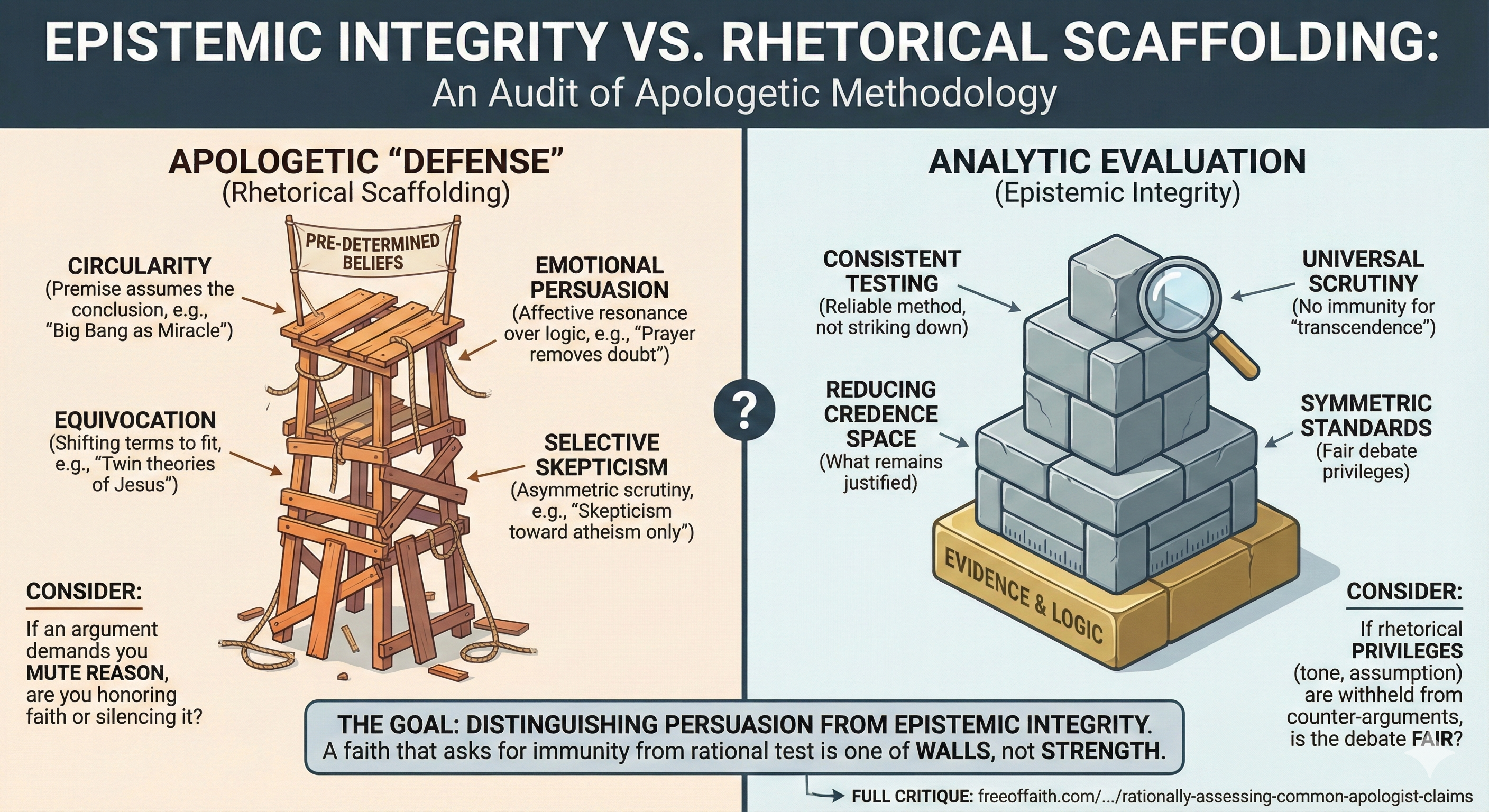
Turek’s arguments rest on selective skepticism, presuppositions, and emotional appeals, rather than rigorous engagement with counterarguments. While he presents Christianity as evidence-based, his method lacks intellectual consistency.
The method of analysis above can be applied to any apologist claim. The key is to critically evaluate:
- Are the premises logically sound?
- Is the same standard of evidence applied consistently?
- Does the conclusion follow without contradiction?
By rigorously testing these claims, we avoid superficial persuasion and maintain a commitment to intellectual integrity. This approach ensures that truth is not assumed but earned, a standard that every worldview—religious or secular—must meet.


 Free of Faith
Leave a comment