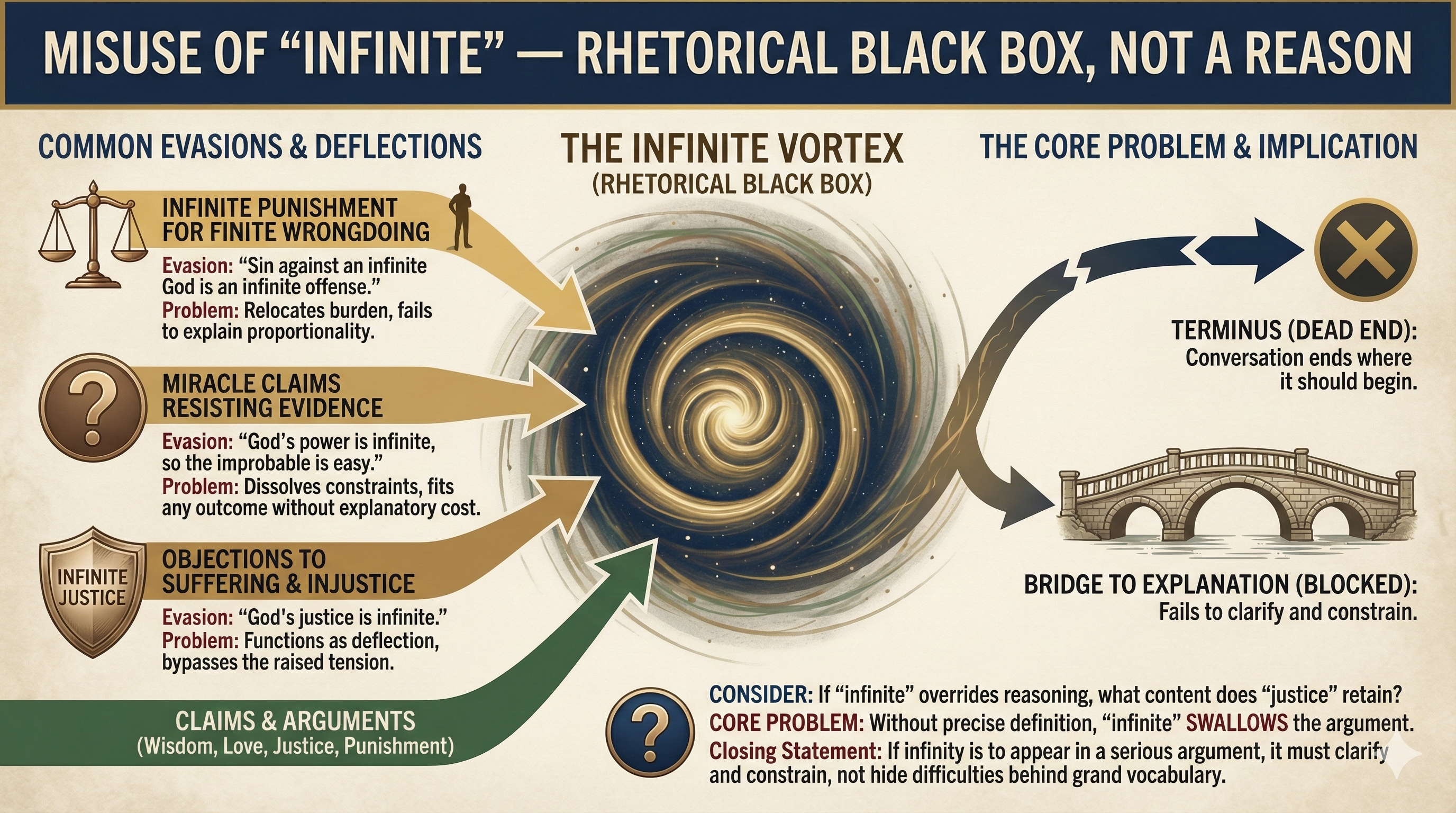
The phrase “God is infinite” often appears as a knee-jerk response in theological debates. While it might sound profound, it risks logical incoherence if left undefined or taken as an all-purpose reply to challenges. Below is a concise analysis illustrating why “God is infinite” can be logically problematic or incoherent when used without precise clarification.
Examples of Misuse
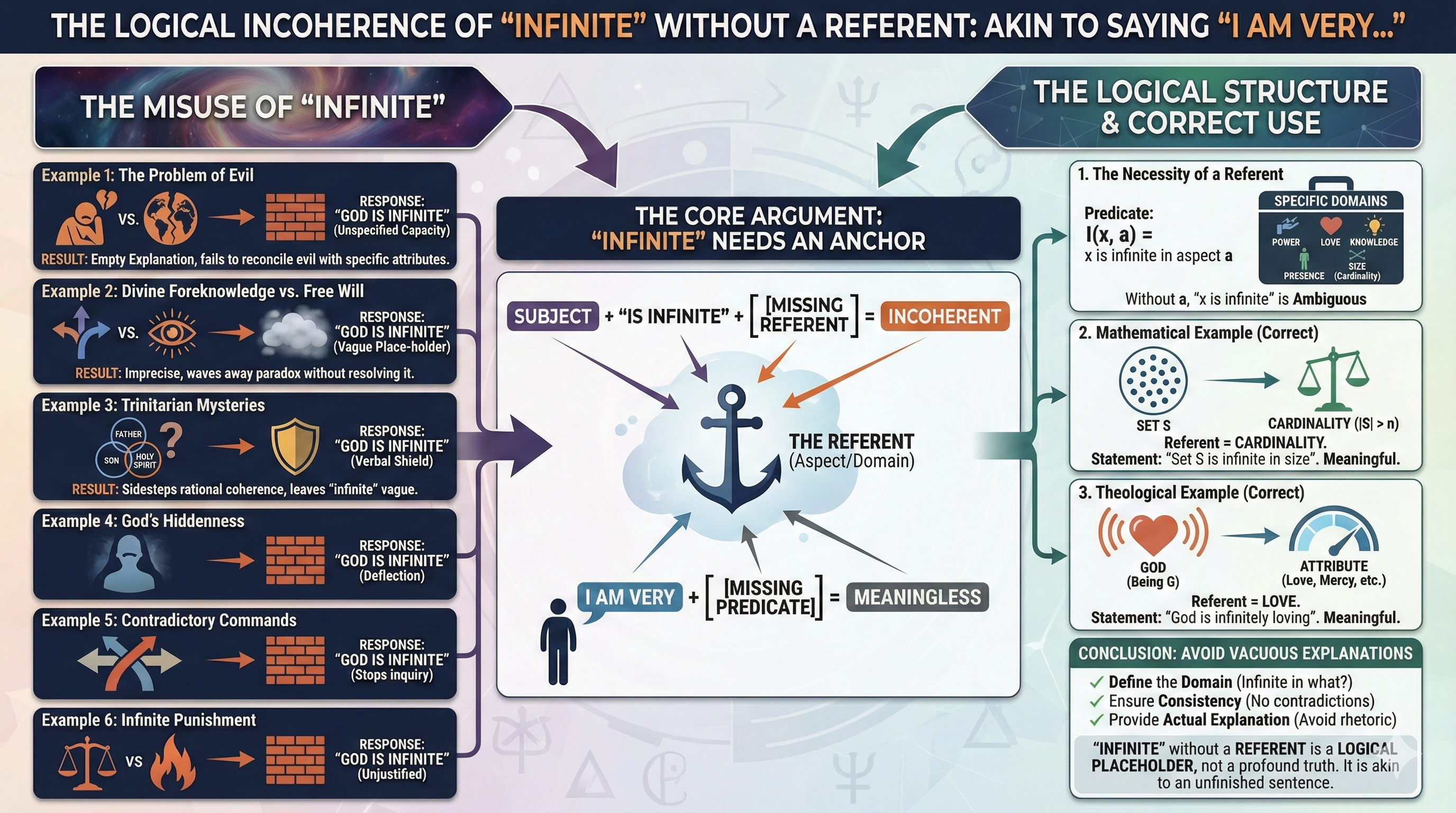
Example 1: The Problem of Evil
A classic theological dilemma involves reconciling a perfectly good, all-powerful God with the existence of immense suffering and evil in the world. In response to the question “Why does God allow such suffering?” some may offer “God is infinite” as a purported solution. However, this reply—if it neglects to specify infinite in what capacity—fails to address how God’s power or goodness actually intersects with the reality of evil, thus providing an incoherent or empty explanation.
Example 2: Divine Foreknowledge vs. Human Free Will
Debates arise over how humans can have genuine free will if God supposedly knows every future event. A quick answer of “God is infinite” might be used to wave away the need to explain how divine omniscience coexists with freedom of choice. Without clarifying in which dimension God’s “infinity” resolves this paradox (e.g., God’s vantage point outside time, or a special mode of knowing), the statement becomes an imprecise placeholder.
Example 3: Trinitarian Mysteries
Within Christian theology, the Trinity (one God in three Persons) is often considered beyond full human comprehension. Some might respond to inquiries about logical consistency with “God is infinite,” implicitly suggesting that human categories cannot grasp a God who transcends all limits. If left at that, it sidesteps attempts at rational coherence—leaving the notion of “infinite” vague and failing to illuminate how the three-in-one structure avoids contradiction.
Example 4: God’s Hiddenness
A puzzle emerges when individuals ask why an infinitely loving or infinitely just God would remain hidden or obscure to many. Answering “God is infinite” might be used to deflect further probing, as though God’s boundlessness explains the hiddenness. Since this doesn’t specify any meaningful attribute—such as infinite wisdom guiding a certain pedagogical distance or infinite justice allowing for faith—it remains an incoherent explanation.
Example 5: Contradictory Divine Commands
When scriptural or traditional accounts appear to present conflicting commands from God, some respond with “God is infinite” to imply that human logic cannot resolve divine instructions. Without pinpointing which dimension of God’s nature (e.g., moral perfection, knowledge, or authority) supposedly reconciles the conflicting directives, the phrase “God is infinite” serves as a verbal shield that forecloses rational discussion rather than clarifying it.
Example 6: Infinite Punishment for Finite Offenses
Does God’s “infinite” wrath make infinite punishment for finite sins just?
Click image for larger version.Click image for larger version.
1. The Necessity of a Referent
Saying something is “infinite” is incomplete unless one specifies infinite in what respect—e.g., infinitely loving, infinitely powerful, or infinitely present. “Infinite” requires a referent:
Predicate Form
Predicate: “” = “ is infinite in aspect .”
Without , the statement “ is infinite” is ambiguous.
Application: If “God is infinite” is meant to convey “God is infinite in every possible way,” the claim becomes too vague or contradictory (e.g., is God infinite in size, power, existence, qualities, locations, knowledge, or every dimension imaginable?).
When a statement cannot anchor “infinite” to a clear domain, it fails to establish meaning—hence verges on incoherence.
Click image to increase size.
2. Contradictions in “Infinitely Everything”
Claiming an entity is “infinite in all respects” can lead to contradictions:
Conceptual Confusion
Size: If God has infinite spatial extension, does God occupy all points in space?
Attributes: If God is infinitely powerful andinfinitely merciful, what happens in scenarios where absolute power conflicts with unconditional mercy?
Piling these “infinites” together can produce paradoxes or degrade into nonsensical claims.
Category Mistake
Attributing “infinite” to a trait that does not admit a gradient (like holiness if taken as a binary purity) yields a category error. Something either exhibits that trait or does not; forcing “infinity” upon it injects confusion.
Hence, combining multiple “infinite” properties without coherent definitions results in internal contradictions or claims with no discernible content.
3. Vagueness and Argument Stoppers
The rhetorical force of “God is infinite” often halts deeper inquiry:
Disguised Ignorance
Instead of explaining how God might reconcile, say, suffering with omnibenevolence, responding “God is infinite” sidesteps the challenge.
It effectively says, “God’s ways are beyond finite reasoning,” offering no logical clarity.
Vacuous Explanation
A claim that something is “infinite” without specifying its scope or nature does not provide an answer; it simply labels the unknown as boundless.
This empty usage of “infinite” adds no explanatory power or resolution to the theological challenge at hand.
4. Logical Form of the Incoherence
To show logical incoherence formally, consider a simplistic symbolic approach:
Let be a subject of discourse.
Let stand for “God is infinite” with no referent specified.
The statement must be expanded as:
meaning “There exists at least one aspect in which God is infinite.” If the theology claims “God is infinite in all aspects,” we face:
This universal claim leads to:
Potential Contradictions: Some aspects (like spatial boundedness vs. unboundedness) conflict logically when each is deemed “infinite.”
Category Errors: Many attributes do not naturally admit a notion of “infinity” (e.g., if “holiness” is simply the absence of imperfection).
Without defining each or demonstrating no contradictions arise, the universal claim remains logically incoherent.
5. Conclusion
The claim “God is infinite” stands as a placeholder rather than an informative proposition when it lacks:
A Clear Domain: Infinite in what?
Absence of Contradiction: Demonstrating that these infinite aspects can coexist consistently.
Actual Explanation: Avoiding rhetorical stopgaps that ignore the question rather than answer it.
In technical terms, “God is infinite” without a referent is logically incoherent, since it either says nothing specific or produces a contradictory cluster of unbounded attributes. Rather than illuminate theological questions, the phrase can obscure them under a veneer of profundity.
A More Technical Explanation
In most mathematical, philosophical, and theological contexts, the term infinite requires a referent—that is, some domain, dimension, or property that is said to be without bound. Below is a more detailed explanation that integrates symbolic logic to illustrate how “infinite” is typically predicated of something.
1. Formalizing “Infinite” as a Predicate
We can introduce a predicate that asserts “The entity is infinite in aspect .”
Here, aspect could be cardinality (e.g., a set’s size), a property (e.g., love, mercy), or a dimension (e.g., spatial extent).
The statement is meaningful only when is specified (i.e., “infinite” must refer to something).
Hence, without , the formula “” is underspecified. This indicates that infinite alone typically does not stand as a self-contained attribute; it needs a referential anchor.
2. Mathematical Example
In mathematics, saying “a set is infinite” means:
,
where is the cardinality of . Symbolically, we write:
Here, cardinality is the referent. If we tried to say just “ is infinite” with no mention of cardinality, we would still implicitly refer to the size of . Thus, even in pure mathematics, there is a property (the set’s size) to which “infinite” applies.
3. Theological/Philosophical Example
When we say “A being is infinitely loving,” we can frame it as:
This indicates that the love attribute is unbounded—no upper limit exists for ’s capacity to express love. Without referencing the type of infinity (love, mercy, knowledge, etc.), the bare label “infinite” is incomplete.
4. Conclusion
Predicate Form: In logic, “infinite” commonly operates as a predicate that must be applied to an entity with respect to some referent.
Necessity of a Referent: Saying something is infinite always implies “infinite in some respect” (cardinality, dimension, attribute).
Why Referents Matter: This keeps “infinite” from being ambiguous or meaningless; it clarifies what is unbounded.
Therefore, the notion of infinite indeed requires some referent to specify the aspect in which infinity is claimed.
Completely vs Infinitely
Another issue is the confusion between “completely” and “infinitely“.
Definitions
Completely: Conveys that a set (or process) has no remaining parts to be added or no gaps left unfilled, i.e., the condition under discussion is fully satisfied.
Infinitely: Denotes an unbounded extension in magnitude, quantity, or sequence, i.e., there is no terminal point or largest element.
Syllogistic Framework
Premise 1: If a set is complete, then for every member in , all required conditions are satisfied with no gap or omission. Formally: .
Premise 2: If a set is infinite, then the cardinality of exceeds any finite bound. Formally: .
Conclusion: Completeness pertains to the total fulfillment of a condition or the closure of a process, whereas infinitude pertains to an unbounded size or extent. Symbolically: .
Hence, completeness is about being finished or closed under relevant operations, while infinitude is about having no limit or boundary in size or extent. Both terms always require a referent.
The Biggest Logical Blunders in a Contemporary Christian Apologetics Corpus I recently surveyed a local transcript corpus from Frank Turek’s I Don’t Have Enough FAITH to Be an ATHEIST podcast. The point was not to catch one awkward sentence or score cheap rhetorical points. The point was to identify the…
Alvin Plantinga’s “Warrant” isn’t an epistemic upgrade; it’s a design for inaccuracy. My formal proof demonstrates that maximizing the binary status of “knowledge” forces a cognitive system to be less accurate than one simply tracking evidence. We must eliminate “knowledge” as a rigorous concept, replacing it with credencing—the honest pursuit…
This article critiques the stark gap between the New Testament’s unequivocal promises of answered prayer and their empirical failure. It examines the theological “bait-and-switch” where bold pulpit guarantees of supernatural intervention are neutralized by “creative hermeneutics” in small groups, transforming literal promises into unfalsifiable, psychological coping mechanisms through evasive logic…
This article characterizes theology as a “floating fortress”—internally coherent but isolated from empirical reality. It details how specific theological claims regarding prayer, miracles, and scientific facts fail verification tests. The argument posits that theology survives only through evasion tactics like redefinition and metaphor, functioning as a self-contained simulation rather than…
This post applies parsimony (Occam’s Razor) to evaluate Christian Theism. It contrasts naturalism’s high “inductive density” with the precarious “stack of unverified assumptions” required for Christian belief, such as a disembodied mind and omni-attributes. It argues that ad hoc explanations for divine hiddenness further erode the probability of theistic claims,…
Modern apologists argue that religious belief is a rational map of evidence, likening it to scientific frameworks. However, a deeper analysis reveals a stark contrast. While science adapts to reality through empirical testing and falsifiability, theology insulates belief from contradictory evidence. The theological system absorbs anomalies instead of yielding to…
This post critiques the concept of “childlike faith” in religion, arguing that it promotes an uncritical acceptance of beliefs without evidence. It highlights that while children naturally trust authority figures, this lack of skepticism can lead to false beliefs. The author emphasizes the importance of cognitive maturity and predictive power…
This analysis examines the agonizing moral conflict presented by the explicit biblical command to slaughter Amalekite infants in 1 Samuel 15:3. Written from a skeptical, moral non-realist perspective, it rigorously deconstructs the various apologetic strategies employed to defend this divine directive as “good.” The post critiques common evasions, such as…
Modern Christian apologetics claims faith is based on evidence, but this is contradicted by practices within the faith. Children are encouraged to accept beliefs uncritically, while adults seeking evidence face discouragement. The community rewards conformity over inquiry, using moral obligations to stifle skepticism. Thus, the belief system prioritizes preservation over…
In the realm of Christian apologetics, few topics generate as much palpable discomfort as the Old Testament narratives depicting divinely ordered genocide. While many believers prefer to gloss over these passages, serious apologists feel compelled to defend them. They must reconcile a God described as “perfect love” with a deity…
This post examines various conditions Christians often attach to prayer promises, transforming them into unfalsifiable claims. It highlights how these ‘failsafe’ mechanisms protect the belief system from scrutiny, allowing believers to reinterpret prayer outcomes either as successes or failures based on internal states or hidden conditions. This results in a…
In public discourse, labels such as “atheist,” “agnostic,” and “Christian” often oversimplify complex beliefs, leading to misunderstandings. These tags are low-resolution summaries that hinder rational discussions. Genuine inquiry requires moving beyond labels to assess individual credences and evidence. Understanding belief as a gradient reflects the nuances of thought, promoting clarity…
The featured argument, often employed in Christian apologetics, asserts that the universe’s intelligibility implies a divine mind. However, a meticulous examination reveals logical flaws, such as equivocation on “intelligible,” unsubstantiated jumps from observations to conclusions about authorship, and the failure to consider alternative explanations. Ultimately, while the universe exhibits structure…
The piece discusses how historical figures like Jesus and Alexander the Great undergo “legendary inflation,” where narratives evolve into more than mere history, shaped by cultural needs and societal functions. As communities invest meaning in these figures, their stories absorb mythical elements and motifs over time. This phenomenon illustrates how…
[…] #34 ✓ Consider: Can punishable culpability for an offense be legitimately reassigned to someone ot… […]
[…] #33 ✓ Consider: Would simple forgiveness without bloodshed logically violate the character of the … […]
[…] #30 ✓ Consider: Can we legitimately be held culpable for following an unrequested & unavoidabl… […]
[…] #29 ✓ Consider: Wouldn’t the personal introduction of a God take away my free will to reject tha… […]
[…] #27 ✓ Consider: Is it possible this profound peace and joy I feel isn’t actually from the Christ… […]
[…] #08 ✓ Consider: Is the confirmation of the Holy Spirit distinguishable from an evil demon or psych… […]
[…] ✓ Was the Big Bang a “Miracle”? […]
Sure. You have open permission to post anything from this site. Your regular feedback has been appreciated.
Hi Phil: I was wondering: After coming across an online discussion posted on a biblical studies website regarding whether the…
Just read this; enjoyed the summary of critiques of fine-tuning arguments. Building off what you said in one section above,…
Phil Stilwell
A Deep Dive into Common Faith-Based Concepts & Claims



” = “
is infinite in aspect
.”
be a subject of discourse.
stand for “God is infinite” with no referent specified.
![\exists A,[ \mathrm{Inf}(\text{God}, A)],](https://s0.wp.com/latex.php?latex=%5Cexists+A%2C%5B+%5Cmathrm%7BInf%7D%28%5Ctext%7BGod%7D%2C+A%29%5D%2C&bg=ffffff&fg=000&s=0&c=20201002)




in
are satisfied with no gap or omission. Formally:
.
.


 Free of Faith
Leave a comment