How a Circular Defense Mechanism Undermines Intellectual Honesty
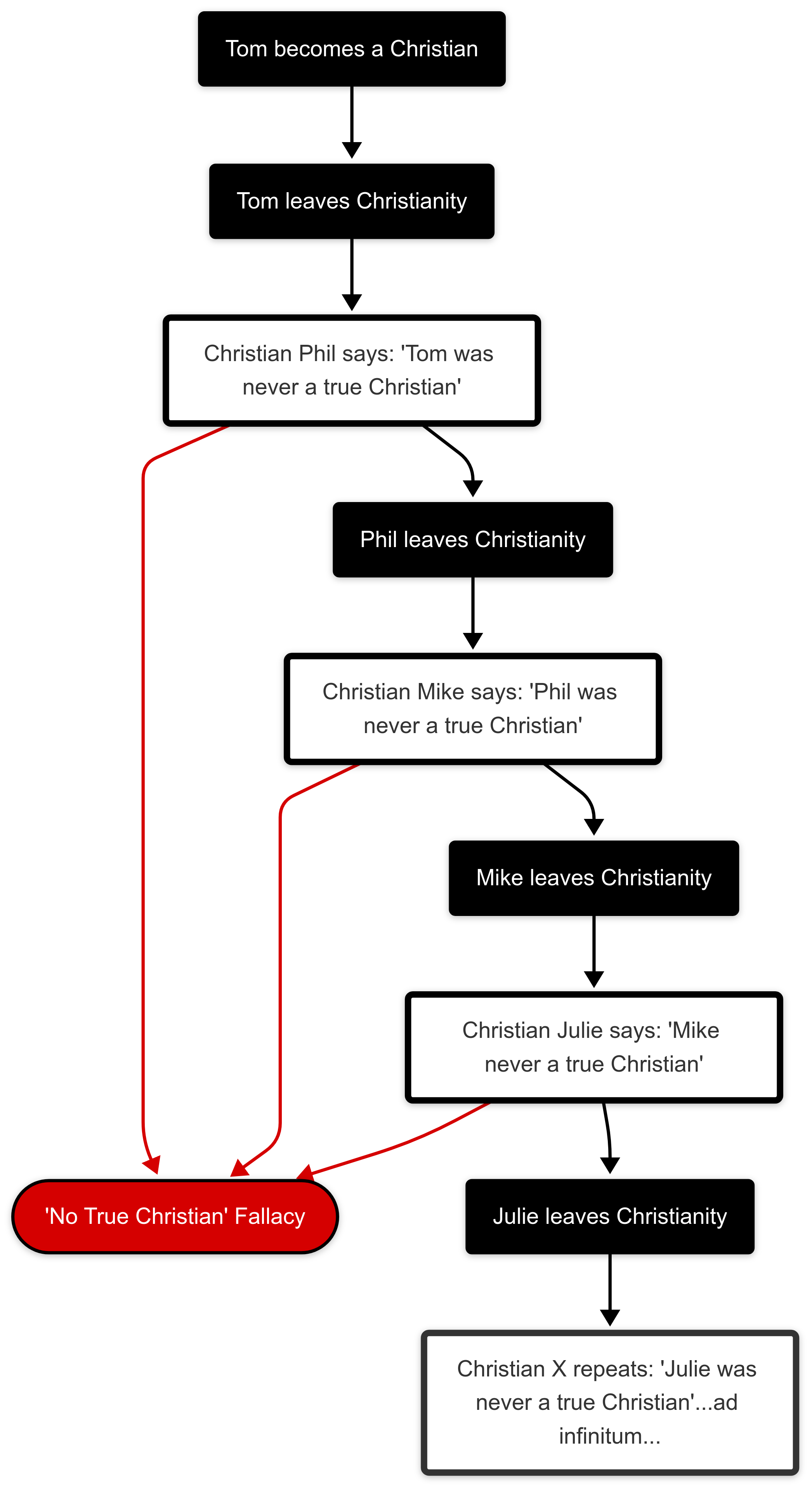
The “No True Christian” fallacy—a specific instance of the No True Scotsman fallacy—is a rhetorical escape hatch used by some Christians to protect the coherence and ideal image of their belief system. As clearly depicted in the uploaded diagram, the fallacy takes the following form: when an individual who once professed belief in Christianity leaves the faith, current believers retroactively claim that the person “was never a true Christian.” This assertion is not only logically incoherent but functions as a defensive psychological mechanism to insulate the faith from rational scrutiny.


The Core Incoherence: Shifting Definitions

The most obvious incoherence lies in the self-modifying definition of what it means to be a “true Christian.”

  • A person professes belief, engages in worship, studies the Bible, prays, evangelizes, and dedicates years to Christian living.
  • Upon deconversion, their past devotion is dismissed as inauthentic because they left.

This retrospective reinterpretation is not based on any observable metric, but solely on the inconvenient fact that the individual ceased believing. It renders the term “true Christian” impervious to falsification, which is epistemically irresponsible. If no amount of sincere belief, obedience, or spiritual transformation counts once someone exits the faith, then the term becomes vacuous—a floating signifier unanchored from any behavioral or experiential anchor.


The Recursive Trap: Everyone Becomes a Heretic

As seen in the diagram, the fallacy inevitably consumes its own defenders.

  • Phil says Tom was never a true Christian.
  • Phil leaves. Mike says Phil was never a true Christian.
  • Mike leaves. Julie says Mike was never a true Christian.
  • And so on.

This recursive sequence shows that the very people who make the accusation are vulnerable to the same dismissal, often within the span of a few years or decades. Thus, today’s gatekeeper becomes tomorrow’s apostate. If each person who leaves was “never a true Christian,” then at some point all former Christians were “never true Christians,” which entails that the vast majority of Christianity was composed of false Christians—an absurd conclusion that collapses any attempt to measure authenticity.


A Shield Against Honest Engagement

They went out from us, but they did not really belong to us. For if they had belonged to us, they would have remained with us; but their going showed that none of them belonged to us. — 1 John 2:19

Beyond its logical failings, the fallacy serves a tactical purpose:
It protects the believer from the discomfort of examining why people leave.

This is critical. Former Christians often leave for reasons grounded in:

  • Contradictions in Scripture
  • Ethical concerns with the character of the biblical God
  • Scientific understanding incompatible with Genesis accounts
  • Historical failures of prophecy
  • Psychological harm caused by doctrines like eternal damnation

But instead of grappling with these critiques, Christians who deploy this fallacy dismiss the critic entirely. If the ex-Christian “was never one of us,” then there’s no need to ask why they left or whether their objections have merit. This strategy depersonalizes dissent, transforming it into a problem of spiritual fraud rather than theological inadequacy.


Faith in a Fortress of Air

Ironically, this approach portrays Christianity not as robust, but as fragile—a worldview so delicate that it must constantly reclassify dissenters to protect itself.

  • If Christianity is true, it should withstand deconversion narratives.
  • If it is rational, it should welcome critical examination.
  • If it is coherent, it shouldn’t need to revise its definition of “true believer” after every defection.

The “No True Christian” fallacy betrays an insecurity at the heart of the faith: a fear that those who leave might have good reasons for doing so, reasons that could unravel the beliefs of those still within.


Conclusion

The “No True Christian” fallacy is not only circular and incoherent, but also strategically employed to avoid honest dialogue. It delegitimizes ex-believers, thus shielding current believers from engaging with critical arguments that may threaten their worldview. This intellectual bypass is not an act of faithfulness, but of epistemic cowardice—a refusal to follow the evidence wherever it leads.

If Christianity is to have any claim to truth, it must dispense with this fallacy and begin listening to those who, having walked the path of faith, now choose a different route not out of rebellion, but from hard-earned conviction.


6 responses to “✓ No True Christian”

  1. Ron Avatar

    Hello Phil…

    Observations on the post

    1. The NTS fallacy is a little problematic in applying it to a “Not a true Christian” instance. The NTS fallacy appears to be applied in an instance where the purity of the individual is in question. Is the person, or is the person not, a Scotsman in the first place. If the person is born in Scotland then they’re a Scot, regardless of whether or not that is inconvenient. Christianity is a profession. No one is born a Christian. The fallacy breaks down there.
    2. If Christianity is true then it should withstand deconversion narratives. Correct. It cannot, however, guarantee that there will be no deconversions. One has to hold to an ideology that goes under Christian language, but is not explicit in the Bible (explicitly Christian) that describes the narrative of where Christianity emanated from in the first place. The notion that a believer cannot lose their salvation is a debated subject. It cannot be definitively determined from the source material.
    3. On a personal note, when someone tells me that they used to be a Christian, I take them at their word. Although there a many who push back on that, there are many who accept the person for what they say.
    1. Phil Stilwell Avatar
      Phil Stilwell

      I appreciate your willingness to take a person’s word for their claim they were a Christian. I might tighten up a few points, though.

      ◉ 1. No True Scotsman Still Applies
      It’s important to remember that this becomes a fallacy whenever someone redefines a category post hoc to exclude inconvenient counterexamples.

      Christian: “A true Christian would never leave the faith.”
      Former believer: “But I was sincere for 20 years, studied the Bible, prayed daily, evangelized, and sacrificed deeply for the faith.”
      Christian: “But you were never truly a Christian as evidenced by your apostasy.”

      This isn’t an honest empirical test of sincerity or belief. It’s a logical shield to avoid considering that genuine believers can later see reasons to leave. It’s precisely what the No True Scotsman fallacy warns against: changing the definition to protect an ideology rather than confronting counter-evidence.

      ◉ 2. On Doctrinal Ambiguity and Its Exploitation
      You noted that Christian theology is internally debated on the issue of apostasy. But this doesn’t help the case—it weakens it. If Christians themselves cannot agree on whether salvation can be lost or whether leaving implies false belief, then the use of “true Christian” as a rigid disqualifier of deconversion stories becomes intellectually dishonest.

      One cannot say, “It’s debated,” and then dogmatically exclude defectors by invoking one particular interpretation when convenient. The ambiguity of Scripture makes such certainty unjustified.

      ◉ 3. The Biblical Version of Playground Logic
      Consider 1 John 2:19:

      “They went out from us, but they were not of us; for if they had been of us, they would have continued with us.”

      This is often cited as proof that those who leave were never genuinely Christian. But note what this passage actually does: it begs the question. It assumes that continued belief is the proof of true belief, and departure is the proof of counterfeit belief.

      This is no different than a group of schoolgirls saying:

      “If she had really been our friend, she’d still be our friend. But she isn’t, so she never was.”

      It’s circular. It’s defensive. And it’s rooted not in objective assessment but in social-exclusion dynamics. Just as the schoolgirls shield themselves emotionally from rejection, the verse—and those who invoke it—shield themselves psychologically from the unsettling idea that people can honestly and thoughtfully walk away from belief.

      ◉ 4. Objective Criteria Challenge

      What objective, falsifiable, non-circular criteria can be used to determine who was a true Christian—one that doesn’t simply reduce to “They left, therefore they weren’t”?

      This is a fair standard in any rational dialogue. If none can be given, then the claim “you were never a true Christian” becomes nothing more than a theological tautology designed to block engagement with actual arguments and experiences.

      ◉ Final Note
      When someone says, “I used to be a Christian,” and then offers reasoned and deeply considered grounds for why they left, the only intellectually honest response is to engage those reasons. Rewriting their past to preserve your worldview does not show strength—it shows fragility.

      Would you be willing to provide that objective standard? I’d welcome the conversation.

      1. Ron Avatar

        Hello again Phil:

        To point #1: 

        I am mostly in agreement here. To the point: Calvinists claim that a current believer is, or was, irresistibly drawn into a relationship with God. It is God alone who calls, responds, etc. The professed Christian has no say so. The “Christian cannot lose their salvation” (CCLS) person/crowd seems to have the same methodology, but in reverse. It makes a judgment based on certain areas of scripture that they claim to hold to, while ignoring other areas of the same scriptures. I would agree that that is fallacious reasoning. I would contend, however, that to make the assertion, then, that Christianity lacks any empirical test of sincerity or belief (I think that’s what you were getting at… I could be wrong) becomes problematic. I don’t see any effective measure for determining a persons “sincerity or belief.” I can only go off of what I observe. If a person claims to be a Christian, and has outworkings of being a Christian, then I take them at their word at that point, regardless of how things might change down the road. 

        To point #2

        I’ve read this over a few times now, and I’m not following your argument. What “case” are you referring to? There are large swaths of professing Christians who think that a sincere believer can, at some point, lose that sincerity, and ultimately walk away from the Christian faith. There are other large (or larger) swaths that claim that that “walking away” proves that they were never a Christian (they were “never a true believer/Scotsman”). Until I see some convincing reason to rescind my current position, I’m strongly in the first camp. There is no NTS fallacy for those in the first camp. That issues are debated does not make a conclusion, per se, intellectually dishonest. I’m not dogmatically excluding anyone. It’s simply an observation.

        To point #3:

        1 John 2:19 appears to be addressing teachers, not everyday professing believers. All I can objectively say is that if a person is teaching certain doctrines, and those doctrines run counter to arguably sustainable doctrines that have previously been enacted/imposed/taught, then those doctrines would objectively be, at best, highly problematic, at worst… flat out false.

        To point #4:

        I know of no “objective, falsifiable, non-circular criteria” that can be used to determine if a person was, or was not, a true Christian. My objection (and you’ve stated your disagreement with me) is that the NTS fallacy should not, or perhaps cannot, be used in this area. Again, the only objective criteria I have is whether or not a person, at a given point in time, professes to be, and appears to live in, the Christian faith. A person who ex post facto claims that another was not a true Christian only has their opinion, and ideological claims that may or may not be sustainable, to go on. They can claim “the Bible says…” but they have to be able to back up that line of reasoning across the panoply of biblical scripture.

        I would agree that engaging a person’s reasoning as to why Christianity is problematic, or flat out false, is something that professing Christians need to be much better at.

        I have a feeling that this could go on forever. You have a lot on the site that I’m looking at and considering, so I will just give you the final word.

        1. Phil Stilwell Avatar
          Phil Stilwell

          A few clarifications and expansions:

          ◉ 1. On Your Agreement with the NTS Concern
          You’re right to note that certain theological camps—like the Calvinist or CCLS positions—deploy self-sealing reasoning. Whether God is said to irresistibly save someone or a person is said to never truly have been saved, the pattern is similar: the outcome is preloaded into the premise, rendering any contrary evidence inadmissible by definition. You also correctly point out the difficulty of measuring “sincerity” externally. But that, I’d argue, is precisely the problem.

          If there is no observable or falsifiable way to distinguish a “true” Christian from a “false” one in real time, then the claim that someone was “never truly a Christian” upon their deconversion becomes not only unfalsifiable, but vacuous. It’s not a matter of declaring that Christianity offers no test of sincerity—it’s that when every available test fails to count once someone exits, the designation becomes a retroactive fiction rather than an empirical category.

          ◉ 2. On Doctrinal Diversity and Its Implications
          You asked what “case” I was referring to. In short: the case for using “true Christian” as a meaningful disqualifier.

          You mentioned that you lean toward the position that people can sincerely believe and later walk away. That’s commendably honest. But many others cite verses like 1 John 2:19 to claim the opposite. The content I shared addresses those who exploit doctrinal ambiguity to selectively enforce exclusion. When definitions shift depending on theological need, that’s not intellectually stable—it’s ideologically opportunistic.

          So yes, debates per se aren’t dishonest. But claiming certainty amid ambiguity, while also using that supposed certainty to dismiss others’ lived experiences, is dishonest.

          ◉ 3. On 1 John 2:19 and the “Teachers” Defense
          Whether this passage targets teachers or ordinary believers, the logical structure remains the same. It assumes what it sets out to prove: they left, therefore they were never of us. That’s not sound reasoning; it’s circular.

          And while doctrinal consistency is a fair concern, it doesn’t rescue this verse from the psychological function it serves—it’s deployed not to assess doctrine critically, but to emotionally buffer the community from having to reckon with defections.

          ◉ 4. On Criteria and Circularity
          I appreciate your concession here. If there are no objective, falsifiable, non-circular criteria by which we can establish who was or was not a true Christian, then claims like “you were never one” are reduced to personal intuitions bolstered by selective scripture. That’s not enough for a position that purports to be grounded in ultimate truth.

          Again, I’m not faulting believers for lacking omniscient insight into others’ sincerity. I’m challenging the impulse to redefine terms post hoc to safeguard theology from inconvenient data points like thoughtful deconversion. That’s where the No True Christian fallacy comes in—precisely where there is no reliable test and yet dogmatic exclusion is made.

          ◉ Final Thought
          You noted this could go on forever. Perhaps. But I find these discussions deeply worthwhile—not to score points, but to sharpen the clarity and honesty with which belief systems are held and expressed.

          If Christians truly believe their faith is coherent and anchored in reality, then thoughtful defections should be met with reflection, not rhetorical shielding. Thanks for your insightful engagement.

  2. Ron Avatar
    Ron

    I was indicating that this particular discussion/debate over the applicability of NTS to particular Christian ideological camps could go on forever. I agree with much of your response here. I didn’t mean to imply that I was not open for further discussion. There are some areas that compel me a little more… not that this argument is not important. You have a lot on the site. I would like to engage in other areas that I’m observing… that’s all I was getting at.

    1. Phil Stilwell Avatar
      Phil Stilwell

      Sorry, I misunderstood you. Feel free to explore and comment on any other articles.

Leave a reply to Ron Cancel reply

Recent posts

  • Hebrews 11:1 is often misquoted as a clear definition of faith, but its Greek origins reveal ambiguity. Different interpretations exist, leading to confusion in Christian discourse. Faith is described both as assurance and as evidence, contributing to semantic sloppiness. Consequently, discussions about faith lack clarity and rigor, oscillating between certitude…

  • This post emphasizes the importance of using AI as a tool for Christian apologetics rather than a replacement for personal discernment. It addresses common concerns among Christians about AI, advocating for its responsible application in improving reasoning, clarity, and theological accuracy. The article outlines various use cases for AI, such…

  • This post argues that if deductive proofs demonstrate the logical incoherence of Christianity’s core teachings, then inductive arguments supporting it lose their evidential strength. Inductive reasoning relies on hypotheses that are logically possible; if a claim-set collapses into contradiction, evidence cannot confirm it. Instead, it may prompt revisions to attain…

  • This post addresses common excuses for rejecting Christianity, arguing that they stem from the human heart’s resistance to surrendering pride and sin. The piece critiques various objections, such as the existence of multiple religions and perceived hypocrisy within Christianity. It emphasizes the uniqueness of Christianity, the importance of faith in…

  • The Outrage Trap discusses the frequent confusion between justice and morality in ethical discourse. It argues that feelings of moral outrage at injustice stem not from belief in objective moral facts but from a violation of social contracts that ensure safety and cooperation. The distinction between justice as a human…

  • Isn’t the killing of infants always best under Christian theology? This post demonstrates that the theological premises used to defend biblical violence collapse into absurdity when applied consistently. If your theology implies that a school shooter is a more effective savior than a missionary, the error lies in the theology.

  • This article discusses the counterproductive nature of hostile Christian apologetics, which can inadvertently serve the skepticism community. When apologists exhibit traits like hostility and arrogance, they undermine their persuasive efforts and authenticity. This phenomenon, termed the Repellent Effect, suggests that such behavior diminishes the credibility of their arguments. As a…

  • The post argues against the irreducibility of conscious experiences to neural realizations by clarifying distinctions between experiences, their neural correlates, and descriptions of these relationships. It critiques the regression argument that infers E cannot equal N by demonstrating that distinguishing between representations and their references is trivial. The author emphasizes…

  • The article highlights the value of AI tools, like Large Language Models, to “Red Team” apologetic arguments, ensuring intellectual integrity. It explains how AI can identify logical fallacies such as circular reasoning, strawman arguments, and tone issues, urging apologists to embrace critique for improved discourse. The author advocates for rigorous…

  • The concept of the Holy Spirit’s indwelling is central to Christian belief, promising transformative experiences and divine insights. However, this article highlights that the claimed supernatural benefits, such as unique knowledge, innovation, accurate disaster predictions, and improved health outcomes, do not manifest in believers. Instead, evidence shows that Christians demonstrate…

  • This post examines the widespread claim that human rights come from the God of the Bible. By comparing what universal rights would require with what biblical narratives actually depict, it shows that Scripture offers conditional privileges, not enduring rights. The article explains how universal rights emerged from human reason, shared…

  • This post exposes how Christian apologists attempt to escape the moral weight of 1 Samuel 15:3, where God commands Saul to kill infants among the Amalekites. It argues that the “hyperbole defense” is self-refuting because softening the command proves its literal reading is indefensible and implies divine deception if exaggerated.…

  • This post challenges both skeptics and Christians for abusing biblical atrocity texts by failing to distinguish between descriptive and prescriptive passages. Skeptics often cite descriptive narratives like Nahum 3:10 or Psalm 137:9 as if they were divine commands, committing a genre error that weakens their critique. Christians, on the other…

  • In rational inquiry, the source of a message does not influence its validity; truth depends on logical structure and evidence. Human bias towards accepting or rejecting ideas based on origin—known as the genetic fallacy—hinders clear thinking. The merit of arguments lies in coherence and evidential strength, not in the messenger’s…

  • The defense of biblical inerrancy overlooks a critical flaw: internal contradictions within its concepts render the notion incoherent, regardless of textual accuracy. Examples include the contradiction between divine love and commanded genocide, free will versus foreordination, and the clash between faith and evidence. These logical inconsistencies negate the divine origin…

  • The referenced video outlines various arguments for the existence of God, categorized based on insights from over 100 Christian apologists. The arguments range from existential experiences and unique, less-cited claims, to evidence about Jesus, moral reasoning, and creation-related arguments. Key apologists emphasize different perspectives, with some arguing against a single…