
The following quote is from Dr. William Lane Craig. He made these remarks during a podcast episode of “Reasonable Faith.” In this episode, Dr. Craig addressed a question from a listener named Kyle, who was concerned about the level of epistemic confidence required to rationally hold Christian beliefs. Dr. Craig suggested that even if there’s a very low probability (e.g., one in a million) of Christianity being true, the potential benefits are so significant that it would still be worth believing.
“It would be wrong to demand higher standards of evidence for this (the Christian Gospel). If anything, it would seem to me that one would be more ready to believe if there’s any sort of shred of evidence that would be supportive of it because of the tremendous practical benefits. … If there is just one chance in 1 million that this thing is true, it is worth believing.”

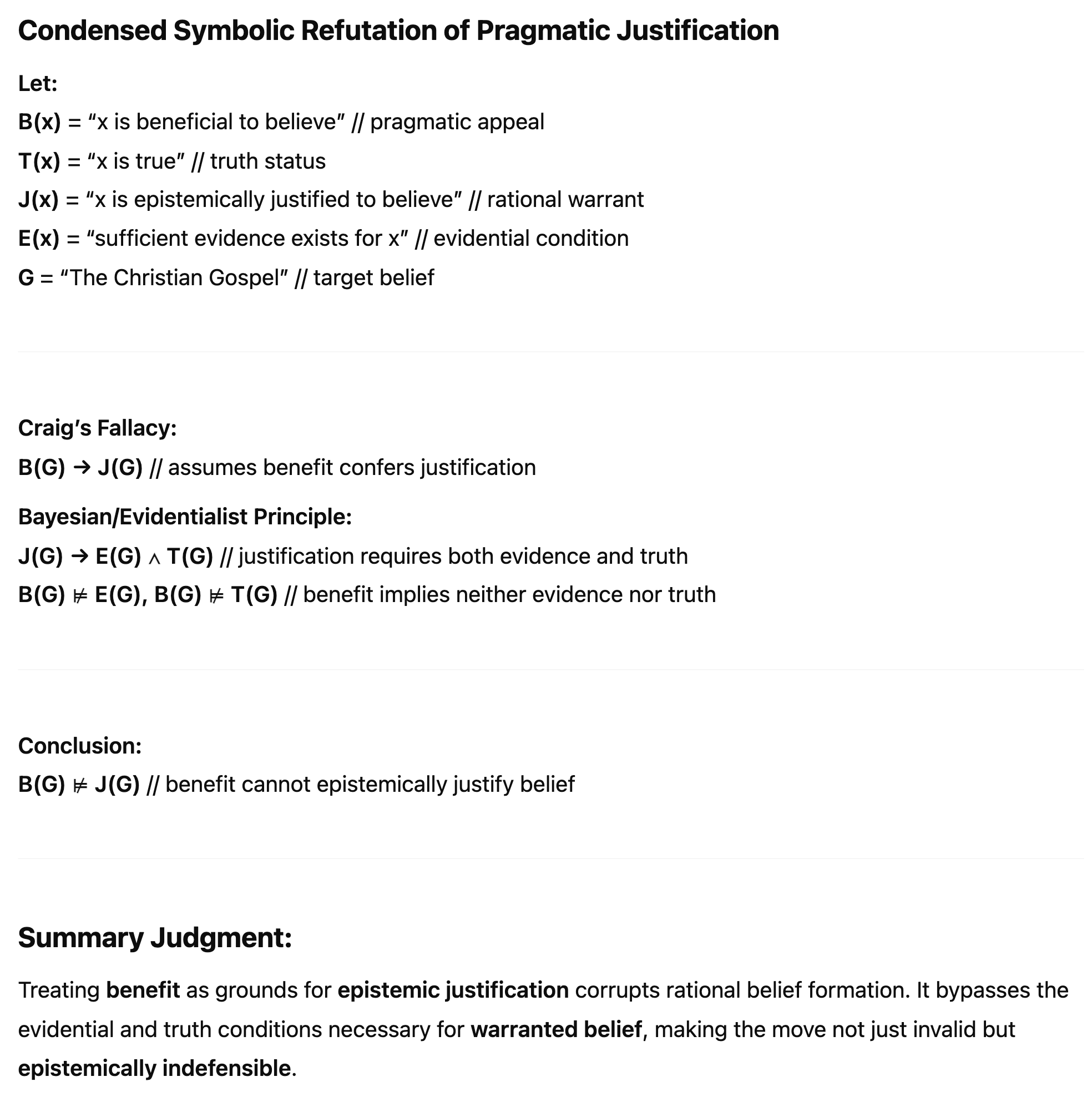
Lowering the Bar: A Rigorous Critique of William Lane Craig’s Epistemic Laxity
William Lane Craig, a prominent Christian apologist and philosopher, has argued that it would be wrong to demand high evidential standards for believing the Christian Gospel. He further contends that even a “shred” of supportive evidence should prompt belief, given the supposed “tremendous practical benefits” of Christianity. In a striking admission, Craig concludes that even if there is merely one chance in a million that the Gospel is true, it is worth believing. While rhetorically potent to his audience, Craig’s reasoning commits several profound epistemic blunders. This essay outlines those missteps and explains why they undermine the integrity of rational belief formation.
1. Special Pleading for the Gospel
Craig’s central claim—that demanding higher standards of evidence for the Gospel is inappropriate—constitutes a clear case of special pleading. Normally, the more extraordinary a claim, the more demanding our evidential standards become. Claims involving supernatural entities, virgin births, bodily resurrection, and eternal destinations are not trivial. They stretch well beyond common human experience and thus warrant greater scrutiny, not exemption. To shield these claims from rigorous evidential demands while holding other belief systems to higher standards is intellectually inconsistent. If anything, epistemic integrity requires us to raise the bar for such metaphysical assertions—not lower it.
2. The Confusion Between Pragmatic and Epistemic Justification
Craig leans heavily on the pragmatic benefits of Christian belief—salvation, meaning, comfort—as a basis for adopting it. Yet this is a conflation of instrumental utility with epistemic justification. It may indeed be psychologically advantageous or socially cohesive to believe a proposition, but this does not make the proposition any more likely to be true. To confuse “it is useful to believe” with “it is rational to believe” is to collapse the distinction between truth-tracking and wish-fulfillment. This pragmatic justification risks devolving into motivated belief—accepting something primarily because one wants it to be true, regardless of the evidence.
3. The Erosion of Evidential Thresholds
By claiming that “any sort of shred of evidence” is sufficient to warrant belief, Craig signals a departure from rational credencing. Bayesian epistemology—widely accepted as a model for updating beliefs—holds that belief strength should be proportional to the quality and quantity of evidence. A “shred” of evidence, especially for a claim with a low prior probability, should yield only a minimal shift in credence, and certainly not warrant full commitment. Craig’s threshold is not only arbitrarily low but selectively applied. One wonders whether he would adopt the same leniency for belief in other religious systems, alien abductions, or reincarnation, each of which can claim at least a “shred” of supporting testimony.
4. The Implausibility of One-in-a-Million Belief
Perhaps the most striking epistemic surrender comes when Craig declares that even if the Gospel were only true one time in a million, it would still be worth believing. This statement abandons any pretense of epistemic proportionality. A 1-in-1,000,000 probability translates to a credence of 0.000001—an extraordinarily low level of likelihood. No rational agent would believe a proposition with such a low probability without overwhelming supporting evidence. By endorsing belief at this improbably low threshold, Craig effectively renders credal coherence impossible. If such standards were universally applied, one could justifiably believe in any religious claim with existential stakes, no matter how poorly supported.
5. Implicit Pascalian Reasoning Without Structure
Craig’s position loosely echoes Pascal’s Wager—the idea that belief in God is warranted because the potential rewards (eternal life) outweigh the costs. Yet unlike Pascal, who framed his wager in decision-theoretic terms, Craig offers no formal cost-benefit matrix and no account of expected utility. Worse still, he ignores the many-gods objection: if belief is warranted for low-probability, high-stakes claims, then Islam, Mormonism, or any other faith system with promised eternal consequences might also warrant belief. The absence of such a structure makes Craig’s argument seem not reasoned, but rather selectively indulgent.
6. The Rejection of Epistemic Humility
Underneath Craig’s formulation lies a rejection of epistemic humility—the virtue of proportioning one’s belief to the strength of evidence and being willing to withhold judgment when the evidence is weak or ambiguous. His model elevates credulous affirmation over cautious doubt and treats belief as a desirable posture even in the absence of robust reasons. This violates the fundamental aim of rational inquiry: to seek truth through evidence, not desire. Rational belief requires not merely that something could be true, but that the weight of the evidence makes it probable.
Conclusion: Why Standards Matter
Craig’s lowering of the epistemic bar for Christianity is not merely a tactical move—it is a methodological abdication. It turns belief into a wager based on benefits rather than a reasoned inference from evidence. In doing so, it opens the door to countless unjustified beliefs, weakens our ability to distinguish truth from wishful thinking, and privileges emotional comfort over rational responsibility.
The bar is there for a reason. Lower it too far, and belief is no longer an act of epistemic virtue, but of intellectual surrender.
Critique of Segment 1:
“It would be wrong to demand higher standards of evidence for this (The Christian Gospel).”
Epistemic Blunders:
- Special Pleading Fallacy
This line commits special pleading—an informal fallacy in which a general principle (e.g., extraordinary claims require extraordinary evidence) is selectively suspended. Claims involving supernatural events and eternal destinies are more extraordinary than mundane claims and thus warrant greater, not lesser, evidential standards. - Misplaced Burden of Proof
By suggesting that higher scrutiny is “wrong,” the speaker implies that the Gospel should be exempt from the ordinary burden of proof. This is unjustified, particularly when the claim is metaphysically ambitious. Exempting a claim from scrutiny merely because one desires it to be true is epistemically irresponsible. - Neglect of Proportional Belief
Bayesian reasoning mandates that belief strength should be proportional to the evidence. Arguing that demanding higher standards is “wrong” reverses the norm: the lower the prior probability and the higher the stakes, the more evidence is needed.
Critique of Segment 2:
“If anything, it would seem to me that one would be more ready to believe if there’s any sort of shred of evidence that would be supportive of it because of the tremendous practical benefits.”
Epistemic Blunders:
- Pragmatic Justification Fallacy
The idea that “practical benefits” justify belief conflates pragmatic usefulness with epistemic justification. Just because a belief is comforting or socially beneficial does not make it epistemically warranted. - Confirmation Bias and Cherry-Picking
The reference to a “shred of evidence” betrays a low evidential threshold that signals confirmation bias. The speaker suggests readiness to affirm the claim on any supportive evidence while ignoring counter-evidence. This is antithetical to honest epistemic inquiry. - Wishful Thinking
Anchoring belief on how much one wants something to be true leads to wishful thinking. This epistemic vice confuses emotional comfort with rational assent, and opens the door to countless delusions.
Critique of Segment 3:
“If there is just one chance in 1 million that this thing is true, it is worth believing.”
Epistemic Blunders:
- Abandonment of Rational Credencing
A 1-in-1,000,000 chance of truth yields a credence of 0.000001. According to basic Bayesian principles, belief should scale with evidence. Believing something with this level of improbability without overwhelming compensatory evidence is epistemically irrational. - Pascalian Mimicry Without Justification
This resembles Pascal’s Wager, but it lacks Pascal’s decision-theoretic frame. It merely asserts belief as warranted at low probabilities without evaluating the full cost-benefit structure, ignoring alternative beliefs with similarly low probabilities and existential stakes. - Neglect of Rival Hypotheses and Opportunity Cost
Many claims (Islam, Hinduism, UFO religions) could be said to have some low chance of being true. Believing in one at 1-in-a-million while rejecting others with similar (or greater) plausibility is epistemically inconsistent and invites credal overload.
Summary of Key Violations
| Violation | Explanation |
|---|---|
| Special Pleading | Applies looser evidential standards to favored belief. |
| Pragmatic Substitution | Substitutes desirability for likelihood. |
| Wishful Thinking | Lets emotion drive belief rather than evidence. |
| Non-Bayesian Credencing | Believes at a probability far below rational thresholds. |
| Confirmation Bias | Accepts only confirming evidence, ignoring disconfirmation. |
| Neglect of Opportunity Cost | Fails to consider cost of rejecting better-supported alternatives. |
| Pascalian Illogic | Invokes the “worth” of belief without structured justification. |
Here are several formal syllogisms that rigorously expose the epistemic flaws in William Lane Craig’s position as expressed in the quote.
Syllogism 1: Against Special Pleading
P1: Claims that are extraordinary require stronger evidence to be reasonably believed.
P2: The Christian Gospel includes extraordinary claims (e.g., virgin birth, resurrection, eternal life).
P3: Craig argues that we should not demand higher standards of evidence for the Gospel.
Conclusion: Therefore, Craig is making an exception to a general evidential principle, committing special pleading.
Syllogism 2: Against Pragmatic Justification
P1: The pragmatic benefits of a belief do not determine its truth value.
P2: Craig asserts that the Gospel is worth believing because of its tremendous practical benefits.
P3: Believing something because it is beneficial, not because it is likely true, is epistemically unjustified.
Conclusion: Therefore, Craig’s justification of belief based on benefit is epistemically flawed.
Syllogism 3: Against Believing on Weak Evidence
P1: Rational belief should be proportionate to the amount and quality of evidence available (Bayesian principle).
P2: Craig claims that “any sort of shred of evidence” is sufficient for belief in the Gospel.
P3: A shred of evidence is not sufficient to justify belief in a low-prior probability claim.
Conclusion: Therefore, Craig’s standard for belief is irrationally low and violates evidential proportionality.
Syllogism 4: Against One-in-a-Million Credence
P1: Beliefs with extremely low probability (e.g., 1 in 1,000,000) are not rationally adoptable without overwhelming evidence.
P2: Craig claims that belief in the Gospel is justified even if there is only one chance in a million that it is true.
P3: He does not provide overwhelming evidence to raise that credence significantly.
Conclusion: Therefore, Craig’s endorsement of belief under such low probability is epistemically indefensible.
Syllogism 5: Against Selective Low-Threshold Belief
P1: If one adopts belief in a proposition with a 1-in-1,000,000 chance of being true due to potential benefits, then one should also believe all other similarly improbable high-stakes propositions.
P2: Craig advocates belief in the Gospel under such conditions but rejects other religious or metaphysical systems.
P3: Selectively believing one improbable claim while rejecting others of similar structure is epistemically inconsistent.
Conclusion: Therefore, Craig’s position entails an inconsistent and irrational belief policy.
Syllogism 6: Against Abandoning Epistemic Responsibility
P1: Epistemic responsibility requires proportioning belief to evidence and maintaining skepticism when evidence is weak.
P2: Craig encourages belief even when the probability is extremely low and evidence minimal.
P3: This approach undermines the pursuit of truth and promotes epistemic irresponsibility.
Conclusion: Therefore, Craig’s position represents a rejection of epistemic responsibility.
Symbolic Logic Formulations:
Image of Basic Argument
1. Special Pleading
Let:
= “x requires extraordinary evidence”
= “x is an extraordinary claim”
= “x is epistemically justified”
= “The Christian Gospel”
Premises:


Conclusion:

This shows that if extraordinary claims require extraordinary evidence, and the Gospel is extraordinary but Craig denies it needs such evidence, then belief in the Gospel is not epistemically justified.
2. Pragmatic Justification Fallacy
Let:
= “x is beneficial to believe”
= “x is true”
Craig’s Claim:

Epistemic Principle:

Counterposition:


Thus, appealing to 


3. Belief on Insufficient Evidence
Let:
= “x has a shred of evidence”
= “x has low prior probability”
Craig’s Implicit Claim:

Bayesian Principle:
Belief is rational only if 

But with 


4. One-in-a-Million Fallacy
Let:

Craig’s Assertion:

Bayesian Counterprinciple:


Thus, Craig’s threshold undermines standard Bayesian norms.
5. Inconsistency Across Claims
Let:
, where
is another religious claim (e.g., Islam)

Epistemic Consistency Principle:

Craig’s Violation:

This is a violation of consistent epistemic application.
This questionnaire is designed to assess the degree to which Christian apologists agree with or diverge from the epistemic standards expressed by Dr. William Lane Craig in a well-known episode of his Reasonable Faith podcast. In this discussion, Craig makes a series of claims about belief in the Christian Gospel, particularly regarding the standards of evidence required for rational belief and the role that practical benefits should play in belief formation.
Apologists are invited to reflect critically on the implications of these claims and indicate their level of agreement.
The Quoted Position (William Lane Craig):
“It would be wrong to demand higher standards of evidence for this (the Christian Gospel). If anything, it would seem to me that one would be more ready to believe if there’s any sort of shred of evidence that would be supportive of it because of the tremendous practical benefits. … If there is just one chance in 1 million that this thing is true, it is worth believing.”
Section A: Evidential Standards
- It is wrong to demand higher standards of evidence for the Christian Gospel than for other types of claims.
□ Strongly Agree □ Agree □ Neutral □ Disagree □ Strongly Disagree - Religious claims should be held to lower evidential standards than non-religious claims.
□ Strongly Agree □ Agree □ Neutral □ Disagree □ Strongly Disagree - The Christian Gospel should be believed even if it lacks extraordinary evidence.
□ Strongly Agree □ Agree □ Neutral □ Disagree □ Strongly Disagree
Section B: Pragmatic Justification
- The practical benefits of Christian belief (e.g., salvation, meaning, morality) justify belief even if the evidence is weak.
□ Strongly Agree □ Agree □ Neutral □ Disagree □ Strongly Disagree - Belief in the Gospel is justified even if it is not the most probable worldview.
□ Strongly Agree □ Agree □ Neutral □ Disagree □ Strongly Disagree - It is rational to believe a proposition largely because it provides hope, meaning, or comfort.
□ Strongly Agree □ Agree □ Neutral □ Disagree □ Strongly Disagree
Section C: Probability and Belief
- If there is a one-in-a-million chance that the Gospel is true, it is still worth believing.
□ Strongly Agree □ Agree □ Neutral □ Disagree □ Strongly Disagree - Belief is justifiable even when the probability of the claim being true is extremely low.
□ Strongly Agree □ Agree □ Neutral □ Disagree □ Strongly Disagree - Rational belief in a claim does not require high probability if the stakes are eternal.
□ Strongly Agree □ Agree □ Neutral □ Disagree □ Strongly Disagree
Section D: Consistency Across Claims
- If I believe in the Gospel due to low probability and high reward, I should also consider other religions under the same logic.
□ Strongly Agree □ Agree □ Neutral □ Disagree □ Strongly Disagree - It is epistemically consistent to believe Christianity while rejecting similarly improbable alternatives like Islam or Hinduism.
□ Strongly Agree □ Agree □ Neutral □ Disagree □ Strongly Disagree
Section E: Epistemic Responsibility
- Encouraging belief with minimal evidence promotes faith but undermines rational inquiry.
□ Strongly Agree □ Agree □ Neutral □ Disagree □ Strongly Disagree - A belief system should be rejected if it lacks sufficient evidence, even if it promises great rewards.
□ Strongly Agree □ Agree □ Neutral □ Disagree □ Strongly Disagree - It is important to proportion belief to evidence, even when the subject is religious.
□ Strongly Agree □ Agree □ Neutral □ Disagree □ Strongly Disagree - I would affirm William Lane Craig’s statement that even a one-in-a-million chance justifies belief in the Gospel.
□ Strongly Agree □ Agree □ Neutral □ Disagree □ Strongly Disagree
See also:


Leave a Reply