
The Fallacy of Equivocating Rational Confidence with Faith

Equivocation in the Defense of Faith
It is often asserted, particularly by defenders of faith-based worldviews, that “everyone has faith.” This claim typically serves as a rhetorical maneuver to reduce the epistemic gap between religious belief and common rational behaviors. However, such a claim hinges on an equivocation between faith, traditionally understood as belief without—or in spite of—evidence, and rational confidence, which is proportional to available evidence. By equating these two, proponents attempt to normalize religious belief as simply another expression of everyday reasoning. This conflation fails under scrutiny.
The Airplane Analogy: Rational Confidence Based on Evidence
Consider the case of air travel. When we board an airplane, we are placing our lives in the hands of pilots and engineers. Does this demonstrate faith in the religious sense? Hardly. What we exhibit is rational belief grounded in inductive experience. We are aware of several facts:
– commercial air travel is one of the safest modes of transportation;
– pilots undergo rigorous, standardized training and recurrent evaluation;
– airplanes are engineered and maintained according to strict international regulations;
– each successful flight adds to the base of evidence that this system works reliably.
Our confidence is not a leap beyond evidence—it is a response to overwhelming statistical reliability. If airplanes routinely fell out of the sky, or if pilot training was erratic and unregulated, this confidence would justifiably erode. In short, our beliefs are calibrated to the data. This is the epistemic signature of inductive reasoning, not faith.
The Restaurant Analogy: Trust, Not Faith
Imagine dining at a restaurant. You order a meal, trusting that the food is not poisoned. Again, is this faith? Not in any rigorous epistemic sense. Your confidence is derived from lived experience and social norms:
– health regulations govern food preparation;
– restaurants face reputational and legal risk for serving dangerous food;
– you have eaten at many restaurants without incident.
This is an expectation shaped by precedent, not a suspension of critical thought or an embrace of the unknown. Should you walk into an establishment with a history of poisoning patrons, your belief would shift accordingly. This elasticity in belief is evidence-sensitive—a hallmark of rationality.
The Bridge Analogy: Structural Expectations
When you drive across a bridge, you are implicitly trusting that it will not collapse. Is this faith? No. Civil engineering is a mature science. You have crossed thousands of bridges safely. Government inspections, material science, and public accountability form the framework of your confidence. Were this trust to be called “faith,” it would drain the term of its distinctiveness, for it would now include any belief based on probabilistic reliability.
Faith as Belief Without—or Despite—Evidence
What distinguishes religious faith is not that it functions like belief in bridges, meals, or airplanes. It is precisely that it does not. Faith is often treated as a virtue because it resists the tug of evidence. Where evidence points away from religious claims—such as global religious pluralism, the problem of suffering, or biblical inconsistencies—faith is encouraged to hold firm. This is a qualitatively different epistemic stance. It celebrates tenacity where rational belief demands revision. It is epistemically inertial, not responsive.
Conclusion: Clarity in Epistemic Categories
To claim that “everyone has faith” is to conflate rational, evidence-based confidence with ungrounded belief. This is not merely a semantic oversight but a distortion of epistemic categories. Rational belief is contingent, provisional, and updatable in light of evidence. Faith, as traditionally espoused in religious contexts, is not. Therefore, efforts to defend faith by appealing to everyday actions like flying or eating out are intellectually dishonest unless one is willing to collapse the distinction between belief shaped by evidence and belief sustained in spite of it.
A coherent epistemology must maintain the difference between justified confidence and unjustified assertion. To do otherwise is to give cover to irrationality under the guise of common sense.
Belief Calibration Is Always a Choice
While evidence can strongly suggest a conclusion, it never forces belief. Choosing to align your degree of belief with the degree of evidence is a voluntary act of rational discipline, not a logical necessity imposed by reality. Reality does not coerce belief; it merely offers signals. A person may face 80% confirming evidence for a claim and still choose to believe with only 30% confidence—or 100%. That misalignment is not a failure of logic, but a failure to commit to epistemic responsibility. The decision to let evidence shape belief is always an act of will, not inevitability.
Visualizing Rational Belief: Mapping Evidence to Confidence
The Belief-Evidence Gradient: A Visual Framework
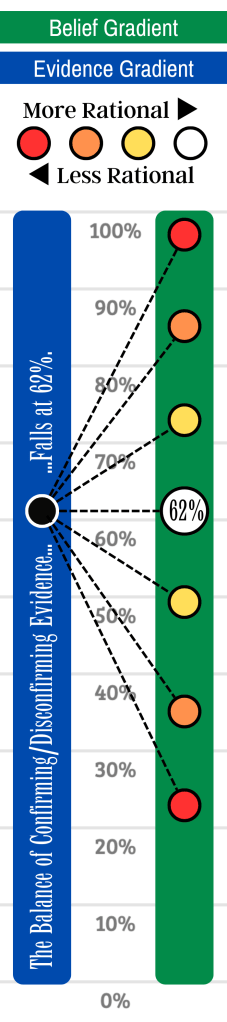
In the context of belief and rationality, the image on the right serves as a powerful visual metaphor for how belief should ideally be proportioned to evidence. It illustrates a principle fundamental to any coherent epistemology: rational belief is not belief at all costs, but belief that adjusts in response to evidence. When belief mirrors the balance of supporting and disconfirming evidence, it is rational. When it does not, the belief drifts toward irrationality.
The image on the right contains two key vertical scales:
- The blue column on the left represents the Evidence Gradient—from 0% (no evidence) at the bottom to 100% (maximal evidence) at the top. This is the actual epistemic support a proposition has based on observable data.
- The green column on the right is the Belief Gradient, reflecting the confidence or credence someone assigns to a claim. This should ideally correspond to the evidence.
A specific case is marked: the evidence for a claim stands at 62%, represented by the black circle on the Evidence Gradient. Several dotted lines stretch from this anchor to various points along the Belief Gradient, each representing a possible level of confidence.
Color-Coded Rationality: Matching Belief to Evidence
Each belief point along the green scale is color-coded:
- A white circle at 62% reflects a belief perfectly aligned with the evidence. This is the most rational position.
- As you move up or down the belief scale away from 62%, the circles become increasingly colored—yellow, orange, and then red. These indicate overconfidence or underconfidence, with decreasing rational integrity the further one strays from the evidence.
For example:
- A person believing with 90% confidence in a proposition supported by only 62% evidence is overconfident—rationally unjustified.
- A belief of 30% confidence would be unnecessarily skeptical given the available support.
This spectrum captures the epistemic virtue of proportioning belief to evidence—a core principle violated by what is typically meant by religious faith.
Faith and the Abandonment of the Gradient
Returning to the essay’s earlier analogies—airplanes, restaurants, bridges—we can now situate them within this visual framework. Our confidence in air travel, for example, is not an act of blind faith; it is a rational response to a body of empirical data. If we roughly estimate that flying is safe 99.9% of the time, then a belief confidence level near 99.9% is warranted and rational, as it hugs the Evidence Gradient.
Faith, however, as it functions in many religious contexts, often operates outside of this framework entirely. It urges believers to hold their confidence firm—even at 100%—regardless of the actual weight of evidence. This disconnect between belief and evidence is not an epistemic virtue. It is a failure of calibration. It treats rational doubt not as a signal for further inquiry, but as weakness or sin. In the visual metaphor, it is as though one arbitrarily chooses the topmost red circle and refuses to descend—no matter what the evidence says.
Conclusion: Evidence-Responsive Belief Is Not Faith
The image on the right is more than a diagram—it’s an epistemic guide. It affirms that the rational mind is one that responds to gradients—that belief should grow or shrink with the evidence. Faith, by contrast, resists this modulation. To equate the two is to obscure a vital epistemic distinction.
So the next time someone says, “everyone has faith,” point them to the image on the right. Ask them where the evidence lies. Then ask them where their belief sits. If the two do not align, they are not modeling rationality—they are modeling epistemic stubbornness disguised as virtue.
Let’s retire the false equivalence. Faith is not just another form of belief—it is belief unhinged from its proper tether: evidence.
Why Humans Default to Binary Belief:
Linguistic and Psychological Pressures
The Problem: Oversimplifying the Epistemic Gradient
In reality, belief is—or should be—a function of evidence. It ought to exist along a gradient, where confidence increases or decreases proportionally to the strength of evidence. Yet humans persistently treat belief as binary: either they accept a proposition or they reject it, with little tolerance for gradation. This tendency is deeply rooted in both linguistic structures and psychological predispositions, which not only coerce thought into categorical molds but also reinforce one another in a feedback loop.
Linguistic Pressure: Binary Terms Shape Binary Thinking
Natural language is not epistemically neutral. The structure of common speech often forces belief into on-or-off categories, regardless of the evidentiary nuances. Consider the following binary-leaning verbs and their effects:
- Believe – Generally interpreted as full assent. Saying “I believe X” rarely signals “I tentatively think X might be true with 60% confidence.”
- Disbelieve – Conveys flat-out rejection, rather than lower confidence.
- Assent – Culturally and semantically framed as full agreement; there is no common way to “partially assent.”
- Agree – Lacks an obvious scale. One typically agrees or disagrees with a statement, not “somewhat agrees” unless hedged awkwardly.
- Know – Perhaps the most epistemically loaded of all, know implies certainty, closure, and finality. To say “I know X” is to commit to epistemic infallibility in everyday parlance.
- Deny, affirm, concede, reject – Each maps to firm boundaries of epistemic positioning, rarely accommodating gradation or probabilistic uncertainty.
The result is a language that linguistically encodes epistemic absolutism. Even modifiers like “probably,” “maybe,” or “might” are syntactically secondary—added awkwardly to hedge a primary verb that remains binary at its core. There’s no common, fluid expression for “I currently lean toward believing X with 70% confidence, but remain open to revision.” Saying this sounds academic or unnatural, which is precisely the problem.
Psychological Pressure: Certainty Feels Safer
This linguistic rigidity is amplified by psychological discomfort with uncertainty. The human brain evolved not for dispassionate Bayesian analysis but for fast, adaptive decisions in high-stakes environments. Uncertainty signals risk, and prolonged ambiguity produces stress. Certainty, by contrast, offers emotional resolution:
- It simplifies cognitive load, allowing decisions to be made more efficiently.
- It reduces anxiety by eliminating the tension of indecision.
- It strengthens identity, especially when beliefs are social markers within a group.
- It confers social trust—those who express certainty are often seen as more confident and competent, even when wrong.
From this perspective, the psychological appeal of binary belief is understandable. If belief is felt as identity, then nuance threatens cohesion—both personal and communal. And if hesitation signals vulnerability, then certainty projects strength. These incentives push us toward black-and-white thinking, where epistemic gradients are flattened.
The Linguistic-Psychological Feedback Loop
The interplay between language and psychology creates a self-reinforcing feedback loop:
- Language restricts expression: Because we lack intuitive vocabulary for partial belief, people are rarely taught or encouraged to speak in graded terms.
- Psychology rewards simplicity: Belief expressed in binary terms feels more decisive and emotionally comfortable.
- Cultural norms form: Social contexts reward strong declarations (e.g., “I know this is true”) and stigmatize hedging (e.g., “I’m not sure yet”).
- Nuance is penalized: Those who express partial confidence may be seen as weak, evasive, or unreliable.
- The loop continues: Language and cognition grow increasingly aligned in favor of categorical belief, even in domains where uncertainty is rationally unavoidable.
This loop is especially pernicious in polarized environments—religious, political, or ideological—where confidence becomes a loyalty test. In such contexts, epistemic humility is not just discouraged; it’s often punished.
Consequences of Binary Framing
This binary framework leads to a host of epistemic problems:
- Overconfidence in weakly supported claims.
- Premature rejection of plausible but underdeveloped ideas.
- Dogmatism that resists contrary evidence due to identity entanglement.
- Polarization, where middle-ground views are drowned out in favor of extreme affirmations or denials.
More subtly, it makes people uncomfortable with expressing suspended judgment or revising beliefs in light of new evidence. In a culture that views belief as static and absolute, epistemic flexibility appears indecisive rather than virtuous.
Conclusion: Resisting the Binary Trap
To move toward more rational discourse, we must recognize and resist the binary defaults embedded in both language and psychology. This involves:
- Developing new linguistic habits—adopting terms like credence, probability, degree of belief, and explicitly noting uncertainty where appropriate.
- Normalizing epistemic humility—teaching that revising belief is not weakness but responsiveness to evidence.
- Fostering tolerance for ambiguity—training ourselves to remain in states of suspended judgment without existential discomfort.
The mature thinker does not seek epistemic closure for its own sake but strives for alignment between belief and evidence. That alignment requires tools—linguistic, cognitive, and cultural—that support gradation, not absolutes.
The choice is not merely between belief and disbelief, but between thinking in gradients or thinking in slogans. Only the former is compatible with intellectual honesty.
Faith as a Poor Epistemic Strategy
Key
- Cr(p) = your credence in proposition p (0 ≤ Cr ≤ 1)
- Ev(p) = the evidential warrant for p (0 ≤ Ev ≤ 1)
- F(p) = act of faith regarding p
- D(p) = distortion of your model of reality about p
- L(p) = lowered predictive / practical success about p
Definition of faith

Faith is any point where your personal confidence in a claim (Cr(p)) rises above the level justified by the evidence (Ev(p)); in short, it is belief that exceeds the relevant evidence.
P1:
Over‑confidence beyond the evidence distorts one’s picture of reality.

P2:
Distortion reliably undermines predictive and practical effectiveness.

Conclusion:
Therefore, faith—credence exceeding evidential support—predictably diminishes real‑world success and is a poor epistemic strategy.


Leave a Reply