The statement “It takes more faith to be an atheist”—typically made by proponents of a faith-based worldview—presents a profound epistemic contradiction. The contradiction arises when someone champions faith as virtuous in their own worldview, yet uses the alleged presence of faith in others as a criticism.


To further clarify the internal contradiction in this rhetorical maneuver, we can turn to the precision of symbolic logic. By translating the apologist’s assertions into formal statements, we can more clearly expose how the very structure of their reasoning collapses. What appears on the surface to be a clever reversal—accusing atheists of having even more faith—reveals itself, under the lens of logical analysis, to be a case of special pleading and semantic inconsistency. Below is a symbolic breakdown that brings this inconsistency into sharp focus.

Symbolic Logic Formulation

Let us define:

  • F(x): x operates on faith.
  • V(x): x holds a virtuous or commendable worldview.
  • C(x): x deserves criticism for relying on faith.
  • Let x = \text{Christian}
  • Let y = \text{Atheist}

We observe the following assertions by the Christian:

  1. F(x) — Christianity is grounded in faith.
  2. F(y) — Atheism (allegedly) requires faith.
  3. F(x) \rightarrow V(x) — Faith is virtuous when applied to their own belief.
  4. F(y) \rightarrow C(y) — Faith is condemnable when applied to atheism.

From (3) and (4), we derive the logical contradiction:


Contradiction Exposed

From (3) and (4), faith is both:

  • a virtue when x uses it: F(x) \rightarrow V(x)
  • a flaw when y uses it: F(y) \rightarrow C(y)

If the basis for commendation and criticism is the same attribute (faith), then the following is entailed:

(\exists z)(F(z) \rightarrow V(z) \land F(z) \rightarrow C(z)) — which violates the Law of Non-Contradiction, because no proposition P can simultaneously entail both V(z) and C(z) unless one equivocates on the meaning or value of faith.

In essence:

  • If faith is good → F(y) should not be a criticism.
  • If faith is bad → F(x) undermines one’s own worldview.
  • If one praises faith in self and critiques it in others solely based on the other’s worldview, this introduces special pleading and semantic equivocation.

Conclusion

By simultaneously affirming faith as a virtue in Christianity and a flaw in atheism, the apologist commits a category error and an instance of epistemic hypocrisy. The logic collapses unless the word faith is equivocated or arbitrarily redefined midstream—a fallacy of equivocation that renders the argument invalid.


Chart Notes:

  • F(x) = Faith in the Christian worldview
  • F(y) = Alleged faith in atheism
  • V(x) = Virtuous worldview
  • C(y) = Criticized worldview
  • The contradiction arises from treating the same property (faith) as both commendable and blameworthy, depending solely on worldview affiliation.
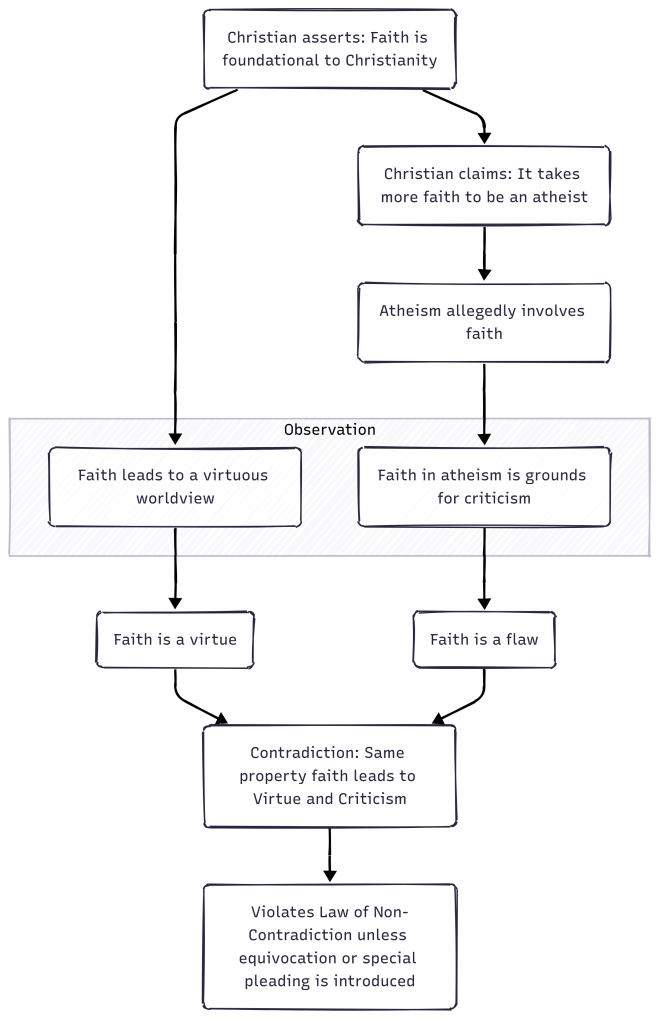
◉ The Incoherence of Praising Faith and Then Weaponizing It

Imagine a man who proudly boasts that his diet consists entirely of chocolate cake. He says, “Cake is the best food—it’s delicious, energizing, and deeply fulfilling.” But the moment he sees someone else eating cake—perhaps a rival—he sneers, “Wow, you eat chocolate cake? That’s disgusting and irrational.” You’d be right to do a double take. Either chocolate cake is a good thing, or it’s not. Praising it when it supports your identity and ridiculing it when someone else partakes is not just hypocritical—it’s logically incoherent.

This, in essence, is the rhetorical move made by many religious apologists who both praise faith as the foundation of their worldview and then attack others by saying, “It takes more faith to be an atheist.” On its surface, this might seem like a clever turn of phrase, but it collapses under basic scrutiny.


Faith as Virtue or Vice?

When the religious believer asserts that their worldview is grounded in faith, they are usually elevating this term. Faith, in their usage, is portrayed as a noble quality—something that rises above the demands of mere evidence and reflects trust in divine truth. It is described as a virtue, a marker of spiritual maturity and commitment.

Yet, in the same breath—or often in the next post—they turn to their interlocutor and say, with a smug tone, “Well, it takes more faith to be an atheist.” This is not intended as a compliment. It is clearly meant as a criticism, suggesting that atheism is even more irrational, even more detached from reason, because it requires even more of the very quality that they just deemed admirable.

This is epistemic sleight of hand.


The Logic Exposed

If we symbolize this, the incoherence becomes evident:

  • Let F(x) mean “x holds faith”
  • Let V(x) mean “x is virtuous”
  • Let C(x) mean “x is culpable or flawed”

When the Christian asserts:

  • F(\text{Christian}) \rightarrow V(\text{Christian}) — Faith is good when they have it
  • F(\text{Atheist}) \rightarrow C(\text{Atheist}) — Faith is bad when someone else allegedly has it

This is a direct violation of logical coherence. If faith is good, it cannot simultaneously be bad when exhibited by someone else just because they are not part of your tribe. That is called special pleading—a fallacy in which a principle is selectively applied to favor oneself and disadvantage others.


Faith as a Moving Target

This also raises another question: what do they even mean by “faith”? Is it trust based on some evidence (like trusting a chair will support your weight), or is it belief in excess of available evidence (such as believing in angels, resurrections, or talking snakes)? The ambiguity of the term allows apologists to equivocate—sliding between meanings depending on what will rhetorically benefit them in the moment.

When the atheist speaks of not believing due to insufficient evidence, the apologist often calls this “faith” simply because it does not amount to absolute certainty. But belief in proportion to evidence is not faith—it is rational inference. To call all uncertainty-based belief “faith” is like calling all food “cake” just because both are edible. It’s a category error that falsely equates rational doubt with doctrinal commitment.


The Umbrella Analogy

Imagine someone holding an umbrella and saying, “Carrying an umbrella is a sign of wisdom. It shows I’m prepared for the rain.” Then, as soon as you pull out your umbrella, they say, “Look at you—so scared of a little rain. You must be weak to carry that.” The object in question is the same: the umbrella. What changed is not the thing itself but who was holding it.

In the case of faith, the same object—faith—is either praised or ridiculed depending not on its epistemic quality but on tribal allegiance. That makes it not a reasoned standard but a rhetorical weapon.


Conclusion

To celebrate faith when it props up your own beliefs, and then condemn it when projecting it onto others, is an act of semantic betrayal. It’s not a matter of truth or reason—it’s about tribal loyalty masquerading as epistemology. Until faith is defined clearly and applied consistently, it will remain a rhetorical fog machine—praising and condemning the same thing based not on its value, but on its ownership.

Consistency is the litmus test of intellectual honesty. And any worldview that flips the virtue or vice of faith depending on who’s holding it has already failed.


See also:


Recent posts

  • Alvin Plantinga’s “Warrant” isn’t an epistemic upgrade; it’s a design for inaccuracy. My formal proof demonstrates that maximizing the binary status of “knowledge” forces a cognitive system to be less accurate than one simply tracking evidence. We must eliminate “knowledge” as a rigorous concept, replacing it with credencing—the honest pursuit…

  • This article critiques the stark gap between the New Testament’s unequivocal promises of answered prayer and their empirical failure. It examines the theological “bait-and-switch” where bold pulpit guarantees of supernatural intervention are neutralized by “creative hermeneutics” in small groups, transforming literal promises into unfalsifiable, psychological coping mechanisms through evasive logic…

  • This article characterizes theology as a “floating fortress”—internally coherent but isolated from empirical reality. It details how specific theological claims regarding prayer, miracles, and scientific facts fail verification tests. The argument posits that theology survives only through evasion tactics like redefinition and metaphor, functioning as a self-contained simulation rather than…

  • This post applies parsimony (Occam’s Razor) to evaluate Christian Theism. It contrasts naturalism’s high “inductive density” with the precarious “stack of unverified assumptions” required for Christian belief, such as a disembodied mind and omni-attributes. It argues that ad hoc explanations for divine hiddenness further erode the probability of theistic claims,…

  • Modern apologists argue that religious belief is a rational map of evidence, likening it to scientific frameworks. However, a deeper analysis reveals a stark contrast. While science adapts to reality through empirical testing and falsifiability, theology insulates belief from contradictory evidence. The theological system absorbs anomalies instead of yielding to…

  • This post critiques the concept of “childlike faith” in religion, arguing that it promotes an uncritical acceptance of beliefs without evidence. It highlights that while children naturally trust authority figures, this lack of skepticism can lead to false beliefs. The author emphasizes the importance of cognitive maturity and predictive power…

  • This analysis examines the agonizing moral conflict presented by the explicit biblical command to slaughter Amalekite infants in 1 Samuel 15:3. Written from a skeptical, moral non-realist perspective, it rigorously deconstructs the various apologetic strategies employed to defend this divine directive as “good.” The post critiques common evasions, such as…

  • Modern Christian apologetics claims faith is based on evidence, but this is contradicted by practices within the faith. Children are encouraged to accept beliefs uncritically, while adults seeking evidence face discouragement. The community rewards conformity over inquiry, using moral obligations to stifle skepticism. Thus, the belief system prioritizes preservation over…

  • In the realm of Christian apologetics, few topics generate as much palpable discomfort as the Old Testament narratives depicting divinely ordered genocide. While many believers prefer to gloss over these passages, serious apologists feel compelled to defend them. They must reconcile a God described as “perfect love” with a deity…

  • This post examines various conditions Christians often attach to prayer promises, transforming them into unfalsifiable claims. It highlights how these ‘failsafe’ mechanisms protect the belief system from scrutiny, allowing believers to reinterpret prayer outcomes either as successes or failures based on internal states or hidden conditions. This results in a…

  • In public discourse, labels such as “atheist,” “agnostic,” and “Christian” often oversimplify complex beliefs, leading to misunderstandings. These tags are low-resolution summaries that hinder rational discussions. Genuine inquiry requires moving beyond labels to assess individual credences and evidence. Understanding belief as a gradient reflects the nuances of thought, promoting clarity…

  • The featured argument, often employed in Christian apologetics, asserts that the universe’s intelligibility implies a divine mind. However, a meticulous examination reveals logical flaws, such as equivocation on “intelligible,” unsubstantiated jumps from observations to conclusions about authorship, and the failure to consider alternative explanations. Ultimately, while the universe exhibits structure…

  • The piece discusses how historical figures like Jesus and Alexander the Great undergo “legendary inflation,” where narratives evolve into more than mere history, shaped by cultural needs and societal functions. As communities invest meaning in these figures, their stories absorb mythical elements and motifs over time. This phenomenon illustrates how…

  • This post argues against extreme views in debates about the historical Jesus, emphasizing the distinction between the theological narrative shaped by scriptural interpretation and the existence of a human core. It maintains that while the Gospels serve theological purposes, they do not negate the likelihood of a historical figure, supported…

  • Hebrews 11:1 is often misquoted as a clear definition of faith, but its Greek origins reveal ambiguity. Different interpretations exist, leading to confusion in Christian discourse. Faith is described both as assurance and as evidence, contributing to semantic sloppiness. Consequently, discussions about faith lack clarity and rigor, oscillating between certitude…

  • This post emphasizes the importance of using AI as a tool for Christian apologetics rather than a replacement for personal discernment. It addresses common concerns among Christians about AI, advocating for its responsible application in improving reasoning, clarity, and theological accuracy. The article outlines various use cases for AI, such…