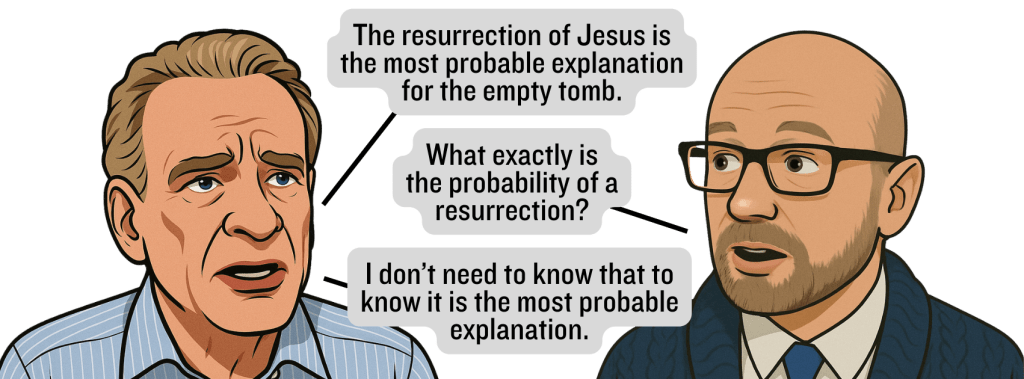
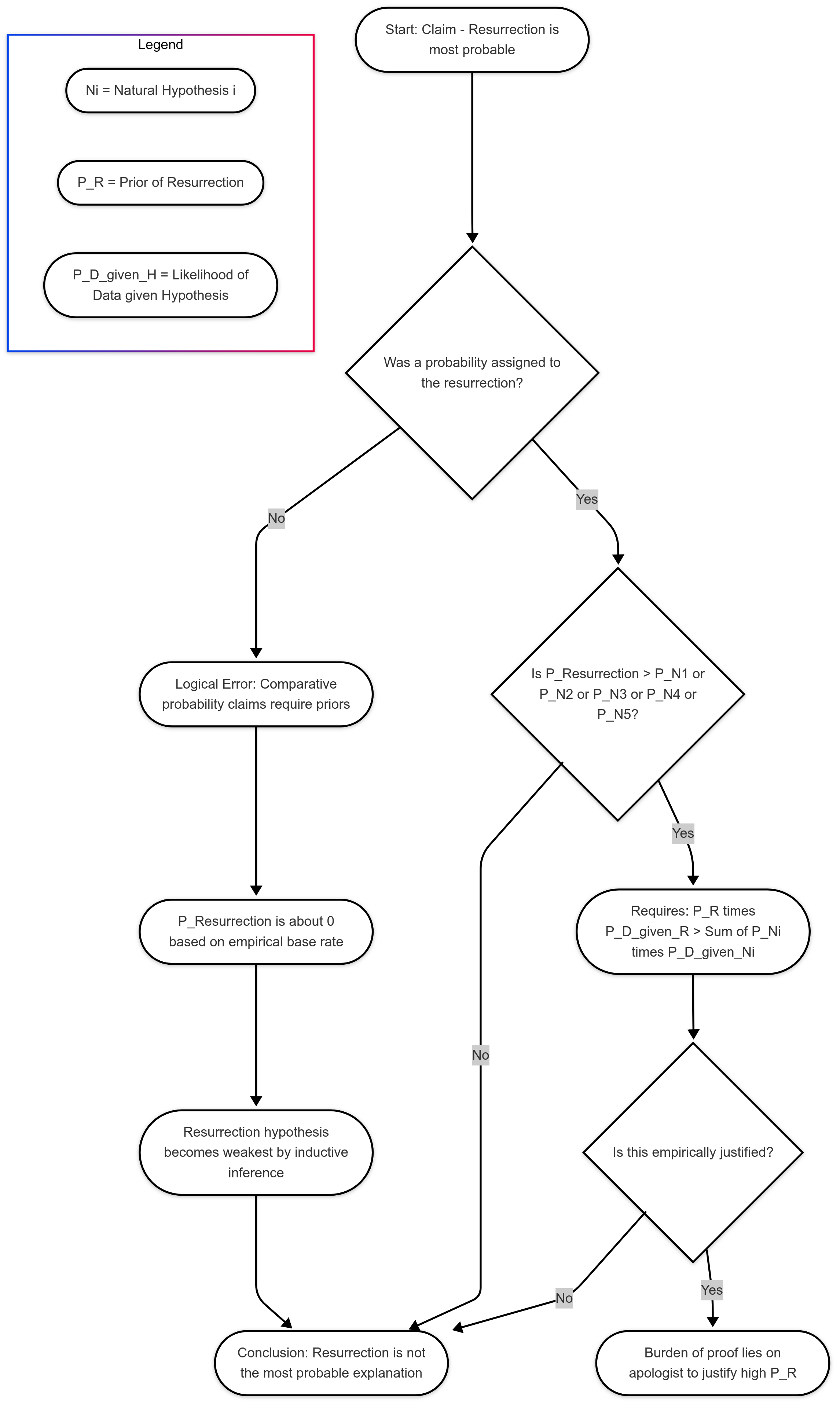
One of the most foundational requirements of rational discourse—especially when adjudicating between competing explanatory hypotheses—is the assignment of relative probabilities. Without this, no comparative claim can be meaningfully asserted. Yet in Christian apologetics, it is not uncommon to encounter the claim that “the resurrection is the most probable explanation” of the empty tomb or the post-crucifixion reports—without any numerical or inferential probability being assigned to the resurrection hypothesis itself. This omission is not merely an oversight; it is a categorical violation of rational inference and epistemic responsibility. This essay will detail the logical implications of this omission and demonstrate why such claims collapse under scrutiny.


Why Probabilistic Comparison Requires All Terms

In any evaluation of competing explanations, Bayesian reasoning provides the normative standard. Bayes’ Theorem is formally represented as:

P(H \mid D) = \frac{P(D \mid H) \cdot P(H)}{P(D)}

Where:

  • P(H \mid D] is the posterior probability of the hypothesis given the data
  • P(D \mid H) is the likelihood of observing the data assuming the hypothesis is true
  • P(H) is the prior probability of the hypothesis
  • P(D) is the total probability of observing the data under all hypotheses

In the case of the resurrection, defenders often highlight anecdotal or testimonial evidence (e.g., post-crucifixion appearances, conversions, eyewitness claims) and argue that these are best explained by Jesus rising from the dead. But unless one specifies P(\text{Resurrection})—the prior probability—the formula breaks down. The comparison to other hypotheses becomes meaningless.

One cannot validly say, “H is more probable than A, B, C, D, and E” unless P(H) and P(H \mid D) are provided and shown to exceed the respective values of P(A \mid D), P(B \mid D), etc.


The Resurrection’s Incoherent Probability Default

What is the value of P(\text{Resurrection})? Given all documented human history, where the base rate of biologically dead individuals returning to life is zero, this yields:

P(\text{Resurrection}) \approx \frac{0}{\text{Observed Human History}} = 0

This does not imply metaphysical impossibility, but it does establish an empirical prior probability that is functionally infinitesimal. The apologetic strategy, however, frequently evades this issue and instead pretends the prior is unspecified or irrelevant. This is epistemically incoherent. One must address the resurrection’s base rate if one is to include it in any comparative analysis.


Disjunction of Natural Hypotheses

Consider the five most common naturalistic theories:

  1. Stolen body by disciples
  2. Stolen body by robbers
  3. Wrong tomb
  4. Apparent death (swoon theory)
  5. Never buried (body discarded or destroyed)

Suppose each is given a minimal probability of 0.1%:

P_1 = 0.001 P_2 = 0.001 P_3 = 0.001 P_4 = 0.001 P_5 = 0.001

Then the disjunction (i.e., the chance that at least one is true) is:

P(\text{At least one naturalistic explanation}) = 1 - (1 - P_1)(1 - P_2)(1 - P_3)(1 - P_4)(1 - P_5)

= 1 - (0.999)^5 \approx 0.005

Even at highly conservative estimates, this value dwarfs the resurrection’s prior.


Formal Logic Summary

Let:

  • R = Resurrection hypothesis
  • N_i = Naturalistic hypotheses (for i = 1 to 5)
  • D = Data (e.g., empty tomb, post-crucifixion appearances)

Then the apologetic claim is:

P(R \mid D) > P(N_1 \mid D) \vee P(N_2 \mid D) \vee \dots \vee P(N_5 \mid D)

But without assigning a value to P(R), this statement is void. In fact, using Bayesian calculus:

P(R \mid D) = \frac{P(D \mid R) \cdot P(R)}{P(D)}

P(N_i \mid D) = \frac{P(D \mid N_i) \cdot P(N_i)}{P(D)}

So the comparison depends entirely on the ratio:

\frac{P(D \mid R) \cdot P(R)}{P(D \mid N_i) \cdot P(N_i)}

Without specifying P(R), the apologist is making an invalid comparative assertion.


Conclusion: Neglecting Resurrection Probability Invalidates the Claim

In summary:

  • The claim that “the resurrection is the most probable explanation” requires a quantified or at least reasoned P(\text{Resurrection}).
  • This requirement is consistently ignored or evaded in apologetic arguments.
  • Since the base rate of resurrections is effectively zero, any minimally probable natural theory will, in sum or individually, exceed the resurrection in probability.
  • Therefore, the failure to provide a resurrection probability is not a minor lapse—it is a logical disqualification from making any comparative claim of probability.

Until the resurrection hypothesis is given a coherent probability assignment, any argument that it is “most probable” must be dismissed as epistemically incoherent and logically invalid.

2 responses to “✓ The Missing Probability”

  1. Steve H Avatar
    Steve H

    Phil, my understanding of the Bayesian analysis of Jesus’ resurrection is based on the Odds Form of Bayes’ Theorem. That form incorporates both the Prior Probabilities (ie. background evidence; knowledge of natural vs supernatural causes) and the Likelihood Probabilities (ie. likelihood of the truth vs falsity of the claim/hypothesis/resurrection in light of having vs not having evidence of empty tomb, post-mortem appearances, origin of disciples’ beliefs).

    That is, the Likelihood Probabilities (LP) calculation can far outweigh the Prior Probabilities (PP) calculation given the existence of evidence which would not otherwise exist if the claim were false. More specifically, the denominator of the LP (probability of existence of evidence if claim is false) is extremely small compared to the LP numerator (probability of existence of evidence if claim is true), which results in a very large LP calculation, which in turn can outweigh the PP.

    Thus, extraordinary claims, if true, require a higher probability of *ordinary* evidence, which can support the resurrection hypothesis as the best explanation over natural hypotheses.

    Your thoughts?

  2. Phil Stilwell Avatar
    Phil Stilwell

    Steve, thanks for jumping in. You’re absolutely right to bring up the odds form of Bayes’ Theorem—it’s a valid and powerful tool. But the issue isn’t with the formula. It’s with the missing input. Specifically: apologists often never assign a resurrection probability at all. That’s not a small oversight—it’s a dealbreaker.

    1. Bayes Requires a Resurrection Prior—But It’s Always Missing

    You point out that likelihoods can outweigh priors. True—but only after the priors are defined. What is the actual prior probability of a resurrection? If that value isn’t explicitly stated and justified, then saying the resurrection is “the most probable explanation” is meaningless. The engine can’t run if a critical variable is left blank.

    2. Inflating the Likelihood Ratio Doesn’t Excuse a Missing Prior

    You highlight that the evidence (empty tomb, postmortem appearances, etc.) is far more likely under the resurrection hypothesis than under naturalistic ones. Even if we grant that—and it’s a big if—it still doesn’t salvage the argument unless the prior is specified. You can’t multiply a likelihood by an undefined prior and pretend it yields a reliable result.

    3. The Resurrection Is Often Given an Implied Default of 1% or More—Without Justification

    In practice, many apologists treat the resurrection hypothesis as though it starts with a reasonable prior—1%, 5%, sometimes more. But nothing in our background knowledge of the world justifies assigning such numbers. This is where the asymmetry becomes stark: naturalistic explanations, even when assigned extremely low priors (e.g. 0.1% each), are still actually assigned values and summed disjunctively. The resurrection hypothesis often gets a rhetorical pass.

    4. The Burden of Quantification Is on the Extraordinary Claim

    Bayesian reasoning isn’t magic. It can’t rescue a claim whose prior hasn’t been defended. Until apologists are willing to say what they think the prior probability of a resurrection is—and why—then all downstream comparisons are epistemically hollow. They’re trying to win a probability contest without submitting a number.

    Bottom Line: No Prior = No Probability Claim

    If someone claims “the resurrection is the most probable explanation,” they are making a comparative assertion. And no comparative claim is valid if one of the terms is left undefined. Until the resurrection’s prior is named, supported, and compared against the disjunction of natural alternatives, the argument doesn’t merely fall short—it never begins.

    I appreciate your attempt to incorporate Bayesian reasoning here. But your central claim—that the “likelihood can outweigh the prior”—only holds after a prior is actually specified. Right now, that key term is being left blank, and without it, any posterior probability is floating in the void.

    You’re essentially saying:

    “Even if the resurrection is unlikely to begin with, the specific evidence is so much more expected if the resurrection happened than if it didn’t, that this makes the resurrection probable overall.”

    That can work in Bayesian reasoning—but only when all the terms are assigned values.

    Let me ask directly:
    What do you assign as the prior probability of a resurrection?
    If you don’t provide that, there’s no way to judge whether the likelihood ratio “outweighs” it.

    More importantly, even if the evidence (e.g., empty tomb, postmortem experiences) is very unlikely under individual natural explanations, the combined disjunction of all natural alternatives—even at small individual probabilities—can still easily exceed the resurrection hypothesis, especially if no coherent prior is given for it.

    So yes, LP can shift things—but only if PP is present in the equation. Right now, resurrection arguments often assume the LP speaks for itself and quietly smuggle in a favorable prior without ever justifying it. That’s not Bayesian reasoning. That’s Bayesian aesthetics.

Leave a reply to Steve H Cancel reply

Recent posts

  • Alvin Plantinga’s “Warrant” isn’t an epistemic upgrade; it’s a design for inaccuracy. My formal proof demonstrates that maximizing the binary status of “knowledge” forces a cognitive system to be less accurate than one simply tracking evidence. We must eliminate “knowledge” as a rigorous concept, replacing it with credencing—the honest pursuit…

  • This article critiques the stark gap between the New Testament’s unequivocal promises of answered prayer and their empirical failure. It examines the theological “bait-and-switch” where bold pulpit guarantees of supernatural intervention are neutralized by “creative hermeneutics” in small groups, transforming literal promises into unfalsifiable, psychological coping mechanisms through evasive logic…

  • This article characterizes theology as a “floating fortress”—internally coherent but isolated from empirical reality. It details how specific theological claims regarding prayer, miracles, and scientific facts fail verification tests. The argument posits that theology survives only through evasion tactics like redefinition and metaphor, functioning as a self-contained simulation rather than…

  • This post applies parsimony (Occam’s Razor) to evaluate Christian Theism. It contrasts naturalism’s high “inductive density” with the precarious “stack of unverified assumptions” required for Christian belief, such as a disembodied mind and omni-attributes. It argues that ad hoc explanations for divine hiddenness further erode the probability of theistic claims,…

  • Modern apologists argue that religious belief is a rational map of evidence, likening it to scientific frameworks. However, a deeper analysis reveals a stark contrast. While science adapts to reality through empirical testing and falsifiability, theology insulates belief from contradictory evidence. The theological system absorbs anomalies instead of yielding to…

  • This post critiques the concept of “childlike faith” in religion, arguing that it promotes an uncritical acceptance of beliefs without evidence. It highlights that while children naturally trust authority figures, this lack of skepticism can lead to false beliefs. The author emphasizes the importance of cognitive maturity and predictive power…

  • This analysis examines the agonizing moral conflict presented by the explicit biblical command to slaughter Amalekite infants in 1 Samuel 15:3. Written from a skeptical, moral non-realist perspective, it rigorously deconstructs the various apologetic strategies employed to defend this divine directive as “good.” The post critiques common evasions, such as…

  • Modern Christian apologetics claims faith is based on evidence, but this is contradicted by practices within the faith. Children are encouraged to accept beliefs uncritically, while adults seeking evidence face discouragement. The community rewards conformity over inquiry, using moral obligations to stifle skepticism. Thus, the belief system prioritizes preservation over…

  • In the realm of Christian apologetics, few topics generate as much palpable discomfort as the Old Testament narratives depicting divinely ordered genocide. While many believers prefer to gloss over these passages, serious apologists feel compelled to defend them. They must reconcile a God described as “perfect love” with a deity…

  • This post examines various conditions Christians often attach to prayer promises, transforming them into unfalsifiable claims. It highlights how these ‘failsafe’ mechanisms protect the belief system from scrutiny, allowing believers to reinterpret prayer outcomes either as successes or failures based on internal states or hidden conditions. This results in a…

  • In public discourse, labels such as “atheist,” “agnostic,” and “Christian” often oversimplify complex beliefs, leading to misunderstandings. These tags are low-resolution summaries that hinder rational discussions. Genuine inquiry requires moving beyond labels to assess individual credences and evidence. Understanding belief as a gradient reflects the nuances of thought, promoting clarity…

  • The featured argument, often employed in Christian apologetics, asserts that the universe’s intelligibility implies a divine mind. However, a meticulous examination reveals logical flaws, such as equivocation on “intelligible,” unsubstantiated jumps from observations to conclusions about authorship, and the failure to consider alternative explanations. Ultimately, while the universe exhibits structure…

  • The piece discusses how historical figures like Jesus and Alexander the Great undergo “legendary inflation,” where narratives evolve into more than mere history, shaped by cultural needs and societal functions. As communities invest meaning in these figures, their stories absorb mythical elements and motifs over time. This phenomenon illustrates how…

  • This post argues against extreme views in debates about the historical Jesus, emphasizing the distinction between the theological narrative shaped by scriptural interpretation and the existence of a human core. It maintains that while the Gospels serve theological purposes, they do not negate the likelihood of a historical figure, supported…

  • Hebrews 11:1 is often misquoted as a clear definition of faith, but its Greek origins reveal ambiguity. Different interpretations exist, leading to confusion in Christian discourse. Faith is described both as assurance and as evidence, contributing to semantic sloppiness. Consequently, discussions about faith lack clarity and rigor, oscillating between certitude…

  • This post emphasizes the importance of using AI as a tool for Christian apologetics rather than a replacement for personal discernment. It addresses common concerns among Christians about AI, advocating for its responsible application in improving reasoning, clarity, and theological accuracy. The article outlines various use cases for AI, such…