
The Importance of Rational Belief and the Distortive Role of Emotion
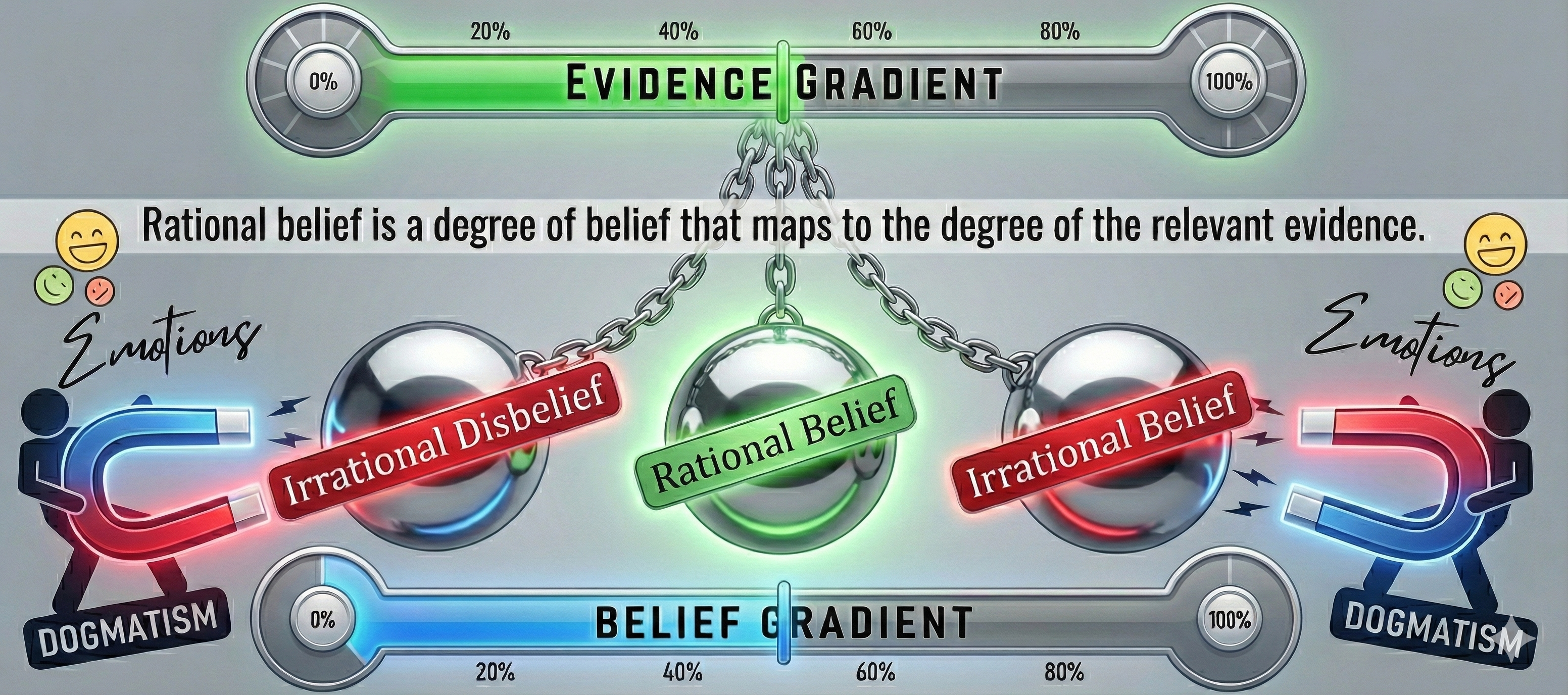
The image presented assumes there is an equal balance (50/50) of confirming and disconfirming evidence for a proposition. At its core, the image presents a critical lesson in epistemic responsibility: our degree of belief should proportionally map to the degree of the relevant evidence. This is not just a matter of intellectual elegance—it is a safeguard against error, confusion, and harm. When belief tracks evidence, we position ourselves to act wisely, anticipate reality more accurately, and engage with the world in ways that respect what is actually likely to be true.
However, this alignment between belief and evidence is constantly threatened by distortive forces—especially those rooted in powerful emotions. These emotions act much like magnetic fields pulling the weights of belief away from their proper position beneath the evidence gradient. Where the image shows chains linking belief to evidence, real-world emotions often tug on these chains, introducing tension and misalignment.
How Emotions Distort Rational Belief
There are many emotions that can pull belief toward dogmatism, overconfidence, or unwarranted skepticism:
- Fear can inflate disbelief beyond what the evidence warrants, as when people reject well-supported claims because they dread the consequences of accepting them.
- Hope can swell belief in propositions that have scant support simply because the outcome is desirable.
- Anger can fuel rejection of evidence that threatens one’s identity, group loyalty, or sense of control.
- Pride can lock us into dogmatism, making us resistant to updating our beliefs even when the evidence shifts.
- Despair can lead to a corrosive under-belief, where even solid evidence fails to inspire appropriate credence.
These emotional forces do not just color our perceptions—they actively warp the gradient of belief away from where rationality would place it. Instead of being calibrated instruments of inquiry, our beliefs can become tools for emotional self-soothing, tribal alignment, or avoidance of cognitive dissonance.
The Danger of Disalignment
When belief becomes untethered from evidence:
- We become vulnerable to dogmatism, clinging to views that no longer deserve our confidence.
- We risk acting on falsehoods, leading to personal and collective harm.
- We erode our capacity for self-correction, as the emotional distortions create blind spots where no amount of new evidence seems sufficient to prompt revision.
Rational belief, as depicted in the image, is not merely an intellectual ideal—it is an essential practice for anyone committed to living in accordance with reality. The chains linking belief to evidence symbolize the disciplined effort needed to keep our beliefs in line with what is actually supported, despite the emotional forces that seek to pull them away.
The Call to Intellectual Integrity
This framework challenges us to:
- Monitor our emotions, recognizing when they begin to exert undue influence on our beliefs.
- Value proportionality, resisting the temptation to let the strength of belief exceed or fall short of what the evidence justifies.
- Avoid dogmatism, remaining open to adjusting belief as new evidence emerges.
In sum, the image reminds us that rational belief is a delicate balancing act—one that requires vigilance against the distorting power of emotions and a commitment to letting evidence, not emotion, set the weight of our credence.
Phrases to Express Rational Belief Calibrated to Evidence
Here is a set of phrases that reflect an appropriate degree of belief at different points on the evidence gradient. These phrases help convey that the speaker’s credence maps proportionally to the strength of the relevant evidence. Each phrase is assessed for the degree to which it expresses epistemic belief (EB) or objective evidence (OE). The scale I use:
- Primarily EB = largely reflects the speaker’s credence or confidence
- Primarily OE = largely references the external evidence
- Mixed = both credence and evidence are expressed significantly
Close to 0% Evidence
- I highly doubt that. → Primarily EB
- That seems extremely unlikely. → Primarily EB
- I see almost no reason to believe that. → Mixed (leans EB, with reference to OE)
- I consider that virtually impossible. → Primarily EB
- There’s almost no credible support for that. → Primarily OE
- That’s as close to certainly false as I can judge for now. → Mixed (EB with a nod to OE)
Around 25% Evidence
- I’m inclined to doubt it. → Primarily EB
- That appears improbable, but I’m not ruling it out. → Mixed (EB + some OE)
- There’s little reason to believe that at this point. → Primarily OE
- It’s unlikely, though not entirely implausible. → Mixed (EB + OE)
- I lean toward disbelief given the current evidence. → Mixed (EB + OE)
- I have low confidence in that claim. → Primarily EB
Around 50% Evidence
- I don’t know. (Perfectly respectable given 50% evidence.) → Primarily EB
- The evidence is evenly balanced. → Primarily OE
- I consider that an open question. → Primarily EB
- There’s as much reason to believe as to disbelieve. → Primarily OE
- My credence is at 50%. → Primarily EB
- I regard that as equally likely and unlikely. → Primarily EB
Around 75% Evidence
- I find that probable. → Primarily EB
- I’m inclined to believe that. → Primarily EB
- There’s good reason to think that’s true. → Primarily OE
- The evidence points in that direction. → Primarily OE
- I hold a fairly strong belief in that. → Primarily EB
- That seems likely based on what I know. → Mixed (EB + OE)
Close to 100% Evidence
- I’m highly confident that’s true. → Primarily EB
- That seems virtually certain. → Primarily EB
- The evidence overwhelmingly supports that. → Primarily OE
- I would be very surprised if that turned out false. → Primarily EB
- I see every reason to believe that. → Primarily OE
- That’s as close to certain as the evidence allows. → Mixed (OE + EB)
Summary
- Primarily EB phrases reflect subjective credence (e.g., I highly doubt that, I find that probable).
- Primarily OE phrases emphasize external, objective conditions (e.g., There’s almost no credible support for that, The evidence overwhelmingly supports that).
- Mixed phrases combine credence and explicit reference to evidence (e.g., I lean toward disbelief given the current evidence, That’s as close to certain as the evidence allows).
Note that there is no binary switch that takes you from disbelief to belief or vice-versa. Stating “I believe X” is only a low-resolution description of your epistemic disposition toward X. Rational belief remains tightly aligned with the degree of the balance of confirming/disconfirming evidence, and adjusts as the balance of evidence changes.
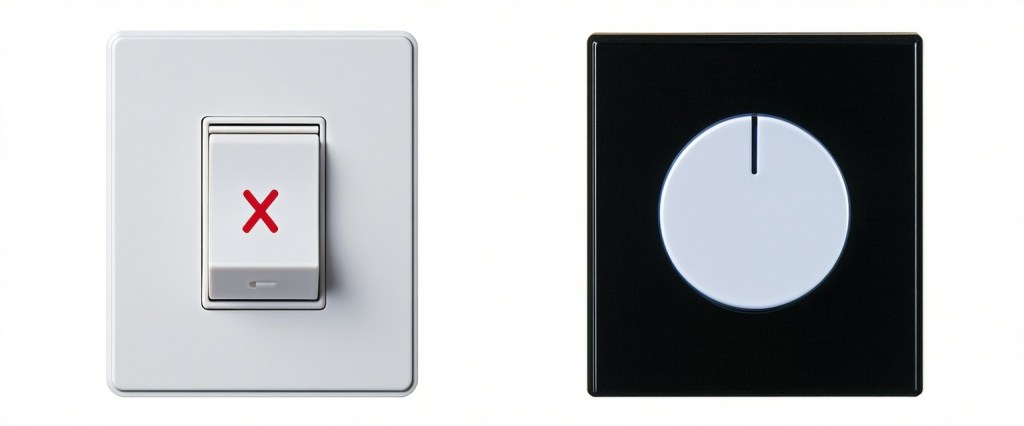
✓ The rational mind understands belief to be more of an adjustable dimmer switch than a binary flip switch.


Leave a Reply