

In the digital arenas of social media, where faith and skepticism collide with unfiltered immediacy, theological doctrines are often subjected to their most rigorous public tests. This analysis stems from one such encounter: a spirited and extensive discussion within a Christian Apologetics Facebook group. The debate was ignited by a single, provocative question that cuts to the core of Christian soteriology: “Can three days of death really pay for an eternity of damnation?” The ensuing thread became a case study in modern apologetics, revealing the common strategies, arguments, and, ultimately, the logical frailties of the defenses for Penal Substitutionary Atonement (PSA). The arguments presented by believers in this public forum were not esoteric academic points but heartfelt, widely-used defenses. It is by examining these real-world responses that we can most clearly see the recurring patterns of flawed reasoning that underpin the doctrine.
The Architecture of Incoherence: Deconstructing the Failed Defenses of Penal Substitutionary Atonement
The doctrine of Penal Substitutionary Atonement (PSA) stands as a central, load-bearing pillar of many Christian traditions, asserting a claim of cosmic significance: that the three-day death of a single man, Jesus Christ, satisfied the eternal punishment deserved by all of humanity. This is a proposition of immense gravity, one that purports to solve the ultimate problem of divine justice and human sin. Yet, when this foundational beam is subjected to the stress test of logical scrutiny, it does not merely bend; it fractures. As demonstrated in the provided source articles and a spirited online debate, the defenses mounted in its favor consistently rely on a handful of recurring logical blunders. These are not minor cracks in the doctrinal edifice, to be patched over with theological spackle; they are foundational flaws in the blueprint itself, rendering the entire structure incoherent. By dissecting these five primary categories of error—the category error of worth versus duration, the appeal to divine fiat, the retreat to mystery, the resurrection contradiction, and the use of flawed analogies—we can expose the architecture of a theology that fails its own claims to justice and reason, a system at war with its own premises.
1. The Category Error: The Illicit Alchemy of Worth into Duration

The most persistent and fundamental error in the defense of PSA is the attempt to transmute a qualitative attribute (“infinite worth”) into a quantitative payment of time (“eternal punishment”). This is a form of metaphysical alchemy, where the base metal of status is supposed to magically become the gold of temporal endurance. Interlocutors like Andrew Bartlett and Leif Egil Rønaasen Reve repeatedly argue that because Jesus is divine, his suffering possesses an “infinite value” that makes any duration, however brief, sufficient. This is a profound category error. As the source article cogently states, “Worth is not a temporal dimension.” Justice, particularly within the penal framework that PSA itself proposes, operates on principles of proportionality and equivalence. A sentence is measured in duration and severity, not in the social or metaphysical status of the person serving it.
To claim that Jesus’s “infinite worth” covers an eternal penalty is akin to arguing that a world-renowned physicist, convicted of a capital crime, can satisfy a life sentence by spending a single afternoon in jail. The argument would be that the “quality” of his intellect and his “value” to humanity are so profound that his brief inconvenience is equivalent to a lifetime of imprisonment for an ordinary person. No rational system of justice on earth would accept this logic, as it rightly separates the identity of the offender from the requirements of the sentence. It confuses who the person is with what the person endures. The penalty for sin, as defined by the doctrine itself, is eternal separation—a punishment quantified by its endlessness. A three-day death, followed by a triumphant resurrection, is a finite, temporary event. No amount of “worth” can magically stretch three days into eternity without a coherent conversion mechanism, a sort of metaphysical exchange rate, which defenders of PSA have never supplied. This move makes the duration of suffering entirely arbitrary, a point both Andrew Bartlett and Leif Egil Rønaasen Reve concede when they admit that “three seconds would have been enough.” This admission is fatal to any claim of proportional justice. If the duration is immaterial, then the suffering itself is no longer a substitutionary payment but a symbolic token, and the system is not one of equivalence but of performative ritual.
2. The Appeal to Divine Fiat: Justice as Authoritarian Whim
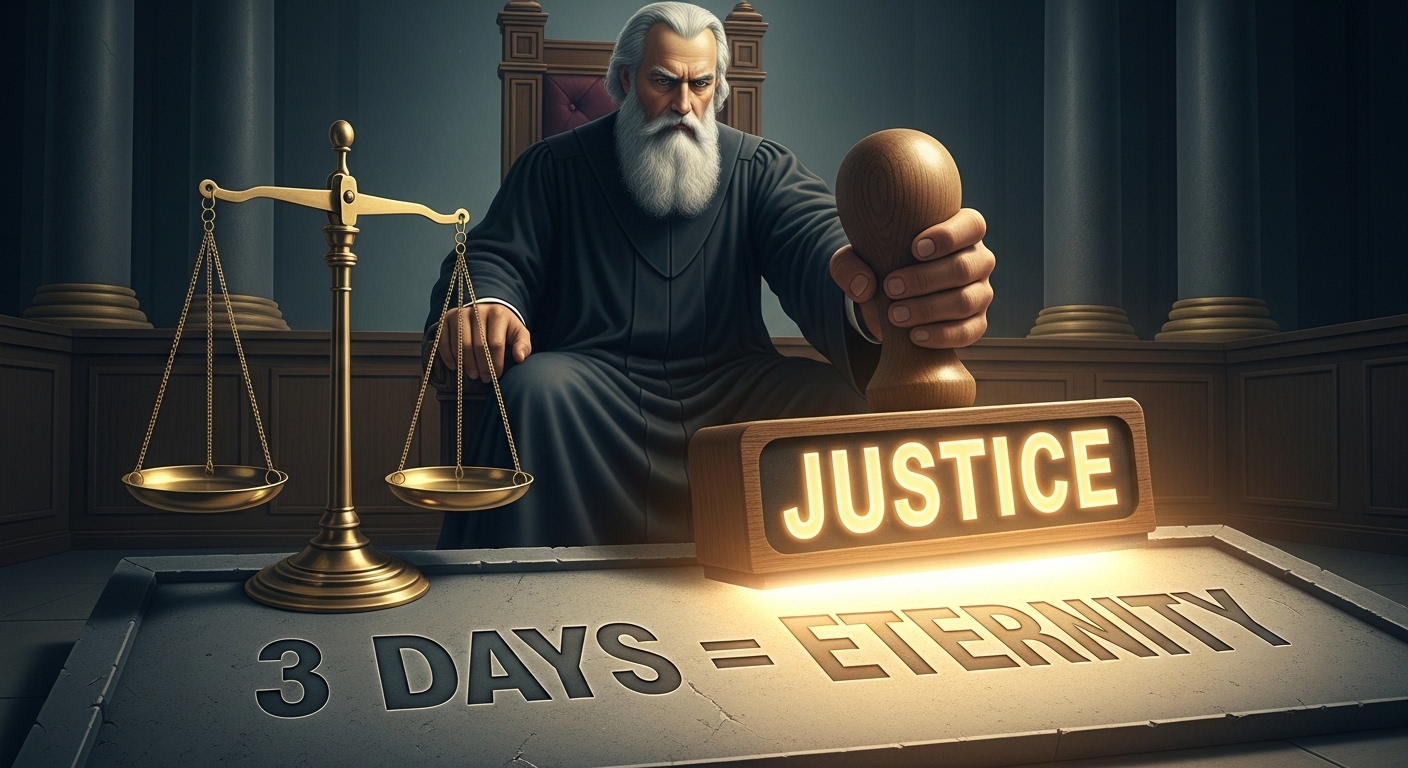
When the illogic of equating worth with duration is exposed, defenders invariably retreat to their final bastion: divine sovereignty. Arguments from Andrew Sills, Benjamin Roald Andersen, and Wayne Clarke pivot to the claim that justice is whatever God declares it to be. “God was satisfied with His sacrifice and that is what matters,” argues Nick Mudge. This defense, however, is not a justification of justice but an abandonment of it. It reduces justice from a principle of rational coherence and proportionality to a mere label applied to the exercise of raw, unaccountable power.
This line of reasoning falls squarely into the Euthyphro dilemma, a philosophical problem that has challenged theologians for millennia: Is an act just because God commands it, or does God command it because it is just? If defenders of PSA choose the former, then justice has no independent meaning; it is simply a synonym for “God’s will.” By this logic, God could decree torture for kindness and it would be definitionally “just.” The term becomes a tautology, devoid of the moral and logical content we associate with fairness and proportionality. The articles correctly identify this as a “circular moral economy” where the “judge validates his own ruling.” A dictator can declare that loyalty is the only virtue and dissent is the only crime, and within his closed system, that is “justice.” But to the outside world, it is recognized as tyranny.
When a defender claims, “All the math and logic in the world cannot rule over the power of God’s sovereignty,” they are not making a theological point but an anti-rational one. They are asserting that their system is exempt from the very principles of coherence that make any claim intelligible. If a doctrine can only be defended by declaring its core tenets immune to logical analysis, it has effectively conceded its own irrationality. It may be a statement of power, but it can no longer be defended as a statement of justice. It is an argument from authority that reveals the absence of any other, more substantive argument.
3. The Retreat to Mystery and Fideism: The Abdication of Reason

Closely related to the appeal to divine fiat is the retreat to mystery. When logical inconsistencies become undeniable and the appeal to authority feels hollow, defenders often pivot to fideism, claiming that the mechanics of atonement are beyond human comprehension and must be accepted on faith. David J. Wireback Jr. makes this move explicitly, stating, “the natural mind cannot comprehend things of God.” Nick Mudge echoes this by quoting scripture about the “foolishness of the cross” to dismiss rational inquiry as “arrogance.”
This tactic is an intellectual abdication. It uses faith not as a foundation for reason, but as a shield against it. It functions as a cognitive stop sign, preventing further inquiry precisely at the point where the doctrine’s claims become most questionable. As the source articles argue, if a doctrine is “immune to logic, then it is also immune to correction. And anything immune to correction is indistinguishable from error fiercely defended.” Invoking mystery is an admission of explanatory failure. It concedes that the model does not hold together under its own terms and that no coherent explanation is available. It is less a defense of the doctrine and more a defense mechanism for the believer, protecting a cherished belief from the discomfort of cognitive dissonance.
Furthermore, this defense is a double-edged sword because it is entirely generic. Every religion and every unfalsifiable belief system uses the exact same argument. A Muslim can claim the Quran’s truth is a divine mystery inaccessible to the unfaithful; a Mormon can assert the same for the Book of Mormon; a conspiracy theorist can claim that the “truth” is hidden from the “sheeple” who rely on “mainstream logic.” By resorting to this defense, the Christian apologist is not offering a unique truth but is employing the standard-issue escape hatch for all claims that cannot withstand rational scrutiny. If a theology requires you to suspend your reason to accept its central claims about justice, it has failed to be rationally compelling.
4. The Resurrection Contradiction: The Annulment of the Penalty
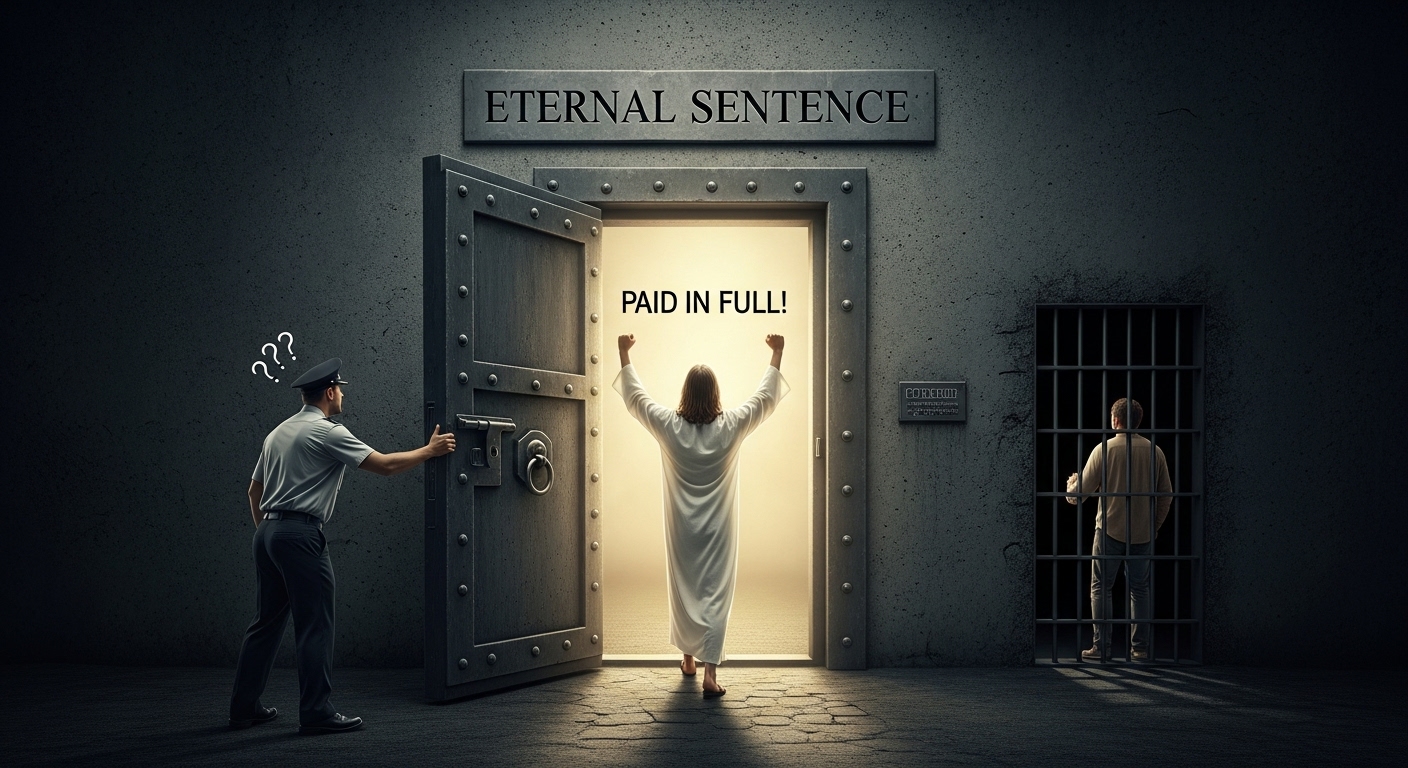
Perhaps the most glaring and consistently ignored blunder in the defense of PSA is the contradiction posed by Jesus’s resurrection. The doctrine asserts that the penalty for sin is eternal death or separation from God. This is not a trivial detail; the infinite nature of the punishment is what supposedly necessitates such a dramatic, divine intervention. However, the cornerstone of the Christian faith—the very event that gives the religion its hope—is that Jesus did not remain dead; he was resurrected after three days and restored to a state of glory.
As the articles and the thread’s protagonist, Phil Stilwell, repeatedly point out, this logically means the penalty was not fully served. If a substitute is meant to endure a life sentence but walks free after a weekend, no one would claim that justice was satisfied. The resurrection transforms the event from an eternal punishment into a temporary, reversible ordeal. More than just the duration, the very nature of the suffering is called into question. If Jesus, as a divine being, knew with certainty that his death was temporary and that he would be resurrected to glory, did he truly experience the existential horror and finality of eternal separation? His experience would be fundamentally different from that of a damned soul who faces an endless future without hope. This makes the substitution not only incomplete in duration but also inequivalent in nature.
Defenders in the thread celebrate the resurrection as a sign of Christ’s victory and divinity, but they fail to grapple with the fact that this victory simultaneously invalidates the claim of a completed substitution. Not a single interlocutor in the provided thread offers a coherent resolution to this problem. They mention the death and resurrection in the same breath, as Scott Kurowicki does, without acknowledging the mutual exclusivity of “serving an eternal sentence” and “being resurrected.” This is not a minor detail; it is a fatal flaw in the logic of substitution. If the penalty is eternal, the substitute must endure that penalty eternally. If he does not, he has not paid the price in full, and the entire judicial framework of PSA collapses under the weight of its most cherished belief.
5. The Blunder of Flawed Analogies: The Deception of False Equivalence

Finally, when attempting to make the logic of PSA more palatable, its defenders often employ analogies that, upon closer inspection, are fundamentally flawed and misleading. These analogies are designed to make the disproportionate transaction seem intuitive, but they do so by misrepresenting the nature of the debt and the currency of justice, thereby committing a bait-and-switch fallacy.
The most common example, used by Andrew Bartlett, is the “millionaire” who pays off a monetary debt. This analogy fails because the penalty for sin is framed as a temporal sentence (eternal punishment), not a financial liability. The currencies are different. While a wealthy benefactor can settle a monetary debt with their resources, they cannot serve a prison sentence with their status. Justice in a penal system requires the serving of time, not the transfer of assets. The analogy deliberately conflates economic exchange with judicial punishment to obscure the central problem of temporal equivalence. It asks us to accept a transaction in one system (economics) as proof of a valid transaction in a completely different system (jurisprudence).
Similarly, Tim Sells’s “apple-pear” analogy, based on subjective preference, is wholly irrelevant to a discussion of objective justice. Justice is not a matter of what one “values” more; it is about meeting a required, proportional standard that is supposed to be impartial and universal. Introducing subjective valuation corrupts the very concept of objective justice, turning it into a matter of personal taste. These analogies are not tools of clarification but instruments of obfuscation. They create a superficial sense of coherence by substituting the actual, difficult problem (how a finite time serves an infinite sentence) with a different, more easily solved problem (how money pays a debt or how a trade can be subjectively pleasing). They are rhetorical tricks, not logical arguments.
Conclusion: A Doctrine at War with Itself
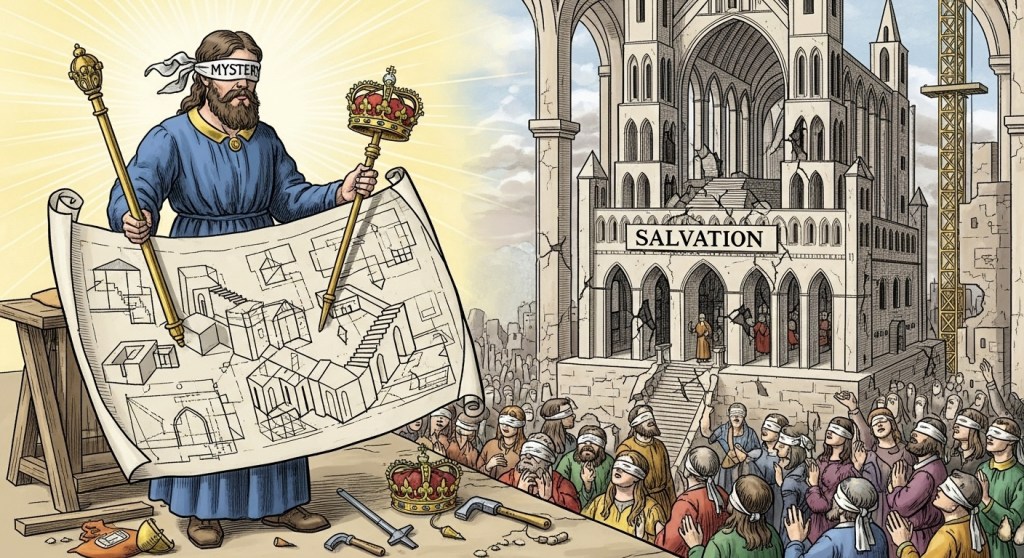
The defenses of Penal Substitutionary Atonement, as showcased in the provided materials, are not robust arguments but a series of evasions, category errors, and appeals to authority that ultimately fail to rescue the doctrine from its own internal contradictions. Each failed defense exposes a deeper weakness, revealing a system that must continually redefine its terms and abandon logical consistency to survive scrutiny. By attempting to equate worth with time, by redefining justice as divine whim, by retreating into the fog of mystery, by ignoring the logical annulment of the resurrection, and by deploying deceptive analogies, the defenders reveal a theology at war with the very principles of reason and justice it claims to uphold. A truly just system would not require such intellectual contortions to be defended. It would be clear, coherent, and proportional. The fact that PSA is none of these things is its most damning indictment, revealing an architecture of incoherence built not on the solid ground of reason, but on the shifting sands of assertion and dogma.


Leave a Reply