Before we dive in, let me pause to commend you for taking this step. Few people are willing to set aside assumptions and look at their deepest beliefs through the lens of careful reasoning. By doing so, you’re showing a rare kind of seriousness and epistemic honesty—the willingness to ask, What should I believe once I fairly weigh the evidence? That question lies at the heart of rational inquiry, and Bayes’ Theorem is one of the best tools we have for answering it.

This post is meant as a gentle first look at how Bayes’ Theorem can help us think about big claims, especially the claim that Jesus rose from the dead. I’m not going into the deepest details here—that will come later. For now, I just want to show how the basic parts of the formula work and why they matter.

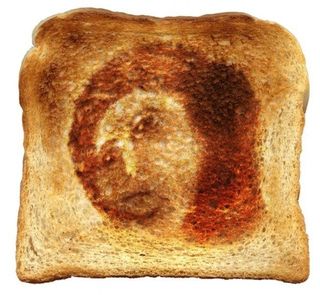
To make things clearer, I’ll also compare the resurrection claim with a lighter example you may have seen in the news: someone finding an image of Jesus on a piece of toast. By setting these two side by side, it becomes easier to see the basic steps of Bayesian reasoning—starting from a prior (how likely something is before the evidence), then asking how strongly the evidence fits if the claim is true versus if it’s false, and finally updating our belief.

Think of this as a warm-up exercise. Later, I’ll use the same Bayesian approach in a much more detailed way to explore what level of confidence we can reasonably have in the resurrection itself. This post is just to help you get comfortable with the structure before we dive deeper.


Here are explanations of the symbols, terms, and related concepts:

Symbols:

  • P: Stands for probability. It is just a way of expressing how strongly you believe something is true, using a number between 0 (impossible) and 1 (certain).
  • H: Stands for hypothesis. This is the claim you are testing. In our examples, H might be “Jesus was resurrected” or “The image on toast was a divine miracle.”
  • E: Stands for evidence. This is the data or observations we actually have in hand—such as reports of appearances in the resurrection case, or the physical piece of toast in the pareidolia case.

Terms:

  • P(H) (Your “prior”, or initial assignment of Probability to the Hypothesis before the analysis): Your starting guess before new evidence comes in. If something almost never happens (like someone rising from the dead), then the prior is tiny. This isn’t prejudice; it’s simply respecting what we already know from experience. Priors are like the “gravity” of reality—they stop us from being tricked into believing rare things too quickly.
  • P(E \mid H) (The Probability of the Evidence if the Hypothesis is true): Ask: If the miracle really did happen, would we expect to see this kind of evidence? This term rewards hypotheses that would naturally produce what we see. It’s where you cash in genuine, discriminating predictions.
  • P(E \mid \neg H) (The Probability of the same Evidence if the Hyposthesis is false (\neg)): Now ask: If the miracle did not happen, could the same evidence still appear naturally? This is the competition. It must include all reasonable rivals—legend, error, fraud, coincidence, etc.—each weighted by how often it occurs. Ignoring this term (or understating it) is how people self-delude.

Related concepts:

  • Denominator: This bottom part of the fraction, P(H)\cdot P(E \mid H) + P(\neg H)\cdot P(E \mid \neg H), is what keeps the process fair. It represents the total probability of the evidence across all possible explanations. Without it, the miracle side could look convincing simply because P(E \mid H) is high, even if the same evidence is just as likely under ordinary causes. By forcing us to divide the “probability pie” among every explanation that can account for the evidence, the denominator prevents any hypothesis from claiming the evidence by default.
  • Posterior P(H \mid E): Your updated belief after running the numbers. Low P(H) needs enormous, clean, discriminating evidence to recover and be legitimately considered probable.
  • Unknowns (Reserve): We always leave some probability mass — usually 5–15% — for causes we haven’t thought of or modeled. This “reserve” acknowledges that our list of alternatives is never complete. Without it, we’d risk overconfidence in our pet explanations. It’s like keeping a drawer labeled “something else we didn’t think of” to ensure humility in the analysis. Taking this concept into account might have prevented the premature invoking of the local God as the cause of lightning before the discovery of electrons.

Combining the terms:

When you hear an extraordinary claim—like a resurrection—the first step is to respect the background facts we already know about the world. That’s the role of the prior, P(H). Priors are not about prejudice; they’re about base rates. Since people who die stay dead in every reliable record of human experience, the prior for a resurrection is already tiny. This “gravity” of the prior prevents us from being tricked by single dramatic stories that go against the grain of everything else we observe.

Next comes P(E \mid H), the likelihood of the evidence if the claim really were true. If a resurrection actually happened, we would expect people to report appearances, to tell stories, and to form a movement around it. This term rewards the miracle hypothesis for fitting the evidence—it’s the place where the claim cashes in its genuine predictive power.

But stopping there would be misleading, because the same evidence might arise in other ways. That’s where P(E \mid \neg H) comes in. This asks: if no resurrection occurred, how likely is it that the same reports would exist anyway? When you include alternatives like legend growth, memory drift, visions, fraud, or political motives, you realize the evidence isn’t unique to the miracle. Humans generate such stories naturally, across cultures and centuries. If you ignore this competitor term, you end up fooling yourself into thinking the miracle is the only explanation when it isn’t.

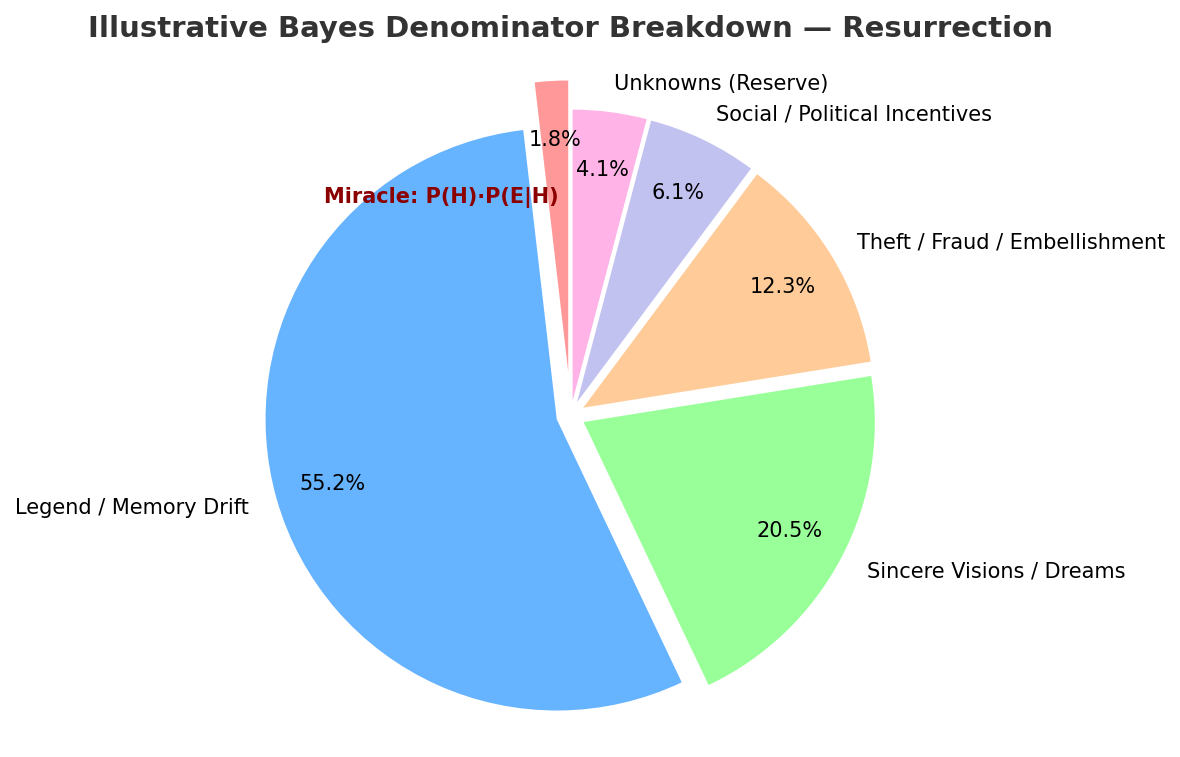
The denominator, P(H) \cdot P(E \mid H) + P(\neg H) \cdot P(E \mid \neg H), is the “fairness check.” It forces you to share the evidence among all possible explanations. Imagine a pie chart: the numerator is the slice of the pie where the miracle both happens and produces the evidence. The denominator is the whole pie—all the ways the evidence could appear. The posterior P(H \mid E) is then the fraction of that pie the miracle really owns. This way, no hypothesis gets a free lunch: it can only claim the evidence to the extent that it explains it better than its rivals. (Explore the two pie charts below for how the denominator’s slices add up for each scenario.)

Finally, the posterior P(H \mid E) is your updated belief after taking both priors and evidence into account. If the prior is tiny, then only enormously strong and discriminating evidence can lift the posterior to a respectable level. And if the natural explanations make the evidence fairly likely as well, the miracle never climbs very far. That’s why Bayes’ Theorem is so powerful: it keeps your credence honest, balancing what you knew beforehand with how surprising—or not—the evidence really is.


Step A — Prior P(H): The Probability that “This toast image of Jesus is a miracle.”

  • Theism prior: First ask if a god exists.
  • Targeting/specificity cost: Would a god really choose a random burn pattern on bread as a communication method? This is an extremely unlikely form of “targeting,” so P(\text{target toast} \mid \text{theism}) is very small.
  • Natural base rate: Burn patterns and accidental face-like shapes (pareidolia) happen constantly. That makes the non-miracle prior P(\neg H) huge.

Step B — Likelihood if true P(E \mid H):
If God actually created the image, of course the toast would show a face. P(E \mid H) \approx 1.


Step C — Likelihood if false P(E \mid \neg H):

  • Pareidolia/physics: Random burns naturally create face-like images.
  • Selection bias: Out of millions of toasts, only the ones with faces get attention.
  • Hoaxes: Some people intentionally burn patterns and call them miraculous.

Together these give P(E \mid \neg H) a very high value—close to the same as P(E \mid H). The Bayes factor \frac{P(E \mid H)}{P(E \mid \neg H)} therefore ends up near 1, meaning the evidence gives the miracle no real advantage over ordinary explanations.

The following is an example distribution of possible Alts.
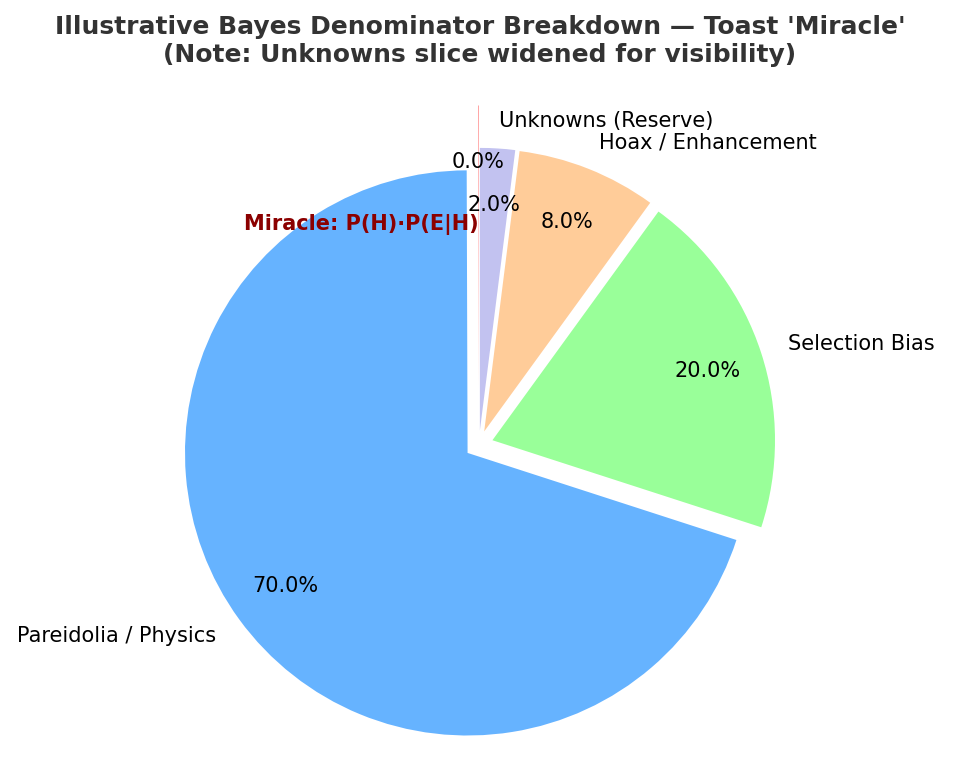
The label for the probability of an actual miracle (thin red vertical line) registers as 0.0%, but is actually 0.05%.

Step D — Posterior P(H \mid E): why it collapses

  • Prior P(H) is astronomically small (God choosing toast as a medium is wildly implausible).
  • The evidence doesn’t discriminate: both miracle and non-miracle predict a face on toast almost equally well.
  • So the posterior P(H \mid E) is basically the same as the prior—effectively zero.

TermMeaning (plain English)Toy value
P(H)Starting plausibility that the toast image is a miracle (prior)0.0004
P(E \mid H)If it were a miracle, how likely is a face on toast to appear and be noticed?0.99
P(E \mid \neg H)If it’s not a miracle, how likely is a “face” anyway (pareidolia, selection, hoax)?0.90

P(H\mid E)=\frac{P(H)\cdot P(E\mid H)}{P(H)\cdot P(E\mid H)+(1-P(H))\cdot P(E\mid \neg H)}
=\frac{0.0004\cdot 0.99}{0.0004\cdot 0.99+(1-0.0004)\cdot 0.90}=\frac{0.000396}{0.900036}\approx 0.000440\text{ or about }0.044\%

Odds: 1 in 2,272 chance (based on these toy numbers)


The Jesus-on-Toast Narrative Walk-Through

When someone claims that an image of Jesus on a piece of toast is a miracle, Bayes’ Theorem gives us a way to carefully weigh that claim. The theorem says our final belief, the posterior P(H \mid E), depends on two things: how plausible the miracle was before the evidence appeared (the prior P(H)) and how strongly the evidence favors the miracle compared to its alternatives (the likelihood ratio \frac{P(E \mid H)}{P(E \mid \neg H)}).

The starting point is the prior, P(H). This represents our initial sense of how likely the miracle is, before considering the toast itself. We begin by asking whether any god exists at all—P(\text{theism}). If that number is low, then the miracle inherits that weakness. But even if you start with a high theism prior, the miracle claim still has to pay what we might call a “specificity cost.” This is the question: if a god exists, how likely is it that the god would choose to reveal itself in exactly this way—by burning a face into a random piece of bread? Compared with all the clearer, more universal ways a god could communicate, this particular channel seems extremely unlikely. That means P(\text{target toast} \mid \text{theism}) is very small, and so the combined prior for the miracle is already minuscule.

Next comes the likelihood if the miracle were true, P(E \mid H). If God actually caused the face to appear, then of course we’d expect to see a face on the toast, and we might expect someone to take a photo and share it. That makes P(E \mid H) very high—almost 1.

But the fairness of Bayes’ Theorem is that we must also ask about the likelihood if the miracle is false, P(E \mid \neg H). Here the natural explanation is extremely strong. Burn patterns on bread often resemble faces because of how heat spreads across uneven surfaces. On top of that, humans are wired for pareidolia, the tendency to see faces in clouds, stains, and shadows. Add in selection bias—millions of pieces of toast are made every day, and only the unusual ones get noticed—and even without any divine action, the chance of someone spotting a “Jesus face” in toast is already very high. Hoaxes only increase this probability. As a result, P(E \mid \neg H) is not small; it’s close to P(E \mid H).

Now we put it all together with the denominator: P(H) \cdot P(E \mid H) + P(\neg H) \cdot P(E \mid \neg H). This denominator is the total probability of the evidence, whether a miracle happened or not. It ensures fairness: every explanation that could produce the evidence gets counted. The numerator—the miracle slice, P(H) \cdot P(E \mid H)—is already tiny because the prior is so small. And since both miracle and non-miracle explanations make the evidence highly likely, the denominator is dominated by the natural side. That leaves the posterior, P(H \mid E), essentially unchanged from the tiny starting prior.

In plain language, this means that seeing a face on toast doesn’t actually make “God put it there” any more believable than it was before. Ordinary processes like random burns and our tendency to see patterns already predict the event very well. The Bayes formula protects us from giving the miracle explanation a free ride, reminding us that evidence must be weighed against all the ways it might come about.


The toast case shows how Bayes handles everyday coincidences. With that warm-up behind us, we can now turn to the much weightier Christian claim of a resurrection and run the same step-by-step test.

Step A — Prior P(H): The Probabiility that “Jesus was resurrected.”
What feeds this number?

  • Natural base rate: In biology, once dead, bodies stay dead. No exceptions in recorded science. That drives a baseline near zero.
  • Theism prior: If you allow for the possibility that a god exists, you can raise the prior somewhat. But even then, it’s only as high as the evidence for “a god” justifies.
  • Targeting/specificity cost: Even if a god exists, would it choose this intervention—raising this particular man in this place and time for this message? The space of possible divine acts is vast. Each extra specification multiplies a cost.

Formally:

P(H) = P(\text{theism}) \times P(\text{target Jesus} \mid \text{theism}) \times P(\text{resurrection} \mid \text{target})

That product is where miracle priors usually shrink to “tiny.”


Step B — Likelihood if true P(E \mid H): what would we expect to see if a resurrection really occurred?

  • Fit to evidence: Reports of appearances, conversions, a movement preaching the event, written traditions—these are reasonably expected if a dramatic public miracle happened.
  • Not 1.0: Even if H is true, messy history happens—documents can be lost, memories vary, politics intrude. So P(E \mid H) can be high, but not perfect.

Step C — Likelihood if false P(E \mid \neg H): could we still get the same evidence without a resurrection?
This is where most analyses go wrong by underestimating the denominator. A proper build is a weighted mixture:

P(E \mid \neg H) = \sum_j w_j \cdot P(E \mid \text{Alt}_j), \quad \sum_j w_j = 1

Where each “Alt” is a natural explanation:

  • NOTE: When we ask how likely the evidence is if no miracle occurred, Bayes’ Theorem tells us not to treat “no miracle” as a single blank category, but as a mixture of many different alternatives. The formula P(E \mid \neg H) = \sum_j w_j \cdot P(E \mid \text{Alt}_j) simply says: take each plausible alternative, give it a share of probability that reflects how likely it is, ask how well that alternative would explain the evidence, and then add all those contributions together. The weights w_j are like slices of a pie, with all the slices adding up to 100%—which is why the condition \sum_j w_j = 1 is there. For the resurrection, one slice might go to legend growth, another to memory drift, another to sincere visions, another to fraud, and still another to unknown causes we haven’t listed. Each slice makes the evidence at least somewhat expected: legends do tend to expand over decades, visions and dreams do occur across cultures, and groups with social or political incentives do spread compelling stories. When you add them together, the overall likelihood P(E \mid \neg H) is not small—it’s substantial. This means the non-miracle side gets a fair share of the explanatory pie, and the miracle doesn’t get to claim the evidence as its own by default.

Alts:

Whole-cloth fabrication of the account: It’s possible the story of Jesus buried in a tomb, later found empty, was simply invented. Since the written records surprisingly appear at least a decade after the supposed events, there was ample time for and legitimate suspicion of a complete fabrication to be introduced and accepted, especially in a world without modern fact-checking.

Legend/memory drift: Stories passed around by word of mouth almost always change. Small exaggerations accumulate, details are added or dropped, and before long the story looks very different from how it began. Over decades, a tale about a respected teacher could easily grow into one about a miracle-working figure who defeated death.

Sincere visions/dreams: People across cultures have vivid experiences—dreams, trances, or visions—that feel real and persuasive to them. Such experiences can convince people they “saw” a dead loved one alive again, even if nothing physically happened. This can create genuine but mistaken testimony without anyone deliberately lying.

Fraud or embellishment: While not necessary to explain the accounts, fraud or deliberate exaggeration is always a possibility. A stolen body, a fabricated claim, or the conscious decision to “improve” a story for dramatic or theological effect could all contribute to the evidence we have today.

Social/political incentives: Stories that help unify a community, strengthen group loyalty, or support leaders tend to spread and endure. A tale of resurrection would be extremely “sticky” because it provides hope, authority, and a unique selling point for a new religious movement.

A combination of the aforementioned “Alts”: These explanations are not mutually exclusive. In reality, it’s likely that more than one process was at work—legend growth, visions, and political incentives could all blend together to produce the traditions we now read.

The aggregate probability of long-tail improbabilities: Sometimes rare or unusual things do happen without any divine action—like a mistaken identification, a coincidental event, or a highly unlikely misunderstanding. Each one may be improbable on its own, but across all of history’s possibilities, these “long-tail” events collectively add up to a significant share of explanations.

Unknowns (reserve): No list of alternatives can ever be complete. To avoid bias, we must leave 5–15% of the probability weight for mechanisms we haven’t thought of or don’t yet understand. This “reserve” prevents us from overfitting our analysis to just the explanations we personally find familiar.

When you add these alternatives together, P(E \mid \neg H) remains high, which keeps the denominator large and prevents the miracle hypothesis from illegitimately gaining much ground.

The key point is that each of these alternatives makes the evidence at least somewhat likely, which means the evidence cannot be claimed exclusively by the resurrection hypothesis. Most of these mechanisms can easily yield “reports of appearances,” conversions, or written accounts. That keeps P(E \mid \neg H) substantial, which weakens the Bayes factor \frac{P(E \mid H)}{P(E \mid \neg H)}.

The following is an example distribution of possible Alts.
Dependence penalty (crucial nuance):
If testimonies share sources, editorial lines, or social contagion, they are not independent draws. Treating them as independent artificially inflates P(E \mid H) and deflates P(E \mid \neg H). You must discount to an effective sample size—often far smaller than the raw number of testimonies.


Step D — Posterior P(H \mid E): why it stays small without loaded assumptions

  • Tiny P(H) × moderately high P(E \mid H) = still tiny numerator.
  • Denominator includes all realistic natural paths with high P(E \mid \neg H), so the denominator is big.
  • Result: P(H \mid E) stays very small. Only by starting with a high P(\text{theism}) and a tiny specificity penalty can one push the posterior into single-digit percentages.

TermMeaning (plain English)Toy value
P(H)Starting plausibility that the resurrection occurred (prior)0.01
P(E \mid H)If the resurrection happened, how likely is the evidence we have (reports, movement)?0.85
P(E \mid \neg H)If it didn’t happen, how likely is similar evidence (legend, visions, social factors)?0.40

P(H\mid E)=\frac{P(H)\cdot P(E\mid H)}{P(H)\cdot P(E\mid H)+(1-P(H))\cdot P(E\mid \neg H)}

=\frac{0.01\cdot 0.85}{0.01\cdot 0.85+(1-0.01)\cdot 0.40}=\frac{0.0085}{0.4045}\approx 0.0210\text{ or about }2.10\%

Odds: 1 in 46 chance (based on these toy numbers)


The Resurrection Assessment Narrative Walk-Through

When people claim that Jesus rose from the dead, Bayes’ Theorem helps us ask whether that claim is something we should actually believe, given the evidence we have. The formula tells us that our updated belief—the posterior P(H \mid E)—depends on two things: how likely the claim seemed before the evidence appeared (the prior P(H)) and how strongly the evidence points to the miracle compared to natural explanations (the likelihood ratio \frac{P(E \mid H)}{P(E \mid \neg H)}). The denominator, P(H)\cdot P(E \mid H) + P(\neg H)\cdot P(E \mid \neg H), acts as the fairness check: it gathers up all the ways the evidence could appear, miracle or not, so we don’t just hand the evidence to the miracle side by default. (See the pie chart above for how the denominator’s slices add up.)

We begin with the prior P(H), which represents our initial guess before any evidence. The problem here is that resurrections don’t naturally happen—no medical records, no reliable eyewitness accounts in all of human history show a corpse coming back to life on its own. That gives us a baseline probability so close to zero it might as well be. If you allow for the possibility that a god exists (P(\text{theism})), the prior is a little higher. But even then, there is a targeting cost: if a god exists, how likely is it that it would choose this exact event—raising one particular man, in one province, at one moment in history—to demonstrate its power? Out of all possible actions, this is still very specific. That means our combined prior,
P(H) = P(\text{theism}) \times P(\text{target Jesus} \mid \text{theism}) \times P(\text{resurrection} \mid \text{target}),
ends up extremely small. This is why extraordinary claims begin “deep in the hole.”

Next, we consider P(E \mid H)—the chance of seeing our evidence if the resurrection actually happened. The evidence here includes reports of appearances, the willingness of disciples to risk their lives, and the growth of a movement centered on the risen Jesus. These make sense if the event were real, so this probability is fairly high. But it can’t be 1.0, because history is messy: even if Jesus did rise, writings could be lost, memories could fade, or stories could be misreported.

Then comes P(E \mid \neg H)—the chance of seeing the evidence if no resurrection occurred. This step is often overlooked, but it is critical. Human history is full of examples of stories growing into legends. People also have vivid dreams, visions, and hallucinations, which can produce sincere testimony. Others may exaggerate or invent details, and new religious groups have strong social and political motives to spread powerful stories. And since we can never list every possible natural cause, we leave a small “unknowns reserve” of 5–15% for other explanations we haven’t even thought of. When you add all these up in a weighted way,
P(E \mid \neg H) = \sum_j w_j , P(E \mid \text{Alt}_j), \quad \sum_j w_j = 1,
you see that the non-miracle side also explains the evidence with fairly high probability.

Finally, we calculate the posterior P(H \mid E). The numerator, P(H)\cdot P(E \mid H), is still tiny because the prior P(H) was nearly zero to begin with. Meanwhile, the denominator—the fairness check P(H)\cdot P(E \mid H) + P(\neg H)\cdot P(E \mid \neg H)—is dominated by the non-miracle side, since those natural explanations already predict the evidence quite well. (See the pie chart above.) That means the final updated belief, based on the non-exhaustive factors discussed above, stays extremely small. Even if you start with a high prior for God existing and being interested in Jesus, you still can’t easily escape the gravitational pull of the denominator, and your posterior lands in a very low range.

In plain terms: the resurrection story fits well under the miracle hypothesis, but it also fits reasonably well under natural explanations, and the starting probability of a resurrection is so tiny that the evidence can’t lift it high enough to be convincing. The math itself forces caution, preventing us from leaping to an extraordinary conclusion on the back of ambiguous human testimony.


Priors P(H): Priors capture everything you already know about how the world normally works before looking at the new evidence. They include both the base rate (how often something like this has ever been observed) and the specificity cost (why this particular person, in this particular time, with this particular outcome?). For miracle claims, the prior is extremely small because resurrections and other supernatural events don’t occur in ordinary human experience. This means miracle claims, because actual miracles are at best very rare, begin “deep in the hole”—they must climb out with overwhelming evidence to even become plausible.

Likelihoods P(E \mid H) vs. P(E \mid \neg H): This is where the evidence itself comes into play. P(E \mid H) measures how likely the evidence is if the miracle really happened, while P(E \mid \neg H) measures how likely the same evidence is if no miracle occurred. What matters is the ratio between these two numbers. Evidence only shifts your belief if it is much more expected under one hypothesis than the other. If both sides explain the evidence about equally well, then the miracle explanation gains nothing—it cannot outcompete natural alternatives.

Dependence matters: Testimonies or documents that rely on each other are not separate confirmations. For example, if one Gospel borrows heavily from another, treating them as independent witnesses artificially multiplies the strength of the evidence. In Bayesian reasoning, such correlated sources must be discounted to reflect their true “effective sample size.” Ignoring dependence inflates P(E \mid H) unfairly and gives the illusion of stronger support than actually exists.

Posterior P(H \mid E): This is your updated belief once priors and evidence are combined. If the prior is tiny and the evidence is also well explained by natural processes (a strong P(E \mid \neg H)), then the posterior remains small. This is why extraordinary claims like miracles rarely become likely: the math doesn’t allow weak or ambiguous evidence to overcome the massive improbability baked into the prior.

Disclaimer
There isn’t just one “official” set of priors or list of factors to use in a Bayesian analysis. Bayes’ Theorem gives us the framework, but each person has to decide what goes into it—how likely they think a god exists, how common miracles are, how stories change over time, and so on. Different people will plug in different numbers depending on what they think best matches reality. The important part is being honest about those choices and not pretending the math answers the question all by itself. Bayes is valuable because it makes our assumptions clear, so we can talk about them openly instead of hiding them.


This post has only sketched the most rudimentary description of the mechanics of Bayes’ Theorem. By comparing the resurrection and the toast example, we’ve seen how priors, likelihoods, and the all-important denominator shape our updated beliefs. In the next stage, The follow-up post linked to below takes this framework much further—digging into the details of testimony, independence, alternative explanations, and historical context—to show how the alleged resurrection of Jesus can be rigorously assessed within a Bayesian framework. In this second-stage post we run the resurrection claim through the full Bayesian machinery. The goal is not to dodge faith or prop it up, but to see what a fair and honest accounting of the evidence really yields.


Recent posts

  • Alvin Plantinga’s “Warrant” isn’t an epistemic upgrade; it’s a design for inaccuracy. My formal proof demonstrates that maximizing the binary status of “knowledge” forces a cognitive system to be less accurate than one simply tracking evidence. We must eliminate “knowledge” as a rigorous concept, replacing it with credencing—the honest pursuit…

  • This article critiques the stark gap between the New Testament’s unequivocal promises of answered prayer and their empirical failure. It examines the theological “bait-and-switch” where bold pulpit guarantees of supernatural intervention are neutralized by “creative hermeneutics” in small groups, transforming literal promises into unfalsifiable, psychological coping mechanisms through evasive logic…

  • This article characterizes theology as a “floating fortress”—internally coherent but isolated from empirical reality. It details how specific theological claims regarding prayer, miracles, and scientific facts fail verification tests. The argument posits that theology survives only through evasion tactics like redefinition and metaphor, functioning as a self-contained simulation rather than…

  • This post applies parsimony (Occam’s Razor) to evaluate Christian Theism. It contrasts naturalism’s high “inductive density” with the precarious “stack of unverified assumptions” required for Christian belief, such as a disembodied mind and omni-attributes. It argues that ad hoc explanations for divine hiddenness further erode the probability of theistic claims,…

  • Modern apologists argue that religious belief is a rational map of evidence, likening it to scientific frameworks. However, a deeper analysis reveals a stark contrast. While science adapts to reality through empirical testing and falsifiability, theology insulates belief from contradictory evidence. The theological system absorbs anomalies instead of yielding to…

  • This post critiques the concept of “childlike faith” in religion, arguing that it promotes an uncritical acceptance of beliefs without evidence. It highlights that while children naturally trust authority figures, this lack of skepticism can lead to false beliefs. The author emphasizes the importance of cognitive maturity and predictive power…

  • This analysis examines the agonizing moral conflict presented by the explicit biblical command to slaughter Amalekite infants in 1 Samuel 15:3. Written from a skeptical, moral non-realist perspective, it rigorously deconstructs the various apologetic strategies employed to defend this divine directive as “good.” The post critiques common evasions, such as…

  • Modern Christian apologetics claims faith is based on evidence, but this is contradicted by practices within the faith. Children are encouraged to accept beliefs uncritically, while adults seeking evidence face discouragement. The community rewards conformity over inquiry, using moral obligations to stifle skepticism. Thus, the belief system prioritizes preservation over…

  • In the realm of Christian apologetics, few topics generate as much palpable discomfort as the Old Testament narratives depicting divinely ordered genocide. While many believers prefer to gloss over these passages, serious apologists feel compelled to defend them. They must reconcile a God described as “perfect love” with a deity…

  • This post examines various conditions Christians often attach to prayer promises, transforming them into unfalsifiable claims. It highlights how these ‘failsafe’ mechanisms protect the belief system from scrutiny, allowing believers to reinterpret prayer outcomes either as successes or failures based on internal states or hidden conditions. This results in a…

  • In public discourse, labels such as “atheist,” “agnostic,” and “Christian” often oversimplify complex beliefs, leading to misunderstandings. These tags are low-resolution summaries that hinder rational discussions. Genuine inquiry requires moving beyond labels to assess individual credences and evidence. Understanding belief as a gradient reflects the nuances of thought, promoting clarity…

  • The featured argument, often employed in Christian apologetics, asserts that the universe’s intelligibility implies a divine mind. However, a meticulous examination reveals logical flaws, such as equivocation on “intelligible,” unsubstantiated jumps from observations to conclusions about authorship, and the failure to consider alternative explanations. Ultimately, while the universe exhibits structure…

  • The piece discusses how historical figures like Jesus and Alexander the Great undergo “legendary inflation,” where narratives evolve into more than mere history, shaped by cultural needs and societal functions. As communities invest meaning in these figures, their stories absorb mythical elements and motifs over time. This phenomenon illustrates how…

  • This post argues against extreme views in debates about the historical Jesus, emphasizing the distinction between the theological narrative shaped by scriptural interpretation and the existence of a human core. It maintains that while the Gospels serve theological purposes, they do not negate the likelihood of a historical figure, supported…

  • Hebrews 11:1 is often misquoted as a clear definition of faith, but its Greek origins reveal ambiguity. Different interpretations exist, leading to confusion in Christian discourse. Faith is described both as assurance and as evidence, contributing to semantic sloppiness. Consequently, discussions about faith lack clarity and rigor, oscillating between certitude…

  • This post emphasizes the importance of using AI as a tool for Christian apologetics rather than a replacement for personal discernment. It addresses common concerns among Christians about AI, advocating for its responsible application in improving reasoning, clarity, and theological accuracy. The article outlines various use cases for AI, such…