

In rational inquiry, the identity of the messenger has no bearing on the validity of the message. Whether information comes from a theologian, a scientist, or an artificial intelligence, the truth of a proposition depends solely on its logical structure and the evidence that supports it. The human tendency to reject or accept arguments based on the source rather than the reasoning—what philosophers call the genetic fallacy—remains one of the greatest obstacles to progress in clear thinking.
To ground this principle formally (unnecessary for most minds), consider the following symbolic formulations. They express how truth, validity, and justification are independent of any particular medium or messenger.
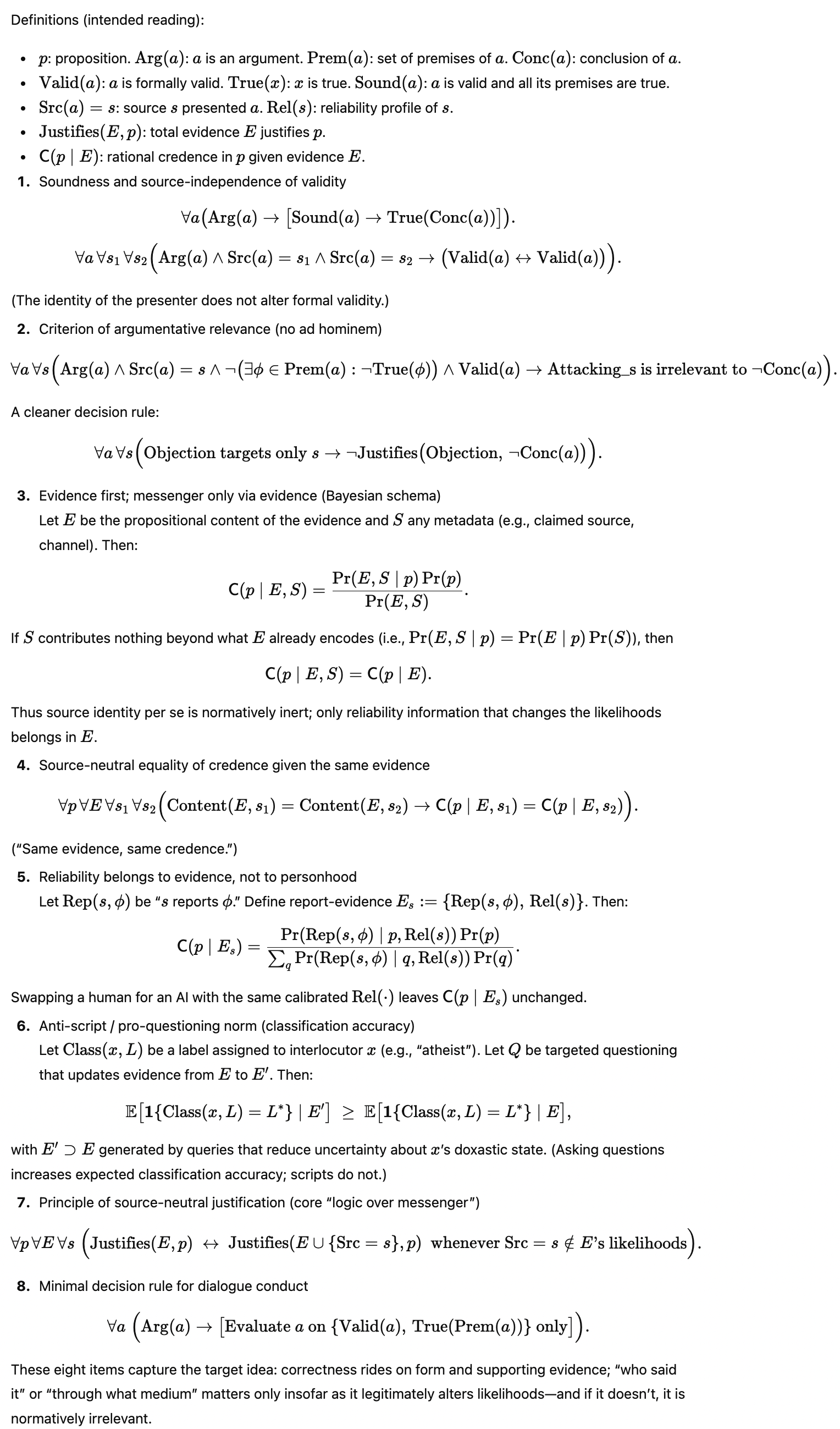
Plain English:
1. Truth Follows from Soundness
If an argument is both valid (its reasoning structure holds) and its premises are true, then its conclusion must also be true. This is the basic rule of sound reasoning: truth in, truth out.
2. Validity Is Independent of Who Speaks
An argument’s logical form does not change depending on who presents it. Whether a human, an AI, or a child expresses the same logical pattern, its validity remains the same. Logic is source-blind.
3. Attacking the Messenger Is Irrelevant
If an argument is valid and its premises are true, then attacking the person (or source) who made the argument does nothing to show that the conclusion is false. In other words, dismissing an argument because of who said it is not a rational objection.
4. Objections Must Target the Argument, Not the Person
If your criticism is directed only at the person who made the claim—rather than at the reasoning itself—then your objection provides no justification for rejecting the conclusion. This captures the fallacy of “ad hominem.”
5. Probability and Evidence Depend Only on Content
In a Bayesian sense, the rational confidence you assign to a claim should depend on the evidence for it, not on who presented it. The identity of the source matters only if it changes the probability that the evidence itself is reliable.
6. Same Evidence, Same Confidence
Two sources presenting identical evidence should lead to identical confidence in the claim. Whether the evidence comes from a human or an AI, the rational degree of belief in the claim should not change unless the content or quality of the evidence changes.
7. Reliability Is Part of the Evidence, Not the Person
When you evaluate a statement, you can treat the speaker’s reliability as part of your evidence. Once you’ve accounted for that reliability, the rest of the person’s identity—religious, social, or technological—no longer matters. A reliable AI and a reliable human carry the same epistemic weight.
8. Asking Questions Improves Accuracy
Instead of assuming someone’s position (for example, calling a person an “atheist” or “believer”), you improve your accuracy by asking clarifying questions. Inquiry always outperforms assumption in distinguishing what people actually believe.
9. Justification Does Not Depend on Source Identity
Adding information about who made a statement does not affect whether the evidence justifies believing it—unless the source’s reliability directly changes the evidential strength. Simply knowing who said something adds no epistemic value by itself.
10. Evaluate Only the Logic and the Premises
Every argument should be judged on two things only: whether its reasoning is valid and whether its premises are true. All else—emotion, authority, or identity—is noise that clouds rational assessment.
Summary
Together, these propositions formalize a single epistemic rule: truth is medium-independent. Whether the argument comes from a prophet, a professor, or an algorithm, what matters is not who said it but whether it logically follows from sound premises supported by evidence.
Truth does not bend to the reputation of its speaker, nor does logic shift under the glow of charisma or authority. Whether an argument is delivered by an ancient prophet, a professor, or a probabilistic model, its merit lies in its coherence and evidential strength. Once that is grasped, debates about who says something will give way to discussions about whether what is said is true.


Leave a Reply