◉ The Indwelling Spirit: A Test of Claim vs. Observable Reality
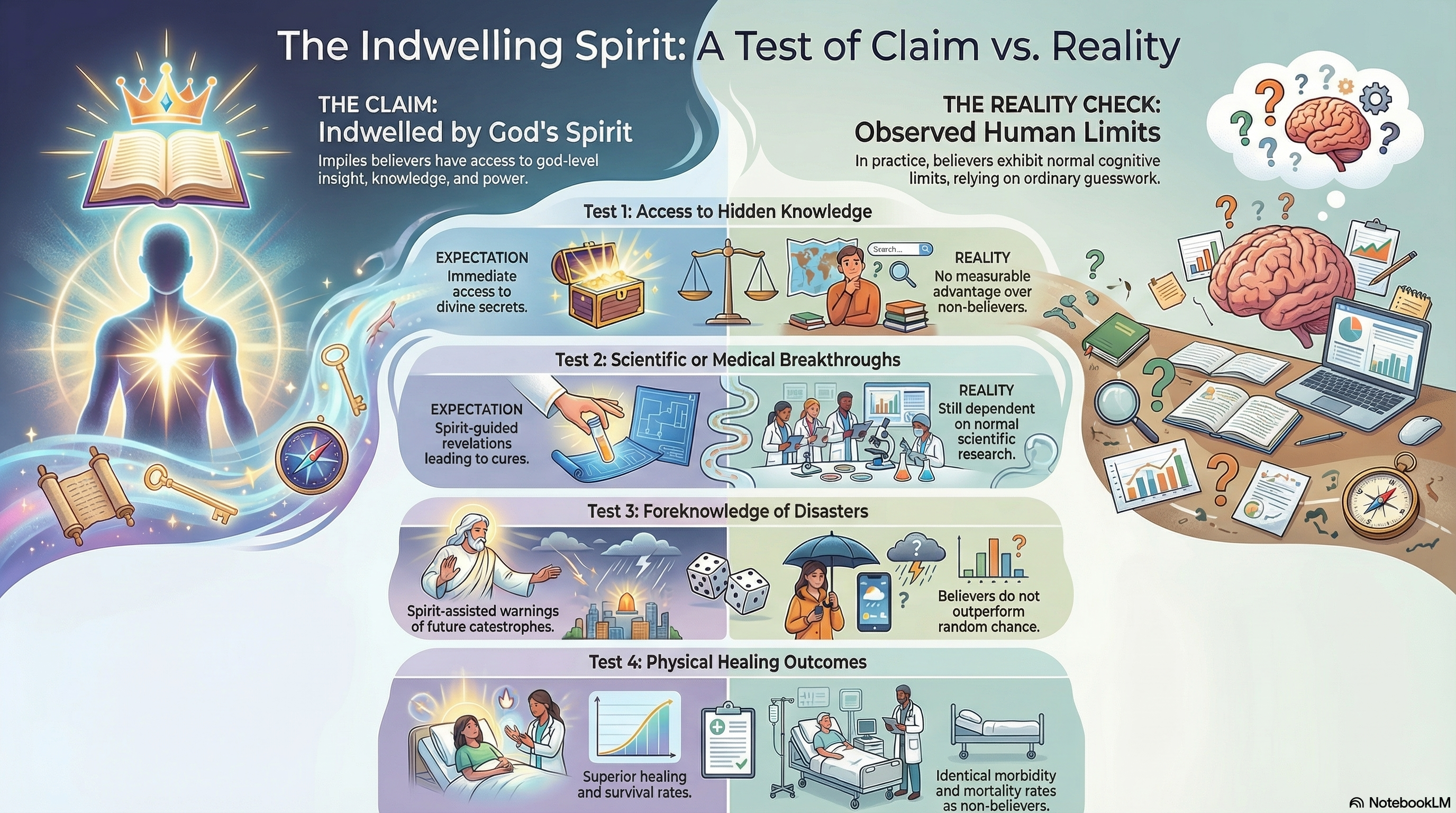
For many Christians, one of the most cherished doctrines is the belief that the Holy Spirit literally indwells believers. This indwelling is often described as a transformative infusion of divine power—providing insight, wisdom, strength, guidance, and even access to truths beyond normal human capacity. In sermons and testimonies, this claim is presented as a defining feature of Christian identity.

But when we move from assertions to measurable outcomes, a consistent pattern emerges: the promised supernatural advantages never materialize in any domain where they should be detectable. Across knowledge, healing, foresight, and innovation, believers exhibit the same cognitive, physical, and predictive limitations as anyone else.

This article examines four key areas where divine indwelling should produce unmistakable results—but does not.


1. Hidden Knowledge: The Expected vs. the Observable

Christian teaching frequently implies that those with the Spirit have access to guidance beyond natural reasoning. Believers often speak of discernment, revelation, spiritual insight, or divine wisdom.

Expectation:

  • Immediate access to divine secrets
  • Spirit-inspired clarity on complex decisions
  • Unique cognitive advantages

Observable Reality:

  • Believers demonstrate the same cognitive biases, errors, and uncertainties as non-believers.
  • No study has ever shown statistically superior performance from believers in problem-solving, intuition, or predictive accuracy.
  • Believers disagree with each other as frequently—and as intensely—as everyone else.

If the Spirit truly provided superior insight, we would expect believers to show above-average outcomes in fields requiring deep understanding. Instead, their performance matches ordinary human patterns.


2. Scientific and Medical Breakthroughs: Spirit-Guided Innovation?
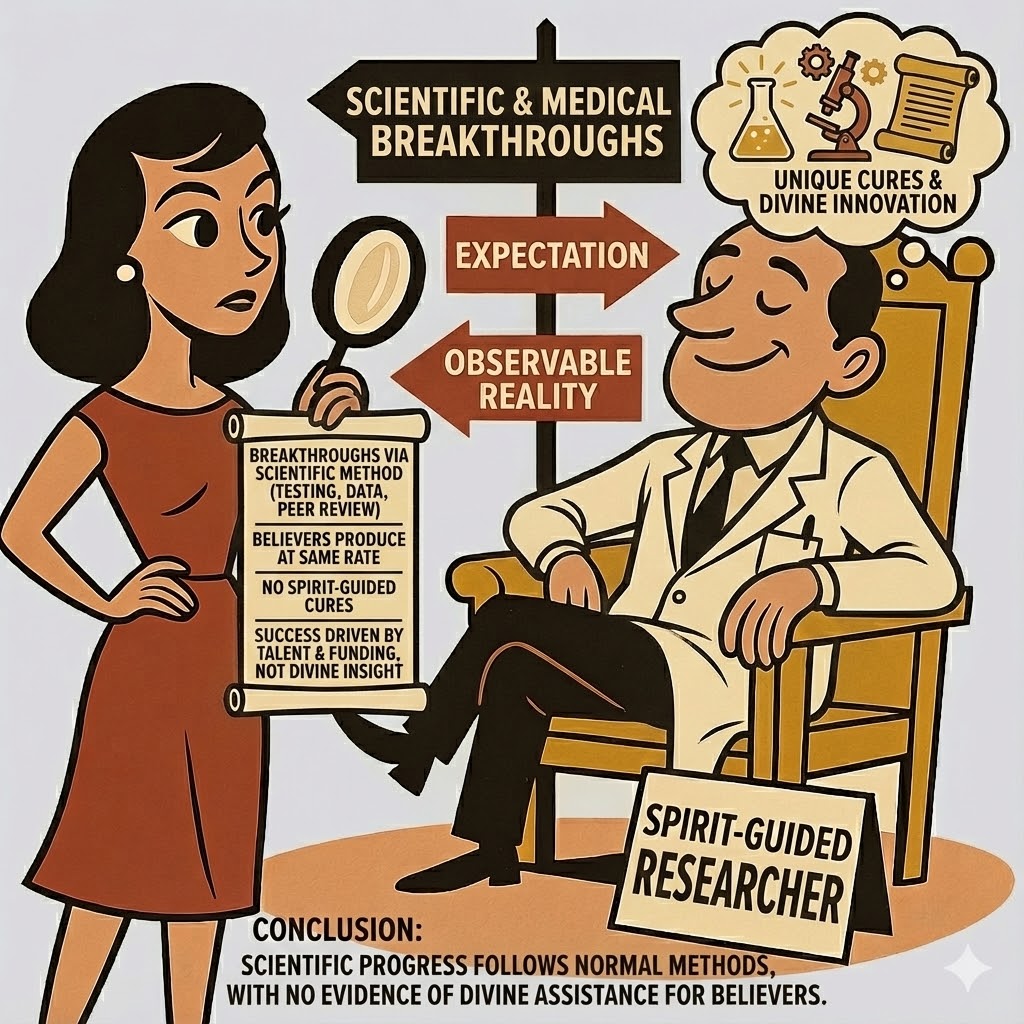
The claim that God indwells Christians suggests a potential conduit for groundbreaking discoveries—especially in medicine, where compassion and human suffering intersect.

Expectation:

  • Spirit-guided breakthroughs
  • Unique access to solutions or cures
  • Innovative discoveries emerging from Spirit-filled researchers

Observable Reality:

  • Breakthroughs arise from the normal scientific method: testing, data, peer review.
  • Believers do not produce scientific advances at rates that reflect divine assistance.
  • No medical cures trace to revelation or Spirit-guided knowledge.

Believing scientists succeed or fail at the same rate as non-believing scientists. Talent, training, collaboration, funding, and data—not divine insight—drive discovery.


3. Foreknowledge of Disasters: An Expected Domain for Divine Warning
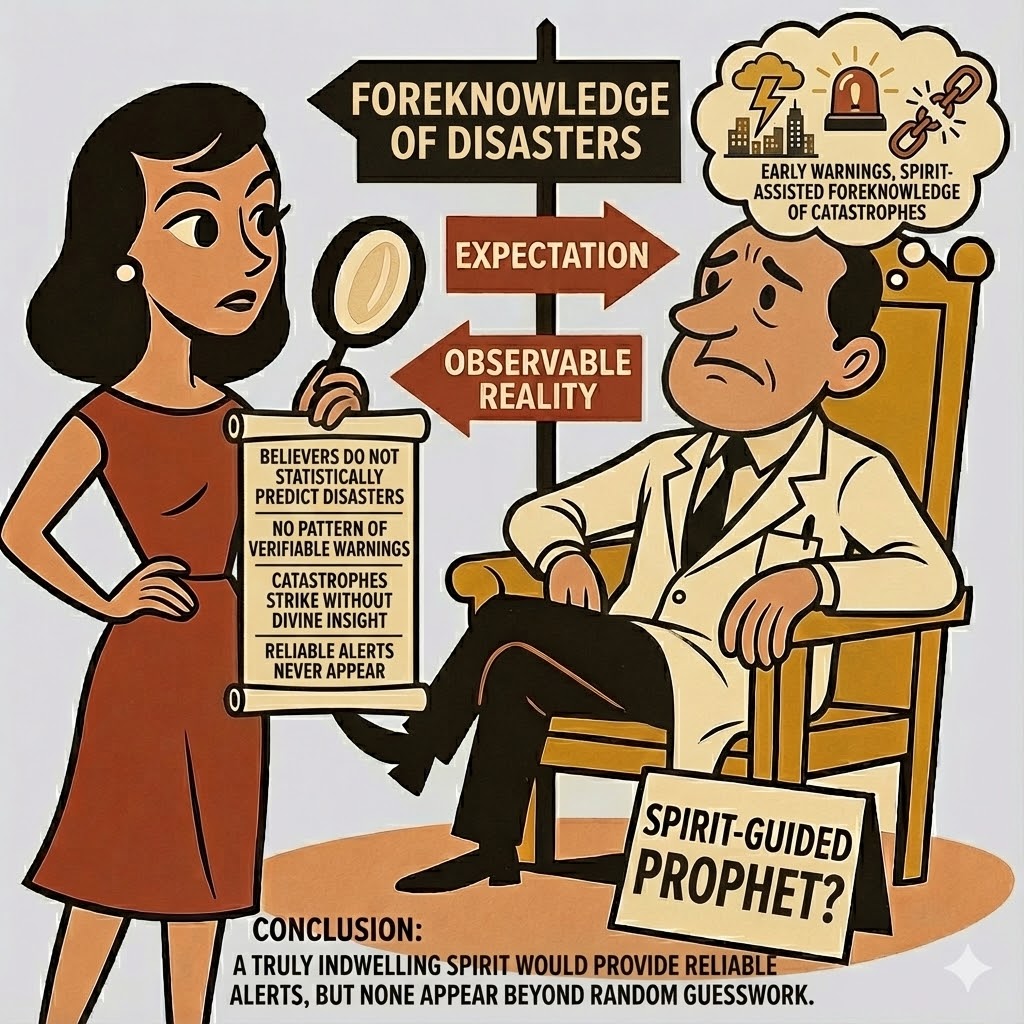
If a supernatural being indwells individuals and cares deeply about humanity, warnings about danger would be a reasonable expected outcome.

Expectation:

  • Spirit-assisted foreknowledge of catastrophes
  • Early warnings about disasters, crises, or threats
  • Believers outperforming chance in predictions

Observable Reality:

  • Believers do not statistically predict disasters with accuracy beyond random guesswork.
  • No pattern of verifiable supernatural warnings emerges across history.
  • Catastrophes strike communities—including Christian ones—without advance divine insight.

A truly indwelling, all-knowing Spirit would provide reliable alerts. Yet those alerts never appear.


4. Healing and Survival Outcomes: Divine Power Measured in Human Bodies
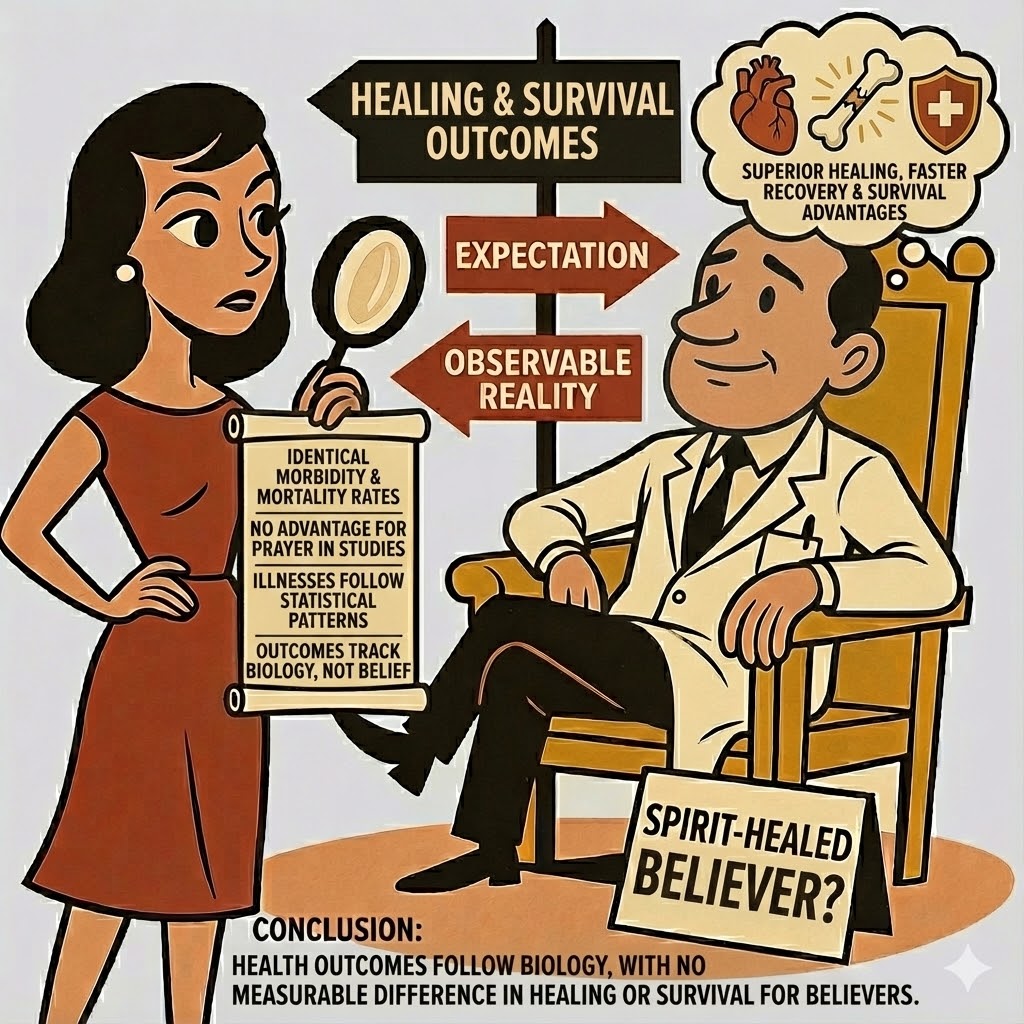
If God dwells within believers, one might expect measurable differences in physical outcomes—faster recovery, greater resilience, lower mortality, or improved survival rates.

Expectation:

  • Superior healing outcomes
  • Noticeably better recovery trajectories
  • Distinct survival advantages

Observable Reality:

  • Believers experience identical morbidity and mortality rates as non-believers.
  • Controlled studies show no advantage for prayer or divine healing.
  • Major illnesses, chronic conditions, and injuries follow the same statistical patterns regardless of faith.

Hospitals do not see believers walking out with supernatural speed. Health outcomes track biology, not belief.


THE CONSISTENT PATTERN:
Extraordinary Claims, Ordinary Outcomes

Across all four domains, the expected effects of divine indwelling fail to appear. The results align perfectly with what we would expect if believers are simply ordinary humans relying on ordinary cognition, ordinary research, and ordinary biology.

This is not a critique of sincerity. It is an evaluation of outcomes.

If a claim predicts extraordinary advantages—and those advantages never manifest—the rational response is to scrutinize the claim rather than bend reality to protect the expectation.

The doctrine of the indwelling Spirit carries weighty implications. If those implications never produce observable effects, the doctrine deserves examination—especially by those who value truth over tradition.

Examination is not hostility.
Scrutiny is not contempt.
Asking a claim to match its predictions is simply part of honest inquiry.


8 responses to “✓ Differentiating Effects of the Spirit?”

  1. J Avatar
    J

    Phil, if it’s alright, I wanted to post a few final “concluding remarks” at the bottom of this new article in response to Morne’s final posts on each of the following named two threads. (I was in the process of writing my responses when there was the decision to end the thread.) Thanks to both of you as well for that thought-provoking discussion.  Thanks, Jeffrey

    “Morne & Phil on PSA”

     My intention is to zero-in on two last things, Morne’s claims about the Resurrection and his statement about infants. In addition, I wanted to offer my own inference to the explanation” regarding Christianity in generalization as final “food for thought”.

    1. Regarding the Resurrection, he offered some of the following statements:
      • He considered it an “inference to the best explanation.” But before going further, even if that were the case, these sorts of inferences are not “airtight” and cannot be used on their own without considering other types of evidence. Consider the following scenario where it could not be relied on for a suspect’s conviction:
        • A couple in apartment decides to go on vacation for a weekend and entrusts their keys to a next-door neighbor. When they return, their belongings are gone and he has is not at his apartment. While the “best explanation” would seem to be that he absconded with their items, his guilt would need to be determined in a court of law. In our legal system, he is still innocent until proven guilty. Maybe another neighbor observed that the couple would be leaving for some time and scared him off while in the process of an armed robbery.  (This is analogous to treating the Resurrection as a violation of known “laws of nature” and the working assumption that the “burden of proof” is on those who believe in it to prove it.)
      • He wrote “When a historian examines the available material—including the early traditions cited in Paul’s letters, the empty tomb narrative, and the sudden, sincere conviction of the disciples—the claim is that the Resurrection provides the most comprehensive, yet also most challenging, explanation for these historical data points.” He also claimed there were minimal historical facts such as “the sudden belief in a crucified Messiah, the willingness of adherents to die for that belief, and the non-existence of Christ’s body.”
        •   Do “historians” universally make these conclusions about the Resurrection? Using Historians in that sense is kind of a vague term and the intellectuals who make pro- or con- claims about the Resurrection are generally religious scholars, theologians, or philosophers. There is no consensus among “scholars” on the “Minimal Facts” or that Jesus physically or even “spiritually” rose from the dead. To better illustrate this, I will exclude philosophers (who are less likely to be religious than the experts in the other two fields) from the following list. Here are relevant experts (to cite just a sample) who doubt the Resurrection and/or the historicity of the “Empty Tomb.”:
          •                   Bible scholar/religious Historian Bart Ehrman (who is agnostic) doubts the historicity of the empty tomb story and the Resurrection.
            • Historian/religious scholar Paula Fredriksen (who is Jewish) doubts the resurrection if not the “empty tomb” as well.
              • Bible scholar/historian John Dominic Crossan (who is a non-Trinitarian Christian) doubts the empty tomb and a physical resurrection. He is well-known for his view that Jesus’ corpse was left to scavengers after the crucifixion.
              • Bible scholar James McGrath (who is a Protestant Christian) doubts the empty tomb stories given in the Gospels.  
              • The late New Testament scholar Maurice Casey (who was irreligious) doubted the empty tomb story and the Resurrection.
              • The late Bible scholar Burton Mack (who was a skeptic) did not think that the Resurrection was an actual physical event.
        • The problem I highlighted in my post is that the “evidences” for things such as the “empty tomb,” “sudden, sincere conviction of the disciples,” “the sudden belief in a crucified Messiah” and “non-existence of Christ’s body” are contained in problematical Christian sources: the Gospels and Acts. (The Gospel of Acts does not include the empty tomb story. Paul counts himself as a “witness” even though he only had either a “vision” or “mystical experience” of Jesus without clarifying that what the disciples experienced was different.) These are not hostile sources. In fact, the only two non-Christians sources that appear to refer to Jesus in the 1st Century A.D. (and so be unaware of the Gospels) are Mara Bar-Serapion (possibly from the 1st century A.D.) and Josephus (the main passage associated with Jesus is likely forged in part). As the excerpts below illustrate, neither one shows any awareness of an empty tomb story (which is striking since they evidently encountered Christians at some point):
          • i. Mara Bar-Serapion (1st Century – 3rd Century A.D. Syrian Philosopher)
          •                         ” For what benefit did the Athenians obtain by putting Socrates to death, seeing that they received as retribution for it famine and pestilence?  Or the people of Samos by the burning of Pythagoras, seeing that in one hour the wholeof their country was covered with sand?  Or the Jews by the murder of their Wise King, seeing that from that very time their kingdom was driven away from them?  For with justice did God grant a recompense to the wisdom of all three of them.  For the Athenians died by famine; and the people of Samos were covered by the sea without remedy; and the Jews, brought to desolation and expelled from their kingdom, are driven away into every land.  Nay, Socrates did “not” die, because of Plato; nor yet Pythagoras, because of the statue of Hera; nor yet the Wise King, because of the new laws which he enacted.” (Taken from Ante-Nicene Fathers, translated by Benjamin Plummer Pratten)                    (Italics mine)
          • Josephus (1st Century A.D.): “Now there was about this time Jesus, a wise man, if it be lawful to call him a man; for he was a doer of wonderful works, a teacher of such men as receive the truth with pleasure. He drew over to him both many of the Jews and many of the Gentiles. …. And when Pilate, at the suggestion of the principal men amongst us, had condemned him to the cross, those that loved him at the first did not forsake him; for he appeared to them alive again the third day; as the divine prophets had foretold these and ten thousand other wonderful things concerning him. And the tribe of Christians, so named from him, are not extinct at this day.” (Taken from Jewish Antiquities)


    1. J Avatar
      J

      (Continued from above)

      -When he wrote that comparing Tacitus to the Gospels “is fair but the genre and purpose are different,” it seemed this ignored my first point. If Tacitus’s Histories and Annals are historical writings, wasn’t he tacitly acknowledging that the Gospels are not? We would have more reason to trust the facts Tacitus would provide for any potential pagan miracles since he actually demonstrates he is willing to weigh the evidence on “unbelievable” events. (Also, unlike, Luke or Acts, there is no mention in Tacitus that his purpose in writing is to make you “believe” in Vespasian.)

      -Saying that there was among Christians a “willingness” to die for their beliefs doesn’t prove much. The real scope of persecution in the early church was greatly exaggerated as Candida Moss argues in her book The Myth of Persecution. Also, what about the early Muslims who were reportedly slain in Mecca for their faith in the prophet Muhammad (whose message would have seemed absurd in a mostly polytheistic environment) and Jains who willingly starve themselves to death for a better future life. Being crucified doesn’t nearly require the investment of time and prolonged uneasiness that a month-long hunger strike does.

        -Since I don’t know if he read the articles by Peter Kirby and Matthew Ferguson linked to in the original post, I wanted to offer another article dealing with apologetics claims about the Resurrection by lawyer Robert G. Miller belowa.

        -When he wrote that “regarding infants, the tradition that they went to hell is a human doctrine not fully supported by the total scriptural evidence,” I never suggested that they automatically went to hell. (Many apologists like William Lane Craig and Paul Copan actually think children automatically go to heaven upon death.) My point is that if God created people because he wanted free agents to choose to obey him, the existence of infants presents a trilemma: all are saved, all are eternally damned, or they are divided up somehow between the eternal destinations. If they are all saved, then God ultimately doesn’t care about voluntary submission to his will since they cannot exercise autonomy. If they are all damned, then the same critique not only applies but “hell” is now populated in part by people who never demonstrated stubborn rebellion in life. If God divvies up the deceased infants, what extant “historical record” of their decisions does he draw upon?

        -For additional thought, I respectfully wanted to pose my “own inference to the best explanation”. Consider the apparent silence of God, the fact that evidence indicates life evolved like it would have if things were entirely naturalistic, the inability of Christians to perform convincing “miracles” in front of skeptical audiences, and the unfalsifiable nature of responses to prayer. I suggest the following two explanations depending on if someone who is presently a Christian must maintain the existence of God for cosmological or design purposes:

        i. If they don’t think a God is needed to explain the existence of anything, then the “best inference” would be that there is no God or he is not separate from creation. The world seems to operate as if there is no transcendent God. (They could still believe in pantheism if you needed something to be divine in some way.)

               ii. If he or she must posit a God to explain existence, then consider a sort of deism, pandeism, or finite Godism for religious belief which are outside the scope of mainstream Christianity. If God doesn’t intervene miraculously in any presently discernible way, perhaps he never did so in the past. This would maintain his constancy and inherent goodness in some sort of way.

        a. Robert G. Miller Article Link: https://infidels.org/library/modern/legal-evaluation-of-minimal-facts-apologetics/

    2. J Avatar
      J

      (Continued from Above)

      “The Source of Human Rights”

      1. He referred to how “the theological view claims that an objective moral order, necessary for all existence, may require the corporate consequence of moral contamination.”
        • How would an “objective moral order” necessitate that an individual be contaminated morally from being in proximity or associated with other individuals who have sinned? You also fail to explain why the punishment for populations like infants must be death as a result of “contamination” rather than exile. Also, how is it just for certain peoples (e.g. the Amalekites, Canaanite cities) to suffer entire extermination at the hands of divine command, while other societies encountered by the Israelites were not subjected to this? According to Exodus, for example, the Egyptian pharaoh ordered the death of Jewish babies and yet the plagues sent in the story did not completely wipe out the population of ancient Egypt. (There are still enough Egyptians left for a massive chariot force to chase the escaping Israelites to the Red Sea.) This continues to make the actions of the biblical God seem completely arbitrary.
      2. He posited in regard to biblical slavery that the “the Universal Worth (Status) is the constant, and the Conditional Law (slavery regulation) is the variable that manages an imperfect reality. The historical argument is that the Status is the internal engine that eventually makes slavery morally intolerable to those who adhere to the texts, leading to abolition movements, even if the ancient text itself codified its temporary management.”
        • This still doesn’t explain why God has to “condescend” to the “norms” of historical societies rather than directly inspiring people to alter the laws around them in a way that is distinguishable from an evolutionary explanation for the development of human rights thought. More on this later below….
      3. One lingering problem with the “Imago Dei” principle is that it seems to be interpreted differently by those that appeal to it. Is there any particular reason why someone who supports an absolute monarchy or theocracy could not appeal to it if they wanted to claim that “God” ultimately determines how to “incorporate” his “universal natural law” to a given society. Also, why did the Ancient Greeks and Romans come to the conclusion that some form of democracy or republic was necessary before the Israelites did? Does that not contradict the idea that the biblical notion of “Imago Dei” is responsible for modern conceptions of rights and governments?
      4. What discernible advantage does his “Imago Dei” system of ethics have other ethical systems like utilitarianism, deontological ethics, intuitionism, and Buddhist ethics? One common understanding of Buddhist ethics, to illustrate, is based on the idea that living things are inherently sacred in a sense. If you were to object that this does not prioritize the needs of humans, consider that such a system of ethics might have advantages over those that were historically associated with the more Christian west. Treating living things as sacred who not only be conducive to the pacificism taught by Buddhism (in contrast to the growing problem of the military-industrial complex in the United States), but it would help curtail the idea that the environment is simply to be exploited for humans. After all, it’s the western countries that brought the polluting techniques used worldwide for extracting fossil fuels into existence. Consider the damage this is doing to the quality of living around the world.

    3. J Avatar
      J

      (Continued from Above)

      -Is it possible that simply declaring humans have “inherent worth” or have “the divine within them” is more parsimonious than declaring they are all some mere “images” of a God if we needed rights to have their source somewhere? Why do we need to posit an invisible “third-party” in our dealings with each other? One of my critiques of Christianity is that positing the existence of judgement or reward “from above” prevents us from finding out who would really pursue “the good” even in the absence of external motivators. Wouldn’t the most moral person seek the ethical course of action for its own sake rather than thinking of reward or punishment from a divine monarch figure?

      -To conclude with, regarding slavery in the Bible, (as well as the claim that the “Bible” is some sort of progression toward a divinely-mandated system of civil liberties), consider the following from scholar Dan McClellan (Ph.D. from University of Exeter). (He is also a professing Mormon so he can’t be accused of being fundamentally “biased” against the claims of the Bible as would a more skeptical critic):

      In his book The Bible Says So, McClellan offers the following insights about biblical slavery in context in the chapter entitled “The Bible Says Slavery is Wrong”:

      1. He notes the following with regard to the relationship between the biblical passages and similar codes of law from the ancient Near-East:

                       “Exodus 21 is a part of the holiness code” which “is actually adopting and adapting legislation directly directly from the laws of Hammurabi. The biblical laws were based on the laws of the nations around Israel. (…) all but the Middle Assyrian laws come from more than a thousand years before the compositions of Exodus, Leviticus, and Deuteronomy (and the Middle Assyrian laws still predate the Covenant Code by centuries). So the Covenant Code (including Exodus 21) and all the later biblical legislation should have the benefit of centuries of supposed progress.” (The Bible Says So, pg. 68)

        2. He offers the following comparisons between passages from the Torah and other Ancient Middle-Eastern legal codes:

                                i. In Exodus 21:32, “if a man negligently allows his ox to escape and it gores another man’s male or female enslaved person to death, he owes the man 30 shekels”. “This is only a slight variation on the fine of 20 shekels- the standard value-imposed for the same discretion by Hammurabi’s law number 252 from more than a thousand years earlier.” (ibid,pg. 68)  

                               ii. “Exodus and Deuteronomy require Israelite debt slaves work for six years to earn their release, while Leviticus saddles them with forty-nine years. According to Hammurabi’s law number 117, a subjected to debt slavery was only required to serve for three years before earning their release.” (ibid, pg. 70) 

        iii. “According to both Exodus 21: 2-6  and the laws of Ur-Nammu, if an enslaved man marries an enslaved woman, and then the man is released from his enslavement, his wife remains enslaved.” (ibid, pg. 69) 

                            So, these passages from the Old Testament seem indicative of a historical tendency to modify other legal codes without any notable sign of a divine process ensuring moral progress to our modern conceptions of legal personhood.  

        3. Finally, McClellan offers the following conclusion on the debate over Bible slavery :

                                       “The history of slavery between second-century CE Christianity and the widespread abolishment of slavery in the eighteenth and nineteenth centuries CE also shows no consistent or curated trajectory toward justice. The rhetoric of the Bible certainly doesn’t achieve any such progressive incrementalism. While there are sporadic and notable exceptions beginning from the earliest generations of Christians, the Bible was leveraged overwhelmingly by Christian readers to defend the institution of slavery, and the reason is that the bible repeatedly endorses that institution. In my opinion, the consensus view regarding the morality of slavery was overturned primarily because of (1) advocacy on the part of enslaved people themselves and the abolitionist who supported them – frequently via liberationist renegotiations of the biblical texts… [as the Bible was taken as authoritative among the wider public of the time and abolitionists who denied some form of scriptural inspiration like Thomas Paine in his work The Age of Reason found themselves alienated in society] … and (2) the influence of Enlightenment Rationalism and the philosophical arguments it developed for universal human rights. If one wants to argue that these two processes were orchestrated by God, that’s one thing- and a dogmatic one at that- but to argue they’re baked into the biblical texts or were an inevitable outcome of what’s in the Bible is just pure and utter nonsense.” (The Bible Says So, pg. 76) (Italics and Words in brackets are my additions.)

      1. J Avatar
        J

        I did want to clarify and correct one thing I wrote in the posts above:

        I wrote above “refuting the claim” about the discussion of infants going to hell and wrote that was not something I said. However, after reading earlier posts, I saw that he was responding to my mention of the belief in the early church that unbaptized infants were condemned. I wanted to apologize for that misunderstanding.

        1. Phil Stilwell Avatar
          Phil Stilwell

          Feel free to make any corrections/clarifications.

      2. J Avatar
        J

        Thanks. Other than a few repeated words and outline/formatting mistakes, I think the rest of the posts seem okay.

        1. J Avatar
          J

          Oops. I realized that there was one other part of what I wrote that could use some clarification:

          The chapters in Dan McClellan’s The Bible Says So are titled after claims from various apologists or skeptics he is referencing. So the chapter in the book titled “Slavery is Wrong” was actually written to address assertions made by Christians (particularly Frank Turek) that the Bible is a “progressive” text where slavery is concerned. McClellan ends up concluding that Turek is mistaken and notes passages where the Bible explicitly condones the practice of owning slaves. (I thought the references to a work from a Bible scholar would help “confirm” the suspicions about the meaning of or intent of certain Bible passages.)

      Leave a reply to Phil Stilwell Cancel reply

      Recent posts

      • Alvin Plantinga’s “Warrant” isn’t an epistemic upgrade; it’s a design for inaccuracy. My formal proof demonstrates that maximizing the binary status of “knowledge” forces a cognitive system to be less accurate than one simply tracking evidence. We must eliminate “knowledge” as a rigorous concept, replacing it with credencing—the honest pursuit…

      • This article critiques the stark gap between the New Testament’s unequivocal promises of answered prayer and their empirical failure. It examines the theological “bait-and-switch” where bold pulpit guarantees of supernatural intervention are neutralized by “creative hermeneutics” in small groups, transforming literal promises into unfalsifiable, psychological coping mechanisms through evasive logic…

      • This article characterizes theology as a “floating fortress”—internally coherent but isolated from empirical reality. It details how specific theological claims regarding prayer, miracles, and scientific facts fail verification tests. The argument posits that theology survives only through evasion tactics like redefinition and metaphor, functioning as a self-contained simulation rather than…

      • This post applies parsimony (Occam’s Razor) to evaluate Christian Theism. It contrasts naturalism’s high “inductive density” with the precarious “stack of unverified assumptions” required for Christian belief, such as a disembodied mind and omni-attributes. It argues that ad hoc explanations for divine hiddenness further erode the probability of theistic claims,…

      • Modern apologists argue that religious belief is a rational map of evidence, likening it to scientific frameworks. However, a deeper analysis reveals a stark contrast. While science adapts to reality through empirical testing and falsifiability, theology insulates belief from contradictory evidence. The theological system absorbs anomalies instead of yielding to…

      • This post critiques the concept of “childlike faith” in religion, arguing that it promotes an uncritical acceptance of beliefs without evidence. It highlights that while children naturally trust authority figures, this lack of skepticism can lead to false beliefs. The author emphasizes the importance of cognitive maturity and predictive power…

      • This analysis examines the agonizing moral conflict presented by the explicit biblical command to slaughter Amalekite infants in 1 Samuel 15:3. Written from a skeptical, moral non-realist perspective, it rigorously deconstructs the various apologetic strategies employed to defend this divine directive as “good.” The post critiques common evasions, such as…

      • Modern Christian apologetics claims faith is based on evidence, but this is contradicted by practices within the faith. Children are encouraged to accept beliefs uncritically, while adults seeking evidence face discouragement. The community rewards conformity over inquiry, using moral obligations to stifle skepticism. Thus, the belief system prioritizes preservation over…

      • In the realm of Christian apologetics, few topics generate as much palpable discomfort as the Old Testament narratives depicting divinely ordered genocide. While many believers prefer to gloss over these passages, serious apologists feel compelled to defend them. They must reconcile a God described as “perfect love” with a deity…

      • This post examines various conditions Christians often attach to prayer promises, transforming them into unfalsifiable claims. It highlights how these ‘failsafe’ mechanisms protect the belief system from scrutiny, allowing believers to reinterpret prayer outcomes either as successes or failures based on internal states or hidden conditions. This results in a…

      • In public discourse, labels such as “atheist,” “agnostic,” and “Christian” often oversimplify complex beliefs, leading to misunderstandings. These tags are low-resolution summaries that hinder rational discussions. Genuine inquiry requires moving beyond labels to assess individual credences and evidence. Understanding belief as a gradient reflects the nuances of thought, promoting clarity…

      • The featured argument, often employed in Christian apologetics, asserts that the universe’s intelligibility implies a divine mind. However, a meticulous examination reveals logical flaws, such as equivocation on “intelligible,” unsubstantiated jumps from observations to conclusions about authorship, and the failure to consider alternative explanations. Ultimately, while the universe exhibits structure…

      • The piece discusses how historical figures like Jesus and Alexander the Great undergo “legendary inflation,” where narratives evolve into more than mere history, shaped by cultural needs and societal functions. As communities invest meaning in these figures, their stories absorb mythical elements and motifs over time. This phenomenon illustrates how…

      • This post argues against extreme views in debates about the historical Jesus, emphasizing the distinction between the theological narrative shaped by scriptural interpretation and the existence of a human core. It maintains that while the Gospels serve theological purposes, they do not negate the likelihood of a historical figure, supported…

      • Hebrews 11:1 is often misquoted as a clear definition of faith, but its Greek origins reveal ambiguity. Different interpretations exist, leading to confusion in Christian discourse. Faith is described both as assurance and as evidence, contributing to semantic sloppiness. Consequently, discussions about faith lack clarity and rigor, oscillating between certitude…

      • This post emphasizes the importance of using AI as a tool for Christian apologetics rather than a replacement for personal discernment. It addresses common concerns among Christians about AI, advocating for its responsible application in improving reasoning, clarity, and theological accuracy. The article outlines various use cases for AI, such…