
Modern apologists claim that religious belief is a rational map of available evidence. A closer look at the mechanisms of belief reveals the exact opposite: a system designed to insulate commitment from reality.
Introduction: The Claim of Evidential Expression
In contemporary discussions between skeptics and believers, a significant shift has occurred. Many sophisticated apologists no longer rely solely on “blind faith” or presuppositional claims. Instead, they adopt the language of rationality and science. They argue that Christian belief is an “evidential” framework—that their degree of belief is a proper “mapping” to the actual degree of historical, philosophical, and experiential evidence available.
They claim their worldview functions much like a scientific paradigm: a robust framework that best explains the data of reality.
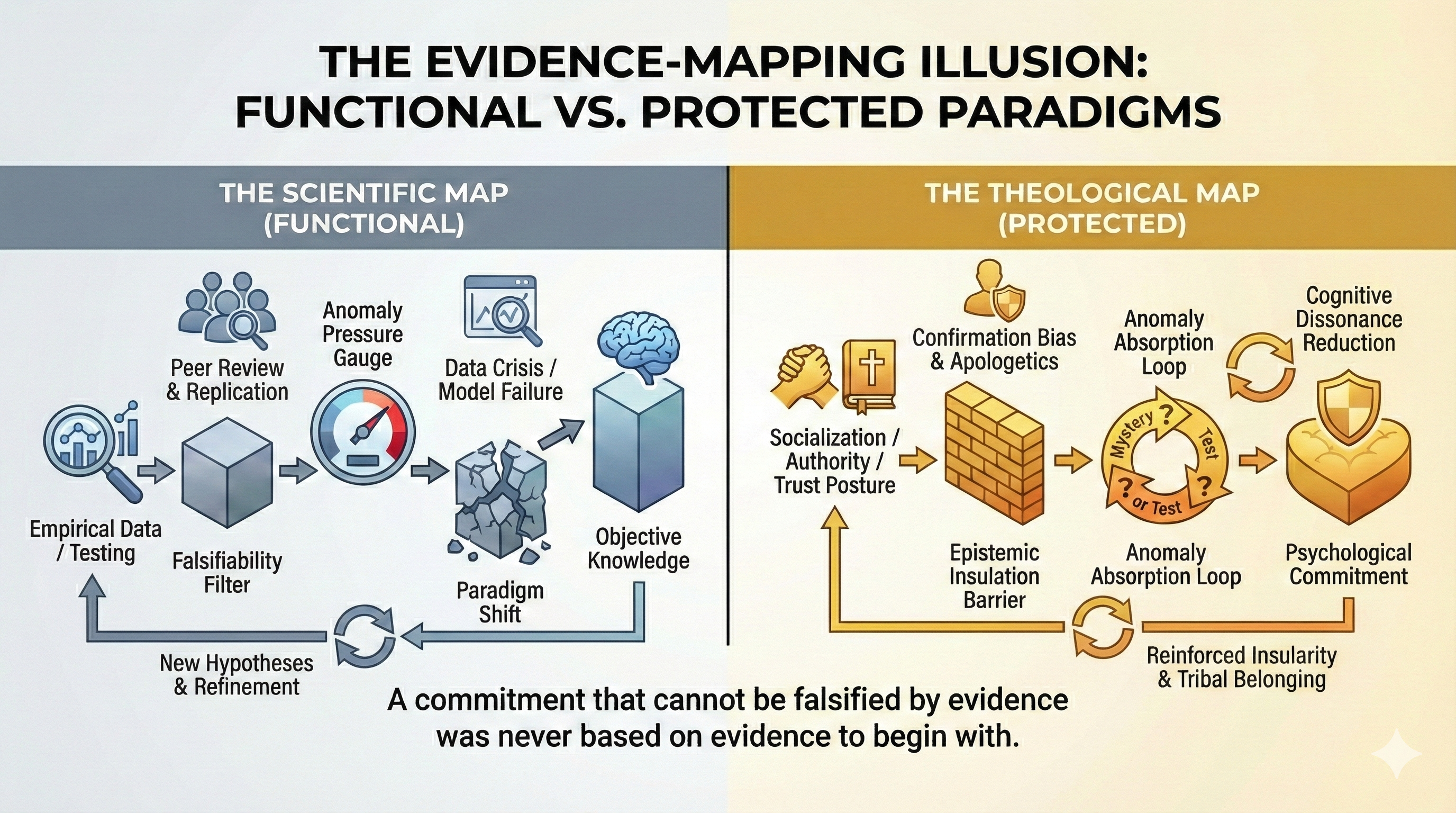
However, if we look beneath the surface—past the stated intentions and at the actual mechanisms of how these two systems operate—we find a fundamental divergence. As illustrated in the accompanying infographic, science and theology are not merely different roads to truth; they are opposing epistemological structures. One is built to function by adapting to reality; the other is built to protect itself from it.
Here is an analysis of the evidence-mapping illusion.
1. The Scientific Map: A Functional Paradigm
The left side of the infographic details the structure of a rational, scientific paradigm. The defining characteristic of this system is that it is subordinate to external reality.
The Input: Empirical Data and Antagonistic Testing Science begins not with a “posture of trust,” but with observation and doubt. Data is gathered and subjected to rigorous, antagonistic testing. The goal of an experiment is not to prove a hypothesis right, but to try and prove it wrong.
The Mechanism: The Falsifiability Filter and Peer Review A crucial concept, often misunderstood in theological circles, is falsifiability. For a claim to be scientific, there must be a theoretical observation that could disprove it. This “Falsifiability Filter,” combined with the collective scrutiny of “Peer Review & Replication,” ensures that personal biases and errors are eventually weeded out.
Handling Anomalies: The Pressure Gauge In the previous debate, the concept of Thomas Kuhn’s “normal science” was raised. While it is true that scientists work within established paradigms, the system is designed to handle anomalies (data that doesn’t fit the model) critically.
Anomalies are not ignored; they create pressure. The “Anomaly Pressure Gauge” rises as contradictory data accumulates. Eventually, the current model can no longer bear the weight of its own failures. This leads to a “Data Crisis,” forcing a “Paradigm Shift.”
The Outcome: Objective Knowledge Because the system is capable of failing, it is capable of progressing. When a paradigm shifts, it is replaced by one that explains everything the old model did plus the anomalies that broke it. The result is “Objective Knowledge” and “New Hypotheses”—a map that gets closer and closer to the actual territory.
2. The Theological Map: A Protected Paradigm
The right side of the infographic demonstrates how theological systems mimic the complexity of rational systems while inverting their purpose. The goal is not discovery, but preservation.
The Input: Socialization and the “Trust Posture” Unlike science, religious commitment rarely begins with an objective weighing of data. It begins with “Socialization,” reliance on “Authority” figures (parents, pastors), and the adoption of a “Trust Posture.”
In previous discussions, this “childlike” trust was defended as a virtue—an openness to the divine. Epistemologically, however, this is a vulnerability. It is the lowering of critical defenses to accept metaphysical claims without sufficient evidence. The journey begins with the conclusion already accepted.
The Mechanism: The Epistemic Insulation Barrier Once inside the framework, the believer encounters the “Epistemic Insulation Barrier.” This is where apologetics and theology function not as open inquiry, but as a defense mechanism.
Apologetics is the practice of starting with the conclusion (God exists and the Bible is true) and working backward to find supporting arguments, while simultaneously filtering out contradictory data through “Confirmation Bias.” It is not a search for truth; it is sophisticated maintenance for a pre-existing commitment.
3. The Critical Divergence: The Anomaly Absorption Loop
The most salient contrast between the two paradigms is how they handle failure.
In science, too many anomalies break the model. In theology, anomalies are absorbed into the model.
When a believer encounters contradictory evidence—such as the problem of evil, unanswered prayers, historical inaccuracies in scripture, or scientific conflicts—the paradigm does not experience pressure. Instead, it activates the “Anomaly Absorption Loop.”
The contradictory data is relabeled. The silence of God becomes a “mystery.” A tragic event becomes a “test of faith.” The lack of evidence becomes a demand for “greater trust.” By redefining failures as features, the theological paradigm becomes unfalsifiable. There is no amount of contradictory evidence that cannot be processed through this loop.
Conclusion: The Outcome Gap
The outputs of these two systems are as different as their mechanisms.
The scientific method, with its brutal requirement for falsifiability, yields objective knowledge and technological progress that works regardless of what one believes.
The theological method, designed for protection, yields “Psychological Commitment,” “Reinforced Insularity,” and “Tribal Belonging.” These provide immense emotional and social comfort, but they do not provide a reliable map of reality.
The claim that faith is a rational mapping of evidence is an illusion meant to validate a pre-rational commitment. As the infographic summarizes: A commitment that cannot be falsified by evidence was never based on evidence to begin with.


 Free of Faith
Leave a comment