
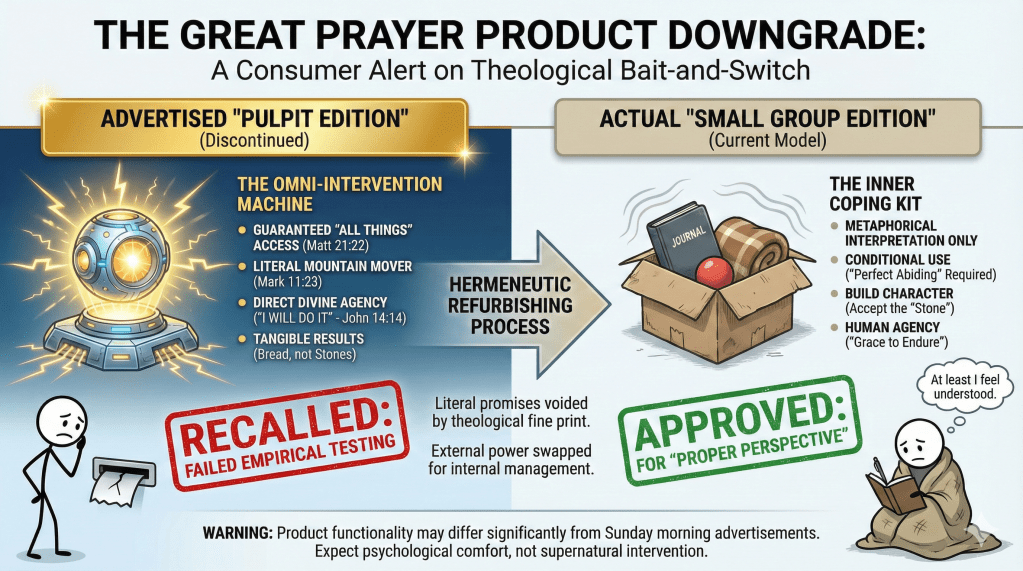
There is a distinct vertigo that many believers experience during their spiritual journey. It is the dizzying sensation felt when moving from the electrifying environment of a Sunday morning service to the quiet, often disappointing reality of a Tuesday afternoon prayer closet.
From the pulpit, the promises of the New Testament regarding prayer are presented as thunderous, history-altering guarantees. We are told we serve an omnipotent God who has handed us the keys to the kingdom, offering a direct line to supernatural intervention.
Yet, when these promises fail to materialize in crises—when the cancer returns, when the bank foreclosure proceeds, when the heavens remain stubbornly silent—the believer is ushered into a different room. Usually, a small group or a pastor’s office. In this room, the soaring rhetoric of Sunday is systematically dismantled by the “proper guidance” of theological hermeneutics.
The “blank check” is swapped for a treatise on spiritual resignation. And pious chuckles are heard at the notion that they ever innocently expected God to answer in a way that reflected the “blank check” terminology the verses clearly contained.
This article explores the profound gap between the unequivocal promises of Jesus and the apostles regarding answered prayer, and the creative, often illogical maneuvers used by modern theology to explain why those promises rarely work as advertised. It is an examination of the great hermeneutical bait-and-switch.
Part 1: The Pulpit Promise (The Contract)
To understand the depth of the disappointment, we must first appreciate the height of the promise. The New Testament does not mince words when it comes to the efficacy of petitionary prayer. It does not offer slight nudges toward probability; it offers absolute guarantees using universal quantifiers.
If we take the text at face value—the way it is often preached to inspire faith—the deal is transactional and nearly limitless.
Consider the linguistic framing of these five key passages.
The Universal Guarantee
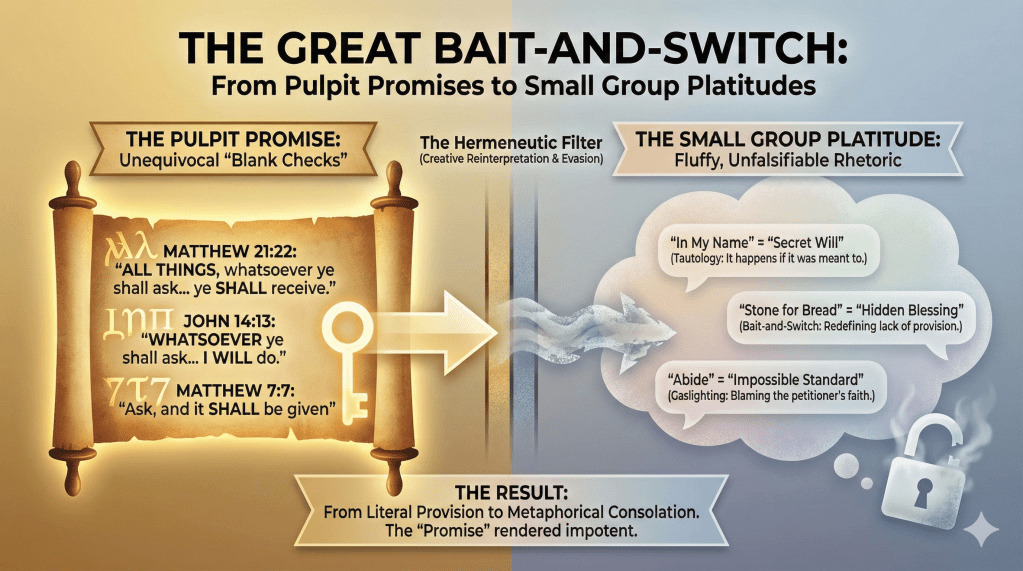
Matthew 21:22 (KJV): “And all things, whatsoever ye shall ask in prayer, believing, ye shall receive.”
The Greek text uses panta hosa (“all things, as many as”). There is no fine print here, no linguistic delimiter restricting the scope of “all things.” It is a blanket statement of total coverage, conditioned only by belief.
The Divine Totem
John 14:13-14 (KJV): “And whatsoever ye shall ask in my name, that will I do… If ye shall ask any thing in my name, I will do it.”
Here, the guarantee is doubled down. The agent of action is Jesus himself (“I will do it”). The scope remains universal (“whatsoever,” “anything”).
The Physical Intervention
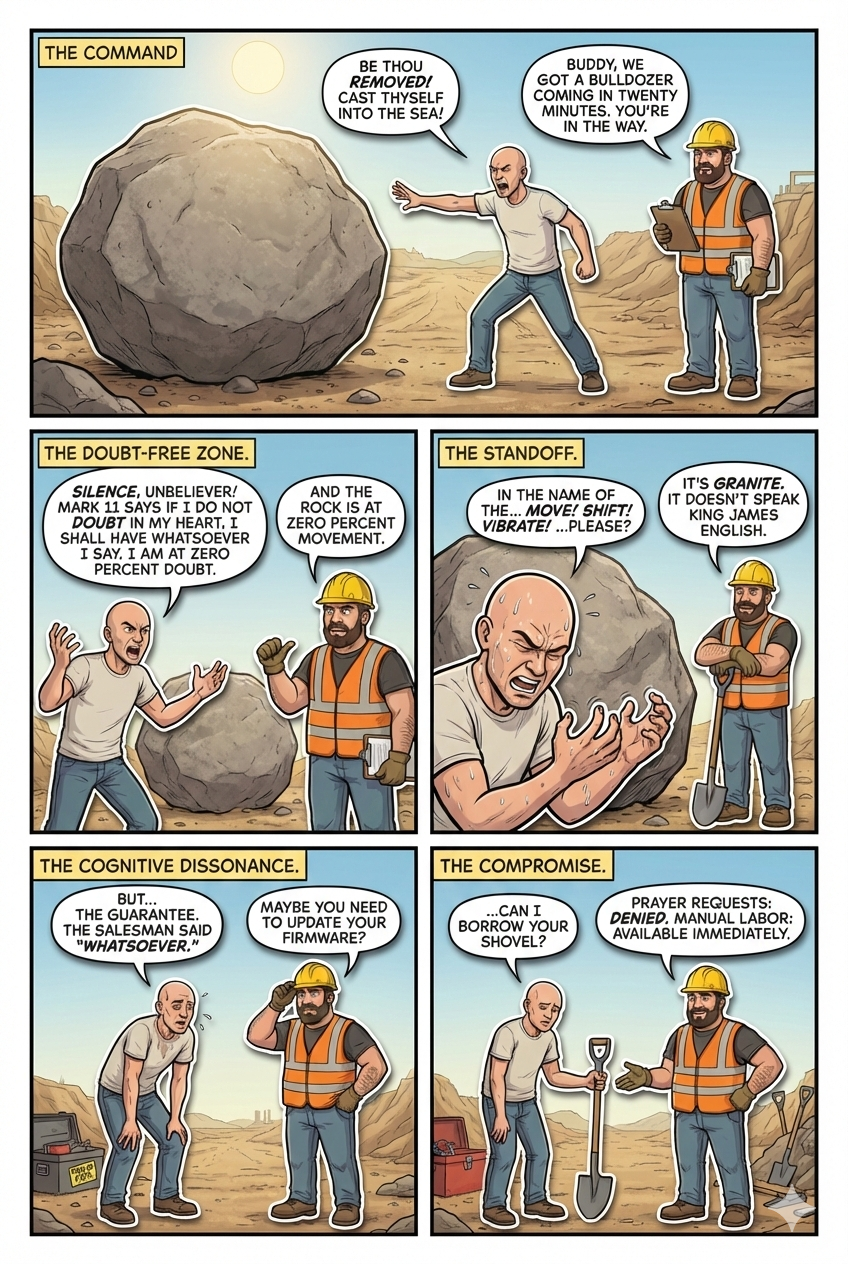
Mark 11:23-24 (KJV): “…whosoever shall say unto this mountain, Be thou removed… and shall not doubt in his heart… he shall have whatsoever he saith.”
This passage explicitly links prayer to physical, empirical change in the material world—moving a mountain. It is not a metaphor for internal emotional shifts; it is a promise of supernatural agency over physical reality.
The Fatherly Analogy
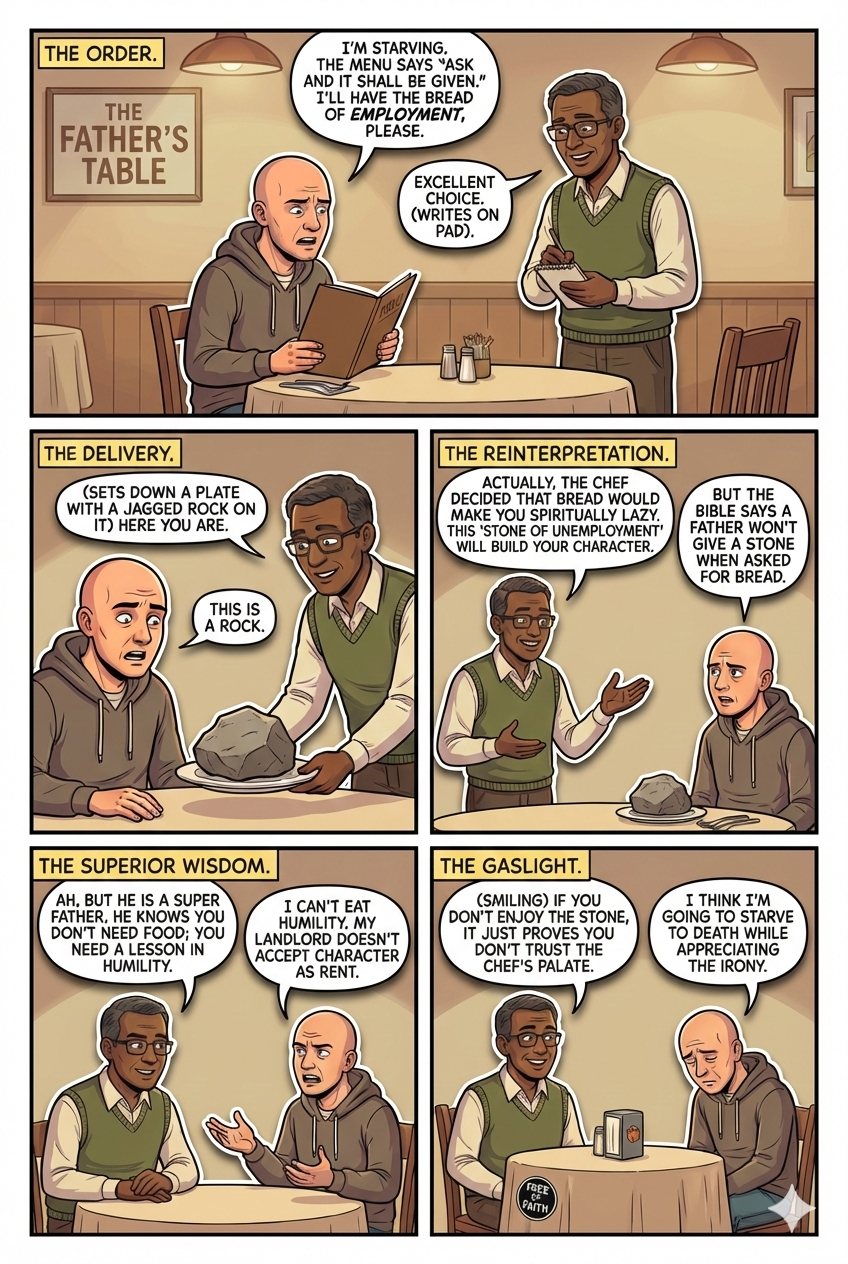
Matthew 7:7-11 (KJV): “Ask, and it shall be given you… For every one that asketh receiveth… Or what man is there of you, whom if his son ask bread, will he give him a stone?”
Jesus grounds the reliability of prayer in a relatable human analogy: a good father does not mock his child by substituting a basic need (bread) with a useless object (a stone).
Part 2: The Crisis of Silence
The new believer, armed with these texts, approaches God with high expectations. Why wouldn’t they? The language is clear.
But inevitably, the collision occurs. The empirical reality of the world does not bend to these promises. Statistical studies on intercessory prayer for medical outcomes repeatedly show no effect beyond placebo. On a personal level, every believer has a “mountain” they desperately prayed to move, only to watch it remain immovable.
This discrepancy creates immense cognitive dissonance. If the text is true, why is the experience false?
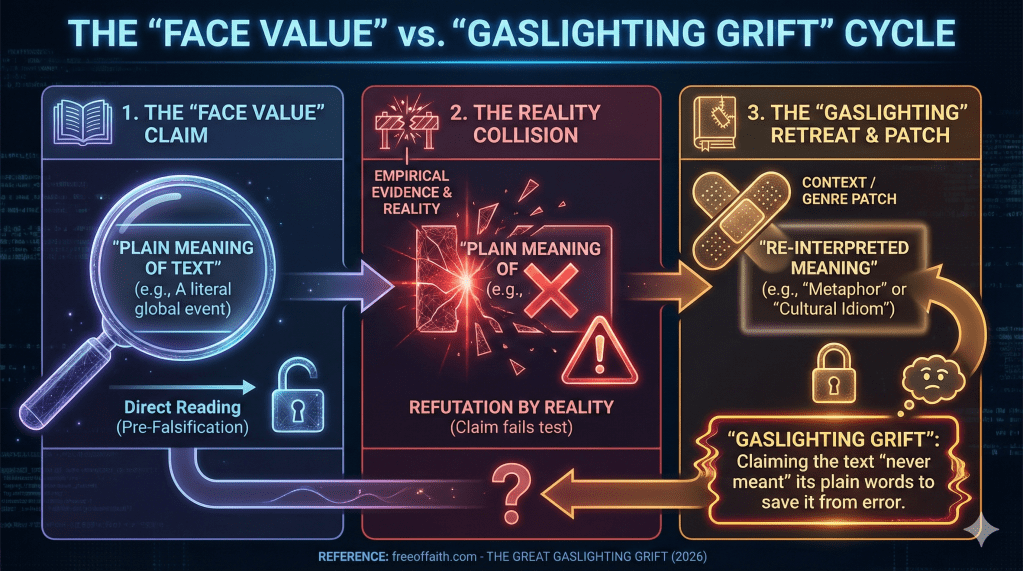
This is where hermeneutics—the science of interpretation—steps in. In many modern church contexts, hermeneutics functions not to clarify the plain meaning of the text, but to rescue the text from its own empirical failure.
Part 3: The Hermeneutics of Evasion
When the “small group leader” or apologist begins to explain why you didn’t get the “bread” you asked for, they engage in a series of logical maneuvers designed to neutralize the literal force of the promise while preserving its theological appearance.
Here are the three most common methods of evasion.
A. The Tautology of “His Will” (The ‘In My Name’ Escape)
The most common defense centers on the phrase “in my name” (John 14) or concepts like aiming for the “will of God.”
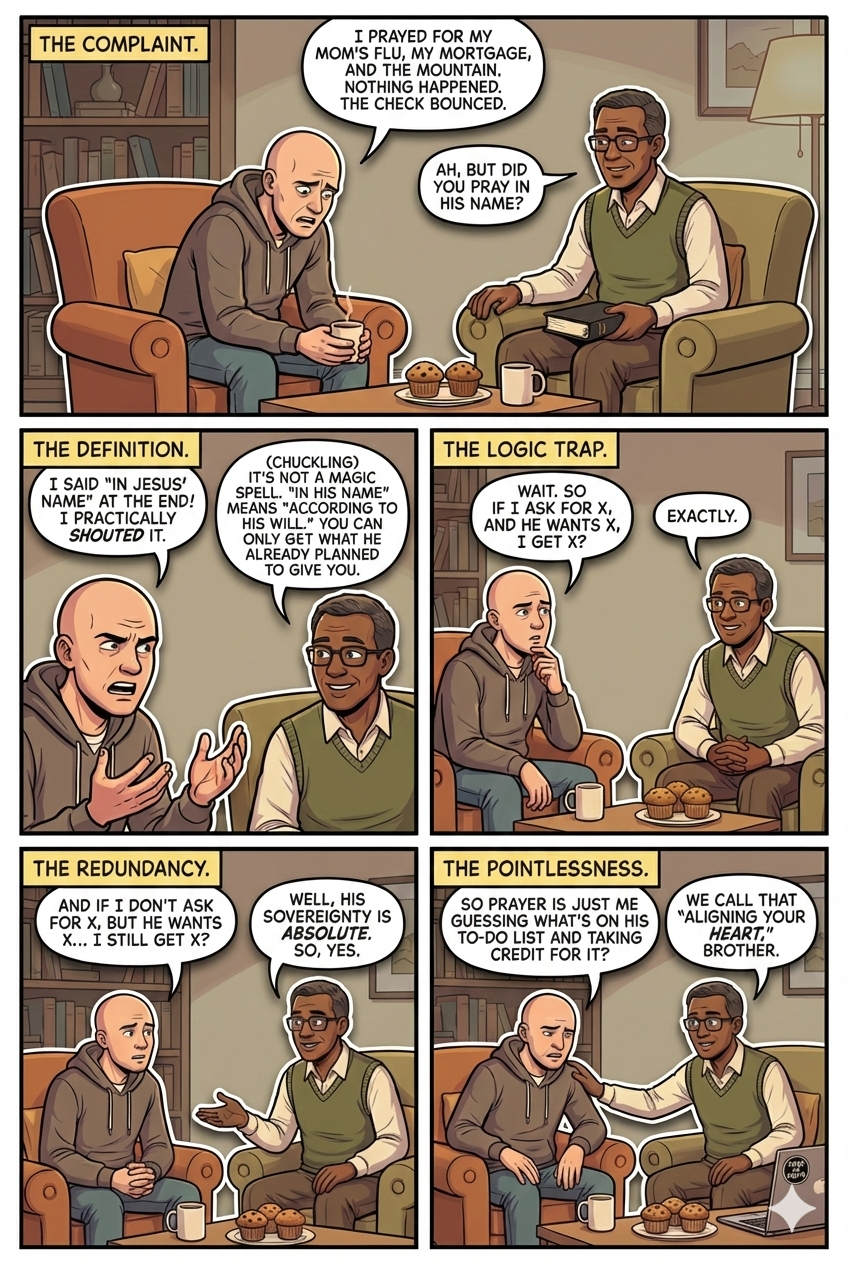
The interpretation goes like this: To ask “in His name” does not mean simply appending “Jesus” to the end of a prayer. It means to ask for things that align perfectly with Jesus’s character and predetermined divine plan.
The Rigorous Critique:
While this sounds pious, it renders petitionary prayer logically redundant. It creates a tautology:
- If you ask for X, and X is God’s will, you will get X.
- If you ask for X, and X is not God’s will, you will not get X.
Under this hermeneutic, the promise of prayer is reduced to: “Whatever was going to happen anyway will happen.” If prayer only works when it changes nothing about the divine itinerary, it has no causal power. It is merely a spiritual exercise in guessing what God already intends to do.
B. The Bait-and-Switch of the “Better Gift”
When confronted with the Matthew 7 analogy—the child asking for bread and receiving a stone—the apologist must get creative.
The common explanation is that God, in His infinite wisdom, knows that what we asked for (the bread of healing, the bread of employment) isn’t actually best for us. Instead, He gives us a “stone” (continued sickness, poverty, silence) because that “stone” will build character or lead to a greater spiritual good we cannot see.
The Rigorous Critique:
This interpretation violates the internal logic of Jesus’s own analogy. Jesus used the comparison to establish God’s superior benevolence over human fathers.
If a human child asks for food because they are starving, and their human father decides to teach them a lesson about patience by letting them starve, we do not call that father wise. We call the authorities.
To reframe the denial of basic, good requests as a “hidden spiritual blessing” is a moral bait-and-switch. It allows the deity to fail the test of benevolence set up in the text, while the interpreter absurdly reframes that failure as a higher form of love.
C. The Victim-Blaming Escape Hatch (Faith and Abiding)
Finally, when all else fails, the text allows the blame to be shifted entirely onto the petitioner.
Passages like Mark 11:24 condition receipt on “not doubting.” John 15:7 conditions it on “abiding” in Christ.
The Rigorous Critique:
In practice, these conditions create impossible, unfalsifiable standards. If the prayer is not answered, the verdict is automatic: you must have harbored a microscopic grain of doubt, or you were not truly “abiding.”
This is a closed loop. The promise can never be proven false, because any failure is immediately categorized as human error. It is a theological mechanism that preserves the image of a giving God by gaslighting the believer into believing their spiritual inadequacy is the cause of their suffering.
Conclusion: The Trajectory of Faith
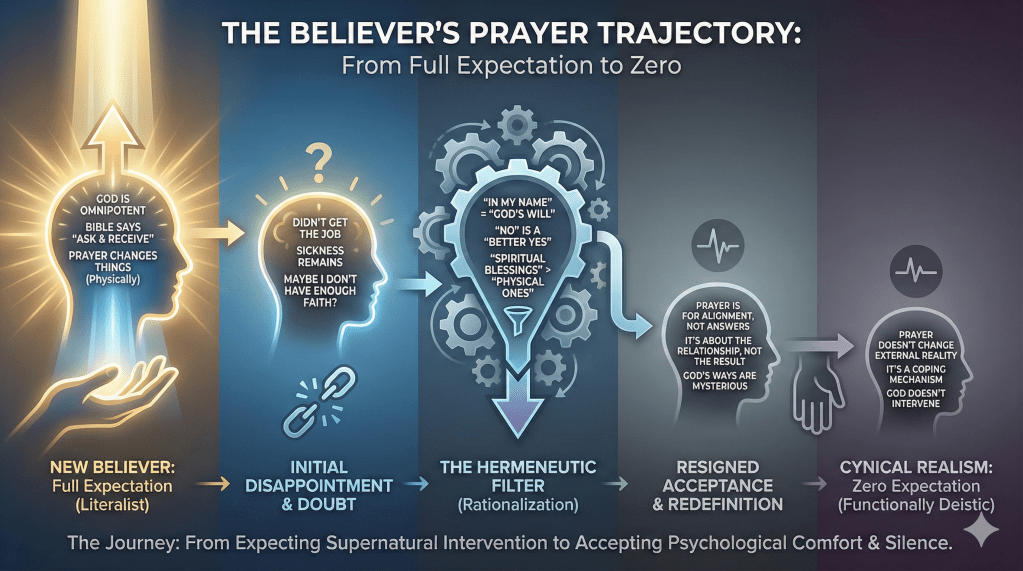
The journey from the pulpit promise to the small group explanation is a trajectory of decay.
The believer starts with an expectation of supernatural intervention into physical reality. When that fails, they enter a phase of doubt. Then, they are processed through the theological machinery that rationalizes the failure, redefines the words, and spiritualizes the physical promises.
Eventually, the believer arrives at a state of resigned acceptance. They still pray, but the expectation has shifted radically. They no longer expect the mountain to move; they pray for the strength to climb it. They no longer expect the bread; they pray for the grace to endure the hunger.
Let us be honest about what has happened. The religion has mutated. It has transitioned from a faith based on the interventionist promises of an ancient text to a modern psychological coping mechanism clad in ancient vocabulary.
If the “unequivocal” promises of the New Testament require a secondary library of apologetics to explain why they rarely work, we must ask a hard question: In what meaningful sense were they ever “promises” to begin with?






Leave a Reply