
The Biggest Logical Blunders in a Contemporary Christian Apologetics Corpus
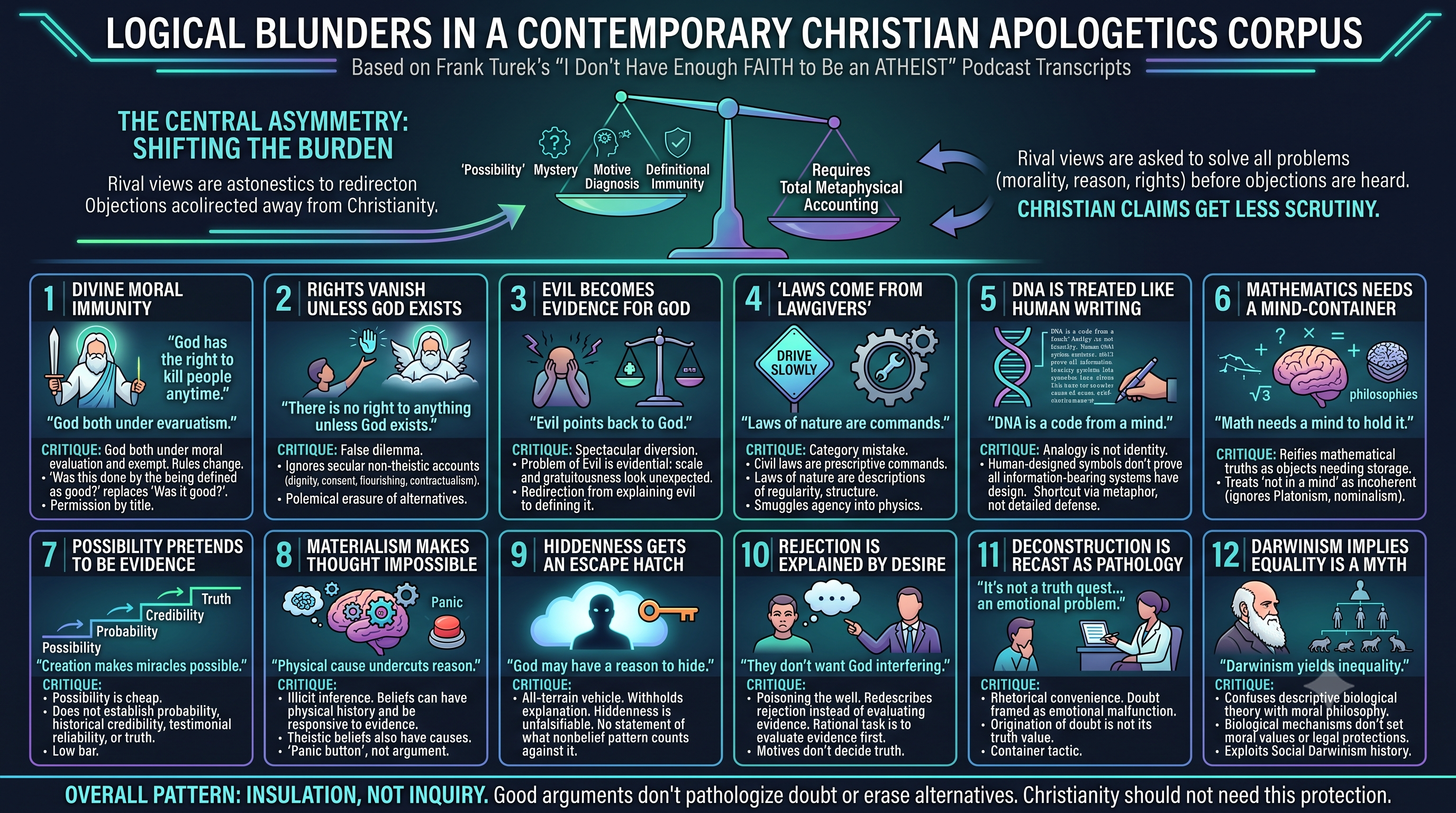
I recently surveyed a local transcript corpus from Frank Turek’s I Don’t Have Enough FAITH to Be an ATHEIST podcast. The point was not to catch one awkward sentence or score cheap rhetorical points. The point was to identify the recurring argumentative habits that shape the apologetic posture.
The result is hard to miss: many of the strongest-sounding arguments work by moving the burden away from Christianity and onto the skeptic. Instead of asking whether Christian claims survive ordinary evidential pressure, the discussion often turns into an interrogation of whether the critic has a worldview that entitles them to criticize at all.
That move is not intellectual confidence. It is insulation.
The timestamps below are approximate. The transcripts do not include reliable embedded timecodes, so I estimated location by word position at roughly 150 spoken words per minute.
1. Divine Moral Immunity
Source: Shocking Egyptian Evidence for the Exodus Plagues.txt
Approximate timestamp: 00:24:34
“God has the right to kill people anytime he wants”
The discussion answers the killing of Egypt’s firstborn by saying God, as creator, has the right to take life. It then pivots to the atheist’s supposed inability to ground moral criticism.
The blunder is glaring. The argument treats God as both the being under moral evaluation and the being exempt from moral evaluation. The question “Was this act good?” gets replaced by “Was this act done by the being defined as good?”
That is not a defense. It is a rule change.
A serious moral argument would need independent criteria for when killing children is justified, and those criteria would need to apply consistently outside the Christian story as well. Otherwise, the argument is not moral reasoning. It is permission by title.
2. Rights Vanish Unless God Exists
Source: Do You Have "Blood on Your Hands" 3 Questions About "Trans Rights".txt
Approximate timestamp: 00:03:38
“There is no right to anything unless God exists”
This is one of the corpus’s most common moves: either rights come from God, or rights are just personal opinion.
But that is a false dilemma masquerading as profundity. Secular moral philosophy is not empty space. There are non-theistic accounts of rights, dignity, obligation, consent, flourishing, harm, contractualism, capabilities, moral realism, and human-rights norms.
One may reject those theories. But one may not pretend they do not exist.
The polemical force of the argument depends on erasing the alternatives before the audience notices they were there.
3. Evil Becomes Evidence for God
Source: Nihilism and Mass Shootings.txt
Approximate timestamp: 00:37:50
“evil does not disprove God”
The argument goes further than saying evil does not deductively disprove God. It suggests that evil requires a standard of good, and therefore evil points back to God.
This is a spectacular diversion. The problem of evil is not usually the claim that evil makes God logically impossible in one step. It is the evidential claim that the scale, distribution, and apparent gratuitousness of suffering look less expected if a perfectly good, perfectly powerful God exists.
Turning evil into evidence for God skips the hard question. It asks whether the skeptic can define evil, while avoiding whether Christianity can explain this evil.
4. “Laws Come From Lawgivers”
Source: Can You Explain the 5 M's - Part 2.txt
Approximate timestamp: 00:37:48
“Laws come from lawgivers”
This sounds tidy. It is also a category mistake.
Civil laws are prescriptive commands issued by agents. Laws of nature are descriptions of regularity, structure, or mathematical relation. Calling both of them “laws” does not make them the same kind of thing.
The argument gets its punch from a verbal bridge. It smuggles the agency of legal law into the descriptive order of physics. Once the shared word is removed, the inference collapses.
5. DNA Is Treated Like Human Writing
Source: He Gets Us. Why Don't We Get Him Plus Q&A.txt
Approximate timestamp: 00:31:36
“Information, a message, a code always comes from a mind”
The argument treats biological information as if it were a text message, a computer program, or a written note. Human codes come from minds. DNA is code-like. Therefore, DNA must come from a mind.
But “code” is doing too much work. DNA can be described as code by analogy, but analogy is not identity. The existence of human-designed symbols does not prove that all information-bearing systems have human-like intentional causes.
A rigorous design argument would need to defeat evolutionary, chemical, and information-theoretic explanations at the same level of detail. This shortcut does not do that. It points to a metaphor and calls it evidence.
6. Mathematics Needs a Mind-Container
Source: Is the Cosmological Argument Still Sound with Dr. William Lane Craig and Dr. Stephen C. Meyer.txt
Approximate timestamp: 00:21:03
“there must be a mind in which to hold that math”
The claim is that if mathematics is prior to the universe, then it must exist in a mind. Math, we are told, does not simply float around disembodied.
But this reifies mathematics. Mathematical truths are treated as if they were objects needing storage. The argument skips over whole philosophies of mathematics: Platonism, nominalism, structuralism, fictionalism, and more.
The problem is not that theism cannot offer a philosophy of mathematics. The problem is that the podcast’s move treats “not in a mind” as though it were obviously incoherent. It is not.
7. Possibility Pretends to Be Evidence
Source: Inside Noah's Ark with Dr. Tim Chaffey.txt
Approximate timestamp: 00:14:15
“If that verse is true, every other verse is at least possible”
This is a classic apologetic ratchet. If God created the universe, then miracles are possible. If miracles are possible, then biblical miracle claims are not ruled out. So far, fine.
But possibility is cheap.
It is possible that many things happened. Possibility does not establish probability, historical credibility, testimonial reliability, or doctrinal truth. A claim does not become well-supported merely because it survives the low bar of not being logically impossible.
The real question is not “Could God have done this?” The real question is “What evidence shows that this happened?”
8. Materialism Is Said to Make Thought Impossible
Source: How Philosophy Helps Theology & Apologetics with Dr. Richard Howe.txt
Approximate timestamp: 00:22:03
“Unless I believe in God, I can’t believe in thought”
The argument is that if our thoughts are physically caused, then they cannot be trusted. Therefore materialism undercuts reason.
That inference is doing a lot of illicit work. Being causally produced is not the same thing as being irrational. A belief can have a physical history and still be responsive to evidence. Theistic beliefs also have causal histories, including culture, upbringing, emotion, and community reinforcement.
The move from “brains are physical” to “reason is impossible” is not an argument. It is a panic button.
9. Hiddenness Gets an Escape Hatch
Source: Why Does God Hide with Michael Jones and Eric Hernandez.txt
Approximate timestamp: 00:26:30
“God is not revealing himself to them … for a reason”
Divine hiddenness is one of the most serious challenges to Christian theism. Why would a loving God remain hidden from sincere nonbelievers?
The answer offered here is that God may be withholding revelation for a reason. But a merely possible reason can rescue anything. If the evidence appears, God is revealing himself. If the evidence does not appear, God may have a reason not to reveal himself.
That is not an explanation. It is an all-terrain apologetic vehicle.
A serious account of hiddenness would need to state what patterns of nonbelief would actually count against Christianity. Without that, hiddenness becomes unfalsifiable by design.
10. Rejection Is Explained by Desire
Source: The Top 3 Reasons Why We Can Believe in the Resurrection - Part 2.txt
Approximate timestamp: 00:34:12
“they don’t want God interfering with their lives”
Here, skepticism toward the resurrection is explained not by the weakness of the evidence, but by desire. People have seen the evidence, the suggestion goes, but they do not want God interfering.
This is a poisoning of the well. It tells the audience how to interpret rejection before the objections are considered. The skeptic is not merely mistaken; the skeptic is resistant.
Of course, motives can matter. But motives do not decide truth. A person can dislike a conclusion and still have good reasons for rejecting it. A person can want Christianity to be true and still be wrong.
The rational task is to evaluate the evidence first.
11. Deconstruction Is Recast as Pathology
Source: Help! My Loved One Says I'm Toxic! with Alisa Childers and Tim Barnett.txt
Approximate timestamp: 00:23:34
“it’s not a truth quest … it’s an emotional problem”
This is one of the most revealing moves in the corpus. Exit-oriented doubt is redescribed as emotional malfunction rather than rational assessment.
That framing is rhetorically convenient. If someone remains Christian, belief can be treated as a healthy conviction. If someone leaves Christianity, disbelief can be interpreted through hurt, rebellion, emotional damage, or bad motives.
But the origin of a doubt is not the truth value of a doubt. A person may have emotional reasons for reconsidering a belief and still discover that the belief was poorly supported. The biography of doubt does not refute the content of doubt.
This is where apologetics begins to look less like inquiry and more like containment.
12. Darwinism Is Made to Imply Equality Is a Myth
Source: Is Christianity good Isn't it anti-women and pro-slavery with Abdu Murray.txt
Approximate timestamp: 00:41:49
“equality is a myth”
The argument contrasts Christian equality with Darwinism, suggesting that Darwinism naturally yields hierarchy, domination, and inequality.
But this confuses a descriptive biological theory with a moral philosophy. Evolutionary biology describes mechanisms of biological change. It does not by itself tell us what we ought to value, how law should protect persons, or what moral status human beings have.
The argument also trades on the ugly history of social Darwinism while treating that history as if it were the moral essence of secular thought. That is not analysis. It is guilt by association wearing a lab coat.
The Larger Pattern
Across these examples, the same habit keeps appearing:
- A challenge is raised against Christianity.
- The challenge is redirected toward the skeptic’s worldview.
- The skeptic is told they cannot even ask the question unless they first solve morality, reason, rights, meaning, or epistemology.
- Christianity is then treated as the default answer.
That is the central asymmetry.
Christian claims are allowed to survive on possibility, mystery, motive diagnosis, and definitional immunity. Rival views are asked to provide a total metaphysical accounting before their objections are heard.
This is not how rigorous inquiry works. A good argument does not need to pathologize doubt, erase alternatives, or turn every objection into proof of itself. A good argument can say what would count against it.
The most damaging blunder in this corpus is therefore not one fallacy. It is the apologetic habit of refusing symmetrical risk.
If Christianity is true, it should not need that protection.


Leave a Reply