
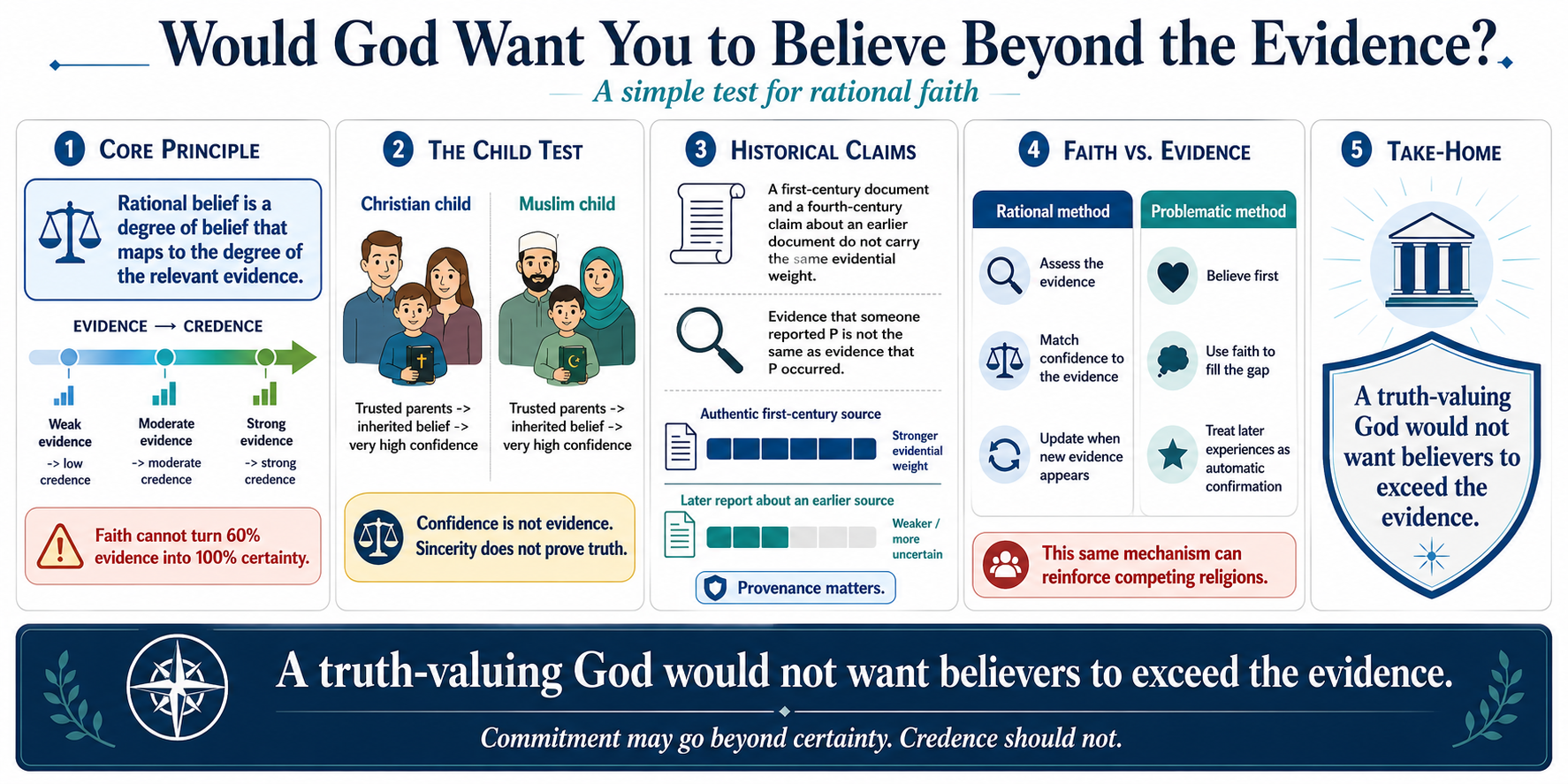
A Simple Test for Rational Faith
Let’s begin with a premise that I suspect many Christians will readily accept:
If God exists and values truth, God would not want you to believe Christianity more strongly than the relevant evidence warrants.
That principle may sound almost trivial. But it has surprisingly powerful consequences.
It means that having more faith cannot make an insufficiently supported belief more rational.
It means that certainty inherited from parents cannot substitute for evidence.
It means that disputed historical documents should receive exactly the confidence their provenance warrants.
And it means that when the evidence stops, our confidence should stop with it.
The central principle is simple:
Rational belief is a degree of belief that maps to the degree of the relevant evidence.
If the evidence warrants 90% confidence, then 90% confidence is rational.
If it warrants 60%, then 60% is rational.
And if it warrants only 30%, possessing 100% confidence does not somehow improve the epistemic situation.
It makes it worse.
1) Meet the Christian Child
Imagine a six-year-old child growing up in a loving Christian family.
Her parents tell her:
Jesus is God.
Jesus died for her sins.
Jesus rose bodily from the dead.
The Bible is God’s word.
She believes all of this wholeheartedly.
Why?
Because Mom and Dad believe it.
Her parents have fed her, protected her, comforted her when she was frightened, taught her not to touch hot stoves, and correctly answered thousands of questions about the world.
From her perspective, trusting them makes perfect sense.
So when they tell her:
“Jesus rose from the dead.”
she may possess essentially 100% confidence that Jesus rose from the dead.
But notice something important.
Her degree of confidence is extremely high.
Her evidential basis for the resurrection is not.
She has not examined the historical sources.
She has not investigated alternative explanations.
She has not studied textual transmission.
She has not compared Christianity with competing religions.
She has not assessed miracle claims probabilistically.
She simply trusts her parents.
That may explain why she believes.
It does not establish that her degree of belief is warranted by the evidence available for the resurrection itself.
2) Now Change Only the Parents
Imagine exactly the same child born into a devout Muslim family.
Her parents lovingly teach her:
There is no God but Allah.
Muhammad is his prophet.
The Qur’an is God’s revelation.
She trusts them for exactly the same reasons.
Or place the child in a Mormon family.
Or a Hindu family.
The mechanism remains:
trusted parents → inherited religious claims → very high confidence
Yet these children can acquire extremely strong confidence in mutually incompatible propositions.
That tells us something important.
Confidence is not evidence.
Sincerity is not evidence.
Parental conviction is not evidence.
The psychological strength with which someone believes a proposition tells us very little about whether the proposition is true.
This is why faith cannot be allowed to function as an epistemic multiplier.
If it could, every religion could use precisely the same mechanism.
3) What Happens When the Child Grows Up?
Now imagine our Christian child at age twenty-five.
She begins seriously investigating the resurrection for herself.
She reads Christian apologists.
She reads skeptical historians.
She examines the Gospel traditions, Paul, manuscript questions, alleged eyewitness testimony, alternative explanations, and arguments about miracles.
After months of careful investigation, she concludes:
“I think there is about a 65% probability that Jesus actually rose from the dead.”
What should she do?
This is where the issue becomes very clear.
Should she say:
“But I was raised to be certain. Christianity requires faith. Therefore I will remain 100% confident.”
Or should she say:
“The evidence presently warrants about 65% confidence, so 65% is approximately where my credence should remain.”
I would argue strongly for the second.
And I suspect that a God who values truth would prefer the second as well.
Why would God want her to pretend that her evidence warrants greater confidence than she actually thinks it does?
If stronger evidence later appears, she should update upward.
If serious counterevidence appears, she should update downward.
That is not stubborn skepticism.
That is simply intellectual calibration.
4) The Epistemic Gradient
We often speak as though belief were binary:
believe / don’t believe
But our minds do not actually operate so simply.
Consider these:
“Maybe Jesus rose.”
“Jesus probably rose.”
“I strongly believe Jesus rose.”
“I am virtually certain Jesus rose.”
Those are different degrees of belief.
The important question is not merely:
Do you believe?
It is:
How strongly do you believe, and does that strength correspond to the strength of the evidence?
This is the epistemic gradient.
A rational thinker should move along that gradient as evidence changes.
We can express the principle very simply:
strong evidence → strong belief
moderate evidence → moderate belief
weak evidence → weak belief
What we should not have is:
moderate evidence → faith → certainty
Faith does not create new data.
Commitment does not create new testimony.
Trust does not authenticate a manuscript.
And conviction does not increase the probability that the proposition producing the conviction is actually true.
5) The Ancient-Document Test
This principle becomes especially useful when evaluating historical evidence.
Imagine that a fourth-century historian says:
“I copied this document from a first-century royal archive.”
There are several different propositions here:
P1: The fourth-century historian wrote those words.
P2: The historian actually saw an earlier document.
P3: That earlier document really came from the first century.
P4: The purported first-century author actually wrote it.
P5: What that author reported was accurate.
These propositions do not automatically receive the same probability.
Suppose someone says:
“The date of the surviving copy doesn’t matter. A fourth-century copy of a first-century document is like a photocopy of an older textbook.”
That analogy misses the problem.
If I am holding a photocopy of a textbook, the relationship between the copy and the original has already been established.
With an ancient text of uncertain provenance, that relationship is exactly what we are trying to establish.
A late manuscript can certainly preserve an authentic early text.
But we must investigate the evidential chain.
Where did the text come from?
What is its earliest attestation?
Are there independent references to it?
How secure is the claimed archive?
Do textual features fit the proposed period?
Are there alternative explanations?
Calling something a “copy of a first-century document” cannot itself establish that it actually is one.
That would put the conclusion inside the premise.
6) Evidence of a Report Is Not Necessarily Evidence of the Event at the Same Strength
There is another distinction that often disappears in apologetic discussions.
Suppose we authenticated an ancient document saying:
“Pilate reported that Jesus rose from the dead.”
That would be significant.
But notice what the document would establish most directly:
Pilate reported that Jesus rose from the dead.
That is not identical to:
Jesus rose from the dead.
We would still want to ask:
What did Pilate personally observe?
Who supplied his information?
How independent were those sources?
What did the original terminology mean?
Were competing explanations investigated?
How reliable was the transmission?
Each step affects the evidential weight.
This is not a special skeptical standard invented for Christianity.
We should treat claims about Muhammad, Joseph Smith, Hindu miracles, paranormal events, UFOs, political allegations, and ordinary historical events exactly the same way.
The same epistemic rules must apply to everyone.
7) Where Does Faith Enter?
Now we reach the central issue.
Suppose someone carefully examines all of the resurrection evidence and concludes:
“The evidence gives me 70% confidence.”
What is faith permitted to do?
If faith means:
“I will commit myself to Christ despite retaining 30% uncertainty,”
that is at least conceptually coherent.
Human beings make binary decisions under uncertainty constantly.
You might be only 90% confident that a surgeon is competent but still make a 100% decision to undergo surgery.
The decision can be categorical while the underlying credence remains probabilistic.
But notice what faith cannot rationally do:
70% evidential warrant + faith = 100% belief
Nothing has happened to the evidence.
The remaining 30% uncertainty has not been answered.
It has merely been renamed.
This distinction is critical:
Evidence can raise credence.
Trust can motivate commitment.
Faith cannot legitimately manufacture additional evidential confidence.
8) “But God Can Confirm It Later”
Perhaps someone says:
“You have to take the leap first. Then God reveals himself through transformation, answered prayer, the Holy Spirit, or personal experience.”
Fine.
If genuinely new evidence appears afterward, rational credence can rise afterward.
That fits perfectly within the epistemic gradient:
new evidence → updated belief
But there is still an important question about the original leap.
Suppose the sequence is:
insufficient confidence → leap of faith → transformative experience → greater confidence
The transformative experience may constitute new evidence.
But evidence acquired after the leap cannot retroactively make the original leap evidentially warranted.
And there is another problem.
Christians are not the only people who report powerful confirmation after commitment.
Religious converts across traditions report experiences that they interpret through their newly adopted worldview.
This creates an obvious danger:
commit first → interpret subsequent experiences through the commitment → become increasingly certain
That mechanism can produce sincere certainty in incompatible religions.
So if our goal is truth rather than merely conviction, we need a method capable of distinguishing among them.
That discriminator must ultimately be the evidence.
9) What Would a Truth-Valuing God Want?
This brings us back to the premise with which we began.
Suppose Christianity is entirely true.
Suppose God exists.
Suppose Jesus really rose bodily from the dead.
Why would God want anyone to believe those propositions more strongly than the evidence available to that person warrants?
Would God prefer this?
“I am only 55% persuaded by the evidence, but I will claim certainty because certainty demonstrates faith.”
Or this?
“At present, I am 55% persuaded. I remain open to further evidence and will update accordingly.”
The second person is being more careful with truth.
If God provides powerful additional evidence tomorrow, that person may move to 70%.
Then 85%.
Then 99%.
Nothing about this process prevents Christianity from being true.
It simply prevents overconfidence from masquerading as faith.
10) The Symmetry Test
Here is one of the easiest ways to test our reasoning.
Ask:
Would I accept this method if it produced belief in another religion?
If a Muslim says:
“I believed first, and afterward Allah confirmed Islam to me,”
would the Christian accept that as sufficient?
If a Mormon says:
“I trusted first, prayed, experienced confirmation, and now I know Joseph Smith was a prophet,”
is that enough?
If not, then Christians should not demand that identical procedure from potential converts to Christianity.
A truth-sensitive epistemology must be symmetrical.
It cannot become rigorous when evaluating another religion and permissive when evaluating our own.
11) Take-Home
✓ Rational belief is a degree of belief that maps to the degree of the relevant evidence.
✓ High confidence does not become rational merely because it is sincere.
✓ Children can inherit near-certainty from parents without possessing evidence sufficient to warrant that certainty.
✓ The same mechanism produces confident Christians, Muslims, Hindus, Mormons, and others.
✓ A late text may preserve an early authentic source, but that relationship must be established rather than assumed.
✓ Evidence that someone reported an event is not necessarily equally strong evidence that the event occurred.
✓ New evidence should move our credence upward or downward.
✓ Personal transformation may count as evidence, but it must still be compared with alternative explanations.
✓ Faith may motivate commitment under uncertainty.
✓ Faith cannot rationally turn evidence warranting 60% confidence into 100% confidence.
✓ A truth-valuing God should have nothing to fear from properly calibrated belief.
The Core Question
This leaves us with a very simple question for Christians:
Should your confidence in the resurrection stop exactly where the relevant evidence stops?
If the answer is yes, then faith contributes nothing epistemically beyond the evidence. It may describe commitment, hope, reliance, or religious allegiance, but it cannot legitimately increase confidence that a proposition is true.
If the answer is no, then faith is functioning as an epistemic supplement: it is being used to justify believing more strongly than the evidence warrants.
That is precisely where faith fails as a coherent epistemic standard.
The problem is not merely that faith can sometimes lead people astray. The deeper problem is that faith itself contains no reliable mechanism for distinguishing truth from error.
A Christian can invoke faith in Christ.
A Muslim can invoke faith in Allah and Muhammad.
A Mormon can invoke faith in Joseph Smith’s prophetic calling.
A Hindu can invoke faith in Hindu revelation or experience.
These faith commitments can generate high confidence in mutually incompatible propositions. Therefore, faith cannot itself be the truth-discriminator.
Evidence must do that work.
So if the historical evidence for the resurrection warrants 55% confidence, rational credence should remain around 55%.
If further evidence raises that warrant to 80%, credence should rise accordingly.
If exceptionally strong evidence warrants 99%, then 99% is rational.
But there is no legitimate epistemic operation of:
55% evidential warrant + faith = certainty
Faith does not supply the missing evidence. It simply licenses confidence that has not otherwise been warranted.
And if God exists and values truth, I see no reason to think such overconfidence would be desirable.
A truth-valuing God should prefer the person who says:
“This is exactly how strongly the evidence currently warrants my believing, and I will revise my credence when the evidence changes.”
That is the epistemically responsible position.
The broader conclusion is therefore stronger than merely saying that faith should not exceed the evidence:
Faith is not a coherent independent method for determining what is true.
Where faith tracks adequate evidence, the evidence is doing the epistemic work.
Where faith exceeds the evidence, the excess is unwarranted.
And where different religions use faith to arrive at incompatible conclusions, faith provides no neutral mechanism for determining which, if any, is correct.
So when the question is what should I believe, and how strongly should I believe it?, the answer should not be:
Have faith.
It should be:
Examine the relevant evidence and proportion your credence to its strength.
No epistemic leap is required—and no epistemic leap is justified.


Leave a Reply