
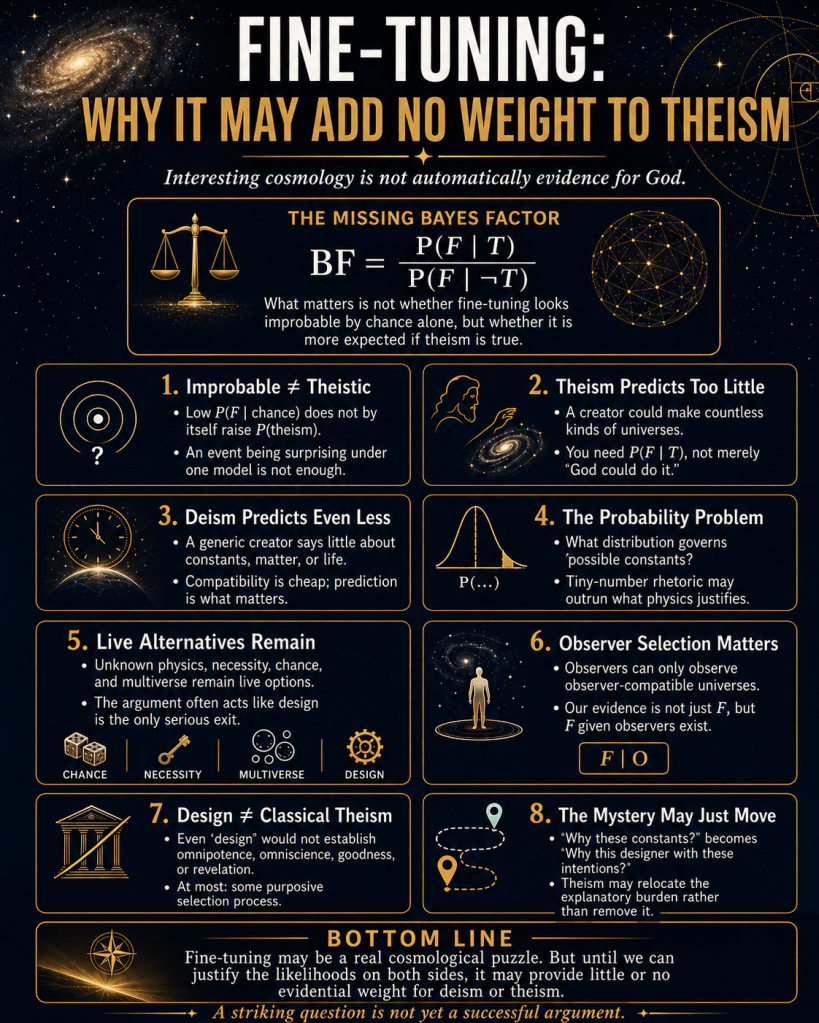
The fine-tuning argument is often presented as one of the strongest arguments for the existence of God.
The basic observation is familiar. Certain physical constants appear to fall within extraordinarily narrow ranges compatible with complex matter, stars, chemistry, and eventually life. Change gravity too much, alter the strength of the nuclear forces, modify the expansion rate sufficiently, and the universe as we know it disappears.
That is genuinely interesting.
But something important tends to happen immediately afterward.
The discussion quietly slides from:
These constants appear extraordinarily special.
to:
Therefore their values are evidence for God.
Those are not the same proposition.
In fact, once the argument is formulated properly, it becomes surprisingly difficult to show that fine-tuning should increase our credence in either deism or theism at all.
The problem is not that fine-tuning has been explained away.
The problem is more fundamental:
We do not currently appear to possess the probabilities necessary to establish that fine-tuning favors God over the alternatives.
1. Improbability Is Not Evidence for God
Suppose we call the apparent fine-tuning of the universe 
The fine-tuning argument often emphasizes something like:

where 
But that is not enough.
If we want to determine whether fine-tuning supports theism, the relevant comparison is something like:

where 
That ratio asks the question that actually matters:
How much more should we expect fine-tuning if God exists than if God does not exist?
Showing that fine-tuning looks improbable under one particular chance model does not answer that question.
This is an elementary but frequently neglected point.
A highly improbable event under hypothesis A does not automatically become evidence for hypothesis B. Hypothesis B must actually predict the event better.
Otherwise we are simply pointing at something surprising and announcing that God has gained probability.
That is not Bayesian reasoning.
2. Theism Does Not Clearly Predict a Life-Permitting Universe
Here is an uncomfortable question for the fine-tuning advocate:
Why should the existence of God make a universe like ours likely?
Consider what a generic creator could presumably create.
A creator might create:
- no universe at all,
- a universe containing no matter,
- a universe containing no biological organisms,
- nonphysical minds,
- entirely different laws of nature,
- radically different forms of life,
- multiple universes,
- a universe without stars or planets,
- or something completely beyond our conceptual categories.
Fine-tuning advocates normally spend considerable effort emphasizing how improbable our universe supposedly is without God.
Much less effort is spent establishing how probable our universe is with God.
Yet that second probability is indispensable.
We need some defensible estimate of:

And where exactly is that estimate supposed to come from?
Merely saying that God could fine-tune a universe tells us almost nothing. God could presumably do countless other things as well.
Possibility is not prediction.
3. The Problem Is Even Worse for Deism
This difficulty becomes especially severe for deism.
Traditional religions sometimes attribute specific intentions to God: creating humans, establishing relationships with persons, revealing himself, producing embodied rational agents, and so forth.
A generic deistic creator usually comes with far less baggage.
That makes deism simpler in one sense—but correspondingly less predictive.
If all we hypothesize is:
There exists some creator responsible for the universe,
what follows about the expected values of the gravitational constant, cosmological constant, nuclear forces, or any other physical parameter?
Very little.
Fine-tuning might be compatible with deism.
But compatibility is cheap.
Practically every conceivable universe is compatible with an unspecified creator capable of choosing practically anything.
The more freedom we give the designer, the less surprising any particular design becomes—but also the less predictive the hypothesis becomes.
That is the problem.
4. We Do Not Know the Probability Distribution Over Possible Constants
Fine-tuning discussions routinely contain astronomical probability claims.
We hear that a constant could have taken an enormous range of values and that only a tiny fraction would permit life.
But there is a prior question:
What probability distribution governs those possible values?
Suppose a parameter can range from 1 to a trillion.
Are all values equally probable?
Why?
Should the distribution be uniform over the numerical value?
Its logarithm?
Some more fundamental field?
Some state of an underlying physical theory?
Some symmetry-breaking process in the early universe?
Until we have a justified probability distribution, moving from:
“Only a narrow range permits life”
to:
“It was fantastically improbable that the constant would fall within that range”
is not automatic.
A narrow interval is not by itself a probability.
Probability requires a measure.
Without one, claims that the universe beat odds of 


5. Unknown Physics Could Completely Change the Calculation
There is another possibility that fine-tuning apologetics tends to move past much too quickly.
Perhaps the constants were established through physical processes we do not yet understand.
For example, imagine that some early cosmological phase transition fixed various parameters. Perhaps the process was deterministic. Perhaps it was indeterministic. Perhaps the constants emerge from deeper physical structures that have not yet been discovered.
We simply do not know.
And that ignorance matters.
If the constants arise from an underlying physical mechanism, then probabilities assigned while pretending the constants were independently selected from enormous mathematical ranges may bear little relation to the actual probability-generating process.
This is analogous to seeing an unusual result from a machine whose internal mechanism we do not understand.
Before calculating the probability that the result occurred “by chance,” it might be useful to discover how the machine works.
Cosmology has not yet handed us that manual.
Declaring design before obtaining it is premature.
6. Extremely Improbable Events Still Happen
There is also a conceptual mistake lurking behind some versions of the argument.
People understandably feel that an extraordinarily improbable outcome “cannot just happen.”
But of course it can.
Shuffle a deck of cards.
The exact sequence you obtain had a probability of:

That is approximately:

Yet some sequence had to occur.
What makes certain sequences suspicious is not merely that they were individually improbable.
A deck arriving perfectly ordered from ace through king in each suit would be suspicious because that particular pattern has significance under alternative hypotheses involving deliberate arrangement.
The inference works because we have some idea what agents do.
We understand card players.
We understand cheating.
We understand sorting.
We understand human intentions.
But when the proposed agent is an unconstrained cosmic mind whose preferences are largely unknown, the comparison becomes dramatically harder.
The analogy loses much of its force precisely where the fine-tuning advocate needs it most.
7. Necessity Has Not Been Eliminated
Another common move is to say that the constants could have been otherwise.
Perhaps.
But how exactly was that established?
Conceivability does not automatically entail physical or metaphysical possibility.
We can write equations containing different values for gravity. That does not demonstrate that there exists a genuinely possible universe governed by those values.
There may eventually be some deeper theory from which the constants follow necessarily.
Or perhaps their necessity is not mathematical but nomological or metaphysical.
We do not currently know.
Fine-tuning arguments often treat contingency as though physics had established it.
It has not.
If the constants could not actually have been different, then much of the apparent improbability evaporates.
There is nothing remarkable about a necessary value taking the only value it could take.
8. A Multiverse Cannot Simply Be Dismissed as an Atheist Escape Hatch
The multiverse is frequently caricatured as an extravagant invention created by atheists desperate to avoid God.
That would indeed be unimpressive if cosmologists had simply said:
Fine-tuning looks awkward for atheism, so let us invent trillions of universes.
But that is not the only possibility.
Some multiverse proposals arise from broader cosmological theories independently of fine-tuning.
If we acquire independent evidence for a sufficiently large ensemble of universes with varying constants, fine-tuning becomes much less surprising.
The logic is straightforward.
If enough combinations are instantiated, some universes will fall within life-permitting ranges.
And observers will necessarily find themselves in one of those universes.
This does not prove the multiverse.
It does mean that the relevant question is not:
“Is a multiverse extravagant?”
It is:
“What probability should we assign to multiverse models given the total evidence?”
The same standard should apply to God.
Neither hypothesis deserves exemption from evidential accounting.
9. Observer Selection Cannot Be Ignored
Fine-tuning arguments sometimes treat our observation of a life-permitting universe as though we were neutral spectators who could just as easily have observed a sterile one.
We could not.
Observers can observe only universes compatible with observers.
So our evidence is not simply:
It is something more like:

where 
This does not explain why there is a life-permitting universe in the first place.
But it changes the evidential calculation.
No inhabitants of a lifeless universe are sitting around wondering:
“Why did we get such terrible constants?”
There are no such inhabitants.
Any serious probability analysis has to account for this selection effect rather than treating our location as though it were randomly sampled from every conceivable universe.
10. Even Design Would Not Get Us Very Far Toward Theism
Suppose, for the sake of argument, that we somehow established that the constants were deliberately selected.
What follows?
Not nearly as much as many presentations imply.
It would not establish:
- one designer rather than many,
- omnipotence,
- omniscience,
- timelessness,
- perfect goodness,
- personhood,
- continued involvement with the universe,
- interest in humanity,
- revelation,
- answered prayer,
- Christianity,
- Islam,
- Judaism,
- or any other developed theology.
At most, the evidence would support something like:
Some purposive agency was involved in determining certain features of physical reality.
That would certainly be interesting.
But notice how far this is from traditional theism.
Fine-tuning arguments often borrow rhetorical power from the word God while actually arguing, at best, toward a vastly thinner proposition.
The conclusion gets inflated after the inference has already been made.
11. The Designer May Simply Move the Explanatory Problem
There is one final difficulty.
Suppose the explanation for the extraordinary specificity of the constants is an extraordinary cosmic mind capable of selecting exactly the right constants.
Why does that mind exist?
Why does it possess those capacities?
Why does it have preferences favoring physical universes?
Why does it choose embodied conscious organisms?
Why this structure rather than another?
The standard response is usually that God is necessary, simple, self-existent, or otherwise exempt from the explanatory demand.
Perhaps.
But notice what has happened.
The argument began by insisting that we should not tolerate unexplained necessity when discussing the universe.
Then, once God enters the discussion, unexplained necessity suddenly becomes available again.
If necessity is a legitimate ultimate stopping point, it is not obvious why reality must route that necessity through a divine mind rather than through fundamental physical reality itself.
Theism does not automatically eliminate the mystery.
It may simply relocate it.
The Fine-Tuning Argument’s Missing Bayes Factor
This brings us back to the central issue.
Fine-tuning supports theism only to the extent that:

More precisely, its evidential force is represented by something like:

A Bayes factor greater than 1 favors theism.
A Bayes factor near 1 gives fine-tuning essentially no evidential weight either way.
And that is precisely where the fine-tuning argument runs into trouble.
We do not currently have a defensible estimate for either side of that ratio.
We do not know the probability distribution governing possible physical constants under non-theistic reality.
We do not know whether the constants genuinely could have been different.
We do not know whether deeper physics determines them.
We do not know whether there is a multiverse.
And we certainly do not know the probability that an unspecified deity, if one existed, would choose this particular sort of universe.
So when someone announces that fine-tuning makes God “vastly more probable,” the appropriate response is simple:
Show the likelihoods.
Not merely the alleged improbability of life under one preferred chance model.
Show why a deity makes these observations substantially more expected.
Until that has been done, the argument has not earned its conclusion.
Interesting? Yes. Evidence for God? Not Yet.
The apparent fine-tuning of the universe is a fascinating feature of cosmology.
It deserves investigation.
It deserves philosophical attention.
It may ultimately tell us something profound about the structure of reality.
But none of that means we are presently justified in moving our credence toward deism or theism because of it.
Perhaps future physics will reveal that the constants were contingent.
Perhaps it will reveal deeper necessity.
Perhaps multiverse theories will gain strong independent support.
Perhaps some entirely unexpected explanation will emerge.
And perhaps, somehow, design will eventually become the best explanation.
Those possibilities remain open.
But openness is not evidence.
At present, the fine-tuning argument appears to contain a conspicuous gap between “this requires explanation” and “God explains it.”
Until that gap is filled with defensible comparative probabilities, the argument may have no actual evidential weight for deism or theism at all.
It may simply be an unanswered cosmological question wearing theological clothing.


Leave a Reply