
Does Science Need Christian Grounding?
A Reply to Thomas Doane
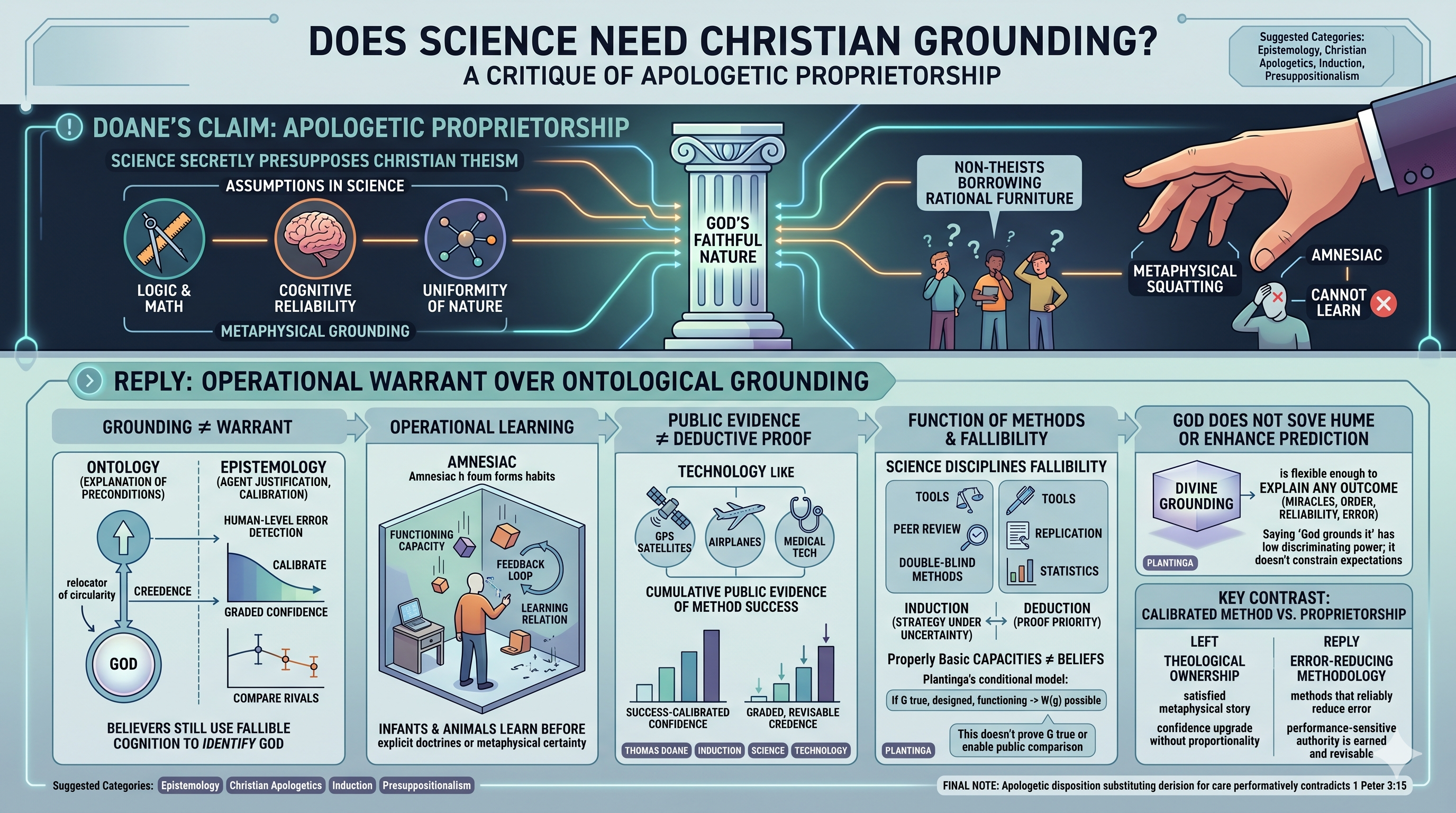
Does Science Need Christian Grounding? A Reply to Thomas Doane
Excerpt: Thomas Doane argues that science is secretly presuppositionalist because it depends on logic, induction, cognitive reliability, and the uniformity of nature. But the argument only works by conflating unwarranted presuppositions with working assumptions based on a substantial density of evidence, confusing metaphysical explanation with agent-level warrant, and granting Christianity an exemption from the very calibration standards it demands of science.
Suggested categories: Epistemology, Christian Apologetics, Induction, Presuppositionalism
Suggested tags: Thomas Doane, induction, science, presuppositionalism, Plantinga, Reformed epistemology, Hume, Goodman, Christian apologetics, credence, epistemology
Note: Quoted Doane passages below are taken from the supplied Facebook-thread text.
The Claim
In a recent Facebook thread, Thomas Doane argued that the scientific method is itself “presuppositionalist.” His basic claim was this:
- Science depends on assumptions such as the uniformity of nature, reliable cognition, logic, causation, and the mathematical structure of the world.
- Those assumptions cannot be justified by science without circularity.
- Therefore science is not epistemically neutral.
- Christian theism supplies the metaphysical grounding for those assumptions.
- Naturalists and atheists therefore borrow the rational furniture of a Christian worldview while pretending to be neutral.
This is a familiar apologetic pattern, though Doane tries to distance himself from Van Til and Bahnsen. He says he is not a presuppositionalist and instead identifies his framework as virtue epistemology. But the actual argument he gives is still a form of apologetic proprietorship: science works, unbelievers reason, technology functions, and human beings learn, but Christianity allegedly owns the metaphysical conditions that make these activities possible.
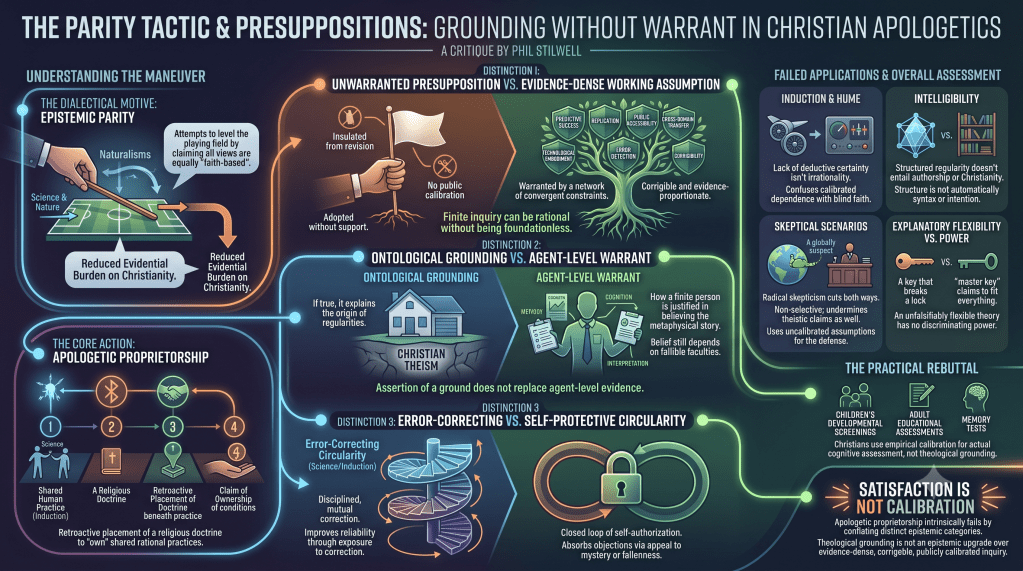
The key mistake appears immediately: Doane treats every starting commitment as though it had the same epistemic status. But there is a deep difference between an unwarranted presupposition and a working assumption based on a substantial density of evidence. A presupposition without evidential warrant is adopted in advance of support and then protected from revision. An evidence-dense assumption is adopted because repeated, public, independent, error-correcting evidence has made it the most rational thing to rely on for now.
Doane states the headline plainly:
“The Scientific Method is Presuppositionalist.”
He then expands the claim:
“Science presupposes the uniformity of nature, the reliability of cognitive faculties, the mathematical structure of the universe, the existence of causal laws, and the validity of logic.”
And later:
“Christianity explains why performance is even possible.”
We can formalize Doane’s core argument like this:


The weak points are premises 3, 5, and 6. Premise 3 equivocates between “methodologically relies on” and “is presuppositionalist in the apologetic sense.” Premise 5 asserts Christian grounding rather than demonstrating it. Premise 6 ignores non-theistic accounts of fallibilistic warrant, pragmatic vindication, evolutionary tracking, mathematical modeling, and public calibration. Most importantly, Doane’s argument bypasses premise 4: the possibility that an assumption can be warranted by substantial evidential density even if it is not deductively proven from outside all cognition.
That position is more modest than crude presuppositionalism. Doane does not say that an atheist must consciously believe in God before doing arithmetic. He grants that non-Christians can reason, do science, and learn from the world. His claim is that they can do so only because they inhabit a God-grounded order and possess God-designed cognitive faculties.
That distinction is important. It is also where the argument begins to unravel.
What Doane Gets Right
Before criticizing the argument, we should grant its strongest points.
Science is not assumption-free. No serious philosophy of science should pretend that inquiry begins from nowhere. Scientists rely on observation, memory, inference, mathematics, instrument calibration, public replication, and background regularities. No scientist can step outside all cognition to validate cognition from a God’s-eye position.
Doane is also right that induction is not deductively certain. Hume’s problem remains real: past regularity does not logically entail future regularity. If someone claims that induction has been deductively proven from pure reason, that person has misunderstood induction.
He is also right that methods do not float in a vacuum. Every method operates inside a broader ecology of cognition, language, training, correction, and social practice.
So the problem with Doane’s argument is not that he asks foundational questions. Foundational questions are legitimate. The problem is that he treats a theological placement of God at the foundation as though it solves the finite agent’s epistemic problem.
It does not.
Presupposition vs Evidence-Dense Assumption
The central distinction is this:
An unwarranted presupposition is a commitment held without adequate evidential support, often insulated from revision. It is a starting point in the bad sense: it does not earn its role by performance, and it does not expose itself to meaningful defeat.
An evidence-dense assumption is different. It is a defeasible reliance formed from a large pattern of successful interaction, prediction, correction, and survival under scrutiny. It may still be an assumption in the broad sense that finite agents must rely on it before they can complete every possible justification. But it is not epistemically naked. It is clothed in evidence.
This phrase, “substantial density of evidence,” is doing real work. It does not mean that a proposition has been proven with Cartesian certainty. It means that many independent streams of evidence converge on the same reliance: perception checked by instruments, instruments checked by prediction, predictions checked by replication, replication checked by peer criticism, and all of it checked by the practical consequences of success and failure.
The distinction can be formalized:


latex \land R(p)) \rightarrow A_E(p)[/latex]


Evidential density is not a magic phrase. It means that a claim or method is supported by many converging indicators: repeated success, independent replication, public accessibility, cross-domain usefulness, predictive precision, error correction, technological embodiment, and willingness to revise when the pattern breaks.
This is why “science has assumptions” is not enough. Of course it does. The question is whether those assumptions are epistemically idle starting points or high-density assumptions forced on us by massive contact with reality. Doane’s argument weakens precisely because it treats these as though they occupy the same evidential category.
Doane’s Christian grounding claim, by contrast, is not evidence-dense merely because it is metaphysically satisfying. To become evidence-dense, it would need public calibration, discriminating predictions, defeater conditions, and comparative superiority over rival explanations. Without those, it remains an unwarranted or under-warranted metaphysical presupposition.
The Central Distinction: Grounding Is Not Warrant
Doane repeatedly argues that Christian theism “grounds” logic, cognition, induction, mathematics, and natural order. But grounding is not the same as warrant.
These are different questions:
- What explains why there is order at all?
- What explains why cognition exists?
- What justifies a finite agent in trusting a particular method?
- What makes one belief-forming practice more reliable than another?
- What public procedures allow us to detect error?
- What should raise or lower our credence in a claim?
Doane answers the first two with a theological story, then acts as if he has answered the rest. That is the central error.
His own wording makes the shift visible:
“Christian theism, by contrast, doesn’t start with phenomenal experiences and hope they map onto reality. It grounds cognition in a rational Creator.”
That is an ontological claim about what reality supposedly depends on. It is not yet an epistemic account of how a finite person should responsibly assign confidence among competing claims.
The distinction can be represented this way:


Even if a proposition would explain the conditions of inquiry if true, the finite agent still needs warrant for that proposition and a way to compare it with rivals.
Suppose, for the sake of argument, that God created a rational world. A human agent still has to decide:
- whether God exists;
- which God exists;
- whether Christian theism is true rather than Islam, Judaism, deism, pantheism, simulation theory, Platonism, or some unknown metaphysical structure;
- whether the Bible is revelation;
- which interpretation of scripture is correct;
- whether Plantinga’s account of warrant is right;
- whether a particular religious experience is trustworthy;
- whether a miracle report is historical;
- whether an apologetic argument is valid.
Every one of those judgments is made by the same fallible human cognition Doane says needs grounding. The believer does not get to bypass the problem by saying “God grounds reason,” because the believer must use reason to identify God as the ground.
That is not an escape from circularity. It is a relocation of circularity behind theological vocabulary.
The Amnesiac Thought Experiment
The clearest pressure point in the thread was the amnesiac-in-a-room case.
Imagine a man wakes up with no memory and no explicit metaphysical beliefs. He is in a room with objects he can manipulate. He picks up an object, drops it, sees it fall, repeats the action, and gradually forms an expectation that similar objects will behave similarly.
Can he learn?
Doane eventually answers yes, but with a qualification: the amnesiac can learn only because he retains God-given cognitive structures in an ordered world.
At first, he denies that the amnesiac has knowledge:
“Without metaphysical grounding, the amnesiac cannot learn anything at all.”
Then, after pressure, he concedes the practical point:
“And the amnesiac example? Yes, he can learn. Because his cognitive faculties still function in an ordered world.”
Later he states the theological reinterpretation:
“Sure—but only because I would still possess the God-given cognitive structure that makes learning possible in the first place.”
That answer concedes the operational point.
Here is the structure of the concession:


The addition does not defeat the operational thesis. It merely adds a theological explanation after the learning relation has already been granted.
The amnesiac does not need to infer Christianity, construct a doctrine of divine faithfulness, solve Hume, read Plantinga, or articulate a metaphysical theory before he begins learning. He needs functioning perceptual and cognitive capacities interacting with a world that supplies feedback.
Doane may then add, “Those capacities are ultimately grounded in God.” But that is a metaphysical interpretation of the learning process, not an operational prerequisite for the learning process.
This distinction matters. If the amnesiac can learn before forming any theistic belief, then explicit God-belief is not necessary for learning. If Doane retreats to the claim that God is the hidden metaphysical cause of the learning, then he has changed the claim from an epistemic requirement to a theological explanation.
That explanation still needs evidence.
Presupposition, Capacity, and Working Assumption
Doane’s argument depends on sliding between several meanings of “presupposition.”
This is clearest when he writes:
“You didn’t remove presuppositions; you removed backstory.”
But “backstory” and “presupposition” are not the same thing, and neither is identical to an innate capacity.
Sometimes he means a conscious belief:
I believe nature is uniform.
Sometimes he means a methodological working assumption:
I will provisionally model this regularity because it has held so far.
Sometimes he means an innate cognitive capacity:
The mind is structured to detect patterns.
Sometimes he means an ontological condition:
A world must be ordered for observation to be possible.
Sometimes he means a theological ground:
God created a rational order.
These are not equivalent.
The equivocation can be made explicit:


Doane’s argument gains force only by letting these categories blur into one another.
An infant does not need a conscious belief in the uniformity of nature before forming expectations. A dog does not need a metaphysical theory before learning that a sound predicts food. A scientist does not need dogmatic certainty that nature is eternally uniform before testing a model. A Bayesian updater does not need a final foundation before adjusting credence in response to success and failure.
Capacities are not doctrines. Working assumptions are not dogmas. Methodological reliance is not metaphysical certainty.
Once those distinctions are kept separate, Doane’s charge loses much of its force.
The important point is not that science has no assumptions. It is that scientific assumptions are continuously disciplined by evidential density. They are not treated as sacred axioms immune to revision. They are retained because they remain massively useful under pressure. When a background assumption stops matching the evidence, science does not preserve it as a devotional commitment. It changes the model.
The False Equivalence About Circularity
Doane repeatedly says science is circular:
- You trust cognition by using cognition.
- You justify induction by appealing to induction.
- You trust perception by relying on perception.
- You use mathematics to confirm mathematics.
There is a genuine issue here. Finite agents cannot get outside every faculty at once. But it does not follow that all circularity is equal.
There is a difference between:
- a method that continues because it survives public, repeated, adversarial testing; and
- a doctrine that declares itself the necessary condition for all testing.
Science is circular only in a broad, unavoidable, fallibilistic sense. It begins with limited faculties, tests them against one another, extends them through instruments, exposes them to replication, quantifies error, and revises models when they fail. Its confidence is earned, graded, and defeasible. The circularity is constrained by evidential density.
Theological grounding is circular in a different sense. The believer uses cognition to identify God, scripture, doctrine, and revelation, then says God validates cognition. That loop is not made non-circular by calling it “hierarchical.”
Doane explicitly tries to escape this objection by hierarchy:
“The Christian claim is not that my interpretation grounds induction; it’s that God’s nature grounds the reliability of the world.”
But the human agent still has to identify God’s nature, decide that Christianity is true, and judge that this theological claim is the right explanation. Those are agent-level tasks performed by fallible cognition.
The hierarchy move looks like this:


The theological ground may be placed “above” cognition in the story, but the believer’s access to that story still runs through cognition.
The real issue is not whether there is any circularity. Some circularity is unavoidable for finite agents. The issue is whether the circle is error-correcting or self-protective.
Science calibrates belief to performance. Doane’s theological grounding calibrates performance to a prior theological story.
Those are not the same epistemic posture.
We can express the difference directly:


Technology Is Evidence, Not Deductive Proof
Doane mocks appeals to technology as though the argument were:
- We have phones.
- Therefore metaphysics is solved.
But that is not the argument.
The argument is that technology is cumulative, public evidence of method. Airplanes, antibiotics, satellites, MRI machines, semiconductors, GPS, lasers, vaccines, and engineering tolerances are not isolated lucky guesses. They are the residue of models that repeatedly survive contact with reality across independent domains. They are evidential density made physical.
This does not deductively prove induction. It does not provide metaphysical certainty. It does not show that nature must remain uniform forever.
Doane’s dismissal is blunt:
“Success is not the same thing as justification.”
That sentence is half right and half too strong. Success is not deductive proof, but sustained predictive success is evidence.
But it does raise rational confidence.
A lucky gambler may win once. Perhaps twice. But if someone repeatedly makes precise, public, risky predictions across centuries, under adversarial review, in independent domains, with correction mechanisms and practical outputs, “luck” is no longer the best explanation.
In a fallibilistic epistemology, evidence is exactly what should move credence.
If a method repeatedly outperforms its rivals, continuing to use it is rational. If it stops working, rational agents should revise or abandon it. That is not blind faith. That is calibrated dependence.
A compact performance formalization is:


This is not a proof that the future must resemble the past. It is a rule for rational method-selection under uncertainty.
The point is not “technology works, therefore science is metaphysically certain.” The point is “technology works across vast domains, under public constraint, with repeatable precision, therefore scientific assumptions have very high evidential density.” Doane’s rhetoric collapses this into “mere success,” but success at this scale is not mere. It is the principal way finite agents distinguish reliable maps from attractive inventions.
Induction Does Not Need to Become Deduction
Doane treats the problem of induction as though induction fails unless it becomes deductively certain. But that demand is misplaced.
Induction is not trying to be deduction. Its role is different.
Deduction preserves truth if the premises and rules are granted. It does not supply the premises, identify the domain, stabilize the meanings, calibrate the instruments, or tell finite agents when a formal system applies to the world.
Human beings learn before they formalize. Infants track regularities before they state logical rules. Children learn language by exposure, correction, and generalization. Scientists form models, test them, revise them, and only later build formal structures around what has proven stable.
Deduction has priority inside a proof. Induction has priority in the human ecology that makes proof usable.
That is why “induction is not deductively justified” is not the devastating objection Doane thinks it is. Of course induction is not deductively justified. The question is whether it is the best available strategy for finite agents under uncertainty.
It is.
The rational rule is modest:
To the degree and for as long as a method works, let it inform expectation.
In formal terms:


![\forall M \forall t\,[W_\lambda(M,t) \rightarrow I_t(M)]](https://s0.wp.com/latex.php?latex=%5Cforall+M+%5Cforall+t%5C%2C%5BW_%5Clambda%28M%2Ct%29+%5Crightarrow+I_t%28M%29%5D&bg=ffffff&fg=000&s=0&c=20201002)

That rule is self-referential, but not viciously so. It selects itself only insofar as it performs. If a better method appears, the rule tells us to move toward the better method. Dogma does the opposite: it protects the conclusion before performance is assessed.
This is why induction can be rational without being deductively certain. It has density, not finality. It is justified by the accumulated weight of successful use, correction, and comparative failure of alternatives, not by pretending to be an axiom floating above experience.
Christianity Does Not Solve Hume
Doane says Christianity grounds induction in the character of a faithful Creator. But that does not solve Hume’s problem. It adds a theological premise that itself requires support.
His formulation is:
“Christianity doesn’t solve Hume by offering a new inductive argument; it solves Hume by grounding induction in the character of a faithful Creator.”
To use “God’s faithful character” as a solution, the believer must already trust:
- cognition;
- memory;
- testimony;
- textual transmission;
- interpretation;
- theological inference;
- the reliability of religious experience;
- the correctness of Christian doctrine over rival doctrines.
Those are precisely the kinds of faculties and practices under discussion.
So the attempted solution has this form:


The Christian cannot say, “I know induction is reliable because God is faithful,” unless he also explains how he knows God is faithful without already relying on the cognitive and inductive practices he says need God as their ground.
This is why the move is not a solution. It is an extra loop.
The “God Explains It” Inflation
There is a difference between an explanation and a label placed over a mystery.
Doane repeatedly says Christian theism explains order, cognition, logic, mathematics, and projectibility. But a claim does not become an explanation merely by being placed at the bottom of a diagram.
Here is one of his strongest summary statements:
“Christian theism doesn’t slap a divine sticker on the mystery; it provides ontological grounding, modal grounding, epistemic grounding, and mathematical grounding for the very conditions that make science possible.”
An explanation should do some work. It should clarify mechanisms, constrain expectations, discriminate between possible worlds, or improve prediction.
An explanation earns its keep only if it changes expectation:


Doane asserts this advantage. He does not calculate it, constrain it, or show that Christian theism predicts the actual pattern better than alternatives.
What does “God grounds induction” predict?
Would it predict a perfectly orderly universe? Apparently not, because theism allows miracles.
Would it predict occasional exceptions? Apparently yes, because theism allows miracles.
Would it predict mathematical elegance? Yes, if we observe elegance.
Would it predict mathematical messiness or cognitive opacity? Also yes, if the apologist appeals to mystery, fallenness, divine transcendence, or finite minds.
Would it predict reliable cognition? Yes, because we are designed for truth.
Would it predict unreliable cognition? Also yes, because we are finite, fallen, embodied, biased, damaged, or affected by sin.
This is not explanatory power. It is explanatory flexibility.
A hypothesis that can absorb every outcome has not earned confidence from any particular outcome. It has become a floating interpretive overlay.
The problem is unfalsifiable flexibility:


The Intelligibility Leap
Doane’s argument depends heavily on the idea that an intelligible universe points to a rational mind. But this requires several bridge premises he does not establish.
The move often goes like this:
- The universe is intelligible.
- Intelligibility is mind-like.
- Therefore the universe is grounded in a mind.
- That mind is eternal, immaterial, rational, personal, maximally great, and Christian.
Each step needs argument.
The invalid strengthening is:


“Intelligible” can mean several things:
- modelable by finite agents;
- structured by stable regularities;
- comprehensible in principle;
- intentionally designed to be understood.
The evidence most clearly supports the first two. It does not automatically support the fourth.
Stable structure does not entail authorship by a mind. Snowflakes, crystals, river deltas, immune systems, ecosystems, and planetary orbits display structure without being artifacts in the ordinary sense. If the apologist wants to infer a mind from structure, he must show that structure is more expected on theism than on rival explanations after accounting for complexity, prior probability, alternative mechanisms, and observer-selection effects.
Even if a mind were somehow inferred, the full Christian package would not follow. “Some mind grounds intelligibility” is not equivalent to “the triune God of Christianity exists, revealed himself in scripture, and validates Christian doctrine.”
That final leap is doing enormous hidden work.
The Problem With “Green, Not Grue”
Doane appeals to Goodman’s “grue” problem: if we rely on patterns, why privilege ordinary predicates like green over artificial predicates like grue?
He states the charge this way:
“Theism explains why green is projectible and grue is not. Your worldview can’t even tell the difference.”
This is a real philosophical puzzle. But theism does not solve it merely by saying “God grounds projectibility.”
The missing step is:


Even if God grounded projectible kinds, the agent still needs a method for identifying which predicates are projectible. That method is supplied by ordinary inductive practice, not by the bare assertion of divine grounding.
Why is green projectible and grue not? If the answer is “because God made a stable world,” how do we know which descriptions capture the stability God made? We find out by experience, compression, causal modeling, background theory, simplicity, and predictive success.
That is induction again.
The theist still has to use the same projectibility practices to decide which predicates are natural, which kinds are stable, and which regularities matter. Saying “God grounds natural kinds” does not tell us which kinds are natural. It gives no usable rule for distinguishing green from grue unless ordinary inductive practice has already done the sorting.
So the grue objection pressures naive induction. It does not uniquely support Christian theism.
The Brain-in-a-Vat Move Backfires
Doane repeatedly invokes hallucinations, simulations, dreams, and brains in vats. His point is that a stable experience could be false, so pragmatic success cannot distinguish reality from a well-designed illusion.
His strongest formulation is:
“Stable hallucinations produce the same ‘functional expectations’ as real perceptions.”
But this skeptical weapon cuts both ways.
A Christian could also be:
- hallucinating revelation;
- misreading scripture;
- deceived by religious experience;
- trapped in a simulation with Christian-seeming data;
- formed by a culture that rewards Christian interpretations;
- cognitively biased toward agency and teleology.
Theism does not defeat skepticism simply by asserting that God would not deceive. That assertion is itself one more theological claim requiring warrant.
The symmetry is straightforward:


If Doane’s standard is that a worldview must eliminate all skeptical possibilities before learning counts as knowledge, then Christianity fails too. If the standard is more modest, then ordinary fallibilistic inquiry is back on the table.
The amnesiac does not need certainty that he is not in a simulation before learning how the room behaves. He can form reliable expectations relative to the experiential environment he occupies. That is enough for functional knowledge and rational action.
The Plantinga Overreach
Doane appeals to Reformed epistemology and properly basic cognitive capacities. But several distinctions are being blurred.
He writes:
“Christian philosophy calls these properly basic capacities: perception, intentionality, rational intuition, causal awareness, and the ability to form beliefs at all.”
And then:
“Properly basic rational capacities are not reducible to the brain.”
First, properly basic beliefs are not the same as cognitive capacities. Perception, memory, inference, and object recognition are capacities. Belief in God is a propositional or quasi-propositional commitment. Treating them as equivalent lets theistic belief inherit the plausibility of ordinary cognition without doing the same public work.
The category mistake is:


Second, Plantinga’s warrant model is conditional. Roughly, if Christian theism is true, and if God designed human cognitive faculties for truth, and if the relevant faculties are functioning properly in the right environment according to a truth-aimed design plan, then Christian belief can be warranted even without inferential evidence.
That conditional can be represented as:


But this does not yield:

Nor does it give a public procedure for comparing Christianity with rival religious claims.
But that is not a public demonstration that Christianity is true. It is a description of how Christian belief could be warranted if Christianity is true.
Third, religious diversity creates a calibration problem. Many people report properly basic-seeming religious beliefs that conflict with Christianity. If the sensus divinitatis delivers Christianity to one person, Islam to another, Hindu devotion to another, and non-theistic spiritual experience to another, then the public question returns: which deliverances are truth-tracking?
Plantinga does not make that question disappear. He relocates it.
Fourth, proper-function claims need calibration. In ordinary cases, we test perception and memory through cross-checking, prediction, testimony, instruments, and correction. Theistic belief is often insulated from those same checks. That is epistemic exceptionalism.
Evolution and “Survival, Not Truth”
Doane also argues that evolution selects for survival, not truth, and therefore naturalism cannot trust cognition.
His version is:
“Evolution selects for survival, not truth.”
This is too quick.
The overstatement can be shown formally:


The fact that evolution selects directly for fitness does not imply that truth-tracking is irrelevant to fitness. In many ordinary domains, truth-tracking is one of the ways fitness is achieved.
Evolution need not produce perfect cognition to produce usable cognition. In ordinary environments, many true-enough beliefs are survival-relevant. If an organism systematically misrepresents cliffs, predators, food, fire, social threats, or bodily injury, it will tend to fare poorly.
Of course evolution also produces bias, over-detection, confabulation, motivated reasoning, tribal cognition, and false positives. That is exactly why science does not merely trust raw cognition. It disciplines cognition through:
- measurement;
- instrumentation;
- replication;
- statistics;
- peer review;
- adversarial testing;
- double-blind methods;
- error bars;
- public correction.
The scientific method is not built on the fantasy that our minds are perfectly reliable. It is built around the fact that our minds are not perfectly reliable.
Doane treats fallibility as a defeater. Science treats fallibility as a design constraint.
The Practical Rebuttal: Christians Do Not Use Divine Grounding to Assess Minds
There is also a behavioral problem for Doane’s view.
Christians do not actually assess cognitive reliability by appealing to divine grounding. They use the same empirical tools as everyone else.
For children, they use developmental screenings, educational assessments, and psychological evaluation.
For adults, they use academic performance, job testing, professional certification, and observed competence.
For aging minds, they use memory tests, neurological evaluation, and medical diagnosis.
No one says, “This person is made in the image of God, therefore no cognitive assessment is needed.” In practice, Christians treat cognitive reliability as something measured by performance, health, behavior, and error patterns.
That practice is correct. It is also a performative rebuttal to the claim that divine grounding gives actionable epistemic assurance.
What Doane Would Need to Prove
To make his argument work, Doane would need to show more than “science has assumptions.” Everyone serious grants that finite inquiry has starting points.
He would need to show all of the following:
- That naturalistic, pragmatic, and fallibilistic accounts of cognition and induction are not merely incomplete, but unusable.
- That Christian theism supplies not just a possible metaphysical story, but a better explanation than rival metaphysical stories.
- That the Christian explanation yields public calibration advantages rather than merely redescribing the same practices.
- That the believer can identify God, revelation, scripture, and doctrine without relying on the same fallible faculties under dispute.
- That Christian theism explains both order and exception without becoming unfalsifiably flexible.
- That Plantinga-style proper function can distinguish Christian belief from rival religious deliverances in a publicly responsible way.
- That theistic grounding improves our actual ability to assign credence, detect error, and revise belief.
He does not establish these. He mostly asserts that Christianity “grounds” what science “assumes.”
That is not enough.
The missing demonstration is an evidential-density demonstration. Doane would need to show that Christian grounding has more predictive, explanatory, and calibrating density than the fallibilistic assumptions used by science. Merely naming God as the ground does not supply that density.
The Real Contrast
Doane asks:
What ultimate metaphysical story would make cognition and induction secure?
My position asks:
Which methods reliably reduce error for finite agents under uncertainty?
Those are different questions.
A second contrast is equally important:
Is this an unwarranted presupposition, or is it an assumption whose role has been earned by substantial evidential density?
This contrast matters because Doane’s own summaries repeatedly return to ownership language:
“Christianity explains why perception is reliable, why inference tracks truth, why memory has continuity, and why the world is intelligible in the first place.”
That is not a method for public calibration. It is a theological proprietorship claim.
Doane treats failure to answer the first as defeat. But the first question is often inflated beyond human reach. Finite agents do not need absolute metaphysical security before acting rationally. They need methods that constrain confidence, expose error, and improve prediction.
The scientific method does not claim certainty from nowhere. It operates with graded confidence. It observes patterns, tests expectations, revises models, discards failures, and retains methods that continue to predict and explain experience with superior reliability. Its assumptions are not weightless. They are dense with public evidence.
Christian apologetics often moves in the opposite direction. It declares a foundation, interprets the world through that foundation, and then treats the declaration as the condition for rationality itself. That is a low-density presupposition masquerading as a high-density explanation.
That is not an epistemic upgrade. It is a confidence upgrade without proportional calibration.
Conclusion: Apologetic Proprietorship Is Not Explanation
Doane’s argument is not foolish. It is not the worst version of presuppositionalism. It recognizes that non-Christians can reason and that explicit God-belief is not required before doing science.
But its more sophisticated form still fails.
It takes the success of shared human cognition and places Christianity underneath it after the fact. It then calls that placement “grounding.” But unless the grounding claim improves prediction, constrains expectation, supplies public calibration, or gives finite agents a better method for assigning credence, it is not doing the epistemic work claimed for it.
The scientific method does not need to be metaphysically self-grounding. It needs to be the most reliable fallibilistic method available to agents like us. Its authority is not absolute. It is earned, revisable, performance-sensitive, and evidentially dense.
That is exactly its virtue.
Christian theism may offer believers a satisfying metaphysical story. But satisfaction is not calibration. A theological explanation that can be fitted around every outcome, that depends on the same cognition it claims to validate, and that grants itself exemption from public defeaters has not solved the problem of induction. It has not converted itself from an unwarranted presupposition into an evidence-dense assumption.
It has merely moved the mystery upstairs and renamed it God.
Related Reading
- Induction: The Best Game in Town
- Induction Before Deduction
- Grounding Ways of Knowing
- Why an Intelligible Universe?
- God Does Not Ensure Cognition
- Against Epistemic Exceptionalism in Plantinga’s Warrant Theory
Final Note: Doane’s Disposition and 1 Peter 3:15
There is also a specifically Christian standard worth mentioning. 1 Peter 3:15 is often cited as the apologetic mandate: believers should be ready to give a reason for their hope, but do so with “gentleness and respect.”
On that internal standard, Doane’s rhetorical disposition is difficult to defend.
This is not a complaint that he is forceful. Strong argument is not a vice. Nor is it a demand that disagreement be wrapped in sentimental softness. The issue is that Doane repeatedly substitutes derision for dialectical care. He calls opposing claims “adorable,” “cute,” “wishful thinking with a lab coat,” “metaphysical squatting,” and “the kind of wrong that’s almost impressive in its density.” He compares interlocutors to toddlers, mocks their reading comprehension, and frames disagreement as intellectual embarrassment rather than as a serious exchange between persons.
That posture matters because apologetic rhetoric is not merely decorative. It reveals how the apologist understands the person across the table. A Christian apologist who claims to defend rationality while treating interlocutors with contempt performs a quiet contradiction: he may offer arguments for Christianity, but his manner of offering them becomes evidence against the moral and spiritual formation Christianity is supposed to produce.
The problem is especially sharp because Doane explicitly presents himself as someone seeking “genuine philosophical discourse.” But genuine philosophical discourse requires more than vocabulary, references, and confidence. It requires charity, responsiveness, conceptual discipline, and the ability to represent an opponent’s position without sneering at it. By that standard, his disposition repeatedly undermines his stated aim.
So the final critique is not merely epistemic. It is performative. Doane argues that Christianity grounds rationality, virtue, and the conditions of knowledge. Yet his public apologetic style often violates the very Christian norm most commonly attached to apologetics itself. A defense of the faith delivered without gentleness and respect may still be rhetorically entertaining, but it is poorly aligned with 1 Peter 3:15.
A Deeper Treatment of the Dynamics: The Parity Tactic and Presuppositions


 Free of Faith
[…] #34 ✓ Consider: Can punishable culpability for an offense be legitimately reassigned to someone ot… […]