

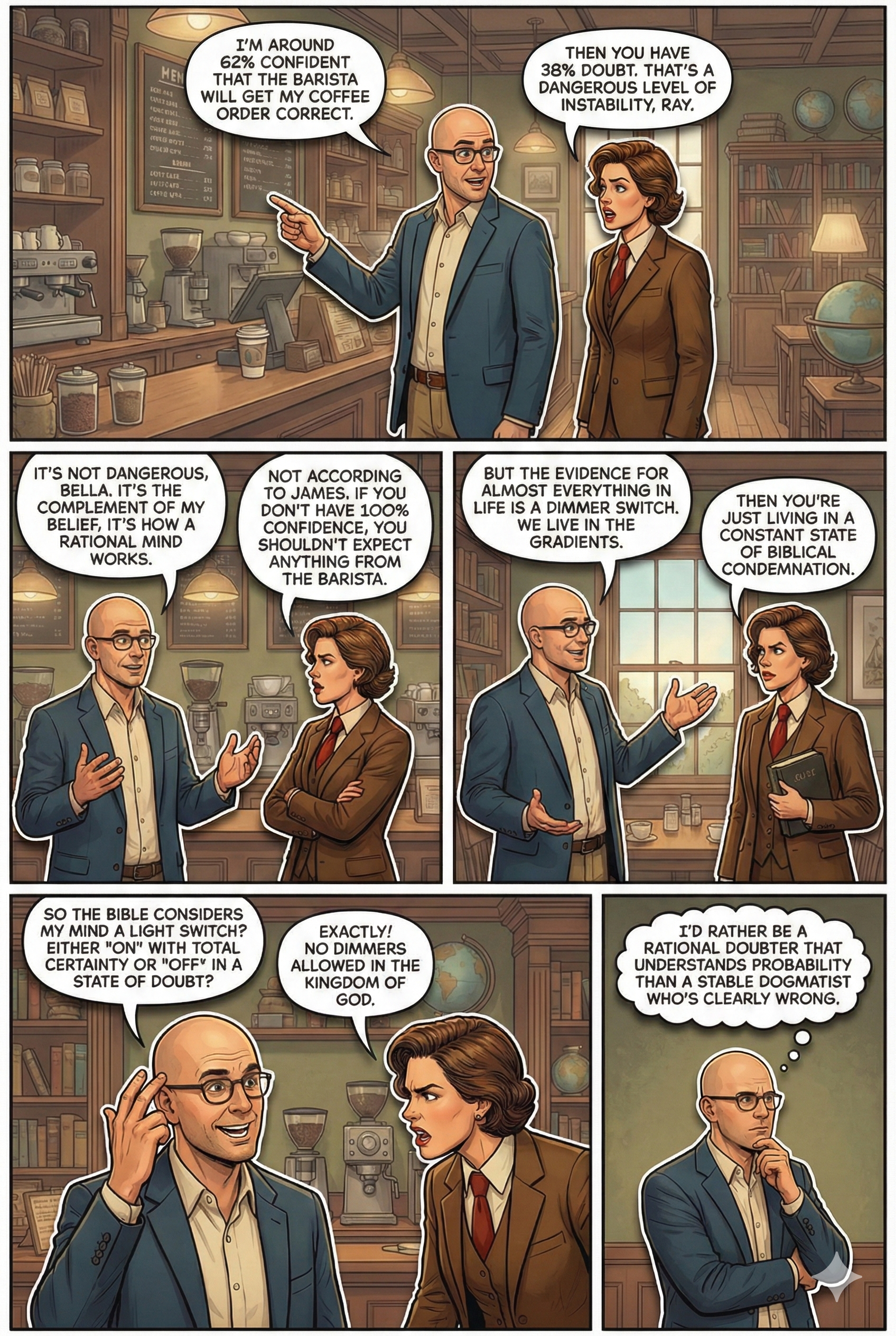
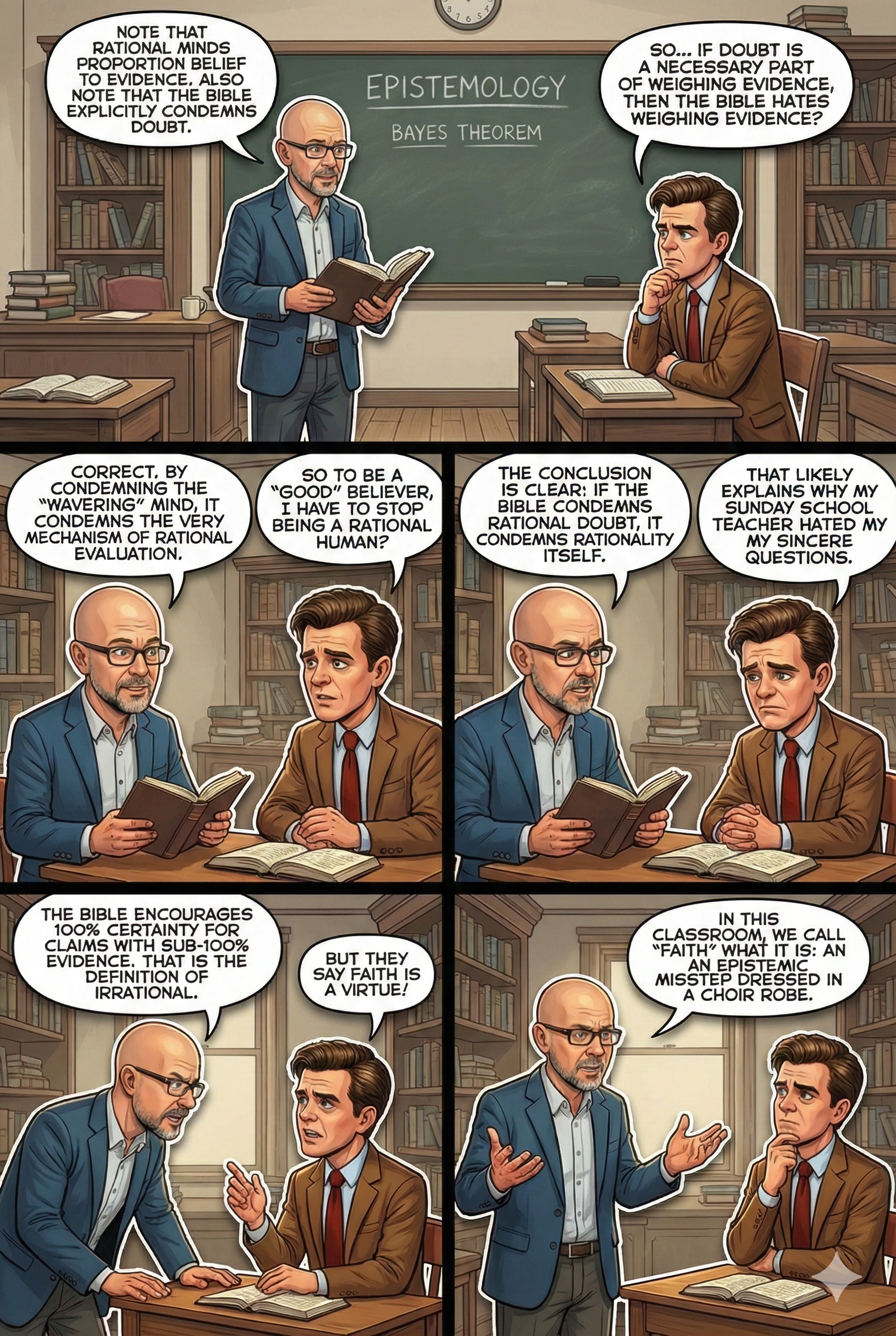
If your degree of confidence in a claim is 62%, your degree of doubt will be 38%, its complement. Rational minds weigh the balance of confirming and disconfirming evidence and position their degree of confidence at that level of evidence.
This is the source of the predictive success of rational minds in every domain of life. For all things inductively assessed, the degree of belief for a rational mind can never legitimately reach absolute certainty, but only asymptotically approximate absolute certainty or absolute disbelief.
It follows from this that doubt is in no way intrinsically illogical, evil, or non-virtuous. Doubt is an epistemic virtue whenever it maps to the degree of uncertainty that follows from the evidence.
Here are a few examples:
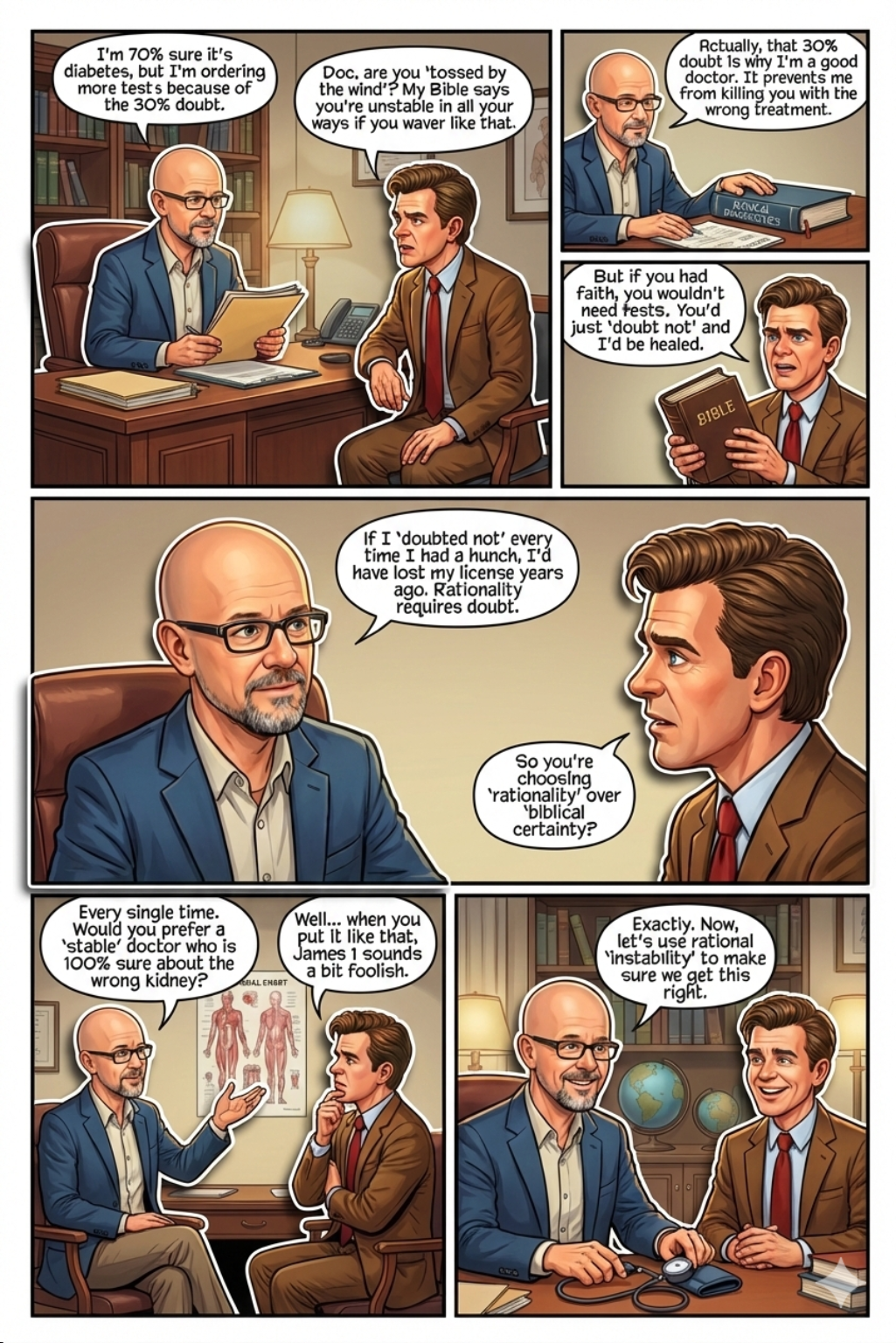
- Medical Diagnosis: A doctor has reviewed test results and symptoms and estimates a 70% probability that a patient has Condition A. Given the 30% chance it could be another condition, the doctor orders additional tests before confirming a diagnosis.
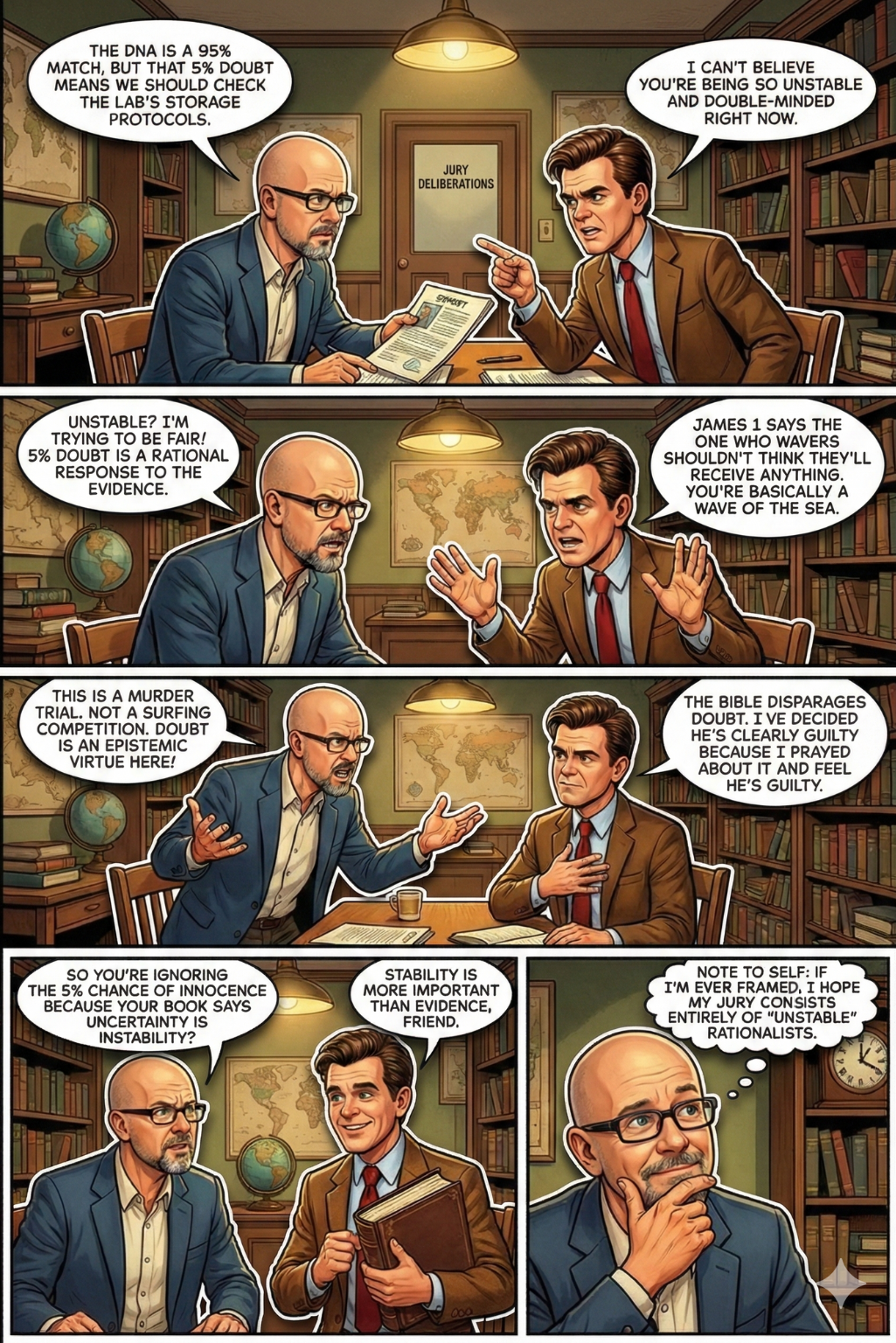
- Jury Decision-Making: A juror hears strong evidence for a defendant’s guilt but also sees some inconsistencies in the prosecution’s case. They assign an 80% probability to guilt but maintain a 20% doubt, leading them to ask for further deliberation before reaching a verdict.
- Stock Market Predictions: An investor analyzes market trends and determines there is a 65% chance that a stock will rise in value. Acknowledging the 35% chance of decline, they diversify their investments to manage risk.
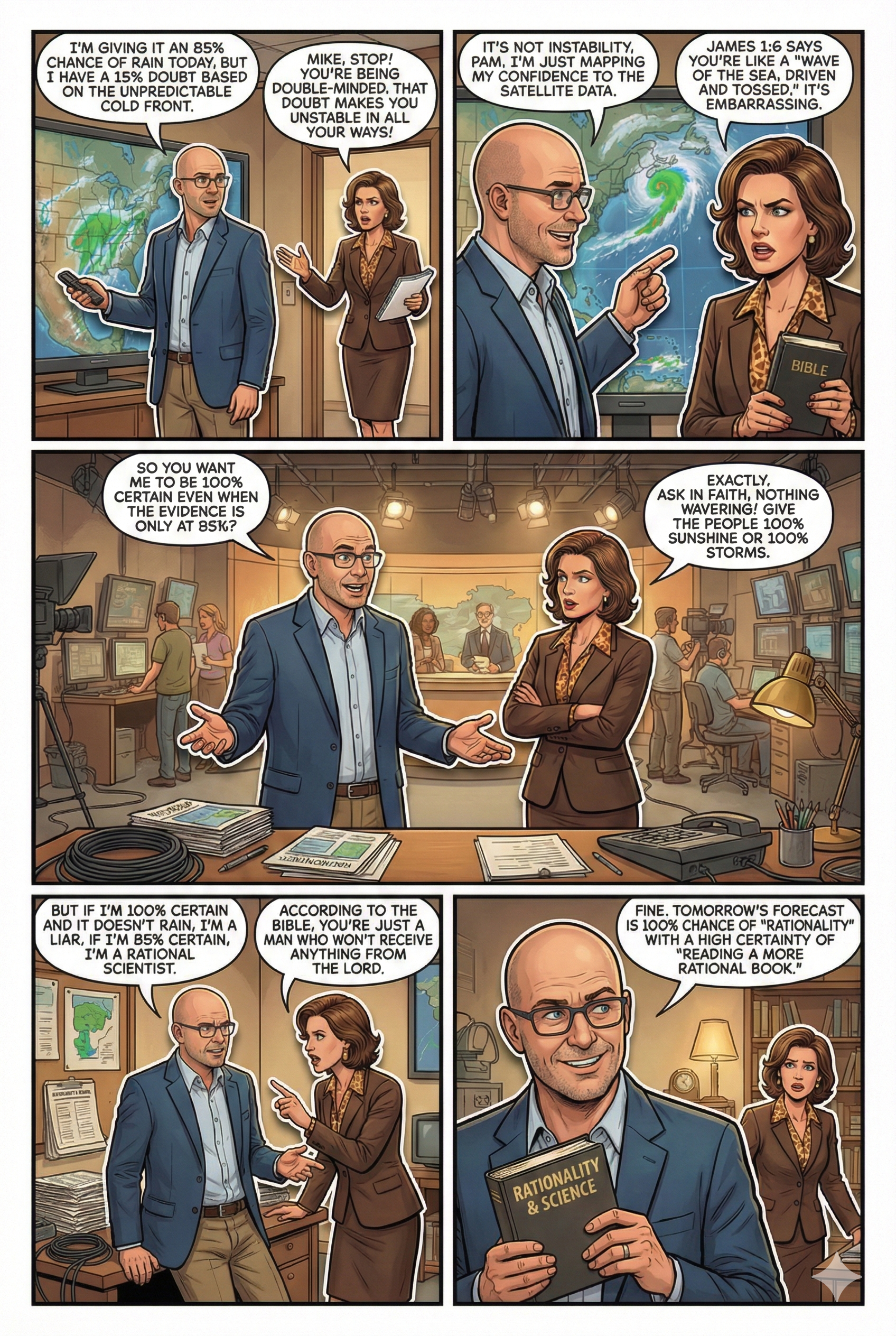
- Weather Forecasting: A meteorologist predicts an 85% chance of rain based on satellite imagery and historical patterns but still acknowledges a 15% chance of dry weather, advising people to carry umbrellas just in case.
- Scientific Theories: A physicist evaluates an emerging theory in quantum mechanics. Given current experimental results, they assign a 90% probability that the theory is correct but recognize a 10% uncertainty that future discoveries might refine or overturn it.
- Historical Analysis: A historian examines multiple sources and concludes that there is a 75% chance that a specific battle occurred on a particular date. The remaining 25% uncertainty leads them to consider alternative interpretations.
This is not how the Bible treats doubt. The Bible makes it clear that doubt reflects instability and double-mindedness. The following verses are from the first chapter of James:
5 If any of you lack wisdom, let him ask of God, that giveth to all men liberally, and upbraideth not; and it shall be given him.
6 But let him ask in faith, nothing wavering. For he that wavereth is like a wave of the sea driven with the wind and tossed.
7 For let not that man think that he shall receive any thing of the Lord.
8 A double minded man is unstable in all his ways.
There is no admonition to map one’s degree of confidence in actually receiving wisdom to the degree that God has come through in the past. Bible believers are told not to have doubt. And the reason is not specific to asking for wisdom. The reason is universal; as universal as the waves of the sea driven and tossed by the wind. The one who doubts is unstable in all this ways. Any degree of doubt reflect a weak mind, according to the Bible, and is enough to be denied wisdom.
This is not the only Biblical context in which doubt is shown to be unacceptable. The following is from Chapter 21 of Matthew:
21 Jesus answered and said unto them, Verily I say unto you, If ye have faith, and doubt not, ye shall not only do this which is done to the fig tree, but also if ye shall say unto this mountain, Be thou removed, and be thou cast into the sea; it shall be done.
22 And all things, whatsoever ye shall ask in prayer, believing, ye shall receive.
Any veteran Christian will have experienced asking for something in full confidence they will receive what they ask for…only to not be given what they asked for. This is not a trivial incoherency between biblical promises and reality. However, we want to here focus on the Bible’s incoherent disparagement of rational doubt.
Christians who claim that the Bible allows for rational doubt must twist or hide these verses that transparently condemn doubt. A doubting human is unstable in all his ways.
The following is a logical formulation of the primary argument:
Syllogistic Form:
P1: Rational minds proportion their degree of belief to the weight of the available evidence.
P2: Doubt is the complement of belief and represents the remaining epistemic uncertainty.
P3: Rational minds necessarily experience doubt when the evidence does not reach 100% certainty.
P4: The Bible explicitly condemns doubt, treating it as instability and double-mindedness.
P5: If rational doubt is condemned, then the Bible condemns rational evaluation of evidence.
C: Therefore, the Bible condemns rational evaluation of evidence.
Symbolic Logic Form:

Let:
- B(x) = x proportionally adjusts belief to evidence
- D(x) = x experiences doubt in proportion to uncertainty
- R(x) = x is rational
- C(y, z) = y condemns z
- BIBLE = Biblical doctrine
Formalized argument:
(All rational minds proportion belief to evidence and experience doubt accordingly.)
(Doubt is the complement of belief.)
(Rationality entails doubt when certainty is not absolute.)
(The Bible condemns doubt.)
(If the Bible condemns doubt, then it condemns rationality.)
(The Bible condemns rationality.)


Conclusion:
The Bible is irrational. Doubt is rational in every case in which the evidence is not absolute, and the evidence is never absolute for claims that require the inductive exploration of claims outside our minds. Any source that condemns doubt as a product of an unstable mind is itself irrational. The Bible is irrational.

Theistic arguments against the essay above:
Objection 1: The Bible Condemns Unjustified Doubt, Not Rational Inquiry
Argument:
The Bible does not condemn all forms of doubt but only doubt that stems from a lack of trust in God. Rational inquiry, including doubt based on evidence, is not inherently condemned. For instance, Thomas doubted Jesus’ resurrection, and Jesus provided evidence rather than rebuking him harshly (John 20:24-29).
Response:
- The general biblical stance on doubt is overwhelmingly negative. James 1:6-8 does not specify “unjustified doubt”; it states that any wavering makes a person unstable in all ways. Other biblical authors may have beel less dogmatic than James, but if you want to say the Bible is the word of God, you’ll need to accept Jame’s universal condemnation of doubt.
- The contrast between rational minds (who necessarily doubt when evidence is incomplete) and biblical faith (which discourages doubt) is unavoidable. Faith demands unwavering confidence, which is incompatible with rational epistemology. One only needs to read the binary disposition toward redemptive beliefs in the third chapter of John to realize that doubt cannot exist in a “proper” conversion, much less be considered epistemically virtuous.
Objection 2: Rational Minds Can Hold Strong Faith While Accepting Some Uncertainty
Argument:
Many theistic philosophers, such as Alvin Plantinga, argue that belief in God is “properly basic,” meaning it does not require empirical evidence. A rational mind can accept religious belief as a foundational assumption, just as one assumes the reliability of logic or the external world.
Response:
- The distinction between “properly basic beliefs” and empirical evidence does not resolve the contradiction. If rational minds proportion belief to evidence (P1 of the syllogism), then faith, by definition, requires an arbitrary exception to that rule.
- Unlike assumptions such as logical axioms, belief in God makes empirical claims (e.g., divine interventions, answered prayers), which should be subject to the same scrutiny as any other inductive claim.
- A properly basic belief should not lead to contradictions with observable reality, yet religious claims (such as guaranteed answered prayers in Matthew 21:22) demonstrably fail in real-world testing.
Objection 3: The Bible Encourages Seeking Evidence (Acts 17:11, 1 Thessalonians 5:21)
Argument:
Some biblical verses, such as Acts 17:11 (“examining the Scriptures daily to see if these things were so”) and 1 Thessalonians 5:21 (“test everything; hold fast to what is good”), support critical evaluation of beliefs. This shows that rational analysis is not condemned.
Response:
- These verses only encourage examination within a predefined framework (i.e., testing whether claims align with Scripture). They do not advocate for open-ended skepticism or doubt proportional to evidence. Additionally, there is no mention of the tools of rationality that would guide rational belief in those few contexts in which Christians are told to test their beliefs. (See Considerations #07.)
- Testing within a closed system (e.g., confirming biblical consistency) is not the same as rational inquiry that allows for falsification. (View the article on unfalsifiability.)
- The primary biblical stance remains that faith should be unwavering. Any testing that results in continued doubt contradicts James 1:6-8 and Matthew 21:21-22. Biblical passages that conflicts with these verses cannot be used to counter the clear admonitions against doubt they contain.
Objection 4: Rationality is Limited, and Divine Truth Transcends It
Argument:
Rationality is a human construct, and divine truth surpasses human logic. If God exists, His ways would not necessarily conform to our limited epistemic methods. Faith is necessary because God’s knowledge is beyond human comprehension.
Response:
- This is the argument of all religions Christians consider false.
- This argument concedes that religious belief is not based on rational principles but on the separate and inferior epistemic framework of faith.
- If a belief system requires abandoning rational consistency, then it cannot be defended using logic—this is an implicit admission that it fails by rational standards.
- Moreover, invoking divine transcendence as a justification for faith does not provide a method for distinguishing true religious claims from false ones. This justifiably demotes faith an unreliable epistemic tool.
Objection 5: The Success of Rational Minds Does Not Disprove Faith
Argument:
Rationality may be effective in practical domains (e.g., science, medicine, law), but this does not mean faith in God is irrational. Faith concerns spiritual truths that operate in a different domain than empirical inquiry.
Response:
- If faith claims never need to align with empirical evidence, then they cannot be assessed as true or false, making them indistinguishable from arbitrary beliefs.
- However, many religious claims are empirical (e.g., miracles, divine intervention, prophecy fulfillment). These should be evaluated with the same scrutiny as other factual claims.
- The essay’s argument does not require faith to be empirically disproven, only that it is epistemically inconsistent with rational standards. If religious belief discourages proportional doubt, it remains in conflict with rational inquiry.
Objection 6: Faith and Rationality Can Coexist as Separate Modes of Knowing
Argument:
Some theologians argue that faith and reason serve different purposes. Rationality helps us navigate the world, while faith connects us to spiritual truths that are not accessible through reason alone.
Response:
- If faith operates outside of reason, then it cannot claim rational justification. This is functionally equivalent to admitting that religious belief is non-rational.
- Claiming that faith is a “separate way of knowing” does not explain how it provides knowledge rather than mere belief. Without a mechanism for verification, faith remains indistinguishable from superstition.
- There appears no way to establish that faith is produces superior results within whatever domains it is said to operate. If an apologists would like to step up with a rigorous way to test the epistemic superiority of faith in particular domains, Free of Faith would like to hear from you.
Objection 7: Miracles and Personal Experience Provide Non-Rational Justification for Faith
Argument:
Many believers claim personal religious experiences as evidence. Reports of miracles, answered prayers, and deep spiritual transformations indicate that faith is justified beyond purely rational means.
Response:
- Personal experience is unreliable as an epistemic method. People from all religions report miracles and divine interventions, often in ways that contradict each other. However, if there are Christian apologists who have the faith to move mountains in a God who responded to Elijah’s request for fire from Heaven, Free of Faith would like to hear from you.
- Human cognitive biases (e.g., confirmation bias, pattern recognition, placebo effects) can explain many religious experiences without invoking the supernatural. However, statistical data such as COVID-19 mortality/morbidity rates among Christians and non-Christians could serve as legitimiate evidence in favor of miracles. Free of Faith always welcomes verifiable statistical evidence.
Conclusion:
Each theistic objection either misinterprets the essay’s argument or concedes that faith operates outside rational epistemology. The core issue remains: If rational minds proportion belief to evidence, and the Bible discourages doubt, then biblical faith is fundamentally at odds with rational evaluation.



 Free of Faith
Leave a reply to Phil Stilwell Cancel reply