
Full Discussion Thread from Christian Apologetics Group
◉ Would a Truly Compassionate God Condemn Honest Seekers — or Only Those Who Reject Faith?
Click to view the initial Facebook group post
1. MI-WI Thread
MI-WI:
John 3:17 – “For God sent not his Son into the world to condemn the world; but that the world through him might be saved.”
→ PH-ST: MI-WI
If God “did not send the Son to condemn,” then condemning proportioned belief under symmetric inputs contradicts that posture. Romans 1–2 at most ground general awareness, not selection among rival revelations. So either God clarifies which revelation is true in time, or He does not punish honest uncertainty.
→→ MI-WI: PH-ST
There is no difference in the trains of thought here. Both Romans and John are explaining God’s effort to redeem man and man’s rejection of God. Here’s the whole thought from John 3:16-21 […] “He that believeth not is condemned already …”
→→→ PH-ST: MI-WI
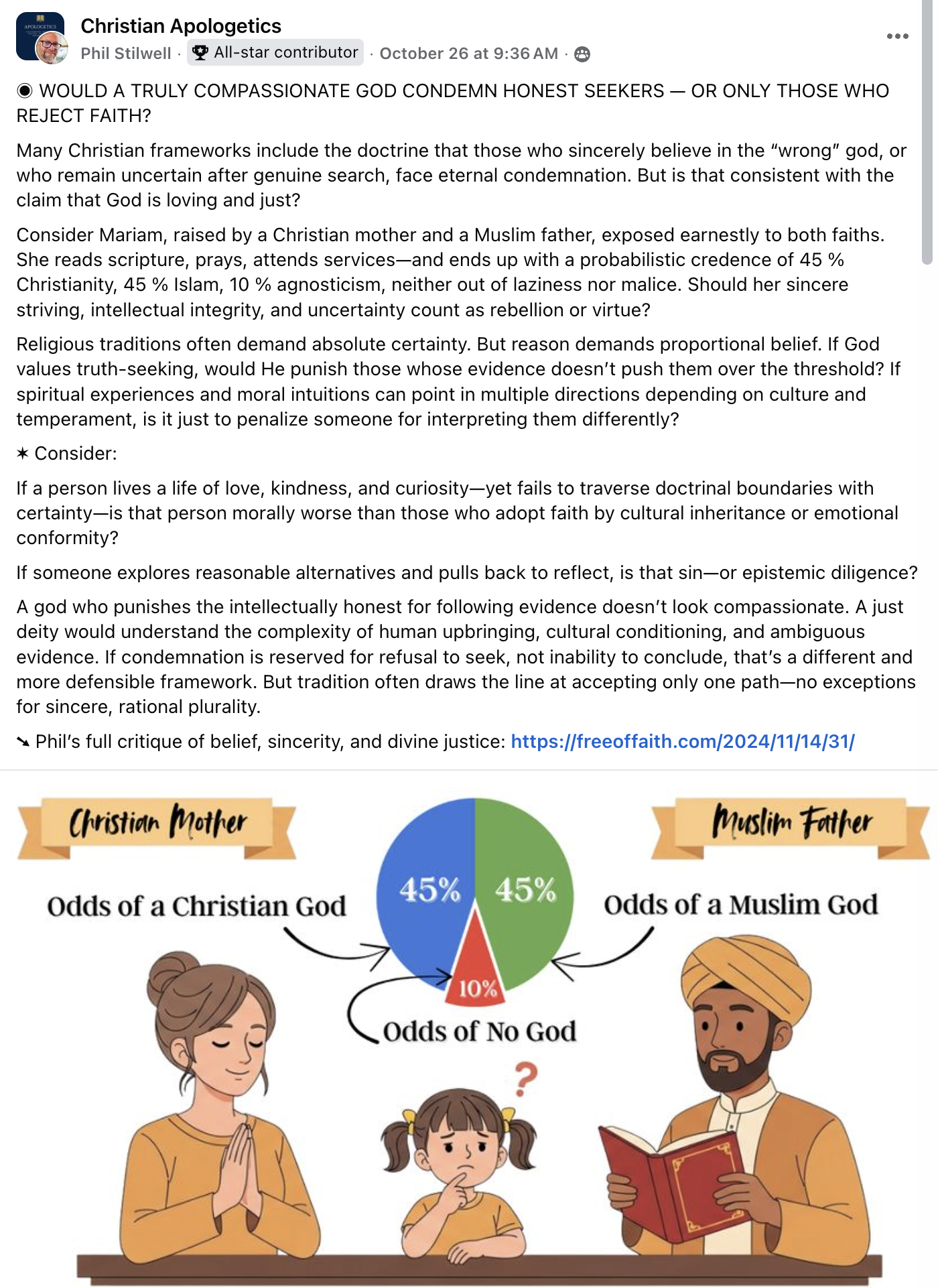
You’re quoting the passage that condemnation is for “loving darkness rather than light.” How does that apply to Miriam? She is honestly trying to figure out which light is the light. Her 45/45/10 split is not “loving darkness”; it’s respecting ambiguity. Are you defining her caution as sin? If so, you’ve made intellectual honesty a vice. If salvation depends on accepting a claim one never had clear grounds to verify, the offer becomes coercive. A just deity would reward honesty and rational caution, not punish them.
→→→→ MI-WI: PH-ST
Not only have you taken the ideas to the extreme but also taken God out of the equation—as if He’s unable to know who’s sincere or not. God’s judgments are both merciful and condemning; He knows the difference. Jesus accepted unlikely sinners by faith and rejected religious leaders by works. Faith reaches beyond law.
→→→→→ PH-ST: MI-WI
I’m not taking God out of the equation—I’m asking what He does with honest sincerity and limited evidence. If He condemns that, you’ve called justice partiality.
2. DA-HA Thread
DA-HA:
Well, Islam is demonstrably false and one of the easiest belief systems to debunk. An earnest search would prove Christianity true.
→ PH-ST: DA-HA
You can swap out Islam for any religion. Miriam is honest in her assessment, as are millions of Muslims. Each claims truth with identical certainty. If a child’s mind is honestly split between rival gods, what God would condemn that?
→→ DA-HA: PH-ST
No other belief system aside from Christianity (and its root in Judaism) has historical claims with evidence. Think of the Pilate Stone or the second-century church in Corinth.
→→→ PH-ST: DA-HA
Artifacts don’t decide divinity. Every faith has archaeology. The issue is not whether events occurred but whether the interpretations are true.
→→→→ DA-HA: PH-ST
You’re presupposing too much about God’s character. Scripture is clear already.
→→→→→ PH-ST: DA-HA
“Clear” is what both parents claim. Clarity in two directions is indistinguishable from ambiguity.
3. SH-SI Thread
SH-SI:
You cannot continue to have the mind of a child. When I was a child, I thought as a child, but when I became a man, I put away childish things. Islam teaches that Jesus will judge men. Who can judge except God?
→ PH-ST: SH-SI
That argument misreads Islamic eschatology. Jesus judges as God’s agent, not as God Himself. And you’re calling real children “childish.” Children die. What is the fate of an honest child mid-search?
→→ SH-SI: PH-ST
Children and those with limited capacity will be judged by their knowledge and ability. Everyone reaches a point of choice to accept or reject truth. You can’t fool an omniscient God.
→→→ PH-ST: SH-SI
Then acknowledge that honest uncertainty is non-culpable. Otherwise you’re punishing people for their birth circumstance and cognitive limits.
4. GE-ME Thread
GE-ME:
It’s not who looks for God; it’s the sheep that are called. Jesus said His sheep hear His voice. No one can come to Him unless the Father draws them. So it’s not the one who seeks but the one who is sought.
→ PH-ST: GE-ME
If destiny reduces to being in the set of “sheep,” Miriam’s evidence is irrelevant—again conceding the justice problem. Are you willing to say plainly: honest uncertainty + non-sheep → damnation? If not, affirm she’s safe.
→→ GE-ME: PH-ST
Romans 9 answers this: the Potter has the right to make one vessel kept and another discarded. God can do as He wills. No one combines biblical Christianity with any other belief.
→→→ PH-ST: GE-ME
Appealing to Romans 9 is the most direct rejection of justice possible. That’s power, not fairness. You’ve abandoned “just” for “sovereign.” A potter discarding a vessel that couldn’t know which potter called is not justice.
5. ST-WA Thread
ST-WA:
“The true light which gives light to everyone was coming into the world.”
“The times of ignorance God overlooked, but now He commands all people everywhere to repent.”
→ PH-ST: ST-WA
“Light to everyone” + “times of ignorance overlooked” together imply my claim: honest ignorance is not rebellion. If you accept that, say Miriam is safe. If you deny it, you void those texts’ fairness.
→→ ST-WA: PH-ST
Yes, I believe Miriam is saved in the name of Jesus if she responds to His light even without knowing His name.
→→→ PH-ST: ST-WA
That’s coherent and compassionate —but doesn’t it undermine exclusivity claims (John 14:6, Acts 4:12, “must be born again”)? If she can be saved without explicit belief, you’ve granted that honest seeking suffices.
→→→→ ST-WA: PH-ST
No — like Old Testament saints believing in Christ without knowing the name. “In the name of” is often misunderstood.
“I write to you who believe in the name of the Son of God that you may know you have eternal life.” (1 John 5:13)
→→→→→ PH-ST: ST-WA
That’s inclusivism — a reasonable position. It affirms my central point: a just God does not punish honest, non-culpable uncertainty.
6. NI-IN Thread
NI-IN:
Miriam’s confusion comes from not recognizing that truth isn’t divided. Christ alone embodies it. If she truly desired the truth, the Spirit would guide her to it.
→ PH-ST: NI-IN
Your claim implies that all honest seekers who land elsewhere weren’t “truly” seeking. That’s convenient but circular. It turns falsity into proof of insincerity. How is that just?
→→ NI-IN: PH-ST
Because Scripture says those who seek find. If someone hasn’t found, then by definition they haven’t sought rightly.
→→→ PH-ST: NI-IN
That’s tautological. “Seek → find; didn’t find → didn’t seek.” It protects doctrine at the expense of coherence.
7. RO-OS Thread
RO-OS:
The ability to find truth is a gift from God. In Miriam’s case, if her search is sincere, it’s the Spirit drawing her. Christ will come to her in time.
→ PH-ST: RO-OS
You say God gifts the ability to find truth and the Spirit draws sincere seekers. Good—now apply it.
If equally sincere seekers “feel drawn” into different revelations, how do you distinguish Spirit from culture without begging the question?
If Miriam dies before that drawing resolves, is she safe because sincerity matters, or damned for not crossing the doctrinal line in time?
→→ RO-OS: PH-ST
There is only one true God who seeks His own. She won’t remain abandoned. The trick is learning to trust that pursuit.
→→→ PH-ST: RO-OS
If He seeks all, why do sincere seekers end in opposite faiths? If He was still “seeking” when Miriam died, is she safe pending that pursuit—or damned for not trusting a claim she couldn’t distinguish?
→→→→ RO-OS: PH-ST
Some truths God keeps as mystery.
→→→→→ PH-ST: RO-OS
Appealing to mystery concedes the system’s irrationality. You can’t call it just while admitting the reason for damnation is unknowable. If justice is a mystery, so is mercy.
→→→→→→ RO-OS: PH-ST
If an all-powerful God exists, it’s irrational to assume creation could comprehend Him.
→→→→→→→ PH-ST: RO-OS
Yet you do claim comprehension—enough to declare Him just. Either justice is comprehensible or the claim is empty. Pick one.
8. JO-WI Thread
JO-WI:
We face God’s wrath for rebellion, not confusion. To avoid punishment we must put faith in Jesus Christ. God punishes no one over “contested exegesis” but for crimes. A judge who punishes the criminal is just.
→ PH-ST: JO-WI
“Rebellion” presumes clarity. Miriam’s case is symmetric evidence, not moral revolt. If her confusion blocks access to salvation, punishment still falls on epistemic limitation. That’s not justice—it’s roulette.
→→ JO-WI: PH-ST
Sin is universal; confusion doesn’t erase guilt. Without faith in Christ there’s condemnation.
→→→ PH-ST: JO-WI
Then the gospel isn’t “good news”—it’s a geography test. Born to Christian parents → reward; born elsewhere → damnation. That framework rewards luck, not integrity.
9. BU-US Thread
BU-US:
“Will not the Judge of all the earth do what is just?” (Genesis 18:25) God doesn’t owe anyone more time; every heartbeat is mercy. The question isn’t whether He gives enough time but whether we give Him enough trust.
“If you seek Him, He will be found by you.” (1 Chron 28:9) God isn’t hiding—He’s giving you time now to respond, not to philosophize endlessly.
→ PH-ST: BU-US
You’re appealing to “trust” over evidence, but Miriam’s case shows why that’s incoherent. A just God couldn’t demand trust before providing clarity when rival faiths claim identical revelation. Punishing proportioned belief would be punishing honesty.
→→ BU-US: PH-ST
Miriam’s story shows God invites trust amid uncertainty. Faith isn’t belief without evidence; it’s trust in sufficient revelation. God honors sincere seekers responding to light.
→→→ PH-ST: BU-US
Then answer plainly: if Miriam dies before that “trust” resolves, is she safe or damned? If safe, honest uncertainty isn’t rebellion; if damned, you claim God demands credence beyond evidence. Which?
→→→→ BU-US: PH-ST
To whom much is given, much is required. To whom little, little is required. God judges the heart, not perfect certainty.
→→→→→ PH-ST: BU-US
Good—then her honesty is exculpatory. Evidence symmetry makes restraint integrity, not sin.
10. KE-SH Thread
KE-SH:
Adam sinned; death spread to all. Jesus, born of God’s line, broke the curse. He fulfilled the law we couldn’t, died a substitutionary death, and imputed righteousness to believers.
Romans 6:23 — “For the wages of sin is death; but the gift of God is eternal life through Jesus Christ our Lord.”
Philippians 2:5-11 — “Every knee will bow…”
Acts 4:12 — “There is no other name under heaven by which we must be saved.”
→ PH-ST: KE-SH
These verses assert exclusivity, not demonstrate it. Islam has parallel claims with Qur’an 3:85. How does Miriam adjudicate between them without circular appeal to her inherited scripture? If salvation depends on choosing correctly under equal rhetoric, justice collapses.
→→ KE-SH: PH-ST
Because Jesus proved His divinity through resurrection; Muhammad didn’t.
→→→ PH-ST: KE-SH
That’s debated history, not self-authenticating fact. Muslims cite the Qur’an’s linguistic miracle and the incorruptibility of revelation. If God expected children to parse conflicting miracle claims, He designed confusion then punished it.
→→→→ KE-SH: PH-ST
Faith fills the gap where evidence ends.
→→→→→ PH-ST: KE-SH
Then faith becomes epistemic bias—trusting one side before testing. A fair deity wouldn’t tether eternity to that bias.
11. JE-CR Thread
JE-CR:
While I admire the sentiment here, that’s all it is. It’s unbiblical to conclude that anyone of their own volition truly seeks God.
Faith comes through hearing the Word of Christ; God grants belief. Those who don’t believe already stand condemned.
If we demanded pure justice, all would be condemned. Grace is the reprieve. Jesus Himself said, “I am the way, the truth, and the life.” There aren’t many ways—only Him.
→ PH-ST: JE-CR
You’ve just conceded the fatal problem: belief isn’t chosen. If faith is gifted, damnation for lacking it punishes non-recipients. That’s not justice—it’s favoritism. A moral lottery cannot be called grace.
→→ JE-CR: PH-ST
It’s not a lottery; it’s mercy. God owes no one salvation.
→→→ PH-ST: JE-CR
Mercy has meaning only against a backdrop of fairness. If fairness is denied, mercy collapses into arbitrary selection.
12. JO-WA Thread
JO-WA:
Faith precedes understanding. You don’t demand proof before trusting your doctor; why demand it from God?
→ PH-ST: JO-WA
Because doctors produce outcomes. Revelation produces contradictions.
Trust without verification works in fiction, not epistemology.
→→ JO-WA: PH-ST
Miracles are verification.
→→→ PH-ST: JO-WA
Then which miracles? Muslims, Hindus, and Catholics each report theirs.
If miracle testimony suffices, exclusivity dies.
13. KE-SH and FL-MA Thread
FL-MA:
Why is Jesus’ sacrifice described as the only way for sins to be forgiven?
What does it mean to depend fully on God rather than trusting our own goodness?
→ KE-SH: FL-MA
Adam’s sin placed a curse of death on humanity. Jesus, born of God, not Adam, broke that curse through obedience and sacrifice.
Romans 6:23—“The wages of sin is death…”
Phil 2:5-11—Christ humbled Himself to death on a cross.
Acts 4:12—“Salvation exists in no one else.”
→→ FL-MA: KE-SH
Thank you! That shows beautifully how His obedience leads to life. How does Acts 4:12 emphasize salvation’s uniqueness?
→→→ KE-SH: FL-MA
Because it closes every alternative door. Humanity wants pluralism; God offers exclusivity for clarity.
→→→→ PH-ST: KE-SH
Then we’re back to Miriam. “Clarity” that produces symmetrical exclusivities (Bible vs Qur’an) isn’t clarity. It’s duplication of certainty.
14. RI-WA Thread
RI-WA:
Kevin Shirley gave the correct answer.
→ PH-ST: RI-WA
Cheerleading isn’t an argument. Do you hold Miriam—dying at 45/45/10 after sincere effort—safe or damned? On what non-circular principle?
→→ RI-WA: PH-ST
I wasn’t arguing; I was agreeing.
→→→ PH-ST: RI-WA
Agreement isn’t justification. Either defend the claim or reconsider it.
→→→→ RI-WA: PH-ST
Fair enough—God judges hearts, not hypotheticals.
→→→→→ PH-ST: RI-WA
Then concede that honest doubt isn’t rebellion. That’s the heart of the question.
15. CO-HO Thread
CO-HO:
The very notion of your “just deity” collapses. A deity is by definition the standard; nothing higher can judge it.
If you imagine a god answerable to justice, you’ve created yourself as god.
Romans 9 again—He has mercy on whom He wills.
→ PH-ST: CO-HO
That logic immunizes tyranny. Saying “God defines justice” makes the word meaningless; it becomes mere power.
Would you call a being “good” if it could equally decree cruelty and call it righteousness?
→→ CO-HO: PH-ST
A clay pot doesn’t lecture the potter.
→→→ PH-ST: CO-HO
And yet you speak for the potter while telling others not to. The moment you declare Him just, you’ve invoked the same standard you deny.
16. BR-DA Thread
BR-DA:
If Miriam really wanted truth, she’d already have it. Scripture says all have enough revelation. She’s suppressing it.
Romans 1:20 — “For since the creation of the world God’s invisible attributes… have been clearly seen.”
→ PH-ST: BR-DA
So ignorance equals rebellion? Then every sincere Muslim or Hindu is guilty of “suppressing.”
That’s not justice; that’s pre-emptive guilt. You can’t call inquiry sin.
→→ BR-DA: PH-ST
All suppress truth until regenerated. That’s why grace exists.
→→→ PH-ST: BR-DA
Then honesty is irrelevant and regeneration arbitrary. That’s divine determinism wearing a moral mask.
17. BO-PE Thread
BO-PE:
That’s a lofty claim. Consider this: the rapid growth of Islam in the seventh and eighth centuries came from promises of conquest, riches, and women.
Why does anyone move toward one religion or another?
Christianity’s uniqueness is that it requires surrender rather than indulgence.
Every false god in history offers self-satisfaction.
Even atheism feeds pride through imagined intellectual superiority.
Finally, saying Miriam’s “sin nature” was invented ignores the universal moral fall described in Scripture.
No one is innocent.
God’s invisible attributes are evident in creation, leaving humanity without excuse.
Jesus claimed exclusivity; Miriam, with her exposure, would have faced that choice just as you do.
If you don’t repent, you will one day see your shame and understand why you refused the truth.
→ PH-ST: BO-PE
Your argument assumes its conclusion — that Christianity is true.
Miriam’s question isn’t about preference; it’s epistemic.
You’re asking her to repent before she can rationally determine which revelation is genuine.
That’s not repentance; it’s coerced allegiance under uncertainty.
→→ BO-PE: PH-ST
Faith precedes understanding. The demand for evidence is prideful rebellion.
You trust medicine before knowing how it works; why not trust God before knowing every detail?
→→→ PH-ST: BO-PE
The analogy fails.
Medicine produces reproducible outcomes; revelation produces contradictions.
Trust in demonstrably effective systems is rational; trust in mutually exclusive testimonies is not.
If epistemic humility is pride, then your theology exalts credulity.
18. JO-SO Thread
JO-SO:
BO-PE, I agree. I’ve engaged PH-ST before—he goes to great mental contortions to justify unbelief.
No one fights so hard against something they don’t know deep down is true.
He’s in conflict between conviction and pride.
→ BO-PE: JO-SO
Exactly. I’ve wondered what his intentions truly are.
→→ PH-ST: JO-SO and BO-PE
Ad hominem is not argument.
Claiming I “know it’s true deep down” concedes you can’t show it’s true up front.
Psychologizing dissent is the refuge of the indefensible.
If God’s existence were as evident as you claim, He wouldn’t need character assassination as defense.
19. AN-LA Thread
AN-LA:
The problem is that you’re trying to use finite logic to understand an infinite God.
Faith begins where logic ends.
→ PH-ST: AN-LA
Logic doesn’t confine God; it defines coherence.
If “infinite” means “immune to reason,” then any claim about God—including yours—evaporates.
→→ AN-LA: PH-ST
Reason itself is a creation of God. He’s not bound by it.
→→→ PH-ST: AN-LA
Then words lose meaning.
If God can both love and damn the honest seeker, then “love” and “justice” are noise.
20. PA-RO Thread
PA-RO:
God’s justice is perfect whether or not we grasp it.
Job 38 — “Where were you when I laid the earth’s foundation?”
Humans have no standing to question Him.
→ PH-ST: PA-RO
Then stop calling Him “just.” If you mean only “powerful,” use that word.
Justice implies recognizable fairness.
If it’s beyond recognition, asserting it becomes empty praise.
→→ PA-RO: PH-ST
Reverence requires accepting limits.
→→→ PH-ST: PA-RO
Reverence doesn’t require abandoning clarity.
If justice and love are undefinable, faith becomes submission without comprehension — the hallmark of tyranny.
21. CH-MA Thread
CH-MA:
You say “a loving God wouldn’t condemn Miriam,” but God’s love doesn’t cancel holiness.
Love warns, corrects, and judges.
He gave His Son so no one needs to perish; rejecting that gift is self-condemnation.
→ PH-ST: CH-MA
A gift that demands acceptance before clear authentication isn’t love—it’s coercion.
If two rival faiths each claim that gift, honesty requires hesitation.
Would a just giver punish someone for examining both before choosing?
→→ CH-MA: PH-ST
It’s not coercion; it’s opportunity.
The gospel has gone out to all nations. Ignorance is willful.
→→→ PH-ST: CH-MA
Then you’re calling the accident of birth “willful.” That’s moral geography, not justice.
22. DA-MI Thread
DA-MI:
Miriam’s parents each follow a false gospel. If she reads the Bible, the Spirit will testify within her that Jesus is Lord.
John 16:13 — “The Spirit of truth will guide you into all truth.”
→ PH-ST: DA-MI
Both parents say precisely that. Each claims an indwelling spirit confirming their revelation.
If internal testimony can’t discriminate truth from illusion, how does God expect children to know which whisper is divine?
→→ DA-MI: PH-ST
Because only one Spirit aligns with Scripture.
→→→ PH-ST: DA-MI
Circular again: Scripture is verified by the Spirit and the Spirit by Scripture.
That loop explains certainty, not truth.
23. HE-AD Thread
HE-AD:
I understand your question, but we must remember God’s thoughts are higher.
We trust His justice even when it seems unfair.
→ PH-ST: HE-AD
That statement concedes appearances of injustice while insisting on hidden fairness.
If justice is invisible, then the word describes nothing verifiable.
Would you accept that defense from any earthly judge?
→→ HE-AD: PH-ST
Earthly judges aren’t omniscient. God is.
→→→ PH-ST: HE-AD
Omniscience doesn’t redefine fairness.
Knowing more than the victim doesn’t justify the punishment of honesty.
24. EL-RO Thread
EL-RO:
You’re assuming salvation is about fairness. It’s about grace. If God were fair, none would survive.
→ PH-ST: EL-RO
Then stop calling Him just.
Grace without justice is favoritism renamed.
If all deserve condemnation, and only a few are spared, that’s not mercy—it’s selective clemency.
→→ EL-RO: PH-ST
That’s your opinion. Scripture reveals truth; human reasoning can’t reach it.
→→→ PH-ST: EL-RO
Then you’re asserting “truth” as a shield against evaluation. That’s dogma, not insight.
25. JU-HA Thread
JU-HA:
Phil, you’re missing the heart of the gospel. It’s not logic but love.
God so loved the world that He gave His only Son.
That’s not coercion—it’s rescue. You just have to accept it.
→ PH-ST: JU-HA
Love that threatens eternal torment for hesitation is extortion dressed as affection.
If acceptance must precede understanding, it’s not love; it’s fear management.
→→ JU-HA: PH-ST
Fear of the Lord is the beginning of wisdom.
→→→ PH-ST: JU-HA
Wisdom founded on fear isn’t moral growth; it’s submission under duress.
A loving parent doesn’t demand terror as proof of trust.
26. MA-JE Thread
MA-JE:
You assume people are neutral investigators, but Scripture says otherwise.
Romans 3:11 — “There is none who understands; none who seeks after God.”
Miriam’s “honest uncertainty” is still rebellion because her heart resists God’s call.
→ PH-ST: MA-JE
So the text declares rebellion even when none is observed.
That’s presuppositional guilt — not justice.
If the charge is built into the definition of “unbeliever,” acquittal becomes impossible by design.
→→ MA-JE: PH-ST
God must convict before He can forgive. Everyone stands guilty first.
→→→ PH-ST: MA-JE
Then justice is procedural theater.
You’re calling predetermined guilt “conviction” and predetermined mercy “forgiveness.”
27. TI-AL Thread
TI-AL:
The world already condemns itself.
People choose darkness because they love sin.
Miriam isn’t neutral; she just loves her own way.
→ PH-ST: TI-AL
You’ve mistaken confusion for corruption.
If two conflicting revelations both claim light, loving caution isn’t loving darkness.
→→ TI-AL: PH-ST
Truth isn’t confusing—Satan is.
→→→ PH-ST: TI-AL
Then your God permits Satan to generate symmetrical revelations and blames the victims for symmetrical confusion.
That’s divine negligence, not justice.
28. CH-JO Thread
CH-JO:
Miriam must simply trust Jesus.
Overthinking causes unbelief.
Like Peter walking on water—look at Christ, not the storm.
→ PH-ST: CH-JO
Blind trust in a crowded marketplace of gods is precisely what causes deception.
Miriam’s “storm” is rival truth-claims, not distraction.
Looking without evidence is how cults recruit.
→→ CH-JO: PH-ST
Faith isn’t blindness; it’s obedience.
→→→ PH-ST: CH-JO
Obedience before comprehension is servility, not virtue.
Truth invites understanding, not suspension of reason.
29. SA-WE Thread
SA-WE:
God can save anyone He chooses, even from another religion.
He looks at the heart, not doctrine.
→ PH-ST: SA-WE
That’s the inclusivist position—reasonable and humane.
But most here deny it, quoting “no other name.”
If you’re right, then exclusivists misrepresent God’s justice.
Will you say plainly that honest seekers outside explicit Christianity can be saved?
→→ SA-WE: PH-ST
Yes—if they respond to the light they have.
→→→ PH-ST: SA-WE
Then we agree: restraint under ambiguity is integrity, not rebellion.
30. BR-TH Thread
BR-TH:
All religions aren’t equal, but they can all contain partial truths.
Christ is the fullness of revelation.
Miriam might not know Him by name, but she can still belong to Him.
→ PH-ST: BR-TH
That echoes the “anonymous Christian” view—salvation through Christ even without knowledge of Christ.
If so, the condemnation many here predict for Miriam is unjustified.
Would you affirm that inclusivism explicitly?
→→ BR-TH: PH-ST
Yes, though many believers dislike that term.
God judges by response to light, not vocabulary.
→→→ PH-ST: BR-TH
Then at least one thread in this discussion retains coherence and compassion.
31. KE-SH Thread
KE-SH:
Jesus said, “I am the way, the truth, and the life; no one comes to the Father except through me.” Both Muhammad and Jesus made truth claims. Both cannot be true. Your premise fails because you think a life of ‘love, kindness, and curiosity’ is enough. God does not require us to be good; He knows we cannot be. We are dead in sin. Jesus came not to make us better but to give us life. Reject His sacrifice and no sacrifice remains. Humanity’s problem is thinking we are enough without God. Acts 4:11-12 makes it plain — “Salvation is found in no one else.”
→ PH-ST: KE-SH
You’ve smuggled the conclusion into the premise. You assume sin, corruption, and separation from God as facts, then fault Miriam for not accepting them. She’s testing which revelation, if any, is true. Demanding belief before clarity is epistemic coercion, not faith freely chosen.
→→ KE-SH: PH-ST
Islam offers works as its solution for sin; Christianity offers grace. If Miriam dies without that transaction through Christ, she cannot stand before God. His presence would consume her impurity.
→→→ PH-ST: KE-SH
So damned for non-culpable uncertainty. How is that just? If holiness requires truth, a just God would resolve ambiguity before tying eternity to it.
→→→→ KE-SH: PH-ST
He did resolve it — at the Cross.
→→→→→ PH-ST: KE-SH
The Cross is the very disputed point. For Miriam, it’s Christianity’s claim against Islam’s counter-claim. You can’t cite the puzzle as its own solution.
→→→→→→ KE-SH: PH-ST
Then we must examine Scripture’s reliability to validate the Cross. John’s Gospel was written “that you may believe.” What evidence shows the Qur’an reliable at all?
→→→→→→→ PH-ST: KE-SH
You’ve shifted from justice to scholarship. Miriam is a child, not a textual critic. Is hell the penalty for failing to finish a PhD in ancient manuscripts?
32. RY-WA Thread
RY-WA:
KE-SH — correct answer.
→ PH-ST: RY-WA
Cheerleading isn’t an argument. Do you say Miriam dying at 45 / 45 / 10 is safe or damned? On what principle beyond team loyalty?
→→ RY-WA: PH-ST
I was just agreeing with Kevin.
→→→ PH-ST: RY-WA
Agreement isn’t reasoning. Which principle of justice covers honest uncertainty?
→→→→ RY-WA: PH-ST
Fair point — agreement is not argument.
33. FL-MA Thread
FL-MA:
KE-SH, why is Jesus’ sacrifice the only way for forgiveness? What does it mean to depend on God rather than our own goodness?
→ KE-SH: FL-MA
Adam’s sin brought death; Jesus, born not of Adam’s line, fulfilled the Law and died a substitutionary death. Our sins were imputed to Him, His righteousness to us. Romans 6:23 — “the wages of sin is death.” Phil 2:5-11 shows His humility; Acts 4:12 shows His exclusivity.
→→ FL-MA: KE-SH
Thank you — that’s powerful. His obedience and death bring life. Could you expand on how Christ’s obedience guides us today and how Acts 4:12 underscores His uniqueness?
34. JE-CR Thread
JE-CR:
This post is unbiblical. No one seeks God of their own will. Faith comes by hearing, and unbelievers already stand condemned. If we demand justice from God, all are condemned; only grace delays judgment. Plural paths are anti-biblical.
→ PH-ST: JE-CR
You assert total inability and pre-condemnation. That makes Miriam’s honesty irrelevant — only election matters. So say it: a child dying 45 / 45 / 10 is damned unless irresistibly chosen. Call that justice?
→→ JE-CR: PH-ST
You deny Jesus’ own words and are therefore wrong.
→→→ PH-ST: JE-CR
I deny your interpretation, not His words. “I am the way” does not mean “I condemn the honestly unsure.” Why must exclusive truth imply punishing epistemic humility?
→→→→ JE-CR: PH-ST
Imagine a building with one door. You can stare at it forever, but until you walk through, you stay outside. Jesus is that door. There’s no other way in.
→→→→→ PH-ST: JE-CR
Then your analogy admits the problem: she’s not refusing to enter; she’s unsure which door is real. Damning that uncertainty is not justice.
35. DA-WA Thread
DA-WA:
Job 12:7-10 — the creatures teach God’s hand in life. Romans 1:20 — His power is clearly perceived. Psalm 19 — the heavens declare His glory. So humanity is without excuse.
→ PH-ST: DA-WA
General revelation suggests “something more” but doesn’t identify which revelation is true. “The heavens declare” is silent on Trinity versus Tawhid. So damnation for failing to solve that ambiguity is not justice.
36. NI-DE Thread
NI-DE:
We don’t know what anyone accepts or rejects in the end. If they deny Christ at death, Scripture is clear—God will not force them to spend eternity with Christ. We can’t see how judgment is conducted; perhaps those sincerely deceived are given another chance. My LDS grandmother just died believing false doctrine. If she persisted, I doubt she’s in heaven, but maybe she’ll face Christ once more before the final choice. Only God knows, and His judgment will be just.
→ PH-ST: NI-DE
This is about Miriam’s disposition at the time of possible early death. She’s honest, not defiant. Muslims and Christians each claim truth with equal conviction. If a child’s mind is honestly divided between gods, what kind of God condemns that?
→→ NI-DE: PH-ST
It’s a hypothetical meant to trap people, but God is all-powerful and just and will make His decision. None of us can.
→→→ PH-ST: NI-DE
Calling the question a “trap” avoids its substance. If divine justice is meaningful, it must apply coherently to honest cases. Saying “God will decide” is an evasion unless you can explain what principle of justice guides that decision.
37. BR-WI Thread
BR-WI:
If God is just, then He’s also sovereign. His ways are higher than ours. Job questioned Him and was silenced. Miriam’s uncertainty doesn’t make God unjust; it proves her fallen nature still doubts.
→ PH-ST: BR-WI
Job’s lesson was humility before mystery, not license for arbitrariness. Appealing to “higher ways” concedes that the system can’t be rationally justified. Justice that can’t be distinguished from caprice isn’t justice.
→→ BR-WI: PH-ST
You’re limiting God to human definitions of fairness.
→→→ PH-ST: BR-WI
If fairness has no coherent meaning even for God, then saying “God is fair” is empty praise. Either justice has intelligible content, or your statement collapses into “God does whatever He wants.”
38. SA-RO Thread
SA-RO:
I think God gives everyone a fair chance, but He also knows who will accept Him. Miriam may be confused now, but God foreknew her decisions before she was born.
→ PH-ST: SA-RO
Foreknowledge without opportunity nullifies fairness. Knowing a coin will land heads doesn’t make it moral to punish tails for never existing.
→→ SA-RO: PH-ST
But He still offers the chance.
→→→ PH-ST: SA-RO
An “offer” indistinguishable from fate is a performance, not mercy.
39. JO-AN Thread
JO-AN:
Faith is not about knowing everything but about trusting what God has revealed. If Miriam doubts, she should pray for revelation, not analyze probabilities.
→ PH-ST: JO-AN
She has prayed—both to Allah and to Jesus—and received conflicting impressions. How is she to know which “revelation” is genuine? Prayer can’t arbitrate contradictory claims.
→→ JO-AN: PH-ST
The Holy Spirit confirms truth to those who truly seek.
→→→ PH-ST: JO-AN
Muslims say precisely the same of Allah’s spirit. Equal sincerity, equal conviction, opposite conclusions. Unless you can provide a non-circular test, “the Spirit told me” is epistemically void.
40. CA-MI Thread
CA-MI:
You’re overcomplicating it. God doesn’t play logic games. He looks at the heart. If Miriam loves truth, she’ll find it.
→ PH-ST: CA-MI
Then you concede the central point: honest love of truth, not correct doctrine, is salvific. That means belief proportioned to evidence—epistemic integrity—is enough.
→→ CA-MI: PH-ST
Maybe so. I still think Jesus is the only truth, but I also believe He saves those who truly seek Him, even if they don’t yet know His name.
→→→ PH-ST: CA-MI
That’s inclusivism again—the humane view. It rescues justice from exclusivism’s cruelty.
41. LI-TH Thread
LI-TH:
People forget that God’s justice and mercy meet at the Cross. We may think He’s unfair, but He bore His own justice. If Miriam doubts, that’s her human limitation, not God’s fault.
→ PH-ST: LI-TH
Your premise assumes the Cross as settled truth. For Miriam it’s the disputed data point, not the resolution. A just God wouldn’t tie salvation to winning a metaphysical coin-flip between rival scriptures.
→→ LI-TH: PH-ST
But Scripture says the message of the Cross is foolishness to those perishing.
→→→ PH-ST: LI-TH
That verse describes response, not epistemic obligation. It doesn’t license punishing honest non-comprehension when rival “foolishness” claims exist.
42. BE-JO Thread
BE-JO:
All humans know God exists; Romans 1 says His nature is clearly seen. If Miriam denies that, she’s suppressing the truth.
→ PH-ST: BE-JO
Recognizing a higher power differs from identifying which revelation is true. Romans 1 covers generic awareness, not doctrinal discrimination. Miriam’s uncertainty is between competing “truths,” not atheism.
→→ BE-JO: PH-ST
But that awareness should lead her to Christ.
→→→ PH-ST: BE-JO
Only if cultural conditioning and equal conviction didn’t pull her both ways. “Should” without evidential clarity is blame without grounds.
43. MA-DA Thread
MA-DA:
God has already shown enough evidence—prophecy, archaeology, changed lives. If people still doubt, it’s because they don’t want God.
→ PH-ST: MA-DA
That’s circular. You count all confirming data but discount contrary evidence as rebellion. If two faiths show miracles, martyrs, and transformation, whose “changed lives” decide?
→→ MA-DA: PH-ST
Only one tomb is empty.
→→→ PH-ST: MA-DA
Each faith has its “sign.” Evidence isn’t self-interpreting; it requires context. Miriam’s 45/45/10 reflects that ambiguity. Honest suspension of belief is not moral failure.
44. KA-RE Thread
KA-RE:
Maybe the point isn’t fairness but God’s glory. He shows mercy to whom He will.
→ PH-ST: KA-RE
Then justice is abandoned. “For His glory” that contradicts fairness transforms morality into spectacle. Glorifying Himself by condemning honesty nullifies love.
→→ KA-RE: PH-ST
We can’t judge the potter.
→→→ PH-ST: KA-RE
Romans 9 again—power without justice. A potter discarding clay isn’t “righteous”; it’s merely sovereign. Calling that goodness evacuates meaning from the word.
45. MI-PA Thread
MI-PA:
Faith isn’t about logic; it’s about relationship. You can’t reason your way to love.
→ PH-ST: MI-PA
True—but you also can’t love an unknown. Relationship presupposes trust, and trust must rest on credibility. When competing gods make contradictory promises, rational discernment becomes the prerequisite of genuine love.
→→ MI-PA: PH-ST
So you’d rather analyze than believe.
→→→ PH-ST: MI-PA
Belief after analysis is conviction; belief before analysis is credulity. A just God rewards the former, not the latter.
46. BR-LA Thread
BR-LA:
You keep asking what God “should” do as if He answers to you. He’s the Creator; we’re the created. Justice is whatever He decrees because His nature defines it.
→ PH-ST: BR-LA
Then “justice” means “might.” That redefines morality into obedience to power. You can’t both praise God for justice and remove any standard by which justice could be recognized.
→→ BR-LA: PH-ST
Our recognition isn’t the measure of truth.
→→→ PH-ST: BR-LA
Then praise loses meaning. If good and evil are whatever He commands, calling Him good is identical to saying “He exists.”
47. JO-HO Thread
JO-HO:
If you truly seek God, He’ll reveal Himself. Those who don’t find are either not seeking or seeking for the wrong reasons.
→ PH-ST: JO-HO
That’s self-sealing logic: whoever disagrees is “not truly seeking.” Miriam’s honesty becomes guilt by definition. That’s not an argument; it’s a tautology.
→→ JO-HO: PH-ST
God tests motives.
→→→ PH-ST: JO-HO
Then you concede the test is moral, not intellectual—so condemning honest doubt becomes punishing honesty.
48. CH-EL Thread
CH-EL:
When people reject God, it’s never for lack of evidence but love of sin. The cross confronts pride.
→ PH-ST: CH-EL
That’s a convenient universal accusation. Muslims say identical things about Christians. Each calls dissent “pride.” If pride explains all disagreement, truth becomes unreachable.
→→ CH-EL: PH-ST
Only one side rose from the dead.
→→→ PH-ST: CH-EL
Every religion claims miracles. Resurrection is an evidential claim, not a presupposed truth. Demanding belief in it before examination reverses reason itself.
49. AL-LU Thread
AL-LU:
The Gospel is simple: repent and believe. You don’t need philosophy to enter heaven.
→ PH-ST: AL-LU
Philosophy becomes necessary when multiple gospels claim to be simple and true. Without reasoning, how would Miriam discern which simplicity to trust?
→→ AL-LU: PH-ST
God resists the proud and gives grace to the humble.
→→→ PH-ST: AL-LU
Humility isn’t rejecting thought. Intellectual integrity is humility before evidence. Blind belief is arrogance in disguise.
50. SH-TH Thread
SH-TH:
Why does everyone make this complicated? Jesus saves. That’s the message. People perish because they refuse it.
→ PH-ST: SH-TH
Refuse implies clarity. Miriam isn’t refusing; she’s uncertain which “Jesus” is real amid competing testimonies. Condemning that uncertainty is condemning rational honesty.
→→ SH-TH: PH-ST
You’re trying to rationalize rebellion.
→→→ PH-ST: SH-TH
You’re redefining rebellion as hesitation. That’s intellectual tyranny, not gospel truth.
51. DA-BO Thread
DA-BO:
When you meet God, all these debates will end. You’ll see He was right all along.
→ PH-ST: DA-BO
Appeal to inevitability is not evidence. “You’ll see when you die” works equally for every religion. The fact that it’s unverifiable keeps it from being a reason.
→→ DA-BO: PH-ST
Faith is believing without seeing.
→→→ PH-ST: DA-BO
Belief without seeing may be trust in a friend—but in rival revelations it’s credulity. The more mutually exclusive the claims, the greater the need for proportioned evidence.
52. LA-RU Thread
LA-RU:
All have sinned and fallen short. That includes Miriam. The question isn’t her confusion but her heart—does she want truth more than comfort?
→ PH-ST: LA-RU
Her “comfort” is irrelevant; her problem is ambiguity. When two revelations both promise truth, loving truth equally leaves her suspended. That suspension is integrity, not rebellion.
→→ LA-RU: PH-ST
You keep shifting the blame from people to God.
→→→ PH-ST: LA-RU
No—I’m evaluating a theological claim. If justice condemns honest doubt, it’s not justice. Blame follows clarity, not confusion.
53. RO-GR Thread
RO-GR:
You assume logic can judge revelation, but revelation judges logic. God authored reason; He’s not bound by it.
→ PH-ST: RO-GR
If He authored reason, then He also authored its reliability. To claim He can violate it is to say He contradicts Himself. Coherence is not rebellion against God; it’s His fingerprint.
→→ RO-GR: PH-ST
You speak as if humans can grasp infinity.
→→→ PH-ST: RO-GR
We grasp consistency, not infinity. Infinity need not be contradictory. If your theology collapses under logic, that’s a problem of formulation, not of finitude.
54. TI-BR Thread
TI-BR:
I think Miriam’s story is about responsibility. God reveals Himself through conscience. She must choose what her heart already knows.
→ PH-ST: TI-BR
Conscience reveals empathy, not doctrine. A Muslim’s conscience tells her God is One; a Christian’s tells him God is Trinity. Conscience explains moral instinct, not revelation accuracy.
→→ TI-BR: PH-ST
Still, it shows everyone has enough light.
→→→ PH-ST: TI-BR
Enough to seek, yes—not enough to choose between mutually exclusive “lights.”
55. PA-MO Thread
PA-MO:
God’s grace covers those who can’t know better—infants, the mentally impaired, and maybe people like Miriam who never heard properly.
→ PH-ST: PA-MO
Then you accept that honest ignorance can be innocent. Extend that principle: if ambiguity prevents knowing better, the same grace should apply. Otherwise you’re drawing mercy lines around geography.
→→ PA-MO: PH-ST
Maybe so; maybe mercy is wider than we think.
→→→ PH-ST: PA-MO
Then you’ve affirmed the very thesis this thread began with—that a just God does not punish proportioned belief.
56. ME-HU Thread
ME-HU:
Phil, you ask good questions, but faith isn’t about getting every answer. It’s trusting that God is good even when we don’t understand. Miriam must do the same.
→ PH-ST: ME-HU
Trust without clarity is only as good as the object trusted. If rival gods both demand that trust, sincerity alone doesn’t identify which is true. A just God would clarify before condemning the mistaken truster.
→→ ME-HU: PH-ST
But God reveals Himself progressively; Miriam will know in time.
→→→ PH-ST: ME-HU
If death interrupts that progression, your system condemns her for timing—another injustice.
57. BE-CO Thread
BE-CO:
Everyone wants fairness, but grace isn’t fair—it’s undeserved. If we all got what’s fair, we’d all be lost.
→ PH-ST: BE-CO
Then “justice” and “mercy” collapse into contradiction. Mercy has meaning only if justice is real. If everyone “deserves” damnation by default, salvation is favoritism disguised as kindness.
→→ BE-CO: PH-ST
We can’t question God’s mercy.
→→→ PH-ST: BE-CO
Then words like “good” and “just” lose substance. Praise without standards is flattery, not worship.
58. LI-CA Thread
LI-CA:
God doesn’t owe Miriam an explanation. He already gave one in Scripture.
→ PH-ST: LI-CA
The Qur’an says the same. Competing “already given” revelations produce the very ambiguity in question. A just deity wouldn’t expect a child to parse conflicting holy books.
→→ LI-CA: PH-ST
That’s why discernment is spiritual, not intellectual.
→→→ PH-ST: LI-CA
And Muslims make the same claim. If “spiritual discernment” yields opposite certainties, it’s not a method—it’s cultural reinforcement.
59. GA-WE Thread
GA-WE:
People can twist scripture all day, but the Bible has one clear message: believe and be saved. God owes no one extra signs.
→ PH-ST: GA-WE
Then “clarity” should produce unanimity. Yet thousands of denominations prove otherwise. If evidence were self-interpreting, Christians wouldn’t disagree so radically about what “believe” means.
→→ GA-WE: PH-ST
Division comes from pride, not scripture.
→→→ PH-ST: GA-WE
Then every interpreter you disagree with is prideful by definition—a self-sealing claim.
60. SU-PR Thread
SU-PR:
What about those who never hear at all? God must have a way to judge them fairly.
→ PH-ST: SU-PR
Exactly. And Miriam’s case is only a mild version of that same problem: absence of clarity. If fairness requires adjustment for ignorance, it equally requires lenience for honest ambiguity.
→→ SU-PR: PH-ST
Maybe that’s why God judges hearts, not creeds.
→→→ PH-ST: SU-PR
That’s a just principle—belief proportioned to evidence.
61. JO-KE Thread
JO-KE:
I believe God gives every person a revelation suited to their heart. Some will reject, others will respond. Miriam’s confusion doesn’t surprise Him. He knows what she would choose if she had clarity.
→ PH-ST: JO-KE
Then the determinant is hypothetical—what she would choose if conditions were fair. That’s reasonable. So you’re agreeing that eternal judgment accounts for epistemic limitation?
→→ JO-KE: PH-ST
Yes, God sees intentions, not just conclusions.
→→→ PH-ST: JO-KE
Then we agree: honest doubt is not rebellion.
62. MA-RI Thread
MA-RI:
This discussion is interesting, but you’re overthinking. God’s ways are not our ways. Salvation is simple—believe in Jesus.
→ PH-ST: MA-RI
Simplicity collapses under pluralism. Multiple “simple” faiths claim exclusivity. Complexity enters the moment sincerity produces contradiction.
→→ MA-RI: PH-ST
You just have to ask the Holy Spirit to confirm truth.
→→→ PH-ST: MA-RI
Muslims say the same. If two spirits yield opposing certainties, one’s method fails—or both do.
63. AN-JO Thread
AN-JO:
If Miriam honestly seeks God, He’ll reveal Himself to her before she dies. I’ve heard countless testimonies of Muslims having dreams of Jesus.
→ PH-ST: AN-JO
Anecdotes cut both ways—Muslims report dreams of Muhammad, Hindus of Krishna. Dreams track culture, not divinity. If God truly revealed uniquely through dreams, empirical distribution would favor no single faith.
→→ AN-JO: PH-ST
But Scripture promises He’ll make Himself known.
→→→ PH-ST: AN-JO
Then the question remains: why symmetrical revelation across contradictory traditions? Either all are false or justice compensates for ambiguity.
64. PE-LE Thread
PE-LE:
Phil, maybe you’re asking a question reason can’t answer. Faith is not a formula.
→ PH-ST: PE-LE
True—faith isn’t formulaic, but it’s not irrational either. If your faith requires condemning honesty, it’s misplaced. A trustworthy God invites scrutiny.
→→ PE-LE: PH-ST
God’s character doesn’t need defending.
→→→ PH-ST: PE-LE
Then you shouldn’t need to call Him “just.” To defend justice is already to invoke reason.
65. DA-RE Thread
DA-RE:
The problem is assuming fairness matters more than holiness. God’s goal isn’t to meet human expectations but to demonstrate His glory.
→ PH-ST: DA-RE
If glory requires injustice, then glory is immoral even on your own terms. A being that glorifies itself through suffering or confusion isn’t praiseworthy.
→→ DA-RE: PH-ST
That’s pride talking—you want to judge God.
→→→ PH-ST: DA-RE
Judging claims about God isn’t pride; it’s responsibility. If reason must be abandoned to maintain devotion, what remains is fear, not faith.
66. LA-MA Thread
LA-MA:
You treat God like a math problem. Faith is trust beyond logic. Without that leap, you’ll never understand.
→ PH-ST: LA-MA
Trust beyond logic is indistinguishable from gullibility. A just deity would invite trust after comprehension, not instead of it. Believing first and testing later is how deception survives.
→→ LA-MA: PH-ST
But Abraham believed before he saw the promise fulfilled.
→→→ PH-ST: LA-MA
Yes—and his faith was justified after evidence appeared. Miriam isn’t refusing obedience; she’s waiting for coherence. That patience is integrity, not rebellion.
67. NI-BR Thread
NI-BR:
You assume human reasoning is trustworthy. The heart is deceitful above all things. Without the Spirit, no one can truly understand.
→ PH-ST: NI-BR
If human reason is untrustworthy, then your interpretation of “the Spirit” is equally suspect. You’re using the same mind you distrust to assert divine certainty.
→→ NI-BR: PH-ST
The Spirit testifies internally; it’s not intellectual.
→→→ PH-ST: NI-BR
Then epistemic chaos follows. Every faith claims identical inner testimony. Without external adjudication, sincerity proves nothing.
68. PA-LI Thread
PA-LI:
At some point, faith is a choice. God wants trust, not endless questioning.
→ PH-ST: PA-LI
Then salvation becomes a personality test favoring the credulous over the careful. If trust precedes verification, cults and truth appear identical.
→→ PA-LI: PH-ST
You’re overcomplicating what’s meant to be simple.
→→→ PH-ST: PA-LI
Simplicity isn’t virtue when the question is complex. Miriam’s case is complicated—two exclusive revelations, both confident, both ancient. A fair judge adjusts to complexity, not dismisses it.
69. JA-HU Thread
JA-HU:
It’s not about fairness; it’s about surrender. Everyone who humbles themselves will see God’s truth. Pride blinds.
→ PH-ST: JA-HU
Humility isn’t measured by credulity. A humble mind can still demand evidence. If “surrender” means silence before contradiction, that’s not virtue—it’s abdication.
→→ JA-HU: PH-ST
You’re making salvation about intellect.
→→→ PH-ST: JA-HU
No—about honesty. Miriam’s restraint is humility in action: belief proportioned to evidence, not inflated by fear.
70. RO-BA Thread
RO-BA:
Miriam’s situation shows why parenting matters. If her parents had both taught truth, she wouldn’t be confused.
→ PH-ST: RO-BA
So eternal destiny hinges on parental geography. That’s not divine justice; that’s cosmic nepotism. A child’s birthplace shouldn’t determine her afterlife.
→→ RO-BA: PH-ST
But God places each person where they can best find Him.
→→→ PH-ST: RO-BA
Then either He miscalculated—since her evidence is symmetrical—or He values testing confusion more than rewarding honesty. Both contradict justice.
71. JO-MO Thread
JO-MO:
Everyone keeps acting like God is unfair, but He’s already done more than enough. He sacrificed His Son. If that’s not justice and mercy together, what is?
→ PH-ST: JO-MO
A sacrifice may display mercy, but it doesn’t resolve the epistemic problem. Miriam’s confusion isn’t rebellion; it’s divided evidence. A just God wouldn’t punish someone for being uncertain which “Son” story to trust.
→→ JO-MO: PH-ST
You think too humanly. God’s ways are higher.
→→→ PH-ST: JO-MO
If “higher” means incoherent, then justice becomes meaningless. Either God’s actions are recognizably fair or your praise reduces to noise.
72. BE-TH Thread
BE-TH:
Why do you assume Miriam’s confusion is innocent? The Bible says people love darkness rather than light because their deeds are evil.
→ PH-ST: BE-TH
Confusion isn’t evil—it’s the product of conflicting information. Equating doubt with wickedness weaponizes scripture to excuse ignorance.
→→ BE-TH: PH-ST
But God knows hearts. If she truly seeks, she’ll find.
→→→ PH-ST: BE-TH
Then the outcome must reflect the quality of evidence available. If the evidence is ambiguous, her honest suspension is the correct moral act.
73. WI-AN Thread
WI-AN:
Maybe God lets ambiguity exist to test humility. If Miriam truly trusts Him, she’ll believe despite confusion.
→ PH-ST: WI-AN
That’s not humility—that’s epistemic recklessness. Believing without clarity isn’t virtue; it’s surrendering reason to probability blindness.
→→ WI-AN: PH-ST
But faith is rewarded.
→→→ PH-ST: WI-AN
Then God’s test becomes a trap favoring credulity. Rewarding belief under ambiguity and punishing proportional doubt inverts integrity.
74. KE-WA Thread
KE-WA:
Scripture never promises total clarity. We walk by faith, not by sight.
→ PH-ST: KE-WA
Faith after sufficient sight is trust; faith before clarity is presumption. “Walking by faith” isn’t meant to justify guessing between contradictory revelations.
→→ KE-WA: PH-ST
But sight isn’t the goal; relationship is.
→→→ PH-ST: KE-WA
Relationship presupposes recognition. Loving an unknown being because you think it’s God is no more meaningful than loving a stranger in the dark.
75. MI-RO Thread
MI-RO:
Maybe Miriam’s confusion proves human depravity. If we were pure, we’d see truth instantly.
→ PH-ST: MI-RO
So ambiguity becomes evidence of sin? That’s self-validating theology—every objection reinforces guilt. A just system must allow epistemic innocence, or it collapses into authoritarian circularity.
→→ MI-RO: PH-ST
But sin clouds understanding.
→→→ PH-ST: MI-RO
Then God punishes us for cognitive limitations He imposed. That’s not holiness—it’s entrapment.
76. DE-MA Thread
DE-MA:
I think this whole debate shows why God hates pride. We want Him to meet our logic standards. Miriam doesn’t need philosophy; she needs humility and faith.
→ PH-ST: DE-MA
Humility without inquiry isn’t virtue. It’s submission to ignorance. A just God would honor the humility of questioning as much as the humility of worship.
→→ DE-MA: PH-ST
Faith isn’t ignorance—it’s trust in what you can’t prove.
→→→ PH-ST: DE-MA
Then you’ve blurred the line between trust and credulity. If “trust in what you can’t prove” is salvific, every religion wins.
77. SA-KA Thread
SA-KA:
If Miriam rejects Christ, it’s her choice. She’s accountable for that.
→ PH-ST: SA-KA
Choice implies clarity. You can’t be accountable for what you can’t discern. Two contradictory revelations cancel clarity; only bias or chance remains.
→→ SA-KA: PH-ST
She has enough light to decide.
→→→ PH-ST: SA-KA
Then why do billions of equally sincere seekers reach opposite conclusions? Either they all ignore “light,” or the light is ambiguous.
78. CH-DA Thread
CH-DA:
The Bible says, “Without faith it is impossible to please God.” You’re trying to make salvation about knowledge instead of trust.
→ PH-ST: CH-DA
Faith and knowledge aren’t opposites. Trust must be proportional to evidence; otherwise it’s indistinguishable from wishful thinking. A fair God rewards honest proportionality, not premature certainty.
→→ CH-DA: PH-ST
Then no one could ever be saved because evidence is never complete.
→→→ PH-ST: CH-DA
Evidence need not be complete, only sufficient. Miriam’s dilemma isn’t lack of total proof—it’s competing partial proofs. Condemning her for that is condemning proportioned rationality.
79. RE-PA Thread
RE-PA:
If you really believed in fairness, you’d accept that God’s justice is above ours. Maybe He saves Miriam; maybe He doesn’t. That’s His call, not ours.
→ PH-ST: RE-PA
Agreed—it’s His call. The issue is the coherence of calling such a being “just.” A mystery can’t carry moral praise unless the principle behind it is intelligible.
→→ RE-PA: PH-ST
We’re not in a position to evaluate Him.
→→→ PH-ST: RE-PA
Then stop calling Him “good.” Evaluation is implicit in the compliment.
80. KA-LI Thread
KA-LI:
Maybe confusion itself is punishment for sin. God blinds those who don’t believe.
→ PH-ST: KA-LI
That logic punishes cause with effect. You claim disbelief produces blindness and blindness proves disbelief. That’s unfalsifiable and cruel—an epistemic noose.
→→ KA-LI: PH-ST
It’s biblical. Pharaoh hardened his heart.
→→→ PH-ST: KA-LI
And the text also says God hardened it—divine causation preceding moral blame. If Miriam’s “blindness” is God’s doing, then damnation is entrapment.
81. JE-BA Thread
JE-BA:
You talk about fairness, but fairness would mean everyone goes to hell. Justice demands punishment. Grace is what saves.
→ PH-ST: JE-BA
Then “justice” becomes indistinguishable from cruelty. Punishing all as default guilt only to pardon a few by fiat is not grace—it’s favoritism dressed as benevolence.
→→ JE-BA: PH-ST
No one deserves heaven.
→→→ PH-ST: JE-BA
Then why invent the concept of “deserving” at all? A moral system that defines everyone as guilty by default annihilates the meaning of innocence.
82. TH-JO Thread
TH-JO:
The real issue is pride. You think you can reason your way to God instead of accepting Him like a child.
→ PH-ST: TH-JO
Childlike trust only has virtue if the object of trust is verified. A child’s innocence doesn’t justify following the wrong parent into traffic. Sincerity isn’t a compass when maps conflict.
→→ TH-JO: PH-ST
But God rewards those who seek in humility.
→→→ PH-ST: TH-JO
Then Miriam’s honest, humble inquiry is the form of seeking He should reward. To punish that is to punish obedience to evidence.
83. JU-DE Thread
JU-DE:
We can’t claim God’s system is unjust just because we don’t like it. Sin earns death; that’s the rule.
→ PH-ST: JU-DE
Rules acquire legitimacy through fairness. If the “rule” punishes honest doubt, it’s not moral law—it’s arbitrary command. “Sin earns death” assumes clarity on what counts as sin. Miriam’s sin is uncertainty; that’s not rebellion.
→→ JU-DE: PH-ST
Unbelief is rebellion.
→→→ PH-ST: JU-DE
Then you’ve defined rebellion as any state short of your conclusion—a tautology posing as theology.
84. AL-DA Thread
AL-DA:
Why can’t you accept mystery? Some things aren’t for us to know.
→ PH-ST: AL-DA
Mystery isn’t the problem; contradiction is. A mystery leaves truth unknown; a contradiction makes it unknowable. Justice that’s opaque is still conceivable; justice that’s incoherent isn’t.
→→ AL-DA: PH-ST
But faith fills that gap.
→→→ PH-ST: AL-DA
Faith may fill gaps in knowledge, but not gaps in logic. Filling contradiction with belief doesn’t resolve it—it hides it.
85. TA-GR Thread
TA-GR:
God has already proven Himself through creation, miracles, prophecy, and Scripture. Denying that is willful blindness.
→ PH-ST: TA-GR
Each religion claims identical proofs. Muslims cite miracles, prophecies, and preservation of their text. If symmetrical evidence yields asymmetrical condemnation, the system’s justice is bankrupt.
→→ TA-GR: PH-ST
You’re equating lies with truth.
→→→ PH-ST: TA-GR
No—I’m equating epistemic conditions. Justice requires equal treatment under uncertainty, not privileged assumptions of correctness.
86. BE-LA Thread
BE-LA:
You keep saying “justice,” but God isn’t accountable to human fairness. His perfection is justice.
→ PH-ST: BE-LA
Then “justice” becomes a synonym for “whatever God does.” That erases moral meaning. If He tortured innocents, you’d still call it good by definition. That’s not theology; that’s wordplay.
→→ BE-LA: PH-ST
You’re assuming you can judge divine actions.
→→→ PH-ST: BE-LA
Yes—using the same reasoning that lets you call them “good.” If judgment is off-limits, praise is too.
87. KA-JO Thread
KA-JO:
All these debates ignore one thing: we’re sinners. Without Jesus, there’s no hope. It’s not about fairness—it’s about grace offered to the undeserving.
→ PH-ST: KA-JO
Grace offered on opaque terms is indistinguishable from favoritism. If Miriam’s confusion disqualifies her, her “undeserving” status stems from divine ambiguity. That makes God the architect of her doom.
→→ KA-JO: PH-ST
She still has free will.
→→→ PH-ST: KA-JO
Free will without clear options is fiction. If she can’t tell which revelation is true, her “choice” is a coin toss. A just God wouldn’t equate honest uncertainty with rebellion.
88. RI-DA Thread
RI-DA:
If Miriam really seeks truth, she’ll find Jesus. That’s the promise.
→ PH-ST: RI-DA
Muslims quote the same promise—“Whoever seeks Allah sincerely will find Him.” Equal earnestness, opposite outcomes. Either both promises are false, or evidence discriminates unfairly.
→→ RI-DA: PH-ST
Jesus is the only one who rose from the dead.
→→→ PH-ST: RI-DA
Resurrection claims exist in many traditions. Historical testimony isn’t self-authenticating; rival religions cite their own miracles.
→→→→ RI-DA: PH-ST
The difference is witnesses and consistency.
→→→→→ PH-ST: RI-DA
Consistency appears in all faiths internally. What’s lacking is cross-confirmation. If God values truth, He’d unify revelation, not splinter it.
89. WI-SM Thread
WI-SM:
Maybe God lets confusion happen so faith can be tested. If Miriam believes despite it, she proves her loyalty.
→ PH-ST: WI-SM
Testing loyalty through epistemic sabotage is cruelty, not pedagogy. You’re describing a God who hides and then punishes those who can’t find Him. That’s not justice—it’s entrapment.
→→ WI-SM: PH-ST
No test is beyond what we can bear.
→→→ PH-ST: WI-SM
A fair test requires clear instructions. If the question is “Which revelation is true?” and both give identical evidence, the test is unwinnable by design.
90. JO-PR Thread
JO-PR:
Maybe God’s justice doesn’t mean what we think. Maybe it’s about harmony, not fairness.
→ PH-ST: JO-PR
Harmony detached from fairness becomes aesthetic, not moral. A symphony isn’t just because it’s beautiful. If divine justice merely balances a story, it may be artful—but not ethical.
→→ JO-PR: PH-ST
That’s an interesting angle. Maybe we can’t separate beauty and goodness in God’s nature.
→→→ PH-ST: JO-PR
Then the standard of goodness must still be coherent to us; otherwise calling it “beautiful” is projection. Harmony without fairness is music to the victor’s ears.
91. BR-CO Thread
BR-CO:
We can’t say God is unjust because we don’t see the full picture. He might reveal Himself to Miriam in ways unseen—dreams, near-death moments, even right before death. His mercy works beyond our comprehension.
→ PH-ST: BR-CO
That’s plausible only if grace extends beyond death, which most in this thread deny. If He offers postmortem clarity, then you’ve conceded the very principle of epistemic fairness I’m arguing for.
→→ BR-CO: PH-ST
Maybe His mercy does reach beyond what we understand.
→→→ PH-ST: BR-CO
Then you affirm a God who saves the honest rather than the credulous—a consistent and compassionate view.
92. RA-DA Thread
RA-DA:
You keep arguing fairness, but sin corrupted the entire creation. Confusion is part of that corruption. God fixes it through Christ, not by adjusting fairness.
→ PH-ST: RA-DA
Then confusion becomes inherited guilt. Miriam didn’t choose her birth, yet you frame her epistemic handicap as moral failure. That’s metaphysical discrimination, not justice.
→→ RA-DA: PH-ST
God’s plan is bigger than our logic.
→→→ PH-ST: RA-DA
Then stop claiming to know His justice. “Bigger than logic” negates the very claim of goodness.
93. SH-RA Thread
SH-RA:
You ask too many questions. Just believe. God resists the proud but gives grace to the humble.
→ PH-ST: SH-RA
Questioning isn’t pride; it’s reverence for truth. If God resists the proud, He should embrace those humble enough to admit uncertainty.
→→ SH-RA: PH-ST
Doubt leads to unbelief.
→→→ PH-ST: SH-RA
Not when doubt is honest. Suppressing it leads to hypocrisy.
94. KE-MA Thread
KE-MA:
All have the chance to hear the gospel somehow. God ensures it. If Miriam doesn’t respond, that’s on her.
→ PH-ST: KE-MA
“Somehow” is doing heavy lifting. If the delivery is ambiguous or culturally filtered, her failure isn’t rebellion but evidence of God’s uneven communication.
→→ KE-MA: PH-ST
Faith comes by hearing, not by reasoning.
→→→ PH-ST: KE-MA
Then deafness to persuasion is sanctified ignorance. A God who forbids reasoning is not protecting faith but protecting fragility.
95. NI-DE (Closing Exchange)
NI-DE:
At the end of the day, only God knows who’s truly seeking. None of us can make that call. He’ll judge perfectly because He alone sees the heart.
→ PH-ST: NI-DE
Then we agree on the conclusion: human judgment is premature. Justice, to be divine, must align with honest intent, not tribal affiliation. If that’s your final position, we’ve found common ground.
→→ NI-DE: PH-ST
Yes, I can agree with that.


 Free of Faith
Leave a comment