
Disappearing ‘oughts’ and apologetic tactics
What a valid deduction about a perfect world leaves open
A Christian apologist offered me a proof that the world we inhabit is the way it ought to be. I asked him to put the argument into symbolic logic. He replied that he had given me enough to do the translation myself. On that point, he was right. He had supplied enough to reconstruct the final deduction. What he had left unfinished was the longer argument meant to warrant its premises. That omission mattered. I could read from possibly good to actually good, and from there to a perfectly good mind, without ever being told which step licensed either transition. When I tried to write each line down, I had to start adding premises of my own.
Our exchange began with a discussion of Richard Swinburne and Bart Ehrman on suffering. I had asked what would justify believing that the suffering of an actual famine victim served a sufficiently good purpose. My interlocutor questioned who would infer such a justification from the mere possibility of divine benevolence. He proposed a more ambitious route. If we can establish on independent grounds that the world is ultimately good, we may have reason to believe there is a justification for suffering even when we cannot identify it in a particular case.
I take that answer seriously. A successful deduction would change what it was reasonable for me to believe about the famine victim. Everything turns on what the deduction asks me to accept.
1. Two possible worlds and a valid deduction
Let 


Here is the apologist’s crucial sentence in his own notation:
w0 != w1 if and only if w1 is not good in the fullest sense
Read the left side as “the actual world and the proposed ideal world differ.” Now we can give his proof in four lines.
| Line | Claim | Grounds |
|---|---|---|
| 1 |  | Granted for the argument. |
| 2 | ( ≠ ) ↔ ¬ | His stated premise. |
| 3 | Suppose ≠ . Then ¬. | The supposition and line 2. |
| 4 | Therefore  . | Line 3 contradicts line 1, so the supposition fails. |
I grant the deduction. I also grant his use of must when he writes that “it follows that w1 must also have this property,” meaning actuality. The natural reading is that anyone who grants his premises is committed to his conclusion. That is correct. Treating his must as a claim that the conclusion is itself metaphysically necessary would saddle him with a stronger assertion than this passage requires. Stanford Encyclopedia of Philosophy, “Modal Logic”
Now look again at line 2. In classical logic it is equivalent to saying that
2. What does it mean for something to be worthy of actuality?
His answer deserves to be read in full at the point where he makes the inference:
That which is good is choice worthy, and to be choice worthy is to be worthy of being or having been brought into actuality. Hence, since w0 has the unique property of being actual, and it follows that w1 must also have this property, w1 = w0.
Let 


| Claim | Symbolic form for the proposed world | What accepting it commits me to |
|---|---|---|
| His explanation of choiceworthiness | →  | A fully good world merits realization. |
| The direction his proof uses | →  | A fully good world is actual. |
I can grant the first implication. Consider a child trapped after an earthquake. Her rescue is worthy of being brought about. Did anyone reach her in time? A reader can understand the first sentence perfectly and still need an answer to the second. The example establishes a modest point about the meaning of worthy. The apologist is free to argue that the complete goodness of a whole world has a feature that guarantees its actuality. In that case I am asking him to identify that feature and give his grounds for attributing it to complete goodness.
What his formulation left implicit
He supplied the biconditional in his proof by contradiction. What he left unstated was the inference by which his later explanation of choiceworthiness was supposed to justify the direction of that biconditional he needed. Here is one way he could have made that inference explicit. I have labeled the premise I am supplying.
- Additional premise.
- From
.
With line 3, the reconstructed argument is valid. It also shows what remains faulty in its defense. The uniqueness of actuality tells us that at most one world is actual. Line 3 tells us which world is actual on the strength of an evaluative property. No amount of emphasis on “only one” supplies a criterion for identifying that one. He could offer a different route from goodness to actuality. This is the premise he would need if worthiness itself is to do the work for this particular world.
Formalization also brings out a question of scope. Let 

A small countermodel shows the scope of the objection. Consider two distinct worlds, each accessible from both. Assign the predicates as follows.
| World | Fully good | Worthy of actuality | Actual |
|---|---|---|---|
| False | False | True |
| True | True | False |
Every fully good world in this model is worthy of actuality. Exactly one world is actual. The two concessions are compatible with the ideal world being the other one. This establishes a failure of entailment from the weaker premises. It leaves his four-line proof intact, since the model makes line 2 false. Nor does putting entries in a table establish that reality could, as a matter of metaphysics, be arranged this way. The table identifies the precise arrangement his account of goodness must give us reason to exclude.
The uniqueness of actuality helps only after that work is done. If two descriptions both pick out the actual world, they pick out the same world. The question is what entitles the description fully good to pick it out in the first place.
3. What if actuality belongs to goodness by definition?
My interlocutor did offer an answer beyond the word choiceworthy. He maintained that nonactuality was incompatible with the very idea of full goodness. He also explained that he was a realist about abstract ideas, including objective goodness. In his view, examining an idea can disclose truths about what exists. An objection that merely assumes all evaluation is subjective would give him little reason to reconsider. I can grant him considerably more.
Suppose there is an objective standard for how the world ought to be. It follows that there is a correct answer to the question How ought the world to be? One intelligible answer is otherwise than it is. The existence of a standard and a world’s conformity to it are separate claims. Indeed, a standard is often most informative when it tells us where a practice has fallen short.
Here is one of the holes a consistent notation would have exposed. Let 


His stronger proposal is that a fully good world, in the relevant sense, already possesses actuality. He presents this as something we can discover by reflecting on goodness. His reason is that excluding actuality would introduce a defect into what was supposed to be wholly good. But a failure to realize an ideal and a defect in the ideal are different things. If every friend were to break a promise, the defect would lie in the friends’ conduct. The ideal of fidelity would retain everything that made it worth pursuing. Why, in the case of a complete world, must a failure of realization become a defect in the ideal itself?
Suppose instead we accept actuality as part of the definition. Notice what happens to line 1. Earlier I could grant a possible world that meets an evaluative standard. I am now being asked to grant a world that both meets the standard and is actual. That definition makes the inference easy by making the starting concession much harder to justify. What establishes that there is an instance of the richer concept?
He appealed to mathematical existence proofs, and in the exchange I answered that analogy too quickly. Mathematics certainly can establish existence by reasoning. If I claim that an even prime exists, I can exhibit 2 and show that it meets both conditions. The analogous question here is which premise warrants an instance of the stipulated goodness. He can answer in English. More symbols would help only insofar as they make the answer easier to inspect.
4. From goodness to a good mind
The two-world proof was his later formulation. His earlier nine-step argument had a further conclusion: “Hence, God actually exists.” Even a successful argument that our world is fully good would leave open what makes it good and whether its goodness is the work of a mind. Reading the steps in order shows where those further commitments enter.
| His steps | What he proposes | What remains to be shown |
|---|---|---|
| 1–2 | Objective goodness is metaphysically possible. Goodness contains only good things. | Understanding the concept, accepting a possible objective standard, and granting a possible world that fully satisfies it are distinct concessions. Which one does the deduction require? |
| 3–4 | A goodness that actually exists would be greater than a merely possible goodness. He concludes that goodness actually exists. | Even granting the ranking, why must the higher-ranked alternative obtain? And why does containing only good things entail possessing every feature judged better? |
| 5–7 | He excludes evil volitions and judges goodness in a perfectly caring mind better than goodness apart from such a mind. He concludes that goodness is of a mind. | Excluding evil volitions leaves open an impersonal standard. If perfect caring occurs, there is a carer. What establishes that perfect caring occurs? |
| 8–9 | Such a mind would be better if it were all-wise and all-powerful. He calls that being God. | Why must wisdom and power each attain a maximum, and why must both maxima belong to one actual mind? The name can be granted once the being it designates has been established. |
The quantifier matters here, too. Let 


There is a genuine modal argument in the neighborhood. In the system S5, if it is possible that God exists necessarily, then God exists necessarily and hence actually. The added word matters. Someone defending that argument owes grounds for the possibility of a necessarily existent being with the relevant attributes. My interlocutor explicitly meant metaphysical possibility, which I grant him as his intended meaning. But the possible existence of objective goodness is a different premise from the possible necessary existence of a divine mind. We should neither charge him with a fallacy merely for using modal vocabulary nor supply him with the stronger premise on the strength of that vocabulary. Stanford Encyclopedia of Philosophy, “Ontological Arguments,” §8
5. Does the exchange exhibit a motte-and-bailey?
LogFall gives an example involving student safety. Someone accuses opponents of a school policy of being indifferent to safety. Challenged, the speaker defends the proposition that safety deserves consideration. A sincere withdrawal of the accusation would settle the matter. The maneuver appears when agreement on the importance of safety is treated as if it answered the criticism of the accusation. LogFall, “Motte and bailey fallacy”
There is a recognizable parallel here. The ambitious claim is that the ideal world is actual. Asked why, the apologist defends the more readily conceded claim that the ideal world merits actuality. In the next sentence he resumes the identity claim. A reader who nods along with the explanation of worthiness can easily miss that the original challenge is still outstanding.
How much does that establish? His repeated appeals to definition support another reading. He may have held the stronger thesis throughout and sincerely taken his account of worthiness to explain it. On that reading, he offered an inadequate defense of a consistent position. The exchange gives me firmer grounds for identifying the gap than for declaring a rhetorical retreat. It gives me no basis for estimating how often Christian apologists employ this maneuver.
This is why I asked for a symbolic formulation of the whole argument. Leaving it unfinished allowed several distinct gaps to pass for a continuous deduction. Goodness first named a standard, then described a world measured against it, then characterized a mind. Better ranked alternatives, after which the preferred alternative was treated as actual. Knowing that there is one actual world settled how many worlds are actual while leaving its identity with the ideal world open. A reader can silently supply an answer at each transition and come away impressed by a proof whose hardest premises the reader supplied.
I overstated my case when I took his resistance to writing more symbols as evidence that he could not produce a valid deduction. He had supplied one. I should have asked him directly. Keep the same symbol whenever you mean the same thing. Where you introduce a new predicate or move from a possible instance to an actual one, show what warrants that line. A careful argument in English could meet that request as well. Giving the missing steps symbolic names lets us examine them. It leaves their truth to be defended.
6. Back to the famine victim
The apologist acknowledged that he could not explain why particular instances of suffering were permitted. He also resisted the inference from seeing evil in the world to declaring the whole world evil. On both counts I can meet him halfway. A person could have independent grounds for trusting an agent while remaining unable to explain a particular decision. And a critic can take suffering as evidence against a hypothesis without claiming to have demonstrated its logical impossibility. Stanford Encyclopedia of Philosophy, “The Problem of Evil”
Suppose, as he suggested, that the opportunity for a freely chosen act of courage or generosity requires a real risk of harm. I can grant that and still ask what justified permitting help to arrive too late for this child. A justification need not show that this was the only permissible outcome. It does have to explain why permitting this outcome was acceptable under the proposed standard. Would an earlier rescue have frustrated the good in question? If someone else grew through witnessing the child’s suffering, what makes that benefit sufficient to justify the cost to her? Those questions matter under his own proposed standard, which concerns “the way things ought to be for all life involved in the world.”
A sound general argument could give me reason to believe an answer exists before anyone discovers its particulars. To do so here, it would need to establish both the goodness of the actual world and why goodness of that whole entails adequate justification for each harm permitted within it. A judgment that a world is good on balance, for example, leaves room for a particular harm that could have been prevented without sacrificing any comparable good.
So I grant the apologist his must. Given his biconditional, his conclusion follows. What I cannot grant on the strength of his explanation is the biconditional itself. A child’s rescue can be worthy of realization even when help arrives too late. What is it about the worthiness of an entire world that guarantees its realization? An independent answer to that question would give me a reason to revise my credence. Until then, the proof gives me no additional grounds for telling a parent there had to be a good reason help came too late.
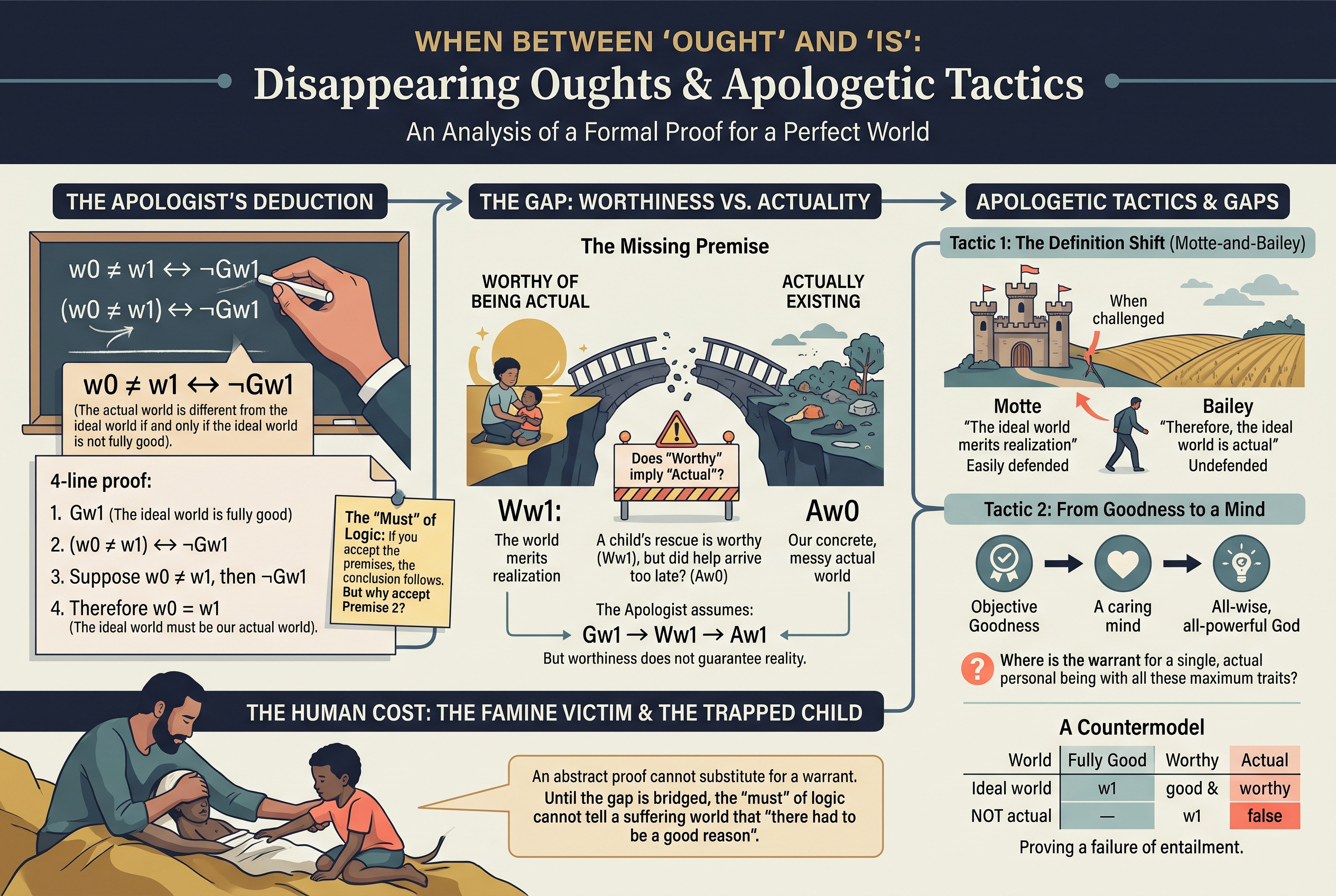
7. The central argument in symbolic logic
Let
| Symbol | Meaning |
|---|---|
| World is fully good. |
| World is worthy of being made actual. |
| World is actual, meaning . |
What his stated premise proves
The apologist says that the two worlds differ if and only if the proposed world falls short of full goodness. Using the definitions above, his premise is:
¬
In classical logic, this is equivalent to:
Grant
What his explanation of goodness proves
His explanation is that whatever is good is worthy of being brought into actuality. I can grant that principle, too. The resulting deduction is straightforward.
- ∀
- Therefore,
The conclusion at line 3 ends in 

We can test the difference with two distinct possible worlds, each accessible from both.
| World | Fully good | Worthy of actuality | Actual |
|---|---|---|---|
| False | False | True |
| True | True | False |
Every claim in lines 1–3 holds here. Exactly one world is actual, so the apologist’s uniqueness claim holds as well. Yet
This is where the motte-and-bailey concern arises. The defensible claim is that the ideal merits actuality. The stronger claim is that the ideal has actuality. He may sincerely regard the first as an explanation of the second. Writing them out shows why I can accept everything he says about what deserves to happen and still ask what establishes that it happens.
Addendum. What does the other half of “if and only if” commit us to?
My interlocutor needed only one direction of an implication to complete his proof. He gave me both. His exact words were:
w0 != w1 if and only if w1 is not good in the fullest sense
Let
Read it once in each direction.
| Direction | What it says | Its role |
|---|---|---|
| → | If the candidate world is fully good, it is the actual world. | This is the direction his proof uses. |
| → | If the candidate world is the actual world, it is fully good. | This is the additional commitment made by “if and only if.” |
The second line raises a question about scope. He described the connection as holding “by definition of the way things ought to be.” Is he offering a definition that applies to any candidate world, including ours? Or is he asserting something particular about the one world he has labeled
Suppose he means a general definition. Then I can take our actual world as the candidate and apply the second line:
→
- Therefore,
Notice what has disappeared. I have made no appeal to a possible ideal world, to its worthiness of realization, or to a contradiction. The general definition and the fact that a thing is identical to itself deliver the conclusion. That makes the inference valid. It also tells us exactly where the substantive commitment entered: the definition already makes actuality sufficient for full goodness. What independent reason do we have to accept that?
Suppose instead that his biconditional applies only to the particular candidate
I would therefore ask him to specify which claim he intends. If he means the forward implication alone, he can drop “if and only if” and defend the move from goodness to actuality. If he means the general biconditional, then I would ask about the direction his proof never uses: What is it about being the actual world that guarantees this world is fully good? That was the very issue the famine victim’s suffering put on the table.
Would the same reasoning make a fully bad world actual?
Consider the parallel claim: Every fully bad world is worthy of actuality. Does my interlocutor’s reasoning commit him to that as well?
No. Let 
The more revealing parallel arises one step later. He argues that a goodness realized is better than one that remains merely possible. Consider a cruelty that someone contemplates but never carries out. Had it been carried out, the outcome would have been worse for the intended victim. Both comparisons are intelligible. Neither tells us what happened. A ranking answers “Which outcome is better or worse?” What premise answers “Which outcome is actual?”
We can see the distinction in his proof itself. If I grant that a fully bad world is possible and add the premise that any fully bad world is actual, its actuality follows just as validly. I have no independent reason to grant that added premise. The apologist has a reasonable reply available to him: goodness gives us a reason to choose the good world, whereas badness gives us a reason to reject the bad one. I agree. My question is what guarantees that the choice for which there is good reason is the choice that reality reflects.


Leave a Reply