

Consider the Following:
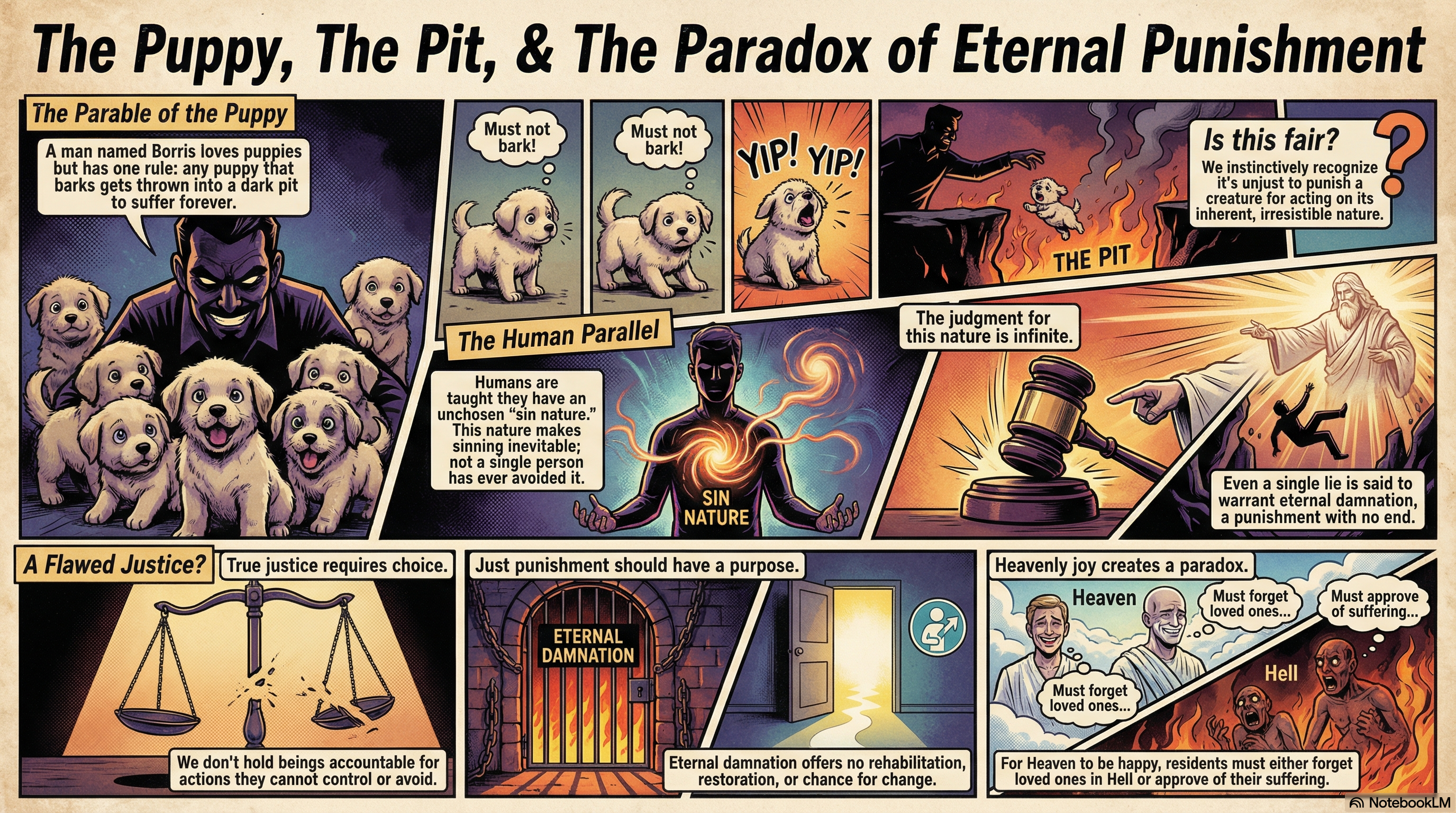
Summary: This post argues that holding humans eternally accountable for sin, given an inescapable sinful nature, is inconsistent with fairness, as genuine culpability requires choice and awareness. It questions whether a just and compassionate God would condemn individuals for actions rooted in an inherent, unchosen disposition.

Imagine a scenario: Borris professes a deep love for puppies, filling his home with them. Yet, he imposes one severe rule—any puppy that barks will be thrown into a dark basement to suffer indefinitely. Despite being trained to avoid barking, each puppy ultimately succumbs to its instinct and is punished.
What feels wrong about this scenario? The puppies’ impulse to bark is inherent; it is part of their very nature. Observing this situation, we would argue that punishing them for an irresistible behavior is profoundly unjust. If no puppy could refrain from barking, how could any be fairly blamed? The punishment is not only disproportionate but overlooks the unchangeable fact of their nature.
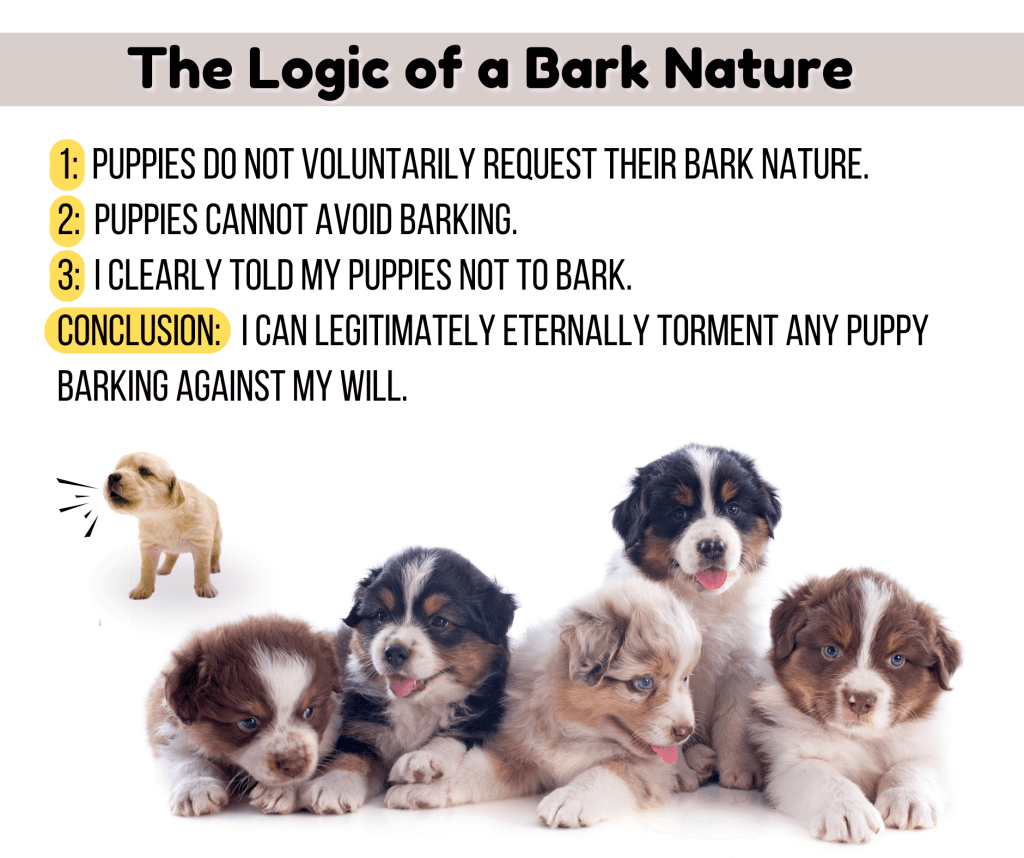
The Bible posits that all humans are born with an innate inclination toward sin. Despite commandments to refrain from sinful actions, no one has succeeded in living a sin-free life. Does it then follow that eternally condemning humans for succumbing to this inescapable tendency aligns with the qualities of a just God? In human societies, we generally avoid punishing animals or individuals for behaviors that align with their nature—especially if that nature is impossible to resist.
A Nature We Didn’t Choose
Many Christians believe they were born with a nature they did not request and cannot control, yet they are held eternally accountable for their actions under this nature. Can we honestly argue that a human possesses the free will to avoid sin if scripture suggests that not a single person has managed to live a sin-free life? While some may argue that free will grants humans a choice, the reality that every individual succumbs to sin points to a universal limitation within human will, one rooted in their very nature.

If eternal punishment were reserved for rare, extreme acts of malevolence, this view might seem more reconcilable with human understandings of justice. However, the Bible suggests that even a single lie warrants eternal damnation. Such an extreme punishment, especially for actions stemming from an inherent nature, raises questions. Why would an all-powerful and all-loving God respond so severely to a minor infraction rooted in an unchosen disposition? How do we reconcile this notion with the image of a God who is supposed to embody love and mercy?
Objectives of Just Punishment
A foundational principle in criminal justice systems worldwide is that punishment serves a purpose. Typically, punishment is designed to:
- Prevent further harm: Deterring the individual or society from engaging in harmful actions.
- Rehabilitate the offender: Encouraging transformation to prevent recurrence of the offense.
- Restore relationships: Where possible, bringing the offender back into good standing within their community, especially when the offender is someone loved.
Eternal damnation, as described in Christian doctrine, does not fulfill any of these purposes. Imagine a young girl who harbors hatred for an abusive father. According to the Bible, her hatred alone is grounds for eternal punishment. Yet, if eternal punishment removes her from any possibility of reconciliation or growth, it fails both rehabilitative and restorative purposes.
Would a just and loving God not seek ways to restore rather than eternally condemn? Where human justice involves correction and opportunities for growth, eternal damnation forecloses all possibilities for change or redemption. It permanently separates individuals from any potential for transformation, suggesting a God more interested in retribution than restoration.
Awareness and Fairness in Judgment
A core consideration in assessing guilt is whether the offender understood their actions were wrong. Take, for instance, the young girl abused by her father. She may understand that her hatred toward him is hurtful, but would she comprehend that this resentment is offensive to a divine being? Many individuals, especially those raised outside a Christian worldview, may be unaware of Christian doctrines on sin and redemption. Punishing individuals who lack awareness of their supposed transgressions is inconsistent with principles of fairness upheld even in human legal systems.
Furthermore, it is questionable whether people born into circumstances with limited exposure to Christian teachings would understand or accept the concept of sin in the same way. If an individual has never encountered Christian teachings or has been taught a vastly different worldview, would it be just to hold them accountable for a belief system they were never given a chance to embrace or reject?
Volition and Accountability
True justice recognizes whether individuals possess the capacity to resist certain actions. We do not hold animals accountable for instinctive behaviors, nor do we blame individuals with certain mental conditions when they cannot control their actions. Similarly, if sin is a universal tendency that humans are born with and that not a single person can avoid, shouldn’t we question whether these actions are genuinely willful transgressions?
Consider this: if every human eventually lies, regardless of upbringing or effort, this universal act suggests an inherent feature of human nature rather than a purely volitional choice. Can we then justly label a single, minor transgression as deserving of eternal punishment if it arises unavoidably from such a nature? The Bible’s suggestion that even the smallest of sins merits endless suffering does not align with principles of proportionate justice.

Reasoned Conclusion
Let us outline a logical structure to examine this issue more rigorously:
- Premise 1: Following an unrequested and unavoidable nature does not warrant blame, as blame assumes an ability to choose otherwise.
- Premise 2: Humans are believed to possess an unrequested, unavoidable inclination toward sin.
- Conclusion from Premises 1 and 2: Humans should therefore not be deemed culpable for actions arising from this unchosen nature.
- Premise 3: It is unjust to punish individuals for actions for which they bear no genuine culpability.
- Premise 4: The biblical doctrine asserts that God punishes humans for actions aligned with their intrinsic nature.
Conclusion: The concept of eternal punishment for unavoidable sin conflicts with fundamental principles of justice and the image of a compassionate, fair deity.
In sum, a just God, as conceived by many believers, would treat humans with compassion rather than condemning them for behaviors rooted in their inherent nature. The rigid doctrine of eternal punishment for inevitable sin raises significant questions: Should we not expect reason and proportionality from the deity revered as the ultimate embodiment of justice?
A Companion Technical Paper:

The Logical Form
Argument 1: Inherent Nature and Blameworthiness
- Premise 1: Blame requires that an individual has the ability to choose otherwise.
- Premise 2: Humans possess an unrequested, unavoidable inclination toward sin.
- Conclusion: Therefore, humans should not be blamed for actions arising from this unchosen nature.

Argument 2: Punishment and Culpability
- Premise 1: Culpability depends on genuine control over one’s actions.
- Premise 2: Humans are unable to avoid sin due to an inherent disposition.
- Conclusion: Humans cannot be deemed culpable for sin if it is unavoidably rooted in their nature.
Argument 3: Proportionality and Justice
- Premise 1: Just punishment should be proportionate to the action and its context.
- Premise 2: The Bible teaches that even a single minor sin warrants eternal punishment.
- Conclusion: Eternal punishment for minor, inevitable transgressions is inconsistent with principles of proportional justice.
Argument 4: Awareness and Accountability
- Premise 1: Justice considers whether an individual understands the wrongness of their actions.
- Premise 2: Many people lack awareness of certain sinful actions or their consequences within Christian doctrine.
- Conclusion: Punishing individuals who lack awareness of their supposed transgressions is unfair and inconsistent with justice.
Argument 5: Divine Justice and Restoration
- Premise 1: A loving and just God would seek the restoration of individuals rather than eternal condemnation.
- Premise 2: Eternal damnation prevents any possibility of reconciliation or personal growth.
- Conclusion: Eternal punishment contradicts the notion of a God interested in restoration and rehabilitation.
Argument 6: Logical Inconsistency of Eternal Punishment
- Premise 1: It is unjust to punish a person without genuine culpability.
- Premise 2: According to biblical doctrine, God punishes humans for actions aligned with their intrinsic nature.
- Conclusion: The concept of eternal punishment for an inescapable nature is inconsistent with the idea of a just God.

(Scan to view post on mobile devices.)

A Dialogue
Is Eternal Punishment Just for an Unchosen Sinful Nature?
CHRIS: I believe that God holds us accountable for our actions, and that eternal punishment is a fair response to sin. After all, He’s given us the ability to choose right from wrong.
CLARUS: But if sin is part of our inherent nature, then we didn’t choose that inclination—it’s unrequested and unavoidable. How can we be justly held culpable for actions that are inevitable?
CHRIS: I understand your concern, but I believe we still have free will to resist sinful urges. God wouldn’t command something impossible for us to achieve.
CLARUS: Let’s look at that closely. The Bible says that everyone sins, without exception, which implies that resisting sin is beyond human capacity. If no one can avoid sin, how can blame apply? Blame implies a genuine choice, which doesn’t seem to exist here.
CHRIS: But wouldn’t God still be justified in punishing sin to uphold justice? He has to address wrongdoings to preserve the order of creation.
CLARUS: Punishment in human systems aims to rehabilitate or deter. Eternal punishment, by contrast, offers no possibility for growth or reconciliation; it simply condemns. Doesn’t that seem more like retribution than a fair or just response?
CHRIS: Perhaps eternal punishment is warranted to show the seriousness of sin. Even minor sins offend an infinitely holy God, deserving infinite consequences.
CLARUS: But proportionality is a key part of any concept of justice. A finite transgression, especially one rooted in an unchosen nature, seems undeserving of infinite punishment. Wouldn’t a just God apply consequences proportionate to the act?
CHRIS: Maybe God’s standard is just higher than ours, requiring eternal consequences to convey the gravity of any sin.
CLARUS: Even so, justice considers whether the offender understood their actions as wrong. Many people grow up without any exposure to Christian doctrines on sin or eternal punishment. Isn’t it unjust to impose eternal consequences on those who may not know they’re offending?
CHRIS: The Bible teaches that God’s law is written on everyone’s heart, so people should naturally know when they’re doing wrong, even without explicit knowledge of the gospel.
CLARUS: But if they lack specific knowledge about eternal punishment or the need for salvation through Jesus, it seems unfair to hold them to the same eternal consequences. Shouldn’t knowledge of these doctrines be a prerequisite for such an extreme punishment?
CHRIS: Perhaps God has reasons we can’t fully understand. Eternal punishment might serve a higher purpose in His divine plan.
CLARUS: But if we’re talking about true justice, it should be comprehensible and consistent. If culpability requires free choice and understanding, condemning people for unavoidable tendencies contradicts the very principles of justice we recognize. Wouldn’t a just God’s actions withstand reasonable scrutiny?
CHRIS: I see your point, but in matters of faith, we trust that God’s ways are beyond human reasoning.
CLARUS: Then perhaps we should question if a belief that eternal punishment reflects a loving and just God is reasonable. Shouldn’t beliefs about divine justice make sense even when subjected to critical thought? If not, we risk attributing to God qualities that any reasonable standard would deem unfair.
Notes:
Helpful Analogies
Analogy 1: The Blameworthy Robot

Imagine a robot built with a programming flaw causing it to unintentionally damage property whenever it performs a certain task. If the robot’s designers know about the flaw but do nothing to fix it, would it be fair to blame the robot for the damage it causes? Just as it would seem unreasonable to blame a programmed machine for following its nature, it’s questionable to hold humans culpable for sins rooted in their unchosen nature.
Analogy 2: The Addicted Patient
Consider a person born with a strong genetic predisposition for addiction. Despite their best efforts, they occasionally succumb to this tendency and relapse. Would it be fair to impose severe punishment on this person for behavior they struggle to avoid due to their inherent disposition? Similarly, condemning people for acting on unavoidable inclinations raises doubts about the fairness of eternal punishment.
Analogy 3: The Impulsive Puppy
Imagine training a puppy with the rule that any time it barks, it will be punished, even though barking is a natural impulse for the puppy. No matter how much it tries, the puppy will eventually bark and face punishment. Just as we wouldn’t find it fair to penalize a puppy for following its instincts, condemning humans for actions driven by their inherent sinful nature seems inconsistent with the idea of just punishment.
Addressing Theological Responses
Theological Responses
1. Free Will and Responsibility
Theologians often argue that while humans may have an inherent inclination toward sin, they still possess free will. According to this view, God’s justice requires holding individuals accountable because they have the capacity to choose between right and wrong, even if avoiding sin entirely is challenging. The choice, rather than the inclination, is what determines culpability.
2. Purpose of Eternal Punishment
Some theologians maintain that eternal punishment serves to underscore the seriousness of sin and the infinite gap between humanity and a holy God. This perspective holds that every sin, no matter how minor, is infinitely offensive to an infinitely holy being, thus warranting an infinite consequence. In this view, the concept of proportionality shifts in light of God’s supreme holiness.
3. Innate Law and Accountability
The idea that God’s law is written on the human heart suggests that people possess an innate awareness of basic moral principles, even without explicit knowledge of Christian doctrines. Theologians argue that this innate moral sense provides sufficient guidance, making people accountable for their actions even if they are not fully aware of the specific tenets of faith.
4. Divine Mystery and Human Understanding
Theologians often caution against measuring divine justice by human standards, suggesting that God’s ways are ultimately beyond complete human comprehension. While eternal punishment may seem unjust from a human perspective, some theologians argue that faith requires trust in a divine order that may not always align with human expectations of justice.
5. Justice as Part of God’s Nature
According to some theological interpretations, God’s nature encompasses both justice and mercy, and eternal punishment reflects the uncompromising aspect of divine justice. Theologians might argue that forgiveness is always available through repentance, making the consequence avoidable. Therefore, eternal punishment applies only to those who choose to reject God’s mercy rather than to all who sin.
6. The Role of Rehabilitation through Faith
From a theological standpoint, eternal punishment may seem severe, but it is not intended for those who earnestly seek repentance and transformation. Theologians often argue that faith in God’s forgiveness provides a path to avoid condemnation, suggesting that eternal consequences apply primarily to those who willfully reject God’s grace rather than to those who err due to a sinful inclination.
7. The Symbolic Nature of Hell
Some theologians propose that hell and eternal punishment may be metaphorical representations of separation from God rather than literal, unending torment. In this view, the consequence of sin is the absence of communion with God, allowing for a theological interpretation that aligns more closely with divine justice while still recognizing the severity of rejecting God’s love.
Counter-Responses
1. Response to Free Will and Responsibility
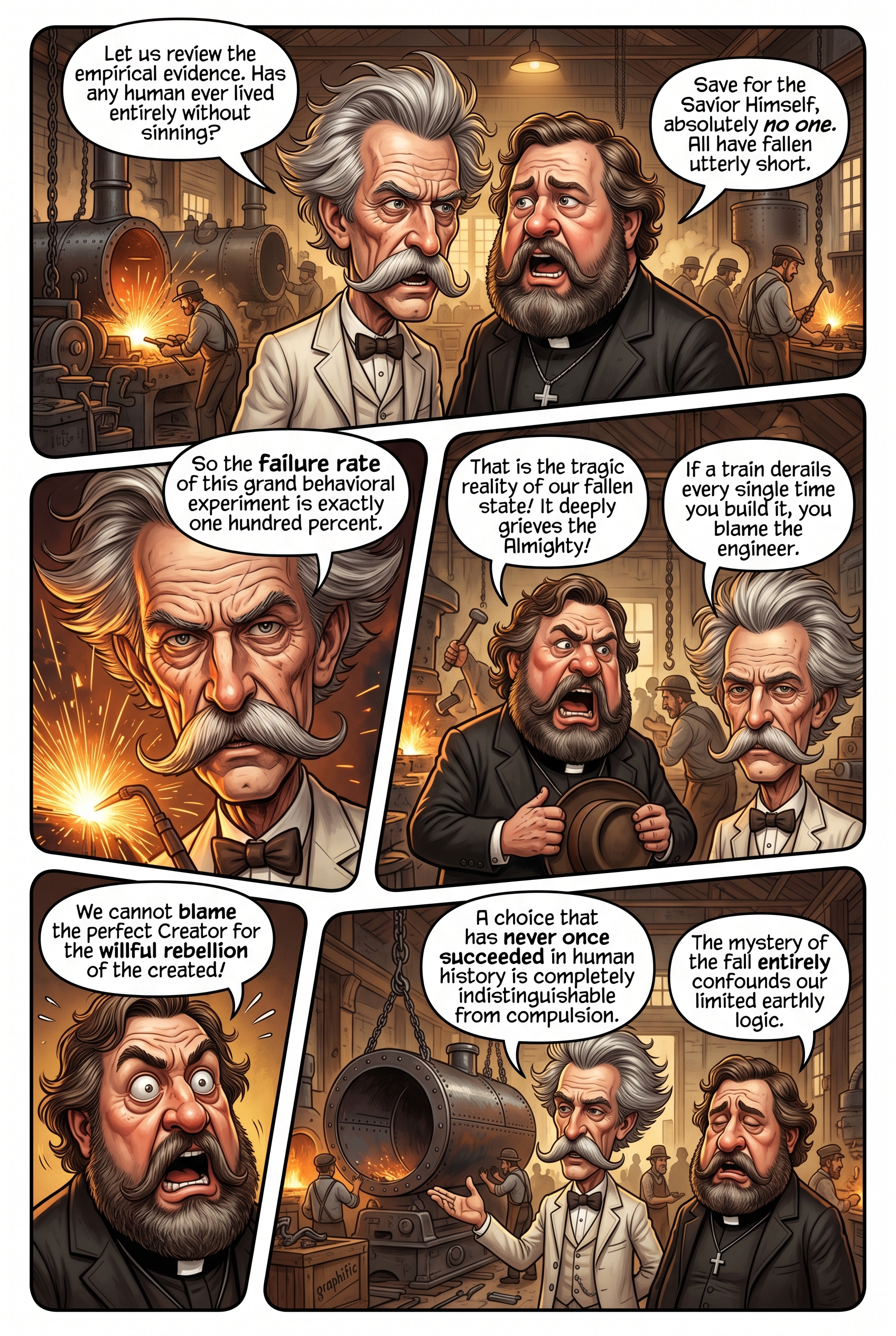
If sin is truly inevitable due to an inherent inclination in human nature, then free will appears insufficient for achieving a sin-free life. While humans may have choices, the universal failure to avoid sin suggests that willpower alone cannot overcome this innate inclination. Culpability requires that avoidance of the action is genuinely feasible, and if every human inevitably sins, it calls into question whether sin is truly a matter of choice rather than compulsion.
2. Response to Purpose of Eternal Punishment
The argument that eternal punishment underscores the seriousness of sin fails to address the principle of proportional justice. If every offense, regardless of severity, merits an infinite consequence, then this punishment lacks proportion and seems to value retribution over fairness. Moreover, if God is infinitely merciful as well as holy, wouldn’t divine justice emphasize mercy and rehabilitation rather than eternal punishment for finite transgressions?
3. Response to Innate Law and Accountability
While theologians claim that God’s law is written on human hearts, this doesn’t clarify the role of awareness in culpability. Many people may feel general guilt for certain actions but lack specific knowledge of Christian teachings on sin and eternal consequences. Without clear, specific awareness of the consequences, it seems unjust to impose infinite punishment based on vague, innate “moral” feelings rather than informed understanding of divine expectations.
4. Response to Divine Mystery and Human Understanding
Appealing to divine mystery to justify eternal punishment assumes that faith requires abandoning rational standards of justice. True justice should be intelligible and consistent with reason; otherwise, it risks appearing arbitrary. If God’s justice contradicts the principles humans understand as fair, it raises valid questions about the coherence of this attribute, as justice implies transparent, rational grounds rather than mystery.
5. Response to Justice as Part of God’s Nature
While justice and mercy are central to theological arguments, eternal punishment for a single transgression implies that justice outweighs mercy. If mercy is always available, it seems contradictory that eternal consequences would remain even after a minor or unavoidable act. True justice would likely seek a balance, offering a proportionate consequence rather than eternal punishment for what could be seen as minor infractions in an inherited sinful nature.
6. Response to Rehabilitation through Faith
The claim that eternal punishment applies only to those who reject repentance overlooks the issue of innate sinfulness. If humans are naturally inclined toward sin, rejecting faith might also stem from this unavoidable disposition. Punishing individuals eternally for tendencies they cannot control, including their doubt or unbelief, undermines the notion of rehabilitative justice by making the outcome dependent on overcoming an inherent weakness, which may not be entirely voluntary.
7. Response to the Symbolic Nature of Hell
While the symbolic interpretation of hell might seem more just, it lacks consistency with many traditional teachings on eternal punishment as a literal, endless consequence. If separation from God is truly metaphorical, then the concept of justice and mercy might appear in a different light. However, using symbolic language to justify eternal consequences raises questions about the clarity of divine justice and the fairness of judging individuals based on unclear metaphors.
Clarifications
The “Logic of a Bark Nature” analogy…
…offers a profound illustration of the inherent challenge of assigning blame for actions rooted in one’s nature. Here’s why this analogy is particularly apt:
- Innate Nature vs. Imposed Expectations: Just as barking is a natural, unavoidable behavior for puppies, sin is often portrayed in Christian theology as an innate part of human nature. Punishing a puppy for barking parallels the idea of condemning a person for acting on an unavoidable disposition, suggesting that punishment might be misplaced when the action is intrinsic.
- Limited Understanding of Rules and Penalties: Puppies lack a clear understanding of human rules and consequences regarding barking, especially before they’ve barked for the first time. Similarly, in theological terms, people may be unaware of certain behavioral or spiritual expectations—particularly those with no exposure to the doctrines outlining “sin” and “punishment.” This analogy highlights the communication gap between rule-givers (owners or God) and rule-followers (puppies or humans), where expectations are not fully understood or explained.
- Inevitability of the Behavior: Barking for a puppy is not just likely but inevitable. Likewise, sin, according to certain theological views, is an unavoidable part of the human experience. This raises the question of whether it’s just to punish for inevitable actions, particularly when those actions arise from an inherent part of one’s nature.
- Intrinsic Communication Barrier: Just as owners and puppies have fundamentally different ways of understanding the world, so too might divine expectations and human nature have an intrinsic disconnect. Puppies don’t fully grasp the obligatory weight (as humans define it) behind barking; they’re responding to instincts. In the theological analogy, humans may similarly struggle to understand divine expectations, making punishment for innate tendencies seem overly harsh.
- Punishment Without Corrective Intent: When owners punish puppies simply for being what they are, it can feel unjust, as the punishment doesn’t correct a behavior that can be genuinely avoided. This mirrors the theological issue of eternal punishment for inherent sinfulness, where the consequence doesn’t provide a path to growth or transformation but serves only as retribution.
- Empathy Gap: Just as it may be difficult for an owner to empathize with a puppy’s natural inclinations, this analogy suggests a potential empathy gap between God and humans. If God’s justice includes eternal punishment for inescapable sins, it may imply a detachment or misunderstanding of human limitations, similar to an owner expecting a puppy to understand complex rules.
By using the “Logic of a Bark Nature,” the analogy critiques the idea of holding beings accountable for acting in line with their inherent nature, raising ethical and philosophical concerns about justice, empathy, and understanding across fundamentally different perspectives.
Formalization:
Here’s a symbolic logic formulation based on the “Logic of a Bark Nature” analogy, intended to illustrate the incoherence of condemning a being for actions that arise from its inherent nature:
Symbolic Logic Argument: The Bark Nature Reductio
Domain Definitions:
- Let B(x) represent “x exhibits behavior b (e.g., barking or sinning).”
- Let N(x, b) represent “x has behavior b as a natural disposition.”
- Let P(x, b) represent “x is punished for behavior b.”
- Let A(x, b) represent “x is accountable for behavior b.”
- Let C(x, y) represent “x fully comprehends the expectations of y.”
- Let I(b) represent “behavior b is inevitable given the nature of the agent.”
Premises:
P1: ∀x ∀b [N(x, b) ∧ I(b) → ¬A(x, b)]
A being cannot be held accountable for behavior that is both natural and inevitable.
P2: ∀x ∀b [¬A(x, b) → ¬P(x, b)]
If a being is not accountable for a behavior, it is unjust to punish it.
P3: ∀x ∀b [N(x, b) ∧ I(b)]
(In Christian theology) All humans have a sinful nature and will inevitably sin.
P4: ∀x ∀b [C(x, G) = false]
There exists a communication/empathy gap between humans and God analogous to that between puppies and owners, such that humans cannot fully comprehend divine expectations.
Conclusion:
C: ∴ ∀x ∀b [P(x, b) is unjust]
Punishing humans (or puppies) for behavior rooted in their nature and inevitability is unjust.
Plain-language Summary of the Reductio:
- If a behavior is both natural and inevitable, then the agent cannot be accountable for it.
- If the agent is not accountable, punishment for that behavior is unjust.
- Sin (or barking) is presented as natural and inevitable.
- Therefore, punishment for sin (or barking) is unjust.
Alternate Framing as a Reductio ad Absurdum:
Assume:
A just God punishes humans eternally for sin, even though sin is natural and inevitable.
Then:
God is punishing beings for doing what they cannot avoid doing.
But:
Punishing beings for what they cannot avoid doing is unjust.
Therefore:
The claim that a just God punishes inevitable sin leads to absurdity.
∴ Either God is not just, or the theological framework is internally incoherent.
Will Heaven’s Bliss Depend on Forgetting or Accepting Hell?
✶ This essay is primarily for those who believe in an eternal torturous Hell.
In Christian theology, Heaven is often depicted as a realm of perfect joy, peace, and union with God. This image is comforting, yet it raises a pressing question: if Heaven truly contains perfect happiness, how will its inhabitants cope with the knowledge that some of their loved ones suffer in eternal torment in Hell? This quandary, known as the Problem of Heavenly Knowledge, has elicited a few theological responses over the centuries. Three main solutions have been proposed: either Heaven’s inhabitants will accept Hell’s punishments with the mind of God, become distracted by God from Hell’s horrors, or be insulated in Heaven from Hell’s anguish by means akin to forgetfulness. Each of these solutions offers fascinating insights, but each also carries weighty implications about the nature of both divine justice and heavenly happiness.
1. Accepting the Torments of Hell with the Mind of God
One common theological response is that the redeemed in Heaven will adopt God’s perspective on divine justice. According to this view, those in Heaven will attain such perfect understanding of God’s will and justice that they will come to fully accept the torments of Hell as deserved and, perhaps even, righteous. Some theologians have gone so far as to say that those in Heaven will look upon Hell with a sense of satisfaction, appreciating the justice that it represents. This is a difficult view to swallow, as it implies a complete recalibration of empathy and a detachment from human compassion, traditionally seen as an aspect of divine love.
One might ask, could the joyful acceptance of suffering ever align with the heart of Christian teaching? If heavenly residents truly embody the mind of God, then they may come to see Hell’s torments as a necessary outworking of divine justice, even if this requires viewing loved ones in agony. This view implies that God’s justice is so paramount that it could transform the compassionate nature of Heaven’s inhabitants, making them smile upon a loved one’s suffering with a God-aligned perspective on the eternal punishment they now deem just. But would this Heaven, in which friends and family suffer with approval from the redeemed, retain any resemblance to human concepts of love?
2. Distracted from Hell with Divine Amusements
Another solution proposed by theologians is that Heaven’s joy will be so overwhelming and all-encompassing that those in Heaven will be utterly distracted from any knowledge of Hell or the fate of the damned. In this view, God will provide such heavenly delights and divine communion that the inhabitants of Heaven will be too engrossed in eternal bliss to even remember Hell, let alone the people in it. Heaven’s pleasures, in a sense, become a kind of divine amnesiac balm, obliterating the memory of friends and family who may not have made it to salvation.
This explanation has its own set of absurd implications. It suggests that eternal happiness requires willful ignorance, achieved not through an active choice by the saved but rather through an external distraction orchestrated by God. If heavenly distractions are necessary to maintain Heaven’s perfection, does that imply a flaw or limitation in the concept of Heaven itself? Is Heaven truly perfect if it must divert its inhabitants’ thoughts away from uncomfortable truths to remain so? Moreover, if Heaven’s inhabitants lose memories of their loved ones and their struggles, is this Heaven still a place of meaningful personal continuity for those who once cherished these relationships on Earth?
3. Insulated from Hell by Divine Forgetfulness
The final solution some theologians propose is that Heaven’s inhabitants will be insulated from Hell by a form of divine forgetfulness or emotional lobotomy, wherein God erases the memories of loved ones who did not attain salvation. According to this view, the screams of the damned will not reach the ears of Heaven’s inhabitants, and memories of earthly relationships with the damned will be erased, allowing the saved to focus solely on the glory and love of God. Heaven, in this sense, becomes an airtight realm, devoid of any reminders of earthly relationships that could potentially tarnish its bliss.
This solution arguably presents the most challenging implications for our understanding of personal identity and love. If Heaven requires the erasure of all meaningful connections to loved ones who didn’t attain salvation, then it seems to undermine the continuity of personal memory that makes Heaven appealing to begin with. Are those in Heaven truly themselves if they have lost core memories of their lives and loves on Earth? If God’s love is presented as perfect and all-embracing, how does it make sense for God to sever meaningful relationships by divine amnesia? Moreover, if Heaven requires a fundamental forgetting of those who are lost, how can it still claim to be a place of perfect unity with God, who, by nature, would presumably retain His knowledge of every soul?
Reflections on Heaven, Hell, and Divine Justice
Each of these views attempts to reconcile the paradox of Heaven’s happiness with the reality of Hell’s torment, but each leaves significant ethical and philosophical questions. If the residents of Heaven truly smile upon Hell’s torments, then Heaven transforms into a place of radical emotional detachment, seemingly alien to Christian values of love and empathy. If Heaven requires distractions or amusements so that the saved forget about Hell, then Heaven’s bliss is sustained by a kind of divine diversion that feels tenuously constructed, as though God Himself must hide uncomfortable truths from His beloved. And if Heaven requires lobotomizing forgetfulness or insulation from Hell, then it presents a profound challenge to the idea of eternal relationships and the notion that Heaven fulfills personal and emotional continuity.
Consider the emotional detachment required of those in Heaven with friends and relatives screaming in Hell. Will they daily reflect on the “justice” the screaming reflects? How about after 10,000 years? Will they not, against God’s righteous judgment, petition Him for a reprieve of the torment? See Considerations #37.
Ultimately, the Problem of Heavenly Knowledge forces us to confront how Heaven’s perfection can coexist with eternal separation from loved ones. Each theological explanation asks Heaven’s inhabitants to forsake either memory, empathy, or rational consistency to maintain their joy, making Heaven seem less like a realm of perfected human existence and more like a state of divinely engineered contentment. The question, then, is not only whether such a Heaven would be desirable, but also whether it would be just.


Leave a Reply