
Consider the Following:
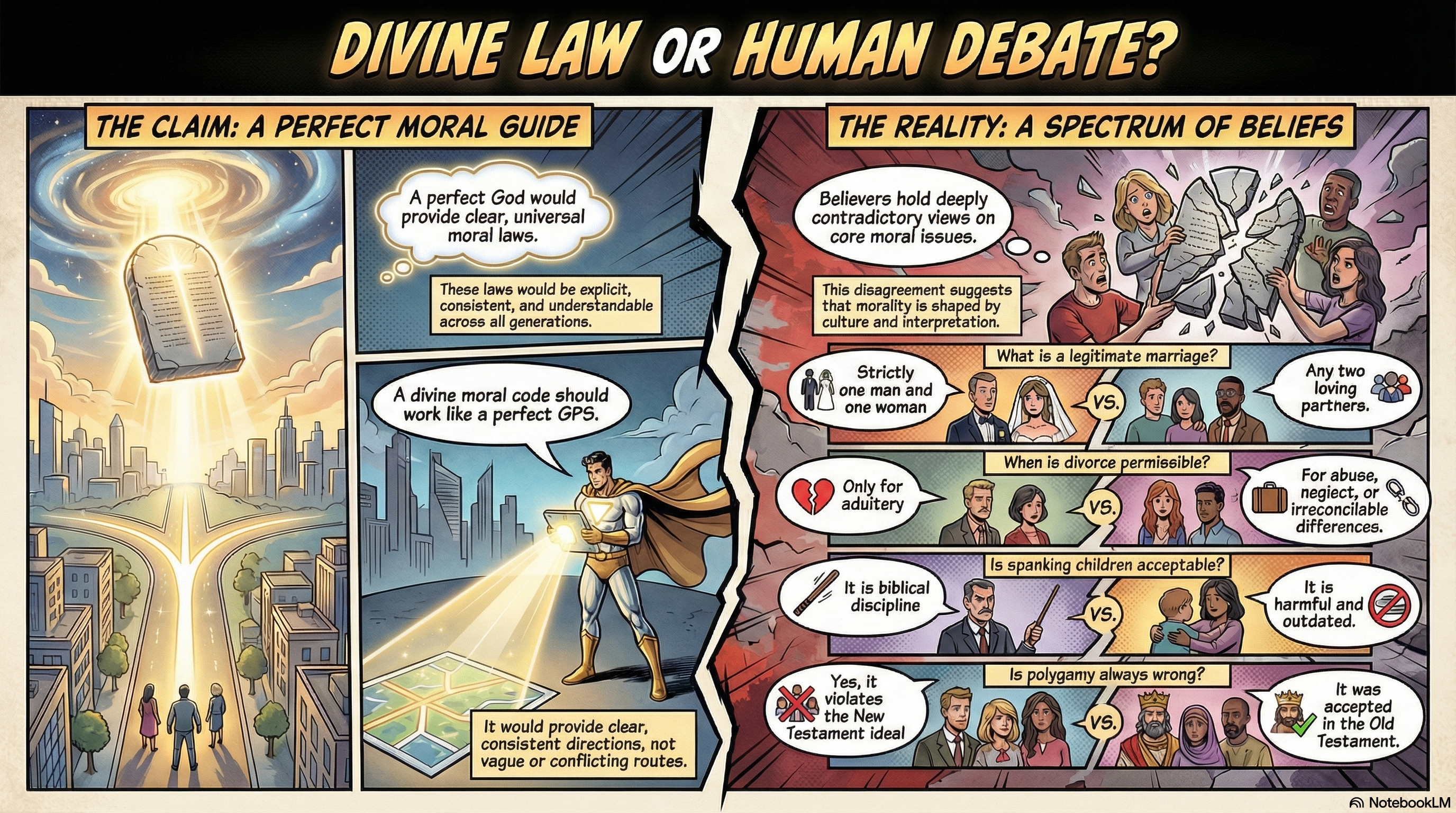
Summary: The initial content examines the ambiguity and inconsistency of the Bible’s moral teachings, questioning its claim as a divinely inspired source of objective morality. It argues that a perfect and omniscient God would provide clear, universal moral directives, yet the Bible reflects human cultural and emotional influences rather than timeless divine guidance.

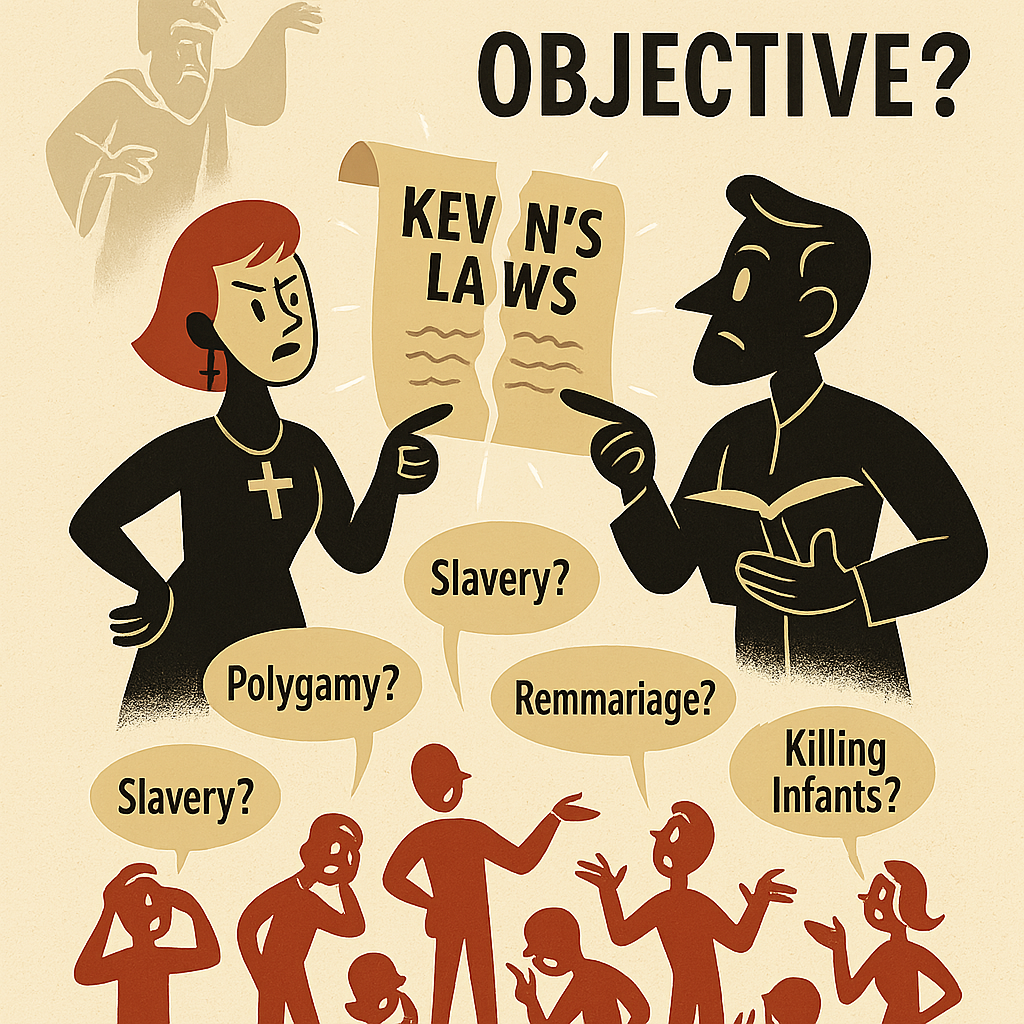
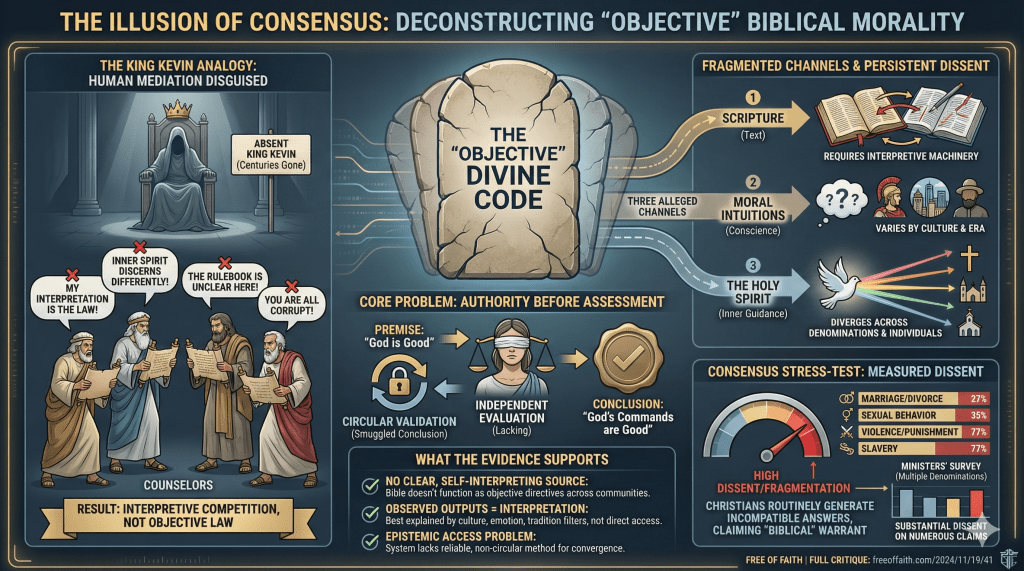
Imagine a kingdom ruled by King Kevin, whose counselors proclaim that any violation of his laws warrants imprisonment. However, these laws are not written down or publicized across all regions of Kevin’s domain. Instead, the counselors claim that individuals can discern these laws through the spirit of Kevin, said to reside in their hearts. If someone lives in accordance with a law the counselors ascribe to Kevin, they claim the person has followed Kevin’s spirit. Conversely, if a person violates such a law, they are accused of rebelling against the clear perception provided by Kevin’s spirit.
A deeper issue emerges: Kevin has been physically absent for centuries, leaving behind a book of rules. Despite this, his counselors cannot agree on the contents of the book. They insist that Kevin is not the author of confusion, yet the book’s lack of clarity has spawned endless interpretations and debates. Each counselor argues that careful study under their guidance will reveal the truth, but no consensus exists on which rules are genuinely Kevin’s and which are the fabrications of a “false” counselor.
What would you think of such a scenario? Would you consider these laws to be objective or the product of human confusion?
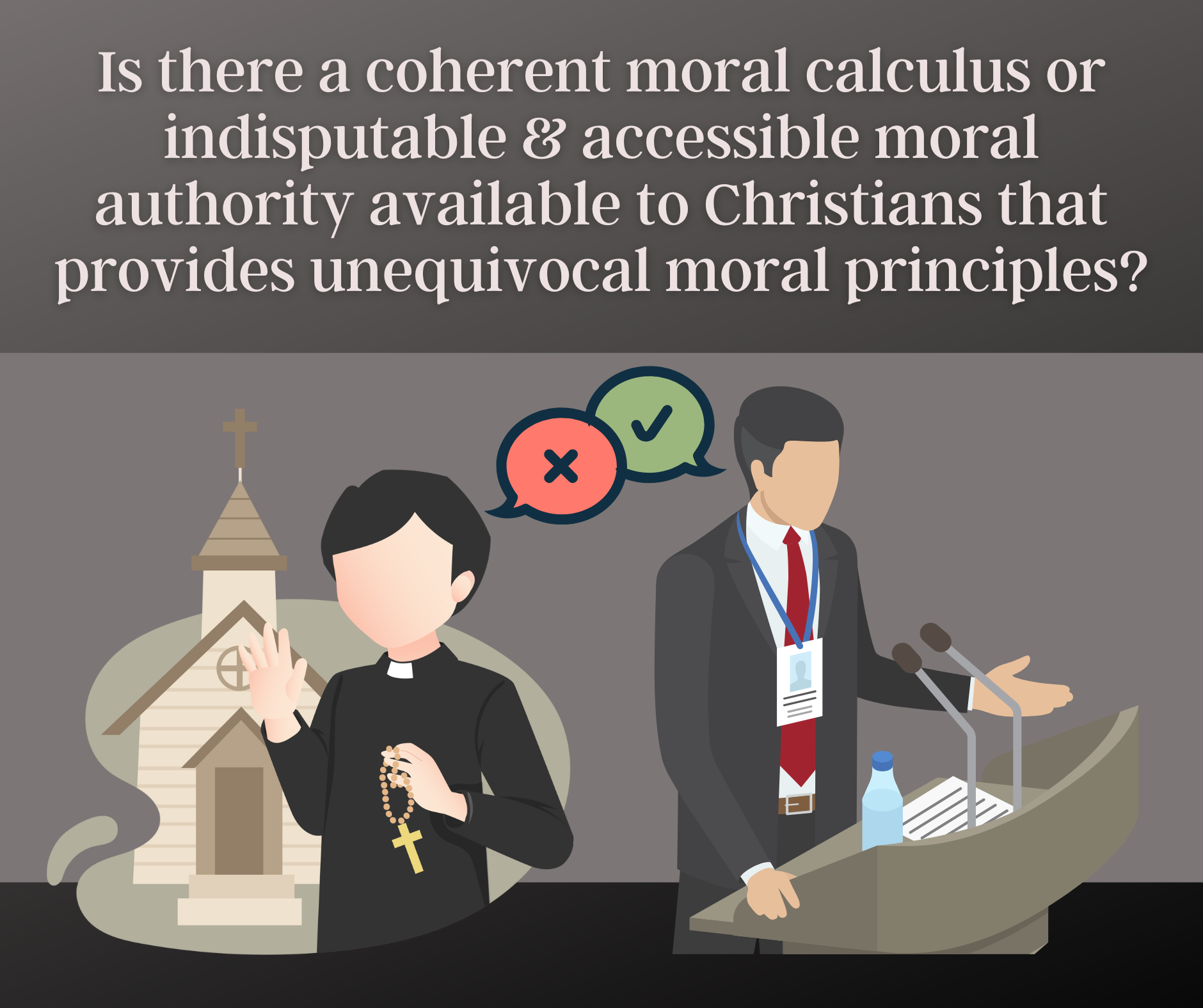
Does the Bible Serve as a Clear Source of Moral Laws?
If tasked with writing a book of moral laws, wouldn’t you ensure these laws are so explicit that no reader could misunderstand their application? If slavery is an indefensible practice, wouldn’t you explicitly define it and condemn it in all contexts? If you could send a spirit to communicate your laws, wouldn’t you make its voice indisputable, so there could be no confusion about its message?
When you examine the moral framework within Christianity, do you find such clarity? Or do you observe a system prone to disagreement and cultural interpretation?
Cultural and Emotional Influences on Morality
Alternatively, could the diverse moral beliefs across societies be better explained by variations in cultural norms and emotional tendencies rather than the unequivocal directives of a universal God? Laws and taboos worldwide seem to reflect the emotional and social fabric of their respective cultures rather than the consistent application of divine moral principles.
If a God of clarity and compassion exists, wouldn’t such a being make rules on slavery, killing, and other critical moral issues so explicit that no debate would be required? Shouldn’t an all-powerful, all-knowing deity prioritize clarity to minimize suffering and confusion?
The Problem of Moral Ambiguity in the Bible
When you read the Bible or seek guidance through prayer, do you receive clear parameters for behavior? Or are you compelled to consult counselors of God to interpret its complexities? Why should divine moral laws require such interpretative effort if they are truly objective and universal?
Challenging Moral Certainty in Christianity
The following questions are designed to test the claim that Christianity offers a clear and objective moral framework. Present these questions to a group of self-identified true Christians, ensuring they respond without consulting each other. Then, compare their answers to evaluate the degree of consensus.
- What constitutes a legitimate marriage in the eyes of God?
- Positions range: Some Christians believe marriage is strictly between one man and one woman, citing Genesis, while others accept same-sex unions, emphasizing God’s love and inclusivity. Other Christians argue over whether the marriage needs to be legally documented.
- Under what conditions is divorce permissible?
- Positions range: Traditionalists argue divorce is only permissible for adultery (Matthew 19:9). Others accept broader grounds such as abuse, abandonment, or irreconcilable differences.
- Is masturbation always immoral?
- Positions range: Some Christians view masturbation as a sin against chastity, while others see it as a natural human act that is not directly addressed in the Bible.
- Are certain sexual acts between married couples prohibited?
- Positions range: Some believe specific acts, like oral or anal sex, are unnatural and against biblical teaching, while others argue that all consensual acts within marriage are permissible.
- Is it immoral to marry a prepubescent or young girl?
- Positions range: Most modern Christians categorically reject this, though some point to ancient practices, such as Mary’s age at betrothal, to argue it was permissible in historical contexts.
- Is polygamy always wrong?
- Positions range: Many Christians view polygamy as contrary to the New Testament’s one-man-one-woman ideal, while others note its acceptance in the Old Testament and argue for its contextual validity.
- Under what circumstances, if any, is it acceptable to kill an infant?
- Positions range: Christians generally condemn infanticide, but some defend the order of God to kill the Amalekite children.
- Is consuming the remains of deceased relatives, as practiced in some cultures, immoral?
- Positions range: Some Christians find this practice inherently disturbing and against biblical purity laws, while others respect it as a culturally specific act that honors the dead.
- At what threshold of effort and expense is it moral to let someone die?
- Positions range: Some advocate extraordinary measures to preserve life at all costs, while others accept allowing natural death when burdens outweigh the benefits of continued intervention.
- Is spending money on entertainment while others suffer immoral?
- Positions range: Some argue radical generosity is required based on Jesus’ teachings, while others balance personal enjoyment with charitable giving.
- Is hunting animals for sport immoral?
- Positions range: Some condemn unnecessary killing as poor stewardship of creation, while others argue it is acceptable if the animal is not wasted.
- Is it moral to clone cells to help infertile couples have children?
- Positions range: Some Christians oppose cloning as interfering with God’s design, while others see it as fulfilling the command to be fruitful and multiply.
- Is it immoral to be avoidably obese?
- Positions range: Some argue it’s a sin against the body as God’s temple, while others emphasize grace and resist judgment on personal habits.
- Is misleading a business competitor through silence wrong?
- Positions range: Some view all forms of deception as sin, while others see certain competitive strategies, like withholding information, as morally neutral.
- Are all forms of suicide immoral?
- Positions range: Traditional views consider it a grave sin, while more modern interpretations focus on mental health and God’s compassion for those in despair.
- Is spanking children an acceptable practice?
- Positions range: Some Christians endorse spanking as biblical discipline, while others condemn it as harmful and outdated.
- What forms of slavery are always immoral?
- Positions range: Most Christians today reject all slavery as immoral, though historical interpretations justified certain forms based on Old and New Testament teachings.
- Is it moral to decide who should be removed from a lifeboat that cannot support all its passengers?
- Positions range: Some advocate self-sacrifice as the moral solution, while others argue that pragmatic decision-making is necessary in such situations.
- Is it moral to choose which of your children will die from hunger?
- Positions range: Most Christians find the scenario morally incomprehensible, but pragmatic considerations vary among thinkers.
- It would be immoral not to kill abortion doctors if it protected the unborn.
- Positions range: Most Christians, even those who equate abortion to the Holocaust, strongly reject this stance, while fringe groups endorse violence under the guise of protecting life.
- It would be morally permissible to kill abortion doctors if it protected the unborn.
- Positions range: Similar to #20, mainstream Christianity rejects violence in almost all circumstances, though extremist factions disagree.
- It is immoral for divorced individuals to remarry.
- Positions range: Some uphold this strictly based on Jesus’ teachings, while others allow remarriage in cases like abuse or abandonment.
- It is immoral to have meals with apostates from Christianity.
- Positions range: Some interpret this as condoning sin, while others see it as an opportunity for witnessing and fellowship.
- It is immoral to knowingly exceed highway speed limits.
- Positions range: Some believe all lawbreaking is sin, while others see minor infractions as morally neutral or context-dependent.
- It is immoral to practice circumcision or clitoridectomies.
- Positions range: Circumcision is often seen as culturally or religiously neutral; clitoridectomy is nearly universally condemned as harmful.
- It would be moral for a government to kill homosexuals for being homosexual.
- Positions range: Nearly all Christians today reject this, though some extremist groups point to Old Testament laws to support such actions.
- It is immoral to intentionally make someone believe you feel the opposite of what you actually feel about something.
- Positions range: Some see all deception as sin, while others permit “white lies” to avoid harm or maintain social harmony.
- Is refusing to give someone your coat who has asked for it immoral?
- Positions range: Some take Jesus’ teaching on radical generosity literally, while others interpret it metaphorically as a call to kindness.
- It is immoral to spend this earthly life enjoying earthly pleasures when unGospelled unbelievers face eternity in Hell, while you will have eternity in Heaven to relax.
- Positions range: Some Christians advocate radical self-denial for evangelism, while others balance the enjoyment of God’s gifts with evangelistic efforts.
- It is immoral to fight for a country in a war merely to gain more territory.
- Positions range: Some endorse pacifism, while others support just wars but condemn wars of aggression.
- It is immoral to divorce over a spouse merely romantically kissing another individual.
- Positions range: Some permit divorce only for adultery, while others view romantic betrayal as sufficient grounds for separation.
- It is immoral not to send money to help someone you know is starving to death.
- Positions range: Some argue that radical generosity is required, while others emphasize the importance of personal responsibility and circumstances.
- Is it moral to swear an oath on the Bible?
- Many Christians find this practice morally acceptable, despite Jesus’ injunction, “do not swear an oath at all.”
These questions underscore the ambiguity and inconsistency in moral teachings attributed to Christianity. They reveal the difficulties in claiming a universal, objective moral standard when interpretations vary widely across cultures, denominations, and individuals.
The Case for Moral Clarity
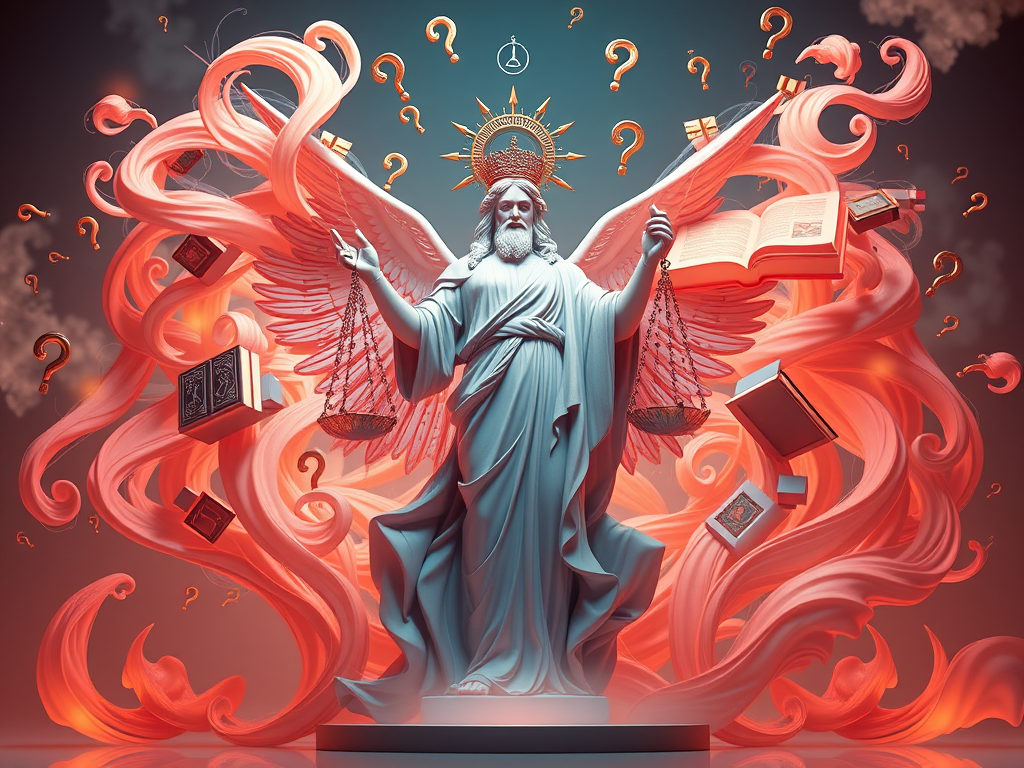
If a deity is truly concerned with human well-being, such a being would ensure moral directives are explicit, consistent, and accessible. A God of compassion and clarity would eliminate the need for interpretation or reliance on fallible counselors. The current state of biblical morality, with its confusion and divergence, calls into question the claim that it originates from a perfect and unchanging deity.
Instead, it appears more likely that what we observe are the emotional constructs and cultural adaptations of human societies, evolving over time to address their unique challenges and values. Can Christianity truly claim to provide objective morality, or is it a reflection of human subjectivity masquerading as divine truth?
See also:
The Logical Form
Argument 1: Moral Clarity and God’s Laws
- If a perfect God exists, God would ensure moral laws are explicit and universally comprehensible.
- The Bible’s moral laws are ambiguous and subject to interpretation.
- Therefore, the Bible’s moral laws are not the product of a perfect God.

Argument 2: The Inconsistency of Christian Moral Teachings
- If Christianity provides an objective moral framework, Christians should reach clear agreement on moral questions.
- Christians hold divergent and contradictory views on key moral issues (e.g., divorce, sexual acts, slavery).
- Therefore, Christianity does not provide an objective moral framework.
Argument 3: Emotional and Cultural Influences on Morality
- If moral laws derive from a universal deity, these laws would remain consistent across all societies and cultures.
- Moral beliefs vary widely across cultures and appear tied to emotional and cultural norms rather than universal principles.
- Therefore, moral laws are more likely the result of human subjectivity than the product of a universal deity.
Argument 4: Divine Responsibility for Moral Clarity
- A compassionate and omnipotent God would prioritize clarity in moral directives to minimize suffering.
- The Bible’s moral laws are unclear, leading to significant confusion and suffering.
- Therefore, the Bible does not reflect the work of a compassionate and omnipotent God.
Argument 5: Christian Moral Ambiguity
- If Christians rely on the Bible for objective morality, it should provide definitive answers to contemporary moral questions.
- The Bible lacks clarity on many critical moral issues (e.g., abortion, homosexuality, violence).
- Therefore, the Bible fails to serve as a source of objective morality for Christians.
Argument 6: The Test of Universal Moral Agreement
- If objective morality exists and is derived from a divine source, individuals who follow this source should agree on fundamental moral principles.
- When asked critical moral questions (e.g., suicide, abortion, divorce), Christians give inconsistent and conflicting answers.
- Therefore, moral claims in Christianity do not reflect objective morality.
(Scan to view post on mobile devices.)

A Dialogue
Moral Clarity and the Christian God
CHRIS: The Bible is the ultimate source of moral guidance because it reflects the will of a perfect and omnipotent God.
CLARUS: If that’s true, wouldn’t a perfect God ensure that these moral laws are clear and universally comprehensible? Yet the Bible contains numerous ambiguous passages that lead to conflicting interpretations. How do you reconcile this?
CHRIS: The Bible requires interpretation, but the Holy Spirit guides believers to understand it correctly.
CLARUS: That doesn’t seem to hold up. If the Holy Spirit truly provides guidance, why do Christians disagree on critical issues like divorce, slavery, or sexual morality? For instance, some Christians believe polygamy is immoral, while others cite the Bible to defend it.
CHRIS: Those disagreements arise because humans are fallible. The Bible itself is clear when read with proper context and faith.
CLARUS: If moral laws are truly objective and derived from God, wouldn’t they be universally understood, not subject to human fallibility? The fact that cultural and emotional influences seem to shape moral views suggests these laws come from human subjectivity, not a divine source.
CHRIS: But cultures diverge because of sin. God’s law remains constant, even if humanity fails to follow it.
CLARUS: That raises another issue. If a compassionate and omnipotent God exists, wouldn’t He prioritize clarity to minimize suffering? Take slavery as an example: why doesn’t the Bible explicitly and unequivocally condemn it in all forms? Instead, the text often seems to regulate rather than abolish it.
CHRIS: The Bible’s context was different. God worked within human systems to gradually improve morality.
CLARUS: But an all-powerful God isn’t limited by human systems. He could have delivered a clear, timeless directive against slavery, killing, or other moral atrocities from the beginning. The failure to do so undermines the claim that the Bible reflects the will of a perfect moral being.
CHRIS: God’s ways are higher than ours, and we may not fully understand His plan.
CLARUS: If we can’t understand His plan, how can we claim the Bible provides objective morality? When Christians can’t agree on basic moral questions, such as whether divorce is acceptable or whether masturbation is sinful, how can you argue for moral clarity?
CHRIS: Those are secondary issues. The Bible’s core message is about salvation, not exhaustive moral laws.
CLARUS: Yet Christians routinely assert that the Bible is a guide to living a moral life. If its moral framework is ambiguous and inconsistent, it fails as a reliable guide. This suggests the Bible isn’t divinely inspired but a product of human cultural and emotional constructs.
CHRIS: But Christians do agree on the most important truths, like loving your neighbor and worshipping God.
CLARUS: Even then, the specifics are vague. How do you define love in practical terms? Is it loving to give all your wealth to the poor, or is it loving to protect your family by keeping it? Without clear directives, Christians interpret these ideas in contradictory ways, undermining the claim of a universal moral framework.
CHRIS: Are you saying that no moral system can be objective if people disagree on its application?
CLARUS: No, I’m saying the Bible’s moral system fails as objective morality because its ambiguity and reliance on interpretation suggest it isn’t the product of a perfect God. An omniscient and omnipotent deity would ensure moral clarity to eliminate confusion and suffering. What we see instead is a document shaped by human subjectivity, leaving no reason to think it reflects divine authorship.
◉ A Companion YouTube Video
◉ A Companion Spotify Episode
Notes:
Helpful Analogies
Analogy 1: The Broken GPS

Imagine relying on a GPS system to navigate a complex city. If the GPS frequently gives vague directions, conflicting routes, or fails to explain critical turns, would you trust it to guide you? A reliable GPS must provide clear, consistent instructions to be effective.
The Bible, as a supposed guide to objective morality, behaves like a faulty GPS, offering ambiguous or contradictory moral directives. If a perfect and omniscient God authored the Bible, it should provide unambiguous moral clarity to ensure no one gets “lost.”
Analogy 2: The Incomplete Lawbook
Imagine a king creates a lawbook for his subjects but writes it in a way that allows for multiple interpretations. The laws on serious crimes, like theft or murder, are vague, and judges disagree on their meaning. Would you consider this lawbook a reflection of the king’s wisdom or justice?
If the Bible is the lawbook of a perfect God, its moral laws should be explicit and comprehensive. Instead, its ambiguity suggests it’s the product of human fallibility, not divine perfection.
Analogy 3: The Dysfunctional Instruction Manual
Imagine buying a complex machine with an instruction manual that contains contradictory steps and leaves out crucial details. When users attempt to assemble the machine, each ends up with a different result. Would you conclude the manual was written by an expert engineer, or would you suspect it was poorly designed?
The Bible, often referred to as a “manual for life,” similarly lacks clear guidance on many critical issues. A perfect and omniscient God would provide an error-free manual, but the Bible’s ambiguities point to its human origins.
Addressing Theological Responses
Theological Responses
Response 1: Divine Mystery
Theologians often argue that God’s ways are beyond human comprehension, emphasizing the concept of divine mystery. While the Bible may seem ambiguous to human readers, this is seen as a reflection of our limited understanding rather than a flaw in the text itself. From this perspective, the Bible provides enough guidance for salvation and righteous living, but it is not intended to answer every possible moral question explicitly. This ambiguity encourages believers to trust in God’s greater wisdom and purposes.
Response 2: Free Will and Interpretation
Another common response highlights the role of free will in interpreting scripture. The Bible’s lack of absolute clarity is viewed as a deliberate feature, allowing individuals to engage in moral reasoning and make meaningful choices. This approach fosters spiritual growth and deeper reliance on the Holy Spirit for discernment. Theologians argue that a perfectly clear moral code would risk reducing faith to mere rule-following, diminishing the personal and communal exploration of God’s will.
Response 3: Historical and Cultural Context
Theologians often point to the historical and cultural contexts of biblical texts, suggesting that some moral directives were tailored to the societies in which they were given. For example, the Bible’s regulation of slavery is interpreted as a concession to ancient norms rather than an endorsement of the practice. Through progressive revelation, God gradually guides humanity toward higher moral standards, making it essential to interpret scripture in light of its original context and ultimate moral trajectory.
Response 4: Core Principles Over Details
A significant theological stance is that the Bible focuses on core moral principles, such as love, justice, and humility, rather than providing exhaustive rules for every possible situation. Theologians argue that while specific directives may vary across cultures and times, the underlying moral truths of the Bible remain universal. This view holds that the Bible’s central teachings, such as the call to love one’s neighbor, transcend the need for clarity on every minor issue.
Response 5: Human Sin and Misunderstanding
Some theologians attribute the lack of consensus among Christians to human sin and the tendency to misinterpret scripture rather than to any flaw in the Bible itself. They contend that personal biases and cultural influences often obscure the clarity of God’s word. The Holy Spirit is seen as a necessary guide to illuminate scripture, but this process requires faith and humility, which are not always consistently practiced by believers.
Response 6: The Role of Faith
Faith is central to many theological responses, with ambiguity in the Bible seen as a means of fostering trust in God’s wisdom. Theologians argue that moral ambiguity challenges believers to seek God earnestly and depend on Him for guidance rather than relying solely on a written text. From this perspective, the Bible’s perceived imperfections are an opportunity to deepen faith and relationship with God, rather than a reason to doubt its divine origin.
Response 7: The Importance of Community
Lastly, theologians emphasize the role of the Christian community in interpreting scripture. They argue that differences in interpretation are not failures but opportunities for dialogue and growth within the church. The community of believers, guided by shared worship and theological reflection, is seen as the body of Christ that mediates and clarifies moral teachings when individual interpretations vary. This communal approach enriches the understanding of scripture and fosters unity in diversity.
Counter-Responses
Response to Divine Mystery
While the appeal to divine mystery acknowledges human limitations, it raises significant issues. A perfect God would presumably be capable of delivering a text that accounts for these limitations, offering clarity rather than ambiguity. If moral laws are meant to guide human behavior, their comprehensibility should match human cognitive capacity. Claiming mystery as an explanation undermines the purpose of moral directives, as laws too ambiguous to be understood cannot be effectively followed. Furthermore, invoking mystery selectively—only when inconsistencies arise—appears to be an ad hoc defense rather than a robust justification.
Response to Free Will and Interpretation
The argument that ambiguity promotes free will and spiritual growth overlooks an essential aspect of moral laws: they are meant to provide clear standards to evaluate behavior. Free will does not require confusion; individuals can freely choose to follow or reject clearly stated laws. Additionally, reliance on the Holy Spirit for interpretation raises questions about the Spirit’s effectiveness, as Christians, despite this guidance, remain deeply divided on significant moral issues. A more rational explanation for these divisions is that the Bible reflects human authorship, influenced by the diverse and conflicting values of its time.
Response to Historical and Cultural Context
While the acknowledgment of historical and cultural contexts is valid, it weakens the claim that the Bible provides timeless, universal moral truths. If certain moral directives were context-specific, they cannot serve as eternal principles applicable to all societies. Furthermore, the argument fails to explain why a perfect God would tolerate or regulate practices like slavery rather than explicitly condemning them. A truly omniscient deity could provide moral laws that transcend cultural boundaries, offering guidance that is equally relevant across all times and places without relying on progressive revelation.
Response to Core Principles Over Details
The argument that the Bible’s focus is on core principles rather than exhaustive details introduces a significant problem: if those principles are central, they should be stated with clarity and precision. For example, principles like “love your neighbor” are vague without clear directives on what actions constitute love in complex situations. Additionally, reliance on core principles does not explain why the Bible includes specific and often contradictory moral rules on issues like slavery or sexual behavior. This inconsistency suggests that the text is more a product of human cultural norms than divine authorship.
Response to Human Sin and Misunderstanding
Blaming human sin for disagreements about scripture deflects attention from the text itself. If the Bible is truly clear, the effects of sin should not render its meaning so opaque that even devout believers cannot agree. Furthermore, the claim that the Holy Spirit clarifies scripture is difficult to substantiate, as it fails to explain why sincere Christians, supposedly guided by the Spirit, hold conflicting interpretations. A more plausible explanation is that the Bible’s ambiguity reflects its origin as a collection of texts written by fallible humans, rather than divine inspiration.
Response to the Role of Faith
While faith may involve trust in God’s wisdom, it does not resolve the problem of ambiguous or contradictory moral laws in the Bible. Faith that demands adherence to unclear directives risks becoming blind allegiance rather than informed trust. Additionally, if moral ambiguity is intended to deepen faith, this suggests a God who prioritizes spiritual struggle over moral clarity, which contradicts the idea of a compassionate deity concerned with minimizing human suffering. Faith should not be used as a shield to avoid addressing the Bible’s inconsistencies.
Response to the Importance of Community
The reliance on the Christian community to interpret scripture introduces further issues. If the Bible were clear and divinely inspired, such mediation would not be necessary. Additionally, the existence of thousands of Christian denominations, each with differing moral interpretations, demonstrates that community-based interpretation has not resolved ambiguity but rather amplified it. The need for communal clarification suggests that the Bible is not a clear, self-sufficient moral guide. Instead, this reliance points to the human origins of the text, shaped by the diverse perspectives and priorities of its interpreters.
Clarifications
An Assessment of Moral Code Evidences

Scientific Indications of a Divine Moral Code
- Universal Moral Consensus Across Cultures and Time
- Evidence: If people across all societies and historical periods independently converged on the same specific set of moral principles—without cultural or environmental factors influencing them—this would strongly suggest the existence of a universal moral code.
- Rationale: Divergent moral systems suggest human cultural or evolutionary origins, while convergence on an identical moral framework without external communication would suggest divine influence.
- Neurological Uniformity
- Evidence: Discovering a specific, universal neural mechanism hardwired into every human brain that aligns perfectly with a single set of moral principles could suggest divine implantation of those principles.
- Rationale: Such uniformity would indicate a purposeful design rather than evolutionary variance or environmental shaping of moral behavior.
- Supernatural Predictions
- Evidence: A religious text explicitly predicting future moral dilemmas (e.g., cloning, artificial intelligence ethics) and providing clear, actionable guidance long before those dilemmas arise.
- Rationale: Accurate foresight combined with clear directives would demonstrate knowledge and concern beyond human capabilities.
- Genetic Encoding
- Evidence: If specific genes encoded universally for adherence to an immutable set of moral rules—distinct from genes linked to survival or reproductive fitness—this could indicate intentional design by a divine source.
- Rationale: Morality tied to genetic predisposition rather than social conditioning would suggest an origin outside cultural evolution.
- Behavioral Uniformity in Isolated Groups
- Evidence: Isolated human groups independently practicing identical moral codes (down to detailed applications) without any contact or influence from other cultures.
- Rationale: This would suggest the moral code was received from a common, universal source rather than cultural diffusion.
Robust Mechanisms for Faithful Transmission of a Moral Code
- Perfectly Preserved Texts
- Mechanism: A religious text immune to human error, mistranslation, or manipulation, verified by its unchanging form across languages and generations.
- Implementation: Supernatural preservation methods or self-correcting mechanisms embedded within the text to identify and fix any alteration.
- Direct Divine Communication
- Mechanism: Ongoing, universally accessible communication with God (e.g., clear and verifiable divine speech or visions) providing clarity on moral dilemmas as they arise.
- Implementation: This could be ensured through a universally perceptible phenomenon (e.g., a divine voice or sign accessible to all humans at will).
- Uniform Spiritual Guidance
- Mechanism: A universally consistent guiding force (e.g., the Holy Spirit) verifiably experienced by all individuals, leading them to identical moral conclusions.
- Implementation: This would require evidence of people, regardless of culture or bias, receiving and agreeing on moral directives through this guidance.
- Evident Supernatural Enforcement
- Mechanism: Immediate, observable consequences for violations of the moral code (e.g., divine punishment or intervention that consistently prevents immoral acts).
- Implementation: This would demonstrate both the existence and seriousness of the moral code.
- Self-Verifying Moral Code
- Mechanism: A moral code accompanied by an unambiguous system of self-verification (e.g., logical proofs embedded in the rules, showing their correctness under all scenarios).
- Implementation: The code would include mechanisms to prove its universal applicability and resolve ambiguities automatically.
- Global Moral Uniformity in Adherents
- Mechanism: Those who claim adherence to the divine moral code would demonstrate identical moral decisions and actions across cultures and contexts.
- Implementation: The consistent behavior of adherents would confirm the faithful transmission and comprehension of the code.
Key Challenges to Validating a Divine Moral Code
- Subjectivity of Interpretation: Even with clear evidence or mechanisms, human biases and cultural influences could lead to divergent applications.
- Testing Beyond Correlation: Distinguishing divine origin from natural or cultural origins requires rigorous differentiation between divine causation and convergent human evolution or societal norms.
- Falsifiability: Any claim of divine moral origin must be testable in ways that allow for falsification, a significant challenge in theological assertions.
By combining scientific methodologies with rigorous mechanisms for transmission, these approaches aim to provide evidence that distinguishes a divine moral code from human cultural or evolutionary constructs. Such evidence would need to be replicable, observable, and resistant to human misinterpretation.
Three Categories of (Pseudo)-Moral Thinking
— Category 1: Blind Obedience Without Moral Assessment
Humans in this category follow commandments or rules without questioning their morality, often citing authority or tradition as justification. Their statements reflect deference to an external source without personal moral evaluation.
Example Statements:
- “I don’t need to understand why it’s wrong; God says it’s a sin, so I avoid it.”
- “If the law says it’s illegal, then it’s immoral to do it.”
- “My parents taught me it’s wrong, so I’ve never questioned it.”
- “The Bible says it, so it’s true, regardless of how I feel about it.”
- “I follow orders because they come from my superior—it’s not my place to decide what’s right or wrong.”
This approach precludes moral reasoning and relies entirely on the external validity of the command itself, often ignoring context or personal circumstances.
— Category 2: Actions Based on Emotions and the Values Those Emotions Generate
Humans in this category base their moral decisions on their emotional responses and the values tied to those emotions, such as empathy, love, anger, or fear. Moral judgments are often fluid, shifting with emotional states or personal attachments.
Example Statements:
- “I just feel it’s wrong to let someone suffer when I can help.”
- “It made me so angry when they hurt that child—it has to be evil.”
- “I can’t explain why, but eating meat feels cruel to me.”
- “If I forgive them, it will bring me peace, so it’s the right thing to do.”
- “I couldn’t bear to see them in pain, so I did what felt right in the moment.”
These judgments are shaped by emotional experiences, which often vary significantly between individuals and cultures, making them subjective and potentially inconsistent.
— Category 3: Genuine Understanding of Moral Right and Wrong Based on Moral Principles
Humans in this category aim for a principled evaluation of morality, employing moral frameworks that are orthogonal to blind obedience (#1) and emotion-driven decision-making (#2). They seek consistent, rational principles to guide their actions.
Example Statements:
- “An action is moral if it maximizes well-being for the greatest number of people.”
- “People have inherent rights, and violating those rights is wrong, regardless of the outcome.”
- “Lying erodes trust, which is foundational to a functioning society; therefore, it’s immoral.”
- “Killing is only justified in self-defense because it respects the principle of preserving innocent life.”
- “Moral actions are those that could be universally applied without contradiction.”
Variety of Moral Calculi Used:
- Utilitarianism: Actions are judged based on their consequences, particularly whether they maximize overall happiness or minimize suffering.
- Example: “Telling a lie is acceptable if it prevents significant harm to others.”
- Deontology: Moral actions are determined by adherence to rules or duties, irrespective of outcomes.
- Example: “Telling the truth is obligatory, even if it causes discomfort.”
- Virtue Ethics: Morality is evaluated based on the character traits and virtues that actions promote.
- Example: “Being generous is virtuous, so sharing my wealth is the right thing to do.”
- Contractualism: Actions are moral if they adhere to principles that rational individuals would agree upon under fair conditions.
- Example: “Stealing violates the social contract we rely on for fairness, so it’s wrong.”
- Care Ethics: Morality centers on maintaining relationships and responding to the needs of others with compassion.
- Example: “I helped my friend because I value our bond and their well-being.”
- Moral Particularism: There are no absolute rules; moral judgments depend on the specific details of each situation.
- Example: “Stealing medicine for a dying person is right because their life outweighs the law.”
- Existentialist Ethics: Morality is derived from the authentic choices individuals make in creating meaning in their lives.
- Example: “I chose to stand against oppression because it aligns with my commitment to justice.”
These diverse frameworks demonstrate that even within principled morality, humans employ a wide range of approaches to arrive at moral conclusions. This contrasts sharply with the rigid adherence of Category 1 and the emotionally fluid reasoning of Category 2.


Leave a Reply