

Consider the Following:
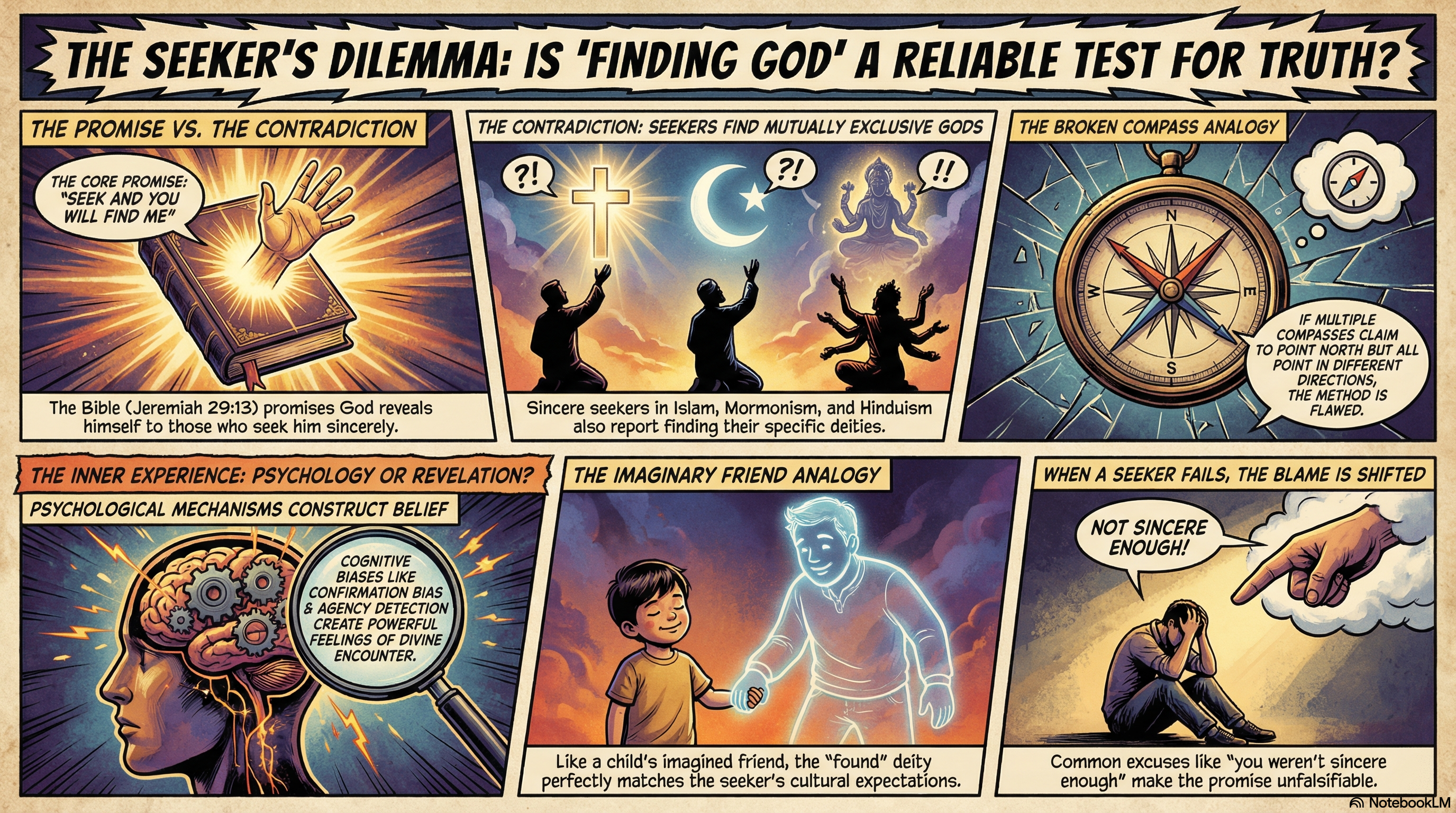
Summary: The claim that the God of the Bible reveals himself to all sincere seekers is undermined by the subjective nature of “heartfelt seeking,” the contradictory outcomes across religions, and the psychological mechanisms driving belief. Scientific testing could evaluate this claim, but existing evidence suggests that “finding God” reflects cultural conditioning and cognitive biases rather than divine revelation.

Imagine a Muslim friend asserts that Allah will reveal himself to all who sincerely seek him. When you inquire about the process, your friend explains that it involves humbling oneself before Allah, opening one’s heart to his spirit, and maintaining a pure heart. They emphasize that millions have successfully found Allah through this method. How would you respond?
This scenario highlights the epistemic challenges of religious claims. Both Christians and nonbelievers often agree that individuals from various religions—such as Muslims, Mormons, and Hindus—who claim to have found a particular deity after earnest searching may actually be conjuring that deity in their imagination. However, Christianity proposes a similar method for discovering the God of the Bible, citing verses like Jeremiah 29:13: “You will seek me and find me when you seek me with all your heart.” How should this claim be evaluated?

The Subjectivity of “Seeking with All Your Heart”
The instruction to “seek with all your heart” raises significant epistemic ambiguities. What does it mean to seek with sincerity? This phrase is inherently subjective, leaving the seeker to navigate questions such as:
- How does one ensure their seeking is sufficiently “heartfelt”?
- Does failure to find the Christian God imply insincerity or an error in the seeking process?
Furthermore, cultural context heavily influences interpretations of sincerity. A Christian might define heartfelt seeking through prayer and Bible study, while a Hindu might approach it through meditation and devotion to Krishna. These cultural frameworks suggest that methodology, rather than truth, often determines outcomes.
Comparative Religious Promises and Contradictory Outcomes
Religions worldwide make similar promises of divine revelation to sincere seekers:
- Islam: The Qur’an states that Allah guides those who strive for Him (e.g., Qur’an 29:69).
- Mormonism: The Book of Mormon encourages seekers to pray for a “burning in the bosom” as confirmation of its truth.
- Hinduism: Mystical experiences during meditation are often cited as evidence of Krishna’s presence.
If these claims lead to contradictory outcomes, with seekers from different traditions reporting the discovery of mutually exclusive deities, the process cannot reliably identify an actual deity. Instead, it suggests that belief is shaped by psychological and cultural factors, undermining the universal validity of any single religious method.

Psychological Mechanisms and the Construction of Deities
Human cognition is prone to hyperactive agency detection, attributing intentionality to natural or ambiguous events. This phenomenon explains why seekers often perceive divine intervention where none exists. Key psychological mechanisms include:
- Confirmation Bias: Seekers interpret favorable events as divine responses and unfavorable ones as tests of faith, reinforcing preexisting beliefs.
- Emotional Arousal: Intense emotions—such as guilt, awe, or gratitude—can produce profound subjective experiences that feel transcendent.
- Social Reinforcement: Communities often validate personal experiences, creating a feedback loop that reinforces belief.
These mechanisms demonstrate how individuals might “find” a deity consistent with their cultural expectations, regardless of that deity’s objective existence.

Why Would an Actual God Not Clearly Reveal Himself?
If the God of the Bible exists and desires a relationship with humanity, as Christian theology asserts, his hiddenness poses a significant challenge. Why would such a God not provide clear, unmistakable evidence of his existence? Several possibilities arise:
- Unequivocal Communication: An actual God could directly and universally reveal himself to all seekers, eliminating ambiguity.
- Consistent Outcomes: Seekers across cultures would independently find the same God using a reliable, repeatable method.
- Verifiable Phenomena: Miraculous events could serve as objective evidence, capable of withstanding scientific scrutiny.
The absence of these markers suggests either the nonexistence of such a God or a divine intention to remain hidden, which contradicts the biblical promise of universal revelation in Jeremiah 29:13.
Logical Analysis of the Central Claim
- Premise 1: There can be, at most, only one actual God (if any exist).
- Premise 2: Multiple religions claim that sincere seeking leads to the discovery of their specific deity.
- Premise 3: These claims produce mutually contradictory outcomes.
- Conclusion: The method of seeking a deity with sincerity is epistemically unreliable for identifying an actual God.
This logical structure demonstrates that subjective religious experiences cannot serve as robust evidence for the existence of any particular deity. Instead, they reflect the psychological and cultural conditioning of the seeker.
How Might We Scientifically Test the Central Claim?

To evaluate the hypothesis that the God of the Bible reveals himself to all sincere seekers, we could design a scientific experiment:
- Recruitment of Seekers: Select participants from diverse religious and non-religious backgrounds who express a willingness to seek the Christian God.
- Standardized Seeking Process: Establish a uniform method (e.g., prayer, meditation, and study of the Bible) to ensure consistency.
- Control Groups: Include groups seeking other deities or no deity at all to compare outcomes.
- Outcome Documentation: Record all experiences, including those perceived as divine revelations, and subject them to independent verification.
- Replication Across Cultures: Repeat the experiment in varied cultural contexts to identify patterns.
Hypothetical Results and Implications
Scenario 1: The Christian God uniquely and consistently reveals himself to seekers.
- This outcome would support the biblical claim and warrant further investigation into the nature of such revelations.
Scenario 2: Seekers report diverse experiences, corresponding to their cultural and religious expectations.
- This result would suggest that subjective experiences, rather than divine intervention, drive the process.
Scenario 3: No significant experiences are reported by any group.
- This outcome would challenge the claim that any deity reliably reveals itself to seekers, casting doubt on the validity of religious promises.
Conclusion

The biblical claim that God reveals himself to all who sincerely seek him is fraught with epistemic and empirical challenges. The plurality of religious outcomes, psychological mechanisms of belief, and absence of consistent evidence all undermine the credibility of this promise. Scientific testing offers a potential avenue for evaluating such claims, but the preliminary evidence points to the conclusion that “finding God” is more likely a function of human cognition and cultural influence than an encounter with an actual deity.
This topic invites rigorous discussion. Share your thoughts and let’s engage further in the comments below!

The Logical Form
Argument 1: The Subjectivity of Heartfelt Seeking
- Premise 1: The instruction to “seek with all your heart” relies on subjective interpretation.
- Premise 2: Subjective experiences vary based on cultural conditioning and personal expectations.
- Conclusion: The phrase “seek with all your heart” cannot serve as a reliable or universal method to discover an actual deity.

Argument 2: Contradictory Outcomes Across Religions
- Premise 1: Multiple religions claim that sincere seekers will encounter their specific deity.
- Premise 2: These claims lead to mutually exclusive outcomes, as seekers from different traditions report finding distinct deities.
- Premise 3: A valid method for discovering an actual deity would produce consistent results across all seekers.
- Conclusion: The contradictory outcomes indicate that the process of religious seeking is unreliable for identifying an actual deity.
Argument 3: Psychological Mechanisms of Belief
- Premise 1: Humans are prone to hyperactive agency detection, attributing meaning to ambiguous or random events.
- Premise 2: Cognitive biases, such as confirmation bias and emotional arousal, influence perceptions of divine intervention.
- Premise 3: Cultural expectations shape the nature of religious experiences, leading seekers to “find” the deity they anticipate.
- Conclusion: The process of “finding God” can be explained by psychological mechanisms rather than the existence of an actual deity.
Argument 4: The Problem of Divine Hiddenness
- Premise 1: If the God of the Bible exists and desires a relationship with all humans, he would provide clear and universal evidence of his existence.
- Premise 2: No consistent and verifiable evidence exists to demonstrate that the God of the Bible reveals himself to all sincere seekers.
- Conclusion: The absence of clear evidence suggests either the nonexistence of the biblical God or a contradiction in his alleged nature and intentions.
Argument 5: Logical Flaw in Religious Seeking as a Method
- Premise 1: There can be, at most, only one actual God (if any exist).
- Premise 2: Praying to a specific deity to find that deity has resulted in belief in multiple, mutually exclusive gods.
- Premise 3: A method that leads to contradictory results cannot reliably identify an actual God.
- Conclusion: Praying to a specific deity to confirm that deity’s existence is an epistemically flawed method.
Argument 6: Scientific Testing of the Claim
- Premise 1: A scientific experiment could test whether the God of the Bible uniquely reveals himself to all sincere seekers.
- Premise 2: If the claim were true, seekers would report consistent and verifiable revelations that align across cultural and personal contexts.
- Premise 3: The lack of consistent outcomes would falsify the claim and suggest psychological or cultural explanations.
- Conclusion: Scientific testing offers a potential avenue to evaluate the validity of the claim, with initial evidence pointing to human cognition rather than divine intervention.

(Scan to view post on mobile devices.)

A Dialogue
Can Sincere Seeking Lead to Finding the Biblical God?
CHRIS: The Bible promises in Jeremiah 29:13 that if someone seeks God with all their heart, they will find Him. Doesn’t that prove God’s willingness to reveal Himself to all sincere seekers?
CLARUS: Not necessarily. The phrase “seek with all your heart” is highly subjective, depending on individual interpretations of what “sincerity” and “heartfelt seeking” mean. Furthermore, if this method were reliable, it would yield consistent results, yet seekers from different religions claim to find mutually exclusive deities.
CHRIS: But Christianity is unique in offering this promise from the one true God. If people earnestly seek the Christian God, they will discover Him—not another deity.
CLARUS: That raises an important question: Why would this method work only for the Christian God, when Muslims, Hindus, and Mormons make identical claims? For example, Muslims believe that sincere seeking will lead to Allah, and Mormons report experiencing a “burning in the bosom” as evidence of their faith. If all these methods lead to different outcomes, the process itself seems unreliable for discovering an actual deity.
CHRIS: But aren’t those other outcomes simply the result of human error? People might misinterpret their experiences, but that doesn’t invalidate the Christian promise.
CLARUS: On the contrary, it highlights the epistemic flaw in using subjective experiences to prove the existence of a specific deity. Human cognition is prone to biases like confirmation bias and emotional arousal, which can easily explain why seekers “find” the deity they already expect. These experiences might reflect psychological mechanisms rather than interactions with a real God.
CHRIS: But if God is real, He would use these emotional and personal experiences to draw people to Himself. Doesn’t that align with how He wants to relate to us personally?
CLARUS: If that were the case, why do these experiences fail to provide clear, universal evidence of God’s existence? An actual God who desires a relationship with humanity could reveal Himself in a consistent and unmistakable way, yet no such evidence exists. This hiddenness undermines the idea that the God of the Bible is both real and eager to be found by all sincere seekers.
CHRIS: Maybe God values faith over evidence and wants people to seek Him on a spiritual level rather than through empirical proof.
CLARUS: That argument has merit within a theological framework, but it conflicts with the explicit promise in Jeremiah 29:13. If the Bible guarantees that heartfelt seeking will result in finding God, this process should work consistently, not produce contradictory outcomes across religions. Faith-based seeking becomes problematic when it lacks verifiability.
CHRIS: How would you propose testing the validity of this promise?
CLARUS: A scientific experiment could provide insight. Participants from various backgrounds could follow a standardized method for seeking the Christian God, with outcomes carefully documented and analyzed. If consistent revelations of the Christian God occurred across all groups, it would support the biblical claim. However, if results varied or aligned with participants’ cultural expectations, it would point to cognitive biases rather than divine revelation.
CHRIS: But faith isn’t something you can measure scientifically. Isn’t it unfair to apply such methods to spiritual truths?
CLARUS: If the claim is that an actual God reveals Himself universally to all sincere seekers, it becomes an empirical question, not merely a spiritual one. The lack of verifiable, consistent outcomes challenges the validity of the promise and suggests that “finding God” is more likely a product of human psychology than divine action.
CHRIS: So you’re saying the process itself is flawed, not just the way people interpret their experiences?
CLARUS: Exactly. Any method that produces contradictory results across different religions is inherently unreliable for discovering an actual deity. The evidence suggests that these experiences are shaped by cultural conditioning and cognitive processes, not by the presence of a real, universal God.
CHRIS: That’s a lot to consider. But as a Christian, I still believe that the promise in Jeremiah 29:13 reflects God’s desire for us to seek Him.
CLARUS: And as a rational skeptic, I think it’s worth exploring why that promise appears indistinguishable from similar claims in other religions. Until clear and consistent evidence emerges, the explanation for these experiences lies in the human mind rather than the divine.
Notes:
Helpful Analogies
Analogy 1: The Broken Compass
Imagine you are given a compass and told it always points to true north. However, you soon discover that several other people have compasses that also claim to point to true north, yet they all point in different directions. When you question this, you’re told the issue isn’t with the compass but with how you’re using it.
This analogy reflects the subjective nature of religious seeking. If sincere seekers in Christianity, Islam, and Hinduism each “find” a different deity, it suggests the method is like the compass—unreliable for identifying an actual God.
Analogy 2: The Imaginary Friend Experiment

Suppose children in a classroom are told to close their eyes, imagine their ideal friend, and describe what happens when they talk to them. Predictably, each child creates a different imaginary friend, influenced by their personalities and experiences. When asked why their friends differ, the teacher says it’s because each child has to truly believe for the friend to “appear.”
This mirrors the psychological mechanisms of belief. When people seek deities, their minds construct experiences shaped by cultural expectations and personal desires. Just as the imaginary friend isn’t real, religious experiences may not reflect the presence of an actual deity.
Analogy 3: The Hidden Professor
Imagine a professor claims to care deeply about their students and promises to help anyone who seeks their guidance. However, instead of holding office hours or making themselves available, they leave vague notes about where they might be found, and only students from certain cultures seem to “find” them. When other students fail, they’re told they didn’t look hard enough.
This highlights the problem of divine hiddenness. An actual God who desires a relationship with humanity would provide clear and universal evidence of His existence. The absence of such evidence suggests either a lack of desire to be found or nonexistence.
Addressing Theological Responses
Theological Responses
1. The Subjectivity of Seeking Is Necessary for Faith
Theologians might argue that the subjectivity of “seeking with all your heart” is intentional because God desires a relationship based on faith, not coercion. If God’s existence were undeniable and objective, faith would be rendered irrelevant, and humanity’s relationship with God would lack sincerity and depth.
2. Contradictory Outcomes Do Not Invalidate the Process
The claim that seekers in different religions find mutually exclusive deities does not necessarily invalidate the Christian promise. Theologians could argue that spiritual deception or misinterpretation might explain these contradictory outcomes, as other religious experiences could stem from human error or even supernatural influences not aligned with God.
3. Psychological Mechanisms Are Tools, Not Explanations
While psychological mechanisms like confirmation bias or emotional arousal may play a role in religious experiences, theologians might argue that these are tools used by God to communicate with humanity. Just as emotions can deepen human relationships, these mechanisms could facilitate a genuine connection with the divine.
4. Divine Hiddenness Respects Human Free Will
Theologians might respond to the problem of divine hiddenness by asserting that God’s lack of universal evidence respects human free will. If God’s presence were undeniably obvious, people might feel compelled to follow Him out of fear or obligation rather than love, undermining the voluntary nature of faith.
5. The Method of Seeking Reflects Individual Sincerity
The claim that religious seeking leads to inconsistent results across cultures might be countered by emphasizing that the Christian God reveals Himself based on individual sincerity. Theologians could argue that cultural influences do not prevent genuine seekers from finding the Christian God if they approach Him with humility and openness.
6. Empirical Testing Is Incompatible with Spiritual Truths
The proposal for scientifically testing religious claims may be dismissed by theologians who argue that spiritual truths cannot be subjected to empirical analysis. They might contend that God’s nature transcends human methodologies and that faith requires a different kind of knowledge—one rooted in the heart and spirit, not in material evidence.
7. God’s Revelation Is Already Sufficient
Theologians might claim that God has already revealed Himself universally through creation, the Bible, and the life of Jesus Christ. They might argue that the issue lies not with God’s hiddenness but with humanity’s unwillingness to recognize the evidence already provided, which satisfies the promise in Jeremiah 29:13.
Counter-Responses
1. Response to: The Subjectivity of Seeking Is Necessary for Faith
While the argument that faith requires subjectivity has theological appeal, it conflicts with the biblical promise in Jeremiah 29:13, which suggests a clear and universal outcome for sincere seekers. Furthermore, subjective faith is indistinguishable from self-deception if the object of faith cannot be verified. If God desires a relationship based on truth, providing objective evidence would not eliminate faith but strengthen it by grounding it in reality.
2. Response to: Contradictory Outcomes Do Not Invalidate the Process
Claiming that contradictory outcomes stem from spiritual deception or human error shifts the burden of proof without addressing the core issue: the process of religious seeking should yield consistent results if it points to an actual God. Without a clear mechanism to distinguish true revelations from false ones, the method becomes epistemically unreliable, undermining its credibility.
3. Response to: Psychological Mechanisms Are Tools, Not Explanations
While psychological mechanisms could theoretically be used by God, the fact that they can fully account for religious experiences without invoking divinity makes their explanatory power suspect. If emotional arousal and confirmation bias are sufficient to produce the same outcomes across religions, these mechanisms are better understood as natural phenomena rather than divine tools. An actual God should provide evidence that transcends psychological predispositions.
4. Response to: Divine Hiddenness Respects Human Free Will
The notion that divine hiddenness preserves free will assumes that clear evidence would compel belief, yet history shows that humans often reject truths even when faced with undeniable evidence. Providing clear evidence of His existence would not override free will but allow people to make informed decisions about their relationship with God. A God who values truth should prioritize clarity over ambiguity.
5. Response to: The Method of Seeking Reflects Individual Sincerity
The argument that outcomes depend on individual sincerity is untestable and creates an unfalsifiable claim, where any failure is attributed to the seeker rather than the process. This shifts the blame from God to the seeker, contradicting the promise in Jeremiah 29:13, which does not condition success on perfect sincerity but on a heartfelt attempt. If the process is genuine, it should work regardless of cultural or personal imperfections.
6. Response to: Empirical Testing Is Incompatible with Spiritual Truths
If spiritual truths are beyond empirical testing, they become indistinguishable from imaginary concepts, as neither can be verified. If the Christian God interacts with the material world, as claimed in the Bible, then some aspect of His revelation should be empirically observable. Rejecting empirical methods while asserting that God reveals Himself universally creates a self-contradiction in theological claims.
7. Response to: God’s Revelation Is Already Sufficient
The assertion that God has already provided sufficient evidence through creation, the Bible, and Jesus fails to address why these revelations are ambiguous and culturally dependent. If these forms of evidence were truly universal, they would convince seekers across all backgrounds equally. The existence of atheists, agnostics, and adherents of other religions demonstrates that these revelations are not as clear or sufficient as claimed.
Clarifications
Annotated List of Common Claims, Accusations, and Excuses Christians Make When Honest Seekers Come Up Empty-Handed
1. “You Weren’t Sincere Enough in Your Seeking”
- Explanation: This accusation suggests that the seeker failed to meet the undefined standard of “sincerity.”
- Weakness: It is an unfalsifiable claim, as no amount of effort by the seeker can disprove it. It also shifts blame to the seeker while ignoring the alleged omnipotence of God, who should be capable of recognizing genuine attempts regardless of imperfections.
2. “You Had the Wrong Motives”
- Explanation: Christians may argue that the seeker approached God for selfish or impure reasons rather than out of humility or love.
- Weakness: This is another unverifiable accusation. It presumes to judge the seeker’s inner motives, which only they (and supposedly God) can truly know. It also contradicts biblical promises that God reveals Himself to those who honestly seek Him (e.g., Jeremiah 29:13).
3. “God Works in His Own Time”
- Explanation: This claim suggests that the seeker may not find God immediately but that revelation might come at a later, divine-appointed time.
- Weakness: This excuse invalidates the urgency and universality implied in biblical promises of revelation. It effectively shifts the goalposts, creating an indefinite waiting period that renders the claim non-actionable.
4. “You Were Influenced by Doubt or Pride”
- Explanation: Christians might argue that the seeker allowed doubt, pride, or intellectual arrogance to block their ability to find God.
- Weakness: This accusation ignores the fact that doubt is a natural and rational response to unclear or contradictory evidence. It also shifts the blame to the seeker while ignoring the responsibility of an omnipotent God to overcome such barriers.
5. “God’s Ways Are Higher Than Ours”
- Explanation: This excuse posits that humans cannot understand why God chooses to remain hidden or why He has not revealed Himself to the seeker.
- Weakness: While it acknowledges divine mystery, it also makes the promise of revelation meaningless. A God who promises clarity in Jeremiah 29:13 but defaults to inscrutability creates a logical contradiction.
6. “God Wants Faith, Not Evidence”
- Explanation: This claim suggests that God values faith and trust over empirical proof or logical certainty.
- Weakness: This excuse conflicts with the biblical accounts of miracles and direct revelations given to figures like Moses, Paul, and Thomas, who were provided with undeniable evidence. It also fails to explain why seekers today are denied similar clarity.
7. “You Were Seeking the Wrong God”
- Explanation: Some Christians argue that the seeker may have been misdirected, searching for a version of God that does not exist (e.g., a “God of their own making”).
- Weakness: This is a form of no true Scotsman fallacy, redefining God in such vague terms that any seeker can be accused of pursuing the “wrong” conception of Him. If the seeker sincerely sought the God of the Bible, this excuse lacks validity.
8. “God Has Already Revealed Himself Through Creation and the Bible”
- Explanation: Christians may claim that evidence for God is already abundant in the natural world, Scripture, and personal testimony.
- Weakness: This assumes that ambiguous or culturally dependent forms of evidence are universally convincing, which they are demonstrably not. If the evidence were truly clear, there would be universal agreement on God’s existence.
9. “Satan Has Blinded You to the Truth”
- Explanation: This claim attributes the seeker’s failure to spiritual interference by Satan, who supposedly prevents them from seeing God’s revelation.
- Weakness: This shifts responsibility away from God, portraying Him as either powerless to overcome Satan’s influence or unwilling to ensure His truth is accessible to sincere seekers. It also lacks any testable basis.
10. “You Need to Let Go of Sin First”
- Explanation: Some Christians argue that sin creates a barrier between the seeker and God, and repentance is necessary for revelation.
- Weakness: This excuse contradicts the biblical notion of grace, where God reveals Himself even to sinners. It also assumes the seeker can somehow address sin without first experiencing divine guidance.
11. “God Reveals Himself in Subtle Ways, Not Obvious Signs”
- Explanation: This claim suggests that the seeker may have missed subtle forms of divine revelation, such as feelings of peace or coincidences.
- Weakness: Subtle signs are inherently ambiguous and indistinguishable from psychological or natural phenomena. A God who values truth should provide clear, unmistakable evidence, not rely on subjective interpretation.
12. “You Stopped Seeking Too Soon”
- Explanation: Christians may accuse the seeker of giving up before God could reveal Himself.
- Weakness: This implies a moving target, as there is no objective standard for how long one must seek. It also shifts blame to the seeker while ignoring the omnipotence of God, who should be able to reveal Himself at any point in the process.
13. “You Are Misinterpreting the Bible’s Promises”
- Explanation: Some Christians might argue that passages like Jeremiah 29:13 are misunderstood and do not guarantee universal revelation.
- Weakness: This excuse undermines the plain reading of the text and raises the question of why God would allow such an important promise to be so easily misinterpreted.
14. “You Are Being Tested”
- Explanation: Christians might suggest that the seeker’s failure is part of a divine test to strengthen their faith or humility.
- Weakness: This excuse makes the process unnecessarily punitive and contradicts the idea of God as loving and just. A God who tests sincere seekers by withholding revelation appears more arbitrary than benevolent.
15. “God Chose Not to Reveal Himself to You”
- Explanation: Some Christians might invoke predestination, suggesting that God simply decided not to reveal Himself to this particular seeker.
- Weakness: This excuse is theologically problematic, portraying God as arbitrary and exclusionary. It also conflicts with the universality of biblical promises such as John 3:16, which speaks of God’s love for all humanity.
16. “You’re Looking for Evidence in the Wrong Way”
- Explanation: Christians might argue that the seeker’s method of seeking (e.g., reliance on science or logic) is incompatible with finding God.
- Weakness: This excuse dismisses rational inquiry, which is often the most honest and rigorous approach to seeking truth. If God exists, He should be discoverable through multiple methods, including reason and evidence.
17. “God’s Revelation Is a Mystery”
Weakness: While appealing to mystery can justify any failure, it renders God’s promises meaningless. A promise that cannot be tested or understood is no different from an empty assertion.
Explanation: Christians might say that God’s reasons for revealing or withholding Himself are ultimately beyond human comprehension.


Leave a Reply