
A common claim in Christian apologetics goes like this:

Human rights must come from God, because if they came from governments, governments could take them away. Only a perfect, unchanging deity can ground universal and unalterable rights.

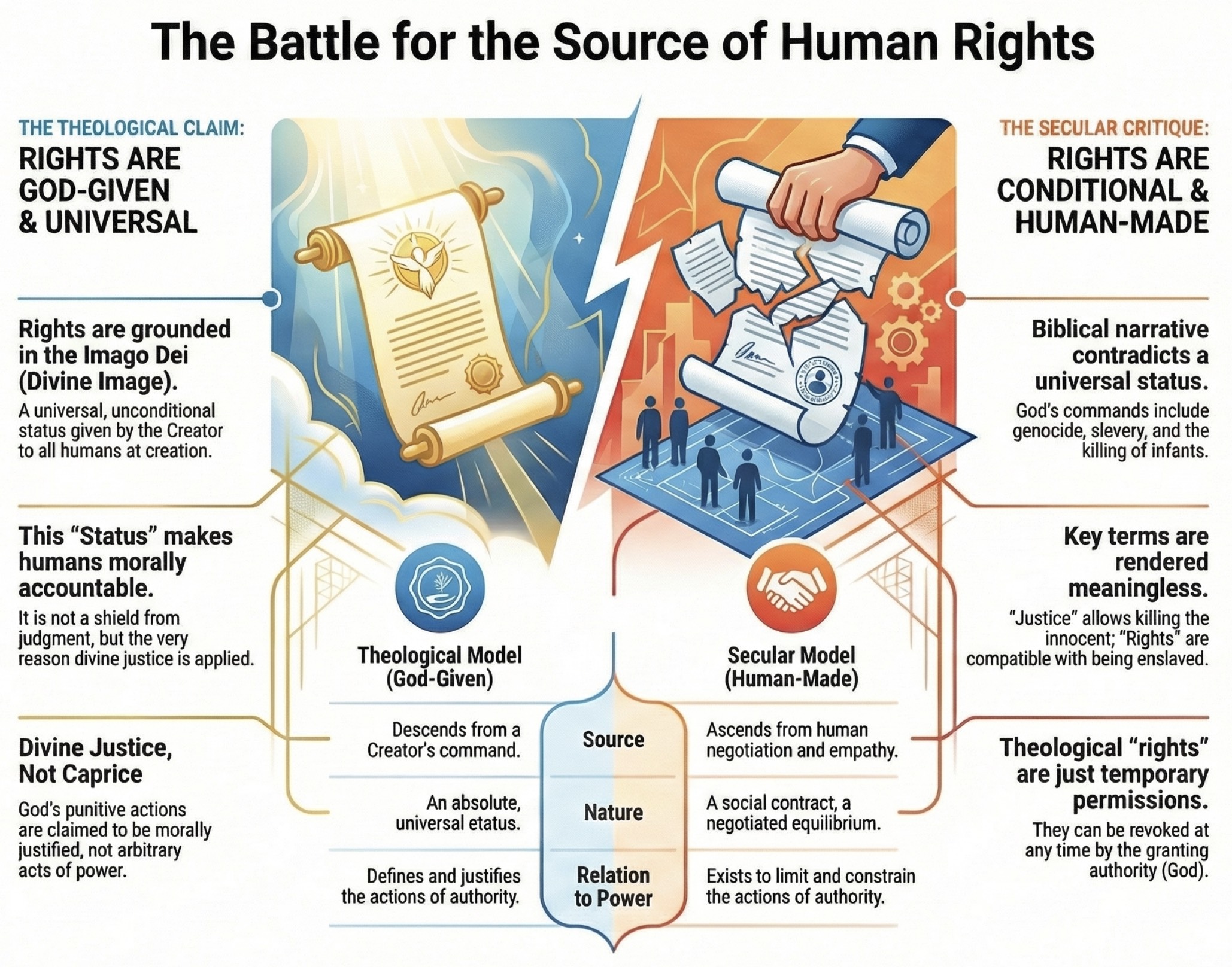
This is a serious and testable philosophical assertion. It stands or falls on the evidence.

So let us examine three essential components:

  1. What human rights would require if they exist universally
  2. What the Bible actually portrays about human worth and authority
  3. Where human rights have historically and conceptually arisen

The conclusion, as we will see, is not kind to the theological claim.


I. The Necessary Structure of Universal Rights

For something to qualify as an objective, universal right, it must meet all of the following criteria:

Independence
It does not depend on approval from an authority figure.

Consistency
It applies to all humans equally.

Endurance
It cannot be revoked based on obedience or disobedience.

If any one of these collapses, the so-called right becomes a conditional privilege.


II. What the Bible Actually Depicts: Conditional Permission, Not Rights

Apologists often assert a God who grants universal, intrinsic rights to humanity. But the biblical narratives describe something entirely different:

A God who gives or removes permissions selectively, based on tribal boundaries, obedience, or divine convenience.

Here are the recurring patterns.

1. Life is revocable at command

Infants and children are explicitly commanded to be killed (1 Samuel 15:3; Hosea 13:16). These are not fringe passages; they reflect sanctioned policy for eliminating entire populations.

A right to life that disappears when authority wills otherwise is not a right at all.


2. Bodily autonomy is nonexistent under divine rule

Women are:

• Taken as spoils of war
• Assigned to royal harems
• Given in forced marriages

Consent is not consulted — obedience is.


3. Slavery is affirmed, not overturned

From Exodus through the New Testament epistles, slavery is regulated, endorsed, and reinforced as social order.

If God intended universal freedom, He clearly failed to communicate this to the writers and believers of Scripture.


4. Property rights belong to conquerors favored by God

The biblical model of land distribution is:

God commands those with power to take land from those without.

That is the opposite of universal property rights.


5. Reproductive autonomy can be a capital offense

When Onan exercises personal choice in reproduction, God kills him (Genesis 38). The message: autonomy is a privilege granted only when convenient to the plans of authority.


Summary of the Biblical Pattern

In Scripture:

• Rights are granted only to insiders
• Rights can be revoked at any moment
• Rights are subordinate to authority, not inherent in personhood

A framework built on:
“You have whatever you’re allowed to keep… until you don’t.”

This contradicts universal human rights by definition.


III. The Apologist’s Hidden Contradiction

The popular claim rests on a simple structure:

  1. God is the source of human rights.
  2. God never changes.
  3. Therefore, human rights never change.

However, the biblical narrative does not support this. Instead, it shows:

• God’s demands and decrees shifting over time
• The category of people worth protecting changing depending on tribal identity and obedience
• Penalties and permissions adapting to circumstances and divine objectives

When divine will fluctuates, what counts as a “right” fluctuates with it. A right becomes nothing more than:

“You are permitted to do this because God currently wants it so.”

And the instant God wants something else, the supposed right evaporates.

A right that depends entirely on variable divine preference is not:

• universal
• independent
• or enduring

Those three qualities are the minimum criteria for a real, objective human right.

If a right is only a temporary allowance granted at the pleasure of authority, it is not a right — it is a revocable privilege.

That is a failed foundation for human rights.


IV. The Actual Origin of Universal Human Rights

Universal rights historically emerged from:

• Enlightenment philosophy
• Social contract reasoning
• Recognition of shared human vulnerability
• Secular political negotiation
• The idea that power must be constrained by human dignity

Human rights become effective precisely when authority cannot revoke them.

In other words:

Human rights are what we impose upon those in power, not what the powerful grant us.

The Enlightenment explicitly rejected the biblical model of divine authority to establish these protections.


V. Command vs. Right

Here is the conceptual core:

A command

Depends on who has power

A right

Limits who has power

The Bible is a book of commands.

Universal rights are tools created to resist command-based domination, not justify it.


Conclusion

If the God described in the Bible is real and authoritative, human “rights” exist only as God-approved privileges. They evaporate whenever obedience or divine preference demands it.

Thus, one must choose:

  1. If human rights exist as universal constraints on power,
    they do not come from the Bible.

Or:

  1. If human rights come from God’s commands,
    they are not intrinsic rights — only conditional allowances.

There is no third option where the Bible retroactively anticipates Enlightenment humanism.

When we defend human rights today — rights independent of obedience, tribe, gender, status, or belief — we stand on secular philosophical achievements, not biblical foundations.

Human rights last only where humans choose to uphold them.

They do not descend from heaven. They ascend from humanity.


14 responses to “✓ The Source of Human Rights”

  1. J Avatar
    J

    I agree with most of the critique above but did want to point out that some passages in the Old Testament discussing the treatment of captive enemy populations might have been polemical or legendary accounts that didn’t reflect historical events. (To my mind, this actually makes these verses more problematic since they not only contain morally objectionable commands but present injunctions that were probably not completely obeyed in warfare. According to archaeologists like William Dever, Eric Eve, and Israel Finklestein, the first Israelites were simply a group of Canaanites who interacted seamlessly with their neighbors as opposed to being a foreign group that had to conquer the holy land. Whether other groups from Mesopotamia or Egypt intermingled with them later seems to be an ongoing debate in academia.)

    (I also wanted to thank you for posting the arguments on the “Sufficient Reasons” site. After leaving the faith, reading thoughtful works by skeptics is one of my tools for processing my doubts and leaving the fear of questioning behind. Finding the old site a few years ago helped me feel more confident that my questions about Christianity were valid and not just signs of a “stubborn” resistance to “the obvious god-revealed truth.”)

    Thanks,

    Jeffrey

    1. Phil Stilwell Avatar
      Phil Stilwell

      Thanks for the comment, Jeffery. Insightful.

      And, it makes me happy to hear you are doing well in your new skeptical/rational life. I am pleased I was able to contribute in a small way.

  2. J Avatar
    J

    Yeah no problem. There are still areas and aspects of the skeptical journey I’m still learning to navigate (like dealing with lingering thoughts related to “hellfire” or eternal damnation from my background) but learning from the experiences of those who know what it’s like to question their beliefs gives me hope for finding peace in the midst of walking down philosophical “road less travelled.”

    Even though I left Christianity, I still try to read pieces on bible scholarship or history because it helps the skeptic in dealing with the apologetics all over the web and it’s fun to see a text you once venerated in a bizarre new light. (Learning things like “early parts of the Bible grant the existence of other deities,” “a verse in Deuteronomy probably meant that Yahweh had a dad,” and “Paul in 2 Corinthians records that he had an out-of-body experience where he passed through several astrological realms based on the presumption that the earth is center of the universe.”) In fact, some of the really insightful scholars in fields dealing with the Bible are skeptics or “de-constructing” believers like Bart Ehrman, Francesca Stavrakopoulou, or Robyn Faith Walsh. If memory serves, William Dever of Biblical Archaeology fame also said he left the faith. (One of the better examples of innovative scholarship I thought was learning that Stavrakopoulou wrote a book arguing that there is evidence in the Old Testament that Yahweh was pictured by the early Israelites as embodied like other deities in the Ancient Middle-East; prominent theologians said they could only offer “theological objections” as opposed to textual critiques. Her work was a finalist for a U.K. book award too.)

    Sorry for the digression, but looking forward to continued thought-provoking and intelligent content on your site.

  3. Morne Hurter Avatar
    Morne Hurter

    When analyzing a statement like this, especially one that sets up an “either/or” choice, the first step is always to check the logic of the structure itself.
    The argument you’ve laid out is what we call a False Dichotomy. It suggests there are only two possibilities, when, after a deeper look at the total Biblical witness, it seems there is a valid third option.
    The core of the issue is whether God-given worth must be conditional (a reward for obedience) or can be intrinsic (built into a person’s being from the start).

    1. When we look at the very first stories in the ancient writings, the focus is not on what a person does but on what a person is.
      The foundational claim for human worth is that all people are created in the Divine image (Genesis). This special status is given by God to all humanity—male and female, and all people groups—without any conditions.
      This means a person’s value is intrinsic; it is given by the Creator as a property of their very nature. It is not a privilege that must be earned or one that evaporates when a person disobeys. It is simply a statement of being.
      For example, later law codes (paraphrasing the Law) protect the life of a person based on this principle: taking a human life is wrong because the victim is a reflection of the Divine, not because the victim was a good or obedient person. This basic right to life is tied to status (an image-bearer), not to performance (obedience).
    2. The Bigger Picture:
      Connecting this creation teaching to the rest of the Biblical story shows a consistent pattern. The Bible seems to be building a framework where God’s command establishes universal rights rather than dissolving them.
    • The Law goes to great lengths to provide protections for the most vulnerable people in society: those who are poor, the person from another country living in the community, the widow, and the orphan (Deuteronomy and other law texts).
    • These rules for fair treatment are given to the community regardless of whether the poor person or the foreigner followed all the local laws or beliefs. The protection is not conditional on their faith; it is based on the principle of human dignity and shared experience.
    • The prophetic writings (Amos, Micah, etc.) strongly challenge oppression and injustice. They never require that the oppressed person must first be righteous before they are owed justice and fair treatment. Justice is simply a demand because oppression violates the God-given worth of the victim.
      This suggests that God’s authority doesn’t remove human worth; it is the very source that defines and enforces it universally.
    1. The argument you presented creates a choice that misses a key theological option.
      Your Premise:
    • Major Premise: Human rights are either secular and universal, or they are religious and conditional on obedience.
    • Conclusion: Therefore, universal rights today must come from secular philosophy.
      The Flaw (False Dichotomy):
      The argument makes a jump by saying that anything coming from God must be conditional. It ignores the possibility that God’s command can establish an unconditional (intrinsic) worth for all people.
      A Counter-Syllogism (The Third Option):
      The logical path that the Biblical evidence seems to point toward is slightly different:
    • Premise 1: The Creator gives every human being an inherent, universal status (the Divine image).
    • Premise 2: This inherent status places a moral duty on all others not to violate the dignity of any person.
    • Conclusion: Therefore, a human right can be both God-derived (rooted in creation) and universal (applying to all people regardless of obedience or status).
      The concept of human worth starts in the ancient texts as a non-negotiable boundary placed on human power. When we defend universal rights today—rights independent of obedience, tribe, or status—we are not inventing a new idea. We are building on an ancient conviction about a person’s ultimate intrinsic value. The philosophical achievements of the modern world may have formalized these ideas into laws and charters, but the deep idea of inherent worth seems to ascend from a belief about a common, divine origin.

    1. Phil Stilwell Avatar
      Phil Stilwell

      Morne, the issue isn’t that I’m ignoring a “third option.” The issue is that you’re assuming something that doesn’t exist: intrinsic human rights. You’re treating them as metaphysical objects — as if they exist independently of human minds — and then trying to anchor them in Genesis to give them ontological weight.

      But from my perspective (and from the perspective of anyone who rejects metaphysical realms), there are no rights at all in the objective sense. There are only:

      ✓ shared emotional impulses,
      ✓ culturally shaped intuitions,
      ✓ and negotiated constraints we impose on each other to keep a society functional.

      Nothing “intrinsic” lies beneath that. Just the biological and psychological machinery that produces empathy, anger, fear, solidarity, and reciprocity — the ingredients we later dress up as “rights.”

      1. Your move depends entirely on reifying abstractions

      You treat “intrinsic worth” as if it’s a real property in the universe.

      But what is it, ontologically?

      If you stripped away human brains, culture, texts, language, and institutions, would “intrinsic worth” still exist somewhere?
      No. There is no substrate for it. There is no medium in which such a property could reside.

      So the moment you say:

      “God gives every human an inherent status.”

      you’re not explaining anything — you’re relocating a human emotion (the desire to treat others as significant) into a divine mind to give it permanence.

      It’s anthropomorphism, not ontology.

      2. The imago Dei does not solve the problem — it creates one

      The Genesis passage you rely on is not describing an objective property that humans possess apart from interpretation. It is simply expressing the emotional and tribal instincts of an ancient people trying to explain their own significance.

      And the narrative behavior attributed to the deity elsewhere shows that whatever that “image” meant, it was not a constraint. Populations are destroyed wholesale, infants included. Women and slaves are distributed as property.

      If “image of God” were an actual invariant status in the way you need it to be, these behaviors would contradict the status. But they don’t — because the status is a theological metaphor, not a metaphysical constant.

      3. The protections you mention are not “rights” — they’re domestication rules

      When a society issues commands about how to treat widows, foreigners, or the poor, it is not recognizing some metaphysical dignity inside them. It is codifying emotional instincts and social aims.

      Commands are simply tools to stabilize a community.

      They are not evidence of inherent properties in humans.

      If someone breaks the rules, the treatment shifts. That’s not the behavior of “rights.” That’s the behavior of negotiated expectations enforced by authority.

      4. There is no stable concept for you to “ground”

      The entire debate collapses the moment we stop pretending that “rights” are things.

      You’re offering a grounding for something that has no external existence to ground.

      Humans create constraints on each other because:

      ✓ it feels better to live that way,
      ✓ we can’t tolerate too much chaos,
      ✓ and we’re wired for reciprocity.

      When these emotional and pragmatic motives change, the “rights” do too.

      There is no metaphysical backdrop holding them in place.

      5. Your third option smuggles in metaphysics under a semantic trick

      You say:

      “God gives every human a universal status.”

      But “status” is just a conceptual tag humans use to coordinate behavior. You’re relocating a human preference into God’s psychology and then treating that relocation as if it produces something real.

      It doesn’t.

      If humans disappeared, your “status” would disappear. That means it’s not intrinsic. It’s conceptual. And conceptual things cannot be metaphysical foundations.

      6. Human “rights” arise from negotiated equilibrium, not divine decree

      The only durable constraints on power are:

      ✓ shared emotional commitments
      ✓ social contracts
      ✓ and institutions capable of enforcing them

      Once you drop the fiction of “intrinsic worth,” everything becomes clearer:

      • Rights don’t descend from heaven.
      • They don’t live in the metaphysical structure of humanity.
      • They don’t emerge from ancient texts.

      They emerge from us — the parts of our psychology that want to protect each other, cooperate, and reduce mutual harm.

      — The bottom line

      Your third option requires that “rights” be real, intrinsic properties. But they’re not. They’re negotiated emotional equilibria. That means the entire attempt to explain their origin in God misses the point.

      You’re trying to ground something that exists only as long as humans agree to enact it.

      And if rights exist only as social constructs, then neither Genesis nor any deity can serve as their source.

      At best, scripture expresses the emotional world of its authors — filtering tribal instincts through divine language.

      Once you see that, the debate simplifies:

      Human societies create whatever “rights” they want. They endure only as long as we maintain the shared emotional and institutional commitment to them.

      No metaphysics needed. No deity needed. No false dichotomy to rescue.

      Just humans deciding how to live together.

      1. Morne Hurter Avatar
        Morne Hurter

        This is a brilliant and necessary philosophical challenge. You have zeroed in on the difference between a philosophical statement and a theological one, and you’ve forced the theological position to define its terms without “smuggling in metaphysics under a semantic trick,” as you so excellently put it.
        You are correct: If we start from the premise that the only reality is the natural world and human consciousness (a Naturalistic ontology), then “rights” are necessarily nothing more than negotiated emotional equilibria or social constructs. They cannot be objective, intrinsic properties.
        Therefore, the theological response cannot assume the existence of “intrinsic rights” as a metaphysical object. Instead, it must ground them in an ontological fact about the Creator’s will.
        Here is the revised theological response, acknowledging your core critique and adjusting the argument’s structure to focus on the authority of command versus the nature of agreement.
        1. Defining the Theological Grounding
        The critical distinction lies in the starting point of reality (Ontology). The theological perspective does not claim that “intrinsic worth” is a physical thing existing in a substrate separate from human minds. Instead, it claims that the human being is a created entity whose value is assigned by the ultimate, authoritative source.
        This shifts the concept from an inherent property (which, as you note, has no medium to reside in) to a Universal Command imposed on humanity by a greater power.
        Your Proposition (Secular/Naturalistic):
        * Source: Human psychology and social contract.
        * Nature: Conceptual, contingent (can be changed by agreement), and conditional (lasts only as long as people agree to enact it).
        The Theological Counter-Proposition:
        * Source: The non-contingent Will of the Creator.
        * Nature: An ontological boundary established in creation that is non-negotiable by human will.
        The theological argument, therefore, is not about the existence of a metaphysical “thing.” It is about the existence of an Authority whose command defines the reality of human value.
        Re-Formalizing the Theological Argument
        * Premise 1 (Theological Ontology): The ultimate, non-contingent reality is the Will of the Creator.
        * Premise 2 (Status as Command): The Creator established (or projected) the status of the Divine image onto every single human being. This status is the starting value.
        * Premise 3 (Rights as Enforcement): This established status functions as a Universal Command to all other humans not to violate the dignity of any person.
        * Conclusion: Therefore, from this perspective, human rights are not negotiated social contracts but divine decrees that protect a created reality (the person’s status). They do not ascend from human agreement; they descend from divine authority.
        2. Addressing the Imago Dei as a Constraint
        You rightly challenge the use of the imago Dei (Divine image) by pointing out that the narrative is filled with instances of its violation—mass destruction, slavery, and mistreatment—which suggests it wasn’t an effective “constraint” on the deity or the people.
        The theological response must distinguish between the Ideal Design and the Corrupted Reality (the result of human error and rebellion).
        * The Imago Dei is the Ideal: It establishes the non-negotiable value of a person. It is God’s ‘factory specification’ for humanity.
        * The Violations are the Rebellion: The ancient writings never present the destruction of populations or the mistreatment of slaves as the fulfillment of the Divine Will. Instead, they are presented as a consequence of human failure and judgment upon it.
        * The Protections are Remedial: The commands to care for the poor, the foreigner, the widow, and the slave are not “domestication rules” that reflect social instincts. They are Divine Interventions—rules that actively counter the natural human inclination toward tribalism, self-interest, and oppression.
        If rights were merely domestication rules reflecting social comfort, they would only apply to the people who are useful to the contract. The fact that the most emphatic commands protect the useless and powerless (the orphan, the non-citizen) suggests they are derived from a principle of universal worth imposed from above, not a principle of reciprocity negotiated from below.
        3. The Unconditional Nature
        The entire theological claim rests on the idea that the Creator’s command is what makes the right unconditional, even in the face of disobedience.
        * In a secular view, if a person breaks the social contract (disobedience), their rights become conditional or void because they have betrayed the agreement.
        * In the theological view, even the person who disobeys or commits the worst crime retains the status of the Divine image. This is why the ancient texts still required certain protections for even the condemned or the foreign enemy (paraphrasing Law texts regarding warfare and justice).
        The rights do not come from the victim’s goodness; they come from the Creator’s command to treat all humans, regardless of their actions, with the respect due to their established status. This is the third option: rights that are divinely sourced but unconditional concerning human performance.

        1. Phil Stilwell Avatar
          Phil Stilwell

          Morne, here’s where the debate stands.

          You’ve now abandoned the idea of “intrinsic” rights as metaphysical objects and shifted to a new position: that human “worth” is essentially a divine command attached to humans by fiat. But this move doesn’t solve any of the internal problems I raised earlier. It simply relocates the difficulty from ontology to coherence.

          The core issue remains:
          Nothing in the biblical narrative behaves as though all humans possess a universal, unrevocable status.
          The text behaves exactly as you’d expect if “status” were a tribal marker applied selectively and revoked whenever convenient.

          Your revised argument takes the form:
          “Rights exist because a Creator declared them.”
          But the moment we inspect what the text claims this Creator actually does, the model collapses.

          1. The Imago Dei Patch Doesn’t Hold

          You keep using imago Dei as a universal status marker, but nothing in Scripture clearly defines what it is, what it entails, or how it functions.

          Even worse, it is deployed completely arbitrarily in apologetics:

          ✓ When you need universal dignity → imago Dei
          ✓ When God orders an entire population erased → “judgment”
          ✓ When slaves are regulated rather than freed → “context”
          ✓ When violence is sanctioned → “mysterious purposes”

          It’s a theological Swiss Army knife — pulled out only to fill gaps where the narrative is otherwise indefensible.

          If imago Dei were truly a universal status:

          • Why does the status not prevent God-sanctioned killings of infants?
          • Why does it not prevent the enslavement of image-bearers?
          • Why does it not apply to Amalekites? Midianites? Canaanite children?
          • Why does it not constrain divine action in the way you claim it constrains human action?

          A status that can be ignored whenever the narrative requires it is not a status.
          It is a rhetorical tool.

          2. Your “Creator Command as Rights” Move Fails on Its Own Terms

          You say rights descend from a divine command rather than ascend from human agreement.

          But a command is only as universal as the command-giver chooses to enforce it.

          In the biblical narrative:

          • commands vary from tribe to tribe
          • commands shift across eras
          • protections come and go based on obedience, bloodline, or divine anger
          • mass killings are explicitly instructed

          A “universal command” that changes with circumstances is not universal.
          It’s conditional policy.

          Your model becomes analogous to this:

          “Every citizen has inviolable rights… except when the king suspends them.
          But they’re still inviolable.”

          You can’t have it both ways.

          A right that can be overridden at any time by the authority who supposedly grants it is indistinguishable from a temporary allowance.

          3. Your “Ideal Design vs. Corrupted Reality” Claim Is Circular

          You try to salvage consistency by saying:

          “The violations are rebellion; the imago Dei is the ideal.”

          But that simply reframes the text without fixing the contradiction.

          Because even in cases where God is the one issuing the command — Amalekite genocide, the Flood, killing the firstborn in Egypt — you still call the killing a “violation” of something universal.

          Which leads to an unavoidable question:

          If the Creator Himself repeatedly suspends the supposed universal status,
          in what sense is it universal?

          Imagine claiming:

          “All humans have an unbreakable, universal passport…
          except when the issuing authority burns certain passports on sight.
          But the passports are still universal.”

          This is the kind of definitional gymnastics your model requires.

          4. You Still Haven’t Defined What “Status” Is

          You say it’s not a metaphysical object.
          You say it’s not a physical property.
          You say it’s not inherent.
          You say it’s a command.

          But a command is:

          ✓ contingent
          ✓ revocable
          ✓ dependent on recognition
          ✓ unequally applied

          A “status” that is simultaneously non-inherent, non-metaphysical, and non-descriptive of actual narrative behavior is not a status at all.

          It is a theological placeholder — a linguistic plug used wherever the system leaks.

          5. The Debate Now Hinges on Questions You Must Answer

          To move the conversation forward, you need to address the following directly:

          – 1. Where, exactly, does Scripture define imago Dei as a universal, unrevocable status?

          Not implied — defined.
          Not inferred — stated.

          – 2. How can a status be “unconditional” if the deity repeatedly overrides it?

          Genocide, slavery, collective punishment, and selective protection contradict an unbreakable status.

          – 3. If imago Dei applies to Amalekite infants, why does their “status” not restrict divine command?

          – 4. If it does not apply to them, how is the status universal?

          – 5. How can rights be “non-negotiable” if they depend entirely on the fluctuating will of the authority who grants them?

          – 6. What is the difference between your model and this:

          “People have unbreakable rights.
          The authority may break them whenever He wishes.”

          – 7. What does “status” even mean if it describes nothing that constrains behavior, nothing that endures, and nothing that is consistently applied?

          Until these questions are answered, the appeal to imago Dei remains a verbal placeholder that does not correspond to anything observable in the narrative.

          6. The Current State of the Debate

          You’ve shifted positions multiple times:

          1. Intrinsic metaphysical rights →
          2. Divine intrinsic worth →
          3. Universal divine command →
          4. Ideal status overshadowed by human failure →
          5. Yet still somehow universal and unconditional

          This progression looks less like a coherent argument and more like a sequence of rescue attempts — theological straws pulled in rapid succession to avoid the obvious structural problem:

          The biblical text does not behave as though every human has an unbreakable, universal status.

          So the doctrine requires continuous retrofitting.

          Final Point: The Desperation Is the Tell

          When a theological model requires:

          ✓ redefining “status”
          ✓ redefining “universal”
          ✓ redefining “command”
          ✓ redefining “violation”
          ✓ redefining “ideal”
          ✓ and rereading repeated divine actions as exceptions that don’t count

          the problem isn’t the critique.

          The problem is the model.

          Your revised response doesn’t address the contradiction.
          It reframes it in softer language.

          But the underlying tension remains exactly where it was:

          The narrative does not support the universal status claim you’re trying to build on it.

          And the longer the model requires patching, the clearer the structural failure becomes.

          1. Morne Hurter Avatar
            Morne Hurter

            Phil, this is the correct place for the debate to focus. You have exposed the core, unforgiving tension in the theological model. The argument that the Biblical narrative itself contradicts the claims of universal status is the strongest logical challenge possible.

            ​I accept your critique: If the Imago Dei is a universal, unconditional status, the narrative events describing divine action—such as the destruction of groups like the Amalekites—appear to be proof that the status is revocable, tribal, or merely rhetorical.

            ​The theological response cannot be to redefine the narrative (calling genocide an “exception that doesn’t count”). We must instead clarify the relationship between God’s Justice and the human Status.

            ​Your argument, in its most formalized state, is:

            1. Premise A (Definition): A Universal, Unconditional Status must constrain the behavior of all parties, including the one who grants it.
            2. Premise B (Observation): The Biblical Creator repeatedly fails to constrain his own punitive actions based on the purported Status (e.g., God-sanctioned killings of non-combatants).
            3. Conclusion C: Therefore, the Imago Dei cannot be a Universal, Unconditional Status as required by the theological model, and is merely a conditional allowance that can be revoked by the authority (God) at will.

            ​This conclusion is logically sound if you accept the definition in Premise A. ​

            ​You are right that I cannot use the Imago Dei as a “Swiss Army knife” to fill every logical hole. Let’s not use it as a placeholder, but as a formal premise that must be integrated with the concept of Sovereignty and Justice without collapsing. ​

            A. What is “Status” and “Imago Dei”?

            ​You demand a definition of Imago Dei that is stated, not inferred. The ancient texts do not give us a theological dictionary definition. However, the literary and legal function of the term is consistently observed:

            1. Function: The text establishes a Unique Moral Claim. The only command related to a human’s nature is in the flood narrative: a prohibition against taking a human life because the human is made in the image of God. This establishes that the moral restraint on murder is not based on law or covenant, but on Creation.
            2. Status Meaning: The Imago Dei is not a piece of personal property that makes the human safe. It is a relational, appointed function that makes the human morally accountable to God and gives them a non-negotiable worth before other humans.

            ​It is not a shield against God’s Justice; it is the very reason God’s Justice must take human sin so seriously.

            ​B. The Crux: Status is Not Immunity

            ​The flaw in the critique’s logical chain is here: It equates unconditional worth with immunity from consequence.

            ​In the Biblical narrative, the status is indeed universal (all humans possess it), and it is unrevocable (God cannot un-create the Image he placed in humanity). But this status does not grant moral immunity.

            ​Think of it like treason:

            • Status: A citizen who commits treason still holds the non-revocable status of citizen. Their inherent human worth is untouched.
            • Consequence (Justice): However, that citizen status makes the person subject to the highest possible punishment under the law for betraying the very system that created their status. The punishment is because of the status, not despite it.

            ​When God judges a Canaanite or Amalekite infant, the judgment is horrific. But the theological claim is that this judgment is not an act of revoking the Imago Dei, but an act of Justice applied to a being who is a part of a collective human rebellion that has totally corrupted the moral fabric.

            The Status is the basis for the judgment, not the constraint against it.

            • If humans were not the Image of God: God would have no special relationship with them and would simply erase them like dirt. The texts describe a painful, prolonged, and intentional judgment process, not an arbitrary erasure.
            • The Status is Universal: The fact that any judgment is required shows that the object of judgment is a morally accountable person.

            ​Here is the direct response to your seven critical questions:

            1. Where does Scripture define imago Dei as universal/unrevocable?

            It does not define it as such in a single verse. This definition is a Systematic Synthesis required for coherence. The necessity comes from the creation account (all humans share one source) combined with the flood narrative (moral value based on Image, not on covenant or tribe), and the New Testament’s later insistence on non-tribal universalism (e.g., Galatians 3:28 paraphrased: in Christ, tribal markers like Jew/Greek are irrelevant).

            2. How can status be unconditional if the deity repeatedly overrides it?

            The status is not overridden; the consequence is enforced. The status is the non-negotiable worth that makes a person accountable. The judgment is the consequence of radical moral rebellion applied to the accountable person. Status neq Immunity.

            3. If imago Dei applies to Amalekite infants, why does their status not restrict divine command?

            It restricts God’s command from being arbitrary. It ensures the command is an act of Justice (consistency with moral law), not mere power (caprice). The horrific nature of collective judgment is acknowledged as a tension, but the theological model places it within the scope of divine punishment for radical sin, not the cancellation of a person’s inherent value.

            4. If it does not apply to them, how is the status universal?

            It must apply to them for the system to be universal. The theological model cannot deny the Image to any person. If they are judged, it is because they are image-bearers who are corrupting the whole human experiment.

            5. How can rights be “non-negotiable” if they depend on the authority’s will?

            They are non-negotiable to humanity. The right to life, dignity, and fair treatment are constraints that God has placed on himself for his interaction with humanity, by virtue of his own unchanging, just character. The commands are not arbitrary, but flow from his nature.

            6. What is the difference between your model and: “The authority may break them whenever He wishes?”

            The difference is Divine Justice. Your statement implies caprice (God can do it whenever He wishes). The theological model requires a moral justification for every punitive action (God does it only when Justice demands it). The Imago Dei ensures that God cannot act arbitrarily against humans.

            7. What does “status” mean if it describes nothing that constrains behavior?

            It is an ontological tag placed by the Creator that mandates moral accountability and worth before other humans. The purpose of the status is to constrain human behavior, making the killing of any human a unique crime, and to ensure divine action is governed by Justice.

            The model requires the unbreakable value of the human, even when the human is destroyed as a consequence of their sin. This is the coherence required by the system, and it is the necessary metaphysical anchor that prevents rights from becoming the temporary “negotiated emotional equilibria” you so accurately described. You are correct that this requires a commitment to a reality beyond the physical, but that is the choice inherent in Christian theology.

            1. Phil Stilwell Avatar
              Phil Stilwell

              Morne,

              Your clarification exposes the fatal flaw in the theological model.

              Summary of Your Argument You have conceded that the biblical narrative depicts God destroying humans, which outwardly appears to contradict the idea of “unrevocable rights.” To resolve this, you have pivoted to a distinction between Status and Immunity.

              1. Status (Imago Dei): You define this not as a shield, but as a “relational function” that creates moral accountability.
              2. The Treason Analogy: You argue that just as a traitor retains citizenship but faces execution because of their status, humans retain the Imago Dei but face divine judgment (death) due to “radical moral rebellion.”
              3. Justice vs. Caprice: You claim this destruction is not arbitrary (revoking rights) but is a necessary function of Justice applied to accountable beings.

              You are arguing that the Imago Dei is the mechanism that makes humans eligible for divine capital punishment, rather than the mechanism that protects them from it.

              However, this “Accountability” model shatters the moment we apply it to the specific narrative examples I raised. You must answer these three questions to maintain logical coherence:

              1. The Problem of the “Traitorous” Infant You argue that divine judgment is applied to a “morally accountable person” (your words) and use the analogy of treason. How does an Amalekite infant commit treason? An infant possesses no moral agency, cannot rebel, cannot “corrupt the moral fabric,” and cannot be held “accountable.”

              • The Question: If the Imago Dei functions as a status of “moral accountability” that justifies judgment, on what grounds is an infant executed? If they are not accountable, their destruction is not “Justice”—it is the arbitrary erasure of a non-combatant. How do you resolve this without reverting to “mysterious divine will”?

              2. The Tautology of “Justice” You claim the difference between your model and “Might makes Right” is Divine Justice—that God is constrained by His nature to only punish when necessary. But if “Justice” allows for the slaughter of infants, the sexual slavery of women (Num 31), and inter-generational punishment, you have emptied the word “Justice” of any recognizable meaning.

              • The Question: If God’s “Justice” produces the exact same physical results as a tyrant’s “Caprice” (genocide, slavery, seizure of property), what is the empirical difference between the two? If “Justice” is simply “Whatever God does,” then you are arguing in a circle.

              3. The Functional Utility of a “Status” That Allows Slavery You claim the Imago Dei places a “non-negotiable value” on a human. Yet, you admit this status allows that human to be owned as property (slavery) and killed by the granter.

              • The Question: If a “Status” does not grant freedom from ownership by others, and does not grant immunity from execution by the state (or God), in what sense is it a “Right”? If I have a “Right to Life” that is compatible with being killed, and a “Right to Liberty” that is compatible with being enslaved, haven’t you simply redefined “Rights” to mean “Temporary Permissions”?

              We cannot move forward if “Justice” allows for the execution of the innocent and “Rights” allow for slavery. That is indistinguishable from having no rights at all.

              1. Morne Hurter Avatar
                Morne Hurter

                The Constraint of Holiness

                ​When we analyze the earliest and most fundamental biblical writings, we find that the Creator’s actions are always governed by something more fundamental than His mere power. This concept, often called Holiness, functions as a radical moral incompatibility.

                ​The evidence suggests that Holiness is not simply a nice quality; it is the absolute standard of being separate from all corruption. Therefore, sin is not viewed merely as a bad choice, but as an active, corrupting existential force. This force spreads, contaminating an individual, a group, or an entire system. Due to His own invariant nature, the Creator cannot simply coexist with total moral contamination. Doing so would mean He ceases to be perfectly pure, which would undermine the very foundation of the moral universe He established.

                ​The absolute necessity of judgment, then, is not rooted in a desire for punishment, but in the unavoidable need to preserve the integrity of the moral structure itself. ​Connecting to the Bigger Picture: Moral Causality

                ​The skeptic correctly demands to know why infinite power cannot find an infinite option for purification that avoids termination. The “Big Picture” theology answers this by defining the limit of power in terms of moral law.

                ​The full scope of the Scriptures shows the Creator upholding two major classes of law: physical law and moral law. While the Creator can instantly reverse a physical law (a miracle), the narrative indicates that He chooses to honor and uphold the moral causality He established.

                • Syllogism of Justice:
                  1. ​The objective moral law states that contamination brings about ultimate consequence (The wages of sin is death).
                  2. ​The Creator is absolutely constrained to uphold the objective moral law to prevent the entire moral universe from collapsing into arbitrary caprice.
                  3. ​Therefore, when a corporate entity reaches a state of total, terminal moral contamination, the necessary cost (the consequence of the law) must be applied.

                ​The cost—even the tragic cost of a non-agent member’s life—is presented as the unavoidable application of the law to a terminally corrupted corporate entity. It is the theological price paid to validate the severity and reality of the moral law itself, a law the Creator is compelled to sustain. ​Practical Application: Standard vs. Caprice

                ​Your skepticism rightly focuses on whether this is an arbitrary act of a tyrant or the necessary action of a moral standard-bearer. The evidence supports the latter by defining the constraint that limits the divine will.

                ​The difference between arbitrary caprice and the theological model is not in the severity of the outcome, but in the invariant standard that compels the outcome.

                Source of Rule

                Defined by the tyrant’s changing personal desire.

                Defined by the Creator’s invariant nature (Holiness).

                Constraint

                None; can change the law instantly for any reason.

                Constrained by the need to uphold the fixed, objective moral law.

                The Outcome

                An arbitrary erasure of worth and privilege.

                A tragic, unavoidable consequence of corporate moral incompatibility.

                The logical point is that by introducing a non-negotiable, fixed standard (Holiness), the Creator removes the possibility of an arbitrary choice. The status of an individual retains its unrevocable worth, but they are not immune from the existential consequence of the environment they are born into. This framework provides an internally coherent and evidence-based argument that moves the action from a simple matter of power to a complex matter of self-constrained necessity.

  4. J Avatar
    J

    Morne:

     Adding to the arguments in Phil’s critique, I did have some questions about your modified basis for human rights:

    1. When you say “ancient writings” or “ancient texts,” were you referring to just the books of Hebrew Bible or including other texts from the Ancient World while highlighting biblical passages? Genesis is generally thought to be a composite work with the majority of the text written no earlier than the Late Monarchy or Babylonian Exile. (It’s long predated by other works in the Ancient Near-East like the Epic of Gilgamesh and Code of Hammurabi.) Genesis doesn’t appear to contain the “very first stories in the ancient writings.”

    2. Do you understand “the killing of any human” to mean “murder”? If you mean that the biblical God does not allow anyone to slay another individual under any circumstances whatsoever, I think this is contradicted by verses mandating warfare, extermination of opposing cities, and the death penalty for crimes like adultery, blasphemy, cursing one’s parents, homosexuality, or certain types of homicide. If you intend it to simply mean “murder”, then part of the issue is that the term basically already means “unlawful killing” which would require that possible cases in which it would be lawful to take lethal action (e.g. self-defense, warfare) be affirmed or denied as legitimate to prevent question-begging.

    3. Part of the problem of grounding human rights in divine command is the fact that the same Creator who is said to have given humans rights would also necessarily have created what are called “natural laws.” (Unless you want to follow Marcion’s route and postulate two different deities.) The laws of nature do not respect the “rights” of people (humans die from natural disasters regardless of their guilt in a legal sense and there is hardly a clear differentiation of the fates of a good and bad person when exposed to the elements.)

    4. How would you differentiate the behavior of a “benevolent” deity who repeatedly refuses to follow rules (e.g. against killing beings without conscience, lying, striking down a man for not wanting to have children) that we would consider necessary in an ethical society (and he supposedly grounds) from a demon?

    5. If we lived in Old Testament times, what would prevent a prophet telling us to attack an enemy city from being able to fool us, since God was said to have speak through men having the “spirit of prophecy?”

    6. One thing to keep in mind regarding the Bible and other ancient texts, is that rulers and the privileged had to pay basic “lip service” to “defending the week” and looking out for society. Like modern politicians today, the prophets in the Hebrew Bible are often guilty of not putting their “money” where their mouth is. (For example, how often does Jeremiah interact with poor in his eponymous book rather than paying “lip service” or cease rom merely crying “doom and gloom” while the Babylonians threaten to overrun the country?) The Bible often has repeated pronouncements of judgement on a ruler by handing over the populations of Israelite or Judahite (including the underprivileged) to be slaughtered or starved in a siege. If we are going to find morally commendable parts of the Bible, we have to start by acknowledging its grossly disturbing aspects as well. To use an example from another ancient civilization, the Mauryan emperor Ahsoka erected inscriptions on pillars that he was the “father” of everyone in society and might have abolished the slave trade after becoming a Buddhist but historians will probably be suspicious in some sense of his well-meaning propaganda.

  5. J Avatar
    J

    (Continued from Above)

    7. Building on what Phil said above in the last post, I would add that your appeal to a “Biblical story showing a consistent pattern” does not hold up when we consider the scholarly consensus of “scriptural errancy” and the following examples of “divinely-sanctioned actions” in the Bible that clash with modern civil liberties:

    a. Death Penalty Demanded for Blasphemy (vs. Free Speech)

    b. Death Penalty Demanded for Cursing (vs. Free Speech)

    c. Death Penalty Demanded for Adultery (vs. Government Non-Interference in Private Sexual Matters)

    d. Death Penalty Demanded for a “Disobedience” Child (Hopefully, no parent today would rush to have their child put to death even if said youth caused a non-lethal injury.)

    e. Condoning the Enslavement (Chattel and Sexual) of Non-Israelites (vs. Abolitionism)

    f. Destruction of Idols (vs. Right to Own Religious Artwork that Conflicts with Beliefs of Majority or Authorities from Other Faiths)

    8. Since the basis of your ethical system seems to be based on Divine command theories, the following are some critiques of divine command thought:

    a. As Phil pointed out, they are a form of “might makes right” since the only reason to obey God without falling into a tautology such as “he is good because he is good” is because he can punish you or reward you as a result of his omnipotence. Saying things like “God does it only when Justice demands it,” or “The commands are not arbitrary but flow from his nature” risks making unfalsifiable statements if we do not have a standard of “justice” to measure any act of God against or if descriptions of God’s nature merely boil down to appeal to presumed biblical authority and historically-conditioned theology. 

    b. If we were in given certain biblical situations where there was a “supposed” command from above (like being told to sacrifice Isaac), could we honestly decide whether God actually gave the command or if some malevolent force (Satan, hallucination, or own dark desires) instead was responsible? (Claiming that Isaac would be resurrected doesn’t really solve the problem. The devil is said to quote scripture in the New Testament and presumably could tempt us to do things contrary to divine command by drawing on our understanding. He told Jesus that God could rescue him if he jumped off of mountain which was true but Jesus apparently weighed his claims to decide it was evil temptation. But this would require us to reject Abraham’s sacrifice of Isaac as immoral.)

    c. Would God really rely on a culturally-conditioned holy book to consult for primary guidance or require us to consult a bunch of “Church Fathers” for scriptural interpretation who did not have to deal with dilemmas arising from modern technology, like contraception, artificial intelligence, or global warming? Why not appear to believers en masse like Paul “claims” in 1 Corinthians regarding the 500 “brothers and sisters” to provide an up-to-date code of ethics in response to technological advances?

    While I have to disagree with Phil on a few things like the possibility of some form of intrinsic rights, I don’t think a Bible-based “divine command” or “image-bearer” worth for humanity could be the ultimate basis for a moral system that encompasses meaningful equality between all people.

    Respectfully.

    Jeffrey

    1. Morne Hurter Avatar
      Morne Hurter

      Jeffrey, that is the heart of the matter. You are right to hold the theological model to an exceptionally high standard of internal coherence. If Justice is simply a word we apply after the fact to any divine action, or if a Status grants no meaningful protection, the entire foundation collapses.

      ​I agree that the “traitorous infant” argument is a bridge too far. It requires me to assume an individual agency the infant doesn’t possess. I need to replace that logical misstep with a model that better fits the “Big Picture” view of corporate reality and moral corruption.

      Doctrinal Justification: The Invariant Anchor of Worth

      ​My claim is that the Status of worth is invariant because it is relational, not because it is a magical shield. It creates an objective moral claim on the universe that must eventually be settled—either through restoration or judgment.

      I. Resolving the Problem of the Non-Agent (Infant)

      ​The contradiction disappears when we distinguish between Individual Punishment and Corporate Consequence.

      1. Status is Relational, Not Just Individual: The Scriptural texts consistently emphasize humanity’s place in corporate units—nations, families, and covenants. The infant is not destroyed because it committed individual treason (which would be unjust), but because its physical existence is relationally dependent upon a corporate moral structure that has become terminally corrupted.
      2. Moral Toxicity: Think of the judgment not as capital punishment for a crime, but as the necessary, tragic severance of an intrinsically valuable object from a morally toxic system. The Status ensures the infant’s moral significance is preserved (the judgment is never trivial), but it does not guarantee the continuation of its physical life within an existence that the creator has determined is now unfit to sustain human flourishing.
      3. Conclusion: The Status is not a guarantee of survival; it is a guarantee of moral significance. The judgment of the Amalekite nation is an extreme act of radical moral cleanup against the entire corporate entity, where the innocent infant becomes a consequence of the corporate failure, not the target of individual punishment. This tragic consequence is the narrative’s way of demonstrating the gravity of moral corruption, not the whims of an arbitrary ruler.

      II. The Falsifiability of Divine Justice (The Tautology)

      ​You correctly point out that if “Justice is whatever God does,” the word is emptied of meaning. The theological model must provide a standard of Justice that is falsifiable—a standard the deity could theoretically violate.

      • The Invariant Standard: The “Big Picture” of the Scriptural texts reveals the standard is not power, but fidelity (consistency to promises) and holiness (uncompromising moral truth). The theological system is falsifiable because its own texts contain a clear standard for what the Creator cannot do.
      • The Prophets as the Veto: The evidence that Justice is not a tautology lies in the role of the prophets. A prophet’s job was to publicly accuse the people and challenge the Creator to remain consistent with His own stated moral nature. The Scriptural narrative is filled with episodes where human figures successfully plead for a stay of execution based only on the Creator’s prior commitment to be true to His word and character.

      If the Creator were to judge a person in full covenant fidelity without any prior moral failure, the Scriptural logic would instantly condemn the action as unjust. The prophetic tradition is the built-in evidence that the standard is external to the moment of action. ​III. The Functional Difference Between Status and Permission

      ​The Status of the Imago Dei is not a “temporary permission” precisely because it imposes a moral obligation on the owner (the slave master or the government) that is not granted by the social contract.

      • Slavery and Status: When the ancient laws regulate slavery (setting limits on duration, dictating how an owner must treat a slave, and mandating release), they are not affirming the legitimacy of chattel ownership. They are legislating the consequences of the Status within a morally fallen society. The Status ensures the slave is never morally objectified; the law acknowledges that the slave is a person created in the divine image whose liberty has been temporarily suspended by social and historical failure. This is why the later texts use the same Status to demand that the follower not have contempt for the enslaved person, but view them as a brother.
      • The Pivot Point: A revocable privilege is taken away when the authority wants it back. An unrevocable Status remains, but its physical benefits (life, liberty) are suspended due to moral consequence. The power of the Status is that it gives moral leverage for the eventual dissolution of systems like slavery, which is precisely what the Scriptural tradition eventually provides.

      IV. Addressing Broader External and Epistemological Critiques

      ​Your additional points, particularly regarding historical dating and modern ethical clashes, are valid historical observations that strengthen the theological model by showing its development.

      1. Ancient Text Dating (1): You are correct. Genesis is not the “very first story” chronologically in the Ancient Near East (ANE). The theological approach acknowledges that Genesis is a literary response to those older narratives (like Gilgamesh and Atrahasis), which provides the alternative, coherent foundation for the world and humanity’s worth. The theological value is in its claim of truth, not its claim of historical dating precedence.
      2. Killing vs. Murder (2): I meant unlawful killing (murder), as the universal prohibition is against the unconstrained, private taking of life. The mandates for capital punishment or warfare are presented as lawful, public acts of judgment, which, while ethically difficult, are distinct from private murder.
      3. Natural Law (3): The model acknowledges that the natural world is also subject to corruption (often called “The Fall”). The lack of “rights” protection from natural disasters is coherently explained as the result of a broken physical order, not the failure of the spiritual Status.
      4. Modern Clashes (7): The conflict between ancient death penalties and modern civil liberties is a necessary outcome of historical-critical reading. The moral code given to ancient Israel (with death penalties for blasphemy, adultery, etc.) was a conditional, localized covenant for a theocratic nation. The theological tradition does not hold that these civil laws are universal or perpetual; they were social-level permissions that protected the sacred, not universally applicable human rights principles.

      ​The model is not a seamless, perfect ethical code. It is a system that begins with a non-negotiable definition of human worth (the Status) and then documents a long, messy, often violent history of trying to apply that worth in a chaotic world through conditional, culturally-conditioned commands. The status is the permanent background; the commands are the temporary foreground.

      1. Phil Stilwell Avatar
        Phil Stilwell

        Morne,

        We have reached the bedrock of your position, and it is disturbing.

        To save the doctrine of “God-given rights” from the reality of “God-commanded genocide,” you have been forced to abandon individual justice entirely and adopt a theory of Corporate Toxicity.

        Let us strip away the theological euphemisms and look at what you have actually just argued.

        1. The “Moral Cleanup” Euphemism (Justifying Collective Punishment)

        You argue that killing an Amalekite infant is not “individual punishment” (which you admit would be unjust) but:

        “The necessary, tragic severance of an intrinsically valuable object from a morally toxic system.”

        The Rebuttal: This is the textbook definition of Collective Punishment. In secular ethics—the very human rights you claim are inferior—killing an innocent person because of the crimes of their government or family is a War Crime. In your theology, it is “Holiness.”

        You have just proven my point:

        • Secular Rights: Protect the individual child against the group/state.
        • Theological “Status”: Sacrifices the individual child for the “cleanup” of the group.

        If your “Status” cannot protect an infant from being “severed” (killed) due to the sins of their parents, then Rights do not exist in your system. Only Tribal Hygiene exists. You call the infant an “object” of value, but you treat them as medical waste.

        2. The Slavery “Regulation” Myth

        You claim:

        “When ancient laws regulate slavery… they are not affirming the legitimacy of chattel ownership.”

        The Rebuttal: This is historically and textually false. Leviticus 25:44-46 does not just “regulate” consequences; it explicitly establishes chattel ownership:

        “You may buy slaves… they shall be your property. You can bequeath them to your children as inherited property forever.”

        That is not “acknowledging a broken system.” That is guaranteeing property rights in humans.

        • If “Imago Dei Status” is compatible with being owned as “property forever,” then “Status” is functionally worthless.
        • A “right” that allows you to be purchased is not a right.

        You are projecting modern abolitionist sentiments onto a text that explicitly codifies the opposite.

        3. The “Localized Covenant” Trap

        You argue that the brutal civil laws (death for blasphemy, etc.) were:

        “Conditional, localized covenant… not universal.”

        The Rebuttal: You have walked into the very trap I warned you about.

        1. You claim human rights come from God’s “Invariant Nature.”
        2. But you admit God’s actual commands (the laws) were “Localized and Conditional.”

        If God’s commands reflect His nature, and His commands ordered the execution of blasphemers and the ownership of slaves, then His nature aligns with those things. If you say, “No, those were just temporary cultural concessions,” then you are admitting that God’s commands are relative to culture.

        The Fatal Dilemma:

        • If God’s laws are relative to culture, they cannot ground Universal Rights.
        • If God’s laws are expressions of His invariant nature, then His nature is Anti-Rights (pro-slavery, pro-execution).

        Final Verdict: The “Status” is a Ghost

        Morne, look at the system you are defending. To maintain that God is the source of Human Rights, you have had to argue that:

        1. Killing infants is “Moral Cleanup.”
        2. Owning humans is “Regulatory Acknowledgment.”
        3. God’s Laws are “Localized” (i.e., not universal).

        You are proving my thesis with every defense you mount. In your system, the “Imago Dei” is an invisible sticker placed on a human that does absolutely nothing to protect them from being killed, enslaved, or displaced if the Deity orders it.

        Real Human Rights (the secular kind) say: “No, you cannot kill this child, even if you think their tribe is toxic.” Your “Divine Rights” say: “This child is valuable, which is why their death is a tragic necessity of moral hygiene.”

        I will choose the secular protection over the theological “cleanup” every time. And so would you, if you were the one being severed.

        I’m declaring this comment thread closed.

Leave a reply to Phil Stilwell Cancel reply

Recent posts

  • Alvin Plantinga’s “Warrant” isn’t an epistemic upgrade; it’s a design for inaccuracy. My formal proof demonstrates that maximizing the binary status of “knowledge” forces a cognitive system to be less accurate than one simply tracking evidence. We must eliminate “knowledge” as a rigorous concept, replacing it with credencing—the honest pursuit…

  • This article critiques the stark gap between the New Testament’s unequivocal promises of answered prayer and their empirical failure. It examines the theological “bait-and-switch” where bold pulpit guarantees of supernatural intervention are neutralized by “creative hermeneutics” in small groups, transforming literal promises into unfalsifiable, psychological coping mechanisms through evasive logic…

  • This article characterizes theology as a “floating fortress”—internally coherent but isolated from empirical reality. It details how specific theological claims regarding prayer, miracles, and scientific facts fail verification tests. The argument posits that theology survives only through evasion tactics like redefinition and metaphor, functioning as a self-contained simulation rather than…

  • This post applies parsimony (Occam’s Razor) to evaluate Christian Theism. It contrasts naturalism’s high “inductive density” with the precarious “stack of unverified assumptions” required for Christian belief, such as a disembodied mind and omni-attributes. It argues that ad hoc explanations for divine hiddenness further erode the probability of theistic claims,…

  • Modern apologists argue that religious belief is a rational map of evidence, likening it to scientific frameworks. However, a deeper analysis reveals a stark contrast. While science adapts to reality through empirical testing and falsifiability, theology insulates belief from contradictory evidence. The theological system absorbs anomalies instead of yielding to…

  • This post critiques the concept of “childlike faith” in religion, arguing that it promotes an uncritical acceptance of beliefs without evidence. It highlights that while children naturally trust authority figures, this lack of skepticism can lead to false beliefs. The author emphasizes the importance of cognitive maturity and predictive power…

  • This analysis examines the agonizing moral conflict presented by the explicit biblical command to slaughter Amalekite infants in 1 Samuel 15:3. Written from a skeptical, moral non-realist perspective, it rigorously deconstructs the various apologetic strategies employed to defend this divine directive as “good.” The post critiques common evasions, such as…

  • Modern Christian apologetics claims faith is based on evidence, but this is contradicted by practices within the faith. Children are encouraged to accept beliefs uncritically, while adults seeking evidence face discouragement. The community rewards conformity over inquiry, using moral obligations to stifle skepticism. Thus, the belief system prioritizes preservation over…

  • In the realm of Christian apologetics, few topics generate as much palpable discomfort as the Old Testament narratives depicting divinely ordered genocide. While many believers prefer to gloss over these passages, serious apologists feel compelled to defend them. They must reconcile a God described as “perfect love” with a deity…

  • This post examines various conditions Christians often attach to prayer promises, transforming them into unfalsifiable claims. It highlights how these ‘failsafe’ mechanisms protect the belief system from scrutiny, allowing believers to reinterpret prayer outcomes either as successes or failures based on internal states or hidden conditions. This results in a…

  • In public discourse, labels such as “atheist,” “agnostic,” and “Christian” often oversimplify complex beliefs, leading to misunderstandings. These tags are low-resolution summaries that hinder rational discussions. Genuine inquiry requires moving beyond labels to assess individual credences and evidence. Understanding belief as a gradient reflects the nuances of thought, promoting clarity…

  • The featured argument, often employed in Christian apologetics, asserts that the universe’s intelligibility implies a divine mind. However, a meticulous examination reveals logical flaws, such as equivocation on “intelligible,” unsubstantiated jumps from observations to conclusions about authorship, and the failure to consider alternative explanations. Ultimately, while the universe exhibits structure…

  • The piece discusses how historical figures like Jesus and Alexander the Great undergo “legendary inflation,” where narratives evolve into more than mere history, shaped by cultural needs and societal functions. As communities invest meaning in these figures, their stories absorb mythical elements and motifs over time. This phenomenon illustrates how…

  • This post argues against extreme views in debates about the historical Jesus, emphasizing the distinction between the theological narrative shaped by scriptural interpretation and the existence of a human core. It maintains that while the Gospels serve theological purposes, they do not negate the likelihood of a historical figure, supported…

  • Hebrews 11:1 is often misquoted as a clear definition of faith, but its Greek origins reveal ambiguity. Different interpretations exist, leading to confusion in Christian discourse. Faith is described both as assurance and as evidence, contributing to semantic sloppiness. Consequently, discussions about faith lack clarity and rigor, oscillating between certitude…

  • This post emphasizes the importance of using AI as a tool for Christian apologetics rather than a replacement for personal discernment. It addresses common concerns among Christians about AI, advocating for its responsible application in improving reasoning, clarity, and theological accuracy. The article outlines various use cases for AI, such…