

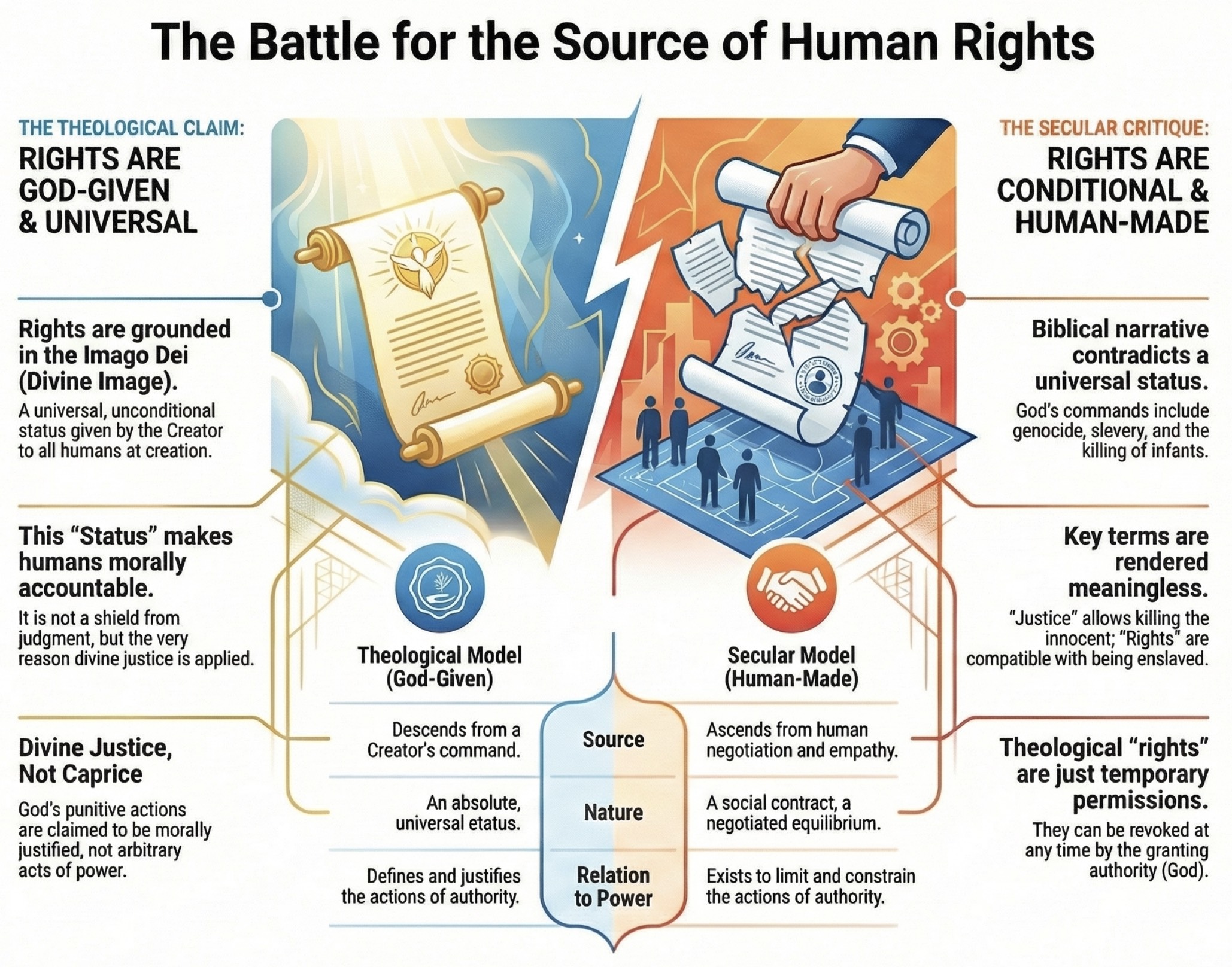
A common claim in Christian apologetics goes like this:
Human rights must come from God, because if they came from governments, governments could take them away. Only a perfect, unchanging deity can ground universal and unalterable rights.
This is a serious and testable philosophical assertion. It stands or falls on the evidence.
So let us examine three essential components:
- What human rights would require if they exist universally
- What the Bible actually portrays about human worth and authority
- Where human rights have historically and conceptually arisen
The conclusion, as we will see, is not kind to the theological claim.
I. The Necessary Structure of Universal Rights
For something to qualify as an objective, universal right, it must meet all of the following criteria:
✓ Independence
It does not depend on approval from an authority figure.
✓ Consistency
It applies to all humans equally.
✓ Endurance
It cannot be revoked based on obedience or disobedience.
If any one of these collapses, the so-called right becomes a conditional privilege.
II. What the Bible Actually Depicts: Conditional Permission, Not Rights
Apologists often assert a God who grants universal, intrinsic rights to humanity. But the biblical narratives describe something entirely different:
A God who gives or removes permissions selectively, based on tribal boundaries, obedience, or divine convenience.
Here are the recurring patterns.
1. Life is revocable at command
Infants and children are explicitly commanded to be killed (1 Samuel 15:3; Hosea 13:16). These are not fringe passages; they reflect sanctioned policy for eliminating entire populations.
A right to life that disappears when authority wills otherwise is not a right at all.
2. Bodily autonomy is nonexistent under divine rule
Women are:
• Taken as spoils of war
• Assigned to royal harems
• Given in forced marriages
Consent is not consulted — obedience is.
3. Slavery is affirmed, not overturned
From Exodus through the New Testament epistles, slavery is regulated, endorsed, and reinforced as social order.
If God intended universal freedom, He clearly failed to communicate this to the writers and believers of Scripture.
4. Property rights belong to conquerors favored by God
The biblical model of land distribution is:
God commands those with power to take land from those without.
That is the opposite of universal property rights.
5. Reproductive autonomy can be a capital offense
When Onan exercises personal choice in reproduction, God kills him (Genesis 38). The message: autonomy is a privilege granted only when convenient to the plans of authority.
Summary of the Biblical Pattern
In Scripture:
• Rights are granted only to insiders
• Rights can be revoked at any moment
• Rights are subordinate to authority, not inherent in personhood
A framework built on:
“You have whatever you’re allowed to keep… until you don’t.”
This contradicts universal human rights by definition.
III. The Apologist’s Hidden Contradiction
The popular claim rests on a simple structure:
- God is the source of human rights.
- God never changes.
- Therefore, human rights never change.
However, the biblical narrative does not support this. Instead, it shows:
• God’s demands and decrees shifting over time
• The category of people worth protecting changing depending on tribal identity and obedience
• Penalties and permissions adapting to circumstances and divine objectives
When divine will fluctuates, what counts as a “right” fluctuates with it. A right becomes nothing more than:
“You are permitted to do this because God currently wants it so.”
And the instant God wants something else, the supposed right evaporates.
A right that depends entirely on variable divine preference is not:
• universal
• independent
• or enduring
Those three qualities are the minimum criteria for a real, objective human right.
If a right is only a temporary allowance granted at the pleasure of authority, it is not a right — it is a revocable privilege.
That is a failed foundation for human rights.
IV. The Actual Origin of Universal Human Rights
Universal rights historically emerged from:
• Enlightenment philosophy
• Social contract reasoning
• Recognition of shared human vulnerability
• Secular political negotiation
• The idea that power must be constrained by human dignity
Human rights become effective precisely when authority cannot revoke them.
In other words:
Human rights are what we impose upon those in power, not what the powerful grant us.
The Enlightenment explicitly rejected the biblical model of divine authority to establish these protections.
V. Command vs. Right
Here is the conceptual core:
A command
Depends on who has power
A right
Limits who has power
The Bible is a book of commands.
Universal rights are tools created to resist command-based domination, not justify it.
Conclusion
If the God described in the Bible is real and authoritative, human “rights” exist only as God-approved privileges. They evaporate whenever obedience or divine preference demands it.
Thus, one must choose:
- If human rights exist as universal constraints on power,
they do not come from the Bible.
Or:
- If human rights come from God’s commands,
they are not intrinsic rights — only conditional allowances.
There is no third option where the Bible retroactively anticipates Enlightenment humanism.
When we defend human rights today — rights independent of obedience, tribe, gender, status, or belief — we stand on secular philosophical achievements, not biblical foundations.
Human rights last only where humans choose to uphold them.
They do not descend from heaven. They ascend from humanity.





 Free of Faith
Leave a reply to J Cancel reply