

◉ Morne is a Christian apologist who presented the following argument in defense of Penal Substitutionary Atonement.
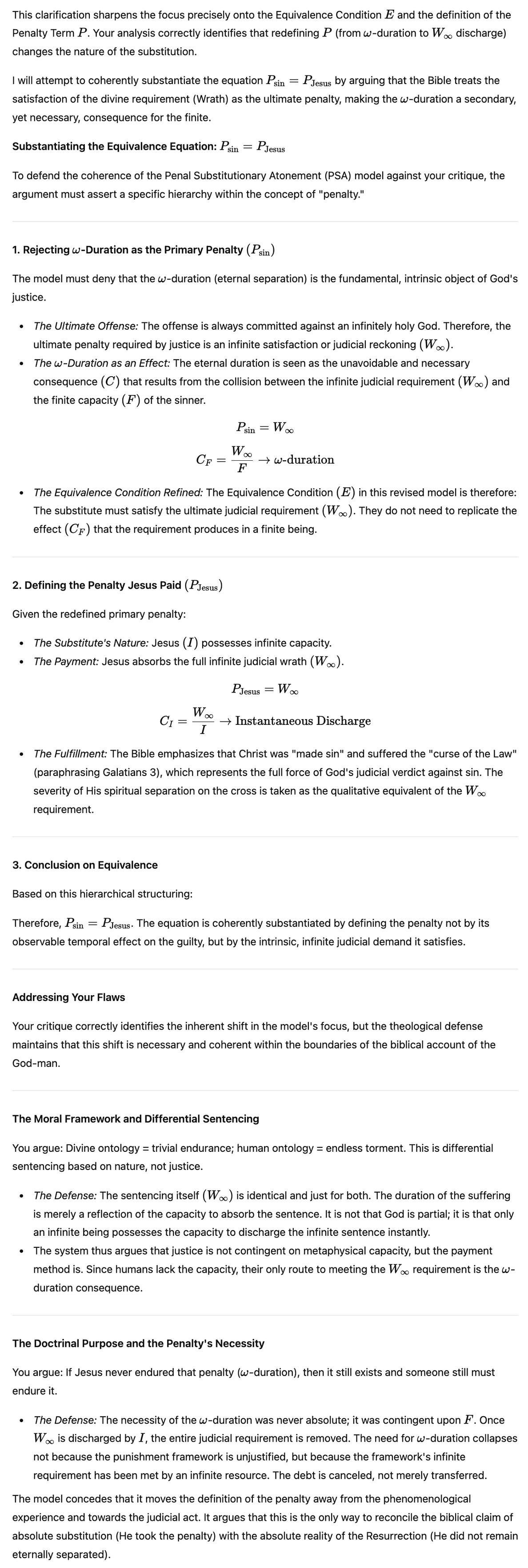
Let us walk Morne’s argument through one careful step at a time. The purpose is not rhetorical victory — it is to expose whether the claimed equivalence genuinely follows from the structure he proposes.
We will repeatedly ask:
Does this step actually yield what it claims to yield?
Step 1: What is the penalty for sin?
According to Morne:
• Question: Where does this definition come from?
The traditional teaching makes the penalty everlasting separation (which is a duration), not an “infinite unit of wrath” (which is a different kind of thing).
So:
If this is the penalty, doctrinal revision has already happened.
Step 2: What is Hell, then?
Morne says the effect of 

• Question: What are the units of 
What operation turns wrath-divided-by-capacity into literal infinite time?
If we cannot answer what kinds of things these symbols represent or how their ratio produces a temporal outcome, then:
The equation merely asserts its truth; it does not show it.
Step 3: Did Jesus receive the same penalty humans will receive without substitution?
According to Morne:

and because Jesus is infinite in capacity:

So Jesus receives zero seconds of what humans would experience forever.
Thus the “substitution” looks like this:
- The guilty: endless conscious separation
- Jesus: brief spiritual suffering
• Question: Can a consequence that one person endures forever and another experiences only momentarily ever be called “the same reality”?
• Question: What is the point of warning humans about the terror of Hell if the substitute avoids precisely that terror?
Step 4: If the punishment is identical “in God’s accounting,” why do humans still suffer?
If
• Why does anyone still receive 
• What remains to be punished?
Two possibilities emerge:
→ Once discharged, Hell becomes unnecessary.- Each sinner has a personal
→ Christ did not actually take their penalty
(He only suffered His own quantity of
Either way, the substitution collapses:
- Universal satisfaction removes Hell entirely.
- Multiple infinities divided by multiple capacities can no longer be “discharged” in one event.
Step 5: Is justice meaningful when the “equivalence” is undetectable?
Morne says equivalence is achieved because the same judicial metric is satisfied, even though:
- The guilty suffer
- Jesus suffers instantaneously.
• Question: What does it even mean to say two punishments are “equal” if no feature of the lived punishment matches?
This raises a deeper issue:
If the only real equality is what God announces from behind the curtains,
then equivalence is not demonstrated — it is decreed.
And decreed equivalence is indistinguishable from arbitrariness.
Logical Summary (Three Core Challenges)
- Equivocation on the nature of the penalty Morne silently switches penalty from
so equivalence is achieved only after the meaning of “penalty” is changed. - Undefined quantities used as if mathematically valid
is asserted, not demonstrated.
No units, no mechanism — only symbolism. - Substitution without substitution A penalty consisting of endless separation is never experienced by Christ.
Therefore He cannot be said to replace the sinner in the actual penalty state.
In symbolic form, Morne’s model claims:
But what is actually true is:

And if the consequence is not substituted, then the penalty is not substituted.
The Key Question
If a doctrine is rescued only by changing what counts as the penalty and by invoking invisible mathematics whose outputs contradict the doctrine’s own warnings…
Is the doctrine being defended — or replaced?
Until Morne can provide:
- A coherent unit-based definition of
.
- A bridge principle explaining why discharging
- A demonstration of how instant suffering is equivalent to eternal torment for the same person for the same actions…
…the claimed equivalence remains a verbal maneuver, not a logical one.
Final Thought
You do not defeat a critique by altering the target mid-argument.
Morne’s version of PSA is like someone “saving” a broken bridge by drawing a new one on a map — while insisting travelers can safely walk across the original structure simply because the paperwork has changed.
If Hell is the penalty, Jesus never bore it.
If Hell is not the penalty, the doctrine has already been rewritten.
There is no third option that preserves both the math and the theology.
Symbol and Notation Guide
This quick reference explains the symbolic logic and mathematical symbols used in the critique. Each item is presented in reader-friendly language with the exact form appearing in the argument.
•
“Penalty of sin.” Represents the punishment assigned to a sinner.
•
“Penalty Jesus paid.” Represents what Jesus is said to suffer on behalf of others.

•
“Infinite wrath.” A theoretical infinite judicial requirement. In Morne’s model, this replaces the traditional notion of eternal conscious torment as the penalty.
•
“Consequence for a finite being.” The result (such as eternal duration) when a finite creature attempts to absorb
•
“Consequence for an infinite being.” What happens when an infinite-capacity person absorbs
•
“Finite capacity.” A symbol for a human being’s alleged limited ability to absorb judicial wrath.
•
“Infinite capacity.” A symbol for Jesus’ alleged unlimited ability to absorb wrath because He is divine.
•
Symbol for an “infinite duration” of time — a stand-in for eternal conscious torment.
•
“Not equal to.” Indicates inequality between two quantities or states.

•
“Equal to.” Indicates identity or equivalence between two quantities or states.

•
“Leads to” or “results in.” Shows a causal or functional output.

•
“Equivalence condition.” The requirement that what Jesus suffered must be the same penalty humans would receive without substitution.

•
“Infinity.” A non-finite quantity; used in the model to express both wrath and duration.

•
Represents time or duration of suffering.

•
Represents value or intensity weight assigned to suffering in some standard PSA attempts.

•
“For all.” Used in universal statements (not heavily used in this section but appears in related formalizations).

•
“There exists.” Used to indicate existence of at least one instance (also appears in related formalizations).

Why These Symbols Matter
The debate requires clarity:
- If
is traditionally defined as
- If instead
, then the doctrine has changed — and must defend an entirely new structure.
These symbols allow us to ask precise questions like:
If that is true — and Morne admits it is — then how can 
The notation is not window dressing: it exposes whether equivalence is real or merely asserted.
➘ A peek at an appendix in an upcoming book that addresses PSA
➘ A follow-up:
Responding To Morne’s pushback:
1. What is the penalty?
Morne:
He now explicitly says he has “performed a doctrinal revision.” The temporal penalty is no longer the 

Phil:
Thank you for stating openly that this is doctrinal revision. That honesty makes the issue much clearer.
However, revision is not salvage. Pew-level PSA and most popular apologetics say that what sinners face is eternal conscious separation and that “Jesus took that for us.” The original target of my critique was exactly that: a literal, endless, conscious state threatened to humans, contrasted with a short, finite suffering for Jesus.
Once you change the penalty from “eternal conscious separation” to an invisible judicial quantity
• Old claim: “The penalty is everlasting separation; Jesus bore it instead of you.”
• New claim: “The penalty is an infinite judicial demand
The mathematical language makes this look continuous with classic PSA, but conceptually the core has shifted. A theory can be revised, but then we should candidly admit that traditional PSA, as preached, does not survive intact.
2. Do the new “units” and the bridge principle really fix the dimensional problem?
Morne:
He now assigns units:
•
•
•
He then introduces “Exhaustion” as the bridge principle that links S_D and T. The key structural relation becomes: 
Phil:
Giving things names does not yet make them quantities that can be divided.
If I say:
• “Guilt” has unit G.
• “Soul-strength” has unit S.
• “Eternity” has unit T.
and then assert that 
Here is the core difficulty that still remains in your model:
- You treat
- You assert that the quotient just is a duration.
- You then appeal to “exhaustion” as a story about why this makes sense.
But at no point is there a non-question-begging account of why S_D divided by C_Ftext(AI) equals T. The story that finite beings “run out of capacity” is psychologically vivid, but it is not a quantitative derivation. It simply rephrases the conclusion: a finite being suffers forever, an infinite one does not.
The original critique was: “You cannot legitimately turn ‘infinite value’ and ‘finite time’ into the same penalty as ‘infinite time’ by algebraic decoration.” Your refinement says: “Call the infinite thing 
That is still decree, not demonstration. The dimensional problem has been moved behind a metaphysical curtain, not resolved.
3. Are Jesus’ consequence and the human consequence the “same reality”?
Morne:
He concedes the phenomenology is different: Jesus’ consequence 

Phil:
Let us separate three things:
- Penalty-definition: what counts as the penalty.
- Judicial bookkeeping: what God says has been satisfied.
- Experiential state: what the subject actually undergoes.
Classic PSA, as actually preached, ties all three together: the penalty is eternal conscious separation; God’s justice requires that penalty; Jesus undergoes that penalty in our place.
Your revision separates them radically:
• The penalty is now
• God declares
• The experiential state can differ arbitrarily, so long as (1) and (2) are said to hold (3).
Once you do that, there is no longer any substantive constraint on what counts as an equivalent penalty. If God announced tomorrow that one second of mild discomfort in heaven also “satisfies
That is why I say the equivalence has become purely verbal. You call both outcomes “the same judicial reality,” but their actual content is unconstrained beyond whatever God chooses to label “full satisfaction.”
For human beings contemplating whether this model is coherent, the crucial question is:
Does it still mean anything to say “Jesus took the punishment I deserved” if Jesus never entered the actual state I am threatened with, and if the only equality is in a hidden metric only God can see and freely redefine?
Under your refined model, the answer is no. The experiential penalty is not substituted; only an unobservable divine quantity is.
4. If is fully discharged, why is anyone still punished?
Morne:
He rejects the horn “Hell is unnecessary” and chooses “one universal penalty restricted in application.” He says:
•
• However, it is only applied judicially to those united with Christ by faith.
• Those who reject Christ remain under
• The difference between the elect and the non-elect is not an inadequacy of
Phil:
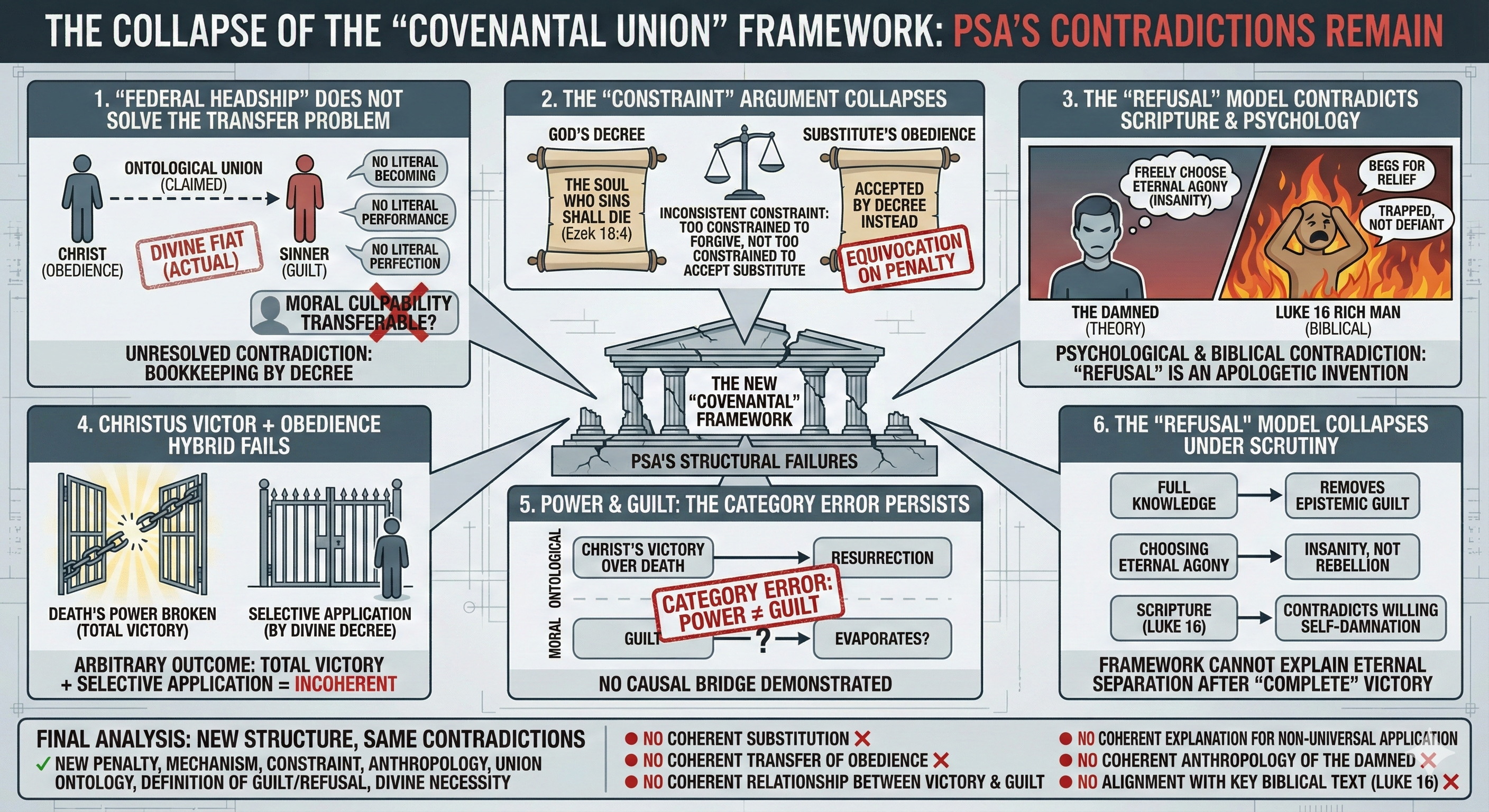
This clarification helps, but it exposes that the substitution was never really about Christ taking each person’s place in their penalty. It makes salvation entirely a matter of administrative application.
Watch what happens to the meaning of “Jesus took my punishment”:
- On your account,
- Therefore, there is no remaining unsatisfied S_D in the system; the demand has been answered.
- Yet you say that for those who “reject the substitutionary act,”
So we have to ask:
If
If there is genuinely no remaining S_D in the ledger, then endless torment becomes pure surplus cruelty.
If there is remaining S_D in the ledger, then Christ did not in fact satisfy the whole of
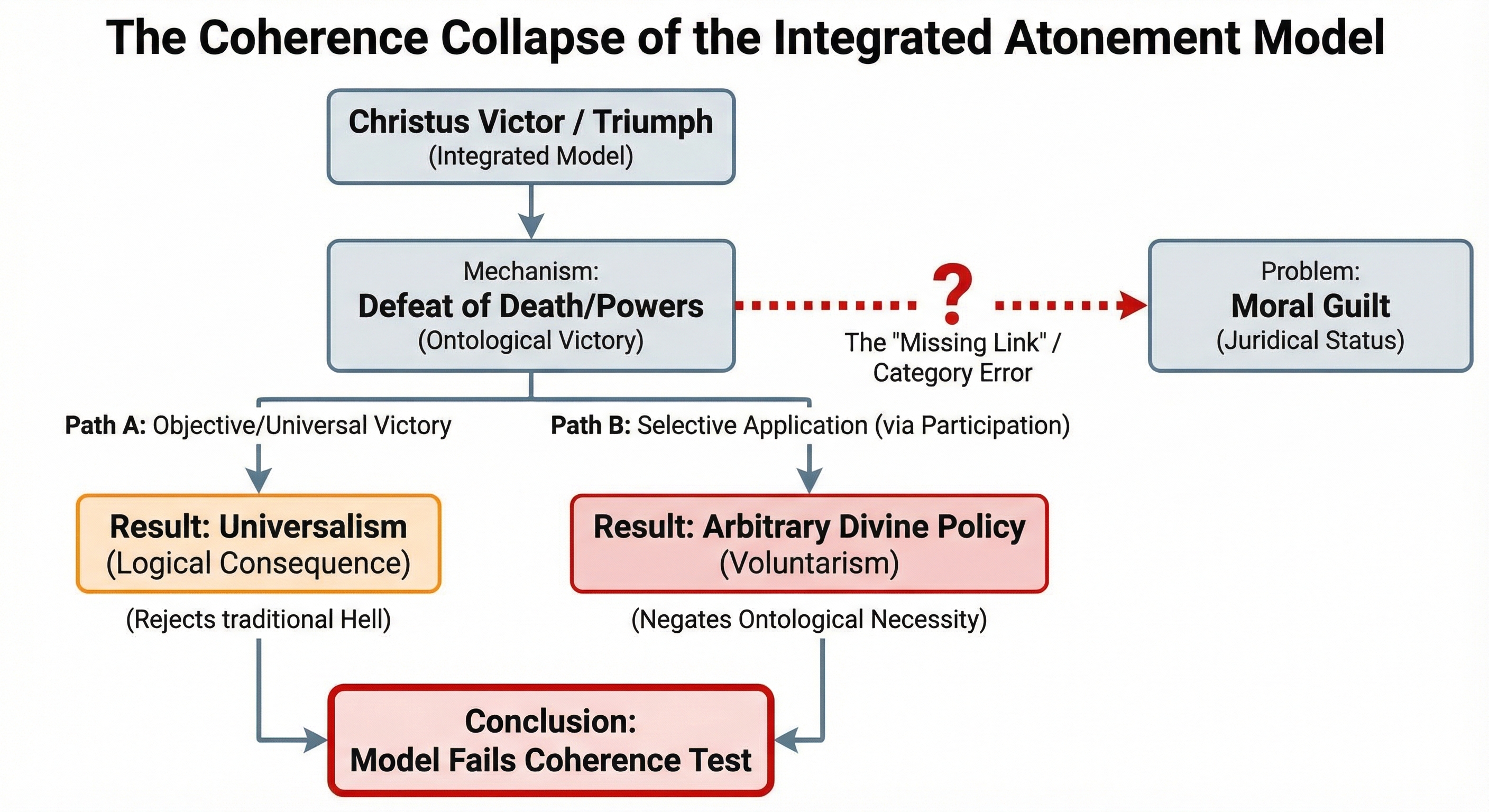
You attempt to thread the needle by saying “the substitutionary ransom is fully sufficient, but its satisfaction is applied only to the account of those who believe.” But that collapses the penal structure into a pure policy decision: God has the right to treat some people as if the penalty has been paid and others as if it has not, despite the underlying ontological fact that the demand has already been met.
At that point, the work done by
The “substitution” thus becomes a global event with potential sufficiency, but whether any individual’s penalty is actually taken is no longer a matter of what Christ suffered; it is a matter of what God chooses to credit to their account.
That is not penal substitution in any robust sense. It is conditional amnesty anchored in an atoning event.
5. Is the equivalence really “ontologically demonstrable”?
Morne:
He claims the equivalence is “ontologically demonstrable and confirmed by the Resurrection.” The argument is:
• If
• Since Christ was raised, we can infer that
• Therefore, justice is not arbitrary; it is matched to the infinite offense and confirmed by this public sign.
Phil:
Even granting, for sake of argument, that the Resurrection occurred, what it would show is that God vindicated Jesus. It would not show that:
- The specific metric
- This metric was fully “paid” in a mathematically exact way.
- The experience of the damned and Christ’s brief experience on the cross are equal as penalties.
The Resurrection, on your own premises, is a divine endorsement that “this sacrifice is acceptable to me.” But that is exactly the voluntarist concern already raised in the critique: adequacy becomes whatever God chooses to accept. The symbolic machinery around
So when you say “the equivalence is ontologically demonstrable,” what you actually mean is: “I infer from God’s endorsement that the equivalence holds.” That is not demonstration; it is theological assumption expressed in mathematical notation.
6. Where Morne’s refinement leaves PSA
Putting your five steps together, your refined model says, in effect:
- The penalty is not what the damned consciously experience; it is an invisible judicial quantity
- The experiential difference between everlasting torment and momentary suffering is morally irrelevant so long as
- Christ’s work fully satisfies
- Those not credited remain under
- We know all this, not because we can see or measure any equivalence in the penalties themselves, but because the Resurrection is taken as God’s endorsement that the sacrifice was adequate.
That does not rescue penal substitution; it transforms it into something else:
• The lived penalty no longer needs to be the same.
• Substitution becomes a conditional crediting mechanism, not an actually borne penalty for each person.
• The core equivalence is located entirely in God’s private accounting system, insulated from human scrutiny.
In other words: the cross may still be viewed as central, sacrificial, and even “satisfying” in a theological sense. But the specific claim that Jesus bore the very punishment the damned deserve, in a way that is coherently equivalent to their eternal state, has not been salvaged.
It has been abandoned in favor of a more abstract satisfaction model whose main engine is divine fiat.
A Direct Challenge to Christians
If the Resurrection had never happened — if Jesus remained dead in a tomb — Christianity could have (and likely would have) claimed:
◉ “His death alone paid the full price.”
◉ “The victory was invisible, spiritual, and real.”
◉ “The empty tomb was never meant to be literal.”
And countless apologists would now be writing books showing how this alternate metaphysics was obviously God’s plan all along.
Because in practice:
Whenever a doctrinal mechanism fails visibly, Christianity simply invents an invisible one.
No evidence needed. No constraints. No falsification risk.
The metaphysics is free-drifting, not anchored.
The Pattern
Whenever the internal logic breaks, Christians introduce metaphysical patches:
✓ A new spiritual dimension
✓ A new ontological property
✓ A new “perfectly sufficient” transaction
✓ A new invisible metric only God can see
✓ A new afterlife mechanism
✓ A new non-physical interpretation
This is not theoretical. This is standard apologetic procedure.
The doctrine never risks collision with reality because reality never gets a vote.
As long as a metaphysical placeholder exists, the system continues.
Greg Koukl’s Case Study
Greg Koukl once argued that Hell must be eternal because:
◉ If souls were annihilated, “there would be nothing left for the flames to burn.”
This shows the underlying strategy:
Invent metaphysics to fill gaps in other invented metaphysics.
Infer a “spiritual fire.”
Then infer an “eternal soul” from the requirement created by that fire.
Then infer eternal torment from the requirement created by that soul.
Then infer divine justice from the requirement created by that torment.
The chain is floating in mid-air.
A tower of assumptions, each manufactured to reinforce the last.
Nothing connects back to reality.
Penal Substitution’s Version of This
Traditional PSA says:
◉ The penalty is eternal conscious separation.
◉ Jesus paid that penalty for us.
Obvious problem:
Jesus did not endure eternal conscious separation.
New metaphysics to the rescue:
◉ “The real penalty wasn’t eternal separation — it was an infinite judicial quantity.”
◉ “The experience doesn’t need to match, only God’s invisible ledger does.”
◉ “Equivalence isn’t observable, only declared.”
With a few symbol changes and an assured divine decree, the contradiction dissolves — not because coherence emerged, but because the goalposts were spirited away.
This is not reasoning.
This is metaphysical arbitrage.
The Challenge
If a worldview can absorb any failed prediction or internal contradiction by:
◉ inventing a new metaphysical agent
◉ redefining the original terms
◉ retreating behind God’s invisible accounting
◉ redefining “punishment” as anything God says it is
◉ redefining “eternal” as anything God says it is
◉ redefining “substitution” as anything God says it is
…then no outcome could ever show the doctrine to be mistaken.
Even a permanently dead Jesus could have been sold as “victory.”
That is the indictment.
The Consequence for Rational Inquiry
A belief system that can never lose
even when reality contradicts its claims
is not a truth-tracking system.
If Hell, justice, punishment, substitution, and resurrection can all be:
◉ redefined
◉ spiritualized
◉ internalized
◉ metaphorized
◉ reversed
◉ symbolized
then Christianity is not being supported by metaphysics —
it is protected by metaphysics.
Anything can be fixed by adding enough invisible pieces.
No scientist, no philosopher, no rational person should treat that as intellectually respectable.
The Question Christians Must Answer
In a world where claims must earn their credibility:
Why should anyone trust a framework that cannot, even in principle, be wrong?
If Christianity can flip the entire metaphysical ontology on a dime
without penalty to the doctrine…
then what exactly keeps it honest?





 Free of Faith
Leave a reply to J Cancel reply