◉ Morne is a Christian apologist who presented the following argument in defense of Penal Substitutionary Atonement.
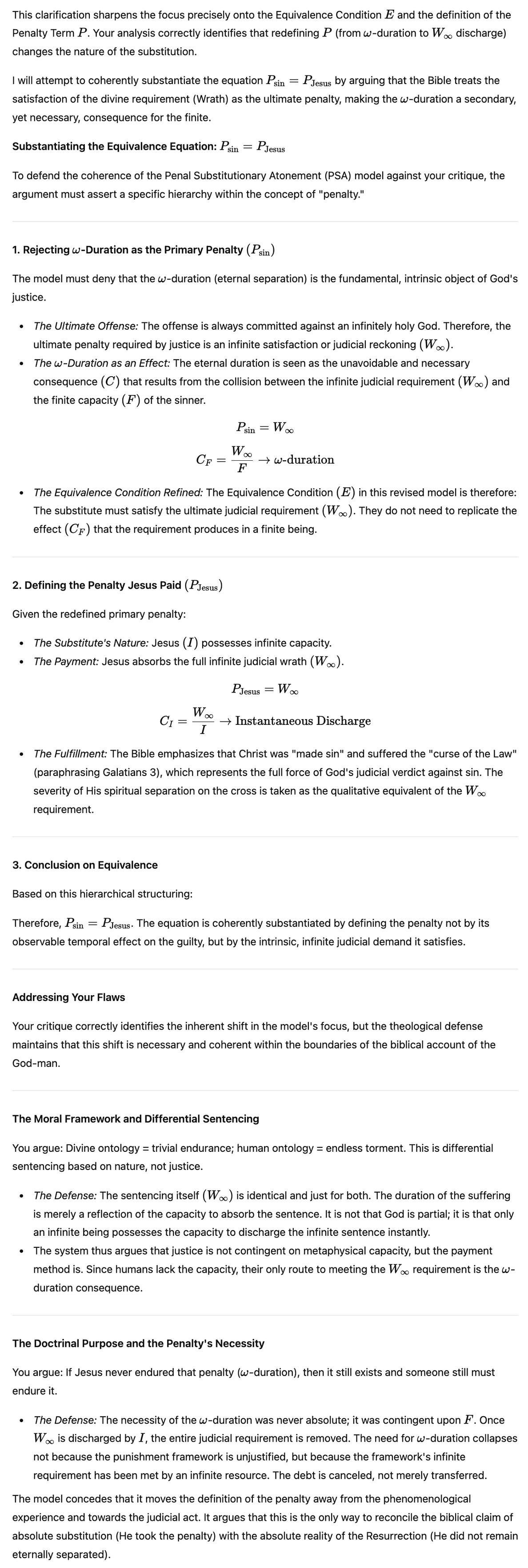
Morne’s Argument | Click to enlarge

Let us walk Morne’s argument through one careful step at a time. The purpose is not rhetorical victory — it is to expose whether the claimed equivalence genuinely follows from the structure he proposes.

We will repeatedly ask:
Does this step actually yield what it claims to yield?


According to Morne:

P_{\sin} = W_{\infty}

• Question: Where does this definition come from?
The traditional teaching makes the penalty everlasting separation (which is a duration), not an “infinite unit of wrath” (which is a different kind of thing).

So:
If this is the penalty, doctrinal revision has already happened.


Morne says the effect of W_{\infty} on a finite being is:

C_{F} = W_{\infty} / F \rightarrow \omega\text{-duration}

• Question: What are the units of W_{\infty} and F?
What operation turns wrath-divided-by-capacity into literal infinite time?

If we cannot answer what kinds of things these symbols represent or how their ratio produces a temporal outcome, then:

The equation merely asserts its truth; it does not show it.


According to Morne:

P_{\text{Jesus}} = W_{\infty}

and because Jesus is infinite in capacity:

C_{I} = W_{\infty} / I \rightarrow \text{instantaneous discharge}

So Jesus receives zero seconds of what humans would experience forever.

Thus the “substitution” looks like this:

  • The guilty: endless conscious separation
  • Jesus: brief spiritual suffering

• Question: Can a consequence that one person endures forever and another experiences only momentarily ever be called “the same reality”?

• Question: What is the point of warning humans about the terror of Hell if the substitute avoids precisely that terror?


If W_{\infty} is fully discharged by Christ, then:

• Why does anyone still receive \omega-duration?
• What remains to be punished?

Two possibilities emerge:

  1. W_{\infty} is one universal penalty
    → Once discharged, Hell becomes unnecessary.
  2. Each sinner has a personal W_{\infty}
    → Christ did not actually take their penalty
    (He only suffered His own quantity of W_{\infty} once).

Either way, the substitution collapses:

  • Universal satisfaction removes Hell entirely.
  • Multiple infinities divided by multiple capacities can no longer be “discharged” in one event.

Morne says equivalence is achieved because the same judicial metric is satisfied, even though:

  • The guilty suffer \omega-duration.
  • Jesus suffers instantaneously.

• Question: What does it even mean to say two punishments are “equal” if no feature of the lived punishment matches?

This raises a deeper issue:

If the only real equality is what God announces from behind the curtains,
then equivalence is not demonstrated — it is decreed.

And decreed equivalence is indistinguishable from arbitrariness.


  1. Equivocation on the nature of the penalty Morne silently switches penalty from
    \omega-duration → W_{\infty}
    so equivalence is achieved only after the meaning of “penalty” is changed.
  2. Undefined quantities used as if mathematically valid W_{\infty} / F = \omega is asserted, not demonstrated.
    No units, no mechanism — only symbolism.
  3. Substitution without substitution A penalty consisting of endless separation is never experienced by Christ.
    Therefore He cannot be said to replace the sinner in the actual penalty state.

In symbolic form, Morne’s model claims:

P_{\sin} = P_{\text{Jesus}}

But what is actually true is:

C_{F} \neq C_{I}

And if the consequence is not substituted, then the penalty is not substituted.


If a doctrine is rescued only by changing what counts as the penalty and by invoking invisible mathematics whose outputs contradict the doctrine’s own warnings…

Is the doctrine being defended — or replaced?

Until Morne can provide:

  1. A coherent unit-based definition of W_{\infty}, F, and I.
  2. A bridge principle explaining why discharging W_{\infty} eliminates the need for any sinner to endure \omega-duration.
  3. A demonstration of how instant suffering is equivalent to eternal torment for the same person for the same actions

…the claimed equivalence remains a verbal maneuver, not a logical one.


You do not defeat a critique by altering the target mid-argument.

Morne’s version of PSA is like someone “saving” a broken bridge by drawing a new one on a map — while insisting travelers can safely walk across the original structure simply because the paperwork has changed.

If Hell is the penalty, Jesus never bore it.
If Hell is not the penalty, the doctrine has already been rewritten.

There is no third option that preserves both the math and the theology.


Symbol and Notation Guide

This quick reference explains the symbolic logic and mathematical symbols used in the critique. Each item is presented in reader-friendly language with the exact form appearing in the argument.

P_{\sin}
“Penalty of sin.” Represents the punishment assigned to a sinner.

P_{\text{Jesus}}
“Penalty Jesus paid.” Represents what Jesus is said to suffer on behalf of others.

W_{\infty}
“Infinite wrath.” A theoretical infinite judicial requirement. In Morne’s model, this replaces the traditional notion of eternal conscious torment as the penalty.

C_{F}
“Consequence for a finite being.” The result (such as eternal duration) when a finite creature attempts to absorb W_{\infty}.

C_{I}
“Consequence for an infinite being.” What happens when an infinite-capacity person absorbs W_{\infty} (Morne claims this yields an instantaneous discharge).

F
“Finite capacity.” A symbol for a human being’s alleged limited ability to absorb judicial wrath.

I
“Infinite capacity.” A symbol for Jesus’ alleged unlimited ability to absorb wrath because He is divine.

\omega
Symbol for an “infinite duration” of time — a stand-in for eternal conscious torment.

\neq
“Not equal to.” Indicates inequality between two quantities or states.

=
“Equal to.” Indicates identity or equivalence between two quantities or states.

\rightarrow
“Leads to” or “results in.” Shows a causal or functional output.

E
“Equivalence condition.” The requirement that what Jesus suffered must be the same penalty humans would receive without substitution.

\infty
“Infinity.” A non-finite quantity; used in the model to express both wrath and duration.

t
Represents time or duration of suffering.

v
Represents value or intensity weight assigned to suffering in some standard PSA attempts.

\forall
“For all.” Used in universal statements (not heavily used in this section but appears in related formalizations).

\exists
“There exists.” Used to indicate existence of at least one instance (also appears in related formalizations).


Why These Symbols Matter

The debate requires clarity:

  • If P_{\sin} is traditionally defined as \omega-duration, then Jesus never endured the actual penalty.
  • If instead P_{\sin} = W_{\infty}, then the doctrine has changed — and must defend an entirely new structure.

These symbols allow us to ask precise questions like:

C_{F} \neq C_{I}
If that is true — and Morne admits it is — then how can P_{\sin} = P_{\text{Jesus}} without replacing the doctrine rather than defending it?

The notation is not window dressing: it exposes whether equivalence is real or merely asserted.

➘ A peek at an appendix in an upcoming book that addresses PSA


A follow-up:

Responding To Morne’s pushback:


He now explicitly says he has “performed a doctrinal revision.” The temporal penalty is no longer the \omega-duration itself. Instead, he defines the penalty of sin as a “Divine Judicial Demand/Satisfaction” \mathbb{W}_{\infty}, with \omega-duration reduced to a consequence determined by finite capacity. The key equation is: P_{\sin} = \mathbb{W}_{\infty}.

Thank you for stating openly that this is doctrinal revision. That honesty makes the issue much clearer.

However, revision is not salvage. Pew-level PSA and most popular apologetics say that what sinners face is eternal conscious separation and that “Jesus took that for us.” The original target of my critique was exactly that: a literal, endless, conscious state threatened to humans, contrasted with a short, finite suffering for Jesus.

Once you change the penalty from “eternal conscious separation” to an invisible judicial quantity \mathbb{W}_{\infty}, you are no longer defending the view under critique. You have introduced a different theory:

• Old claim: “The penalty is everlasting separation; Jesus bore it instead of you.”
• New claim: “The penalty is an infinite judicial demand \mathbb{W}_{\infty}; Jesus satisfied that demand, so your endless separation is no longer the penalty but just what happens when \mathbb{W}_{\infty} meets finite capacity.”

The mathematical language makes this look continuous with classic PSA, but conceptually the core has shifted. A theory can be revised, but then we should candidly admit that traditional PSA, as preached, does not survive intact.


He now assigns units:

\mathbb{W}_{\infty} has unit S_D (“Divine Judicial Demand/Satisfaction”).
F has unit C_Ftext(AI) (“Finite Capacity for Judicial Absorption”).
\omega-duration has unit T (“Time”).

He then introduces “Exhaustion” as the bridge principle that links S_D and T. The key structural relation becomes: C_{F} = \mathbb{W}_{\infty} / F \rightarrow \omega\text{-duration}. He describes this as a “metaphysical analogy” that does not require shared ontology between the quantities.

Giving things names does not yet make them quantities that can be divided.

If I say:

• “Guilt” has unit G.
• “Soul-strength” has unit S.
• “Eternity” has unit T.

and then assert that G / S = T because of a “bridge principle of exhaustion,” I have not solved any dimensional problem. I have wrapped the same opacity in new terminology.

Here is the core difficulty that still remains in your model:

  1. You treat \mathbb{W}_{\infty} as a scalar that can be “divided” by capacity.
  2. You assert that the quotient just is a duration.
  3. You then appeal to “exhaustion” as a story about why this makes sense.

But at no point is there a non-question-begging account of why S_D divided by C_Ftext(AI) equals T. The story that finite beings “run out of capacity” is psychologically vivid, but it is not a quantitative derivation. It simply rephrases the conclusion: a finite being suffers forever, an infinite one does not.

The original critique was: “You cannot legitimately turn ‘infinite value’ and ‘finite time’ into the same penalty as ‘infinite time’ by algebraic decoration.” Your refinement says: “Call the infinite thing \mathbb{W}_{\infty}, call human limitations F, and decree that \mathbb{W}_{\infty} / F is eternal time.”

That is still decree, not demonstration. The dimensional problem has been moved behind a metaphysical curtain, not resolved.


He concedes the phenomenology is different: Jesus’ consequence C_{I} is momentary, the human consequence C_{F} is endless. But he insists they are the “same judicial reality” because both satisfy the same \mathbb{W}_{\infty}. He suggests that Jesus’ cry of abandonment and spiritual separation on the cross is a “qualitative equivalent” to Hell in judicial weight, compressed into finite time.

Let us separate three things:

  1. Penalty-definition: what counts as the penalty.
  2. Judicial bookkeeping: what God says has been satisfied.
  3. Experiential state: what the subject actually undergoes.

Classic PSA, as actually preached, ties all three together: the penalty is eternal conscious separation; God’s justice requires that penalty; Jesus undergoes that penalty in our place.

Your revision separates them radically:

• The penalty is now \mathbb{W}_{\infty} (1).
• God declares \mathbb{W}_{\infty} satisfied by Christ (2).
• The experiential state can differ arbitrarily, so long as (1) and (2) are said to hold (3).

Once you do that, there is no longer any substantive constraint on what counts as an equivalent penalty. If God announced tomorrow that one second of mild discomfort in heaven also “satisfies \mathbb{W}_{\infty},” this very same framework would declare it a perfectly “just” substitution. No structural limit in the theory forbids that move.

That is why I say the equivalence has become purely verbal. You call both outcomes “the same judicial reality,” but their actual content is unconstrained beyond whatever God chooses to label “full satisfaction.”

For human beings contemplating whether this model is coherent, the crucial question is:

Does it still mean anything to say “Jesus took the punishment I deserved” if Jesus never entered the actual state I am threatened with, and if the only equality is in a hidden metric only God can see and freely redefine?

Under your refined model, the answer is no. The experiential penalty is not substituted; only an unobservable divine quantity is.


He rejects the horn “Hell is unnecessary” and chooses “one universal penalty restricted in application.” He says:

\mathbb{W}_{\infty} is one universal penalty, and Christ’s suffering is sufficient for the sins of the whole world.
• However, it is only applied judicially to those united with Christ by faith.
• Those who reject Christ remain under \mathbb{W}_{\infty} with finite capacity F, and therefore experience C_{F} as \omega-duration.
• The difference between the elect and the non-elect is not an inadequacy of \mathbb{W}_{\infty} but rejection of the “Substitutionary Act.”

This clarification helps, but it exposes that the substitution was never really about Christ taking each person’s place in their penalty. It makes salvation entirely a matter of administrative application.

Watch what happens to the meaning of “Jesus took my punishment”:

  1. On your account, \mathbb{W}_{\infty} as a single universal demand has been fully satisfied in Christ.
  2. Therefore, there is no remaining unsatisfied S_D in the system; the demand has been answered.
  3. Yet you say that for those who “reject the substitutionary act,” \mathbb{W}_{\infty} still functions judicially over them and yields C_{F} as \omega-duration.

So we have to ask:

If \mathbb{W}_{\infty} is fully satisfied, what is this “remaining wrath” that the non-elect still face?

If there is genuinely no remaining S_D in the ledger, then endless torment becomes pure surplus cruelty.
If there is remaining S_D in the ledger, then Christ did not in fact satisfy the whole of \mathbb{W}_{\infty}.

You attempt to thread the needle by saying “the substitutionary ransom is fully sufficient, but its satisfaction is applied only to the account of those who believe.” But that collapses the penal structure into a pure policy decision: God has the right to treat some people as if the penalty has been paid and others as if it has not, despite the underlying ontological fact that the demand has already been met.

At that point, the work done by \mathbb{W}_{\infty} in your model is indistinguishable from what would be done by a simple divine decree: “I choose to regard these people as forgiven and those as not.”

The “substitution” thus becomes a global event with potential sufficiency, but whether any individual’s penalty is actually taken is no longer a matter of what Christ suffered; it is a matter of what God chooses to credit to their account.

That is not penal substitution in any robust sense. It is conditional amnesty anchored in an atoning event.


He claims the equivalence is “ontologically demonstrable and confirmed by the Resurrection.” The argument is:

• If \mathbb{W}_{\infty} had not been satisfied, the judicial debt would remain, and Christ could not have been raised.
• Since Christ was raised, we can infer that \mathbb{W}_{\infty} was fully discharged.
• Therefore, justice is not arbitrary; it is matched to the infinite offense and confirmed by this public sign.

Even granting, for sake of argument, that the Resurrection occurred, what it would show is that God vindicated Jesus. It would not show that:

  1. The specific metric \mathbb{W}_{\infty} exists as you define it.
  2. This metric was fully “paid” in a mathematically exact way.
  3. The experience of the damned and Christ’s brief experience on the cross are equal as penalties.

The Resurrection, on your own premises, is a divine endorsement that “this sacrifice is acceptable to me.” But that is exactly the voluntarist concern already raised in the critique: adequacy becomes whatever God chooses to accept. The symbolic machinery around \mathbb{W}_{\infty}, F, C_{F}, and C_{I} is therefore ornamental. The only real ground of equivalence remains divine say-so.

So when you say “the equivalence is ontologically demonstrable,” what you actually mean is: “I infer from God’s endorsement that the equivalence holds.” That is not demonstration; it is theological assumption expressed in mathematical notation.


Putting your five steps together, your refined model says, in effect:

  1. The penalty is not what the damned consciously experience; it is an invisible judicial quantity \mathbb{W}_{\infty}.
  2. The experiential difference between everlasting torment and momentary suffering is morally irrelevant so long as \mathbb{W}_{\infty} is said to be satisfied.
  3. Christ’s work fully satisfies \mathbb{W}_{\infty}, but that satisfaction is only credited to some individuals.
  4. Those not credited remain under \mathbb{W}_{\infty} and receive endless torment, even though the ontological demand has already been answered in Christ.
  5. We know all this, not because we can see or measure any equivalence in the penalties themselves, but because the Resurrection is taken as God’s endorsement that the sacrifice was adequate.

That does not rescue penal substitution; it transforms it into something else:

• The lived penalty no longer needs to be the same.
• Substitution becomes a conditional crediting mechanism, not an actually borne penalty for each person.
• The core equivalence is located entirely in God’s private accounting system, insulated from human scrutiny.

In other words: the cross may still be viewed as central, sacrificial, and even “satisfying” in a theological sense. But the specific claim that Jesus bore the very punishment the damned deserve, in a way that is coherently equivalent to their eternal state, has not been salvaged.

It has been abandoned in favor of a more abstract satisfaction model whose main engine is divine fiat.


A Direct Challenge to Christians

If the Resurrection had never happened — if Jesus remained dead in a tomb — Christianity could have (and likely would have) claimed:

◉ “His death alone paid the full price.”
◉ “The victory was invisible, spiritual, and real.”
◉ “The empty tomb was never meant to be literal.”

And countless apologists would now be writing books showing how this alternate metaphysics was obviously God’s plan all along.

Because in practice:

Whenever a doctrinal mechanism fails visibly, Christianity simply invents an invisible one.

No evidence needed. No constraints. No falsification risk.
The metaphysics is free-drifting, not anchored.


The Pattern

Whenever the internal logic breaks, Christians introduce metaphysical patches:

✓ A new spiritual dimension
✓ A new ontological property
✓ A new “perfectly sufficient” transaction
✓ A new invisible metric only God can see
✓ A new afterlife mechanism
✓ A new non-physical interpretation

This is not theoretical. This is standard apologetic procedure.

The doctrine never risks collision with reality because reality never gets a vote.

As long as a metaphysical placeholder exists, the system continues.


Greg Koukl’s Case Study

Greg Koukl once argued that Hell must be eternal because:

◉ If souls were annihilated, “there would be nothing left for the flames to burn.”

This shows the underlying strategy:
Invent metaphysics to fill gaps in other invented metaphysics.

Infer a “spiritual fire.”
Then infer an “eternal soul” from the requirement created by that fire.
Then infer eternal torment from the requirement created by that soul.
Then infer divine justice from the requirement created by that torment.

The chain is floating in mid-air.
A tower of assumptions, each manufactured to reinforce the last.

Nothing connects back to reality.


Penal Substitution’s Version of This

Traditional PSA says:

◉ The penalty is eternal conscious separation.
◉ Jesus paid that penalty for us.

Obvious problem:
Jesus did not endure eternal conscious separation.

New metaphysics to the rescue:

◉ “The real penalty wasn’t eternal separation — it was an infinite judicial quantity.”
◉ “The experience doesn’t need to match, only God’s invisible ledger does.”
◉ “Equivalence isn’t observable, only declared.”

With a few symbol changes and an assured divine decree, the contradiction dissolves — not because coherence emerged, but because the goalposts were spirited away.

This is not reasoning.
This is metaphysical arbitrage.


The Challenge

If a worldview can absorb any failed prediction or internal contradiction by:

◉ inventing a new metaphysical agent
◉ redefining the original terms
◉ retreating behind God’s invisible accounting
◉ redefining “punishment” as anything God says it is
◉ redefining “eternal” as anything God says it is
◉ redefining “substitution” as anything God says it is

…then no outcome could ever show the doctrine to be mistaken.

Even a permanently dead Jesus could have been sold as “victory.”

That is the indictment.


The Consequence for Rational Inquiry

A belief system that can never lose
even when reality contradicts its claims
is not a truth-tracking system.

If Hell, justice, punishment, substitution, and resurrection can all be:

◉ redefined
◉ spiritualized
◉ internalized
◉ metaphorized
◉ reversed
◉ symbolized

then Christianity is not being supported by metaphysics —
it is protected by metaphysics.

Anything can be fixed by adding enough invisible pieces.

No scientist, no philosopher, no rational person should treat that as intellectually respectable.


The Question Christians Must Answer

In a world where claims must earn their credibility:

Why should anyone trust a framework that cannot, even in principle, be wrong?

If Christianity can flip the entire metaphysical ontology on a dime
without penalty to the doctrine…

then what exactly keeps it honest?


18 responses to “Morne & Phil on PSA”

  1. Morne Hurter Avatar
    Morne Hurter

    Defense of the Judicial Substitution Model

    Your critique forces the coherence of the Penal Substitutionary Atonement (PSA) model to rest entirely on the definition of the Penalty. I maintain that the model is only viable by defining the penalty as the Judicial Demand (Infinite Wrath), not the Experiential Consequence (Eternal Separation).1. Defending the Dimensional Problem: Judicial vs. Empirical Quantities

    Your Critique: The assertion that dividing Infinite Wrath by Finite Capacity yields Eternal Time is unsupported symbolism, lacking coherent units.

    My Defense (Ontological Mechanism): I agree that the formula isn’t a physics calculation, but a qualitative assertion of ontological necessity. The mechanism is Exhaustion and Residual Debt.

    1. The Demand: The penalty required by God’s holiness is an Infinite Judicial Demand.
    2. The Human’s Payment: The finite person has a finite capacity to pay at any given time.
    3. The Necessity: Since the debt is infinite and the payments are finite, the debt is never satisfied. The time required to complete the payment is necessarily infinite. The eternal duration is the state of being perpetually unable to pay the infinite debt. This necessity prevents the system from being arbitrary.

    2. Defending Equivalence Against Verbal Constraint

    Your Critique: Since the experiential state of Christ (momentary suffering) differs radically from the human state (eternal separation), the equivalence is purely verbal and unconstrained (allowing even mild discomfort to satisfy the debt).

    My Defense (The Constraint of Infinity): The framework has a strict structural limit: Infinite Value.

    • The Structural Constraint: Only a being of Infinite Capacity can satisfy the Infinite Judicial Demand instantly.
    • The Barrier to Arbitrary Substitution: Mild discomfort by a finite creature is a finite payment; it fails to satisfy the demand. The substitution is not arbitrary because it is constrained by the God-Man’s infinite value—only His death and spiritual abandonment on the cross carried the infinite qualitative weight necessary to meet the required demand.
    • The Resurrection then serves as the historical, demonstrable sign that the payment was accepted as complete, confirming the adequacy of the substitution.

    3. Defending Justice and the Necessity of Hell

    Your Critique: If the total Infinite Demand is satisfied by Christ, there is no remaining judicial claim, and punishing the non-elect is pure surplus cruelty.

    My Defense (Application and Legal Standing): This maintains the distinction between Sufficiency and Efficiency.

    • Sufficiency: Christ’s sacrifice is globally sufficient; the payment is adequate for the whole world’s sin.
    • Application: The judicial discharge is only applied to the account of those who accept the substitution by faith.
    • The Continued Punishment: The non-elect face the Infinite Demand, not because the total Demand remains unsatisfied, but because they legally stand in their original finite account and have refused to credit the payment to their ledger. The judicial system, therefore, requires them to personally face the consequence of their own Finite Capacity against the Infinite Demand—which is eternal duration.

    The substitution is a global event whose efficacy must be individually accepted. The punishment of the non-elect is thus transformed from being a necessary payment into being the ultimate consequence of rejecting the payment offered by the Substitute.

    1. Phil Stilwell Avatar
      Phil Stilwell

      Your Revised PSA Remains Incoherent

      You insist PSA can remain coherent if you redefine the penalty as Infinite Judicial Demand and treat eternal torment as merely its consequence. But even granting all your revisions:

      • Your model still contradicts itself,
      • Still lacks substitution, and
      • Still leaves justice incoherent.

      Let’s walk through each failure.

      ◉ ◉ ◉ You redefine the penalty — but substitution still fails

      You say:

      The penalty is not eternal separation — it is [Infinite Wrath].

      But then:

      • You keep eternal separation for the damned.
      • Jesus never experiences it.

      So even in your own modified system:

      Syllogism 1

      1. A substitute must take the actual punishment the guilty would suffer.
      2. The damned actually suffer eternal separation.
      3. Jesus does not endure eternal separation.
      4. Therefore Jesus does not take the punishment the damned suffer.

      Even by your own categories, the essential penalty state is not substituted.

      You move the goalposts — and still miss the goal.

      ◉ ◉ ◉ Your “Infinite Value” constraint doesn’t produce equivalence

      You argue:

      Only an infinite being can instantly satisfy Infinite Wrath.

      But you then insist the damned still suffer the same Infinite Wrath forever.

      So:

      Syllogism 2

      1. If Christ fully satisfies Infinite Wrath,
      2. And the damned still suffer Infinite Wrath,
      3. Then Infinite Wrath was not fully satisfied.
      4. Therefore your system denies what it claims to affirm.

      You cannot logically maintain both:

      ✓ Infinite Wrath paid
      and
      ✓ Infinite Wrath still applied

      That is contradiction, not doctrine.

      ◉ ◉ ◉ Your “application” distinction breaks justice itself

      You say:

      The payment is sufficient but only applied to believers.

      But consider:

      Syllogism 3

      1. If a debt is entirely paid on behalf of someone,
      2. It cannot be just that they pay the same debt again,
      3. Yet you claim the damned must pay the debt anyway,
      4. Therefore the debt was not paid on their behalf.

      Your model forces one of two unjust outcomes:

      Option A:
      Hell is punishment for a debt already paid → double punishment.

      Option B:
      Christ only paid for some people → no substitution for the rest.

      Either way:

      You do not have penal substitution; you have selective forgiveness.

      ◉ ◉ ◉ Where This Leaves Your System

      Let’s outline your final structure precisely:

      • The penalty is invisible and unexamined (Infinite Demand).
      • The actual experienced punishment (eternal separation) is never substituted.
      • Justice demands the damned still endure Infinite Wrath anyway.
      • God’s ledger calls this “equivalent,” though nothing actually matches.

      You have constructed:

      A system where Christ’s suffering changes
      nothing about the actual fate of those who suffer eternally.

      Yet you still call that substitution.

      ◉ ◉ ◉ Final Direct Conclusion

      Even after redefining every essential term, your model fails:

      1. No equivalence
         —the punishments are categorically different.
      2. No substitution
         —the damned still receive the same debt Jesus supposedly paid.
      3. No justice
         —God would be punishing a paid debt.

      You can rename the penalty.
      You can reframe the units.
      You can spiritualize the ledger.

      But the central question remains:

      Did Jesus endure the actual fate that sinners face?

      Your own answer is still: No.
      And the moment that answer is No, PSA is dead.

  2. J Avatar
    J

    I’d like to second the critiques of the “Penal Substitution” model given by Phil and also ask some questions about one part of the second comment above.

    Is the “Resurrection” really a “historic, demonstrable sign”?:

    Consider the following facts:

    1. It is the general consensus of biblical scholarship that the authors of Matthew and Luke utilized Mark as a source. There is also a growing number who think that the Gospel of John was familiar with at least one of the other Gospels.

      2. Peter Kirby points out in the article mentioned below that the “empty tomb” story (e.g. Joseph of Arimathea burying the body, the visit to the tomb by the women is absent, and the disciples’ conversation with said female witnesses) is not mentioned anywhere outside of the Gospels in 1st Century A.D. authors. In fact, an early Christian work outside of the New Testament, 1 Clement, offers the mythical story of the phoenix in support of resurrection belief!

      3. Not only does Paul’s resurrection creed in 1 Corinthians 15: 3-9 fail to mention any of the women in the Gospels after identifying “Cephas” (Simon Peter?) as the first “witness”, but he includes his own “visionary experience” as a sort of resurrection proof without differentiating between it and the experiences of disciples who would have encountered Jesus before his ascension. Paul doesn’t even mention the empty tomb or Joseph of Arimathea. Consider that he says in Galatians 1:18 that he spent fifteen days with “Cephas” after his conversion. If Cephas is Simon Peter (who would presumably have been familiar with the details of the empty tomb), why do the Pauline letters show no familiarity with central details of the traditional resurrection story? If Paul has no qualms about naming women in passages like Romans 16: 1-7 and Philippians 4: 2 – 3, why not mention either of the Marys or Salome at the empty tomb if that was a historical fact?

      (One attempt to counter Paul’s silence regarding the women at the tomb that I’ve encountered on the part of web apologists is to claim that legal testimony in the ancient world only counted male witnesses. But given that Paul is addressing a mixed-gendered congregation in 1 Corinthians and he does not introduce the 1 Corinthians 15 chapter with legal terminology or “oath-taking” to indicate that it is the written equivalent of “evidence admissible in a misogynistic ancient court of law,” this seems in my view to be one example among many of apologists doing whatever they can to avoid acknowledging the existence of contradictions in the Bible.)

      1. J Avatar
        J

        (continued from above)

        1. Consider the following as well in regard to the nature of the gospels and Acts:
          • Even though it is usually accepted that whoever wrote Luke was also the author of the Acts of the Apostles, there is no mention of Joseph of Arimathea, the moved boulder, or the witness of the female disciples when a speech by Peter, Paul, or another Christian witness is presented in the latter work. While Pontius Pilate is mentioned, several passages in Acts oddly use the Greek plural to denote the individuals responsible for burying Jesus.
          • The current tendency among biblical scholars is to reject or at least cast doubt on the church traditions that Matthew, Mark, Luke, or John were the primary or even secondary writers of the gospels or acts. The authors don’t even utilize the narrative first-person when presenting their accounts of Jesus’s life: In the Gospel of Luke and Acts, the use of “we” phrases outside of direct quotes by characters in the stories occurs only in the prologues and for events occurring long after Jesus’ ascension into heaven. The Gospel of John uses the first-person only with the “logos” monologue at the beginning, or to describe the relation of the author to the “beloved disciple” at the end. (The fact that John 21: 24-25 has the “beloved disciple” presented in the third-person in contrast to the author(s) who write “we know his testimony is true.”) Contrast this with a Greco-Historian like Tacitus, who consistently positions himself as a witness to events in the Roman Empire using terminology like “we” and “us.” (See Ferguson’s article “Why Scholars Doubt the Traditional Authors of the Gospels” below for an overview of why rejection of the traditional authors is common among scholars.)
          • The Gospels and Acts of the Apostles never employ what we might call “methodological skepticism” when presenting reports of miracles. Rather than the author using the first-person to present his initial doubts while presenting an account of miraculous healings, the resurrection, or visions from above, we have instances of potential refutations placed on the mouths of opponents to the Christian message without granting them any sort of counter-argument other than basically “we know what really happened.” (If someone were to ask you to believe in a paranormal event like alien abductions or ESP and never gave you examples of reports from supposed abductees or psychics that they considered mistaken, how much confidence would you place in their claims to have seen aliens or witnessed extrasensory perception firsthand?)
          • Would it be acceptable to use the reports of Tacitus, Cassius Dio, and Suetonius to “prove” that the Roman general and future emperor Vespasian was a faith-healer who channeled the power of the Egyptian god Serapis? All of these authors independently present this story and the historian Josephus appears to have viewed him as “chosen” or “messianic” in the aftermath of the Jewish Wars.

        I’d like to recommend the following web resources for further discussions of the problems with early Christian documents and associated miracle claims:

        -Peter Kirby’s “The Historicity of the Empty Tomb Evaluated” (https://infidels.org/library/modern/peter-kirby-tomb/)
        -Matthew Wade Ferguson’s “Ancient Historical Writing Compared to the Gospels of the New Testament” (https://infidels.org/library/modern/matthew-ferguson-gospel-genre/)
        -Matthew Wade Ferguson’s “Why Scholars Doubt the Traditional Authors of the Gospels” (https://infidels.org/library/modern/matthew-ferguson-gospel-authors/)

        Scholar Michael Kok has also written works like The Beloved Apostle? and Four Evangelists and a Heresy Hunter in which he debates the traditional authorial claims of the four gospels.

        Thanks,

        Jeffrey

      2. Morne Hurter Avatar
        Morne Hurter

        That’s a solid breakdown of where the theological debate around Penal Substitutionary Atonement (PSA) hits its limits. 👊The purely juridical PSA model, when pushed to its logical extreme, suffers from internal incoherence, specifically the “Double Punishment” problem. The focus of my source material is to shift the debate from the logical mechanics of the penalty exchange to the broader biblical picture of Atonement—one that includes reconciliation, redemption, and Christ’s triumph—which better accounts for the Resurrection.

        1. Phil Stilwell Avatar
          Phil Stilwell

          Morne, shifting from penal substitution to a broader family of atonement motifs doesn’t solve the problem you’re trying to address — it simply abandons PSA at the moment PSA is asked to be coherent.

          You say your goal is now to “shift the debate from the logical mechanics of the penalty exchange to the broader biblical picture of Atonement — reconciliation, redemption, triumph.” But that shift is exactly the concession:

          PSA breaks under inspection, so we relocate the weight somewhere else.

          That’s fine theologically, but it’s a tacit admission that the penal-exchange structure you were defending cannot actually carry the burden you placed on it.

          ✓ If you move to Christus Victor — the problem disappears because PSA is no longer in view.
          ✓ If you move to moral influence — same thing.
          ✓ If you move to reconciliation, participation, or new-covenant motifs — again, PSA is no longer carrying the freight.

          But that is not a rescue of PSA.
          It is a pivot away from PSA at precisely the point the theory must stand or fall.

          Your earlier attempt was:

          1. Redefine the penalty (from eternal separation to infinite judicial demand).
          2. Reassign the consequence (from penalty itself to an overflow effect of finite capacity).
          3. Reframe the substitution (from experiential equivalence to divine bookkeeping equivalence).
          4. Reframe Hell (from necessary justice to the “legal standing” of those who reject the application).
          5. Reframe the Resurrection (from evidence of equivalence to evidence God accepted the transaction).

          Now, when those revisions still produce contradiction, you’re saying:

          “Let’s not stay in the mechanics — let’s look at the broader biblical themes.”

          But the broader biblical themes you list — reconciliation, redemption, triumph — do not depend on PSA at all. In fact, the early church fathers overwhelmingly grounded them in non-PSA models.

          If you’re now leaning on those instead, the debate has already shifted categories:

          You are leaving PSA because PSA does not work.

          And that’s the honest endpoint of this exchange:
          not a refined penal substitution, but a quiet migration away from it.

          Here’s the bottom line:

          ◉ If PSA’s core claim is that Jesus bore the penalty the damned deserve, your revised version explicitly denies that — Jesus never enters their actual penalty state.
          ◉ If PSA’s core claim is that justice requires equivalence of penalty, your model removes equivalence and replaces it with divine fiat.
          ◉ If PSA’s core motivation is to explain why the damned suffer endlessly while Christ did not, your refined framework still cannot give a coherent, non-circular explanation.
          ◉ If PSA fails on its own terms, importing other atonement motifs isn’t a resolution — it’s a retreat.

          Reconciliation themes may be coherent.
          Triumph motifs may be coherent.
          New-creation or participation models may be coherent.

          But none of them repair penal substitution.

          So your pivot is not an expansion — it’s an admission.

          PSA cannot be logically defended without redefining every essential term, and once those redefinitions are made, PSA is no longer what is being defended.

          If you want to explore a non-penal model of atonement, I’m happy to continue that conversation.
          But if the claim is that PSA “still works” once reframed into broader biblical categories, the critique stands untouched:

          The coherence of PSA was the point under dispute.
          You’ve moved to a different doctrine rather than resolving the contradiction.

          But, provide a focused articulation your new doctrine, and I’ll assess it also for coherence.

      3. Morne Hurter Avatar
        Morne Hurter

        Summary of Your Analysis

        • The Failure is Internal
          The paradoxes (especially the Debt Satisfaction Contradiction and Substitution Failure) arise from the model’s reliance on Substantive Equivalence (C₍I₎ = C₍F₎), which is impossible.
        • The Defense is Structural
          The attempted defense was a structural replacement of the penalty metric (ω → 𝔚∞), which failed because it could not resolve the logical contradiction between:
          • the necessity of the Resurrection (debt satisfied), and
          • the necessity of Hell (debt still applied to the non-elect).
        • The Pivot is a Categorical Shift
          Leaning on Reconciliation or Triumph is a shift to different, non-penal doctrines that do not carry the freight of the judicial exchange that was under dispute.

        Conclusion:The Penal Substitutionary Atonement model, as a strictly defined juridical mechanism for transferring and satisfying the eternal penalty of sin, breaks under inspection. This is not a rescue of PSA; it is the abandonment of its core mechanical claim (that Jesus bore the actual ω-duration consequence).

        Since the debate now requires a coherent model, and the logical flaws of the purely penal mechanism are fully exposed, you argue that we must transition to a broader, non-penal atonement framework that integrates the historical Resurrection without relying on the contradictory judicial mechanism. The Integrated Atonement Model

        The new doctrine is a synthesized model built on Triumph and Participation, often termed the Christus Victor model combined with New Creation / Reconciliation. 1. Core Definition: The Atonement as Triumph (Christus Victor)

        The Atonement is defined as God’s act of victory and repossession of humanity from the powers of Sin, Death, and the Devil (the “powers” that held humanity captive).

        • The Penalty
          The penalty is not an abstract judicial demand (𝔚∞), but the real, ontological power of Death (ω-duration) and Sin over humanity.
        • The Mechanism
          Christ enters humanity’s condition of death and captivity (the Incarnation and Crucifixion) and, through his own divine life, breaks the power of Death from the inside.
        • The Resurrection
          The Resurrection is not a mere “receipt”; it is the ontological proof of victory—the ultimate demonstration that Death’s claim has been utterly defeated, freeing all humanity from its necessary ω-duration consequence.

        2. Secondary Motif: The Atonement as Reconciliation and Participation

        The triumph is applied through relational restoration and ontological union.

        • Reconciliation
          Christ’s death is a reconciling act that opens the way for humanity to be restored to communion with God, addressing the relational offense of sin.
        • Participation
          Salvation is achieved by participation in Christ’s death and resurrection through faith and baptism (“dying and rising with Christ”).
          This transfers the believer from the “old creation” ruled by Death to the “new creation” ruled by Christ.

        ❓ The Coherence Challenge for the New Model

        The Triumph/Reconciliation model replaces the burden of explaining judicial equivalence with the burden of explaining ontological necessity and moral efficacy.

        The key challenge is:

        How does Christ’s physical victory over the power of Death (Christus Victor) morally cleanse the guilt of sin, and why is this victory not automatically applied to everyone (Universalism)?

        1. Phil Stilwell Avatar
          Phil Stilwell

          Morne, thanks for laying out the new “Integrated Atonement Model” clearly. You’ve now explicitly:

          ✓ Abandoned PSA as a coherent penal mechanism,
          ✓ Replaced it with a Christus Victor + Participation/Reconciliation model,
          ✓ Admitted that the old judicial-exchange machinery breaks under its own logic.

          That’s real progress. Now let’s do with this new model what we did with PSA: ask whether it actually hangs together.

          1. You’ve conceded the core point about PSA

          You now say explicitly:

          “The Penal Substitutionary Atonement model, as a strictly defined juridical mechanism for transferring and satisfying the eternal penalty of sin, breaks under inspection… It is not a rescue of PSA; it is the abandonment of its core mechanical claim.”

          So we agree on this much:

          ◉ PSA fails on its own terms.
          ◉ The problems (double punishment, failed substitution, incoherent debt language) are internal, not external.
          ◉ Your move to Christus Victor + Participation is a categorical shift, not a refinement.

          That’s exactly what I was arguing from the start. So PSA is off the table as a coherent account of “Jesus taking the penalty we deserve.” Good. Let’s not smuggle it back in under new labels.

          2. What your new model actually claims

          You now propose:

          1. Triumph (Christus Victor)
            ✓ The “penalty” is redefined as the ontological dominance of Sin/Death/Devil over humanity.
            ✓ Christ enters Death, shatters its power from the inside.
            ✓ The Resurrection is the public sign that Death’s claim is broken.
          2. Participation/Reconciliation
            ✓ The “benefit” of this victory is applied through relational union with Christ.
            ✓ Participation (faith, baptism, union) transfers someone from “old creation” under Death to “new creation” in Christ.

          You then pose your own coherence challenge:

          How does Christ’s victory over Death cleanse guilt, and why is this not automatically applied to everyone?

          That’s exactly where the trouble starts.

          3. Power vs. guilt: you’ve changed the game, but not explained the link

          You now say the “penalty” is the power of Death and Sin, not an abstract judicial debt. That sidesteps the PSA math, but it creates a new gap you haven’t bridged:

          ◉ Power and guilt are different categories.
          ◉ Breaking the power of Death doesn’t, by itself, explain why anyone’s “guilt” is dealt with rather than just made irrelevant.

          If Death’s power is broken:

          ✓ Either guilt was never the issue (in which case the whole moralizing frame Christians build on sin, culpability, and “deserving” Hell becomes a sideshow),
          ✓ Or guilt must be separately addressed by some additional mechanism you haven’t actually spelled out.

          Right now, your model quietly oscillates:

          • When you talk like a Christus Victor theologian, sin is a bondage problem: humanity needs liberating from Enemy powers.
          • When you talk like a conservative evangelical, sin is a guilt problem: we deserve punishment and need “moral cleansing.”

          You’re trying to let one event (cross + resurrection) solve both without explaining the logical linkage. How does “breaking Death’s power” entail that God is now free (or obligated) to treat guilty humans as reconciled? You simply assert that participation in Christ’s victory “reconciles,” but you’ve given no non-circular account of why that is necessary or sufficient.

          4. If Death is defeated, why isn’t everyone free? (The non-universalism problem)

          In your new model:

          ◉ Christ has objectively defeated Death.
          ◉ The power that held humanity captive has been broken.
          ◉ Yet many humans, in your view, still end up in ω-duration separation.

          So we face another fork:

          Option A: The victory is truly objective and universal.
          Then all who were under Death’s power are freed. That’s Universalism. Hell as eternal, final captivity collapses.

          Option B: The victory is objective in principle but restricted in application.
          Then “Death is defeated” actually means: God could free everyone but decides to apply the liberation only to some. At that point:

          ✓ The “powers” are no longer the real constraint; God’s selective application is.
          ✓ The driving logic becomes policy, not necessity.
          ✓ We are right back in a voluntarist setup: God chooses to leave some under a defeated power.

          You present participation (faith, baptism, etc.) as the condition of liberation. But that doesn’t follow from “Christ defeated Death”; it’s an extra stipulation. The pattern returns:

          The metaphysics does not force the soteriology. The soteriology is bolted on.

          That is exactly what we saw with PSA: the mechanism never actually explains why some are saved and some are not. The elect/non-elect divide is imported by decree, not driven by the supposed inner logic of the atonement.

          5. “Ontological necessity” is doing rhetorical work, not explanatory work

          You now talk about ontological necessity and “the powers” with the same tone that you previously used for Infinite Judicial Demand. The risk is: you’ve changed symbols but kept the same move.

          With PSA the story was:

          ✓ God had to* satisfy Infinite Wrath;
          ✓ Only Christ’s infinite worth could do this;
          ✓ Therefore the cross was necessary.

          We saw that this “necessity” evaporated the moment you examined it: the constraints were all internal to the system, not grounded in anything independently checkable.

          Now with Christus Victor, the story becomes:

          ✓ Death’s power has to* be broken from within;
          ✓ Only the incarnate God-Man could do this;
          ✓ Therefore the cross and resurrection are ontologically necessary.

          Same structure, new vocabulary. But what is constraining God here other than the story you prefer? Why couldn’t a God, if such existed, simply revoke Death’s power by decree? Why the dramatized internal sabotage operation through incarnation and crucifixion?

          If you say, “Because this is how God chose to do it,” that’s not ontological necessity; it’s narrative preference. If you say, “Because anything else would contradict His nature,” you’re back to building necessity out of your own interpretation of that nature. In both cases, the “must” is not anchored in anything outside the theology itself.

          6. Hell in the new model: what justifies ongoing ω-duration?

          Under your integrated model:

          ◉ The powers are defeated.
          ◉ The decisive victory is past.
          ◉ Humanity’s “prison” has been broken open in Christ.

          Yet some humans, in your view, remain in endless separation.

          What keeps them there?

          • It’s not that Death still has real power — you’ve said that power is broken.
          • It’s not that Christ’s victory is partial — your own language stresses total triumph.
          • So the only remaining explanation is: God chooses not to apply the victory to them.

          That means eternal separation is no longer a necessary result of any metaphysical constraint. It’s the outworking of a divine decision to treat the victory as non-universal. The “powers” stop being a real explanatory agent and become theatrical scenery behind a choice God could have made differently.

          You asked:

          How is the victory not automatically applied to everyone?

          Exactly. There is no internally necessary reason in your system that explains why some remain excluded. You’ve traded the incoherence of double punishment for the arbitrariness of selective non-application after total victory.

          7. The deeper pattern hasn’t changed

          With PSA, the pattern was:

          ✓ When equivalence fails, redefine the penalty.
          ✓ When substitution fails, hide it in God’s ledger.
          ✓ When Hell clashes with “paid in full,” invent application distinctions.

          Now, with Christus Victor + Participation, the pattern is:

          ✓ When penalty mechanics fail, redefine the problem as “powers” and “death.”
          ✓ When guilt doesn’t map onto victory, declare participation to be the bridge.
          ✓ When universal liberation conflicts with Hell, restrict application by fiat.

          Different terminology, same epistemic pattern:

          ◉ Invisible mechanisms absorb any tension.
          ◉ Selective application smooths over any contradictions.
          ◉ The system never faces a real risk of being shown false.

          8. Where this leaves your “Integrated Atonement Model”

          You’ve improved one thing: you’re now aligning more with historic non-penal models (Christus Victor, New Creation, Participation). Those are, in my view, less incoherent than strict PSA. But the sharp questions don’t go away; they just move:

          1. How exactly does victory over Death remove guilt rather than just making punishment unnecessary?
            Right now that’s asserted, not argued.
          2. If Death’s power is broken, what justifies God leaving anyone in eternal separation?
            Either the victory is objective and universal, or Hell is the result of a post-victory choice.
          3. What real “necessity” forces this exact mechanism, rather than God simply reconciling and liberating by will?
            “Ontological necessity” currently functions as a theological label for divine preference, not an independently anchored constraint.

          So yes, you’ve moved past PSA. That’s an honest and important step. But the new model still looks like the same apologetic strategy in a different suit:

          ◉ Central claims are insulated from falsification by unseen metaphysics.
          ◉ Tensions are absorbed by redefining key terms (penalty → power, debt → captivity, justice → participation).
          ◉ The final distribution of eternal fates is driven not by necessity, but by an unexamined policy baked into the story.

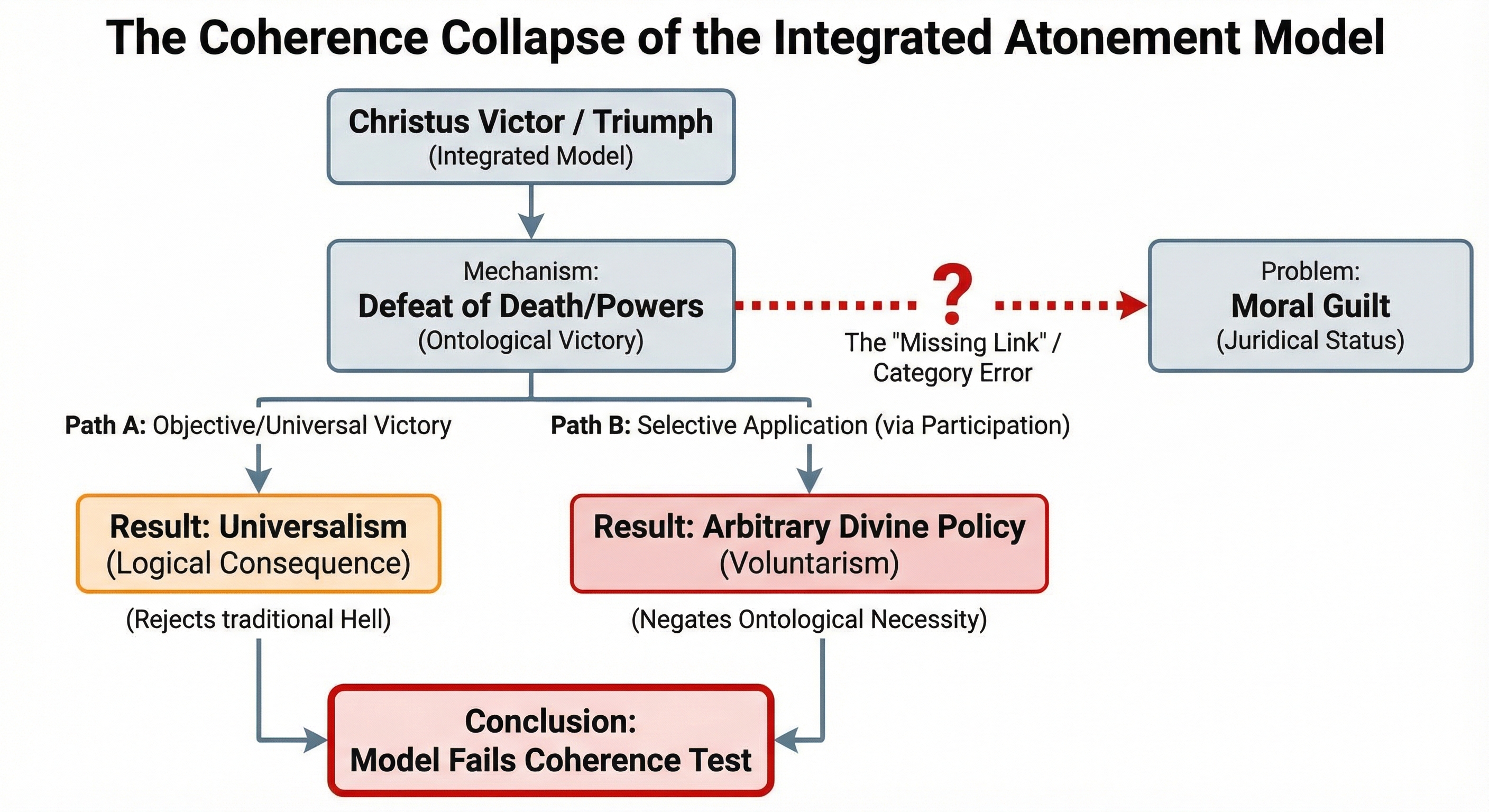
          We need to drill down precisely where your new Integrated Model stalls: the chasm between power and guilt. By redefining the problem of sin from a judicial debt to an ontological bondage (captivity to Death/Sin), you have successfully sidestepped the mathematical contradictions of PSA. But in doing so, you have created a massive category error that you have yet to bridge.

          Consider the analogy of a hostage situation. A tactical team can storm a compound, neutralize the captors, and blow the doors off the hinges. This is a “victory” over the power holding the hostages. But this action does absolutely nothing to determine the moral status of the people inside. Whether a person inside is an innocent victim or a complicit co-conspirator is a question entirely separate from the breaking of the captor’s power. Your Christus Victor model asserts that Christ breaking down the doors of Death somehow automatically results in the “moral cleansing” of the prisoners’ guilt. That is a massive non-sequitur. You have replaced a broken judicial mechanism with a missing ontological one. You must explain how a victory over physics translates into an erasure of crime.

          Central Questions on the Mechanism of Victory

          To help clarify precisely how your new model functions, could you answer the following:

          1. In your view, is humanity’s primary predicament that we are captive victims of an alien power (Sin/Death), or that we are morally culpable perpetrators deserving of judgment? If it is “both,” which aspect does the objective victory of the Cross primarily address?
          2. If Christ’s death and resurrection is fundamentally an ontological victory that breaks the power of Death, by what specific mechanism does that physical/cosmic victory translate into a forensic or moral acquittal of guilt?
          3. Does God require the defeat of the “powers” of Death and the Devil as a necessary prerequisite before He is free to offer forgiveness, or does He defeat them because He has already decided to forgive out of sheer gracious volition?
          4. If the “penalty” is defined as the power of Death holding humanity, and Christ has definitively and objectively broken that power, on what basis does “guilt” remain a relevant, damning category for anyone prior to their subjective participation?
      4. Morne Hurter Avatar
        Morne Hurter

        Your analysis of the Integrated Atonement Model (Triumph/Reconciliation) is devastatingly effective. You have identified the core epistemic pattern—using unseen metaphysics and selective application to absorb tension—and exposed the single, largest flaw in the new system: the Category Error between Power (Victory) and Guilt (Acquittal).

        The model successfully evades the internal contradictions of PSA, but creates a Missing Link in the ontological chain: How does breaking the chains translate into an erasure of the crime?

        I accept the terms of this new challenge. The coherence of the Integrated Model rests on providing a non-circular explanation for the victory-to-acquittal mechanism.

        Bridging the Chasm: Power and Guilt in the Integrated Model

        The Integrated Atonement Model does not simply assert the link between Victory and Acquittal; it attempts to bridge the gap by redefining the nature of guilt itself and the Law’s function.

        1. The Nature of the Predicament: Not Either/Or, but a Unified State

        The Integrated Model (drawing heavily from Irenaeus, Athanasius, and Eastern Orthodoxy) insists that humanity’s predicament is both captivity and culpability, but they are viewed as two sides of the same single ontological coin.

         * Primary Predicament: Captive Perpetrators. We are morally culpable perpetrators because we willfully sold ourselves into the captivity of Sin/Death. Our guilt is defined not by a legal fine, but by our alienation and complicity with the power that rules us.

        The Cross Addresses Both:

           * Power: Objectively shattered by the Resurrection (Triumph).

           * Guilt: Subjectively cleansed by Substitutionary Obedience and the restoration of relationship (Reconciliation).

        2. The Mechanism: The Law, Obedience, and Sin’s Power

        The model answers the question: “How does a physical/cosmic victory translate into forensic/moral acquittal?” by introducing Christ’s perfect obedience as the mechanism that makes the ultimate victory possible and effective.

         * The Link (Theological Answer): The victory over the power of Death (Triumph) is intrinsically linked to Christ’s moral and substitutionary obedience in His death. The two are inseparable.

         * The Process:

           * Guilt as Disobedience: The Law’s ultimate demand is perfect obedience. Failure results in guilt and is enforced by the consequence of Death.

           * Substitutionary Obedience: Christ lives a life of perfect obedience, culminating in His obedient death on the cross (Philippians 2:8). This obedient death is what morally satisfies God’s standard (the moral acquittal). This is a non-penal satisfaction—not paying a fine, but providing the perfect human response God required.

           * The Resulting Power: Because Christ was perfectly obedient, Death had no just claim to hold Him. The Resurrection is the natural, necessary result of His perfect moral status. The moral acquittal (obedience) enables the ontological victory (resurrection/triumph).

        The cosmic victory (breaking Death’s power) becomes the public vindication of the moral acquittal (perfect obedience). The acquittal is not a byproduct of the fight; it is the prerequisite for winning the fight.

        3. The Necessity: Why God Requires the Defeat of Powers

        The question of whether God could just revoke Death’s power by decree hits the core of the debate’s “must.”

         * The Model’s Stance: God could not simply revoke Death’s power by decree because that would violate His justice and truthfulness. The divine decree was: “The wages of sin is death.” To arbitrarily revoke it would make God a liar, undermining the created order.

         * The Necessity of the Mechanism: God required the Incarnation and Crucifixion because the penalty/power had to be defeated within the terms of the created order (i.e., through a human being). The God-Man was required to provide the perfect, obedient human life (guilt-free) that Death could not justly hold.

        This is not simple narrative preference. It is an assertion of divine self-constraint—God must work within the constraints of His own just decrees and created order.

        4. Remaining Relevance of Guilt: The Separation

        Finally, if the powers are defeated, why does guilt remain a relevant category for the non-elect?

         * The Basis of Guilt: Guilt for the non-elect is no longer the threat of an external power holding them captive, but the internal state of unrepentant, alienated disobedience.

         * The Final Penalty: omega-duration separation is redefined as the necessary, eternal consequence of remaining outside the reconciled relationship. The “prison” door is open, but the prisoner refuses to walk through and be reconciled to the Judge. Their eternal state is the result of their own refusal to participate in the moral cleansing and ontological transfer Christ achieved.

        This new model, therefore, places the Obedience of Christ as the missing link that bridges the chasm between Power (Victory) and Guilt (Acquittal).

        1. Phil Stilwell Avatar
          Phil Stilwell

          Morne, you have clarified your position. You are now arguing that the bridge between Power (Christus Victor) and Guilt (Forensic Acquittal) is Vicarious Obedience.

          In your new formulation:

          1. The Mechanism: Christ’s perfect human obedience deprives Death of its rights over Him, leading to Resurrection.
          2. The Connection: This obedience is “substitutionary”—it satisfies the moral demand humanity failed to meet.
          3. The Outcome: The prison door is open, but the damned are those who “refuse to walk through.”

          While this is more historically robust than crude PSA, you have moved the logical gap, not closed it. You are now relying on Vicarious Agency (one person’s obedience counting for another’s) and Libertarian Suicide (people choosing hell).

          To see if this model can actually bear weight, we must drill into how obedience transfers and why anyone remains in the prison.

          Here are the 3 pointed questions you must answer to rescue the coherence of this model:

          1. The Transfer Mechanism (The “How“)

          You claim Christ’s obedience broke Death’s hold on Him because Death had no just claim on a sinless man. That follows logically. But by what specific ontological or legal mechanism does His personal obedience count as my obedience?

          • If it is legally credited (Imputation), we are back to the arbitrary bookkeeping of PSA.
          • If it is not legally credited, then I am still disobedient, and Christ’s victory is His alone.

            Precisely how does the moral status of the Substitute become the moral status of the Sinner without reverting to a “Legal Fiction”?

          2. The “Constraint” Contradiction (The “Must“)

          You argue God cannot simply forgive by decree because He is constrained by His own law: “The wages of sin is death.”

          • However, under your model, the sinner does not pay that wage—Christ pays a “substitutionary obedience” instead.
          • If God is free to accept a substitute payment, He has already waived the literal execution of the original decree (which demanded the sinner’s death).If God is “sovereign enough” to alter the terms of payment to allow a Substitute, why is He “too constrained” to simply forgive without payment?

          3. The Rationality of the “Refusal” (The “Who“)

          You claim the damned remain in omega-duration (Hell) not because of a debt, but because they “refuse to walk through” the open door.

          • Do the people making this refusal possess clear, unclouded knowledge that the alternative is eternal joy and the consequence of staying is eternal misery?
          • If Yes: Then they are acting with a level of irrationality (choosing infinite pain) that qualifies as insanity, which renders them morally incompetent to be punished.
          • If No: Then they are making a decision based on ignorance or deception, in which case their eternal fate is a tragedy of error, not a result of justice.

            Which is it: Are the damned insane, or are they uninformed?

          1. Morne Hurter Avatar
            Morne Hurter

            Phil, the coherence of this model hinges on grounding the legal concepts (imputation, substitution) in an ontological reality (Covenantal Union) that supersedes the strict logic of individual merit and penal equivalence. ​1. The Transfer Mechanism (The “How”)

            ​The question is: How does Christ’s obedience become the sinner’s status without reverting to arbitrary Legal Fiction (pure bookkeeping)?

            ​The answer is Federal Headship and Covenantal Union, which the model posits as an ontological reality established by decree, not just an accounting entry.

            • Federal Headship: This establishes a corporate identity. Just as humanity was ontologically represented by Adam (the “First Man”) in disobedience, resulting in a universal contagion of guilt and death, humanity is now represented by Christ (the “Second Man”) in perfect obedience.
            • The Mechanism (Union with Christ): The transfer is not a simple bookkeeping entry (like PSA’s mathbb{W}_{infty}); it is an organic change of legal identity effected by the Holy Spirit and accessed through faith. The model asserts that being “in Christ” is a real, non-falsifiable, mystical union that transcends purely legal imputation.

            ​The moral status of the Substitute becomes the moral status of the Sinner because the Sinner is declared, by divine decree, to be organically united with the Substitute. The “legal fiction” is dissolved by the reality of the Covenantal Union, making the transfer a matter of existential identification rather than just a credit transfer. ​2. The “Constraint” Contradiction (The “Must”)

            ​The paradox is: If God is sovereign enough to accept a Substitute (modifying the payment terms), why is He not sovereign enough to simply forgive without payment (waiving the decree)?

            ​The answer is that the constraint is not the Law itself, but God’s Immutability and Holiness.

            • The Constraint (Holiness): The statement “The wages of sin is death” is not an arbitrary law God imposed; it is an expression of God’s nature—His Holiness and Justice are immutable. A holy God cannot be in union with sin. The necessary result of sin is the self-inflicted omega-duration of separation.
            • The Substitution: God’s acceptance of Vicarious Obedience is not a waiver of the decree; it is the most profound and costly fulfillment of the decree.
              • The Decree: Demands perfection and requires the separation caused by imperfection.
              • The Fulfillment: Christ provides the perfection (obedience) and personally experiences the separation (death) on behalf of humanity, thereby satisfying both the active demand (perfection) and the passive consequence (death/separation).

            ​God is constrained by His character. To simply forgive by fiat would be to declare that sin is not serious enough to cause separation, thereby denying His own holiness. The substitution is not arbitrary grace; it is grace expressed with ontological and moral necessity. ​3. The Rationality of the “Refusal” (The “Who”)

            ​The question is: Are the damned insane (morally incompetent due to irrationality) or uninformed (tragedy of error)?

            ​The Integrated Model typically asserts that the damned are willfully wicked, making the refusal a final, rational moral act.

            • The Model’s Stance: The refusal is seen as neither simple ignorance nor clinical insanity. It is ultimate, moral wickedness—a decisive and informed act of hostility to God’s love and sovereignty.
            • The Context of the Refusal (Knowledge): The model assumes sufficient knowledge. God’s revelation (through conscience, creation, and Gospel proclamation) is deemed adequate to render all people culpable for their choices (Romans 1-2).
            • The Nature of the Refusal (Insanity vs. Rebellion): The refusal is not irrational in the sense of a broken logical faculty; it is the ultimate manifestation of sin—a definitive choice to reject the source of life and choose autonomy over reconciliation. The damned prioritize their rebellion over the infinite pain, making the refusal a final, self-imposed separation based on moral will, not cognitive failure.

            ​The final state of omega-duration is thus not a tragedy of error, but the necessary, eternal outworking of the sinner’s finalized, conscious moral choice to stand outside the covenant of life and union with God.

            1. Phil Stilwell Avatar
              Phil Stilwell

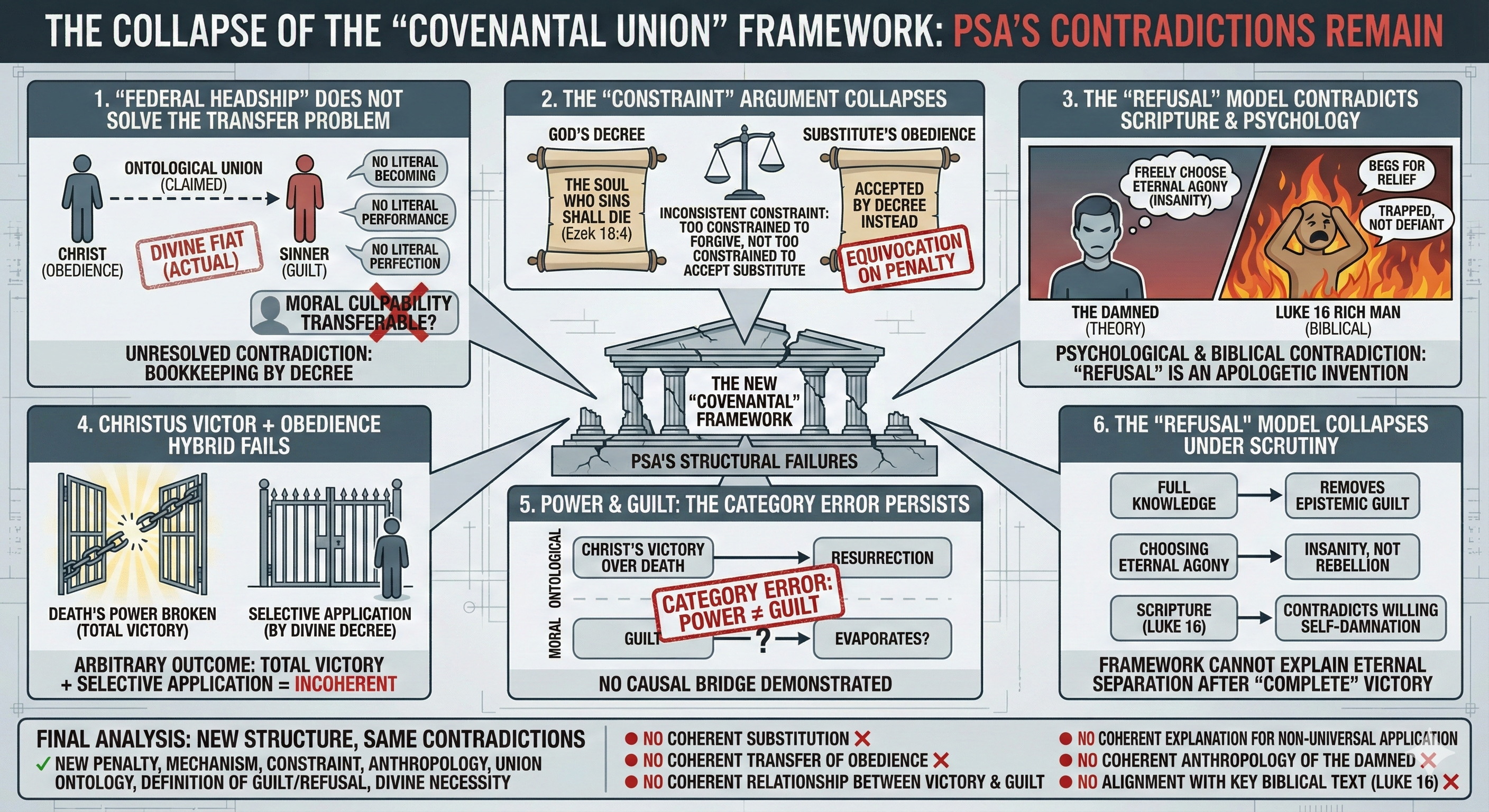
              Morne, your latest formulation tries to resolve the contradictions of PSA by pulling everything into “Covenantal Union,” “Federal Headship,” and “Holiness-as-constraint,” but the problems you’re trying to escape follow you into this new structure unchanged. The same structural failures identified in the diagrams above still apply:

              Substitution without substitution (Jesus never undergoes the actual penalty humans face)
              Category Error: Power ≠ Guilt
              Arbitrary non-application after alleged total victory
              Equivalence declared, never demonstrated

              Your newest version—“Christ’s perfect obedience + union = transfer of identity”—still cannot make the model coherent. Let me take each of your claims exactly as stated and show where the framework collapses. ◉ 1. “Federal Headship” does not solve the transfer problem

              You argue:

              “The transfer is not bookkeeping; it is ontological union.”

              But your union is bookkeeping, because:

              1. You do not claim the sinner literally becomes Christ.
              2. You do not claim the sinner literally performs Christ’s obedience.
              3. You do not claim the sinner literally becomes morally perfect.

              You only claim:

              “God declares the sinner united with Christ by decree.”

              That is precisely PSA’s move with different vocabulary: identity change by divine fiat.
              This is the same problem highlighted in the image: “Decreed, not demonstrated.”

              Federal headship works for inherited conditions (mortality), but you are using it to erase moral culpability, which is not transmissible across persons without becoming a legal fiction.

              Unless you want to say guilt and innocence are not personal but transferable entities—which violates your own earlier insistence that guilt is “a conscious moral choice”—you are back to a contradiction. ◉ 2. Your “constraint” argument collapses into contradiction

              You write:

              “God cannot forgive by decree because His holiness demands death…
              Christ’s obedience fulfills the decree.”

              But notice the internal contradiction:

              If God can accept a substitute’s obedience, then God is already overriding the decree.

              Because the decree was:

              “The soul who sins shall die” (Ezek 18:4)

              Not:

              “The soul who sins may be represented by a different person, whose obedience will be accepted instead.”

              Your God is “too constrained” to forgive by decree,
              but “not too constrained” to accept a substitute by decree.

              That’s inconsistent.

              This is exactly the problem shown in the first image panel: Equivocation on the penalty.
              You change what “death” means mid-argument to salvage the theory. ◉ 3. Your model requires the damned to make a perfect, informed, rational choice—and that contradicts both psychology and your holy book

              You assert:

              “The damned knowingly and willfully reject God. It is an informed, moral refusal.”

              But scripture contradicts you directly.

              Here is the bracketed verse you must now account for:

              Luke 16:19–31
              https://www.biblegateway.com/passage/?search=Luke%2016%3A19-31&version=NIV

              In Jesus’ own parable:

              ● The rich man is not morally insane.
              ● He is not ignorant.
              ● He does not prefer autonomy to agony.
              ● He begs for relief.
              ● He begs for warnings to his family.
              ● He does not want separation.

              His “refusal” is not refusal at all.
              He is trapped, not defiant.

              This destroys your claim that damnation results from a “conscious moral choice to remain outside union with God.”

              Your position is simply not scriptural.

              It is an apologetic invention designed to preserve psychological plausibility where the text does not.

              This aligns with the right-hand panel of the image:
              “The Arbitrariness of Hell”—your system requires Hell to be a selective policy choice, not an ontological necessity. ◉ 4. The Christus Victor + Obedience hybrid still cannot explain why anyone remains enslaved after Death’s defeat

              Your model asserts:

              ● Death’s power is broken.
              ● The prison is open.
              ● Christ’s obedience is complete.
              ● Victory is total and objective.

              Then:

              ● God chooses not to apply this victory to everyone.

              You call this “union by faith,” but that is simply selective application by divine decree.

              This is exactly the problem highlighted in the diagrams:

              Total victory + selective application = arbitrary distribution of outcomes.

              If the powers are defeated, non-universal liberation is incoherent.
              If the powers are not defeated for some, the victory was not total.
              Your system cannot hold both. ◉ 5. The obedience mechanism does not bridge power and guilt—it shifts the contradiction sideways

              You say:

              “Obedience breaks Death’s power and also satisfies the moral demand.”

              This tries to collapse two different categories—ontological and moral—into one act.
              But:

              ● Breaking the power of Death is a cosmic/mortal condition problem.
              ● Guilt is a moral responsibility problem.

              Your model fuses these categories with no causal bridge.

              This is exactly what the image calls a Category Error: Power vs. Guilt.

              Christ’s victory over Death explains why He rises.
              It does not explain why my guilt evaporates.

              You have only asserted a connection, not demonstrated one. ◉ 6. The “refusal” model collapses under minimal scrutiny

              To defend Hell, you must hold:

              1. The damned have full knowledge.
              2. The damned freely choose eternal agony.
              3. This choice is morally culpable.

              But:

              ● Full knowledge removes the epistemic conditions of guilt.
              ● Choosing eternal agony is definitionally insanity, not rebellion.
              ● Scripture contradicts the image of willing self-damnation (again, Luke 16).

              Your claim that “the damned prefer autonomy to bliss” is not psychologically coherent, not biblically supported, and not compatible with any known model of human behavior.

              This is precisely why in the image we see:

              “The Arbitrariness of Hell”
              and
              “The Transfer Problem.”

              Your framework cannot explain why people end in eternal separation after the victory you insist is complete. ◉ Final Analysis

              You have now built:

              ✓ A new penalty
              ✓ A new mechanism
              ✓ A new constraint
              ✓ A new anthropology
              ✓ A new union ontology
              ✓ A new definition of guilt
              ✓ A new definition of refusal
              ✓ A new concept of divine necessity

              All to avoid the failure of PSA.

              But the structure that emerges is still contradictory:

              No coherent substitution
              No coherent transfer of obedience
              No coherent relationship between victory and guilt
              No coherent explanation for non-universal application
              No coherent anthropology of the damned
              No alignment with the key biblical text (Luke 16)

              And the images provided earlier diagnose the same:

              Substitution does not occur.
              Justice is inconsistent.
              Hell becomes arbitrary.
              Equivalence is decreed, not demonstrated.

              Your newer model is more sophisticated, but it falls for the same reasons:

              The mechanics never match the claims.

              If you want, we can now press deeper into any one of these six contradictions.

              1. Morne Hurter Avatar
                Morne Hurter

                Phil,

                That is a comprehensive and relentless audit of the proposed theological structure. Your critique correctly isolates the three main points of internal tension: the coherence of the substitution mechanism, the inconsistency of the divine constraint, and the anthropological and scriptural coherence of damnation (specifically Luke 16).

                ​Before addressing those six points directly, I will perform the requested audit regarding the nature of guilt and transmissibility, as it underpins the entire substitutionary argument.

                Audit of Transmissible Guilt and Federal Headship

                ​You are making a valid point regarding the philosophical starting position on guilt.

                The Nature of Guilt: Individual vs. Corporate

                ​Your critique assumes that guilt and innocence are intrinsically non-transmissible, personal entities, requiring a radically individualized view of moral culpability. This philosophical assertion is often termed moral individualism.

                • The Big Picture Counter-Assertion: The theological system, particularly the structure of the Old Testament, fundamentally rejects radical individualism in favor of corporate personality (often called Federalism or Covenantal Headship). The transfer of moral standing is a necessary feature of this system.

                ​Your critique of the transfer is therefore not a straw man, but an external philosophical demand placed upon an internally coherent theological model that operates under different initial assumptions about moral identity. ​

                Argument Analysis:

                Coherence of the Atonement Model

                ​Let us now address your six points of contradiction using the principles of coherence and evidence from the total Scriptural picture. ​

                1. Federal Headship and the Transfer Problem

                ​You state that the transfer is simply “bookkeeping” because the sinner is not literally Christ, and the change is merely declared by decree.

                • Re-focusing the Claim: The difference is that the original bookkeeping model (PSA) argued that Christ satisfied a penalty externally, while the Union model asserts that the substitutionary satisfaction is made real by the ontological fusion of identity decreed by the Creator. The decree is not the transfer itself; the decree is the mechanism for the union which then makes the standing transferable.
                • The Evidence: The transfer works because the texts present Christ not merely as a substitute but as the New Head of the Human Race. The imago Dei status is preserved through Him, and the corporate identity of the believer is re-defined in Him. Since the texts establish corporate identity as the initial source of the problem (Adam’s inherited failure), it must also be the source of the solution.

                2. The Constraint Argument and Substitution Inconsistency

                ​You highlight the contradiction: God is too constrained to forgive by decree, but not too constrained to accept a substitute by decree.

                • Resolving the Constraint: The constraint is not an arbitrary limitation imposed by God externally; the constraint is God’s own invariant nature (Holiness and Justice).
                  • Holiness Demands Death: Forgiveness by simple decree would violate the coherence of the divine moral order, which established an unbreakable link between sin and death.
                  • Substitution Upholds Justice: Accepting a substitute is not overriding the decree; it is upholding the decree while satisfying the constraint. The decree (“The soul who sins shall die”) is satisfied because the Head of the corporate entity (Christ, who takes the entity’s sin) does die. The substitution is accepted because the value of the substitute’s obedience is commensurate with the standard of holiness, which is exactly what a perfect, non-sinning representative achieves. The model argues that only this unique solution upholds both the necessity of the penalty and the desire for mercy.

                3. Damnation and the Luke 16 Parable

                ​You argue that Luke 16 contradicts the claim that damnation is a “conscious moral choice” because the rich man begs for relief, showing he does not prefer autonomy to agony.

                • Analyzing the Text’s Intent: Scriptural parables are not presented as psychological case studies of the damned; they are pedagogical tools used to illustrate a specific point. The point of Luke 16 is to show the finality of the separation and the unbridgeable chasm that exists after death, not to give a full theological account of free will in hell.
                • The Refusal in Context: The “conscious moral choice” is not the choice of agony over relief, but the choice of a life defined by autonomy over a life defined by relationship with the Creator. The rich man’s life, as narrated, was characterized by the effective rejection of the Creator’s claims upon his wealth and attention while alive. The final agony is the consequence of that ultimate, life-defining moral choice, which is maintained until death.

                4. Christus Victor, Obedience, and Non-Universal Application

                ​You argue that total victory necessitates universal liberation, and selective application makes the victory arbitrary.

                • Redefining Victory: The victory is presented as objective in its power (Death and the powers are defeated), but subjective in its application (it must be appropriated by the new corporate union).
                  • ​The prison is open (objective victory), but the door must be walked through by the prisoners who consent to the new Head (subjective application).
                  • ​The condition for being part of the new Head’s body is presented as faith—an act of willful relational consent. This consent is the necessary link between the historical-cosmic event (the cross/resurrection) and the individual’s new moral standing. The non-universal application is therefore a function of the covenant’s relational nature, not a flaw in the victory’s power.

                5. The Category Error: Power vs. Guilt

                ​You claim the model fails to bridge the cosmic problem (Death’s power) and the moral problem (Guilt).

                • The Causal Bridge: The coherence of the system lies in the fact that Death’s power is the direct consequence of Guilt.
                  • ​The original narrative states that sin (guilt) brought death (power) into the world. The two are causally linked.
                  • ​Therefore, Christ’s perfect obedience (satisfying the moral demand of guilt) necessitates His triumph over Death (breaking the causal power). The obedience satisfies the law, and the resurrection demonstrates the legal consequence: the penalty is fully paid, and the debtor must be released. The link is not asserted; it is defined by the foundational legal structure of the covenant.

                6. The Refusal Model and Psychological Coherence

                ​Your final point correctly notes that choosing eternal agony is not psychologically coherent.

                • The Theological Claim: The model does not claim the damned choose agony; it claims they choose autonomy (self-rule) over relationship with the Creator. The agony is the unwanted but inevitable consequence of choosing final, absolute separation from the source of all life, goodness, and reality.
                • The Inevitable Outcome: If the Creator is the source of all sustaining moral and ontological reality, then final separation must result in a state of absolute, self-inflicted spiritual destitution—which is the theological definition of Hell. The choice is the relationship, the penalty is the consequence of that choice. The model thus maintains that the individual is culpable for the choice while acknowledging that the outcome is abhorrent.
      5. J Avatar
        J

         I wanted to respectfully offer some further questions from the “outside” on some of Morne’s proposed new models for the atonement along with adding some “informal” arguments to what I think are Phil’s strong more formal critiques:

          (I don’t mean to be intruding on the discussions above, and apologize if I am.)

           Before going on, I have heard claims that the Christus Victor model of reconciliation was more prevalent in the early church than it is today. While there are still flaws with this understanding, there have been Christians (such as Greg Boyd and John Anderson) who think that this type of soteriology is better than the penal substitution model. Some even see the idea that a sacrificed had to be made to satisfy God’s justice or wrath as “pagan” or “unchristian.” So, at least to me, this is a commendable rejection of an idea that portrays a loving deity in a rather sanguinary way.

        But the following were my responses to the New Combined Model posited above:

        1. When you wrote that it “insists that humanity’s predicament is both captivity and culpability, but they are viewed as two sides of the same single ontological coin” this would appear to me as synonymous with saying that being a captive and being culpable are inseparable.
          • Is there any logical reason to think that the category of guilt and being hostage are necessarily linked? If in the world around us, there isn’t any link being confined or in bondage and responsibility for that state, (e.g. wrongful conviction for a crime), why is it obvious that suffering goes hand-in-hand with moral culpability? The model requires that there is a logically entailed connection to prevent its being arbitrary on God’s part.
          • Animals (who are incapable of sin in Christian understanding) still suffer from the same forces of death and medical afflictions that are supposed to be concomitant with “disobedience” in a fallen sense. Why didn’t Christ’s death release them since it can’t be the case that some voluntarily choose to reject their Creator?
          • How do human infants without meaningful discernment fit in to the plan? (God didn’t even have to create humans who lack moral judgement from birth. He could have created beings with fully-developed consciousnesses upon emergence from the womb.)
        2. You used the phrase “accounts for the Resurrection” earlier post from above also seemed to already imply that the “Resurrection” is a fact to be taken for granted since we must explain it. What were your thoughts on my first post above with the objections to the biblical accounts and the two links by the classicist/historian that compared the Gospels with the works of classical authors such as Tacitus?
        3. Responding to “This is not simple narrative preference. It is an assertion of divine self-constraint—God must work within the constraints of His own just decrees and created order.”:
          • Why did God have the decree a natural law of “sin results in death” in the first place if he was supposed to have complete control over the constraints of the natural world and knows the future?
        4. One major objection to the Christus Victor theory I have heard from theologians is, in one sense, Christ’s death didn’t actually accomplish anything: we are still all subject to the powers of death whether we are believers or not. According to traditional Christian doctrine, it is the second coming/parousia that will actually ensure the evil powers are defeated resulting in final judgement. But why are believers still subject to a power whose hold has been broken and why did Jesus delay his return, ensuring the birth of more hell-bound sinners?
        5. If it is Christ’s triumph over death that unlocks heaven to those who choose to believe, than what became of people who lived before around 33 A.D.? Did Jesus have to release them from captivity upon his resurrection or did he overlook this “temporal” issue? If God could allow an atoning sacrifice to retroactively apply when “natural” laws would dictate that you can only use an existing cure for a disease, isn’t he already “bending the rules”?
      6. J Avatar
        J

        (Continued from above)

        1. You wrote at the end of the last post that “Guilt for the non-elect is no longer the threat of an external power holding them captive, but the internal state of unrepentant, alienated disobedience” and that the fate of the non-elect “is the result of their own refusal to participate in the moral cleansing and ontological transfer Christ achieved.
          • When you use the term “non-elect,” do you understand this in a sort of Calvinistic sense as people that God chose “from before creation” to receive salvation? If they were “chosen” (and the Bible says that no one can resist the decrees of God), then how can their eternal condemnation ultimately be due to “their own refusal” as opposed to an arbitrary divine act? If this just metaphorical language for “whoever chooses God is clearly chosen by him,” this becomes tautological and uses phrases that signal divine choice become meaningless. (i.e. That statement would then break down to “the proof that God chose who will be saved is that they were in fact saved.”) The other option for using language of election seems to be the Arminian view of “corporate election” which would claim that the “church body” is chosen while its individual members are fully free without being pre-destined. But since an organization is nothing without membership, this is basically a denial that God “chose” persons to be saved while keeping biblical vocabulary. (If I recall correctly, theologian Greg Boyd has articulated the last type of position on election.)
          • (If you aren’t a strict Calvinist and believe that God prioritizes choice in salvation, then please feel free to disregard the next two paragraphs below. I wasn’t sure in what sense you might be using the word “elect.”) Back when I was a believer, I never could accept predestination of any kind but think that certain passages in books like the Pauline epistles seem to imply that humans are simply “clay” shaped by a divine “potter” for his glory (or “puppets” with strings pulled by a “puppetmaster” if you will.) To characterize God in this way is to suggest that no only does his exhibit an equivalent of “vanity,” but that he is lacking in a certain attribute “glory.” Why isn’t behaving in a way that we would consider sadistic for a human (e.g. causing or allowing suffering so that you can do something to earn fame or glory) permissible for God? How can we distinguish such a deity from an all-powerful devil?
        2. One general issue with any soteriology involving freely-chosen restoration and persistence in guilt is that in some ways choices are time-dependent. The following thought experiment might be the best illustration:
          • Take two people. The first accepted Christ when she was fifty-years old after repeated dismissals of the Christian message and the other passed away in his forties because he inherited the genes for a disease while rejecting the faith.
          • No person has complete control over their lifespan. We aren’t responsible for inheriting genes that predispose us to genetic illness, the occurrence of natural disasters, or even coming into existence in the first place.
          • Returning to the above scenario, what if the first person had inherited the illness that resulted in her dying at an earlier age and the second person eventually accepted Jesus after living longer?
          • If one were to answer that God knows who will be saved and who won’t be saved under any scenario, this could be countered with the following objections:
            • If He knows our fates in advance, then why must everyone live out their lives before entering heaven or hell, as if they had a meaningful choice>
            • What becomes of infants who died before reaching moral maturity? If God is content with letting people who have known eternal destinies live out their lives, why not create the human species so that no member would have to pass through a life stage involving potential early death without the opportunity for choice? (For what it’s worth, it was common among the early church fathers to maintain that unbaptized infants went to hell. This was so morally problematic that the doctrine of purgatory ultimately resulted.)
            • Consider also the principle that given sufficient time, “anything that can happen, will happen.” In a timeless world, it can be argued that everyone would convert to Christianity at some point.

        Thanks,

        Jeffrey

        1. Morne Hurter Avatar
          Morne Hurter

          That’s a powerful set of questions, Jeffrey. This kind of thoughtful, focused critique is exactly what helps refine our understanding of something as vast as the Atonement. Thank you for offering a respectful challenge to the proposed model.

          ​Let’s dive into the tensions you’ve highlighted, especially concerning the necessity of the guilt/captivity link and the sticky issue of divine choice versus human responsibility. ​Hypothesis Evaluation (Atonement Model and Its Constraints) ​Primary Interpretation: The Foundation of Evidence

          ​Before we can explain how the model works, we have to touch on the point you raised about its very foundation: assuming the Resurrection is a fact.

          ​You correctly pointed out that the model says it “accounts for the Resurrection” and then you cited your earlier objections based on historical comparison.

          ​Here’s the thing: The combined model isn’t built on a purely presuppositional foundation that simply asserts the Resurrection’s truth. Instead, it is built on the conclusion of an Argument to the Best Explanation.

          • ​When a historian examines the available material—including the early traditions cited in Paul’s letters, the empty tomb narrative, and the sudden, sincere conviction of the disciples—the claim is that the Resurrection provides the most comprehensive, yet also most challenging, explanation for these historical data points.
          • ​Your comparison of the Gospels to classical works like Tacitus is fair, but the genre and purpose are different. The evaluation of the Gospel accounts is not simply about dating or literary style, but about the minimal historical facts that require an explanation: the sudden belief in a crucified Messiah, the willingness of adherents to die for that belief, and the non-existence of Christ’s body.
          • ​The model starts with the evidence for the resurrection as the central point of Christ’s definitive victory. The fact of that historical event (the victory) then forces the theological question: What did the death accomplish to make this victory possible?

          ​Connecting to the Bigger Picture: Necessity, Captivity, and Covenant

          ​Let’s tackle the central problem of the Ontological Coin—the idea that captivity (suffering/death) and culpability (guilt) are inseparable. You ask why suffering must go hand-in-hand with moral culpability, citing cases of innocent suffering.

          ​The model is not saying that all suffering is a direct result of individual sin. It is grounded in the covenantal law of creation: Life is defined as existence in perfect union with God; separation from the Source of Life is Death.

          • P1 (The Moral Law): God established an order where moral life (obedience, union) entails ontological flourishing (life, immortality).
          • P2 (The Fall): The foundational act of disobedience was a willful, moral separation from the Source of Life.
          • Conclusion: Death (the final state of captivity/decay) is the logical, inherent consequence of a moral choice to sever that connection.

          ​God did not arbitrarily decree a natural law of “sin results in death.” He decreed that His Nature is Life. The law is simply a description of what happens when a created being steps outside of that life-giving framework. If He had allowed disobedience without consequence, moral freedom would have been a lie, and His own character (Justice as self-consistency) would have been violated.

          ​This distinction explains:

          1. Animal Suffering: As the appointed head of the created order, when humanity’s relationship with God broke, the entire environment (the cosmos) was put under a kind of decay and futility. Animals suffer not for their own guilt, but because they exist within a broken system now subject to death.
          2. Infants and Wrongful Conviction: This highlights human injustice, not God’s. The concept of “Original Sin” views humanity as a single, representative unit, not just a collection of individuals. All born into this broken covenant inherit the ontological condition of separation (captivity), which is a reflection of the initial culpability of the first representative. Their individual fate is addressed below, under God’s unrevealed, gracious judgment.

          ​The Problem of Continuing Death and Delay (Christus Victor)

          ​This is a profound logical tension: If the power of death is broken, why do believers still die?

          ​The model addresses this using the “already-but-not-yet” principle found in the ancient texts:

          • What was accomplished Already (Ontological Victory): Christ’s death and resurrection achieved the definitive, legal, and ontological destruction of the dominion of sin and death. Death’s sting (its final, separating power) is neutralized. For the believer, death is now merely a transitional event, not a terminal sentence.
          • What is Not Yet (Cosmic Restoration): The entire physical universe has not yet been physically renewed. This full-scale cosmic cleansing is reserved for the Second Coming. Believers still inhabit a body and a world subject to the general decree of decay (the results of the Fall). The “delay” ensures that the moral and historical drama of God’s redemptive plan is fully played out, giving maximum opportunity for all nations to hear and respond.

          ​Retroactivity and Bending the Rules

          ​Your observation about the retroactive application of the sacrifice is excellent.

          ​If we view God as being bound by linear, human time, the retroactive application seems like “bending the rules.” But this commits the error of imposing a human constraint on a timeless being.

          • ​The total scriptural evidence suggests that the Covenant of Grace, fulfilled by Christ, is an eternal decree that was manifested at a specific historical point (33 A.D.).
          • ​The sacrifices before Christ were not the cure itself, but the sign or promise of the coming cure. God’s justice required a payment, and He honored the faith of people living before Christ by applying the future-historical sacrifice to their present need.
          • ​Since God is the author of time, and operates outside of it, He is not bound by the logical rule that an effect must follow its cause linearly. The work of Christ is a single, eternal reality that God applies wherever faith is found, regardless of the calendar date. He is not “bending the rules;” He is merely defining them from a non-temporal perspective.

          ​Practical Application: Sovereignty, Choice, and the “Non-Elect”

          ​You are absolutely right to demand clarity on the term “non-elect” and to point out the logical flaw in saying God chooses salvation but then blames the condemned for their refusal—this sounds like a cruel game of ‘puppet master.’

          ​To escape the problem of the “sadistic potter” without resorting to a tautology, the model uses a view of God’s choice that incorporates genuine human free will, often called Middle Knowledge (or Molinism).

          Definition of Election Used in the Model: Election is God’s eternal choice of which world to create, based on His perfect knowledge of what every person would freely choose in every possible circumstance.

          ​This allows us to construct the argument without making God arbitrary:

          • P1 (God’s Omniscience): God knows, before creation, who would freely choose to accept His grace, and who would freely reject it in the real world (this is His Foreknowledge).
          • P2 (God’s Sovereignty): God sovereignly chooses to actualize the world where these specific, free choices are made (this is His Election).
          • P3 (Human Responsibility): The individual, unrepentant person exercises their actual, free will to refuse the grace offered in the gospel.
          • Conclusion: The condemnation of the “non-elect” is not a cause of God’s arbitrary decision, but the result of their own demonstrable, free choice to persist in alienated disobedience. God’s choice determines who is saved, but the individual’s choice determines who is lost.

          ​This framework successfully avoids the “puppet master” critique by grounding God’s choice in the foreseen free choices of His creatures.

          ​On Time-Dependent Choices and Infants

          ​Your thought experiment about the two people with different lifespans is a perfect way to highlight the mystery of providence.

          • ​If God knows who would have accepted Him if they had lived longer, why does He allow them to die earlier? The logical answer is rooted in Justice:
            • ​God requires a real, historical record of a person’s moral choices to issue a just verdict.
            • ​God’s knowledge of what would have happened is a truth for Him, but the just basis for a public judgment must be the person’s actual life as it was freely lived.
          • ​Regarding infants, the tradition that they went to hell is a human doctrine not fully supported by the total scriptural evidence. Since they died before achieving moral discernment, they have no personal, actual history of free rejection to be judged on. We admit epistemic precision here: the text does not give an explicit, definitive answer, but the logical framework suggests they fall under God’s sovereign grace-judgment, which is separate from a judgment based on individual rejection. The demand that God should have created a species with full moral awareness from birth is essentially a challenge to the way God chose to structure a world that allows for growth, maturity, and a genuine history of choice—a boundary we cannot cross.
          1. Phil Stilwell Avatar
            Phil Stilwell

            We have now reached the terminal phase of this debate.

            You began by defending Penal Substitutionary Atonement (PSA). When the math of PSA failed, you retreated to Christus Victor. When the logic of victory failed to explain the persistence of Hell, you retreated to Federal Headship. And now, to rescue God’s character from the implications of that Headship, you have retreated into Molinism (Middle Knowledge).

            What you are calling an “Integrated Model” is, in functional terms, a Frankenstein Theology. It stitches together incompatible metaphysical parts—a Calvinist view of Union, an Arminian view of free will, and a Jesuit (Molinist) view of sovereignty—simply to keep the machine moving.

            But even this complex machine does not work. Let us dismantle the three specific mechanisms you just proposed.

            1. The “Ontological Union” is still a Legal Fiction

            You argue that “Union with Christ” is not bookkeeping because it is an “ontological fusion decreed by God.”

            The Rebuttal: “Ontological” refers to being. “Decree” refers to legal standing. You cannot simply smash them together to solve the problem.

            • If I am literally Christ (ontological fusion), then I am God, and I died on the cross. That is heresy.
            • If I am distinct from Christ, but God treats me as if I were Him because of a “decree,” that is the dictionary definition of a Legal Fiction.

            Adding the word “Covenantal” does not change the mechanics. It just adds a layer of solemnity to the fiction. You are still asserting that Guilt A (mine) is treated as Obedience B (Christ’s) because of Decree C. The mechanism of transfer remains entirely verbal.

            2. The Molinist Trap (Middle Knowledge fails to rescue God)

            To explain why God is not a “sadistic potter” for creating people He knows will go to Hell, you invoke Middle Knowledge: God surveys all possible worlds, sees who would freely reject Him, and then actualizes a world containing those choices.

            Why this fails: Molinism does not absolve God of the “Puppet Master” charge; it actually cements it.

            Syllogism of the Molinist God:

            1. God knows exactly which circumstances will cause Person X to “freely” reject Him (World A) and which circumstances (if any) would cause Person X to accept Him (World B).
            2. God chooses to actualize World A, not World B.
            3. Therefore, God’s choice of environment determines the eternal fate of Person X.

            If you say, “But Person X freely chose!”, you are ignoring that God selected the specific timeline where that choice was inevitable. If you say, “Maybe there was no feasible world where Person X accepts Him” (Transworld Depravity), then God created a being He knew was doom-dominant in every possible configuration. Creating a being that is effectively un-savable is the act of a sadist.

            Conclusion: Molinism pushes the problem back one step (to the “selection of worlds”), but God remains the architect of the slaughter.

            3. The “Historical Record” Contradiction

            This is where your system explicitly contradicts itself.

            • Claim A (Regarding Infants): God cannot judge them yet because He requires a “real, historical record of a person’s moral choices to issue a just verdict.”
            • Claim B (Regarding Election): God chooses the Elect based on “what they would freely choose” (Middle Knowledge).

            The Contradiction:

            • If God judges based on actual history (Claim A), then Middle Knowledge (what would happen) is irrelevant to judgment.
            • If God elects based on counterfactuals (Claim B), then He does not need a historical record to know the truth of a person’s heart.

            You cannot have it both ways.

            • If God needs a history, He cannot use Middle Knowledge to elect before creation.
            • If God uses Middle Knowledge, He doesn’t need infants to grow up to know they would reject Him.

            Your attempt to answer the infant question (Claim A) destroys your answer to the predestination question (Claim B).

            4. Luke 16 and the “Fantasy of Autonomy”

            You argue the rich man in Hell chooses “autonomy,” and his agony is just a side effect.

            The Textual Rebuttal:

            • He cries for water. (Physical relief, not autonomy).
            • He begs Abraham. (Subservience, not autonomy).
            • He asks to warn his brothers. (Concern for others, not solipsism).

            The text depicts a man who wants out. Your theory requires a man who insists on staying in.

            You are rewriting the Bible to save your theology. If the damned want relief, and God refuses it because “the chasm is fixed,” then the separation is enforced by God, not chosen by the sinner.

            Final Assessment: The “Shift” is Complete

            Morne, look at how far you have traveled to avoid saying “I was wrong.”

            1. PSA Failed — You moved to Christus Victor.
            2. Universalism Threatened — You moved to Restricted Application.
            3. Arbitrariness Threatened — You moved to Molinism.
            4. Injustice Threatened — You moved to “Mystery” regarding infants.

            This is not a cohesive doctrine. This is Ad-Hoc Apologetics. Every time reality pokes a hole in the boat, you nail a new metaphysical plank over it.

            • You redefined Personhood (Corporate Headship).
            • You redefined Time (Retroactive Atonement).
            • You redefined Logic (Middle Knowledge).
            • You redefined History (The Luke 16 narrative).

            The Result: You have a system that is logically “valid” only because you have redefined every variable to equal whatever you need it to equal in that moment.

            But notice what is missing: Simplicity. Justice. Reality.

            A God who sets up a “Covenantal Headship” structure that dooms billions based on one man (Adam), fixes it by killing another man (Jesus), applies the fix based on a “Middle Knowledge” simulation of choices that haven’t happened, and then claims He is “constrained by Holiness” to keep the system running this way…

            That is not the God of the Bible. That is a Rube Goldberg machine constructed by theologians to explain why their system doesn’t match the world we see.

            The Critique Stands: Jesus did not substitute for the penalty. The mechanism of transfer is fictional. The explanation for Hell is contradictory. And the defense has become a retreat into metaphysics.

            I’m declaring this discussion closed.

      Leave a reply to J Cancel reply

      Recent posts

      • Hebrews 11:1 is often misquoted as a clear definition of faith, but its Greek origins reveal ambiguity. Different interpretations exist, leading to confusion in Christian discourse. Faith is described both as assurance and as evidence, contributing to semantic sloppiness. Consequently, discussions about faith lack clarity and rigor, oscillating between certitude…

      • This post emphasizes the importance of using AI as a tool for Christian apologetics rather than a replacement for personal discernment. It addresses common concerns among Christians about AI, advocating for its responsible application in improving reasoning, clarity, and theological accuracy. The article outlines various use cases for AI, such…

      • This post argues that if deductive proofs demonstrate the logical incoherence of Christianity’s core teachings, then inductive arguments supporting it lose their evidential strength. Inductive reasoning relies on hypotheses that are logically possible; if a claim-set collapses into contradiction, evidence cannot confirm it. Instead, it may prompt revisions to attain…

      • This post addresses common excuses for rejecting Christianity, arguing that they stem from the human heart’s resistance to surrendering pride and sin. The piece critiques various objections, such as the existence of multiple religions and perceived hypocrisy within Christianity. It emphasizes the uniqueness of Christianity, the importance of faith in…

      • The Outrage Trap discusses the frequent confusion between justice and morality in ethical discourse. It argues that feelings of moral outrage at injustice stem not from belief in objective moral facts but from a violation of social contracts that ensure safety and cooperation. The distinction between justice as a human…

      • Isn’t the killing of infants always best under Christian theology? This post demonstrates that the theological premises used to defend biblical violence collapse into absurdity when applied consistently. If your theology implies that a school shooter is a more effective savior than a missionary, the error lies in the theology.

      • This article discusses the counterproductive nature of hostile Christian apologetics, which can inadvertently serve the skepticism community. When apologists exhibit traits like hostility and arrogance, they undermine their persuasive efforts and authenticity. This phenomenon, termed the Repellent Effect, suggests that such behavior diminishes the credibility of their arguments. As a…

      • The post argues against the irreducibility of conscious experiences to neural realizations by clarifying distinctions between experiences, their neural correlates, and descriptions of these relationships. It critiques the regression argument that infers E cannot equal N by demonstrating that distinguishing between representations and their references is trivial. The author emphasizes…

      • The article highlights the value of AI tools, like Large Language Models, to “Red Team” apologetic arguments, ensuring intellectual integrity. It explains how AI can identify logical fallacies such as circular reasoning, strawman arguments, and tone issues, urging apologists to embrace critique for improved discourse. The author advocates for rigorous…

      • The concept of the Holy Spirit’s indwelling is central to Christian belief, promising transformative experiences and divine insights. However, this article highlights that the claimed supernatural benefits, such as unique knowledge, innovation, accurate disaster predictions, and improved health outcomes, do not manifest in believers. Instead, evidence shows that Christians demonstrate…

      • This post examines the widespread claim that human rights come from the God of the Bible. By comparing what universal rights would require with what biblical narratives actually depict, it shows that Scripture offers conditional privileges, not enduring rights. The article explains how universal rights emerged from human reason, shared…

      • This post exposes how Christian apologists attempt to escape the moral weight of 1 Samuel 15:3, where God commands Saul to kill infants among the Amalekites. It argues that the “hyperbole defense” is self-refuting because softening the command proves its literal reading is indefensible and implies divine deception if exaggerated.…

      • This post challenges both skeptics and Christians for abusing biblical atrocity texts by failing to distinguish between descriptive and prescriptive passages. Skeptics often cite descriptive narratives like Nahum 3:10 or Psalm 137:9 as if they were divine commands, committing a genre error that weakens their critique. Christians, on the other…

      • In rational inquiry, the source of a message does not influence its validity; truth depends on logical structure and evidence. Human bias towards accepting or rejecting ideas based on origin—known as the genetic fallacy—hinders clear thinking. The merit of arguments lies in coherence and evidential strength, not in the messenger’s…

      • The defense of biblical inerrancy overlooks a critical flaw: internal contradictions within its concepts render the notion incoherent, regardless of textual accuracy. Examples include the contradiction between divine love and commanded genocide, free will versus foreordination, and the clash between faith and evidence. These logical inconsistencies negate the divine origin…

      • The referenced video outlines various arguments for the existence of God, categorized based on insights from over 100 Christian apologists. The arguments range from existential experiences and unique, less-cited claims, to evidence about Jesus, moral reasoning, and creation-related arguments. Key apologists emphasize different perspectives, with some arguing against a single…